
Life, 1899-12-28 · page 6 of 21
Life — December 28, 1899 — page 6: what you’re looking at
What you’re looking at
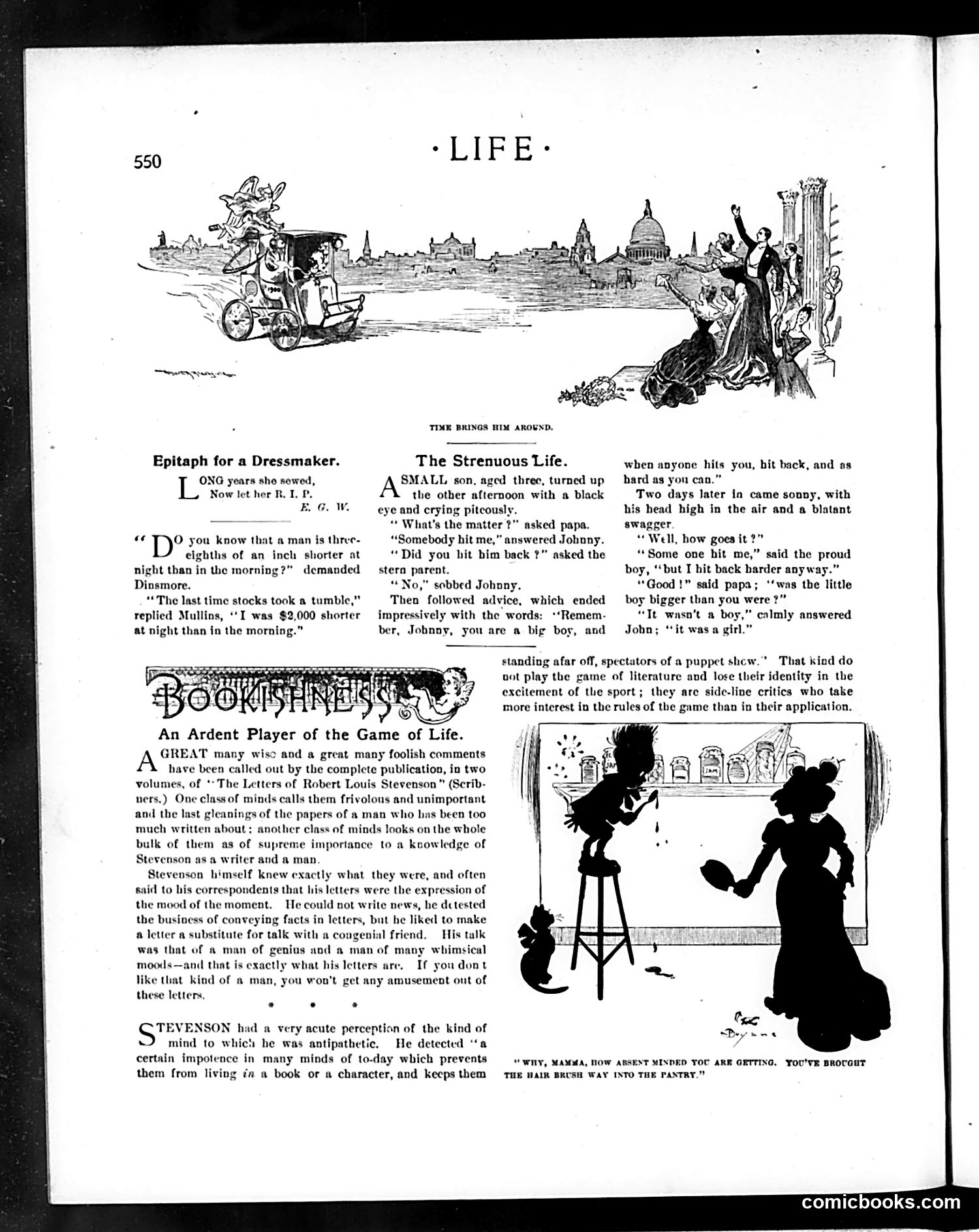
This page contains literary commentary and humorous anecdotes rather than political cartoons. The main article, "An Ardent Player of the Game of Life," discusses Robert Louis Stevenson's letters, praising his wit and conversational skill. The sidebar items include brief jokes: "Epitaph for a Dressmaker" mocks a woman's financial losses, while "The Strenuous Life" presents a child-discipline anecdote where a boy receives harsh parental correction, likely satirizing Theodore Roosevelt's contemporary "strenuous life" philosophy. The silhouette illustration shows a domestic scene with a woman scolding a child about a hairbrush. The humor relies on recognizable middle-class domestic conflict rather than political satire—accessible comedy for Life's general readership circa early 1900s.
📄 Transcribed text from this page (OCR, searchable)
Machine-transcribed from the original scan — historical spelling and the odd misread are preserved.
Epitaph for a Dressmaker. ONG years sho sowed, Now let her R. I. P. EG. WwW. “ O you know that a man is three. eighths of an inch shorter at night than in the morning?” demanded Dinsmore. “The last time stocks took a tumble,” replied Mullins, ‘‘I was $2,000 shorter at night than in the morning.” TIME BRINGS HIM AROUND. The Strenuous Life. SMALL son, aged three, turned up the other afternoon with a black eye and crying pitcously. “ What's the matter ?” asked papa. “Somebody hit me,” answered Johnny. “Did you hit bim back ?” asked the stern parent. “No,” sobbed Johnny. Then followed advice, which ended impressively with the words: *‘Remem- ber, Jobnoy, you are a big boy, and when anyone hits you, bit back, and as hard as yon can.” Two days later in came sonny, with his head high in the air and a blatant swagger. “Well, how goes it 2” “Some one hit me,” said the proud boy, ‘but I hit back harder anyway.” “Good !” said papa; ‘‘was the little boy bigger than you were ?” “Tt wasn’t a boy,” calmly answered Jobn; “it was a girl. standing afar off, spectators of a puppet shew.” That kind do not play the game of literature and lose their identity in the excitement of the sport; they are side-line critics who take more interest in the rules of the game than in their application. An Ardent Player of the Game of Life. Ali "A Z ah AST many wiso and a great many foolish comments have been called out by the complete publication, in two volumes, of ‘The Letters of Robert Louis Stevenson” (Scrib- ners.) One class of minds calls them frivolous and unimportant ani the last gleanings of the papers of a man who bas been too much written about; another class of minds looks on the whole bulk of them as of supreme importance to a keowledge of Stevenson as a writer and a man. Stevenson himself knew exactly what they were, and often said to his correspondents that his letters were the expression of the mood of the moment. He could not write news, he dctested the business of conveying facts in letters, but he liked to make a letler a substitute for talk with a congenial friend. His talk was that of a man of genius and a man of many whimsical moods—and that is exactly what his letters are. If you dont like that kind of a man, you won't get any amusement out of these letters. . . . TEVENSON had a very acute perception of the kind of J mind to which he was antipathetic. He detected ‘a certain impotence in many minds of to-day which prevents them from living éa a book or a character, and keeps them DPyans “WNY, MAMMA, HOW ABSENT MINDED YOU ARE GETTING. THE HAIR BRUSH WAY INTO THE PANTRY.” You'vE BROCGUT comicbooks.com