
Life, 1899-12-28 · page 12 of 21
Life — December 28, 1899 — page 12: what you’re looking at
What you’re looking at
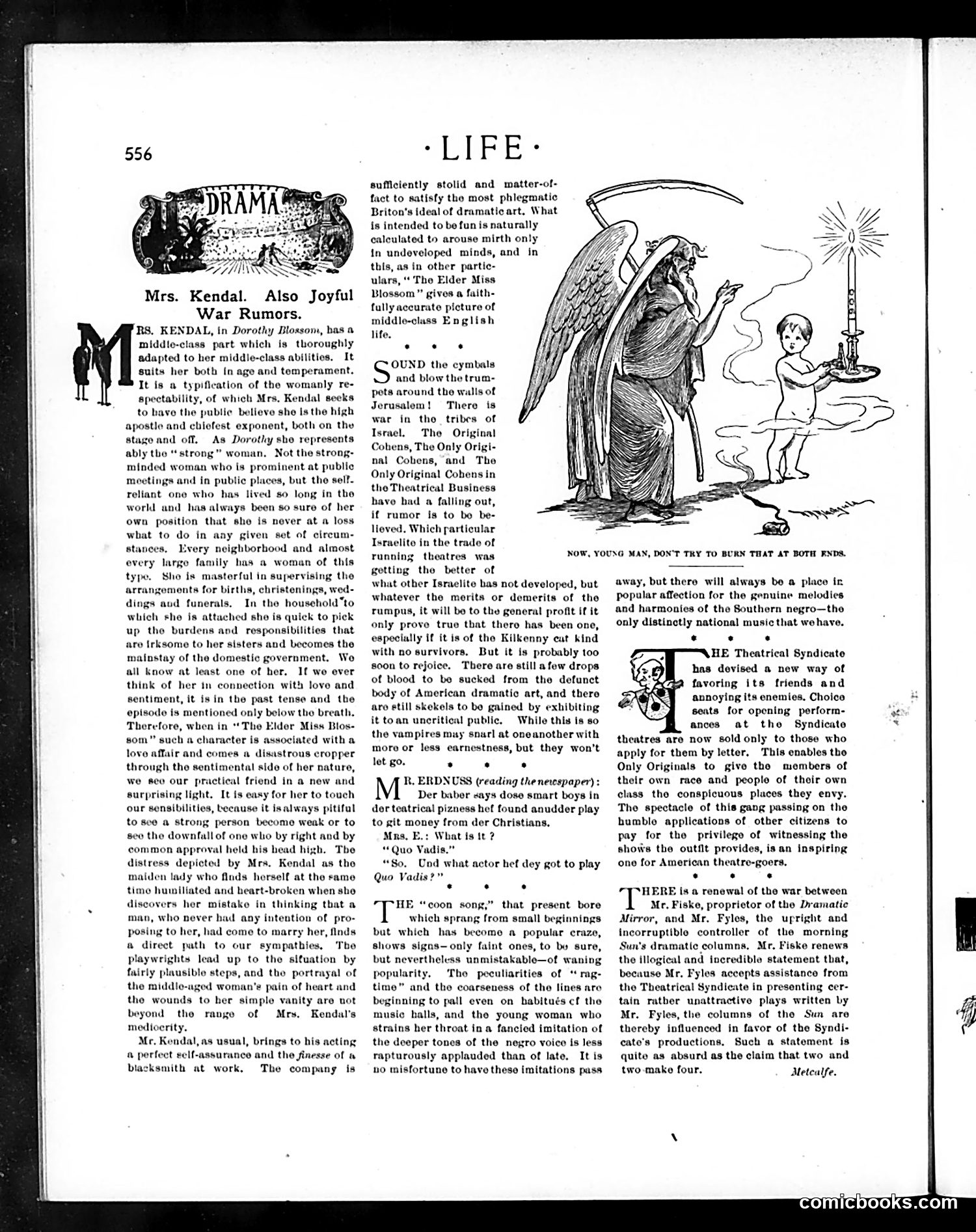
This page contains theatrical criticism and reviews rather than political cartoons. The main illustration shows a winged figure (likely representing artistic inspiration or drama) with a cherub/cupid, captioned "Now, young man, don't try to burn that at both ends." The text discusses Mrs. Kendal, a prominent British actress, praising her as a "strong woman" and skilled performer. The article also critiques contemporary theater trends, particularly discussing popular "coon songs" and ragtime music gaining popularity in musical theater. The writer expresses concern about lowered artistic standards, suggesting audiences prefer crude entertainment over sophisticated drama. The page reflects Edwardian-era theatrical snobbery—elite critics dismissing popular entertainment as artistically inferior while celebrating classically-trained performers like Mrs. Kendal.
📄 Transcribed text from this page (OCR, searchable)
Machine-transcribed from the original scan — historical spelling and the odd misread are preserved.
771.0 Mrs. Kendal. Also Joyful War Rumors. RS, KENDAL, in Dorothy Blossom, has a middle-class part which is thoroughly adapted to her middle-class abilities. It suits her both in age and temperament. It is a typification of the womanly re- spectability, of which Mrs, Kendal seeks to havo the public believe she Is the high apostle and chiefest exponent, both on the stage and off. As Dorothy sho represents ably tho “strong” woman. Not the strong- minded woman who is prominent at public meetings and in public places, but tho self. reliant one who has lived so long in the world and has always been so sure of her own position that sho is never at a loss what to do in any given set of clrcum- stances, Every neighborhood and almost every large family has a woman of this type. Sho is masterful in supervising the arrangements for births, christenings, wed- dings aud funerals. In the household “to which she is attached she is quick to pick up tho burdens and responsibilities that aro irksome to her sisters and becomes the mainstay of the domestic government. Wo ail know at least one of her. If we ever think of her in connection with love and sentiment, it is in the past tense and the episode is mentioned only below the breath, Therefore, when in “The Elder Miss Blos- som" such a character is associated with a love affair and comes a disastrous cropper through tho sentimental sido of her nature, we seo our practical friend in a new and surprising light. It is easy for her to touch our sensibilities, because it isalways pitiful to see a strong person become weak or to seo the downfall of one who by right and by common approval held his head high. The distress depicted by Mra. Kendal as tho maiden lady who flnds horself at the same time huwiliated and heart-broken when sho discovers her mistake in thinking that a man, who never had any intention of pro- posing to her, had come to marry her, finds a direct path to our sympathies, The playwrights lead up to the situation by fairly plausible steps, and the portrayal of the middle-aged woman's pain of heart and the wounds to her simple vanity are not beyond the range of Mrs. Kendal’s mediocrity. Mr. Kendal, as usual, brings to his acting 4 perfect eelf-assurance and the finesse of & blacksmith at work, The company is oo) | ee sufficiently stolid and matter-of- fact to satisfy tho most phlegmatic Briton’s ideal of dramaticart, What is intended to befunis naturally calculated to arouse mirth only In undeveloped minds, and in this, as in other partic- ulars, “Tho Elder Miss Blossom” gives a faith fully accurate picture of middle-class English life. eee OUND the cymbals and blow the trum- pots around tho walls of Jerusalem! Thero is war in tho tribes of Israel, Tho Original Cobens, The Only Origi- nal Cobens, and The Only Original Cohens in the Theatrical Business havo had a falling out, if rumor is to bo be- lieved. Which particular Israclito in the trade of running theatres was getting tho better of what other Israelite has not developed, but whatever the merits or demerits of the rumpus, it will be to the general profit if it only prove true that thero has been one, especially If it is of the Kilkenny cat kind with no survivors, But it is probably too soon to rejoice, There are still afew drops of blood to be sucked from the defunct body of American dramatic art, and thero aro #till skekels to bo gained by exhibiting it toan uncritical public, While this 1s 80 the vampires muy snarl at oneanother with moro or less earnestness, but they won't let go. . «6 «6 R, ERDNUSS (reading the newspaper): Der babor says dose smart boys in dor teatrical pizness het found anudder play to git money from der Christians. Mus, E.: What is tt ? “Quo Vadis.” “So. Und what actor hef dey got to play Quo Vadis?” . . . HE “coon song,” that present bore which sprang from small beginnings but which has become a popular craze, shows signs—only faint ones, to by sure, but nevertheless unmistakablo—of waning popularity, ‘Tho peculiarities of * rag- time” and the coarseness of tho lines aro beginning to pall even on babitués cf the music halls, and the young woman who strains her throat in a fancied imitation of the deeper tones of the negro voice is less rapturously applauded than of late, It is no misfortune to have theso imitations pass NOW, YOUNG MAN, DON'T TRY To BURN THAT AT BOTH ENDS. away, but thero will always be a placo in popular affection for the genuine melodies and harmonies of the Southern negro—tho only distinctly national music that wohave. . . . HE Theatrical Syndicate has devised a now way of favoring its friends and annoying its enemies. Choico seats for opening perform- ances at tho Syndicate theatres are now sold only to those who apply for them by letter, This enables tho Only Originals to give tho members of their own race and peoplo of thoir own class tho conspicuous places they envy. Tho spectacle of this gang passing on the humblo applications of other citizens to pay for tho privilego of witnessing the shows the outit provides, is an inspiring one for American theatre-goors. ° . . HERE is a renewal of the war between Mr. Fiske, proprictor of the Dramatic Mirror, and Mr, Fyles, the upright and incorruptible controller of the morning Sun's dramatic columns, Mr. Fiske renews the illogical and incredible statement that, because Mr. Fyles accepts assistance from the Theatrical Syndicate in presenting cer- tain ratber unattractive plays written by Mr. Fyles, the columns of tho Sun aro thereby influenced in favor of the Syndi- cato’s productions, Such a statement is quite as absurd as the claim that two and two-make four. Metculfe.