
Life, 1899-12-28 · page 4 of 21
Life — December 28, 1899 — page 4: what you’re looking at
What you’re looking at
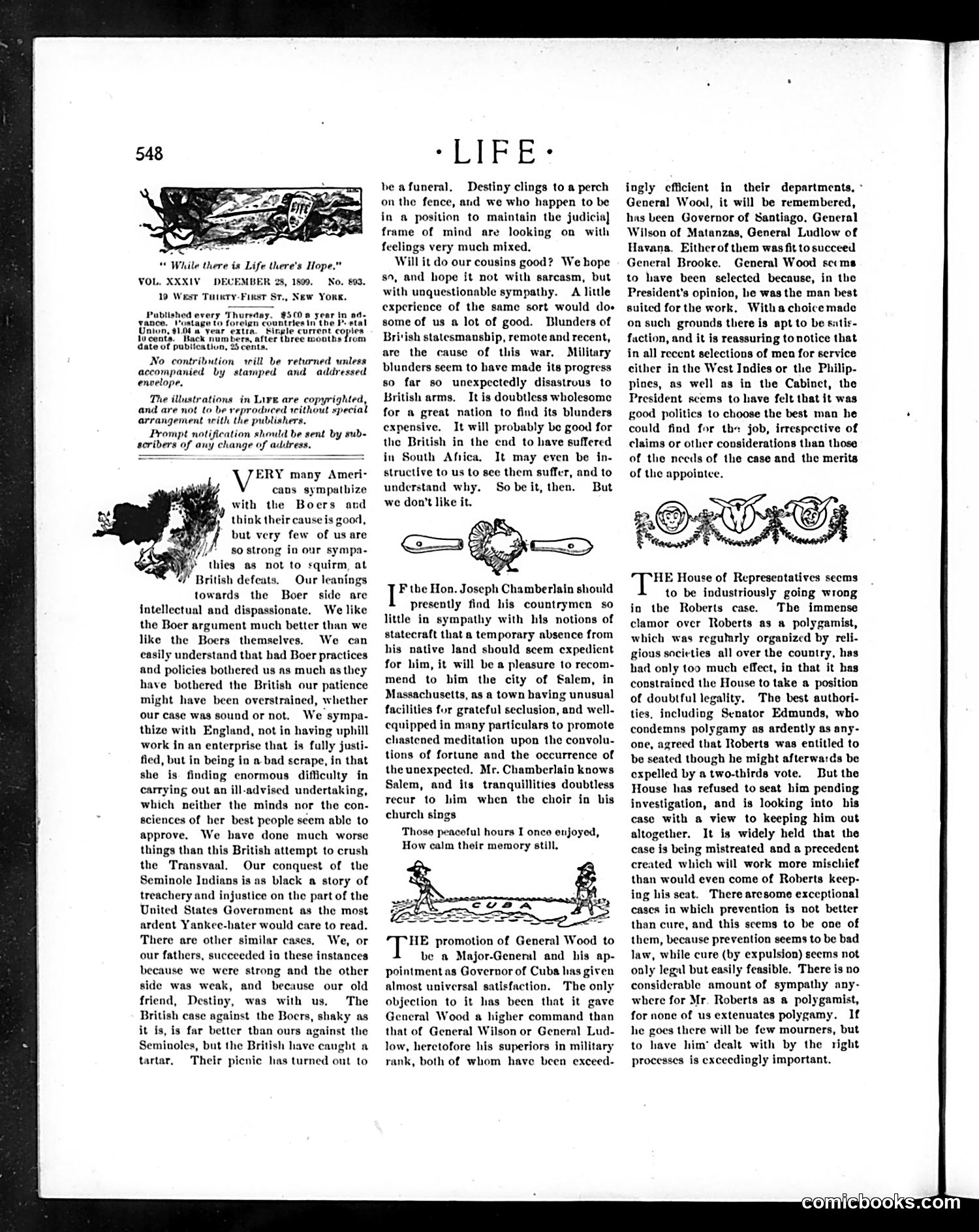
The page contains editorial commentary rather than traditional political cartoons. The text criticizes American sympathy for the Boers in the recent South African War, arguing Americans poorly understand the conflict while maintaining double standards about military conduct. The article also discusses General Wood's promotion to Major-General and appointment as Governor of Cuba, noting satisfaction with this decision. Finally, it addresses controversy over Representative Roberts, a polygamist, remaining in Congress—arguing the House should expel him despite precedent concerns. The small decorative illustrations are ornamental rather than satirical. The content reflects turn-of-century debates about American foreign policy, military leadership, and congressional ethics, presented through serious editorial argument rather than visual satire.
📄 Transcribed text from this page (OCR, searchable)
Machine-transcribed from the original scan — historical spelling and the odd misread are preserved.
“ While there is Life there's Hope.” VOL. XXXIV DECEMBER 23, 1899. No. 19 Wesr Tutery-First St., New YORK. every Thursday. $5009 year ance. Hostage to foreign countries in the Unto Ma Year extra. Single current copies loconts. Hack numbers, after three wonths from ate of publicativn, % cents. No contribution will be returned unless accompanied by stamped and addressed envelope. Pablish The illustrations in Lire are copyrighted, and are not to be reproduced without special arrangement with the publishers. Prompt notification should be sent by sub- soribers of any change of address, ERY many Ameri- cans sympathize , With the Boers and think their cause is good, but very few of us are so strong in our sympa- \, “ “thies as not to squirm, at “British defeats, Our leanings towards the Boer side are intellectual and dispassionate. We like the Boer argument much better than we like the Boers themselves. We can easily understand that bad Boer practices and policies bothered us as much as they have bothered the British our patience might have been overstrained, whether our case was sound or not. We sympa- thize with England, not in having uphill work in an enterprise that is fully justi- fied, but in being in a bad scrape, in that she is finding enormous difficulty in carrying out an ill-advised undertaking, which neither the minds nor the con- sciences of her best people seem able to approve. We have done much worse things than this British attempt to crush the Transvaal. Our conquest of the Seminole Indians is as black a story of treachery and injustice on the part of the United States Government as the most ardent Yankee-hater would care to read. There are other similar cases, We, or our fathers, succeeded in these instances because we were strong and the other side was weak, and because our old friend, Destiny, was with us, The British case against the Boers, shaky as it is, is far better than ours against the Seminoles, but the British have caught a tartar, Their picnic has turned out to LIFE be afuneral. Destiny clings to a perch on the fence, and we who happen to be in a position to maintain the judicia} frame of mind are looking on with feelings very much mixed. Will it do our cousins good? We hope so, and hope it not with sarcasm, but with unquestionable sympathy. A little experience of the same sort would dos some of us a lot of good. Blunders of British statesmanship, remote and recent, are the cause of this war. Military blunders seem to have made its progress so far so unexpectedly disastrous to British arms. It is doubtless wholesome for a great nation to find its blunders expensive. It will probably be good for the British in the cnd to have suffered in South Afiica, It may even be in- structive to us to see them suffer, and to understand why, So beit, then. But we don’t like it, F the Hon. Joseph Chamberlain should presently find his countrymen so little in sympathy with his notions of statecraft that a temporary absence from his native land should scem expedient for him, it will be a pleasure to recom- mend to him the city of Salem, in Massachusetts, as a town having unusual facilities fur grateful seclusion, and well- equipped in many particulars to promote chastened meditation upon the convolu- tions of fortune and the occurrence of the unexpected. Mr. Chamberlain knows Salem, and its tranquillities doubtless recur to him when the choir in bis church sings ‘Thoso peaceful hours I once enjoyed, How calm their memory still. sl (ere promotion of General Wood to be a Major-General and his ap- pointment as Governor of Cuba has given almost universal satisfaction. The only objection to it has been that it gave General Wood a higher command than that of General Wilson or General Lud- low, heretofore his superiors in military rank, both of whom have been exceed- ingly efficient in their departments, * General Wood, it will be remembered, has been Governor of Santiago, General Wilson of Matanzas, General Ludlow of Havana. Eithcrof them was fit to succeed General Brooke. General Wood sccms to have been selected because, in the President's opinion, he was the man best suited for the work, With a choice made on such grounds there is apt to be satis- faction, and it is reassuring to notice that in all recent selections of men for service cither in the West Indies or the Philip- pines, as well as in the Cabinct, the President scems to have felt that it was good politics to choose the best man he could find for th+ job, irrespective of claims or other considerations than those of the needs of the case and the merits of the appointee. pCR HE House of Representatives seems to be industriously going wrong in the Roberts case. The immense clamor over Roberts as a polygamist, which was regularly organized by reli- gious societies all over the country, has had only too much effect, in that it has constrained the House to take a position of doubtful legality, The best authori- ties, including Senator Edmunds, who condemns polygamy as ardently as any- one, agreed that Roberts was entitled to be seated though he might afterwards be expelled by a two-thirds vote. But the House has refused to seat him pending investigation, and is looking into his case with a view to keeping him out altogether. It is widely held that the case is being mistreated and a precedent created which will work more mischief than would even come of Roberts keep- ing his seat. There aresome exceptional cases in which prevention is not better than cure, and this seems to be one of them, because prevention seems to be bad law, while cure (by expulsion) seems not only legal but easily feasible. There is no considerable amount of sympathy any- where for Mr. Roberts as a polygamist, for none of us extenuates polygamy. If he goes there will be few mourners, but to have him’ dealt with by the right processes is exceedingly important.