
A complete issue · 20 pages · 1899
Life — November 30, 1899
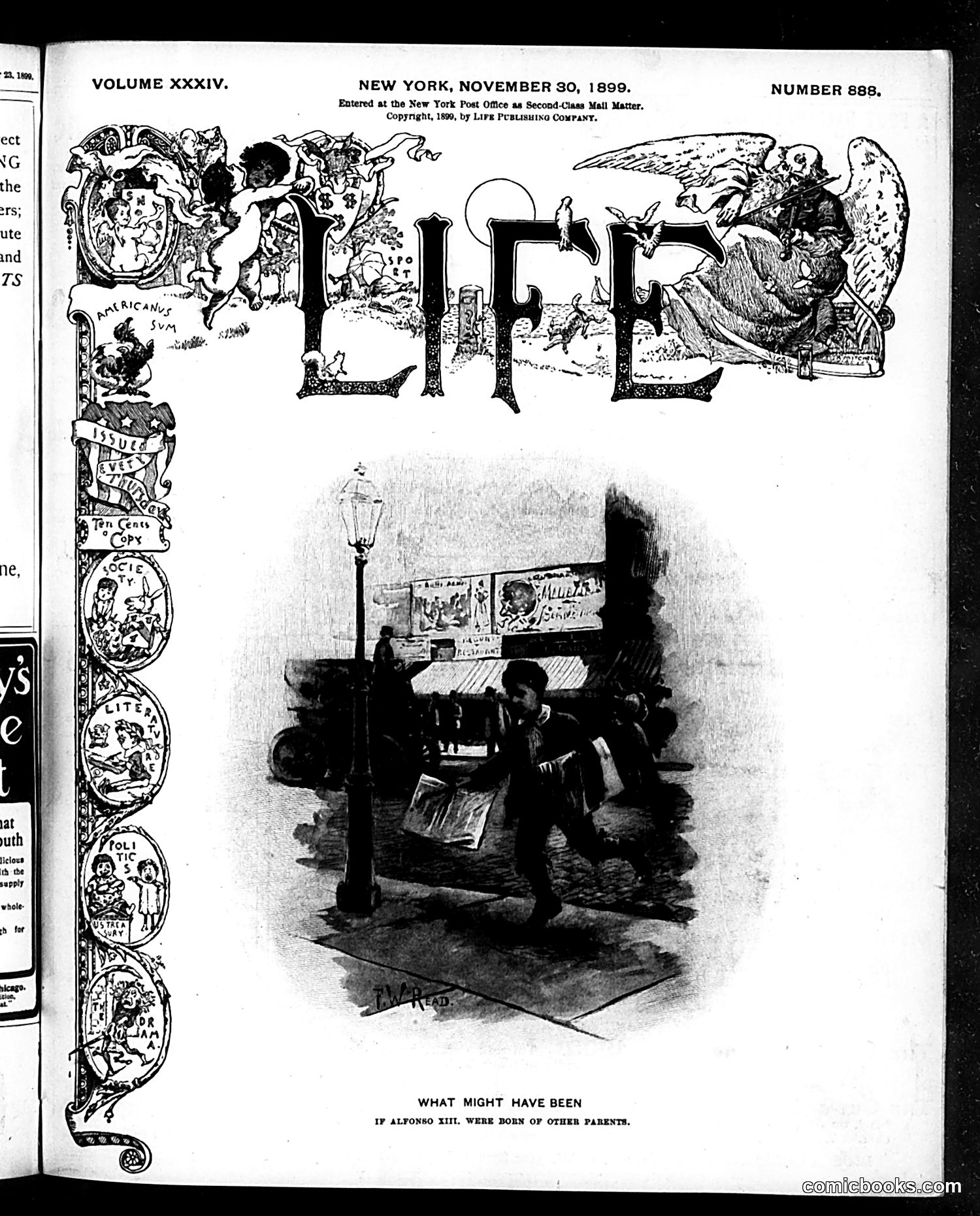
This is the cover of *Life* magazine from November 30, 1899 (Volume XXXIV, Number 888). The main illustration depicts a street scene with children gathered around what appears to be a newspaper or poster stand under a street lamp. The caption reads: "WHAT MIGHT HAVE BEEN IF ALFONSO XIII. WERE BORN OF OTHER PARENTS." The satire references King Alfonso XIII of Spain, who was born in 1886. The joke suggests a counterfactual scenario about his parentage—implying that if he had different parents (likely of lower social status), he would be reduced to selling newspapers or similar humble street work rather than ruling as a monarch. This mocks the arbitrary nature of royal privilege and hereditary power, suggesting that without his aristocratic birth, Alfonso would be an ordinary working child.
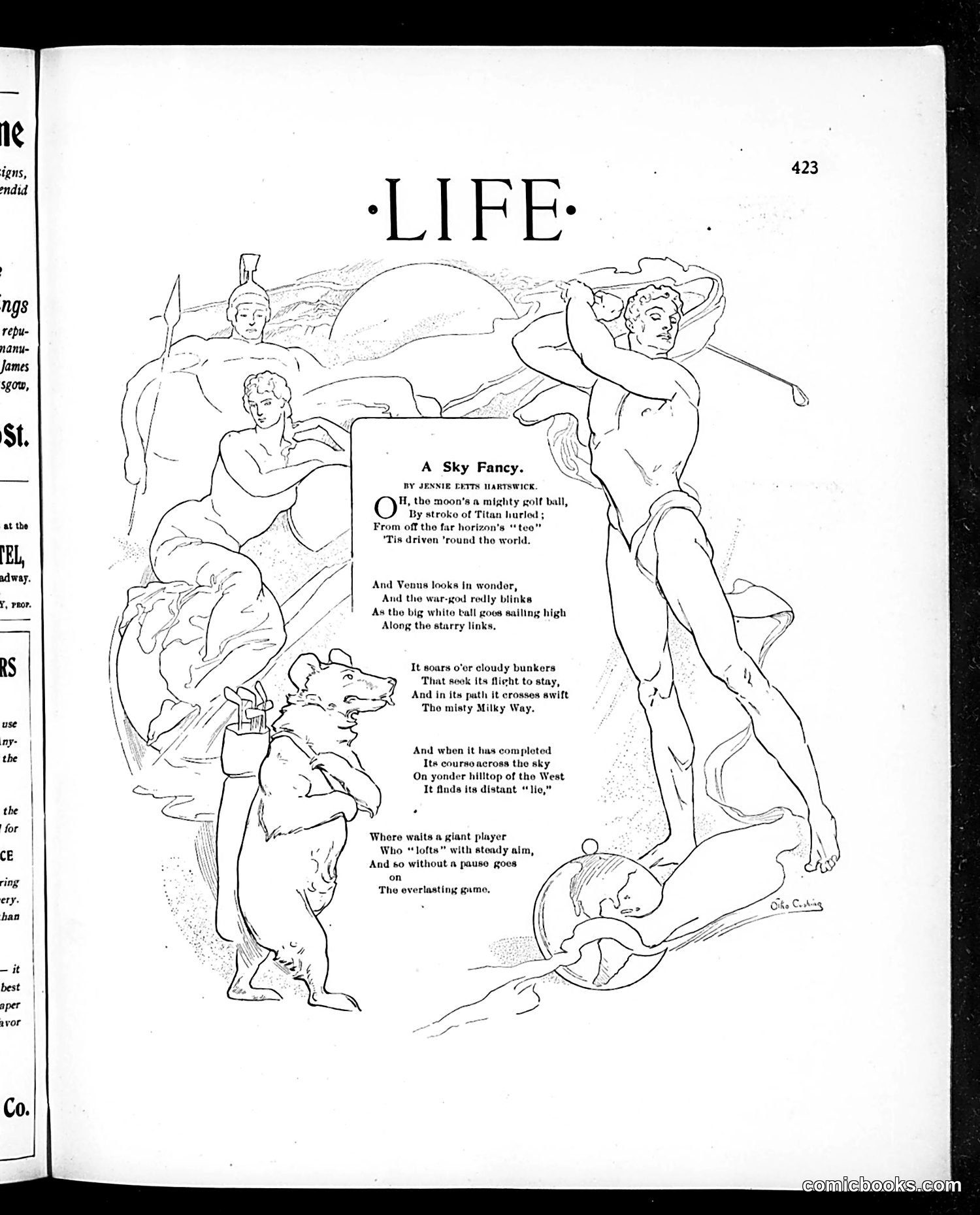
This poem and illustration present a whimsical astronomical fantasy. The text describes the moon being "hurled" across the sky by Titan, with Venus observing and the war-god (Mars) blinking as "the big white ball" (the moon) sails past along the stars. The illustration depicts classical mythological figures—including what appears to be Venus and other deities—surrounding a giant bear character (possibly representing Ursa Major or a similar constellation) who observes the celestial mechanics. The bear holds a surveying tool, suggesting measurement of this cosmic journey. The poem humorously personifies celestial bodies and their mythological associations, treating astronomy through classical mythology rather than scientific fact—a common Victorian-era literary conceit blending science and classical learning for entertainment.
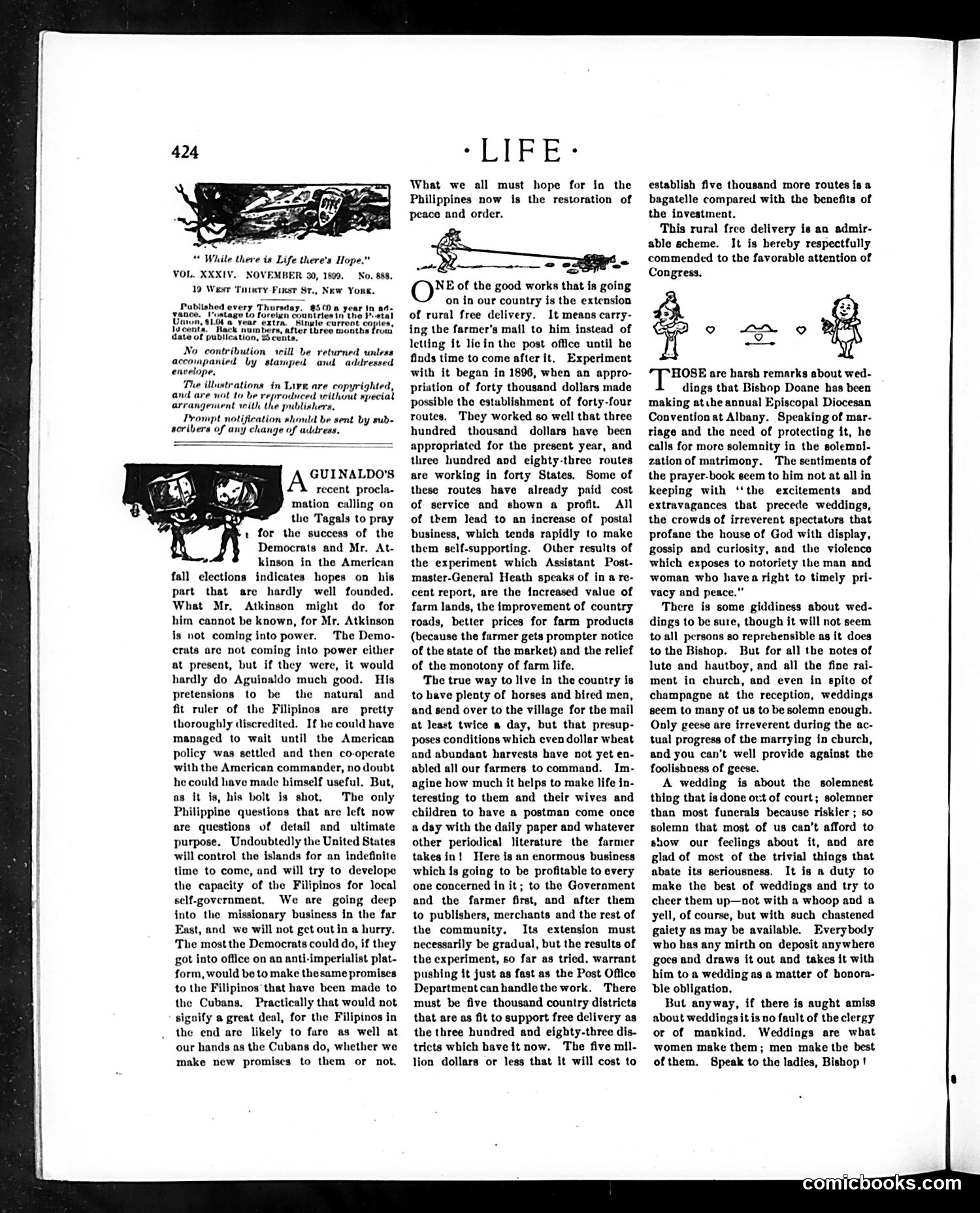
This page contains two satirical pieces about early 20th-century American politics and social issues. **Top cartoon:** References "Aguinaldo's recent proclamation" calling on the Tagalog people. Appears to mock someone's (likely President McKinley's or an American political figure's) failed hopes regarding Democratic election prospects and American intervention in the Philippines, suggesting the situation is poorly managed. **Main article:** Discusses rural free mail delivery expansion—a Democratic policy initiative. It humorously critiques both the Bishop's attitude toward weddings (complaints about solemnity) and clergy's role in marriage ceremonies, while praising the postal service expansion's practical benefits to farmers and rural communities. The satire targets political hypocrisy and institutional rigidity regarding modern reform.
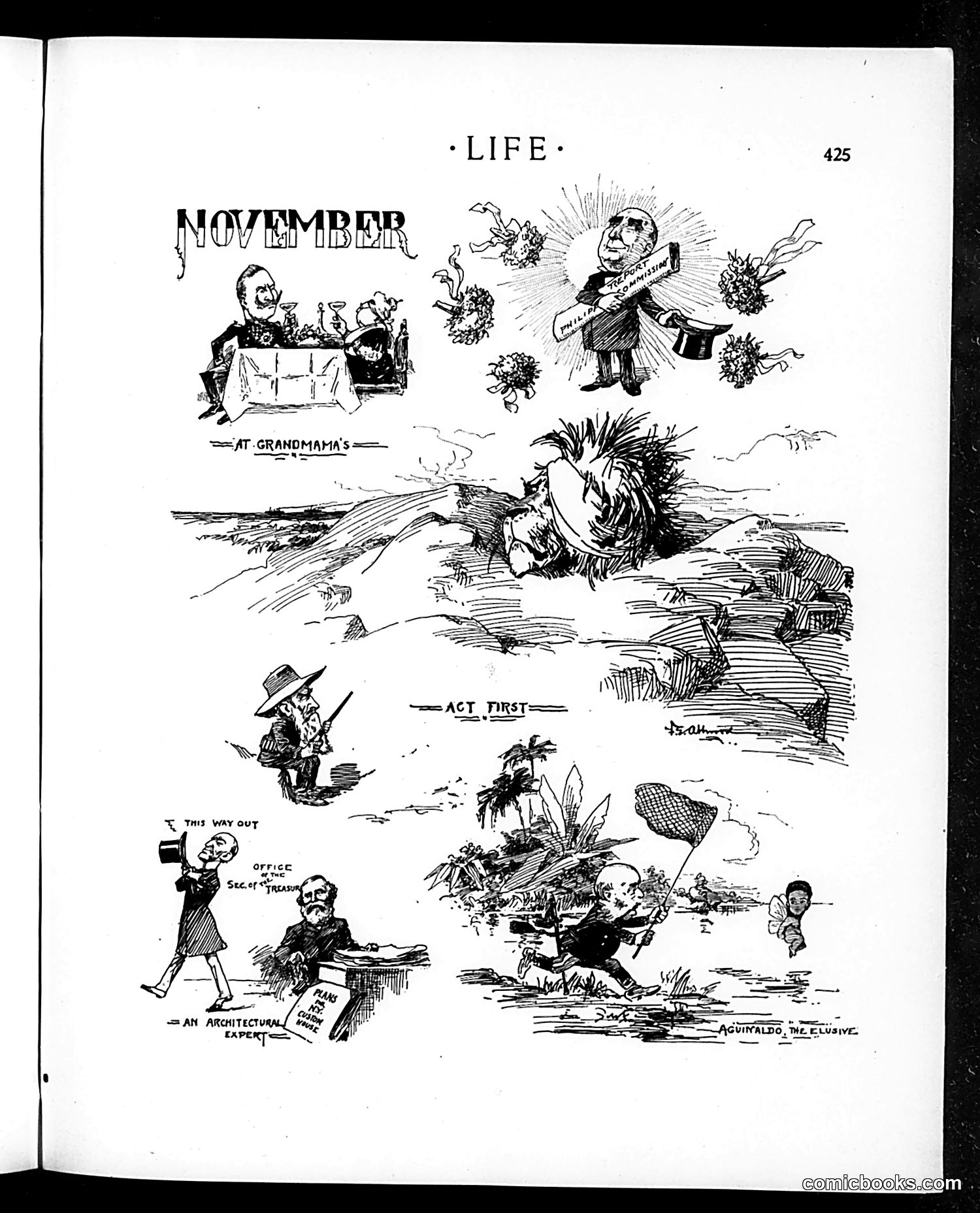
This page presents November-themed satirical sketches labeled "Act First." The top section shows "At Grandmama's" with domestic holiday scenes. The middle features what appears to be a caricatured figure in wilderness/outdoor settings—likely satirizing some contemporary person or type. The lower sketches include "An Architectural Expert" and "Office of the Sec'y of Treasury," suggesting political satire about government incompetence or overreach. The specific identities and events referenced are unclear without additional historical context, though the "Secretary of Treasury" reference indicates commentary on financial or economic policy. The artist's signature appears to be "Aguinaldo" or similar. The overall tone mocks contemporary political figures and social types through exaggerated portraiture and situational comedy typical of early 20th-century satirical journalism.
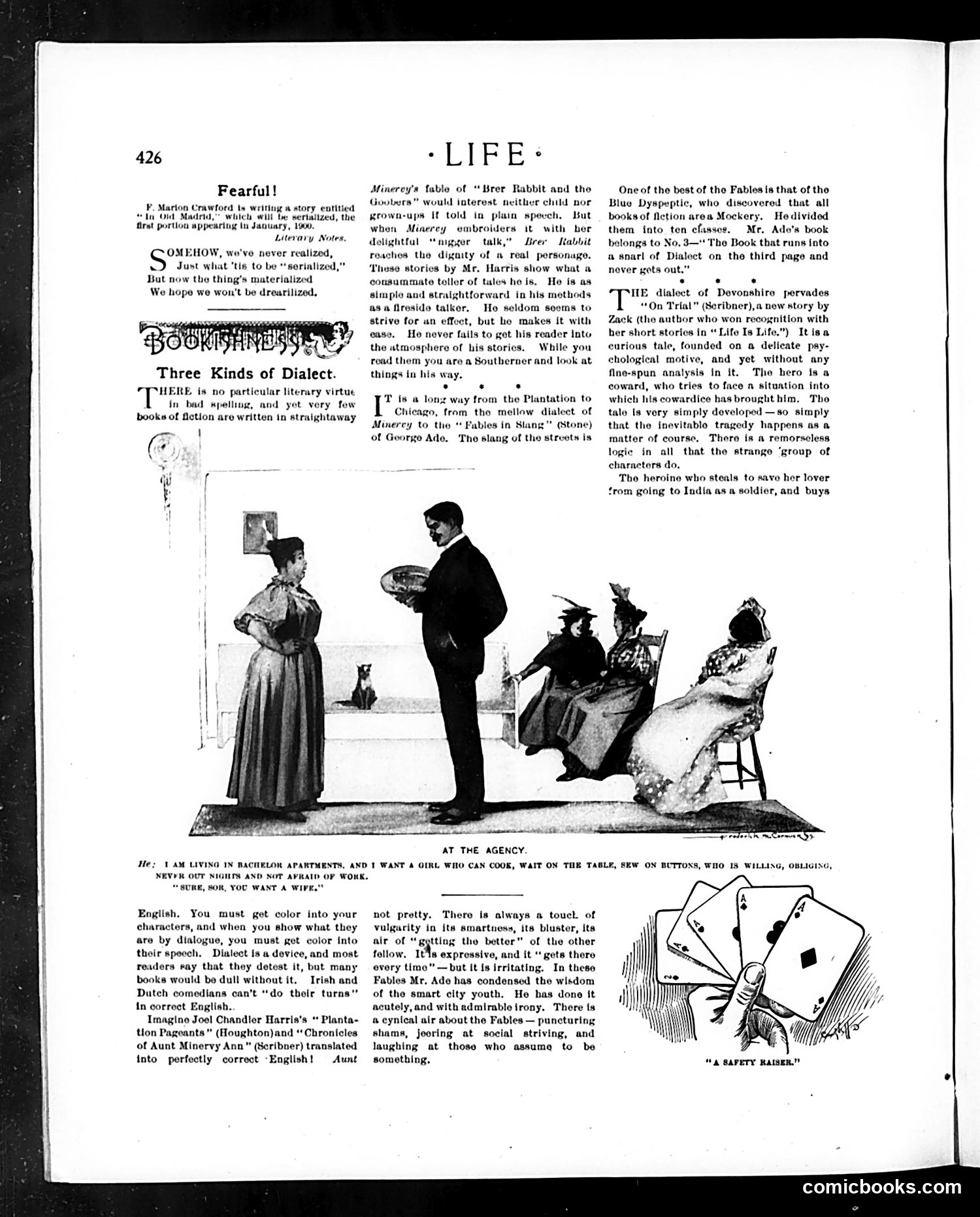
The central cartoon depicts a domestic employment agency scene. A man in formal dress presents himself to female staff, stating he wants "a girl who can cook, wait on the table, sew on buttons, who is willing, obliging, cheerful, and not tired at night and not afraid of work." The satire targets the absurdly unrealistic expectations men held for wives during this era. The man's demands—combining domestic labor, emotional cheerfulness, and constant availability—mock the entitled attitudes many husbands possessed. The agency setting frames marriage as transactional employment, highlighting how women were expected to be perpetually available servants within their marriages, with no legitimate claim to fatigue or personal boundaries.
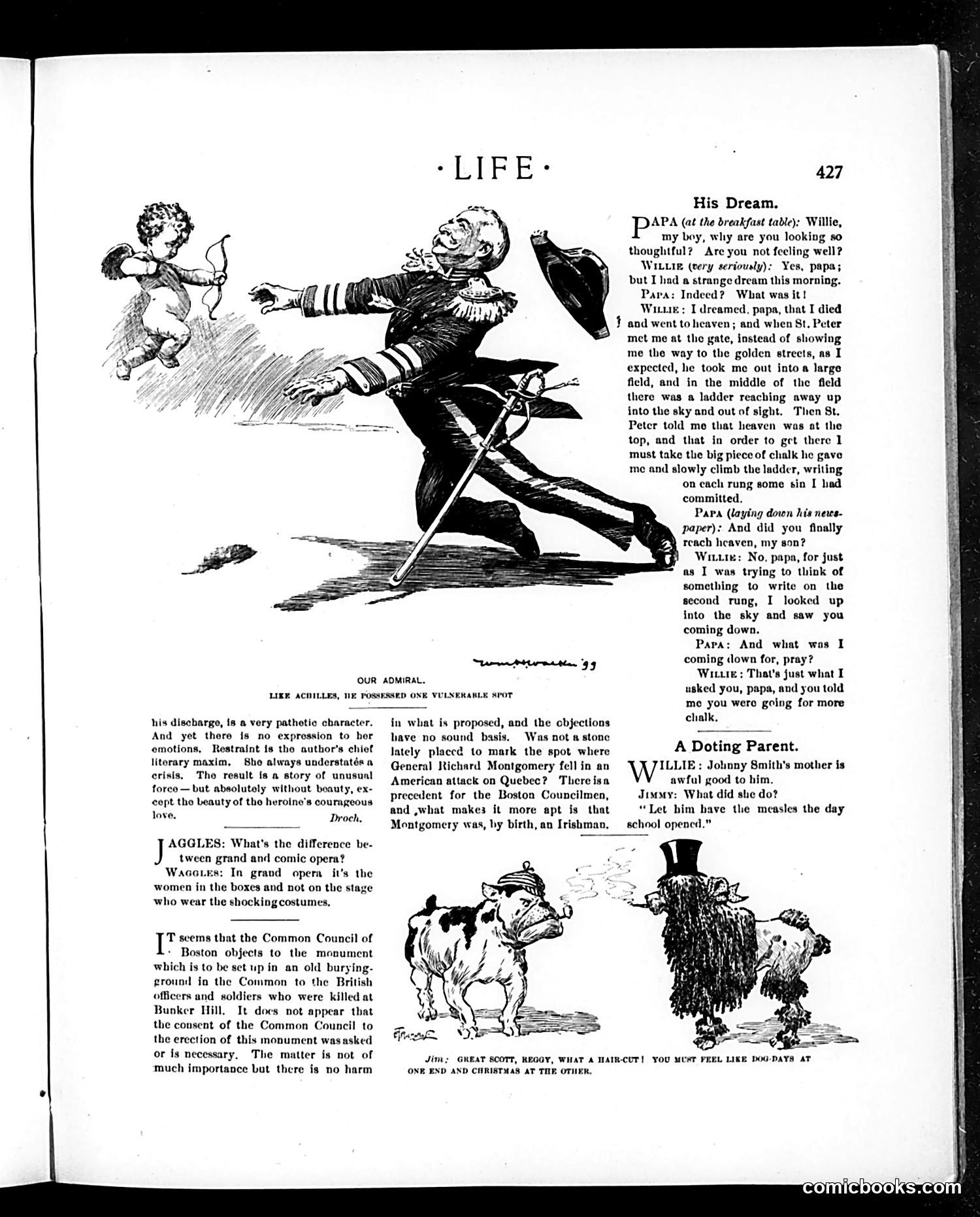
This page contains several satirical pieces. The main illustration shows a man falling from a ladder while climbing toward the sky—a visual gag accompanying "His Dream," a dialogue where a boy named Willie recounts a dream about climbing to heaven with chalk marks on a ladder, only to fall before reaching the top. Below are brief humor exchanges, including "Our Admiral" (about General Richard Montgomery and the Boston Common monument controversy), and "A Doting Parent" (mocking indulgent parenting). The bottom cartoon depicts two dogs with exaggerated features—one small and one large—satirizing physical appearance or social status differences, with the caption playing on "hair-cut" as a joke about their contrasting looks. The satire targets pretension, parental overindulgence, and perhaps civic vanity.
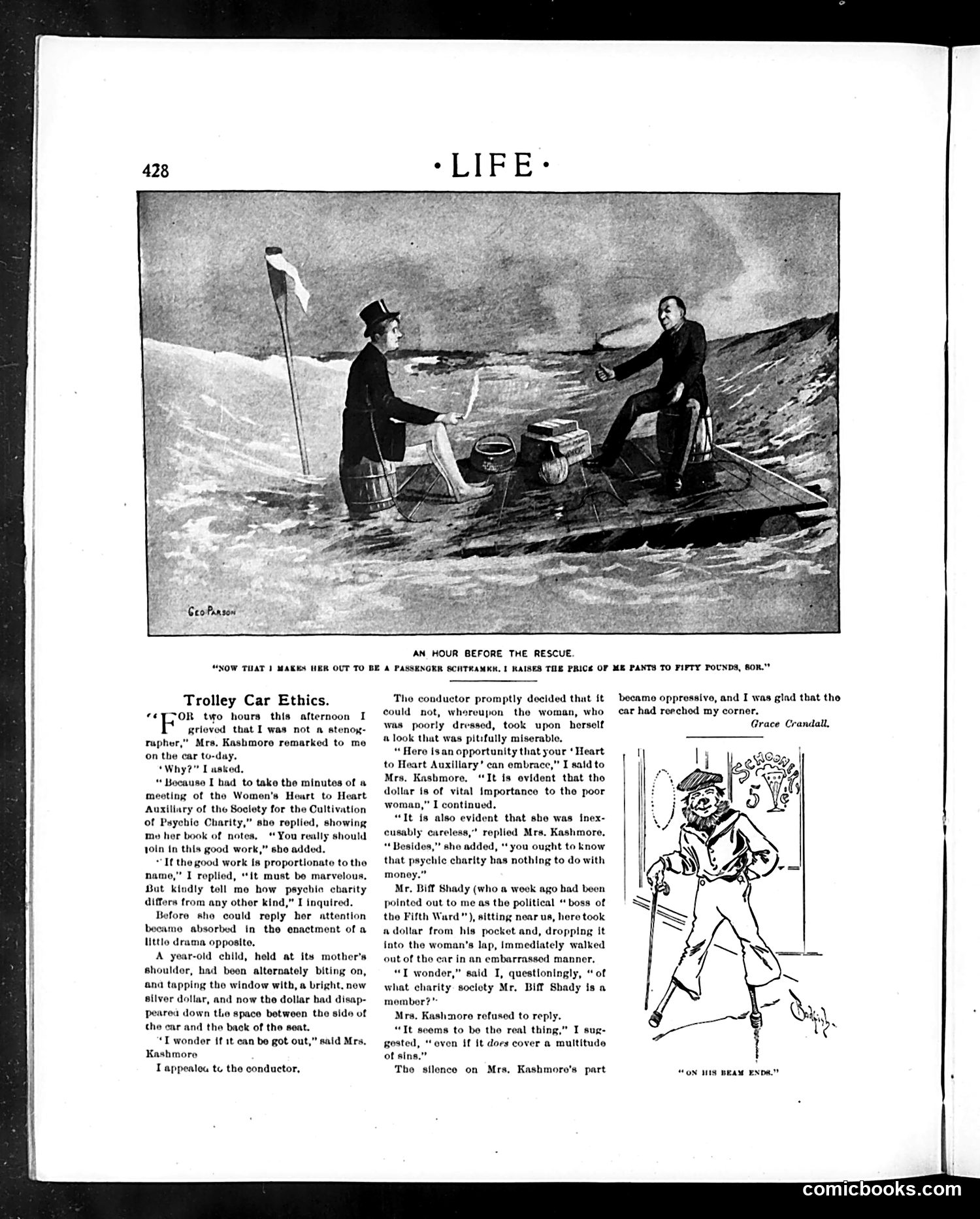
This page satirizes hypocrisy around charitable giving. The main article describes Mrs. Kashmere's dismissal of a poor woman from a trolley car, rejecting appeals to "Heart Auxiliary" charity work. The satire's point: Mrs. Kashmere proudly supports organized charity organizations but callously refuses direct help to a desperate individual—revealing that her "charity" is performative rather than genuine. When a man (identified as "Iliff Shady, political 'boss'") demonstrates real charity by giving a dollar to the woman, Mrs. Kashmere remains silent, unable to defend her own behavior. The small cartoon on the right ("ON HIS BEAM ENDS") appears to illustrate financial distress, reinforcing the economic desperation underlying the scene. The satire critiques selective, institutional charity as morally hollow compared to direct human compassion.
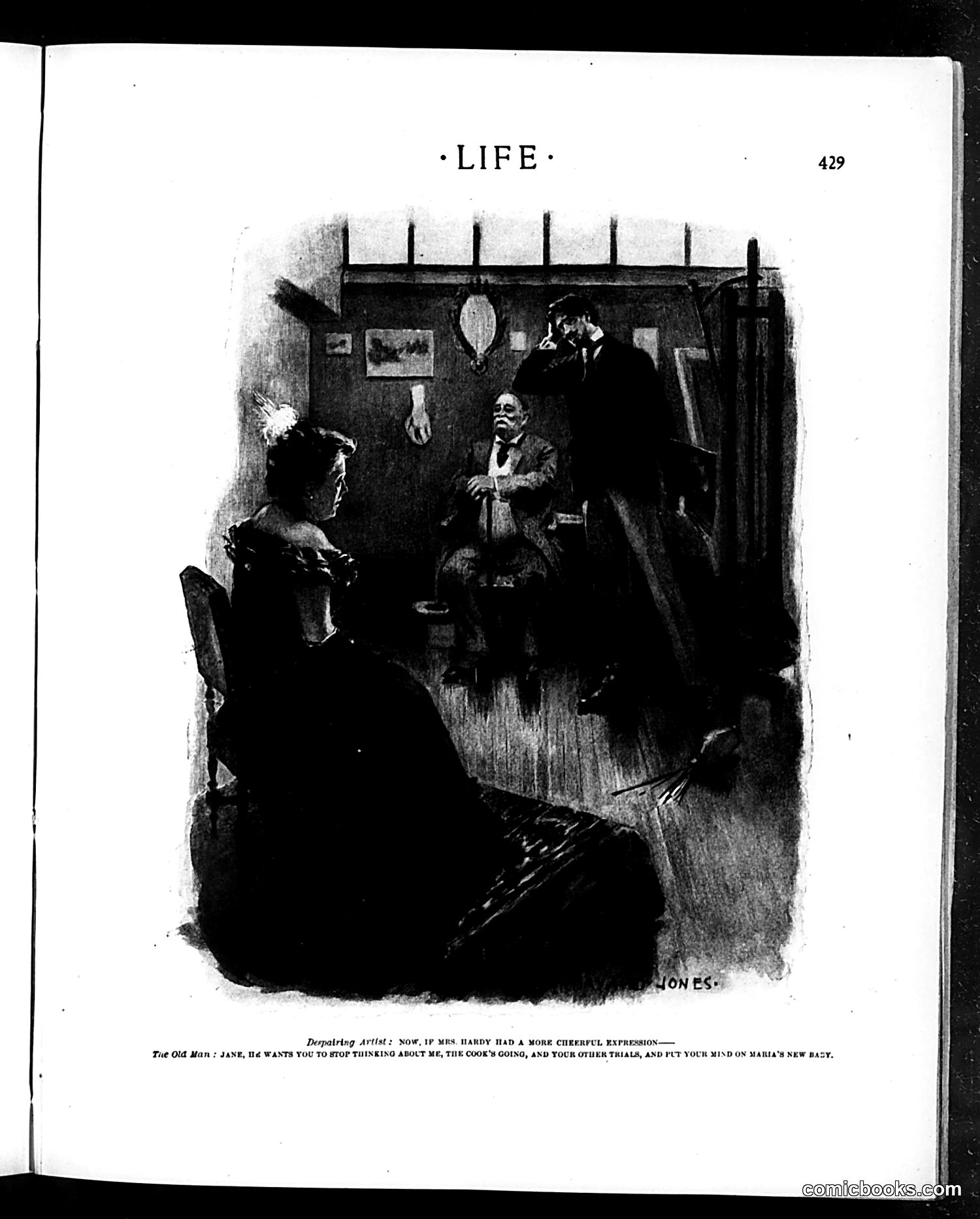
This is a domestic scene depicting an elderly man (labeled "JANE") confronting what appears to be his wife or family member. The caption indicates the man is frustrated about household matters—specifically wanting her to "stop thinking about me, the cook's going, and your other trials, and put your mind on Maria's new baby." The satire targets the common domestic complaint that wives are preoccupied with servants' problems (Maria's baby) and household crises rather than attending to their husbands' concerns. It reflects early 20th-century class attitudes, where upper-class women employed servants yet were humorously portrayed as distracted by their employees' personal lives. The joke relies on the period's assumption that wives should prioritize their husbands' comfort above all else.
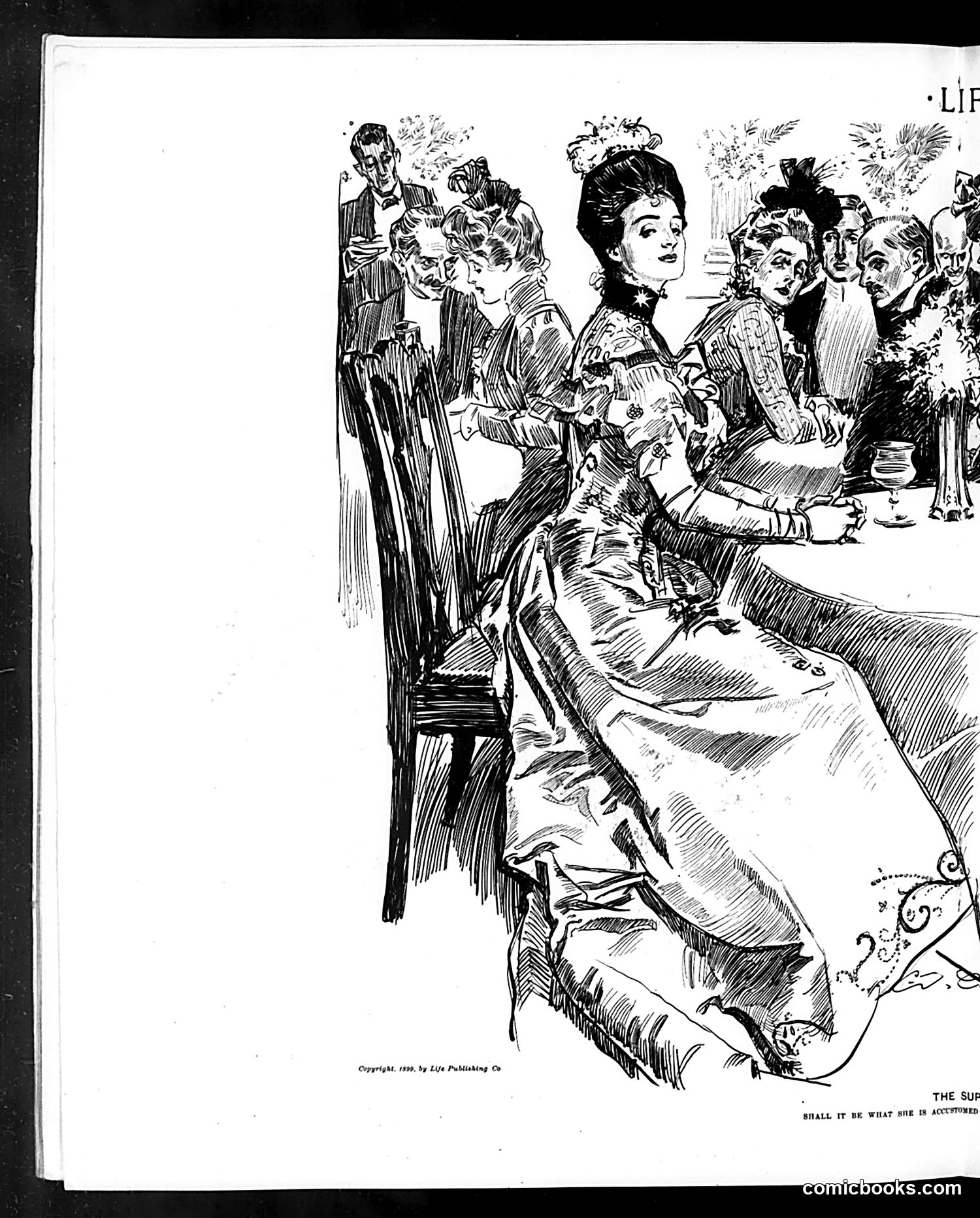
This is a satirical illustration from Life magazine (copyright 1909, per the bottom text). The sketch depicts what appears to be a formal social gathering or salon scene, with elegantly dressed women as the focal point and men in formal attire observing from the periphery. The caption at bottom reads "SHALL IT BE WHAT SHE IS ACCUSTOMED" (text cuts off), suggesting commentary on women's social expectations or status. The satire likely critiques either: - The artificial formality and pretension of high society gatherings - Gender dynamics and women's constrained social roles in early 20th-century America - Questions about marriage, wealth, or women's independence The artistic style—detailed pen-and-ink work emphasizing fabric textures and social positioning—is typical of Life's sophisticated editorial cartoons from this era. The specific social commentary remains somewhat unclear without the complete caption text.
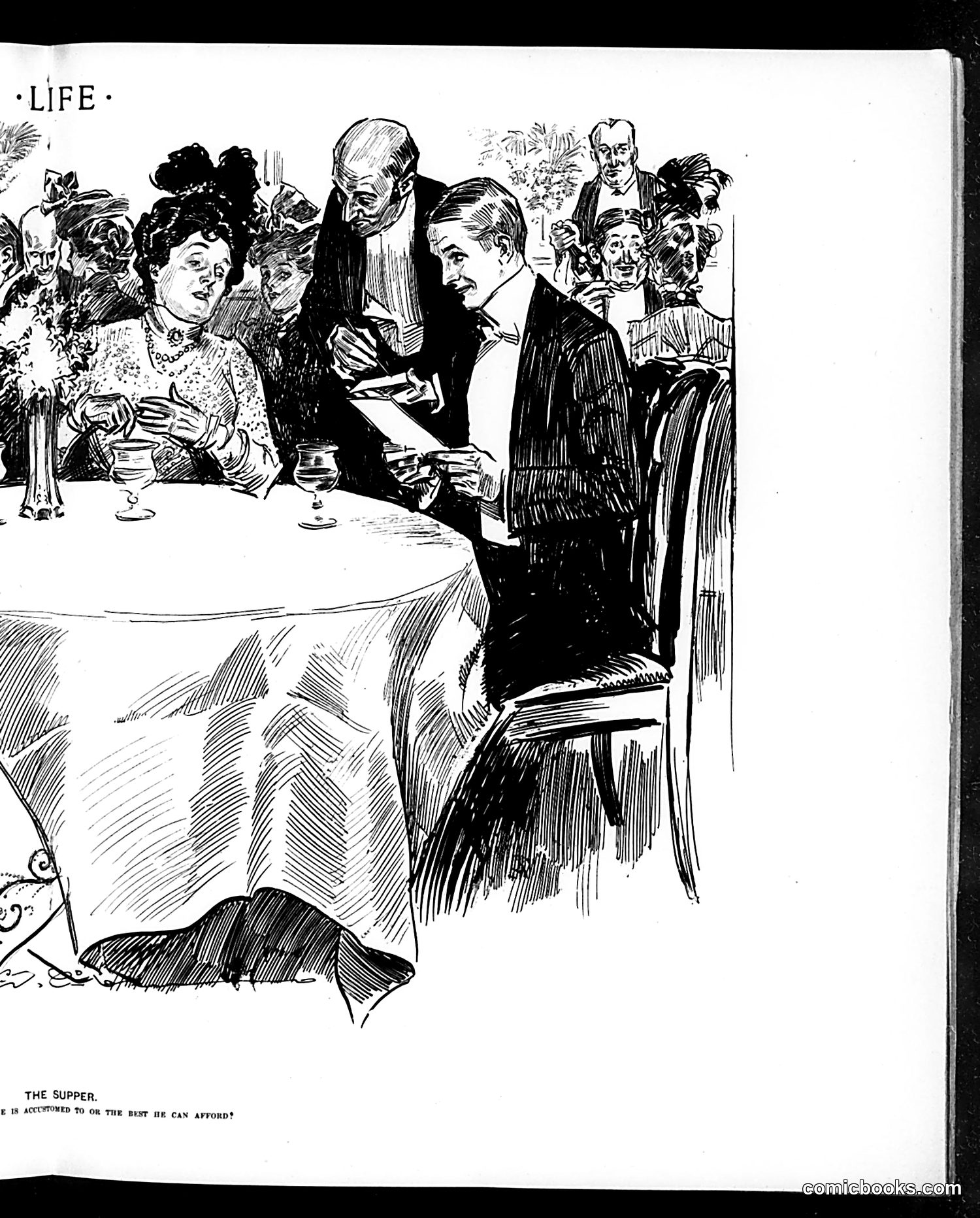
This satirical cartoon depicts a formal dinner scene titled "The Supper" with the caption "He is accustomed to or the best he can afford?" The image shows a well-dressed man seated at a table with an elegantly set meal, surrounded by fashionably dressed guests. The satire appears to target class consciousness and social pretension—specifically mocking whether the diner is genuinely accustomed to fine dining or merely stretching his finances to appear wealthy. The cartoon likely critiques Gilded Age social climbing and the performative nature of upper-class dining. The detailed rendering of fine linens, glassware, and formal attire emphasizes the importance placed on appearing prosperous, while the pointed caption questions the authenticity of such displays.
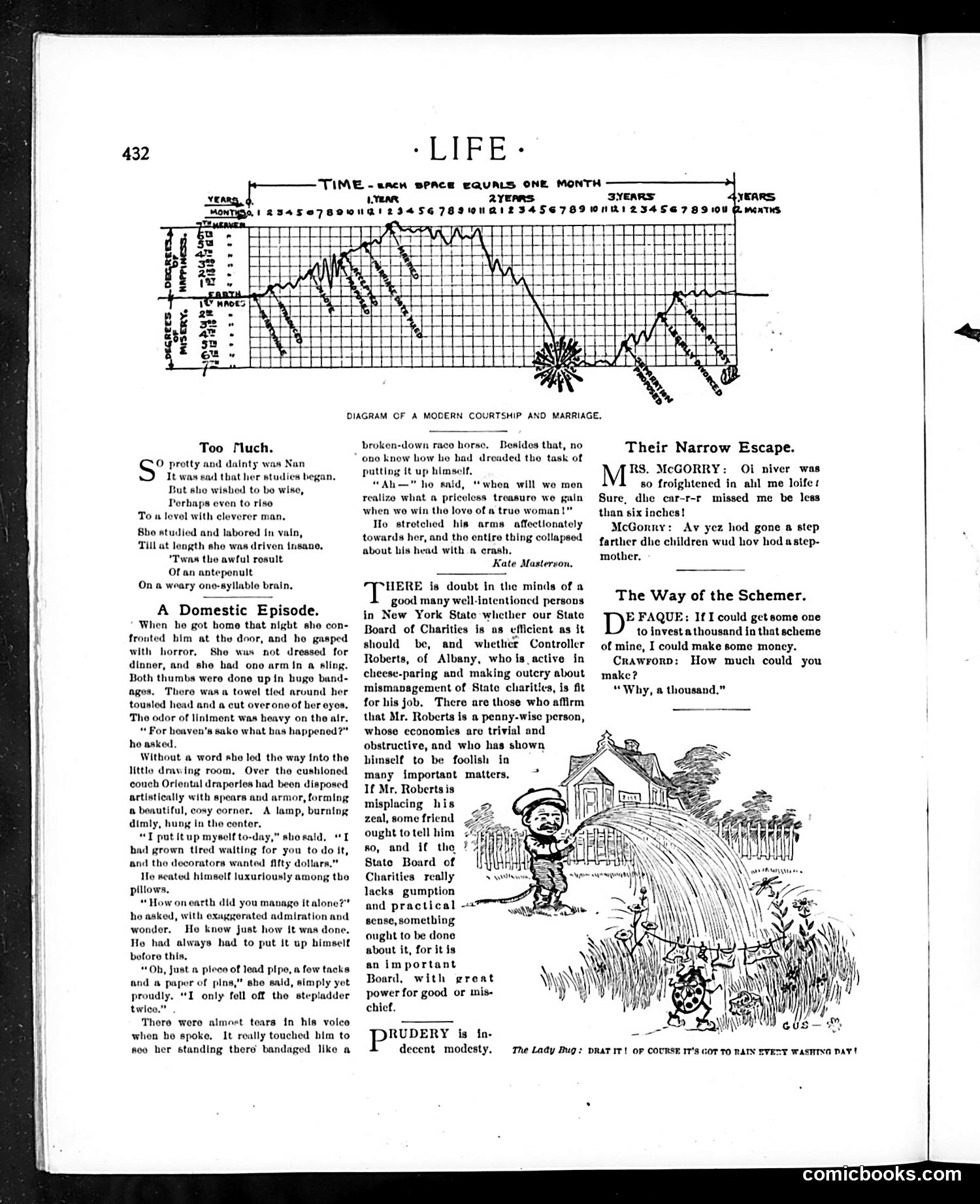
This page contains several pieces of satirical commentary on relationships: **Top graphic**: A chart titled "Diagram of a Modern Courtship and Marriage" plots the emotional/financial trajectory of a relationship over time, showing an initial rise followed by a dramatic collapse—satirizing how romantic relationships deteriorate after marriage. **"A Domestic Episode"**: Mocks newlywed disillusionment, depicting a wife confronting her husband about his post-marriage laziness and neglect. **"Their Narrow Escape"** and **"The Way of the Schemer"**: Brief comedic pieces about matrimonial mishaps and financial schemes. **"The Lady Bug" illustration**: Shows children playing, with the caption sarcastically noting it's fortunate rain won't ruin their day—gentle humor about childhood activities. The overall theme critiques modern marriage's failure to match romantic expectations, using humor to address gender dynamics and domestic disappointment.
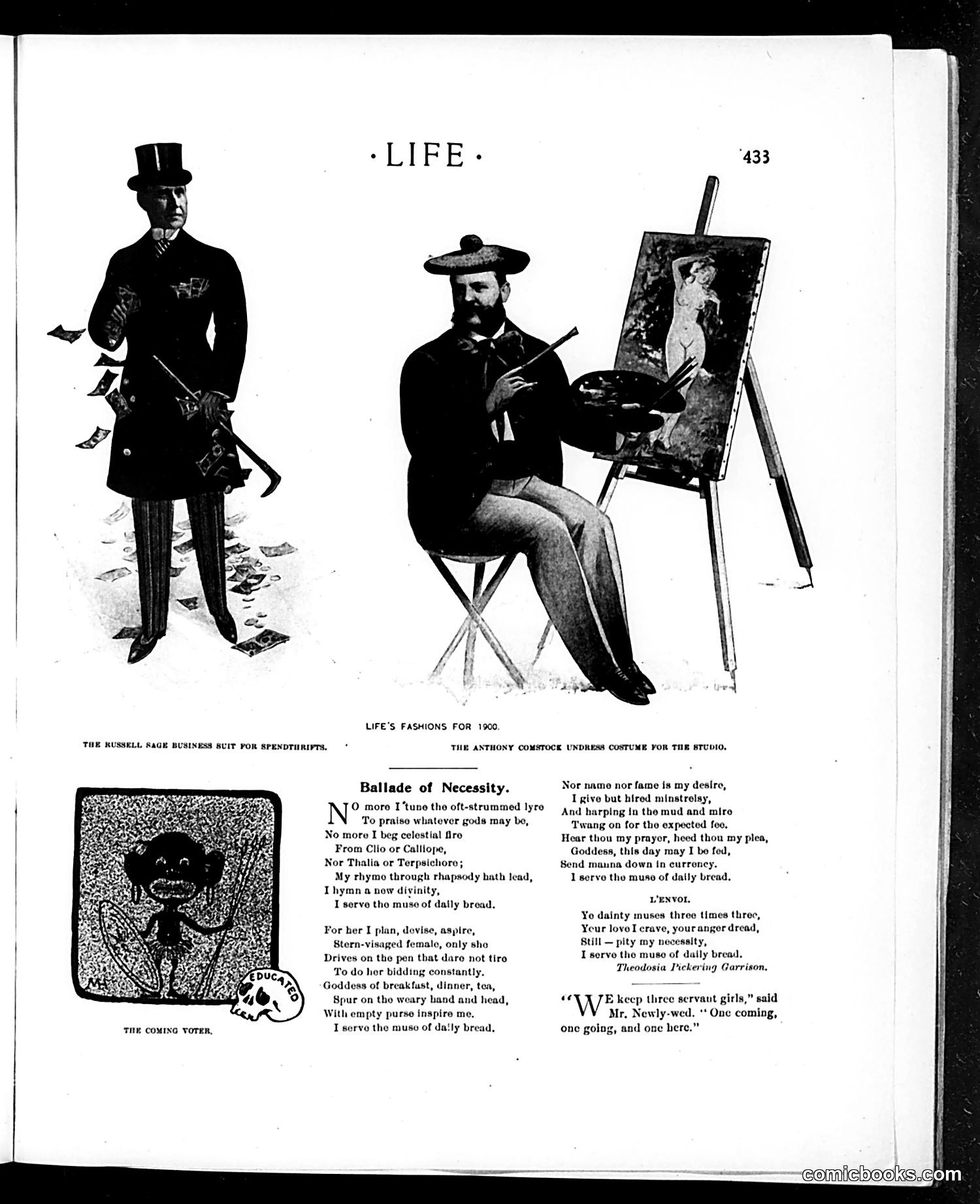
This page satirizes turn-of-the-century fashion and social anxieties through three elements: **Top illustrations**: Mock "fashions for 1900" featuring a well-dressed dandy in a "Russell Sage business suit for spendthrifts" (Sage was a famously wealthy, miserly financier) and an artist in Bohemian attire, parodying contrasting masculine ideals. **"The Coming Voter"** (left): A woodcut-style image suggesting anxieties about expanding voting rights, likely referencing women's suffrage debates. **"Ballade of Necessity"**: A melancholic poem by Theodosia Pickering Garrison about financial desperation—the poet serves "the muse of daily bread" rather than artistic inspiration, reflecting anxieties about economic survival and artistic compromise in the Gilded Age. **Bottom joke**: A domesticity gag about servant-keeping among the newly wealthy, reflecting class anxieties of the period. Overall, the page juxtaposes fashion humor with deeper concerns about money, work, and social change in 1900.
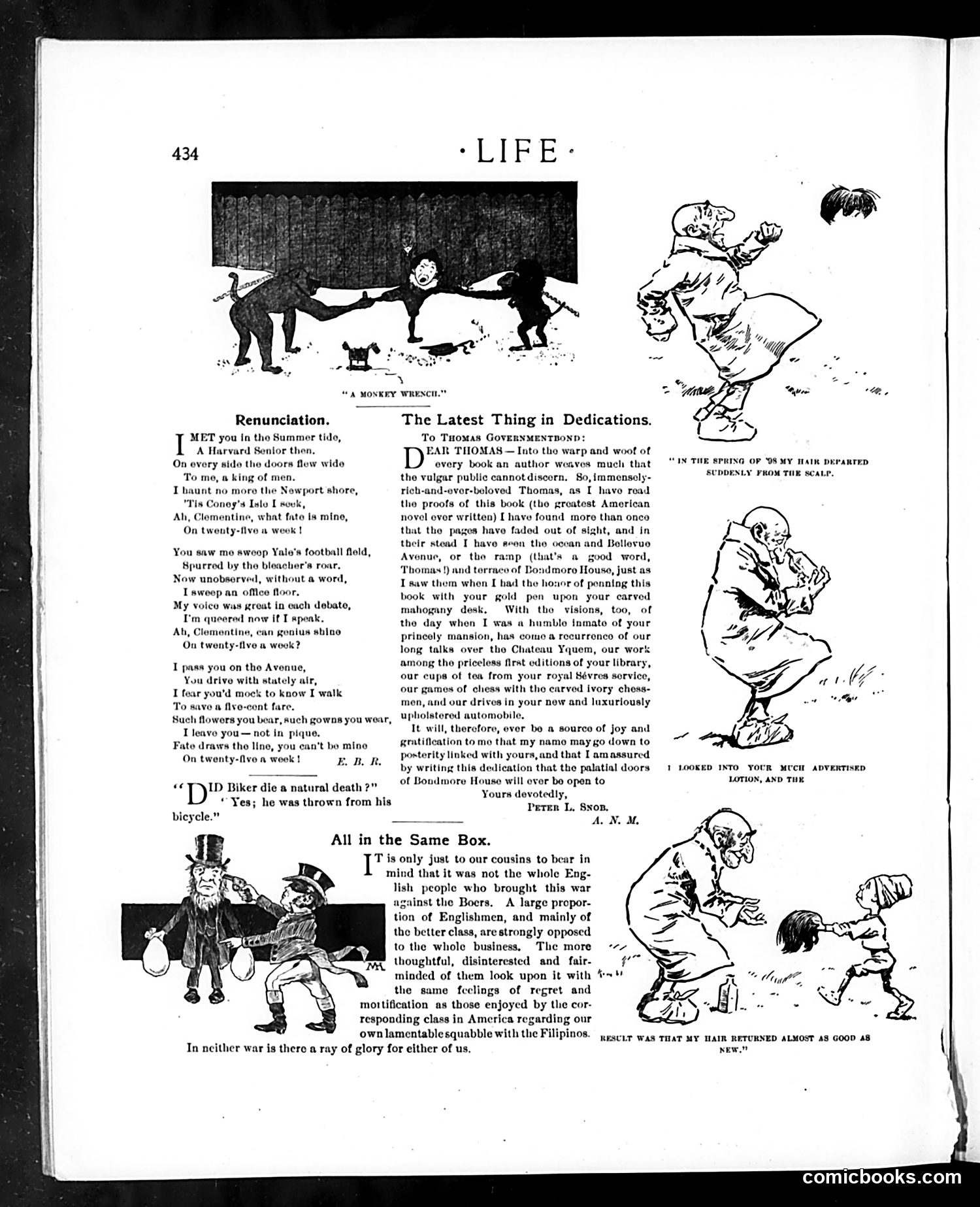
This page contains four distinct satirical pieces from Life magazine (likely early 1900s): **"Renunciation"** — A poem mocking class anxiety. A Harvard graduate who once courted a wealthy woman ("Clementine") now earns only $25/week and cannot afford her. The satire targets nouveau-riche anxieties and the impossibility of marrying across class lines on a clerk's salary. **"The Latest Thing in Dedications"** — A mockery of obsequious author dedications. An author shamelessly flatters his wealthy patron "Thomas Governmentbond" (likely a fictional name satirizing wealthy industrialists), gushing about borrowed prestige and access to his mansion, servants, and fine wines. **"All in the Same Box"** — Commentary on the Boer War (British imperialism in South Africa, 1899-1902) and the Philippine-American War. It notes that educated, thoughtful people on both sides oppose these conflicts as dishonorable, unlike earlier wars. **Hair Lotion Advertisement** — A humorous fake testimonial claiming a hair product restored baldness, mocking dubious patent medicine claims common in the era.
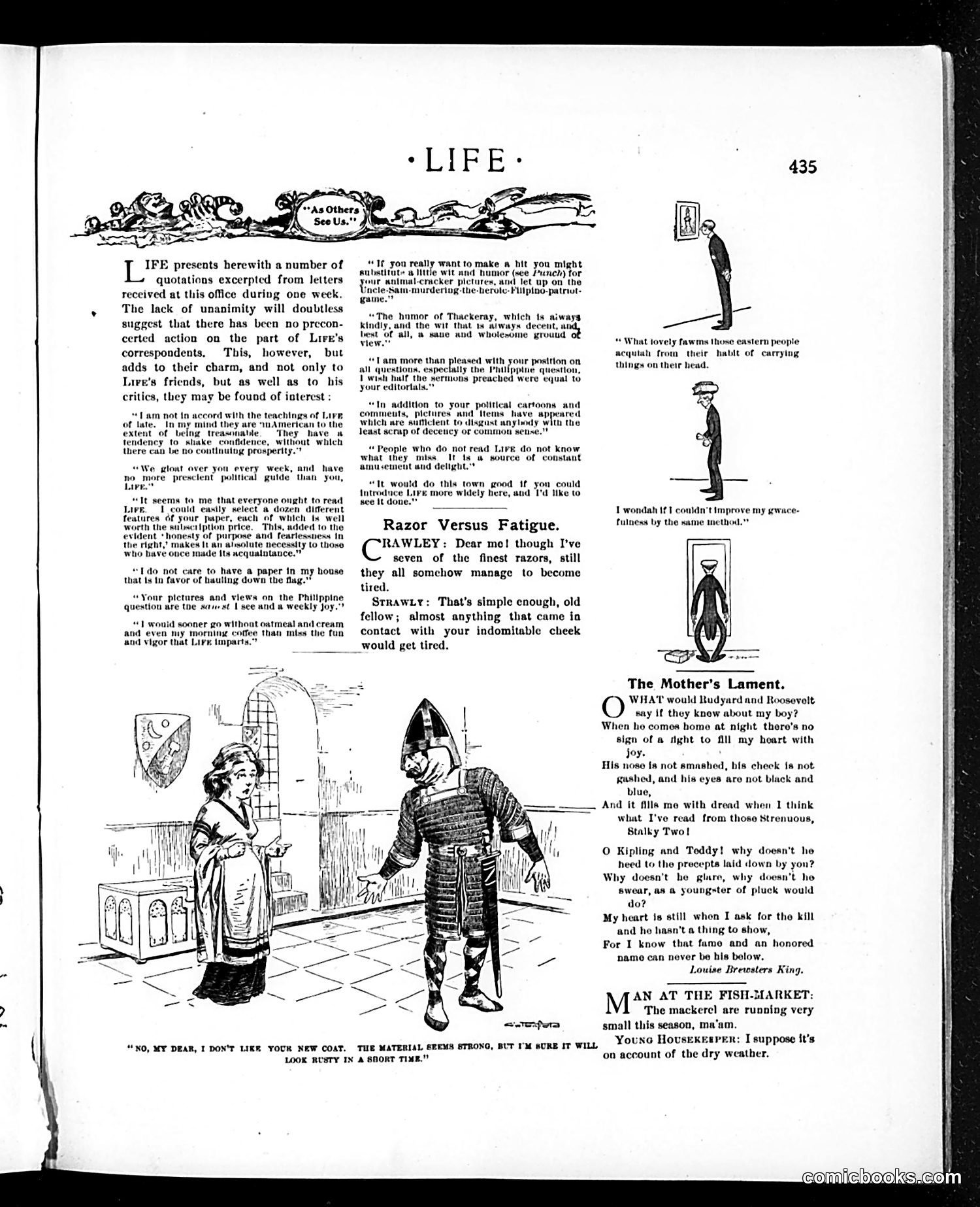
This page from *Life* (circa early 1900s, likely during the Philippine-American War) presents reader letters praising and criticizing the magazine's editorial direction, plus satirical sketches. **Key Context:** The letters reveal deep division over *Life's* political stance. Supporters praise its "fearlessness" and Philippine War coverage; critics accuse it of being "treasonable" for questioning American imperialism and "Uncle Sam murdering the heroic Filipino patriot." **The Cartoons:** - **"Razor Versus Fatigue"**: A crude joke where a man's stubble is so tough it exhausts razors—mocking his rugged masculinity - **"The Mother's Lament"**: Satirizes Theodore Roosevelt and Rudyard Kipling's promotion of "strenuous" masculine ideals. A mother laments her son hasn't come home bloody or broken, making him "dishonorable"—mocking the cult of aggressive manliness these figures championed - **Fish-Market sketch**: A mild joke about small mackerel The page satirizes both *Life's* critics and contemporary masculine ideologies.
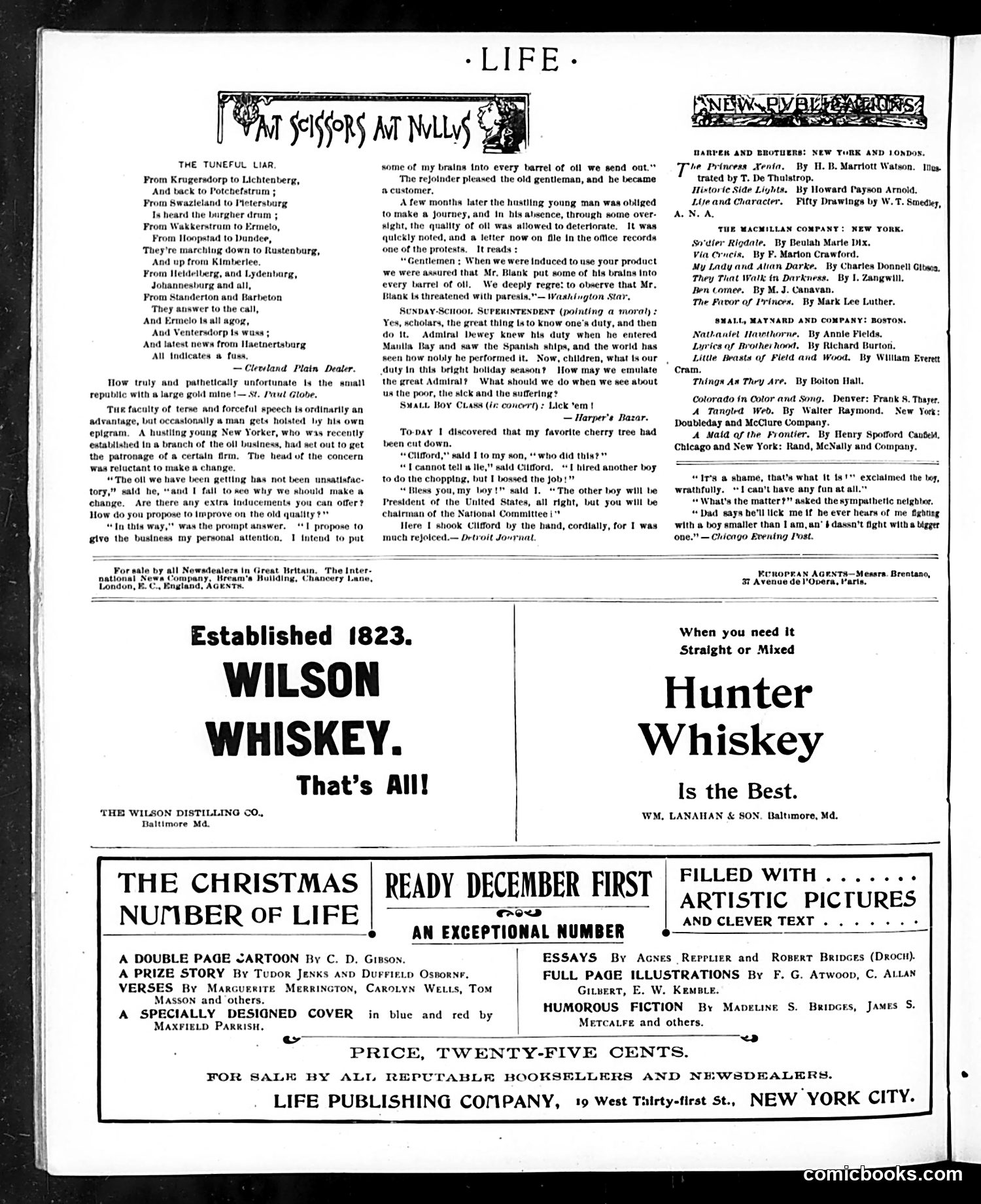
This is primarily a **title/advertising page** for Life's Christmas issue, but includes several short humorous pieces typical of the magazine's satirical style. The cartoons center on common turn-of-century themes: 1. **"The Tuneful Liar"** (poem with datelines from South African towns) appears to mock the **Boer War** (ongoing 1899-1902), satirizing dramatic wartime dispatches from multiple locations as if coordinated action was occurring everywhere simultaneously. 2. **The oil salesman anecdote** jokes about a businessman's boastful claim to "put brains into every barrel," which backfires when quality deteriorates—implying he's now mentally deteriorating ("threatened with paresis," a syphilis reference). 3. **The cherry tree tale** humorously reframes the Washington/Lincoln myth, suggesting the boy who delegates work (rather than does it himself) will become President, while the boss becomes a mere politician. The page advertises the Christmas issue's contents: cartoons, prize fiction, and illustrations. It's vintage early-1900s satirical humor—topical, somewhat crude, and focused on business and social pretension.
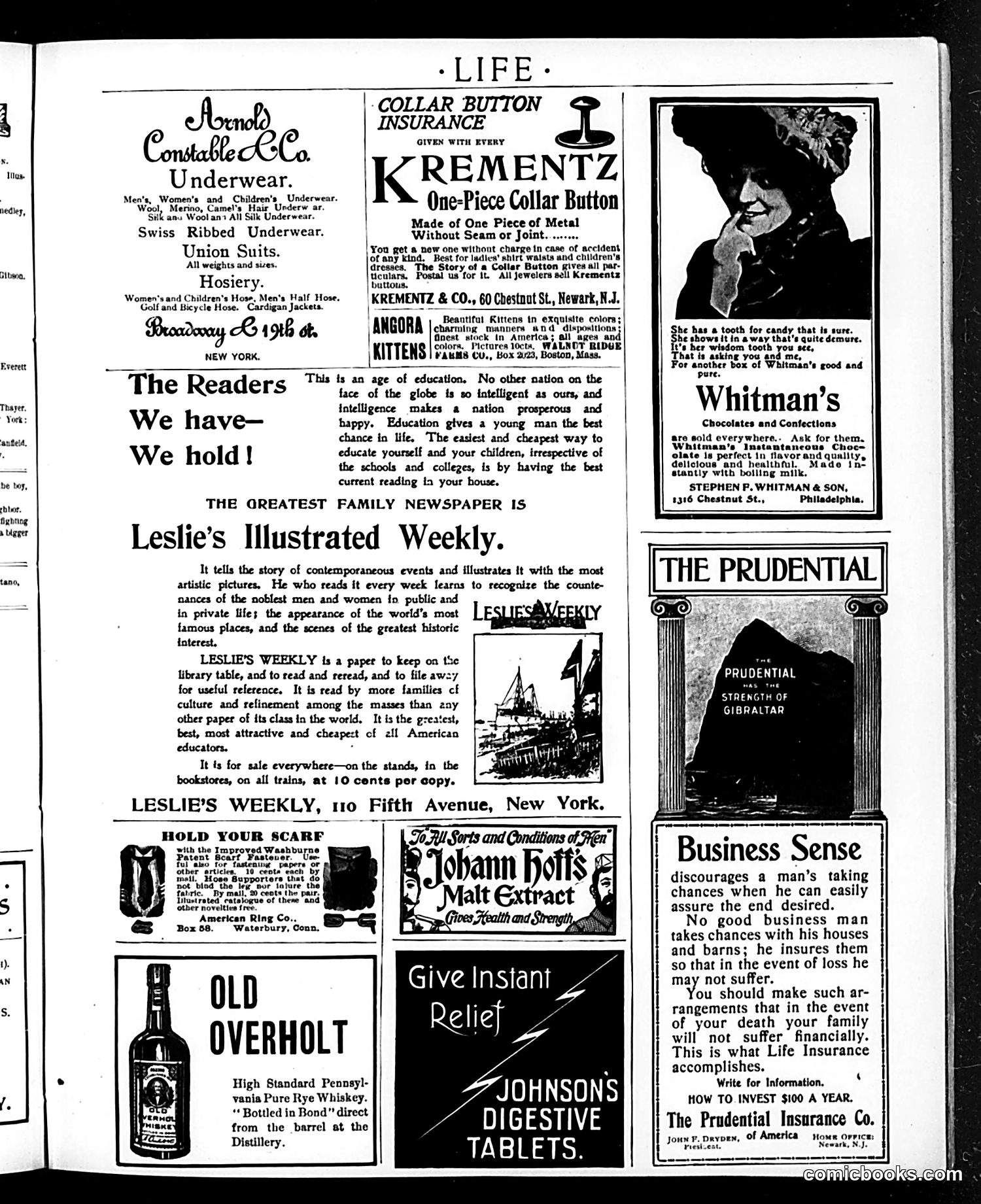
This is primarily a **advertisements and promotional page** from *Life* magazine, not a political cartoon. The page showcases various consumer products typical of the early 20th century: underwear, hosiery, collar buttons, kittens, chocolates, whiskey, and digestive tablets. The main editorial content promotes *Leslie's Illustrated Weekly*, arguing that education and reading foster national prosperity and intelligence. This reflects Progressive Era faith in self-improvement through literature. The **Prudential Insurance advertisement** is notable: it frames life insurance as responsible "business sense" for family protection—a relatively new concept then, positioning insurance companies as essential to modern financial security. The other ads—collar button "insurance," digestive tablets for stomach relief, whiskey claimed to aid health—reflect period attitudes toward consumer goods as solutions to everyday problems, some by modern standards dubious or humorous (like medicinal whiskey). **No specific political figures or satire** are evident on this page.
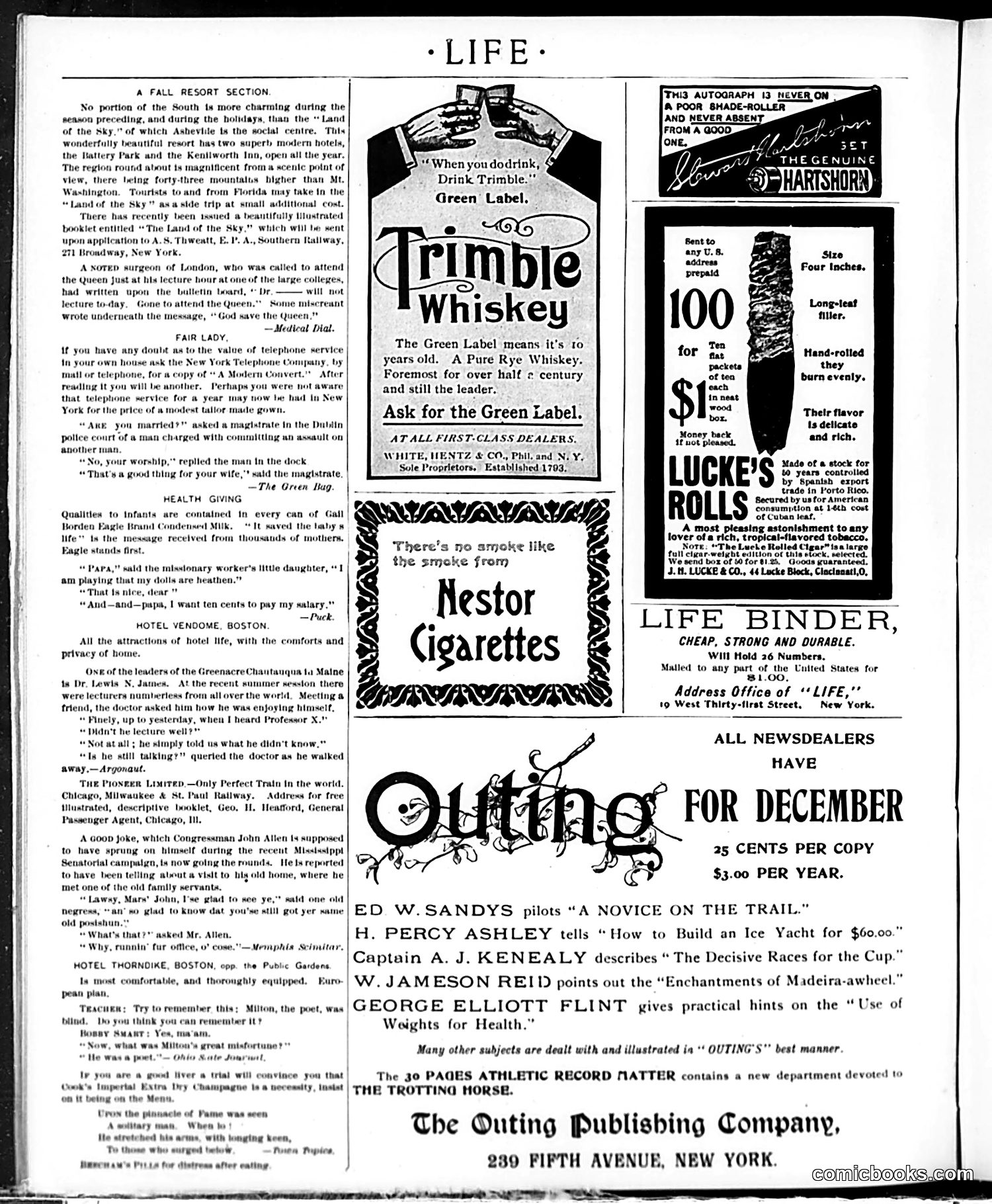
This is primarily an **advertising and humor page** from Life magazine (an early American satirical publication). The content consists mostly of brief comedic anecdotes and product advertisements rather than political cartoons. The humor pieces are mild social satire: a joke about a London surgeon called away from lectures, a Dublin magistrate's quip about marriage, a missionary's daughter wanting "salary" for praying, and a congressman's anecdote about meeting former slaves. These reflect period attitudes and conversational humor. The advertisements dominate: Trimble Whiskey (emphasizing its 10-year age and purity), Nestor Cigarettes, Lucke's Rolls (Cuban tobacco products), and various resort hotels. There are also notices for *Life* magazine subscriptions and the upcoming *Outing* magazine. **No significant political content or caricatures are present.** The page is essentially a humor-and-ads section typical of early 20th-century American magazines, with genteel comedy aimed at educated readers.
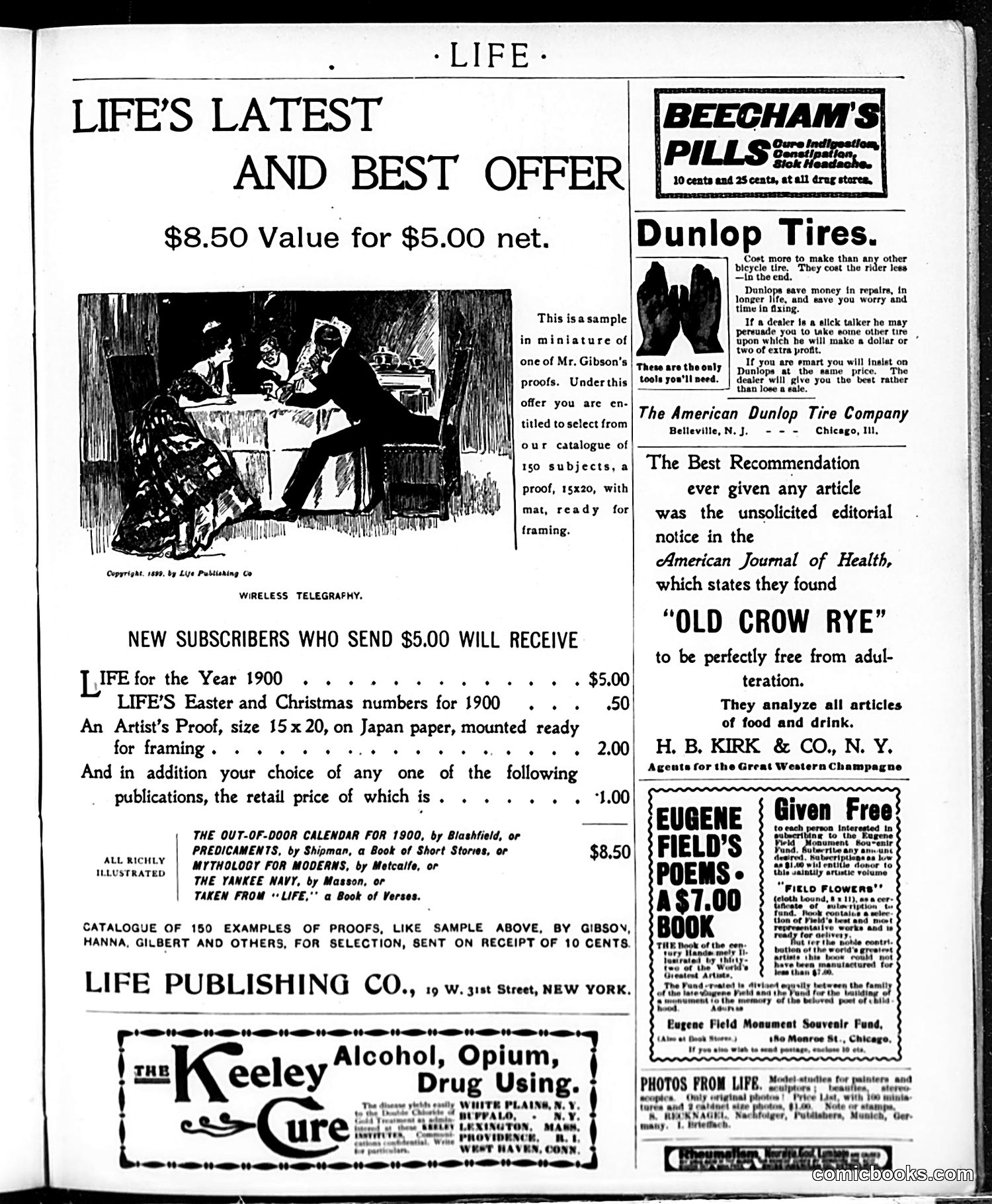
This page primarily consists of advertisements and subscription offers rather than satirical cartoons. The main featured image, titled "Wireless Telegraphy," appears to be a Gibson illustration (likely by Charles Dana Gibson, the famous illustrator) depicting figures in period dress, but its satirical content is unclear from the image alone. The page predominantly showcases Life Publishing Company's subscription offer: $5.00 for a year's subscription plus bonus items including a Gibson proof print and selected books. The advertisements include patent medicines (Beecham's Pills, the Keeley Cure for alcohol/opium addiction), bicycle tires (Dunlop), whiskey (Old Crow Rye), and a collection of Eugene Field's poetry. This reflects turn-of-the-century publication practices, where satirical magazines relied heavily on advertising revenue and subscriber premiums rather than solely on editorial content.
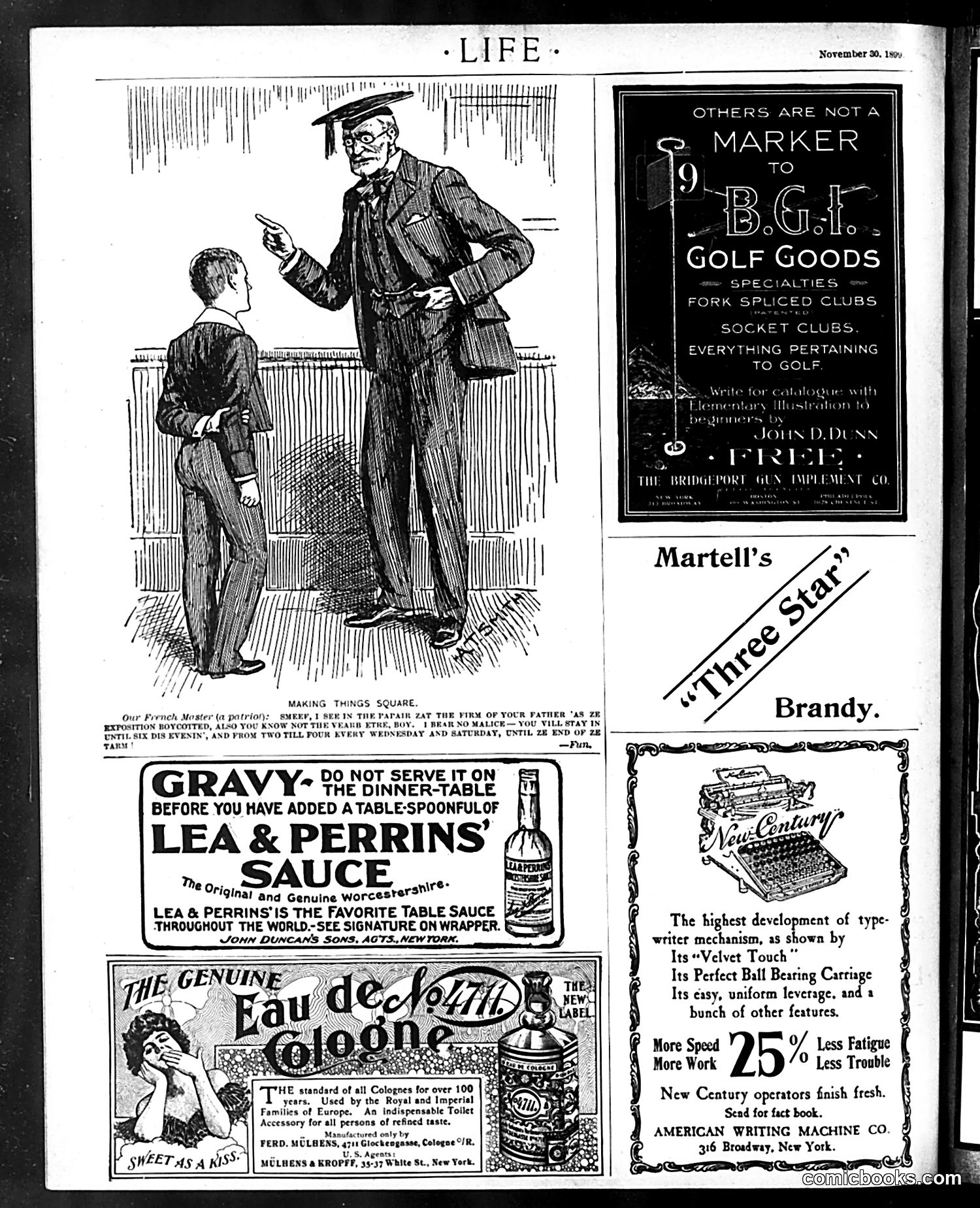
This page is primarily **advertising**, not political satire. The main cartoon at top depicts a French schoolmaster scolding a small boy, captioned "Making Things Square." The caption references a French master at a patriotic exposition who is boycotting something (text unclear due to OCR errors), instructing the boy to attend class on specific days. The cartoon's humor appears to rely on a visual pun or period-specific French-American cultural reference that's unclear today without additional context. The remainder of the page contains product advertisements typical of 1909: Lea & Perrins sauce, Eau de Cologne cologne, Martell brandy, and a New Century typewriter. These ads use common early-20th-century marketing tactics emphasizing product superiority and heritage. **Modern readers miss:** The specific French exhibition reference and why this boycott/schoolmaster scenario would have been timely or amusing to 1909 audiences.