
Life, 1899-11-30 · page 4 of 20
Life — November 30, 1899 — page 4: what you’re looking at
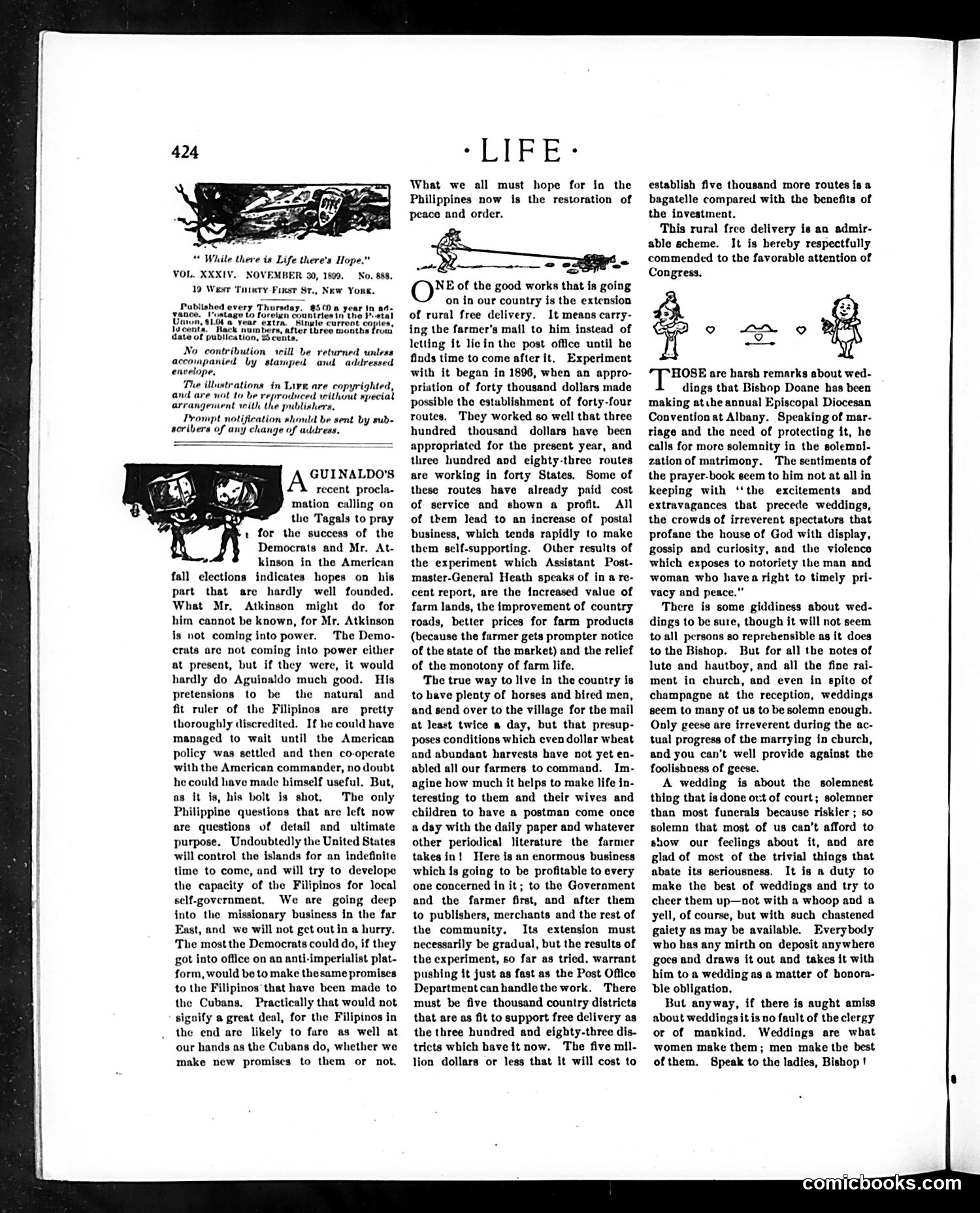
What you’re looking at
This page contains two satirical pieces about early 20th-century American politics and social issues. **Top cartoon:** References "Aguinaldo's recent proclamation" calling on the Tagalog people. Appears to mock someone's (likely President McKinley's or an American political figure's) failed hopes regarding Democratic election prospects and American intervention in the Philippines, suggesting the situation is poorly managed. **Main article:** Discusses rural free mail delivery expansion—a Democratic policy initiative. It humorously critiques both the Bishop's attitude toward weddings (complaints about solemnity) and clergy's role in marriage ceremonies, while praising the postal service expansion's practical benefits to farmers and rural communities. The satire targets political hypocrisy and institutional rigidity regarding modern reform.
📄 Transcribed text from this page (OCR, searchable)
Machine-transcribed from the original scan — historical spelling and the odd misread are preserved.
“ While there is Life there's Hop: VOL. XXXIV, NOVEMBER 20, 1899, No. 888, 19 West Tuiry-Finst St., New Yore. Pubilshed every Thursday, 9500 a year in ad- oatage t0 foreign countries tn tho ¥ inion, $04 a Year extra. single current lucent’. “Rack numbers, after three month dato of publication, cents, No contribution will be returned unless accompanied by stamped and addressed envelope. The illustrations in Live are copyrighted, anid are not to be reproduced without speciat arrangement with the publishers. Prompt notification shoud be sent by sub- scribers of any change of address. GUINALDO'S recent procla- mation calling on the Tagals to pray t for the success of the Democrats and Mr. At- kinson in the American fall elections indicates hopes on his part that are hardly well founded. What Mr. Atkinson might do for him cannot be known, for Mr. Atkinson is not coming into power. The Demo- crats are not coming into power cither at present, but if they were, it would hardly do Aguinaldo much good. His pretensions to be the natural and fit ruler of the Filipinos are pretty thoroughly discredited. If he could have managed to wait until the American policy was settled and then co-operate with the Amcrican commander, no doubt he could have made himself useful. But, as it is, his bolt is shot, The only Philippine questions that are left now are questions of detail and ultimate purpose. Undoubtedly the United States will control the islands for an indefinite time to come, and will try to develope the capacity of the Filipinos for local self-government. We are going deep into the missionary business in the far East, and we will not get out in a hurry. ‘The most the Democrats could do, if they got into office on an anti-imperialist plat- form, would be to make thesame promises to the Filipinos that have been made to the Cubans, Practically that would not signify a great deal, for the Filipinos in the end are likely to fure as well at our hands as the Cubans do, whether we make new promises to them or not. *LIFE= What we all must hope for in the Philippines now is the restoration of peace and order. = NE of the good works that is going on in our country is the extension of rural free delivery. It means carry- ing the farmer's mall to him instead of letting it licin the post office until he finds time to come after it. Experiment with it began in 1896, when an appro- priation of forty thousand dollars made possible the establishment of forty-four routes. They worked so well that three hundred thousand dollars have been appropriated for the present year, and three hundred and eighty-three routes are working in forty States, Some of these routes have already paid cost of service and shown a profit. All of them lead to an increase of postal business, which tends rapidly to make them self-supporting. Otber results of the experiment which Assistant Post- master-General Heath speaks of in a re- cent report, are the increased value of farm lands, the improvement of country roads, better prices for farm products (because the farmer gets prompter notice of the state of the market) and the relief of the monotony of farm life. ‘The true way to live in the country is to have plenty of horses and hired men, and send over to the village for the mail at least twice a day, but that presup- poses conditions which even dollar wheat and abundant harvests have not yet en- abled all our farmers to command. Im- agine how much it helps to make life in- teresting to them and their wives and children to have a postman come once a dsy with the daily paper and whatever other periodical literature the farmer takes in! Here is an enormous business which is going to be profitable to every one concerned in it; to the Government and the farmer first, and after them to publishers, merchants and the rest of the community, Its extension must necessarily be gradual, but the results of the experiment, so far as tried, warrant pushing it just as fast as the Post Office Department can handle the work. There must be five thousand country districts that are as fit to support free delivery as the three hundred and eighty-three dis- tricts which have it now. The five mil- lion dollars or less that it will cost to establish five thousand more routes is a bagatelle compared with the benefits of the investment. This rural free delivery is an admir- able scheme. It is hereby respectfully commended to the favorable attention of Congress, HOSE are harsh remarks about wed- dings that Bishop Doane has been making atche annual Episcopal Diocesan Conventionat Albany. Speaking of mar- riage and the need of protecting it, he calls for more solemnity in the solemni- zation of matrimony. The sentiments of the prayer-book seem to him not at all in keeping with ‘‘the excitements and extravagances that precede weddings, the crowds of irreverent spectators that profane the house of God with display, gossip and curiosity, and the violence which exposes to notoriety the man and woman who havea right to timely pri- vacy and peace.” There is some giddiness about wed- dings to be sure, though it will not seem to all persons so reprehensible as it does to the Bishop. But for all the notes of lute and hautboy, and all the fine rai- ment in church, and even in spite of champagne at the reception, weddings seem to many of us to be solemn enough. Only geese are irreverent during the ac- tual progress of the marrying in church, and you can’t well provide against the foolishness of geese. A wedding is about the solemnest thing that is done ovt of court; solemner than most funerals because riskier ; so solemn that most of us can’t afford to show our feclings about it, and are glad of most of the trivial things that abate its seriousness. It is a duty to make the best of weddings and try to cheer them up—not with a whoop and a yell, of course, but with such chastened gaiety ag may be available. Everybody who has any mirth on deposit anywhere gocs and draws it out and takes it with him to a wedding as a matter of honora- dle obligation. But anyway, if there is aught amiss about weddings it is no fault of the clergy or of mankind. Weddings are what women make them; men make the best of them. Speak to the Indies, Bishop! Comicbooks.com