
Life, 1899-11-30 · page 8 of 20
Life — November 30, 1899 — page 8: what you’re looking at
What you’re looking at
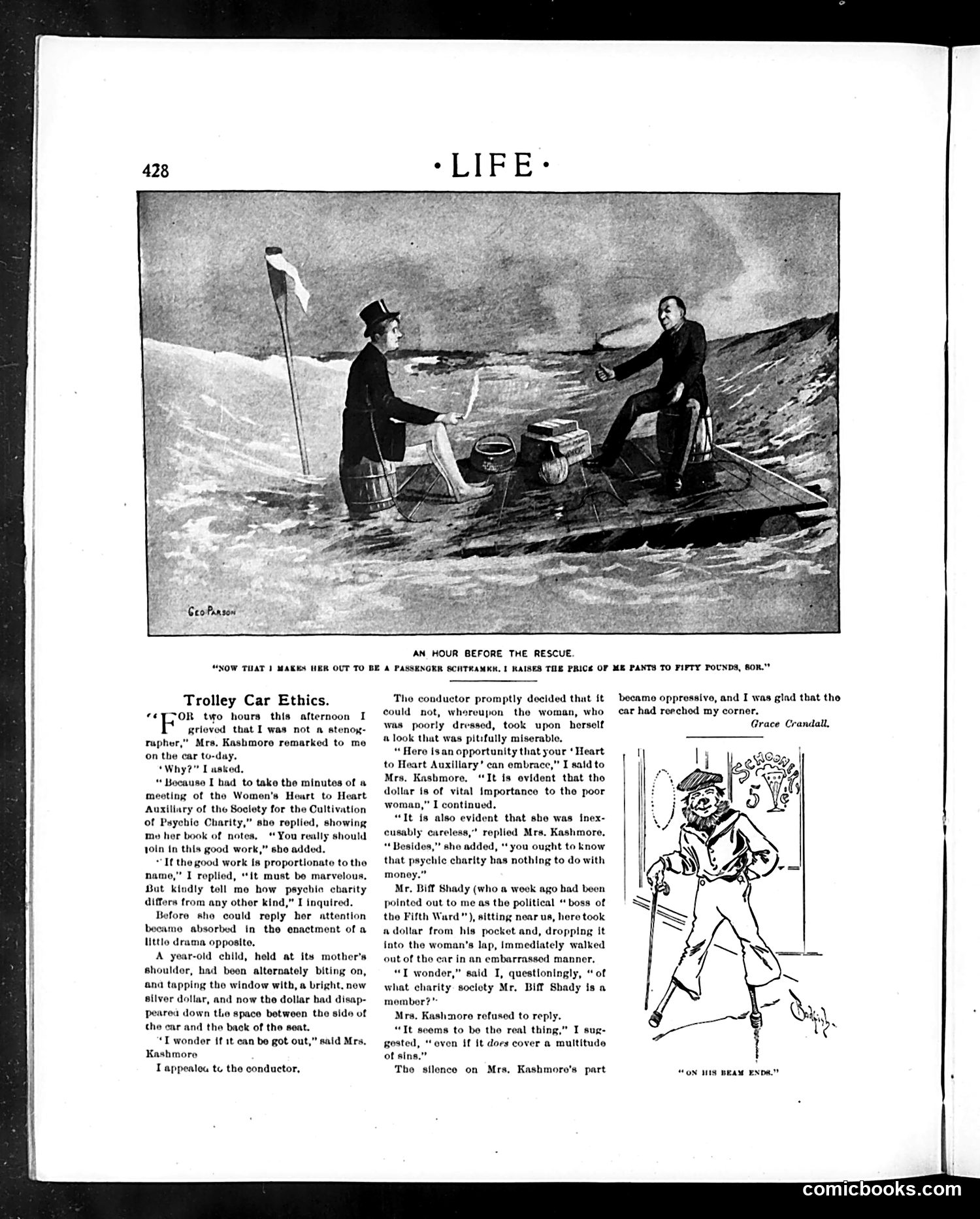
This page satirizes hypocrisy around charitable giving. The main article describes Mrs. Kashmere's dismissal of a poor woman from a trolley car, rejecting appeals to "Heart Auxiliary" charity work. The satire's point: Mrs. Kashmere proudly supports organized charity organizations but callously refuses direct help to a desperate individual—revealing that her "charity" is performative rather than genuine. When a man (identified as "Iliff Shady, political 'boss'") demonstrates real charity by giving a dollar to the woman, Mrs. Kashmere remains silent, unable to defend her own behavior. The small cartoon on the right ("ON HIS BEAM ENDS") appears to illustrate financial distress, reinforcing the economic desperation underlying the scene. The satire critiques selective, institutional charity as morally hollow compared to direct human compassion.
📄 Transcribed text from this page (OCR, searchable)
Machine-transcribed from the original scan — historical spelling and the odd misread are preserved.
CeoPanson “NOW TUAT 1 MAKES Trolley Car Ethics. ¢€J[OR tyo hours this afternoon I grieved that I was not a stenog- ruphor,” Mra, Kashmoro remarked to me on the car to-day, “Why?” [usked, “ Bocause I bad to take the minutes of a meeting of the Women's Heart to Heart Auxiliary of the Society for the Cultivation of Psychic Charity,” she replied, showing my hor book of notes. “You really should Join In this good work,” sho added. “If the good work Is proportionate to tho namo,” I roplied, “it must be marvelous. But kindly tell mo how psychia charity differs from any othor kind,” I inquired. Before sho could reply hor attention became absorbed in the enactment of a littlo drama opposite, A year-old child, held at its mother's shouldor, had been alternately biting on, ana tapping tho window with, a bright, new silver dollar, and now tho dollar had disap- peared down the space between the side of the car and tho back of tho seat. “I wondor it it ean be got out,” sald Mrs, Kashmoro T appealea te the conductor, AN HOUR BEFORE THE RESCUE. Tho conductor promptly decided that it could not, whereupon the woman, who was poorly dressed, took upon horself a look that was pitifully miserable. “ Hero is an opportunity that your ‘Heart to Heart Auxillary’ can embrace," I said to Mrs, Kasbmore, “It is ovident that tho dollar {s of vital importance to the poor woman,” I continued. “It is also evident that she was inex- cusably careless,” replied Mrs, Kashmore, “Besides,” she added, * you ought to know that psychte charity has nothing to do with money.” Mr, Biff Shady (who a woek ago had beon pointed out to me as the political “ boss of tho Fifth Ward"), sitting near us, here took adollar from his pocket and, dropping it {nto the woman's lap, Immediately walked out of the car in an embarrassed manner. “I wonder,” said I, questioningly, “of what charity society Mr. Biff Shady is a mombor?" Mrs, Kashmoro refused to reply. “It seems to be tho real thing,” I sug- “even if it dors cover a multitude Tho silence on Mrs. Kashmoro’s part OUT TO BE A PASSENGER SCHTRAMKK, I RAISES THE PRICE OF ME PANTS TO FIFTY POUNDS, BOR." beeamo oppressive, and I was glad that tho car had rerched my corner, Grace Crandall. “ON HIS BEAM BENDA.” comicbooks.com