
A complete issue · 20 pages · 1899
Life — November 16, 1899
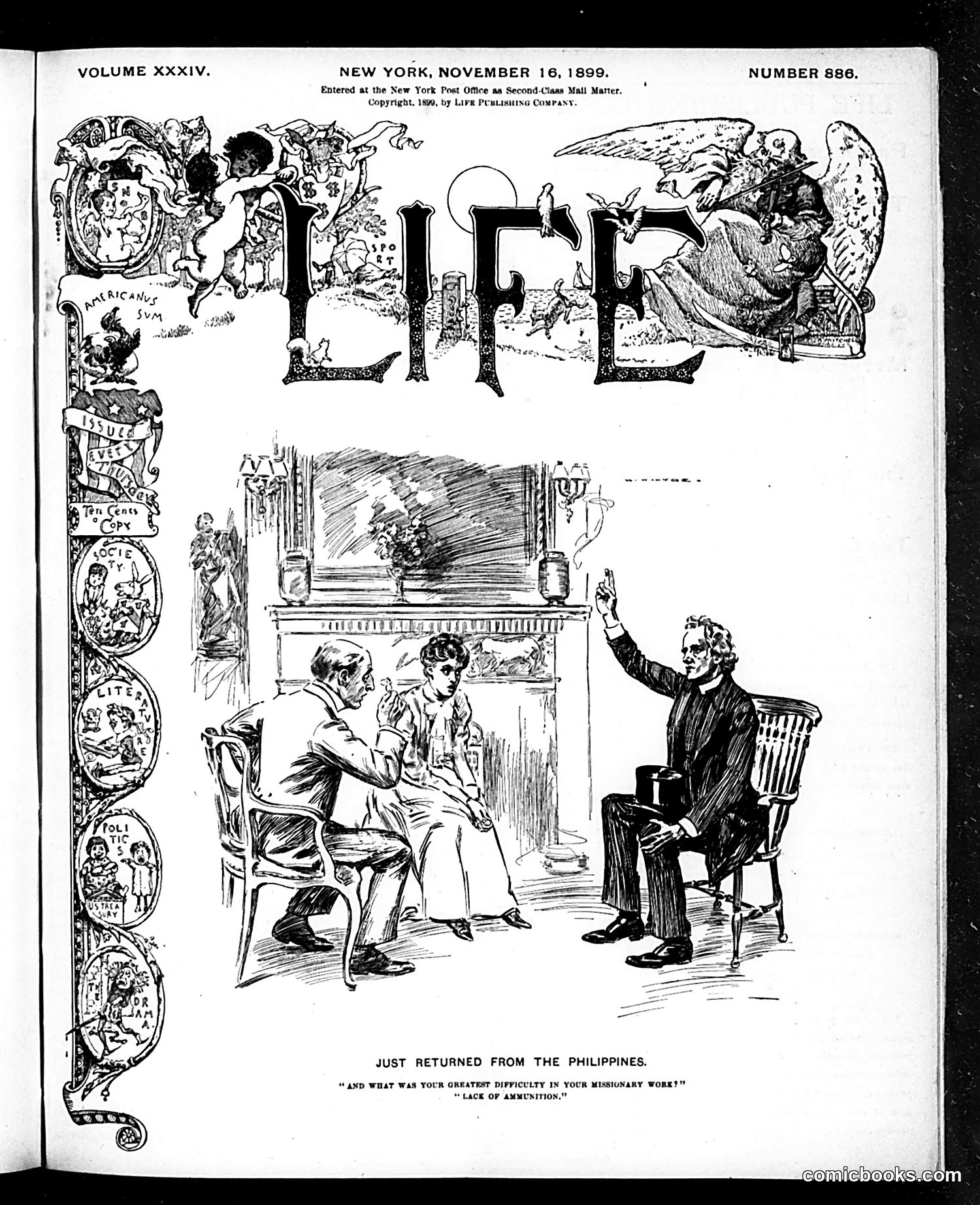
This Life magazine cover from November 16, 1899 depicts a scene titled "Just Returned from the Philippines" with the dialogue: "And what was your greatest difficulty in your missionary work?" "Lack of ammunition." The cartoon satirizes the American-Philippines War (1899-1902). A missionary has apparently returned from the Philippines, but his answer reveals that missionary work there involved armed conflict rather than purely religious conversion. The dark humor suggests that American "civilizing missions" in the newly-acquired Philippines were actually violent military campaigns. The missionary's candid admission that ammunition shortage—not theological obstacles—was his chief problem mocks the hypocrisy of framing colonial military conquest as humanitarian religious work. This reflects contemporary criticism of American imperialism disguised as benevolent mission activity.
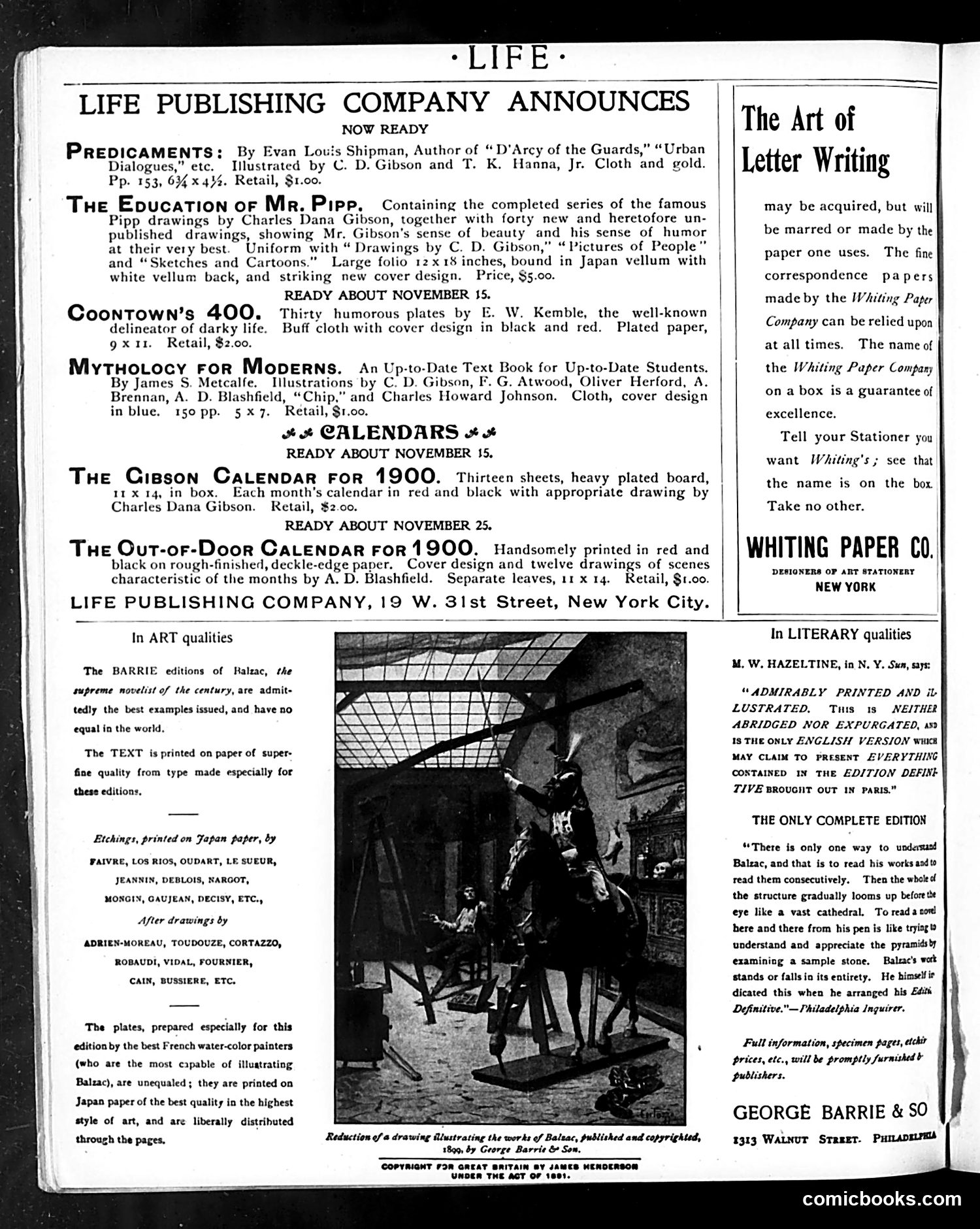
This page is primarily **advertising** for Life Publishing Company's books and products rather than political satire. The central image shows a **reduction of a drawing illustrating the works of Balzac**, credited to George Barrie & Son. It depicts what appears to be a 19th-century interior scene, likely representing a character or moment from Balzac's novels. The advertisements announce various publications: *Predicaments* by Evan Louis Shipman, *The Education of Mr. Pipp* (illustrated by C.D. Gibson), *Coontown's 400*, and *Mythology for Moderns*. Calendar products are also promoted. The right side advertises writing paper from the Whiting Paper Company and a complete English edition of Balzac's works from George Barrie & So. There is **no obvious political cartoon or satire** on this page—it's a commercial publication promoting books and stationery.
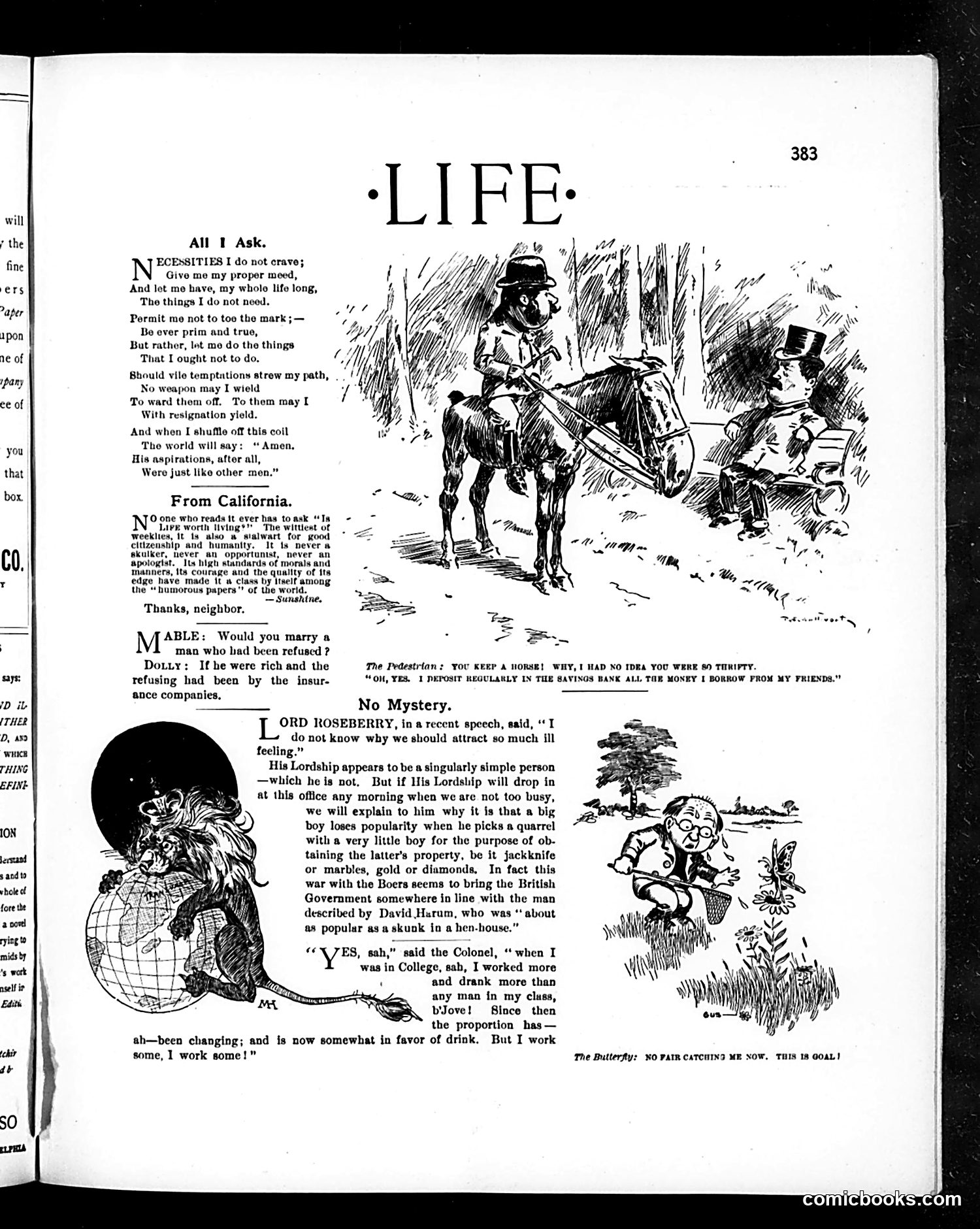
This page contains several satirical pieces typical of early Life magazine's social commentary: **"All I Ask"** - A poem about life's modest aspirations, accompanied by an illustration of a man on horseback talking to someone in a carriage, suggesting class differences or social encounters. **"From California"** - Appears to critique Californian attitudes toward morality and citizenship standards. **"Mable" dialogue** - A brief exchange about marrying a refused man, likely satirizing romantic prospects or insurance company practices. **"No Mystery"** - Features Lord Roseberry's comments about attracting "ill feeling," with caricatures suggesting political unpopularity or public perception issues. The imagery and text suggest criticism of a political figure's popularity problems. **"The Butterfly"** - A humorous caption about catching butterflies. The illustrations use period-appropriate caricature style typical of satirical magazines of this era.
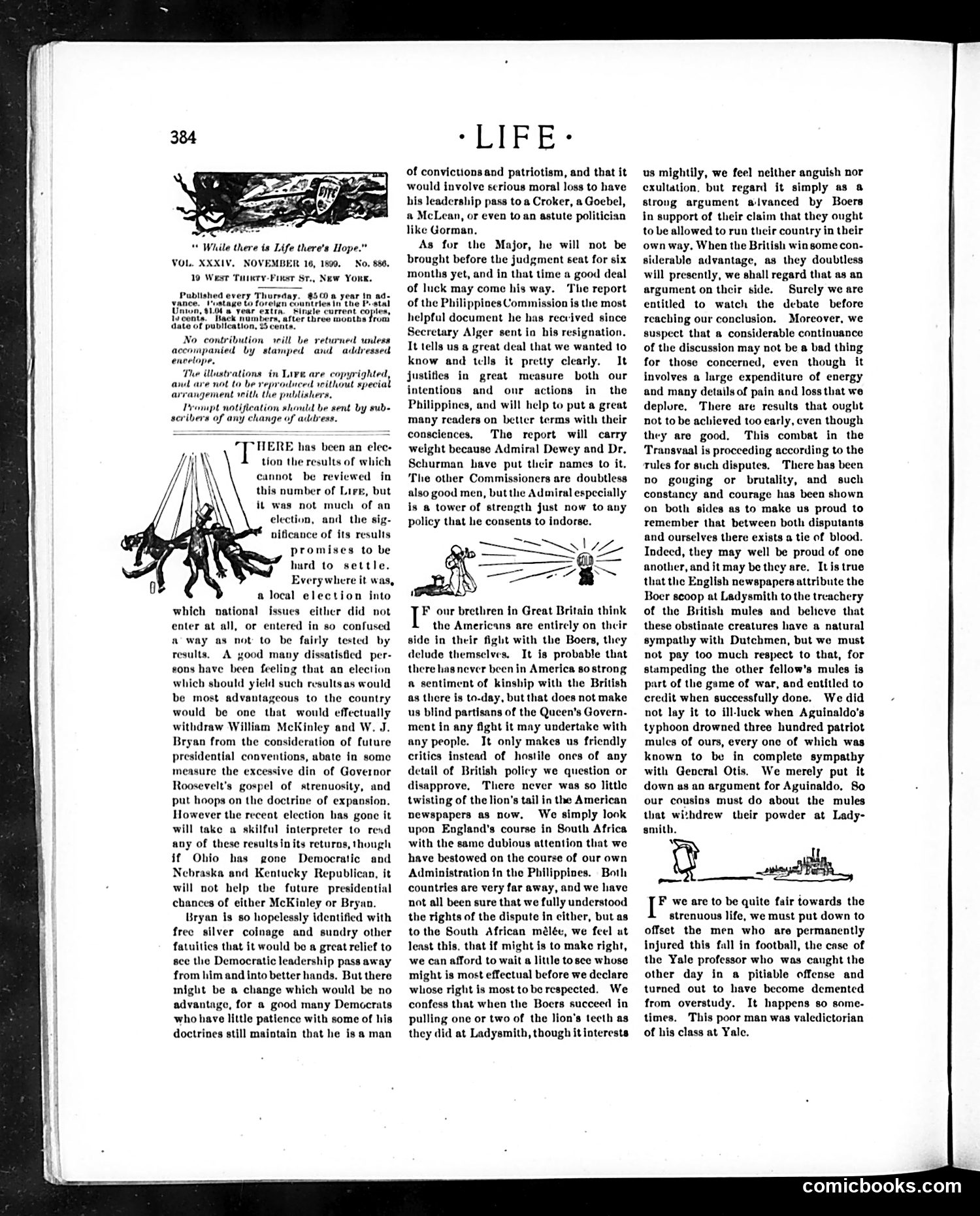
This page contains political commentary on the Philippine-American conflict and British-Boer tensions circa 1900. The main cartoon depicts **figures in conflict**, likely representing American and British positions regarding their respective colonial wars. The text discusses **Admiral Dewey and Dr. Schurman's Philippines Commission**, praising their moral leadership. It contrasts American actions with British conduct in South Africa, where the Boers had recently succeeded militarily. The writer argues Americans should maintain ethical superiority over the British, suggesting the Boers' success at Ladysmith proves British methods weren't inherently effective. A secondary section criticizes the injury of a Yale professor's son in the Philippine conflict, suggesting military service shouldn't require such personal sacrifice from educated elites. The satire targets imperialist hypocrisy while defending American interventionism as morally superior.
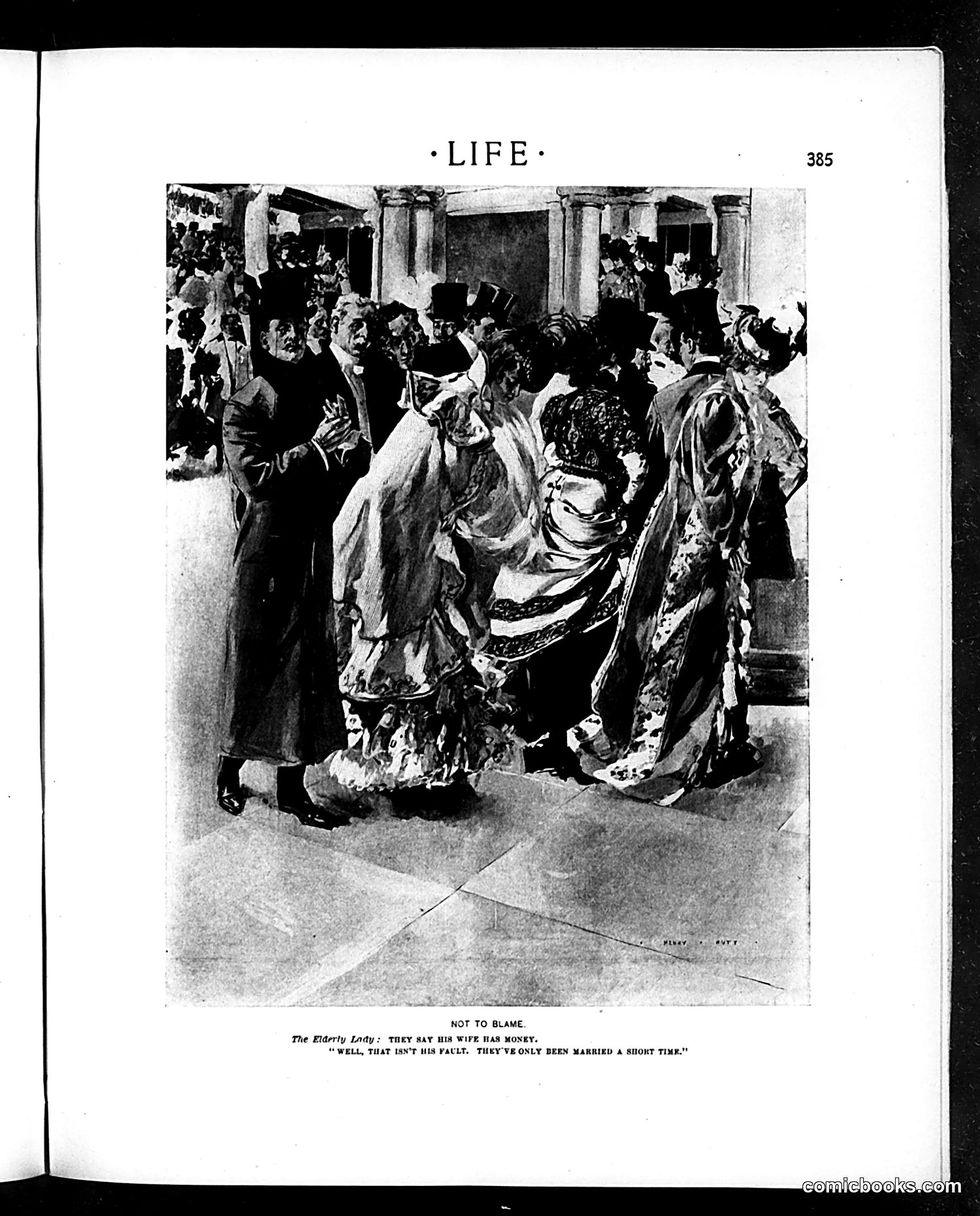
This cartoon satirizes wealthy older men's marital problems. The title "The Elderly Lady" comments on an older woman discussing her friend's marriage troubles. The dialogue reads: "They say his wife has money. 'Well, that isn't his fault. They've only been married a short time.'" The satire targets the social hypocrisy surrounding May-December marriages in early 20th-century America. The joke suggests that when an older man marries a younger wealthy woman, observers shouldn't blame him for the apparent mismatch—after all, the marriage is recent, implying the financial disparity will inevitably become his "fault" once they've been together longer. The cartoon mocks both the practice of marrying for money and society's lenient attitudes toward older men doing so.
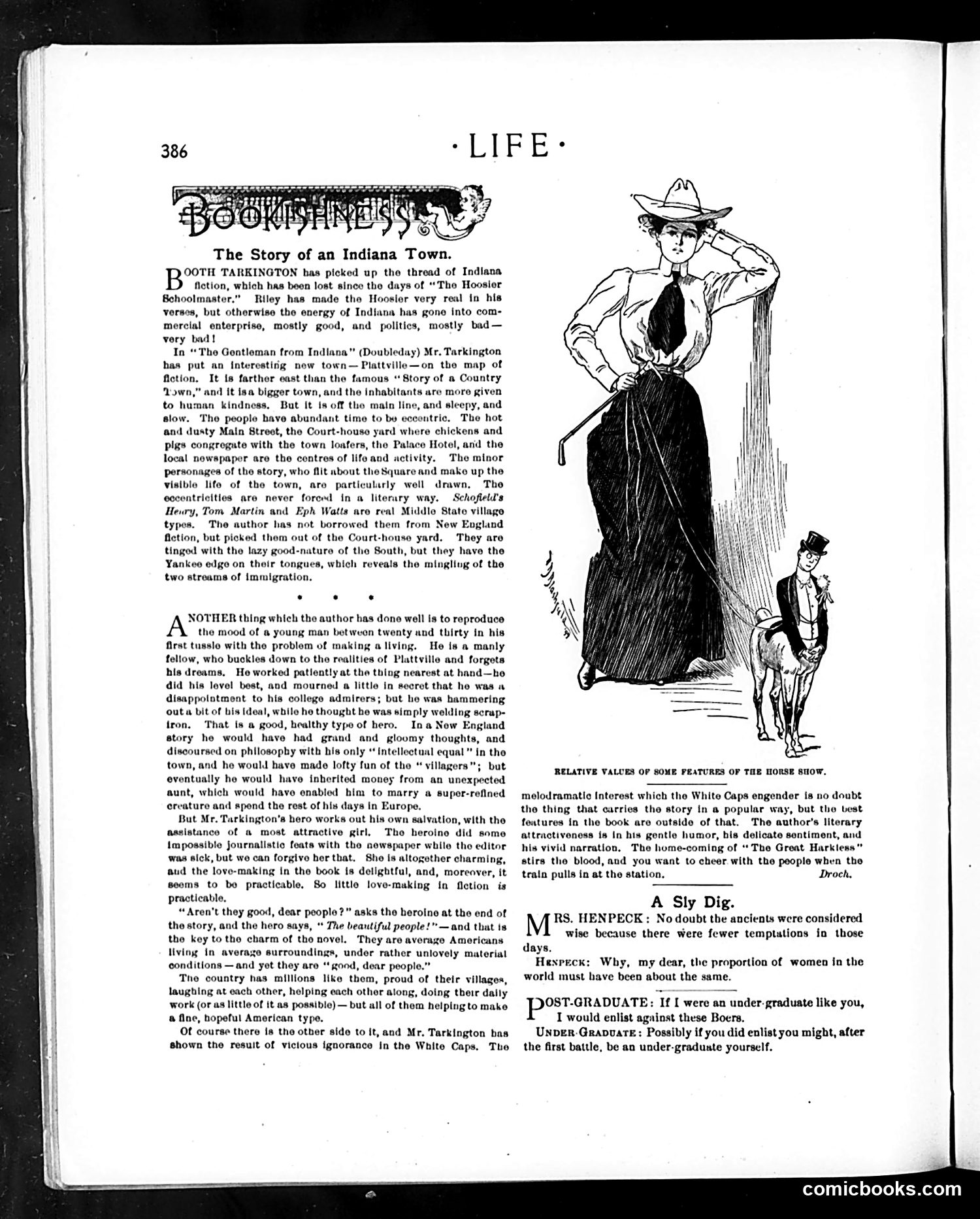
This page contains a short story titled "The Story of an Indiana Town" by Booth Tarkington, describing the fictional town of Plattville. The accompanying illustration shows a tall woman in a wide-brimmed hat alongside a smaller man in formal attire. The cartoon illustrates a scene from Tarkington's narrative about small-town life in Indiana. The exaggerated height difference between the figures appears comedic, likely reflecting tensions or social dynamics described in the story. Below is a brief dialogue section titled "A Sly Dig," featuring characters Mrs. Henpeck and Henpeck debating women's education and military service—social issues of the early 20th century. The humor derives from marital conflict and contemporary debates about gender roles and women's rights.
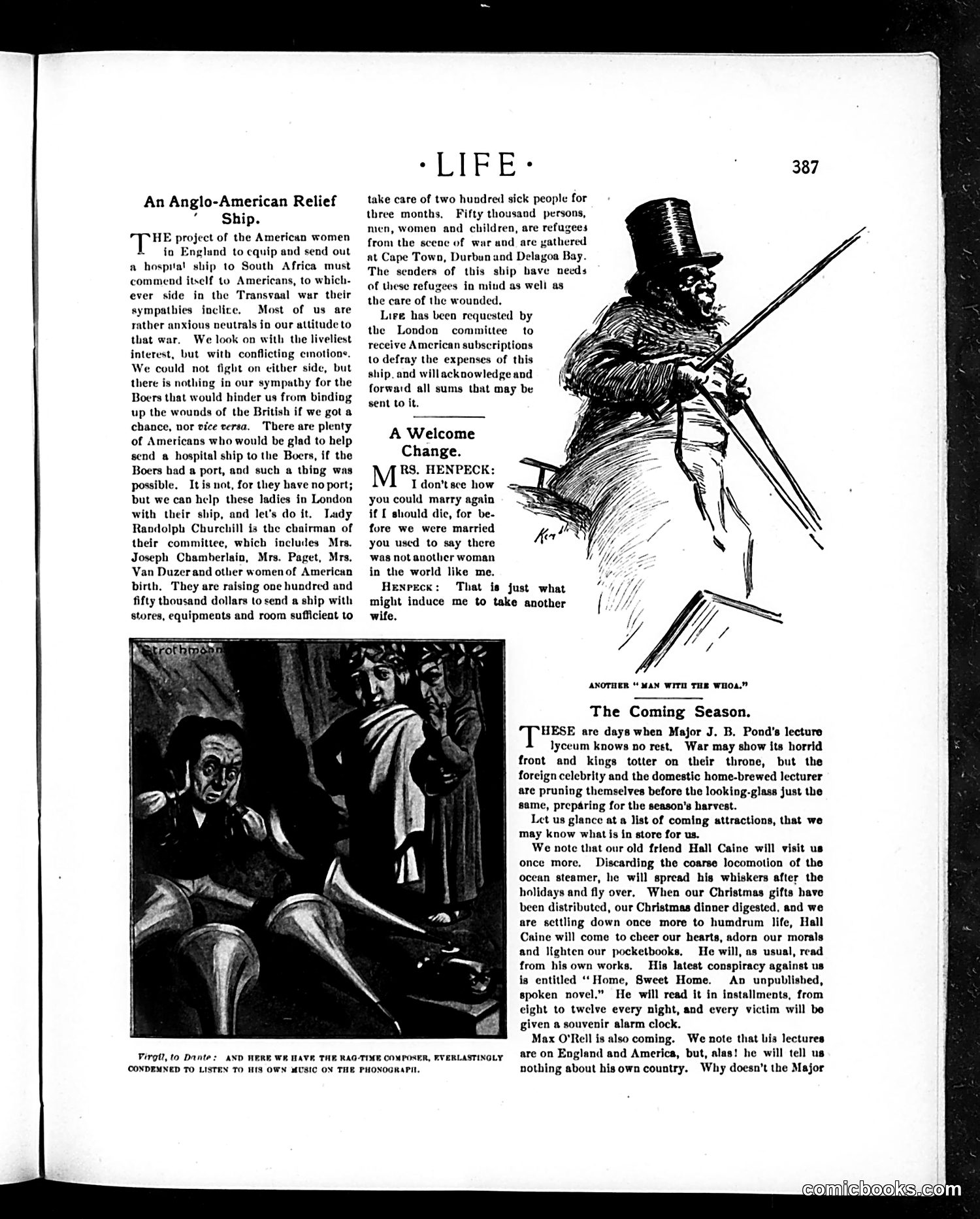
This page contains two main cartoons: **"An Anglo-American Relief Ship"** discusses a hospital ship project for South Africa, likely referencing the Boer War. The text expresses American neutrality while supporting humanitarian aid to British-held territories caring for war refugees and wounded. **"A Welcome Change"** shows a couple debating remarriage. Mrs. Henpeck jokes she wouldn't remarry because no other woman equals her, while Mr. Henpeck suggests remarriage might escape her dominance—a common satirical trope mocking nagging wives. **"Another 'Man with the Whol[e]'"** (title partially visible) appears to be social commentary, though details are unclear. **"The Coming Season"** advertises upcoming entertainment including Hall Caine and Max O'Rell performances. The cartoons exemplify early 20th-century American satire focusing on war relief, domestic gender dynamics, and entertainment culture.
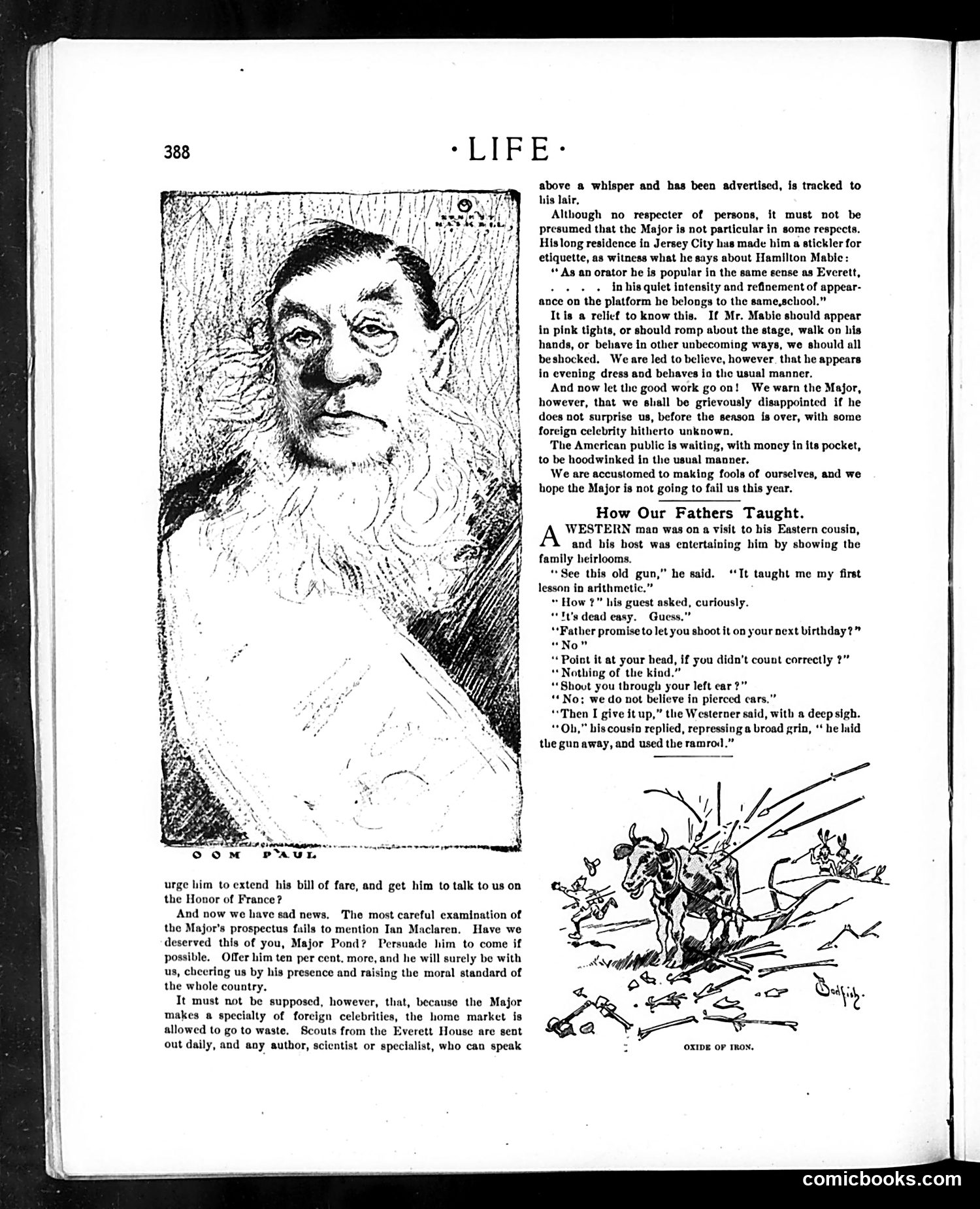
This *Life* magazine page satirizes a visiting dignitary, likely a foreign celebrity or politician referred to as "the Major." The portrait sketch shows a distinguished gentleman with distinctive facial features. The text critiques the Major's behavior and etiquette, noting he lacks respect for social conventions—appearing in unconventional dress or behaving unexpectedly in public. The author expresses hope the Major won't disappoint by arriving with "some foreign celebrity hitherto unknown." The secondary article, "How Our Fathers Taught," is an unrelated humorous anecdote about teaching gun safety through unconventional methods. The small cartoon labeled "OXIDE OF IRON" depicts horses or animals, likely another separate satirical illustration. The page's overall tone mocks foreign visitor pretentiousness and American eagerness to be impressed by international celebrities.
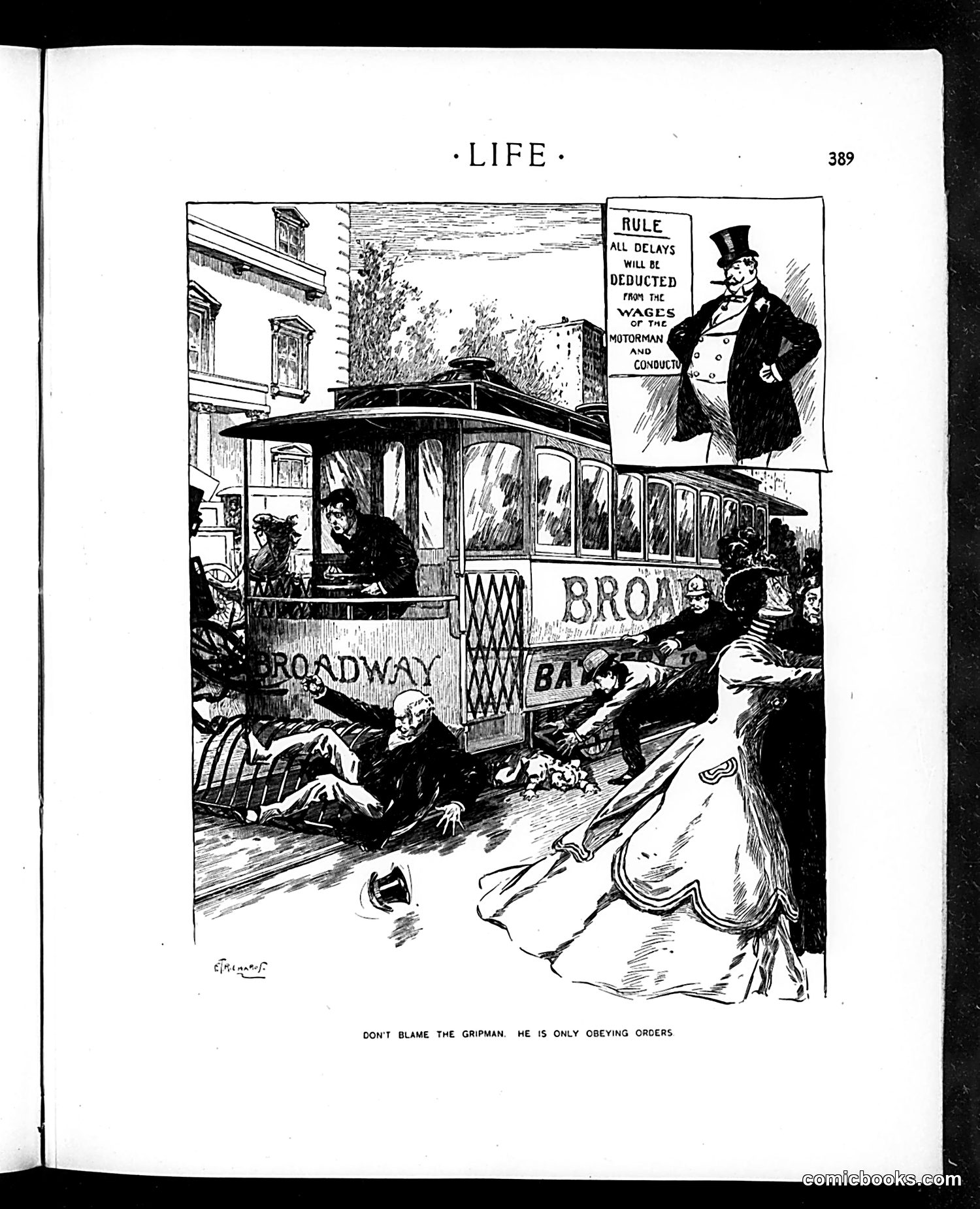
This cartoon satirizes labor disputes on Broadway trolleys in early 20th-century New York. The main image shows a streetcar accident or disruption, with passengers scattered and a person lying on the ground. The inset cartoon depicts a well-dressed figure (likely management or city authority) posting a rule stating "ALL DELAYS WILL BE DEDUCTED FROM THE WAGES OF THE MOTORMAN AND CONDUCTOR." The caption reads: "DON'T BLAME THE GRIPMAN. HE IS ONLY OBEYING ORDERS." The satire critiques how management shifts blame downward to workers while implementing punitive wage policies that incentivize dangerous practices—essentially holding employees financially responsible for circumstances beyond their control, contributing to accidents and poor service.
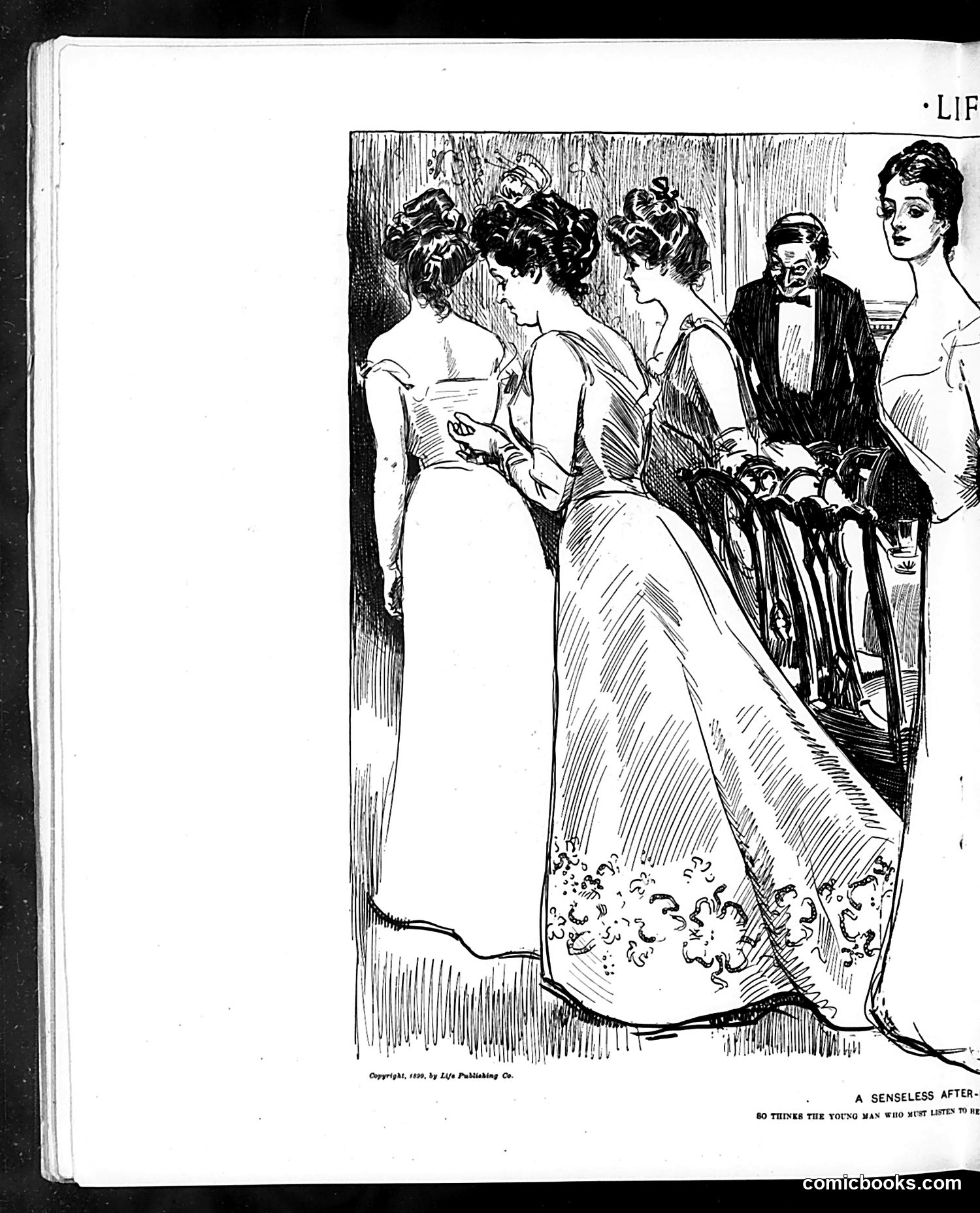
This is a social satire illustration titled "A Senseless After-" (the full caption is cut off). The drawing depicts an elegant evening social gathering, likely from the early 1900s based on the clothing and hairstyles. The scene shows well-dressed women in formal gowns and a man in evening dress at what appears to be a party or social event. The satire likely critiques the superficiality or tedium of high-society gatherings—the title "senseless" suggests the conversation or activities are vapid or meaningless. The illustration's style and Life magazine's satirical tradition indicate this mocks the pretensions of the upper class and their social rituals. However, without the complete caption text visible, the specific target of the satire remains partially unclear.
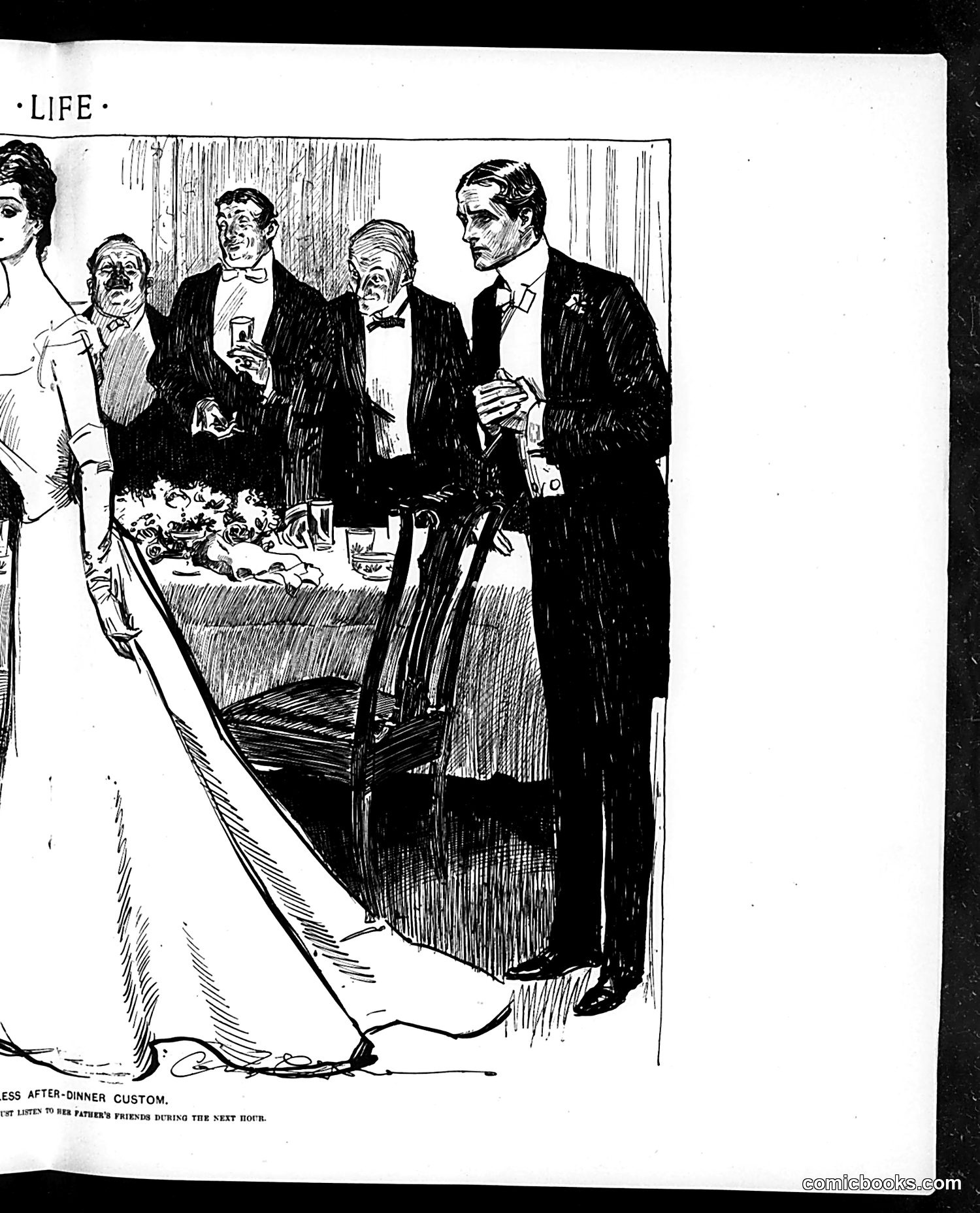
This satirical cartoon depicts a formal dinner scene where well-dressed men in tuxedos stand around a table with food and drinks. The caption references "listless after-dinner custom" and mentions "ladies listening to her father's friends during the next hour." The satire appears to target a Victorian-era social convention: after dinner, men would retire separately from women for drinks and conversation, leaving the ladies to entertain themselves elsewhere. The cartoon mocks this as "listless"—suggesting the enforced separation and tedious masculine socializing was dull and socially awkward. The men's expressions and body language convey boredom or disengagement, critiquing what Life magazine apparently viewed as an outdated, stilted social ritual that separated genders unnecessarily.
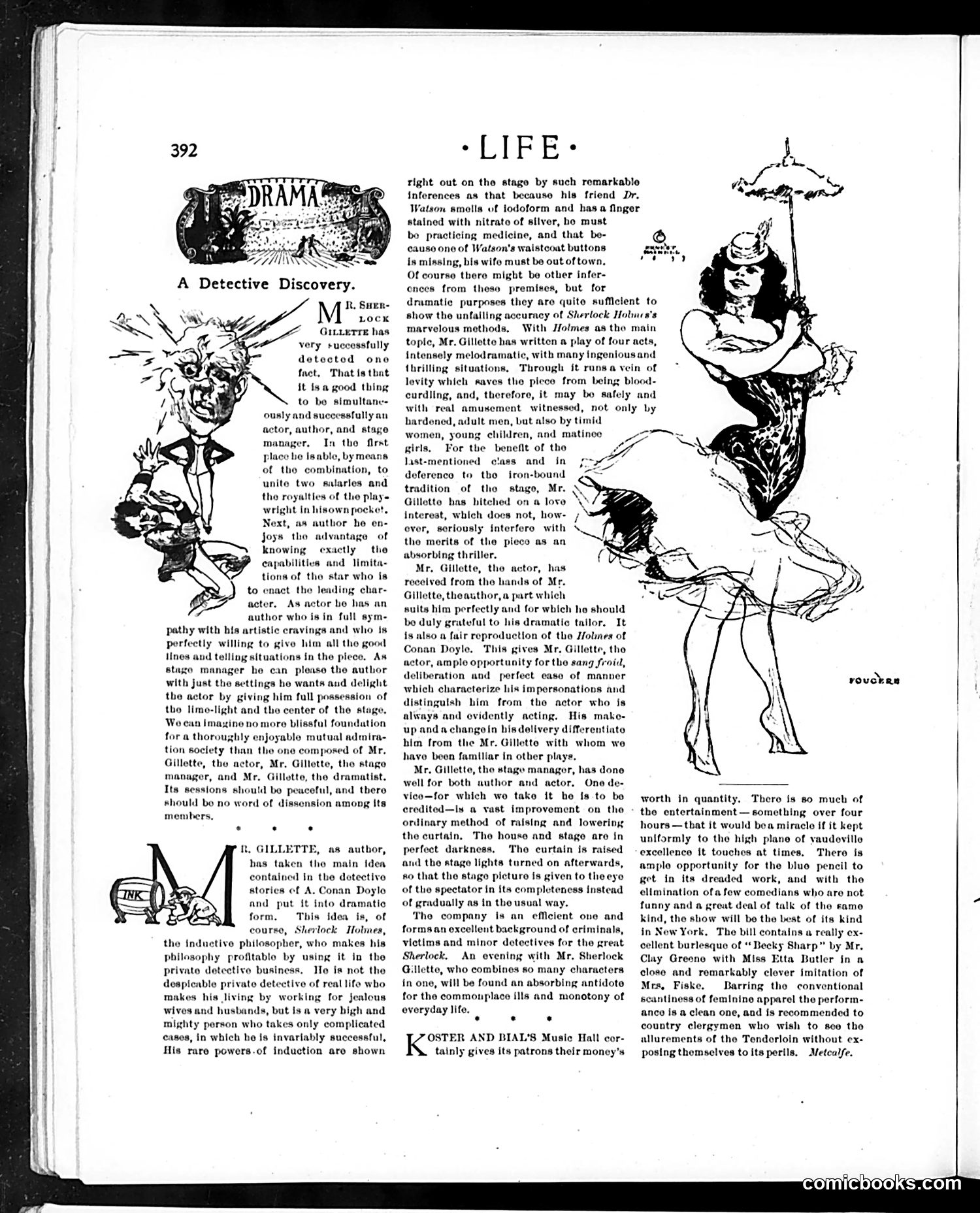
This page discusses a theatrical production—a four-act melodrama based on Arthur Conan Doyle's *Sherlock Holmes* stories, written by playwright William Gillette. The cartoon "A Detective Discovery" (left) depicts an exaggerated theatrical figure examining evidence, satirizing the detective genre's conventions. The text praises Gillette's dual role as both actor and adapter, noting he successfully captures Holmes's methods while making the play accessible to general audiences. The review distinguishes his performance from typical theatrical acting, emphasizing his naturalistic approach. The decorative illustrations on the right appear to be theatrical vignettes related to the production. Overall, this is theater criticism celebrating how Gillette brings a literary detective to the stage effectively.
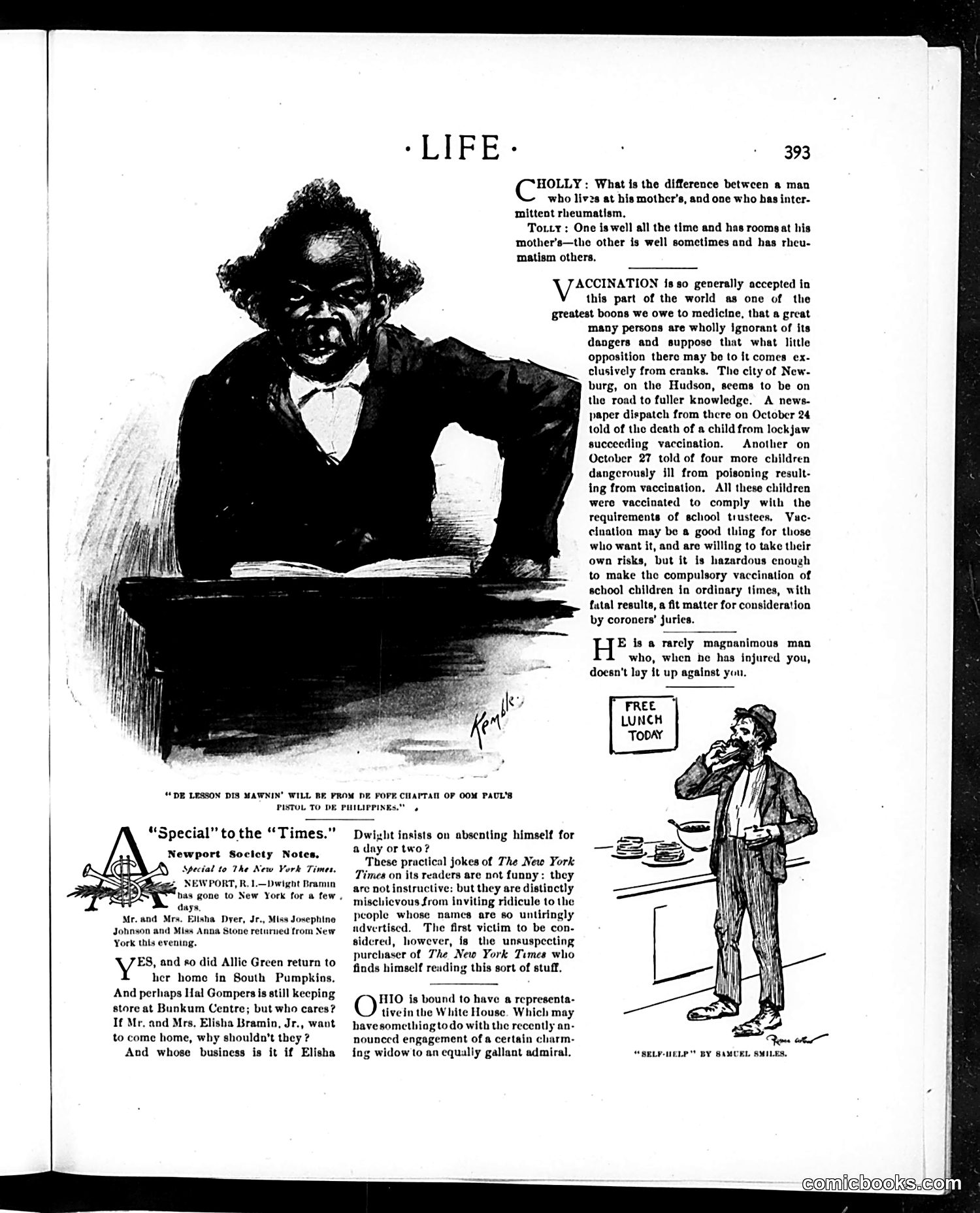
This page contains several distinct satirical pieces targeting contemporary issues circa early 1900s: **Main Cartoon (top left):** A caricatured figure hunched over a desk, likely representing a newspaper editor or society columnist, satirizing the vapid nature of "Newport Society Notes"—gossip about wealthy socialites' trivial movements. **Vaccination Critique:** A serious editorial piece mocking compulsory school vaccination after deaths and illnesses in Newburgh, New York. Life argues vaccination may be beneficial voluntarily but questions forcing it on children when fatal outcomes occurred. **Times Satire:** Ridicules *The New York Times* for running "practical jokes"—likely absurd or fabricated society announcements—that mock readers and the subjects named in them. **Small Cartoon (bottom right):** "Self-Help by Samuel Smiles" depicts a man with a sign advertising "FREE LUNCH TODAY," satirizing self-improvement rhetoric by showing a hungry person resorting to scavenging. The overall page reflects Life's role as social critic, attacking pretension, medical overreach, journalistic dishonesty, and economic hardship.
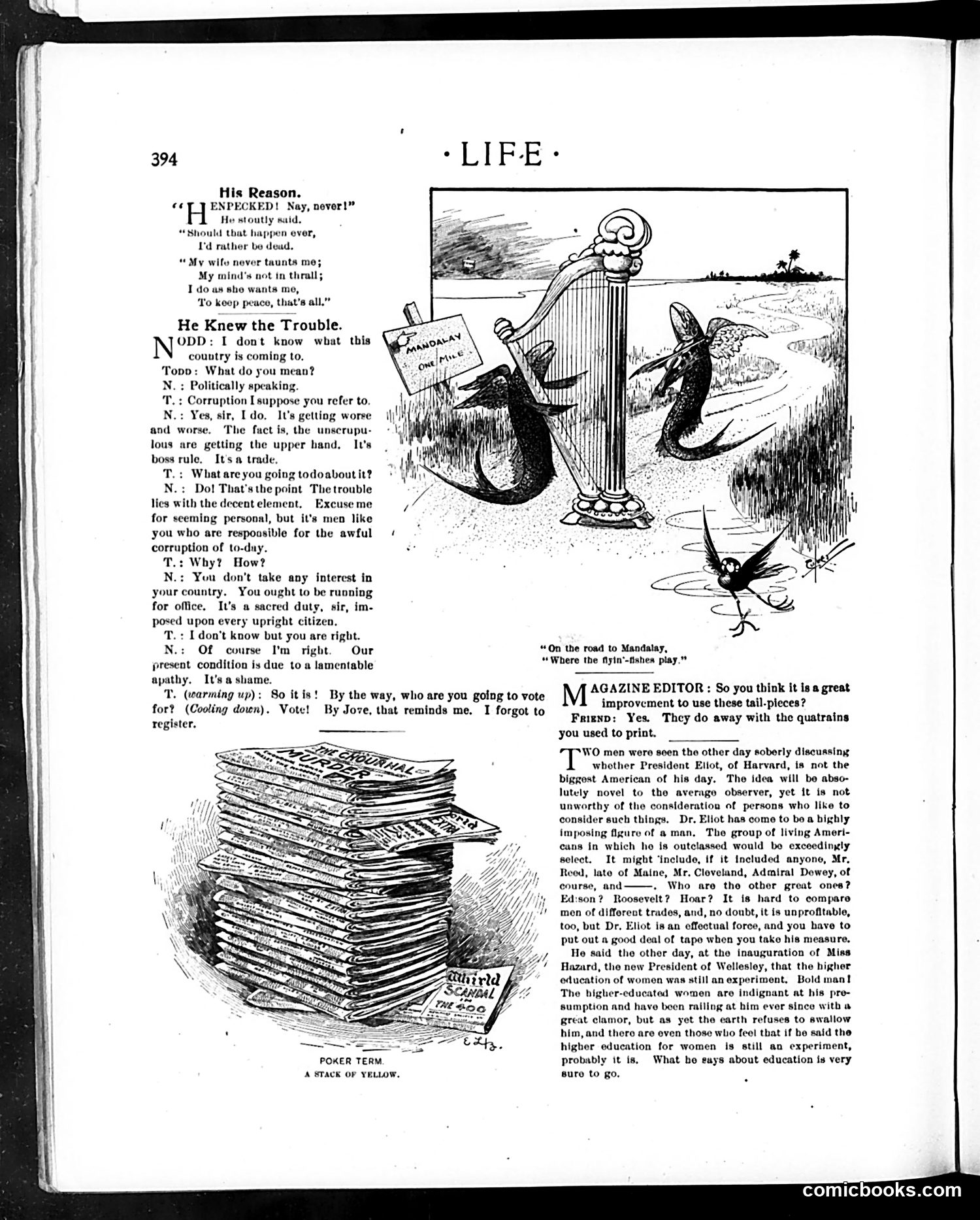
**The Cartoons:** The top cartoon satirizes henpecked husbands. A man insists he's never dominated by his wife while simultaneously admitting he does "as she wants me / To keep peace, that's all"—the contradiction being the joke. **"He Knew the Trouble"** depicts a political conversation where character "N" lectures "T" about civic corruption and apathy, shaming him into voting. The irony: N becomes so heated arguing that T must remind him—N himself hasn't registered to vote. It mocks sanctimonious political preaching from the uninvolved. **The Editorial Section** discusses President Charles Eliot of Harvard as "perhaps the greatest American," then reports outrage from women's education advocates after Eliot called women's higher education "still an experiment" at Wellesley's inauguration. The passage defends Eliot's statement as reasonable, suggesting educated women are being unreasonably indignant. **Context:** This reflects early-1900s tensions over women's education rights and the gap between male civic rhetoric and actual participation.
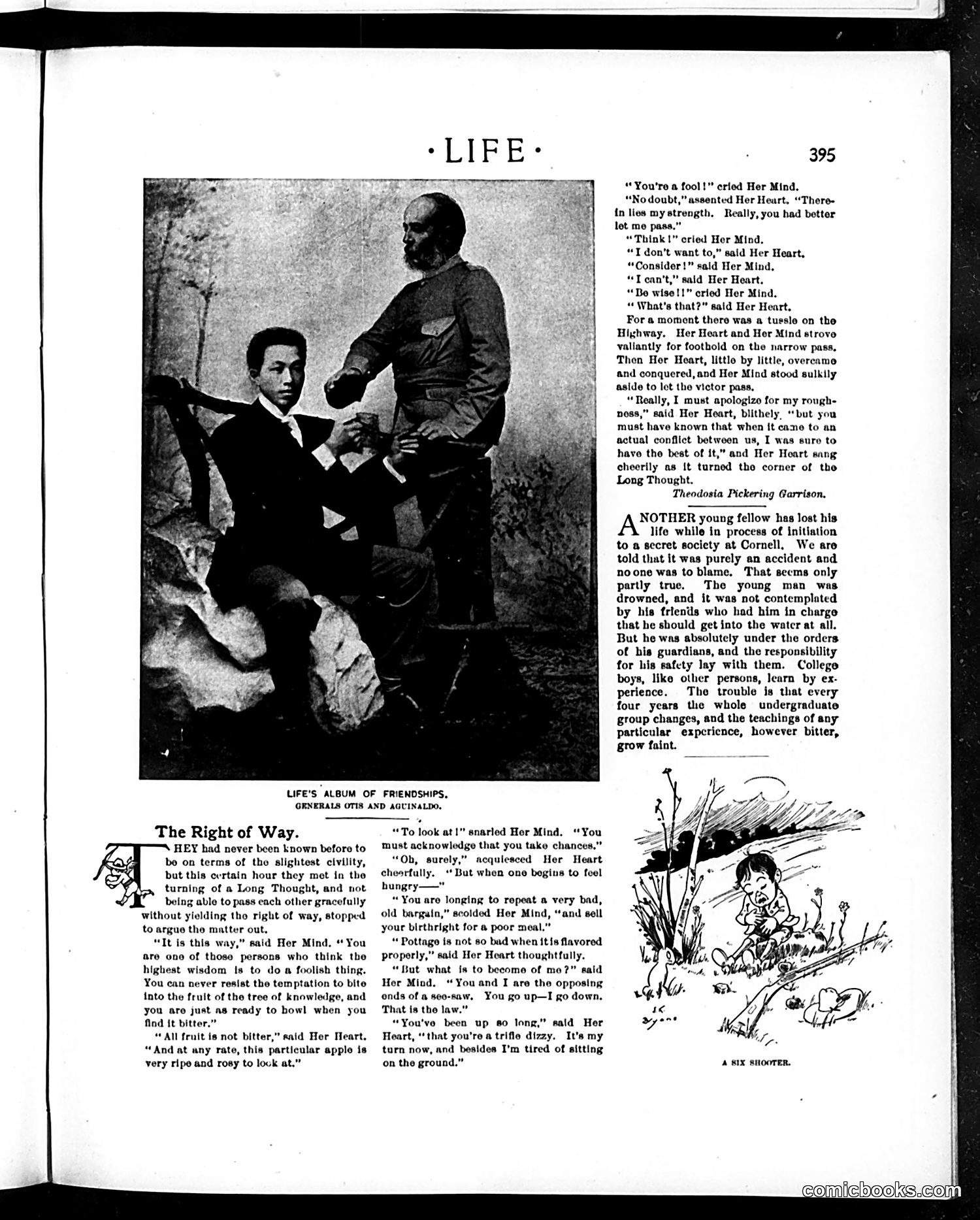
This page presents an allegorical debate between "Her Mind" and "Her Heart"—personified as opposing forces competing for right-of-way on a metaphorical highway. The satire depicts the eternal human struggle between reason (Mind) and emotion (Heart), with Heart ultimately prevailing through physical force rather than logic. The illustration shows two figures locked in conflict, with Mind warning against temptation and foolish choices, while Heart argues for living and experience. Heart's victory—achieved by overpowering Mind rather than persuasion—satirizes how human desires typically triumph over rational judgment, particularly regarding forbidden fruit, sensual pleasure, and impulsive decisions. The accompanying article shifts tone, criticizing Cornell University's secret society initiation practices following a student drowning, arguing that while accidents happen, institutional responsibility remains with adult guardians who perpetuate dangerous traditions without institutional memory or accountability.
This page primarily contains **humorous anecdotes and advertisements** rather than political cartoons. The main content includes: 1. **"Cycling Comedy"** (top): A tongue-twisting poem about a cycling accident involving characters named Corker and Clarissa—pure wordplay humor using alliteration. 2. **Several brief joke stories** mocking: - A judge's hunting prowess (exaggerated boasting) - A wealthy man's new wife presenting him a cheap "gold-filled" watch chain instead of solid gold, with her candid admission she assumes he won't live long enough to justify the expense - A Christian Scientist who pays a "horse doctor" instead, then sues over an imaginary check - An anecdote about Secretary of State James G. Blaine and a consulate applicant 3. **Advertisements** for Wilson Whiskey and Hunter Baltimore Rye whiskey The satire targets **vanity, marriage mercenary behavior, pseudoscience, and bureaucratic absurdity**—typical of Life's light satirical approach of this era.
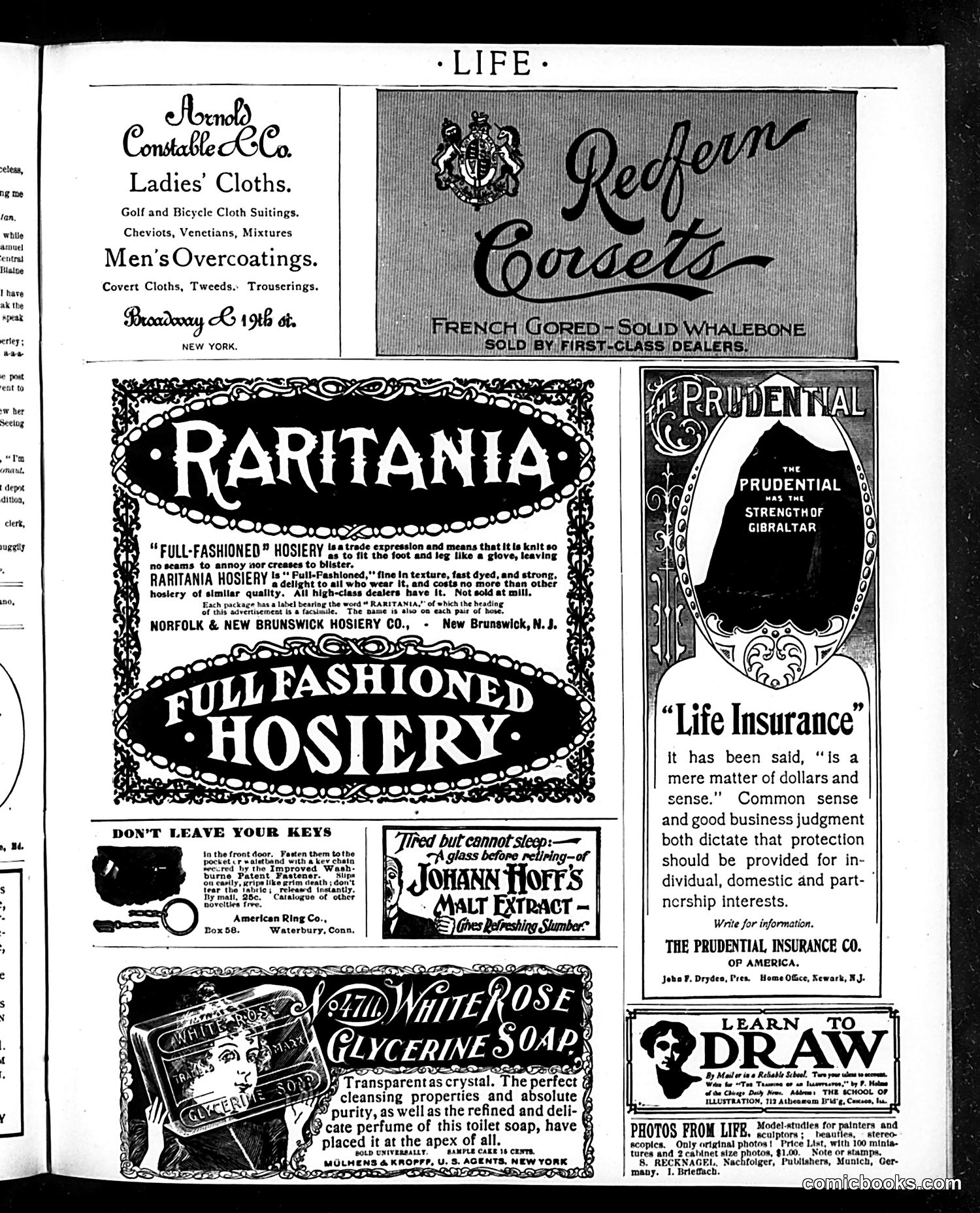
This is primarily an **advertising page** from Life magazine, containing no political cartoons or satire requiring historical context. The page features period product advertisements typical of early 20th-century American magazines: - **Clothing ads** (Arnold Constable & Co., Redfern Corsets) - **Hosiery** (Raritania "Full-Fashioned" Hosiery) - **Consumer goods** (Johann Hoff's Malt Extract, White Rose Glycerine Soap) - **Services** (Prudential Life Insurance, a drawing instruction school) Each ad emphasizes product quality and appeals to middle/upper-class consumers. The Prudential ad promotes life insurance as "common sense" protection for families—a relatively modern financial concept at the time. The only potentially satirical element is the "Don't Leave Your Keys" ad for American Ring Co., which appears to be a practical security device rather than social commentary. This represents the revenue model sustaining Life's publication rather than its editorial content.
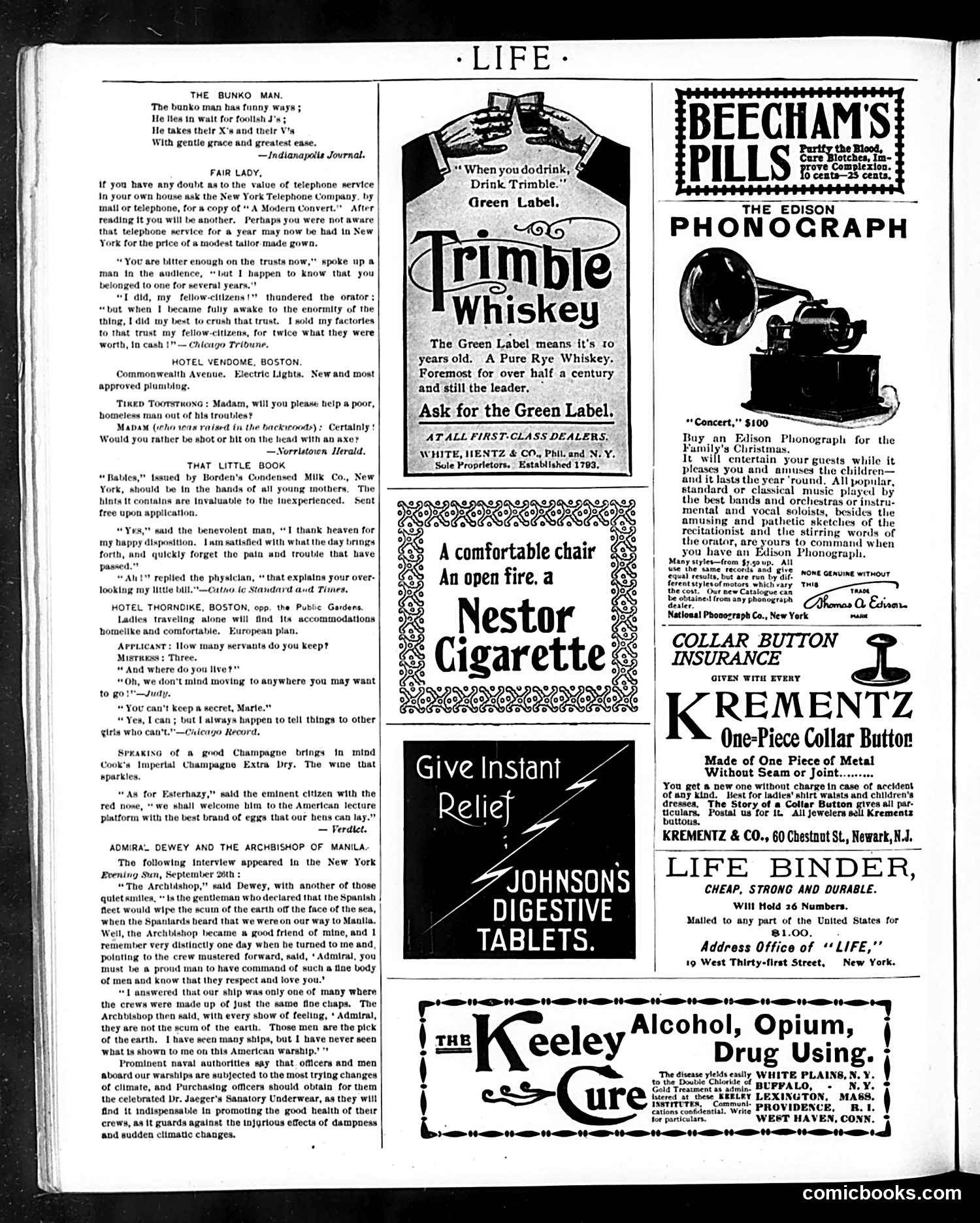
This page is primarily **advertisements interspersed with humorous anecdotes**, typical of Life magazine's format. The cartoons/jokes are brief social commentary rather than political satire: **Key Content:** - **"The Bunko Man"** poem: References con artists who swindle "foolish J's" (likely meaning foolish people generally) - **Trust/Monopoly humor**: A politician claims to have "crushed" trusts by selling his factories to them at inflated prices—satirizing corporate hypocrisy and the trust-busting debates of the early 1900s - **Admiral Dewey anecdote**: References the 1898 Spanish-American War and the Battle of Manila. The Archbishop initially called Spanish sailors "scum" but later praised American sailors—mocking religious/political flip-flopping based on which side was winning **Advertisements** include patent medicines (Johnson's Digestive Tablets, Keeley Cure for drug addiction), phonographs, and cigarettes—products no longer marketed this way. The satire targets common early-1900s targets: corporate corruption, religious hypocrisy, and business pretense.
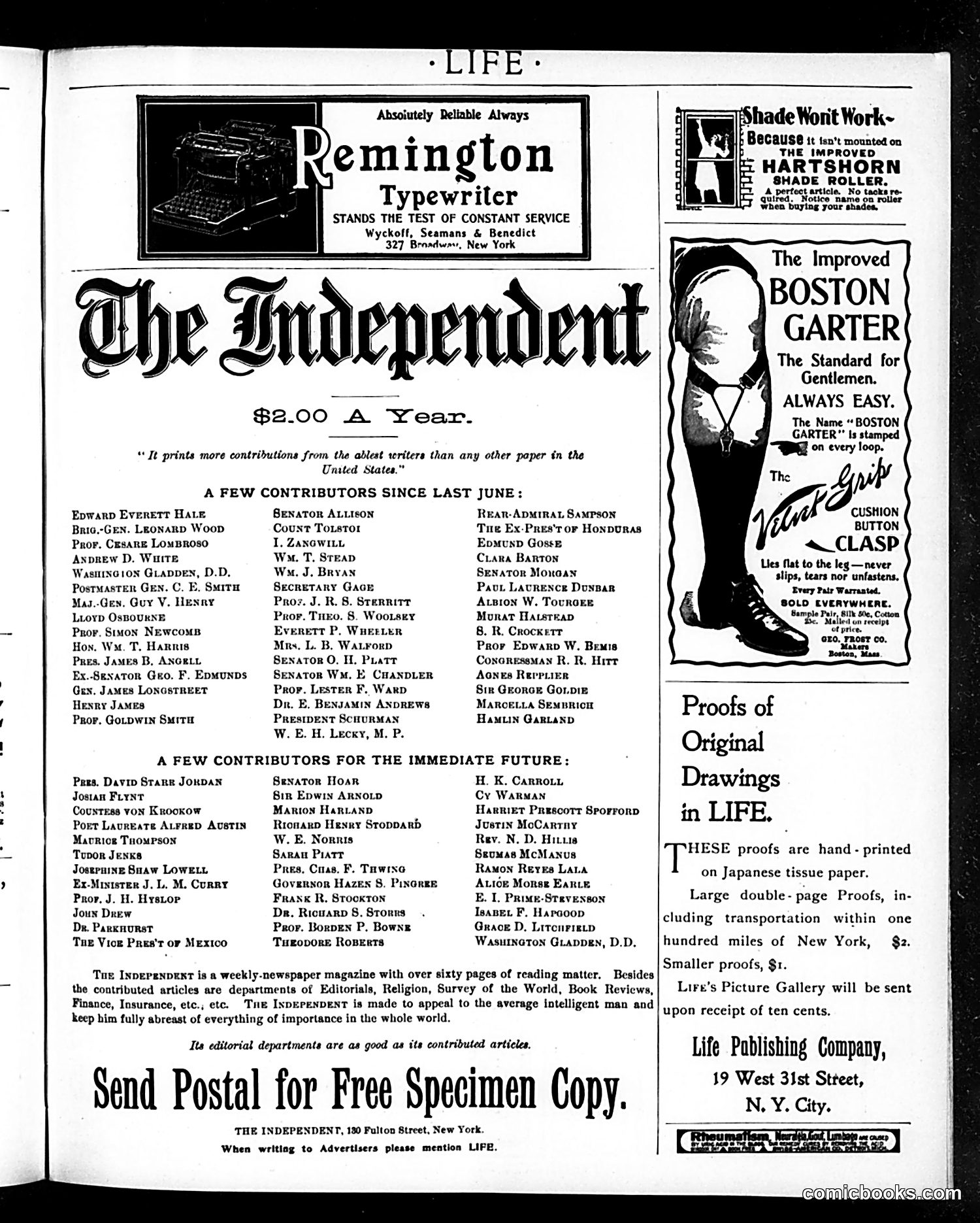
This page is primarily **advertising and promotional content** for *Life* magazine and various products, not political satire. The main feature is *The Independent* magazine's self-promotion, listing prominent contributors (Edward Everett Hale, Henry James, William Jennings Bryan, Clara Barton, Admiral Sampson—figures of late 19th-century American politics, literature, and military prominence) to establish the publication's prestige and appeal to educated readers. The subscription cost of $2/year targets the "average intelligent man." The page also advertises commercial products: a Remington typewriter, Boston Garters (suspenders), Hartshorn window shade rollers, and *Life's* own picture gallery offerings—hand-printed proofs on Japanese paper. There are **no political cartoons visible** on this page. This appears to be a typical magazine back-matter or promotional section rather than satirical editorial content.
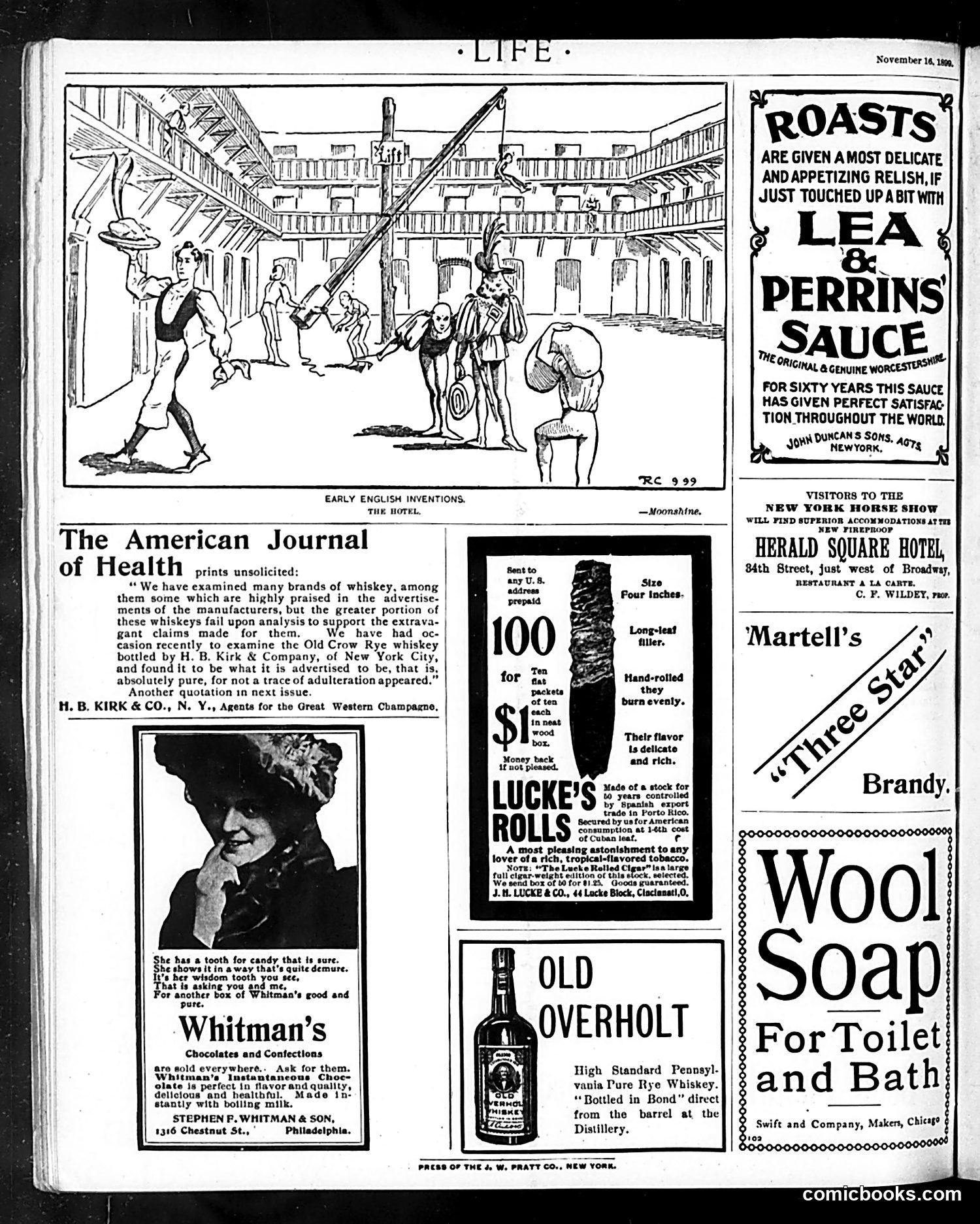
## Main Cartoon: "Early English Inventions: The Hotel" The cartoon depicts a chaotic medieval English courtyard scene labeled as an "invention" of the hotel. Figures in period dress engage in various activities—some appear to be jousting or practicing with weapons, others socializing. The satire suggests that early English "hotels" were disorganized, rowdy establishments far removed from the refined accommodations of 1899. This is gentle historical mockery: Life is humorously contrasting primitive medieval hospitality with contemporary standards, implying progress in civilization and comfort. ## Advertisements The page is primarily filled with period product ads (Lea & Perrins sauce, Whitman's chocolates, Old Overholt whiskey, Wool Soap) and notices for New York establishments—typical of Life's revenue model. The Whitman's ad features a woman's portrait with a pun about "wisdom teeth." The American Journal of Health excerpt endorses Old Crow Rye whiskey's purity, representing 19th-century medical/scientific credibility lending to marketing claims.