
Life, 1899-11-16 · page 6 of 20
Life — November 16, 1899 — page 6: what you’re looking at
What you’re looking at
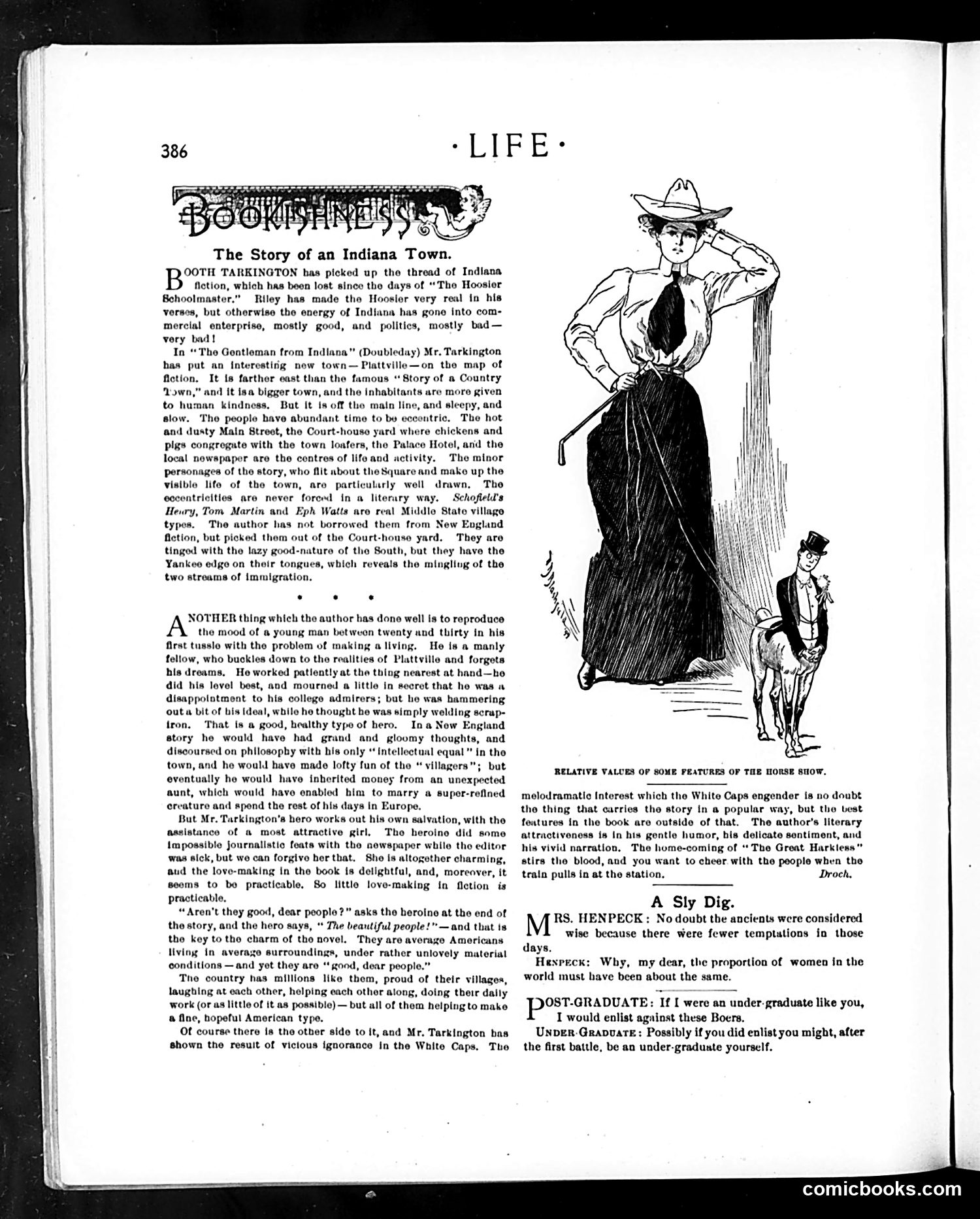
This page contains a short story titled "The Story of an Indiana Town" by Booth Tarkington, describing the fictional town of Plattville. The accompanying illustration shows a tall woman in a wide-brimmed hat alongside a smaller man in formal attire. The cartoon illustrates a scene from Tarkington's narrative about small-town life in Indiana. The exaggerated height difference between the figures appears comedic, likely reflecting tensions or social dynamics described in the story. Below is a brief dialogue section titled "A Sly Dig," featuring characters Mrs. Henpeck and Henpeck debating women's education and military service—social issues of the early 20th century. The humor derives from marital conflict and contemporary debates about gender roles and women's rights.
📄 Transcribed text from this page (OCR, searchable)
Machine-transcribed from the original scan — historical spelling and the odd misread are preserved.
The Story of an Indiana Town. OOTH TARKINGTON bas picked up the thread of Indiana fiction, which has been lost since the days of “Tho Hoosier Behoolmaste: Riley has made the Hoosier very real in his verses, but otherwise the energy of Indiana has gone into com- mercial enterprise, mostly good, and politics, mostly bad— very bad! In “Tho Gentleman from Indiana” (Doubleday) Mr. Tarkington has put an interestiig now town— Plattville—on the map of fiction, It is farther east than the famous “Story of a Country Lown,” and it isa bigger town, and the inhabitants are more given to human kindness, But It {8 off the main line, and sleepy, and slow. Tho people have abundant time to by eccentric. The hot and dusty Main Street, the Court-houso yard where chickens and pigs congrogute with the town loafers, the Palace Hotel, and the local newspaper are the centres of life and activity. The minor personages of tho story, who flit about the Square and make up the visible life of the town, are particularly well drawn, Tho eccentricities are never forced in a literary way. Schofleld's Heury, Tom Martin and Eph Watts aro real Middle State village types. The author has not borrowed them from New England fiction, but picked them out of the Court-houso yard. They aro tingod with the lazy good-naturo of the South, but they have the Yankeo edge on their tongues, which reveals the mingling of the two streams of Immigration, . . . DA’ is wasn ceyeaa the author has dono well is to reproduce the mood of @ young man betweon twenty and thirty in his first tusslo with the problom of making a living. He is a manly fellow, who buckles down to tho realities of Plattville and forgets his dreams. Hoe worked patiently at the thing nearest at hand—ho did his level best, and mourned a little in secret that he was a disappolntmont to his college admirers; but he was hammering outa bit of bis Ideal, while he thought be was simply welding scrap- fron, That is a good, healthy typo of hero. In a Now England story he would have had grand and gloomy thoughts, and discoursed on philosophy with his only “intellectual equal” in the town, and he would have made lofty fun of the “ villagers"; but eventually ho would havo inherited money from an unexpected aunt, which would havo enabled him to marry a super-refined creature and spond the rest of his days in Europe. But Mr. Tarkington's hero works out his own salvation, with tho assistance of a most attractive girl, Tho heroino did some Impossible journalistic feats with tho nowspaper while tho editor was sick, but wo can forgive her that, Sho Is altogether charming, aud the love-making In the book is delightful, and, moreover, it seems to be practicable, So little love-making in fiction is practicable, “Aren't they good, dear people?” asks the heroino at the end of tho story, and the hero says, ** The beautiful people!” —and that ts the key to the charm of tho novel. They aro average Americans living in averazo surroundings, under rather unlovely material conditions —and yet they are “good, dear people.” The country has millions like thom, proud of their villages, laughing at each other, helping each other along, doing their dally work (or as little of it as possible) — but all of them helpingto make @ fine, hopeful American type. Of course there is the otber side to it, and Mr. Tarkington bas shown the result of vicious ignorance in the White Caps. Tho RELATIVE VALUES OF SOME PEATURES OF THE HORSE BOW. molodramatlo Interest which the White Caps engender is no doubt tho thing that carries tho story in a popular way, but tho best features in the book are outside of that. The author's literary attractivenoss is In his gontle humor, bis delicate sontiment, and his vivid narration, The home-coming of “The Great Harkless” stirs tho blood, and you want to cheer with the people when tho train pulls in at tho station. Droch, A Sly Dig. RS. HENPECK: No doubt the ancients were considered wise because there were fewer temptations in those days. Hexpreck: Why, my dear, the proportion of women in the world must Lave been about the same. OST-GRADUATE: If I were an under-graduate like you, I would enlist against these Boers. Unver-Grapvate: Possibly if you did enlist you might, after the first battle, be an under-graduate yourself. comicbooks.com