
A complete issue · 20 pages · 1899
Life — September 21, 1899
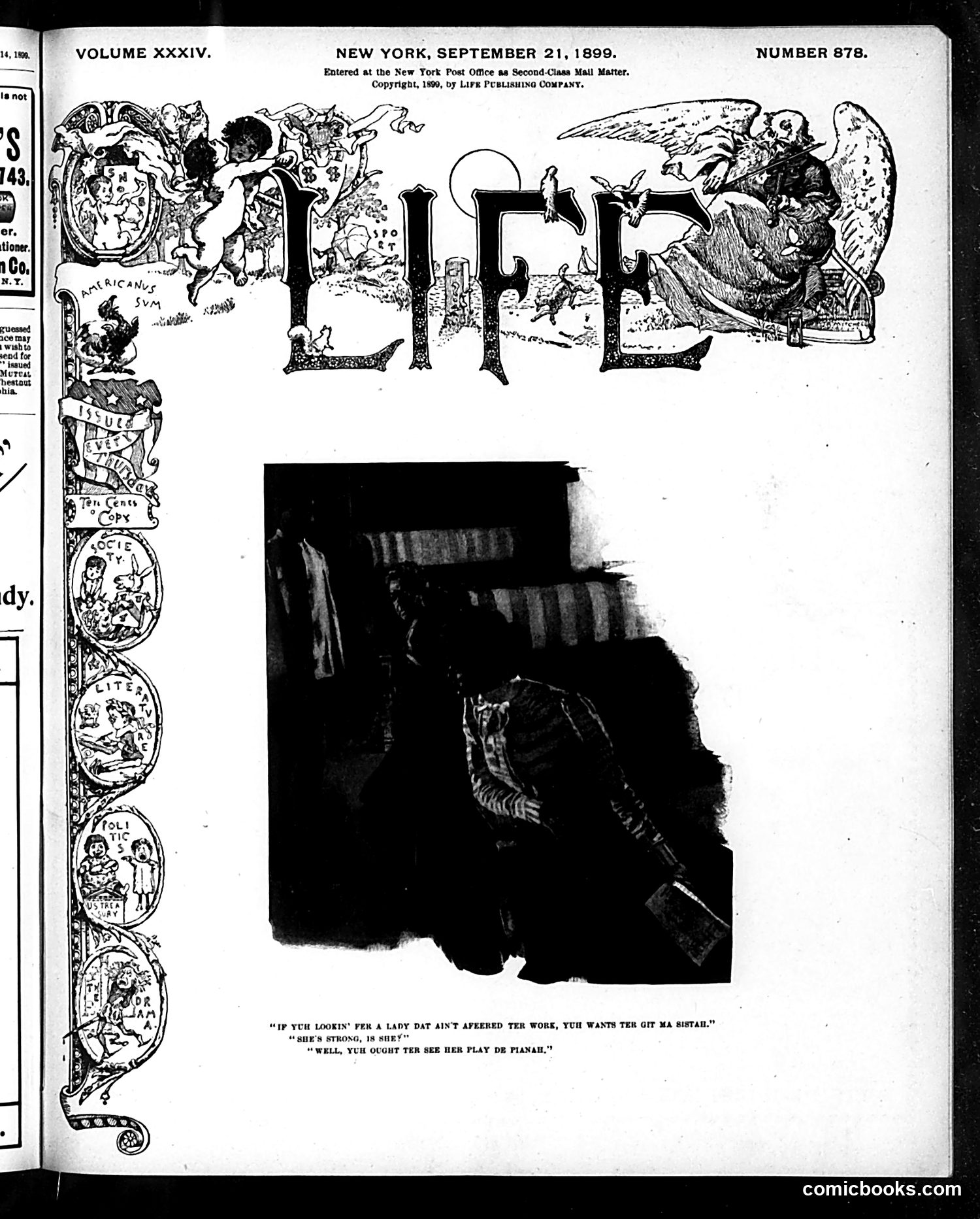
This page features an ornate decorative header reading "LIFE" with allegorical figures. Below is a photograph (poorly reproduced) showing what appears to be an interior domestic scene with two figures. The caption quotes appear to reference gender and social dynamics: "If yer lookin' fer a lady dat ain't offered ter work, yuh wants ter gift ma sister," "She's strong, is she?", and "Well, yuh ought ter see her play in Pinafore." The references suggest satire about women's labor, employment prospects, and entertainment (likely *HMS Pinafore*, the Gilbert & Sullivan operetta popular in America). The dialect and tone indicate working-class perspective on female employment and theatrical performance—typical 1890s commentary on women's changing economic and social roles during this period of American industrialization. The ornamental border contains zodiac-style medallions, common decorative elements for this magazine.
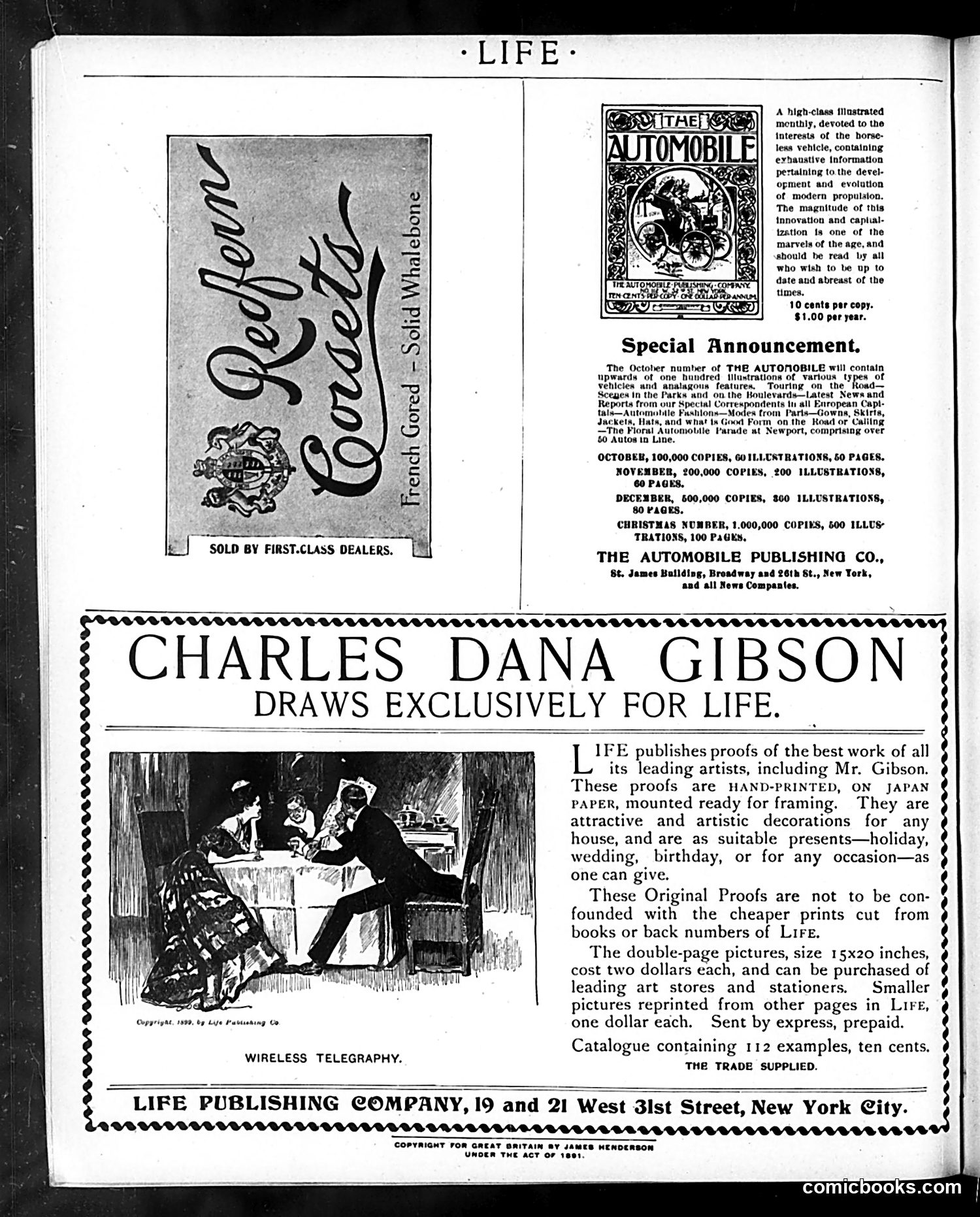
This page is primarily **advertising** rather than editorial content. It contains three advertisements: 1. **Goodrich Tires** - A French-made automobile tire ad 2. **The Automobile Magazine** - Promoting a high-class monthly publication about vehicle development and propulsion technology, aimed at readers who want to stay current on automotive advances 3. **Charles Dana Gibson artwork** - Life Publishing Company advertising exclusive hand-printed proofs of drawings by prominent artist Gibson. The accompanying illustration (captioned "Wireless Telegraphy") shows figures at a dinner table, likely satirizing modern communication technology The Gibson ad emphasizes these are original artistic proofs on Japanese paper, suitable as gifts, and distinct from cheaper mass-produced prints—appealing to wealthy collectors and art enthusiasts. The page reflects early 1900s interests: automobiles as emerging technology and fine art collecting.
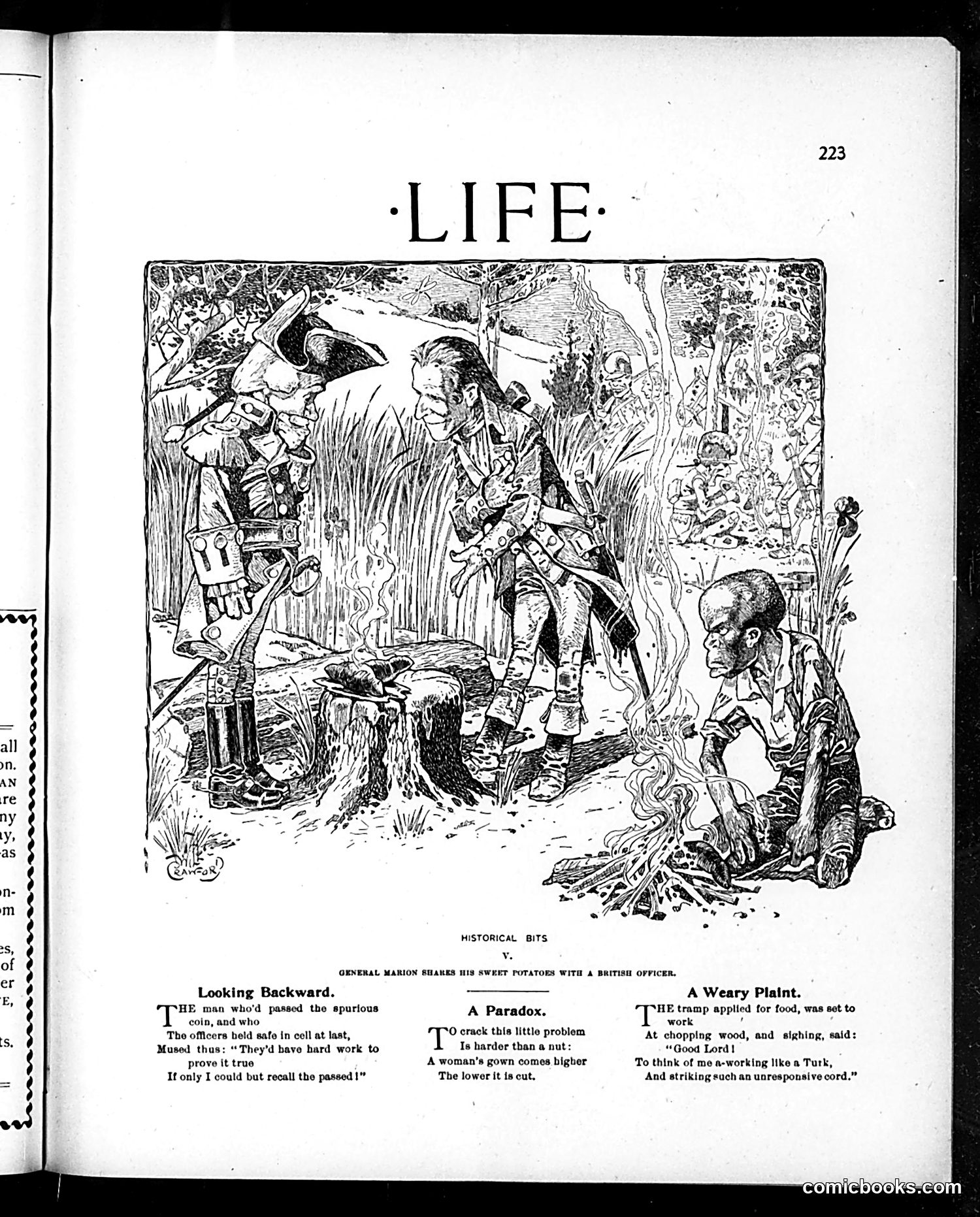
This page features "Historical Bits," a satirical section mocking General Marion (likely Francis Marion, the "Swamp Fox" of the American Revolution) sharing sweet potatoes with a British officer during the Revolutionary War. The three accompanying verses mock paradoxes and hardships of war: - "Looking Backward" suggests soldiers endured brutal conditions for dubious outcomes - "A Paradox" jokes that women's social status inversely relates to their actual freedom - "A Weary Plaint" depicts a tramp cynically comparing manual labor to Turkish servitude The cartoon satirizes the absurdity of enemies sharing meals during conflict, while the verses use dark humor to critique class hierarchies, gender constraints, and labor exploitation—common *Life* magazine themes addressing American social inequalities of the Gilded Age.
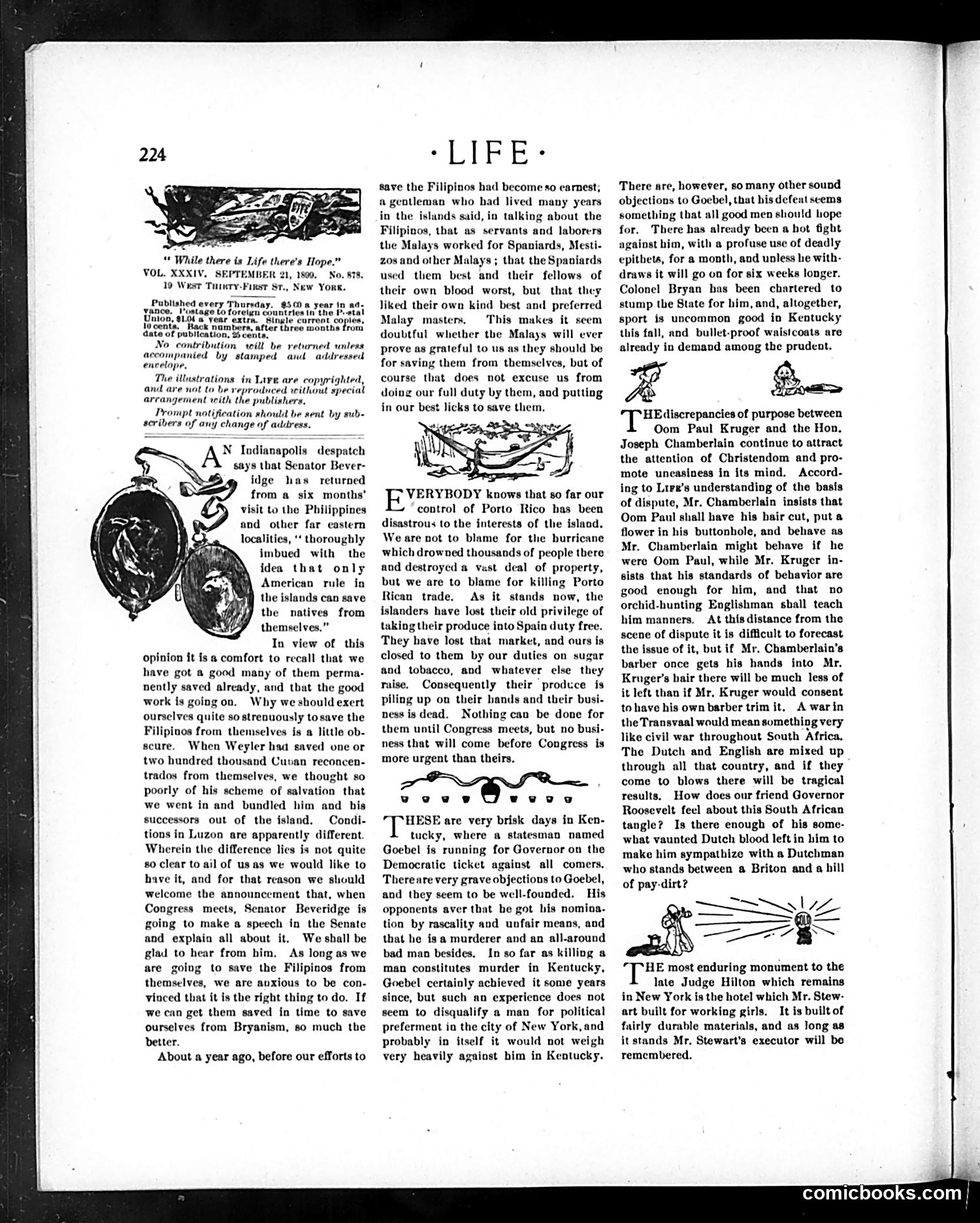
This page discusses American political and colonial issues of the early 1900s. The text references Governor Goebel of Kentucky, who appears to be running for office amid controversy—there are "very brisk days in Kentucky" and "very grave objections to Goebel." The passage mentions accusations of murder and suggests Goebel's political opponents question his fitness for office. The page also discusses American colonial policy in Puerto Rico and the Philippines, debating whether U.S. control benefits these territories. It critiques American rule while defending it as preferable to alternatives. The small illustrations appear to be decorative vignettes rather than political cartoons. Without clearer image resolution, specific satirical targets beyond Goebel remain unclear.
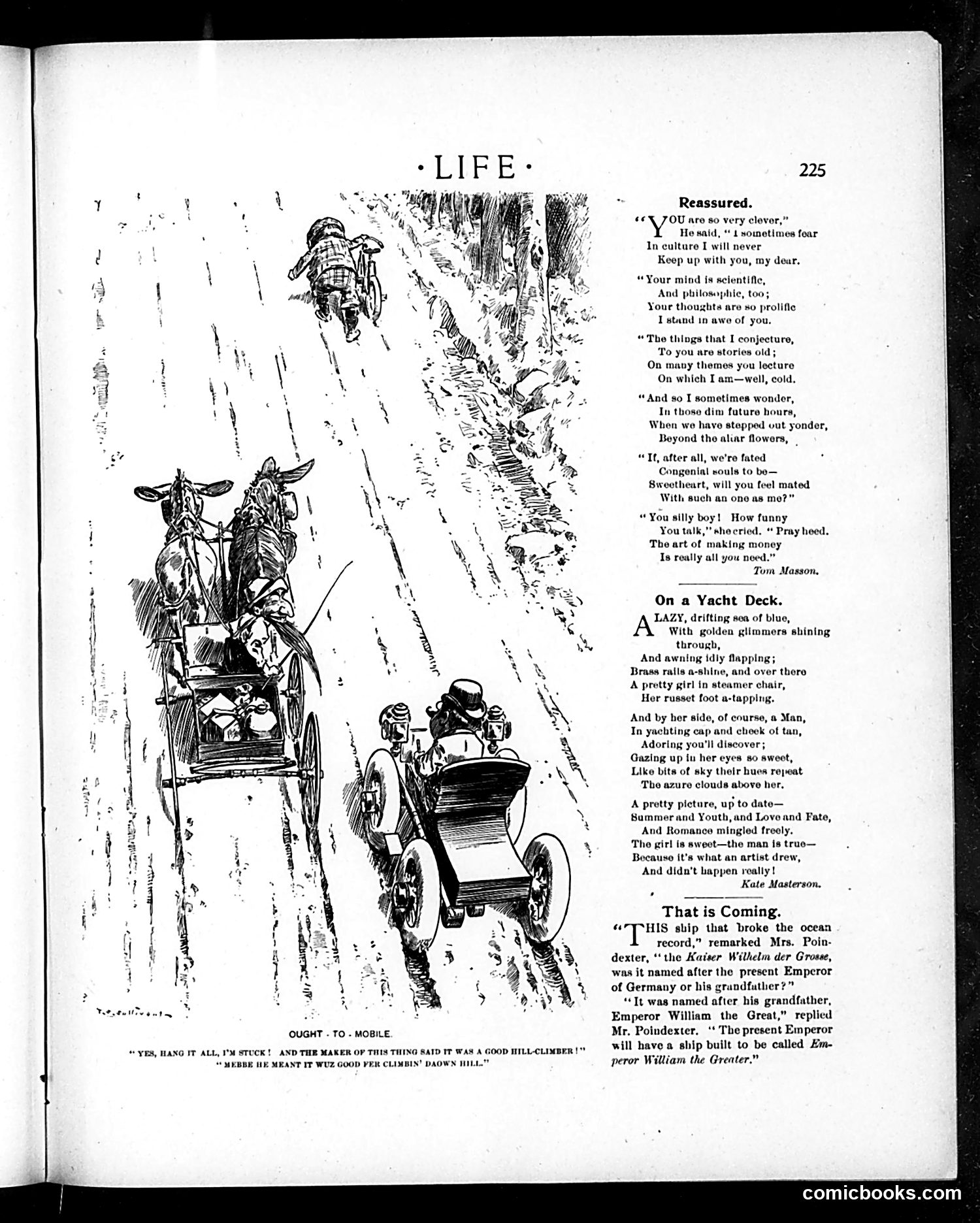
The main cartoon depicts two vehicles on a steep hill: a horse-drawn carriage (top) and an automobile (bottom). The caption reads "OUGHT-TO-MOBILE" with dialogue about the steep climb being difficult for vehicles. This is early automotive satire, likely from the early 1900s when cars were novelties. The joke contrasts traditional horse transportation with the new automobile technology, suggesting both struggle with hill-climbing. The automobile's superiority remains unproven—a common satirical theme when cars were unreliable and horses dominated transportation. The surrounding poems and "On a Yacht Deck" verse are unrelated literary content typical of *Life* magazine's format. The "That is Coming" section discusses a German ship naming, referencing Emperor William the Great, but lacks clear political context without additional historical information.
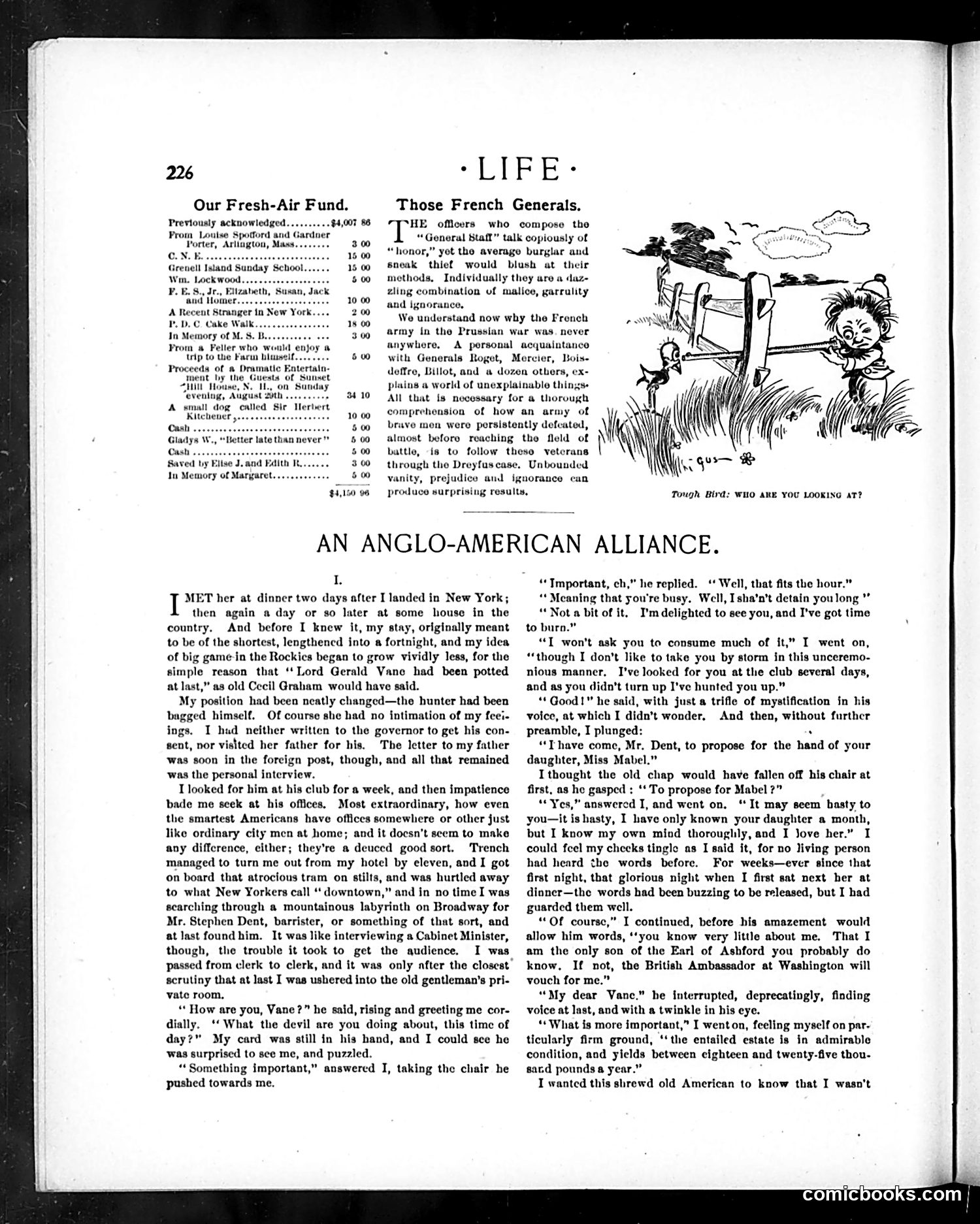
The page contains two distinct sections: **Left column:** A fundraising list titled "Our Fresh-Air Fund," itemizing donations for what appears to be a charitable program providing outdoor recreation access, likely for urban children. **Main content:** "An Anglo-American Alliance," a satirical short story about a social encounter between an American narrator and a British gentleman named Mr. Stephen Dent. **The cartoon:** A simple illustration labeled "Tough Bird: Who Are You Looking At?" depicts a bird perched on a fence post, apparently confrontational in demeanor—likely a humorous commentary on American bluntness or directness, reflecting the story's theme of cross-cultural misunderstanding between Americans and British people. The satire appears to explore social and cultural differences between the two nations through their gentlemen's interactions.
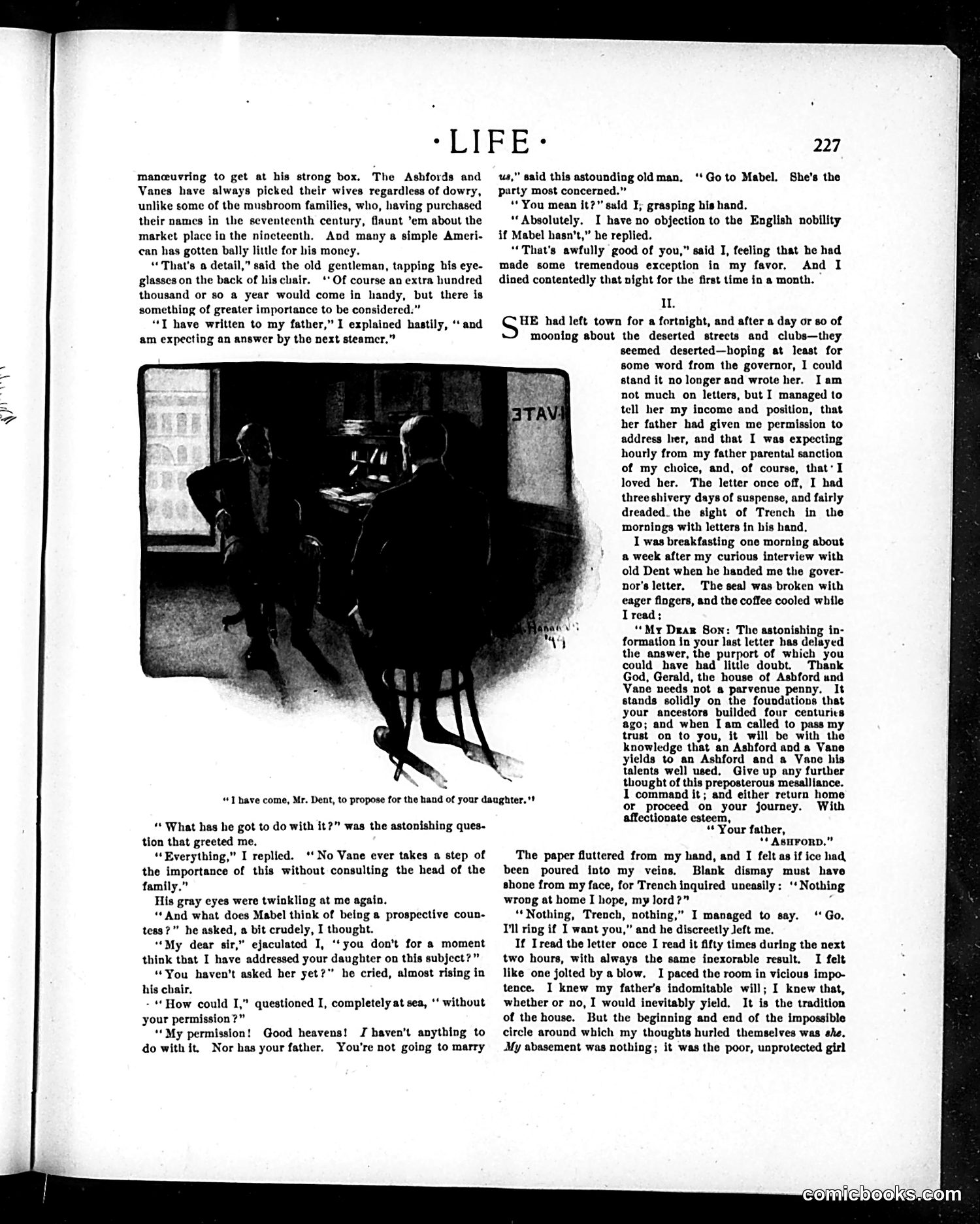
This page contains a serialized story rather than political satire. The illustration shows a dramatic nighttime scene of what appears to be a marriage proposal or family confrontation, with figures seated indoors. The surrounding text is narrative fiction, featuring a character named Gerald receiving a letter from his father regarding marriage to a woman named Mabel. The story involves family objections and concerns about social standing—specifically references to "the English nobility" and the "Ashford and Vane" families needing to maintain their financial foundations. This appears to be serialized entertainment literature typical of Life magazine's content during this era, focusing on domestic drama and class tensions rather than political commentary or satire.
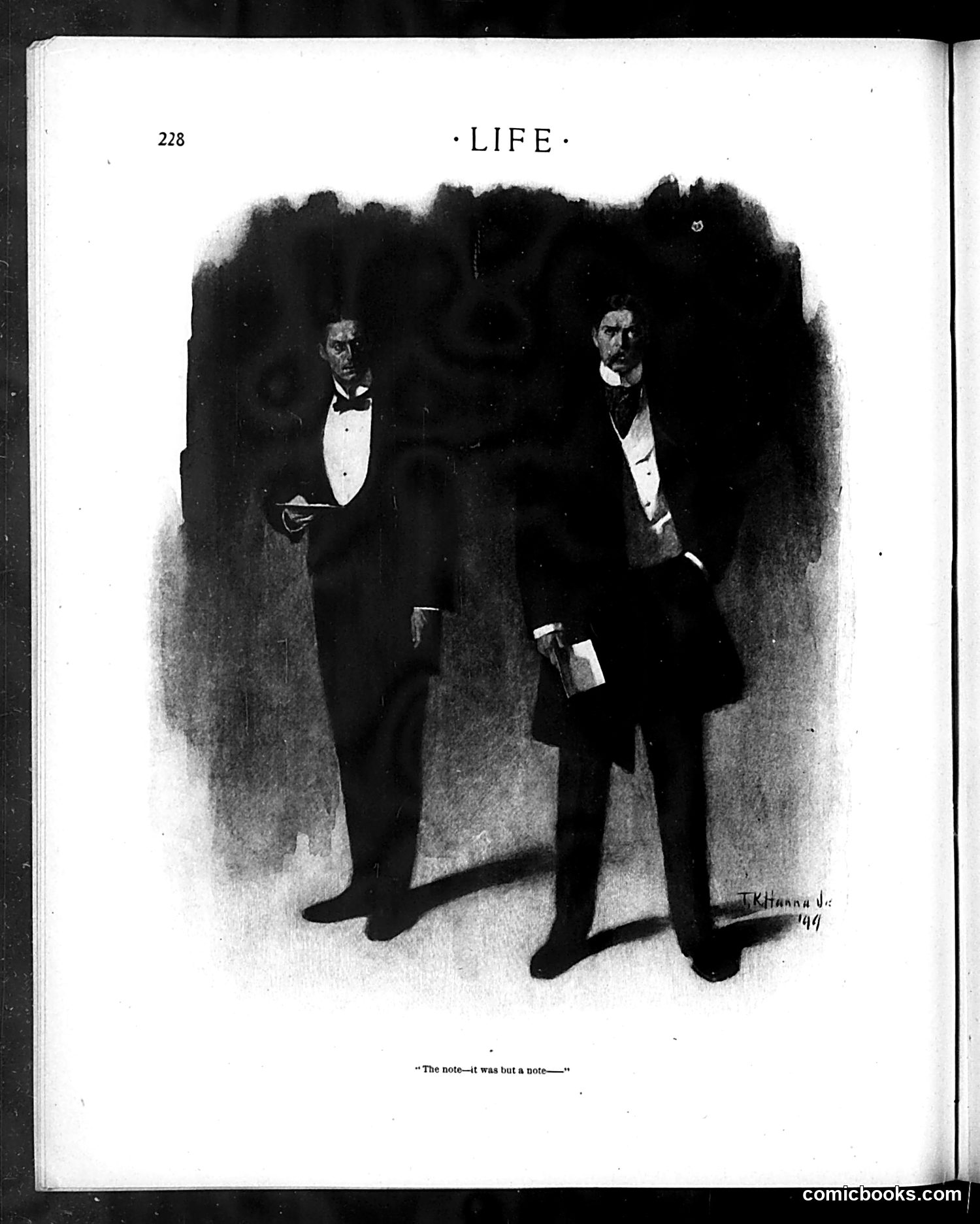
This appears to be a satirical illustration from Life magazine (page 228) showing two men in formal evening wear. The caption reads: "The note—it was but a note——" The cartoon depicts what appears to be a confrontation or tense exchange between two well-dressed gentlemen. The quotation suggests one man has received a brief written message from the other, likely related to some social or political matter that has provoked this formal meeting. Without additional context about the specific historical period or identifiable figures, the exact subjects and satirical target remain unclear. The formal attire and dramatic staging suggest commentary on upper-class social conventions or possibly a duel scenario common in early 20th-century satirical humor. The artist's signature is visible but partially illegible.
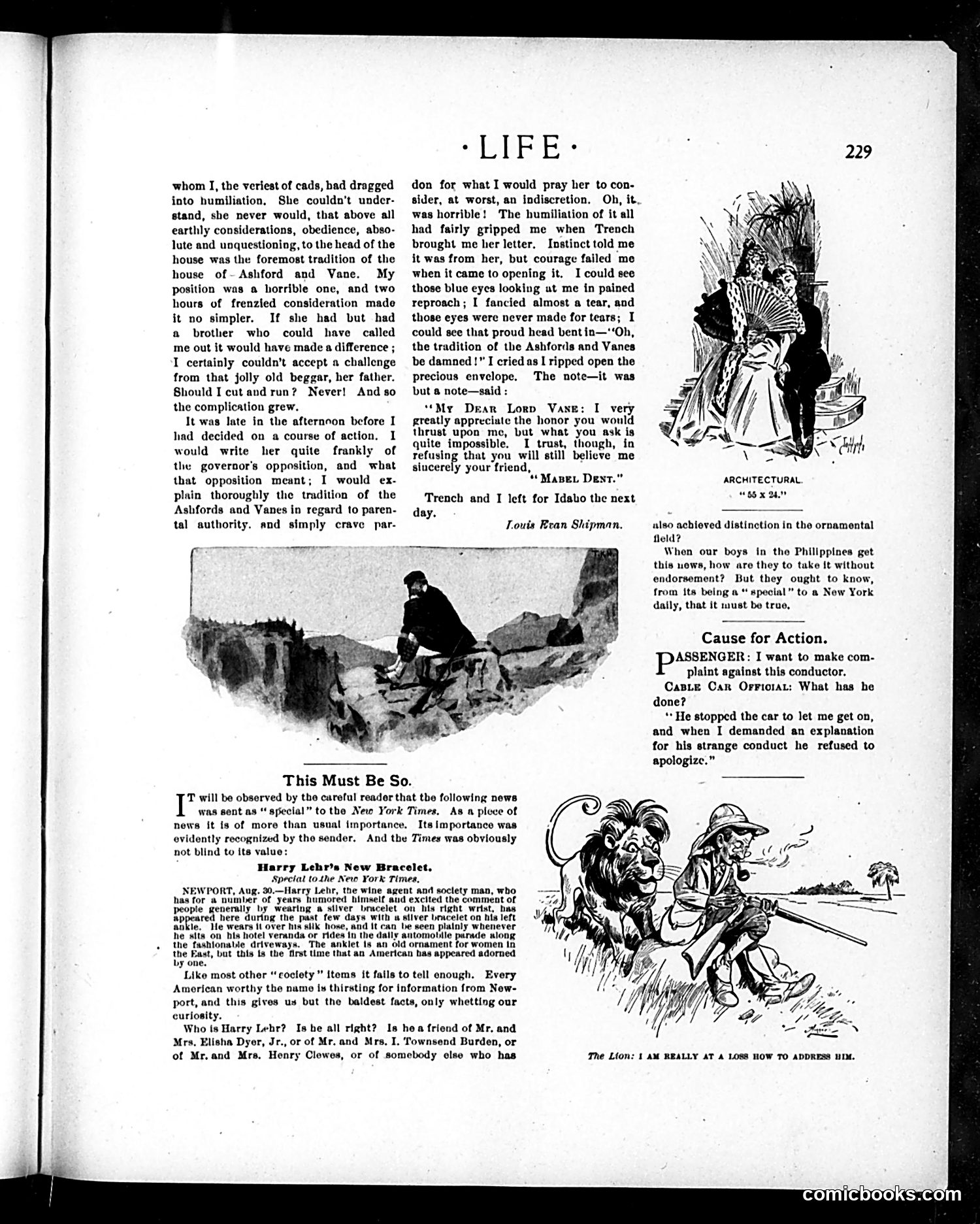
This page contains two distinct sections: **Upper section:** A letter from "Mabel Dent" to "Lord Vane" regarding a social slight or indiscretion, accompanied by an illustration of a woman in Victorian dress looking distressed. **Lower section ("This Must Be So"):** A satirical piece about a well-dressed Newport society man who adorns himself with accessories (alligator-headed cane, etc.) in fashionable affectation. The accompanying cartoon depicts a lion, captioned "I am really at a loss how to address him"—mocking how excessive ornamentation makes someone unrecognizable or ridiculous. The satire targets Gilded Age social pretension and fashion excess among the wealthy elite. The lion's confusion suggests the overdressed figure has become so artificially adorned as to lose his basic human identity.
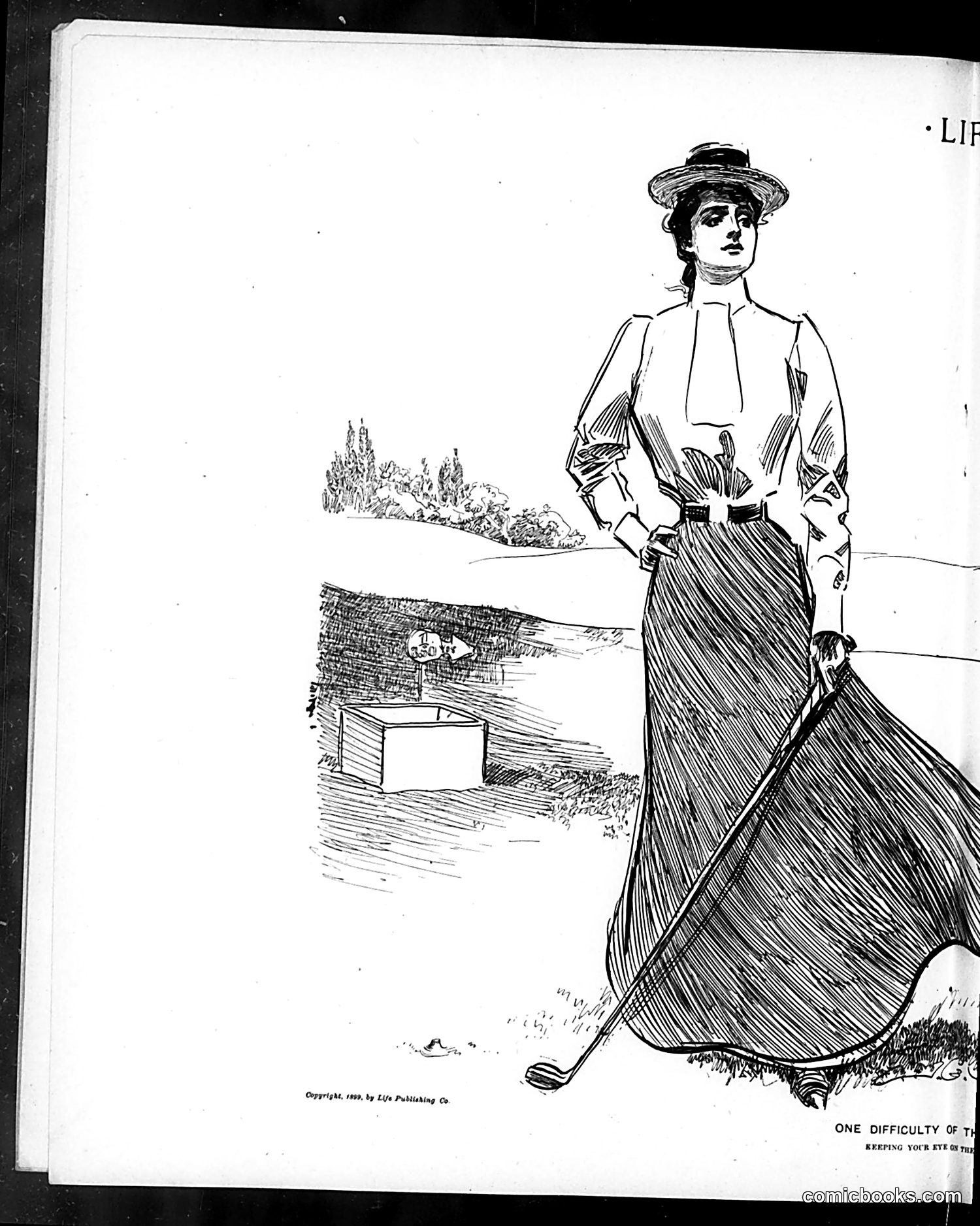
This appears to be a satirical illustration from *Life* magazine (copyright 1903, per visible text). The image shows a fashionably dressed woman in early 1900s attire—puffy sleeves, a fitted bodice, and a long skirt—posed against a rural farm background with a small building. The partially visible caption reads "ONE DIFFICULTY OF..." with text below mentioning "KEEPING YOUR EYE ON TH[E]..." (cut off). The satire likely comments on the contrast between urban fashion-consciousness and rural/agricultural life, or possibly critiques the impracticality of fashionable women's clothing for actual work or outdoor settings. The woman's elegant pose against the modest farmstead suggests tension between gentility and rustic reality—a common theme in early 1900s American satirical humor about class and social pretension.
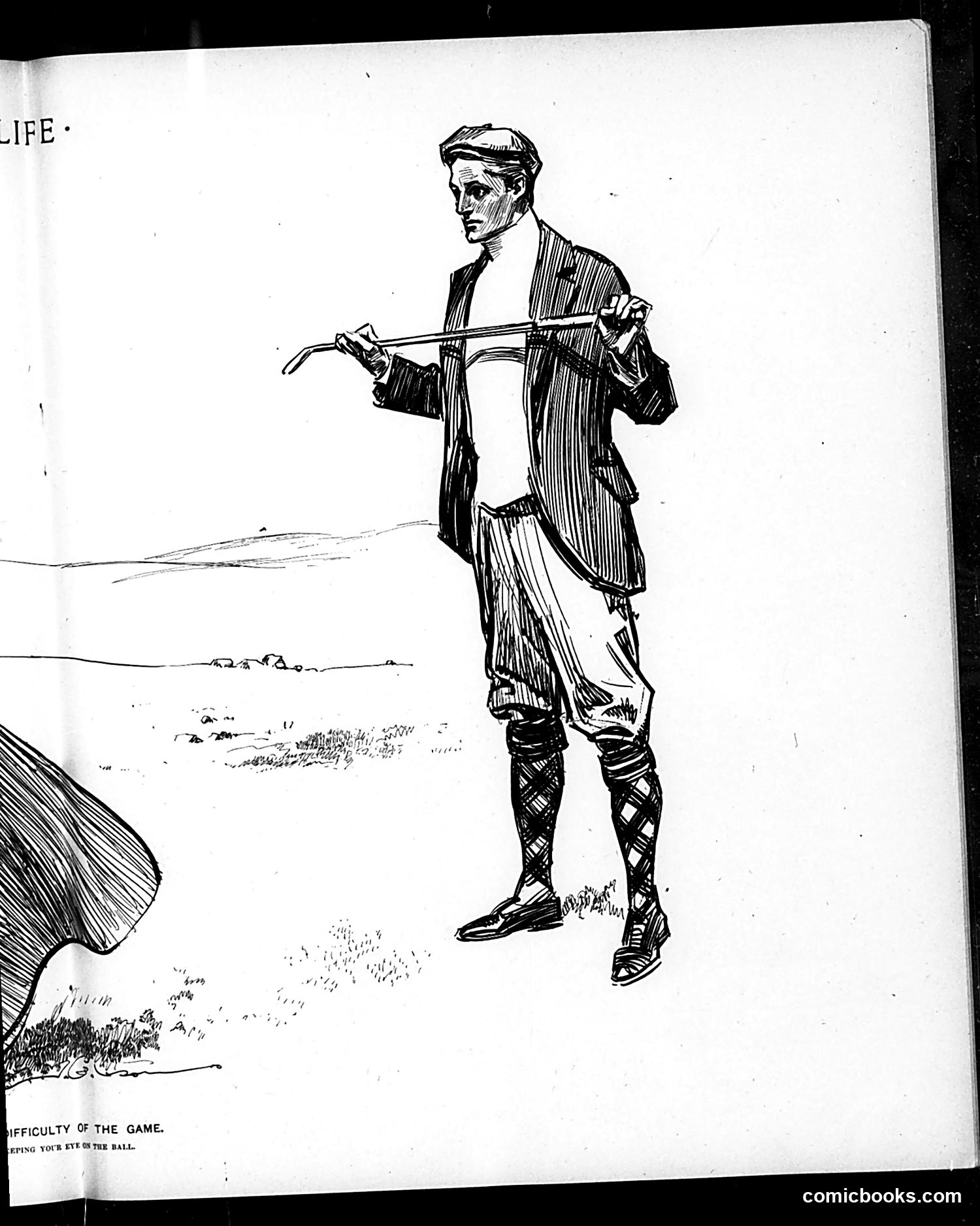
This appears to be a satirical illustration from *Life* magazine showing a golfer in early 20th-century attire (jacket, knickers, and patterned socks) mid-swing. The visible text references "DIFFICULTY OF THE GAME" and mentions "KEEPING YOUR EYE ON THE BALL." The cartoon satirizes golf—likely mocking either the sport's difficulty for amateurs or the pretensions of golf players. The man's focused, somewhat strained expression and formal dress suggest the comedy lies in the contrast between golf's image as a genteel leisure activity and the actual concentration and effort required. The specific identity of the golfer is unclear from the image alone. This appears to be general social satire about golf culture rather than political commentary, targeting the sport's popularity among the American upper classes during this era.
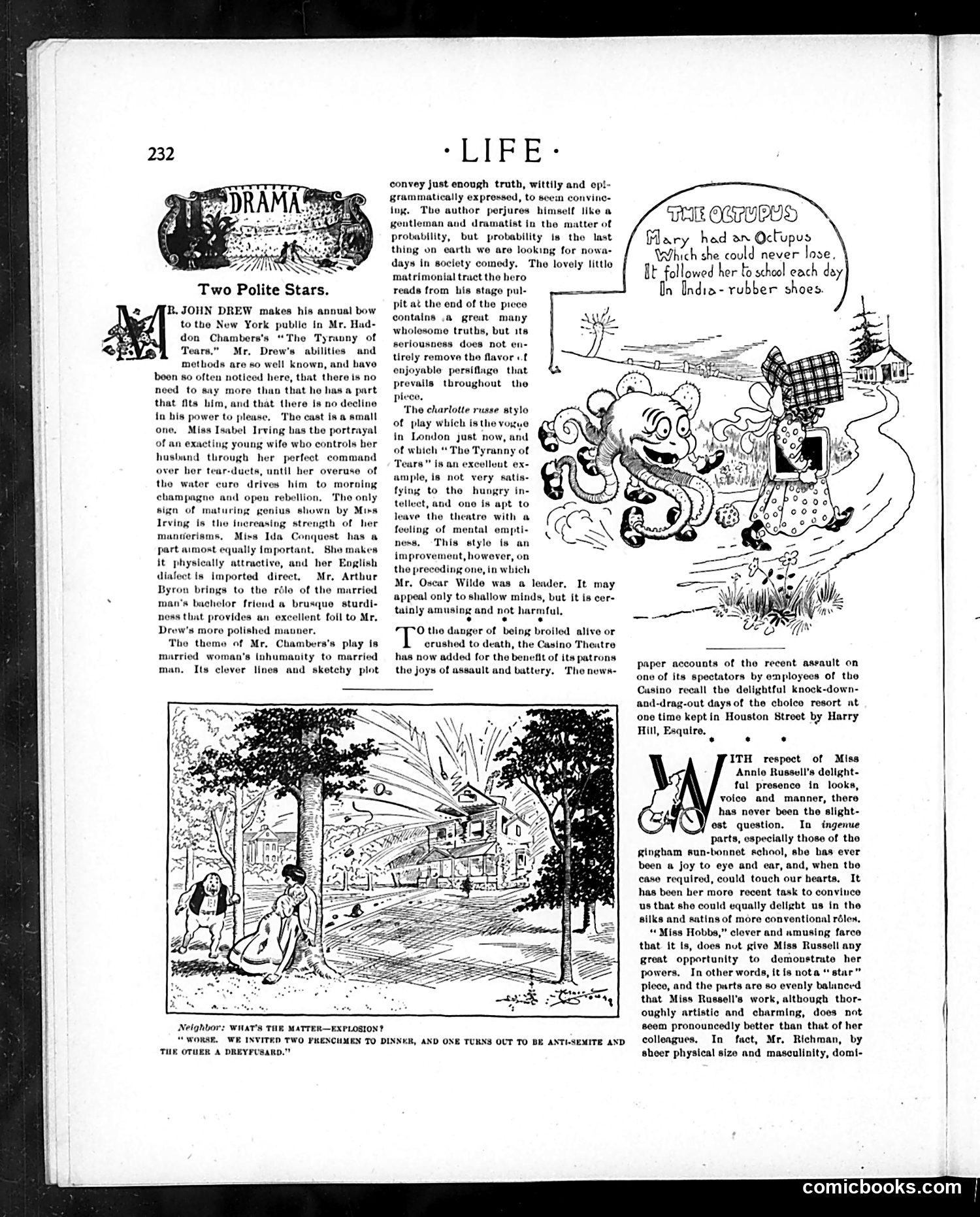
This page reviews theatrical productions, focusing on John Drew's performance in Hudson Chambers' "The Tyranny of Tears" and Miss Ida Conquest in an unnamed play. The text praises Drew's skill and Conquest's physical attractiveness while critiquing the plays themselves as formulaic society comedies lacking depth. The main illustration depicts a domestic scene with two figures and includes the caption about neighbors discussing an explosion at dinner, a servant turning out to be anti-Semite. This appears to be satirizing drawing-room comedy tropes—the polite surface concealing social prejudices and tensions. The review suggests these contemporary theatrical productions, while entertaining, rely on shallow humor rather than meaningful social critique.
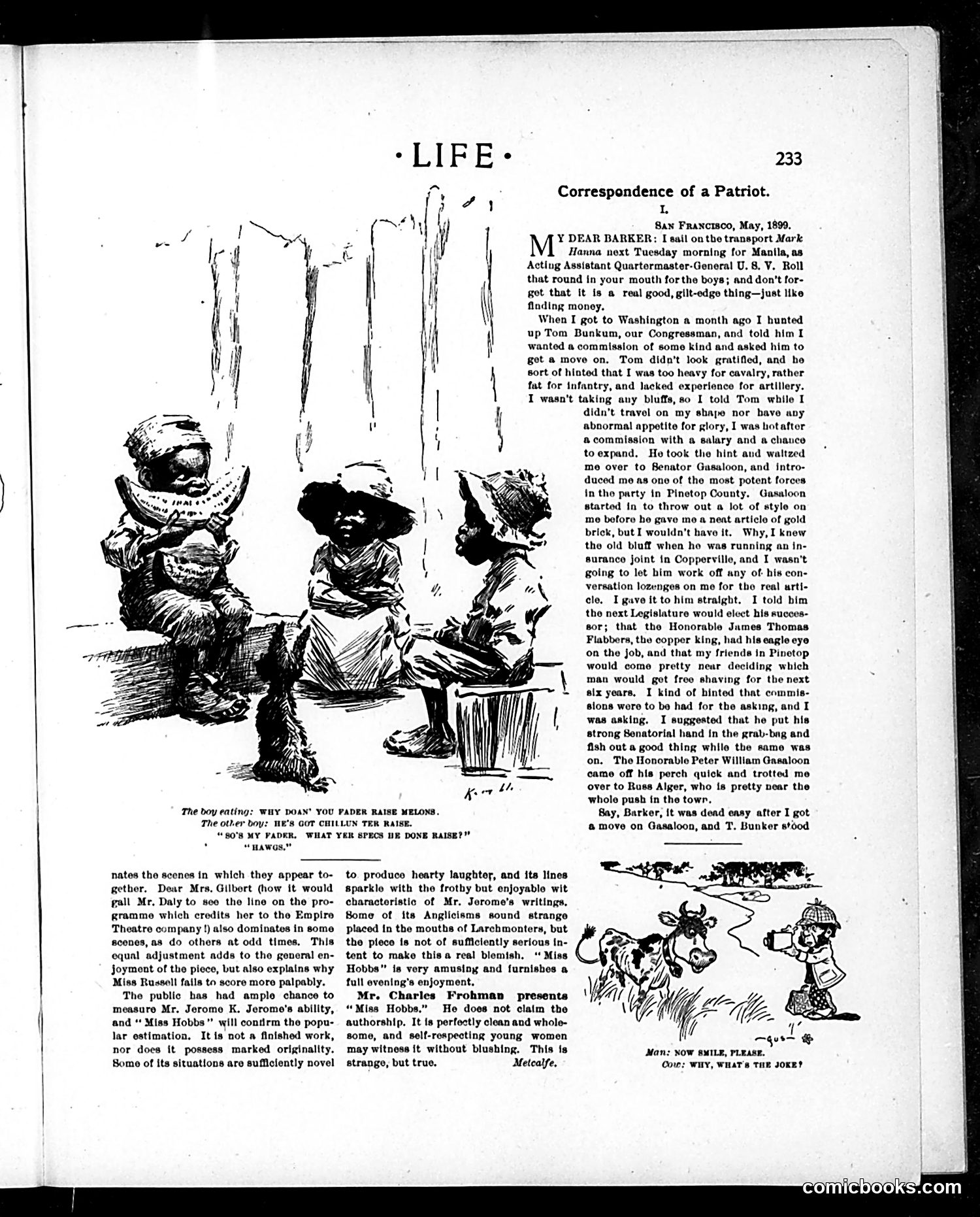
The main cartoon shows two rural boys discussing farming. One asks why the other's father doesn't raise melons; the reply is "We's got chillun ter raise"—a crude joke playing on racial stereotypes. The phrase "What yer specs ule done raise?" suggests the speaker's father raises slaves or Black children, reflecting deeply racist attitudes of the era. This cartoon satirizes the persistence of slavery-era thinking decades after emancipation (1865). By 1899, such explicit racist humor in mainstream publications reveals how normalized these attitudes remained in American culture. The page also contains theater reviews and a letter about military appointments, but the cartoon's racist premise is its central "joke"—one that modern readers would recognize as offensive rather than amusing.
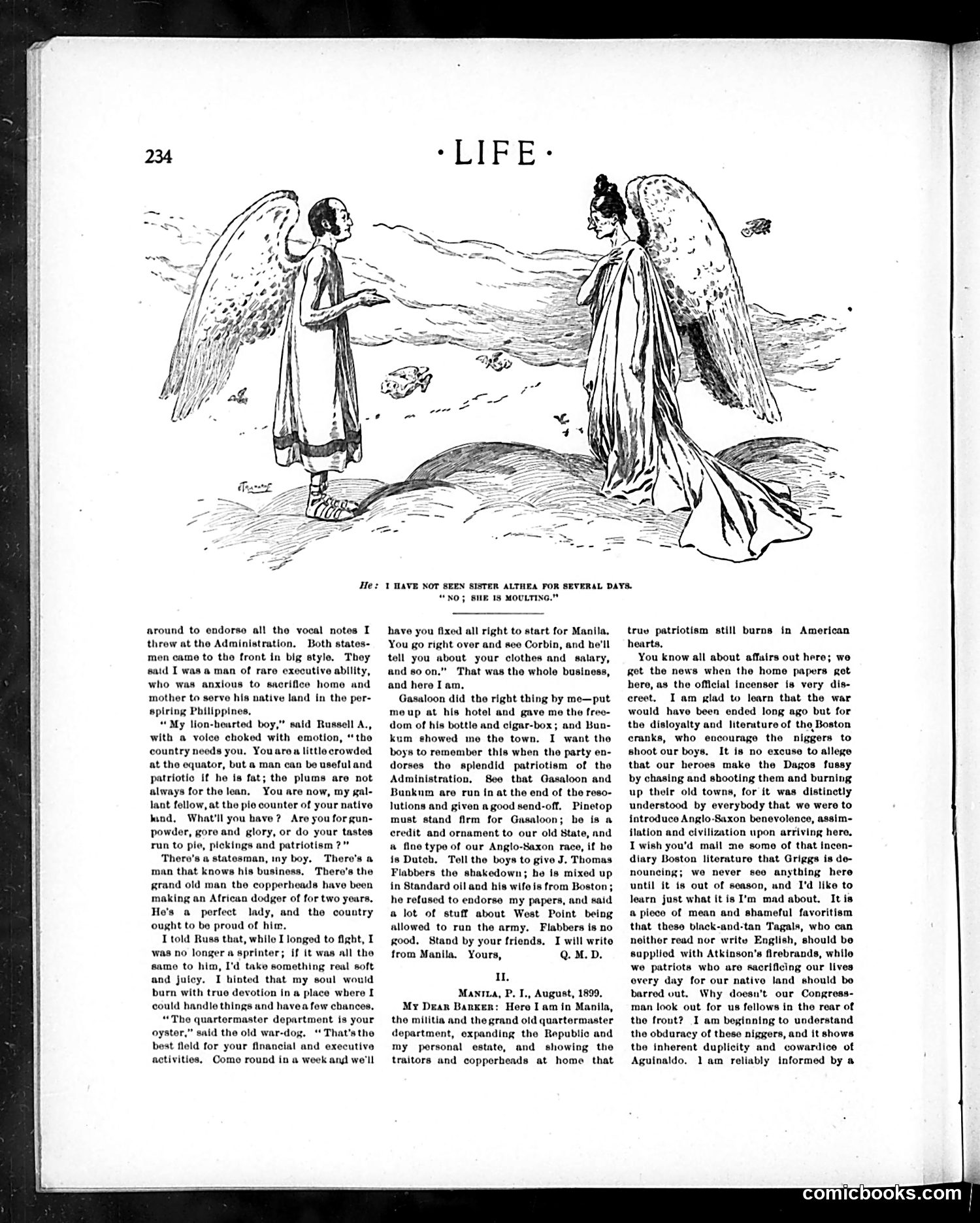
This satirical piece mocks American imperialism during the Philippine-American War (1899-1902). The illustration shows two winged angels—one appearing male, one female—with the caption "I have not seen Sister Althea for several days"/"No; she is moulting," a crude joke suggesting moral decay. The text is a first-person narrative from "Q.M.D." (a Quartermaster Department official) describing how he obtained a cushy military post through political patronage rather than merit. He cynically recounts politicians praising his "patriotism" while actually rewarding him with comfortable corruption—handling supplies and personal enrichment rather than combat. The satire targets: - **Political hypocrisy**: Officials invoke patriotism while enabling self-serving appointments - **Racism**: References to "niggers," "Dagos" (Filipinos), and "Anglo-Saxon benevolence" reveal the era's prejudices - **Imperial arrogance**: Dismissing Filipino resistance and American atrocities as justified "civilization" - **Crony capitalism**: The quarterback system rewarding loyalty over competence The fallen angel imagery reinforces the moral critique: American imperial ambitions corrupted noble ideals.
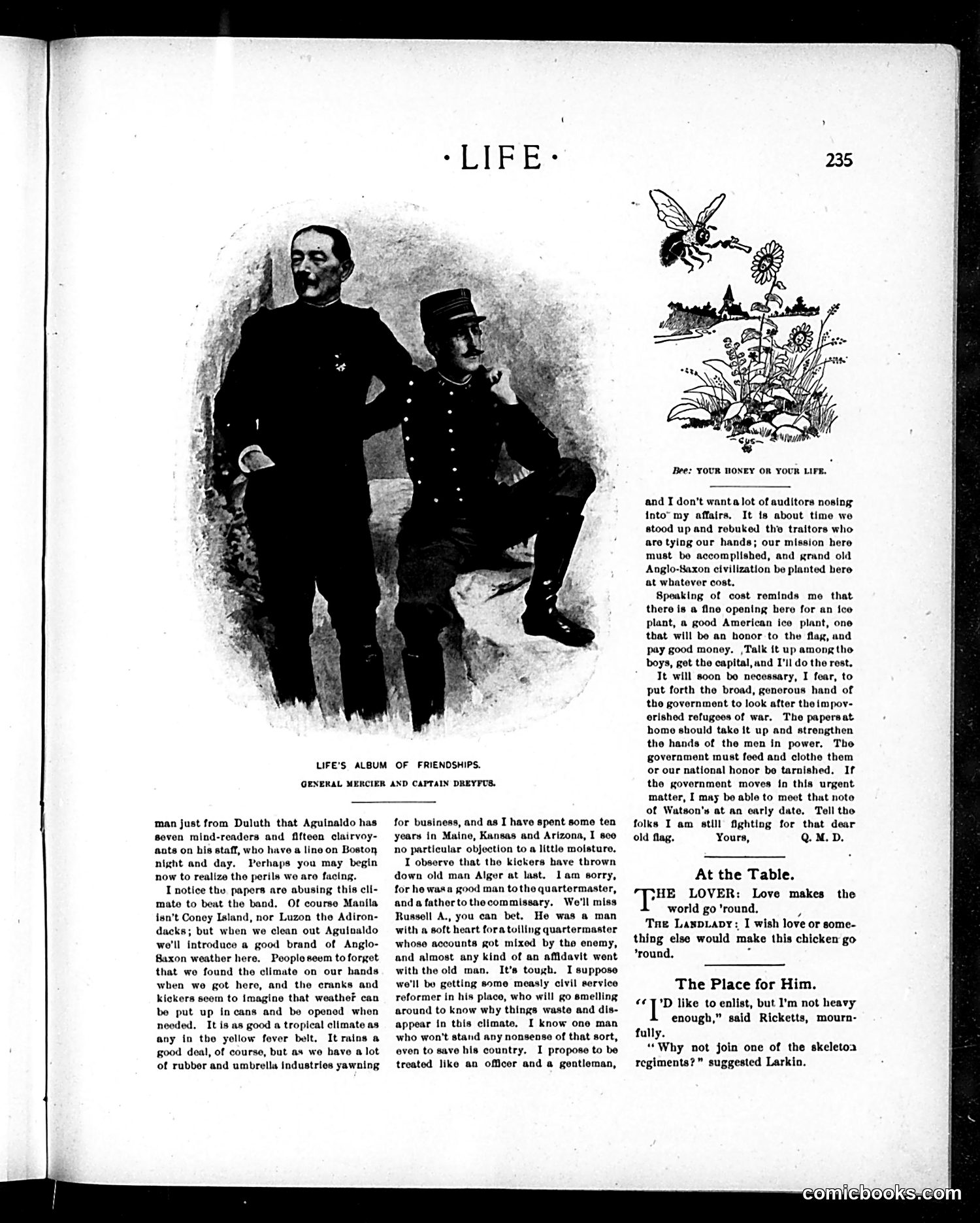
This page satirizes American military corruption and incompetence during the Philippine-American War (circa 1899-1902). The main illustration, titled "Life's Album of Friendships," depicts **General Mercier and Captain Dreyfus**—a reference to the ongoing Dreyfus Affair in France, where a Jewish officer was falsely imprisoned. The pairing is ironic: Life suggests American military leadership mirrors that scandal's injustice. The accompanying letter mocks an unnamed quartermaster's self-serving justifications: profiteering from war supplies, dismissing accountability as "civil service reform," proposing an ice plant venture, and seeking government aid for "impoverished refugees"—really seeking personal financial benefit. The satire exposes how officers enriched themselves while claiming patriotic duty. The smaller jokes ("At the Table," "The Place for Him") are unrelated filler content typical of Life's format. The overall message: American military leadership in the Philippines is corrupt and indifferent to actual governance or justice.
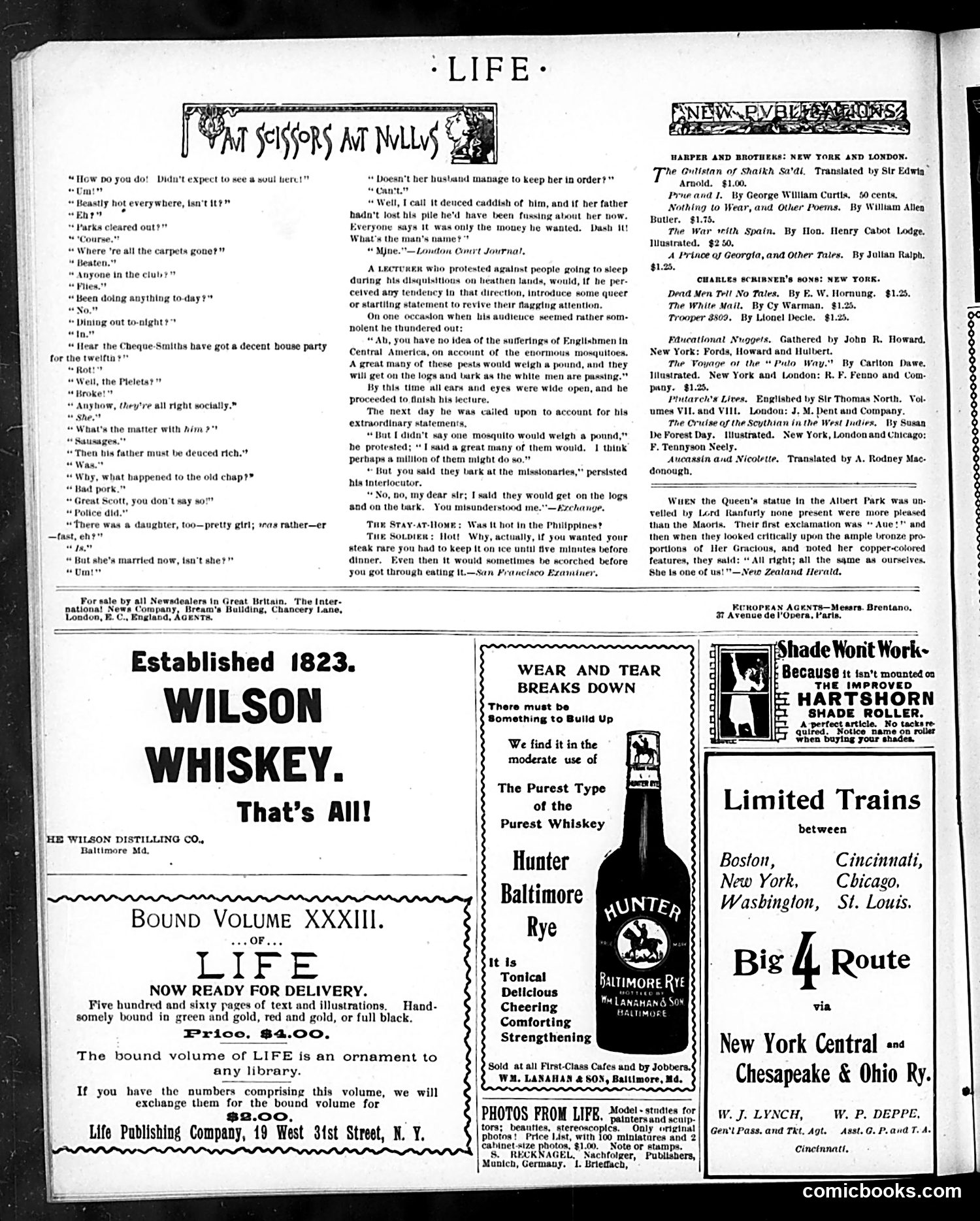
This page from *Life* magazine contains two main satirical pieces: **Top Section - "I Am Scissors at Nulls"**: A dialog-based cartoon mocking upper-class British social conversation. The exchanges ridicule vapid small talk ("Beastly hot everywhere"), gossip about marriages motivated by money ("Everyone says it was only the money he wanted"), and the aimlessness of wealthy society life ("Been doing anything to-day?"). The humor targets the pretension and superficiality of London's drawing-room culture. **Middle Section - The Mosquito Lecturer**: Satirizes academic exaggeration and pomposity. A lecturer claims mosquitoes in Central America "would weigh a pound" and "bark as the white men are passing"—absurd claims he later defends with pedantic quibbling about not saying "*one* mosquito" but "a great many." The satire mocks how speakers use sensationalism to manipulate audiences and then dodge accountability through technical word games. Both pieces use humor to deflate pretension: social snobbery in the first, academic bombast in the second. The page is primarily satirical content with surrounding advertisements.
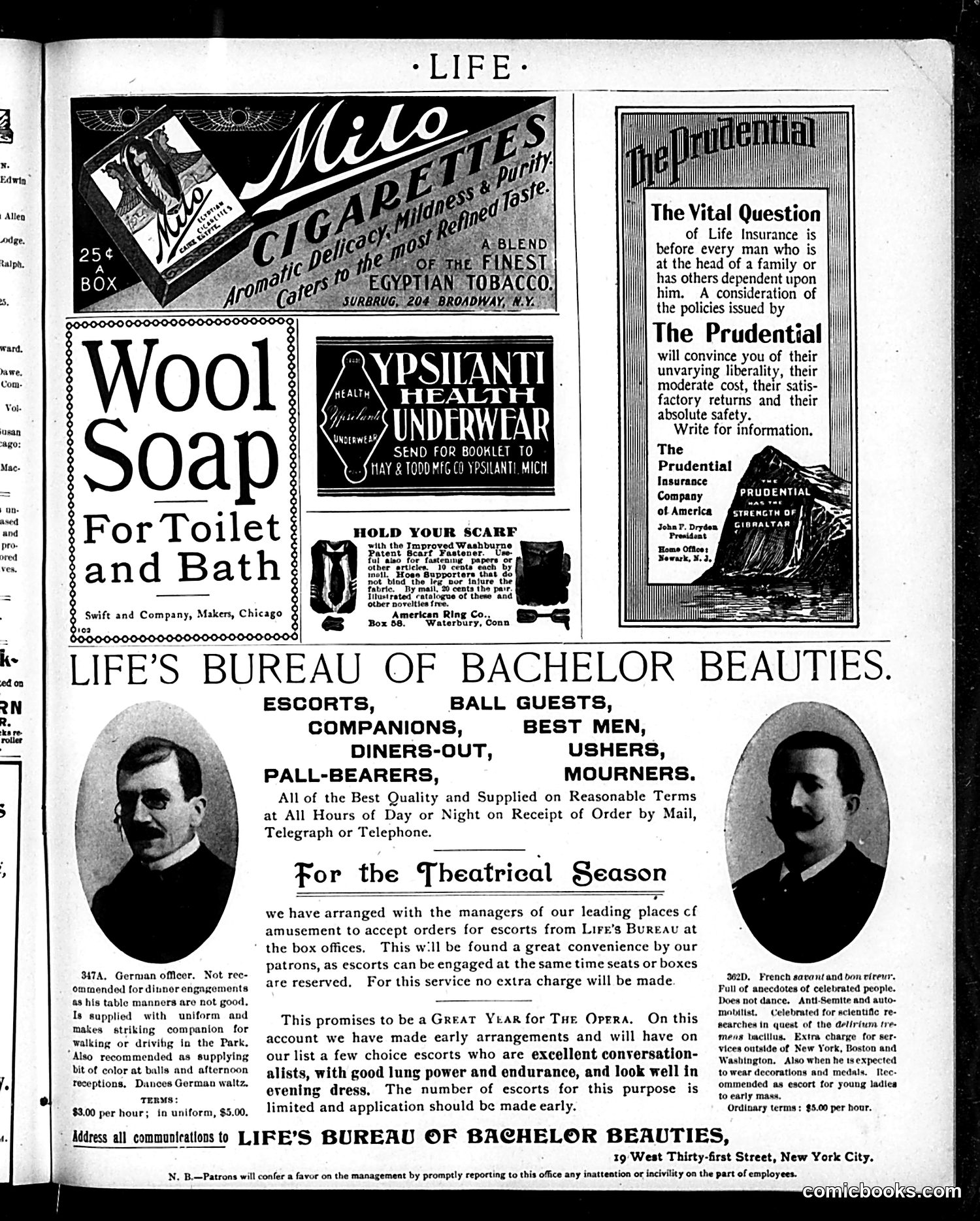
This page satirizes New York's wealthy social scene by advertising a fictional escort service for unmarried men available for social occasions. The joke targets the era's rigid social conventions requiring male "escorts" for proper events—balls, dinners, theater outings, and funerals. The humor lies in the detailed "catalog" descriptions of available bachelors with comically specific flaws: one German officer has poor table manners; another is an anti-Semitic French scientist obsessed with studying delirium tremens. The pricing structure ($3–$5 per hour) and formal booking system mock both the commodification of social status and the absurdity of "renting" respectable companions. This reflects Gilded Age anxieties about propriety and social climbing—the underlying satire suggests that proper society had become so rule-bound that even one's dinner companions could be purchased rather than genuinely befriended. The piece gently mocks wealthy New York's obsession with appearances.
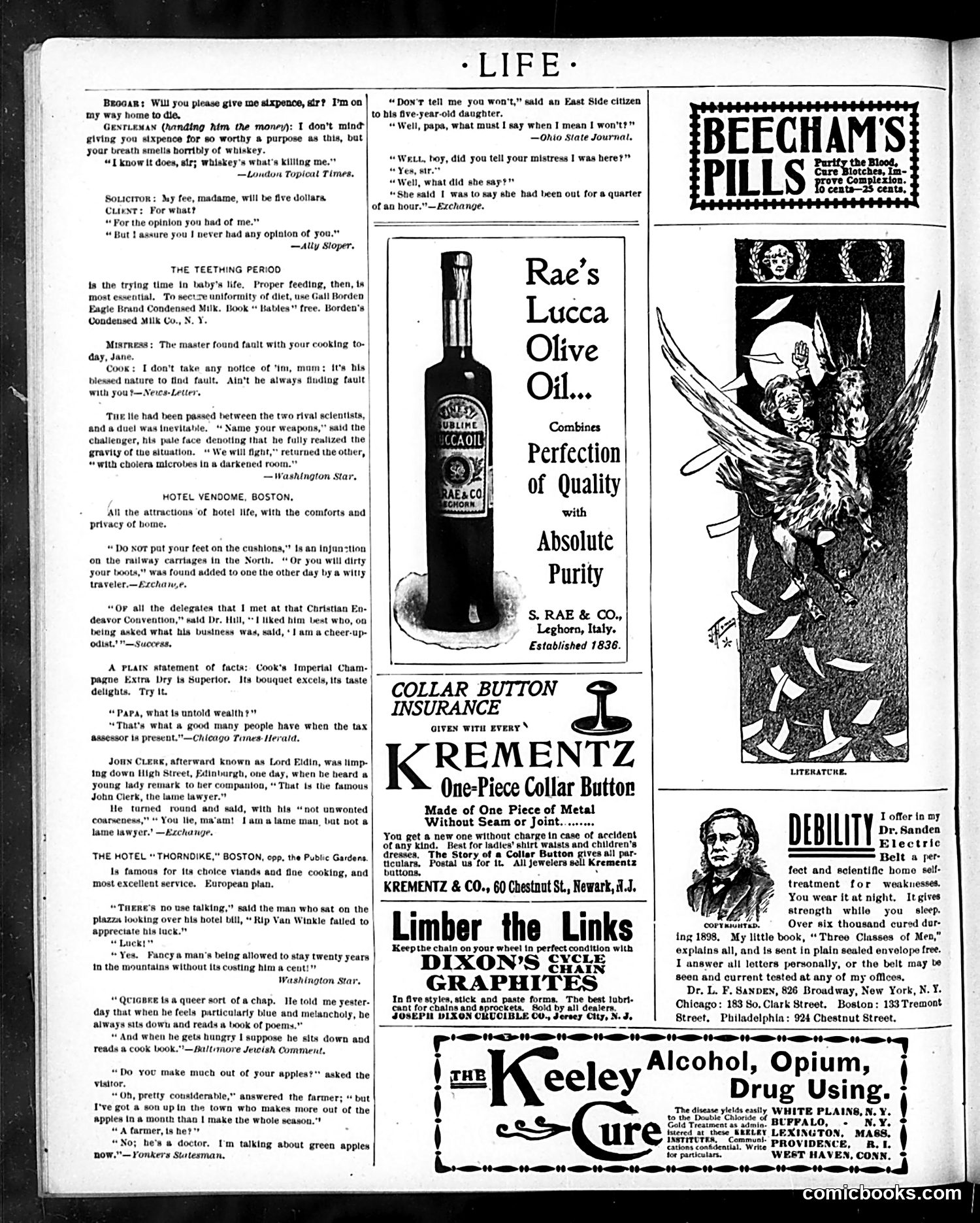
This is primarily an **advertising and humor page** from Life magazine (an early American satirical publication). The page contains multiple brief jokes and advertisements rather than a cohesive political cartoon. The humor pieces reflect **working-class and domestic life** of the era: - A beggar asking for sixpence to "go home to die," blaming whiskey—satirizing both poverty and alcoholism - A lawyer's fee dispute joke playing on class assumptions - Domestic staff humor (cook/mistress conflicts) - A joke about a "cheer-up-dist" at a Christian Endeavor Convention—likely mocking temperance/reformist movements The advertisements reveal period concerns: **baby formula, olive oil, collar button insurance, and notably "The Keeley Cure"**—a famous (and controversial) late-19th-century treatment for alcoholism and drug addiction. The **recurring alcohol theme** (whiskey, champagne, Keeley Cure) suggests contemporary anxieties about drinking and substance abuse, likely reflecting the pre-Prohibition temperance movement gaining momentum in America at this time. No specific political figures or events are referenced.
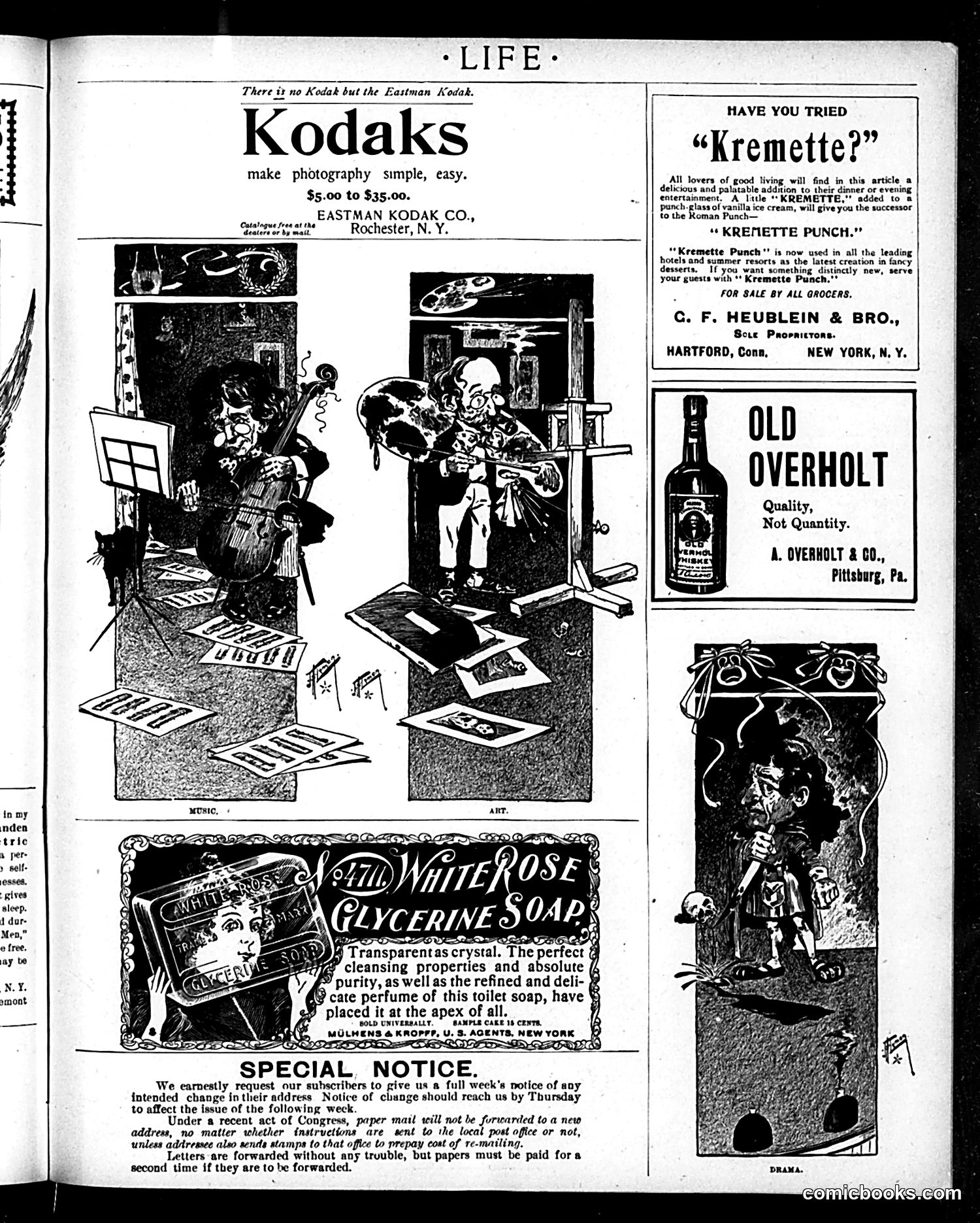
This page is primarily **advertising**, typical of *Life* magazine's revenue model. The main content features two cartoon vignettes labeled "MUSIC" and "ART"—satirizing how photographers of that era staged elaborate, theatrical scenes to capture subjects. The left panel shows musicians performing; the right depicts an artist's studio with exaggerated posing. Both mock the pretentiousness and artificiality of early photography, which required long exposures and careful composition. The joke: photographers treated mundane subjects as grand theatrical productions. The surrounding ads (Kodak cameras, Kremette punch, soap, whiskey) are period products now obsolete or reformulated. The "Special Notice" about address changes and postal regulations reflects pre-digital mail distribution logistics. **Key satirical point**: Photography was still novel enough (early 1900s) that the medium itself—not just the subject—invited mockery for its pretentiousness and technical demands.
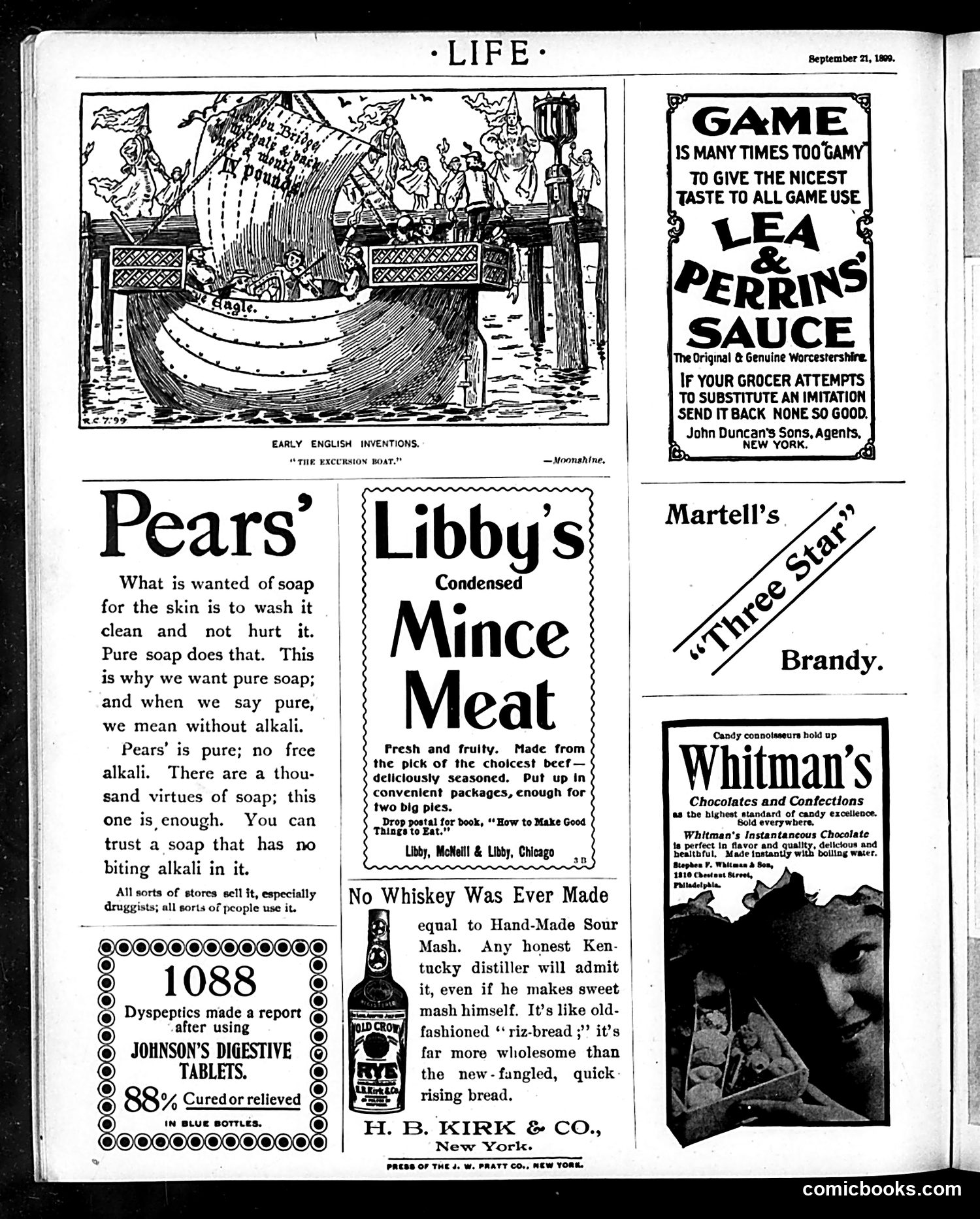
This is primarily an **advertising page** with one satirical cartoon at the top. The cartoon, titled "Early English Inventions: The Excursion Boat," depicts an absurdly oversized boat or vessel launched from a medieval fortification, with crowds of people aboard. The satire mocks primitive or ridiculous historical innovations—suggesting that early English engineering produced impractical contraptions. The humor lies in the exaggerated scale and implied futility of the invention. The page is otherwise dominated by product advertisements typical of 1909: Pears' soap (emphasizing purity and lack of alkali), Libby's mince meat, Lea & Perrins sauce, Martell brandy, Whitman's chocolates, Johnson's Digestive Tablets (claiming 88% cure rate), and H.B. Kirk whiskey. These ads reflect early 20th-century consumer goods marketed with health and quality claims, many (particularly the digestive tablets) making dubious medical promises that would be illegal today.