
Life, 1899-09-21 · page 12 of 20
Life — September 21, 1899 — page 12: what you’re looking at
What you’re looking at
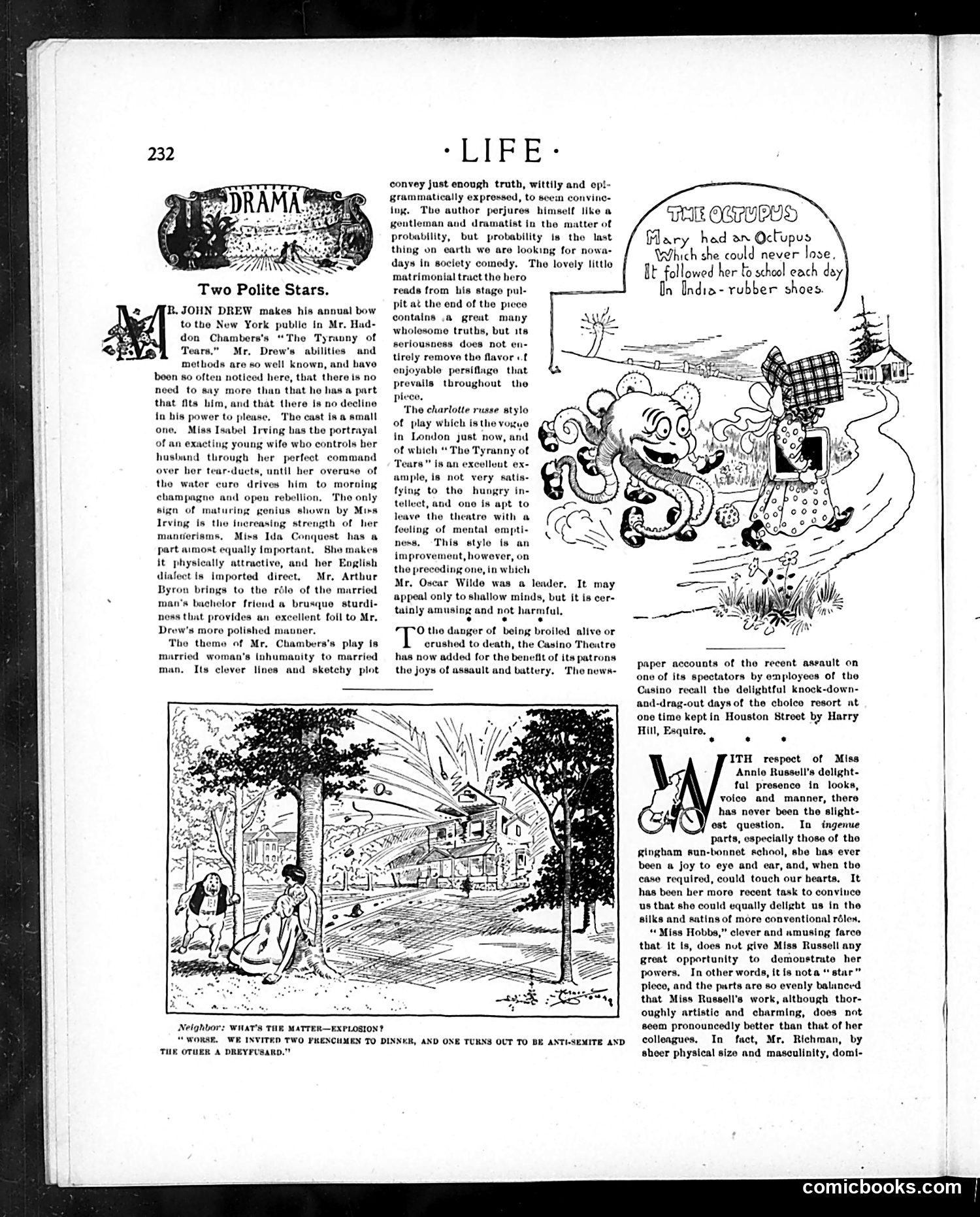
This page reviews theatrical productions, focusing on John Drew's performance in Hudson Chambers' "The Tyranny of Tears" and Miss Ida Conquest in an unnamed play. The text praises Drew's skill and Conquest's physical attractiveness while critiquing the plays themselves as formulaic society comedies lacking depth. The main illustration depicts a domestic scene with two figures and includes the caption about neighbors discussing an explosion at dinner, a servant turning out to be anti-Semite. This appears to be satirizing drawing-room comedy tropes—the polite surface concealing social prejudices and tensions. The review suggests these contemporary theatrical productions, while entertaining, rely on shallow humor rather than meaningful social critique.
📄 Transcribed text from this page (OCR, searchable)
Machine-transcribed from the original scan — historical spelling and the odd misread are preserved.
Two Polite Stars. ‘B. JOHN DREW makes his annual bow tothe New York public In Mr. Had- don Chambers’s “The Tyravny of Tears.” Mr. Drew's abilities and methods are so well known, and have boon so often noticed here, that there is no need to say more than that he has a part that fits him, and that there is no decline in bis power to please, The cast is a small one, Miss Isabel Irving bas the portrayal of an exacting young wife who controls ber husband through her perfect command over her tear-ducts, until her overuse of the water curo drives him to moroing cbampagne and open rebellion. The only sign of maturing genius shown by Miss Irving is the increasing strength of her manterisms, Miss Ida Conquest has a part aimost equally Important, Sho makes it physically attractive, and her English dialect is imported direct. Mr, Arthur Byron brings to the rélo of the married man’s bachelor friend a brusque sturdi- noss that provides an excellent foil to Mr. Drew's moro polished mauner. Tho theme of Mr. Chambers's play Is married woman's inhumanity to married man. Its clever lines and sketchy plot Neighbor: WHATS THE MATTER—EXPLOSION? “WORSE, WE INVITED TWO FRENCHMEN TO DINNER, AND ONE TURNS OUT TO BE ANTI-SEMITE AND THK OTUER A DREYFUSARD.” + LUPE convey just enough truth, wittily and opl- grammatically expressed, to seein convine- ing. The author perjures himself like a gentleman aud dramatist in the matter of probability, but probability is the last thing on earth we are looking for nowa- days in society comedy. The lovely little matrimonial tract the hero reads from his stage pul- pit at the end of the piece contains .a great many wholesome truths, but ite seriousness does not en- tirely remove the flavor uf enjoyable persiflage that prevails throughout the pleco. ‘The charlotte russe stylo of play which isthe voxue in London just now, and of which “The Tyranny of Tears” is an excelleut ex- ample, is not very satis- fying to the hungry in- tellect, and one is apt to leave the theatre with a fevling of mental empti- ness, This style is an improvement, however, on the preceding one, in which Mr. Oscar Wilde was ao leader, It may appeal only to shallow minds, but it is cer- tainly amusing and not harmful, cee ‘0 the danger of being broiled alive or crushed to death, the Casino Theatre has now added for the benefit of its patrons the joys of assault and battery. ‘The news- THE OGPUPYS Plary had an Octupus Which she could never lose, tt followed her to school each day In Indio- rubber shoes. paper accounts of the recent assault on one of its spectators by enployees of the Cusino recall the delightful knock-down- and-drag-out days of the cholco resort at one time kept in Houston Street by Harry Hill, Esquire, * e ¢@ ITH respect of Miss Annio Russell's delight- ful presence in looks, voico and manner, there has nover been the slight- est question. In ingenue parts, especially those of the gingham sun-bonnet school, sbe bas ever been # joy to eye and ear, and, when tho case required, could touch our hearts. It has been ber more recent task to convince us that she could equally delight us in the silks and satins of more conventional réles, “ Miss Hobbs,” clover and amusing farco that it Is, does nut give Miss Russell any great opportunity to demonstrate her powers. In other words, it is nota * star” pleco, and the purts aro 80 evenly baluneed that Miss Russell's work, although thor- oughly artistic and charming, does not seem pronouncedly better than that of her colleagues. In fact, Mr, Richman, by sheer physical sizo and masculinity, dom|- comicbooks.com