
A complete issue · 20 pages · 1899
Life — August 10, 1899
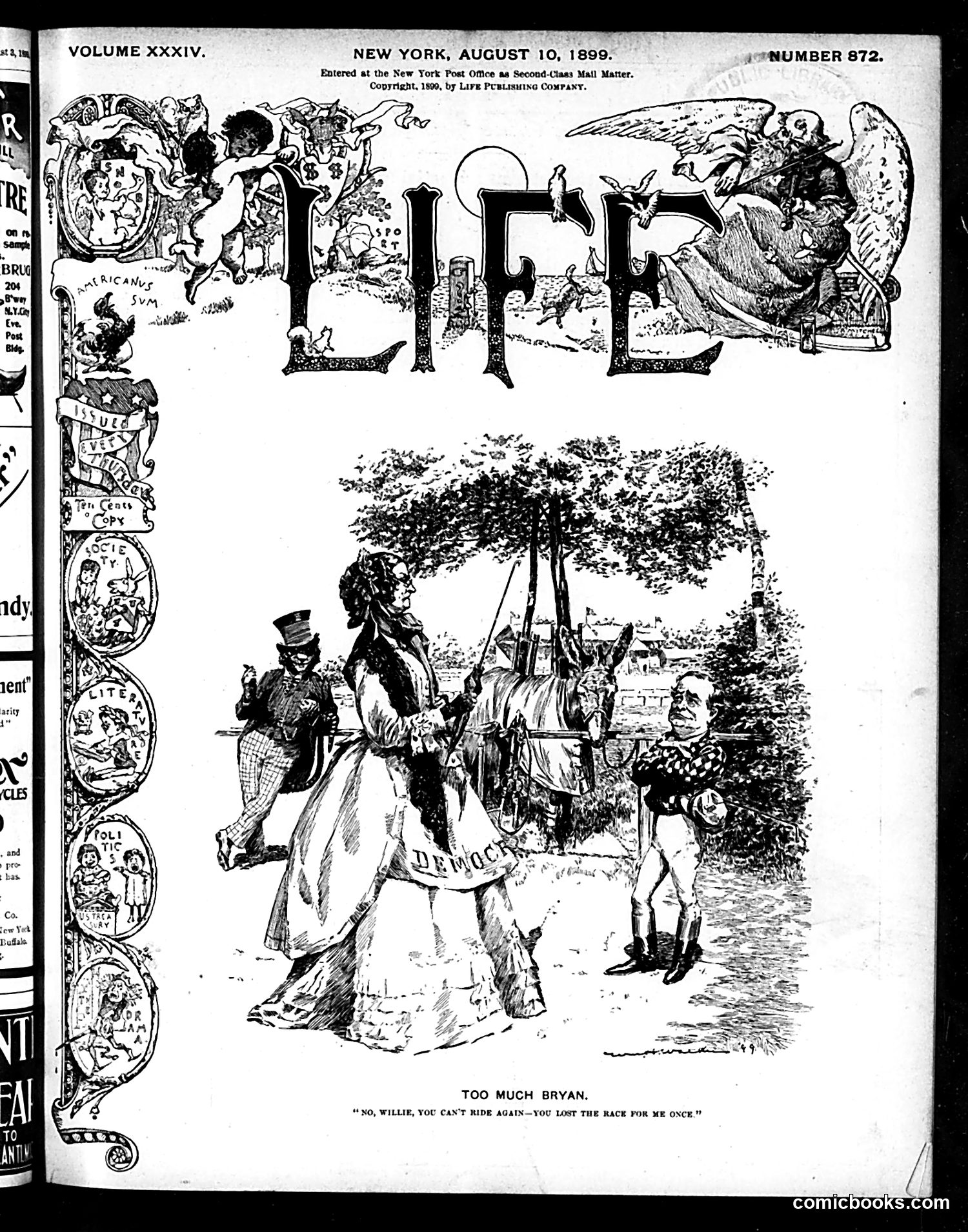
This political cartoon satirizes William Jennings Bryan, the Democratic politician who had run for president in 1896 and 1900. The caption reads: "So, Willie, you can't ride again—you lost the race for us once." The image shows Bryan as a horse labeled "DEMOCRACY" that a military officer (likely representing the Republican/McKinley administration) refuses to ride again. A smaller figure on the right watches the scene. The satire mocks Bryan's bid for another presidential run after his 1896 loss to William McKinley. The "horse" metaphor suggests Democrats view Bryan as a failed political vehicle—too damaged by his previous defeat to carry the party to victory again. The cartoon reflects Republican confidence heading into the 1900 election.
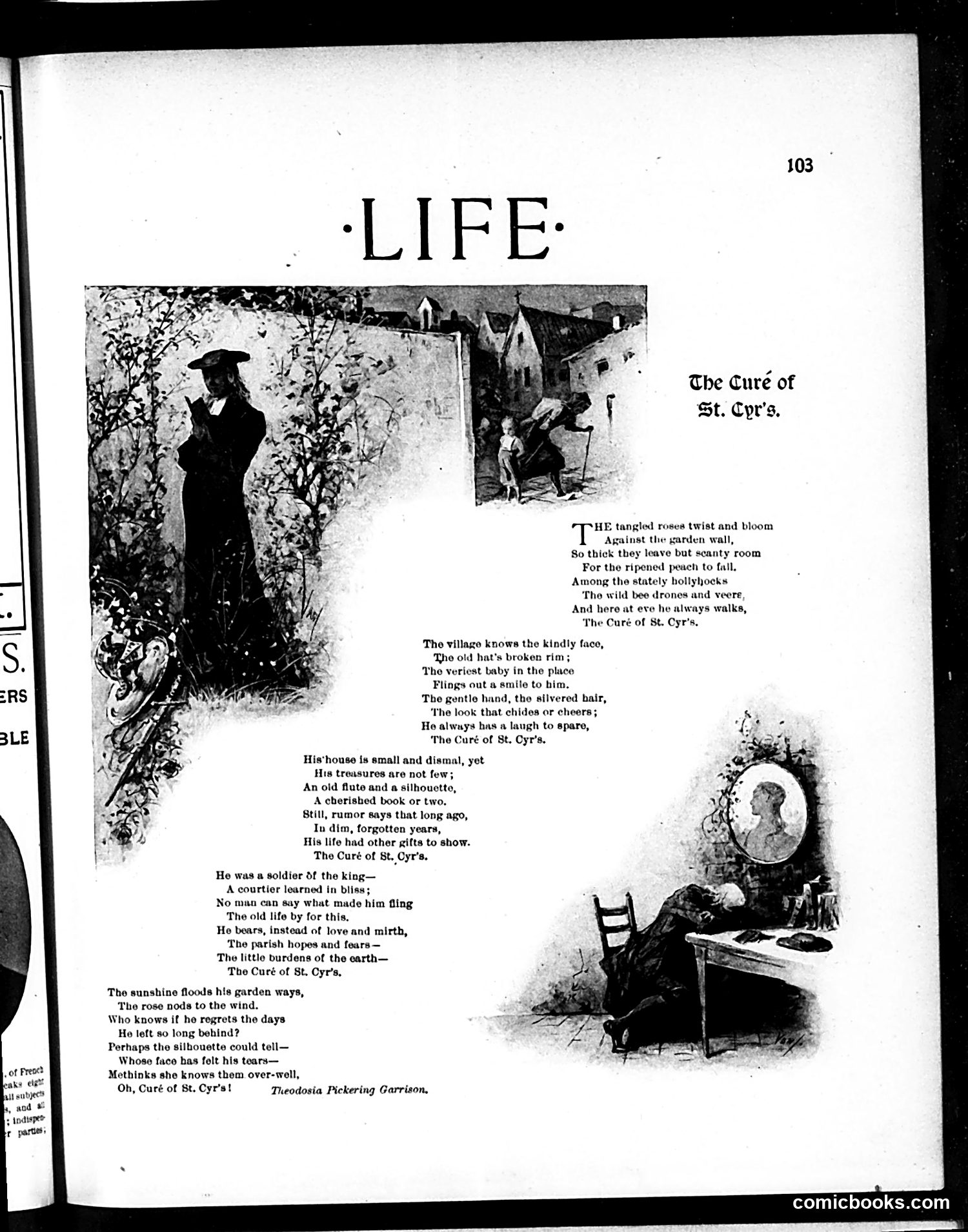
This page presents a poem by Theodesia Pickering Garridon about a village priest (curé). The accompanying illustrations show an elderly clergyman in his garden and later in his modest home. The poem celebrates this rural priest's character and sacrifices. It describes him as a former soldier who devoted his life to serving his parish despite hardship and poverty. Key themes include his kindness to villagers, his small material possessions (an old flute, cherished books), and his acceptance of loneliness and loss. Rather than satirizing a specific figure or event, this appears to be sentimental Victorian-era literature praising rural clergy as moral exemplars—a common theme in period magazines. The illustrations romanticize humble religious devotion and rural life.
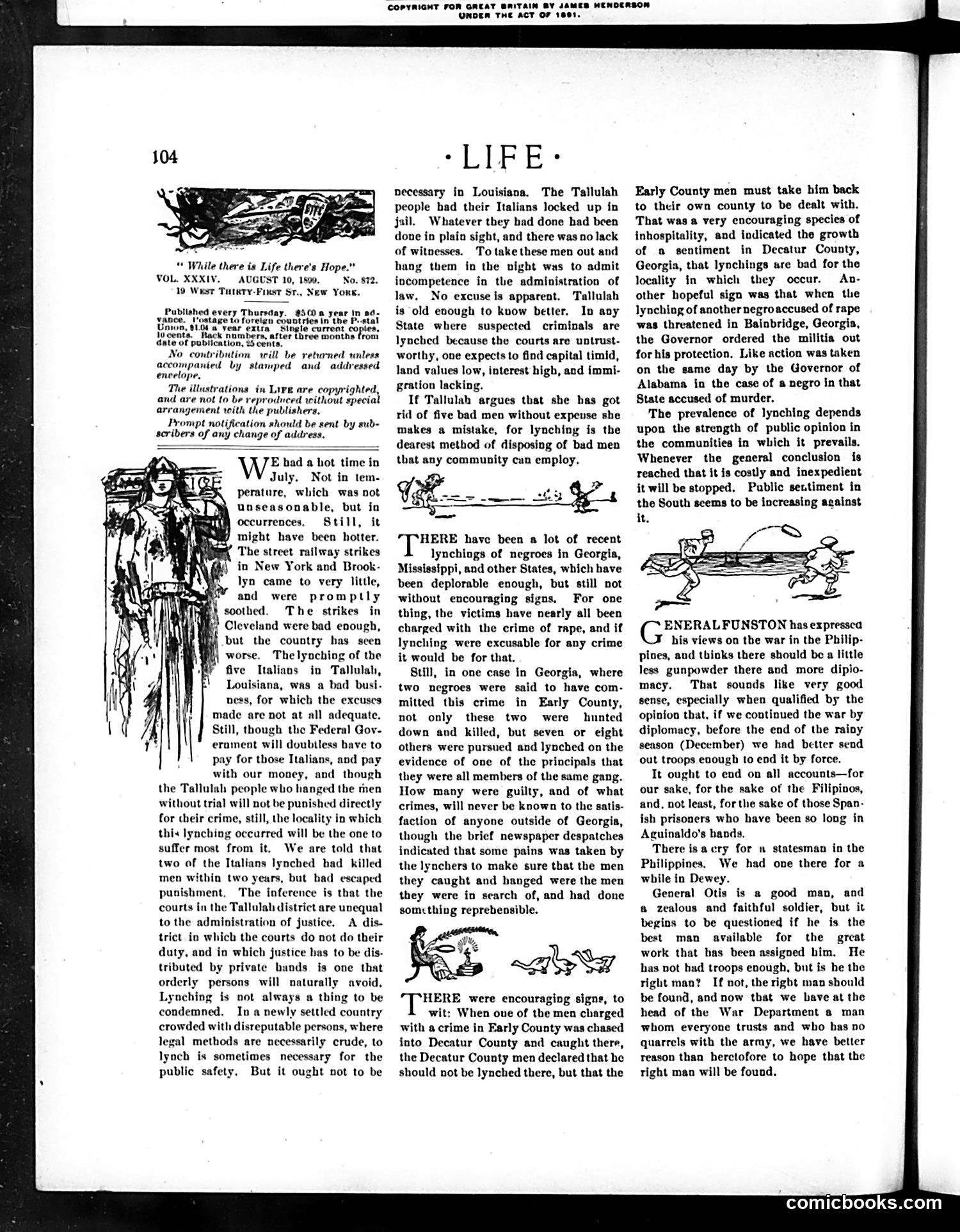
This page discusses recent lynchings of African Americans in Georgia, Mississippi, and other Southern states. The text argues that while lynching victims were often accused of rape, the punishment was disproportionate and undermined legal justice systems. The editorial acknowledges lynching as a response to serious crime but criticizes it as excessive and lawless. It notes that in one Georgia case, seven or eight men were lynched based on insufficient evidence, suggesting mob justice was indiscriminate. The accompanying illustrations appear to depict scenes of mob violence and flight, though specific figures aren't clearly identifiable. The overall message advocates for proper judicial proceedings rather than vigilante violence, reflecting Progressive Era concerns about rule of law and criminal justice reform.
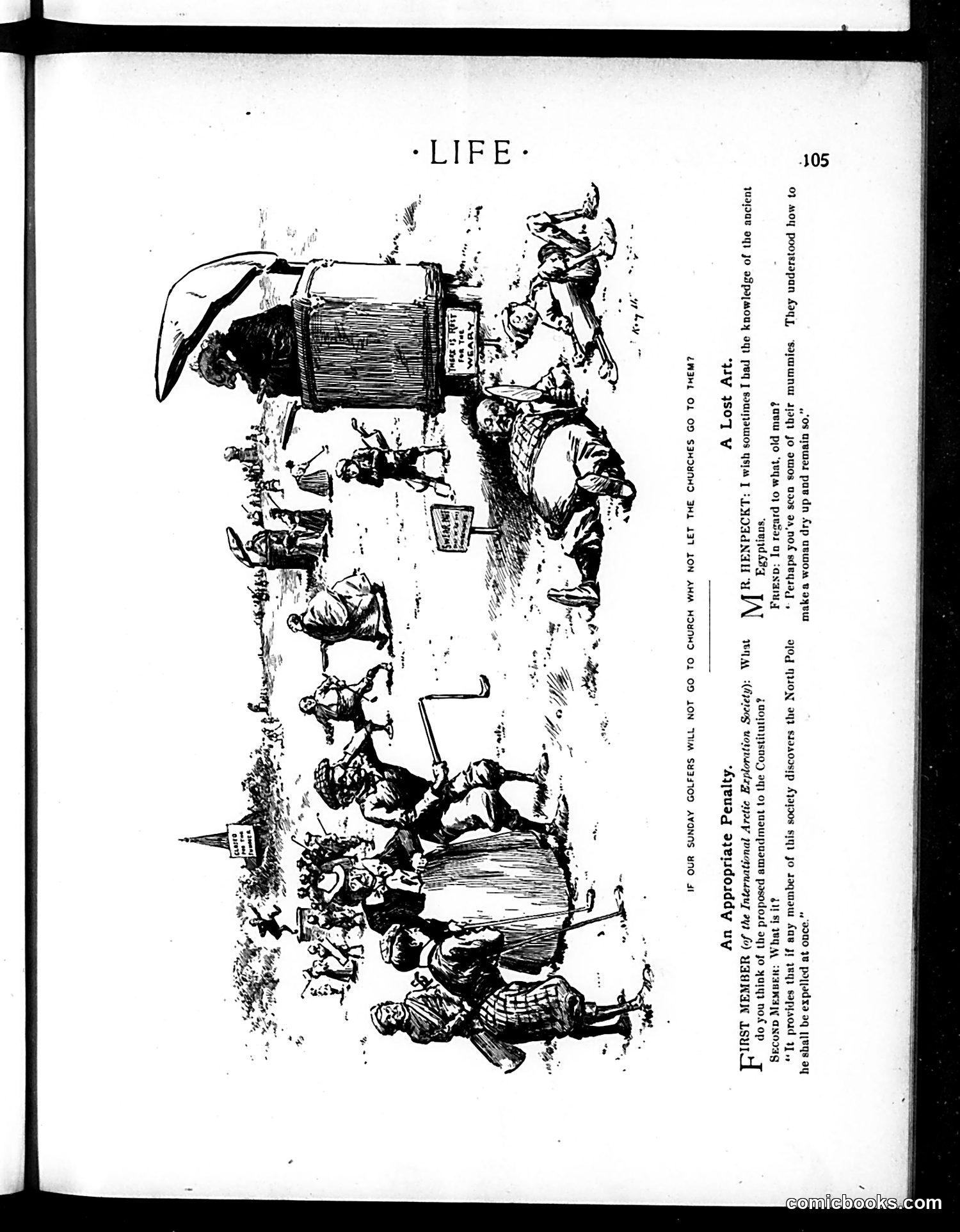
This cartoon satirizes the decline of "appropriate prayer" in society. The caption indicates it's the "First Member of an Appropriate Prayers Society" showing a figure praying, with text stating "Prayers...I have learned...make mighty a man in community life." The illustrated scene appears chaotic, depicting various people in disorderly conduct—arguing, fighting, drinking, and generally misbehaving. The contrast between the idealized notion of prayer's social benefits (stated in the caption) and the actual disorder shown suggests that *genuine* prayer or moral guidance has become a "lost art." The satire critiques either: religious hypocrisy, the ineffectiveness of prayer in modern society, or society's abandonment of moral principles. Without clearer dates or context, the specific historical moment remains somewhat unclear, though it appears to comment on early 20th-century social decline.
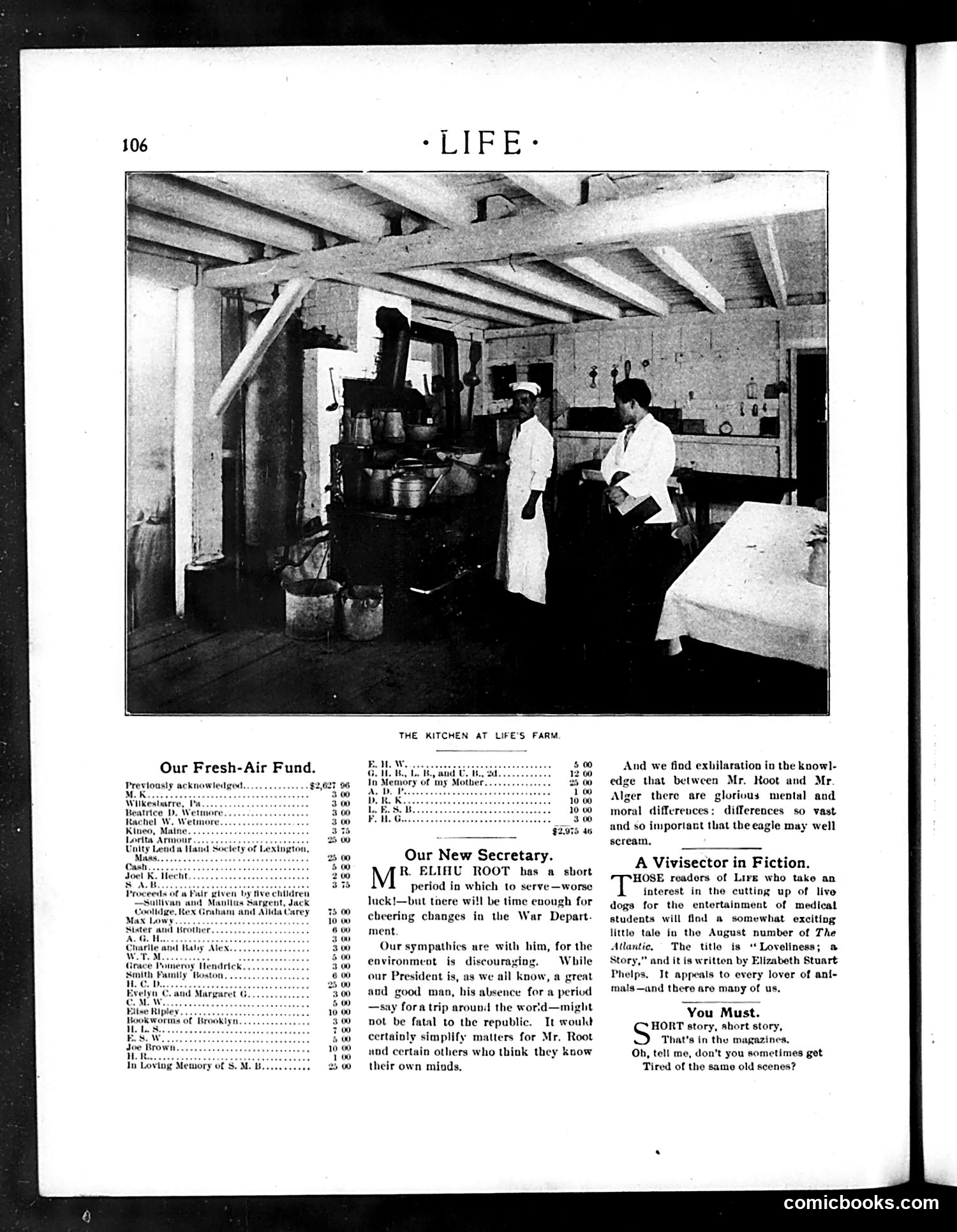
This page is primarily a **fundraising notice** rather than satirical content. "The Kitchen at Life's Farm" photograph shows two workers in a farm kitchen, illustrating Life magazine's charitable initiative. The main text sections include: 1. **"Our Fresh-Air Fund"** — A donation list acknowledging contributors to what appears to be a summer camp or retreat program for underprivileged children or workers, a common Progressive-era charity. 2. **"Our New Secretary"** — A brief notice about E. H. Root joining staff, noting his temporary absence. 3. **"A Visceector in Fiction"** and **"You Must"** — Short humor pieces unrelated to the farm initiative. The page reflects Life's dual role as both satirical publication and social reformer, using its platform for charitable fundraising typical of early 20th-century American magazines.
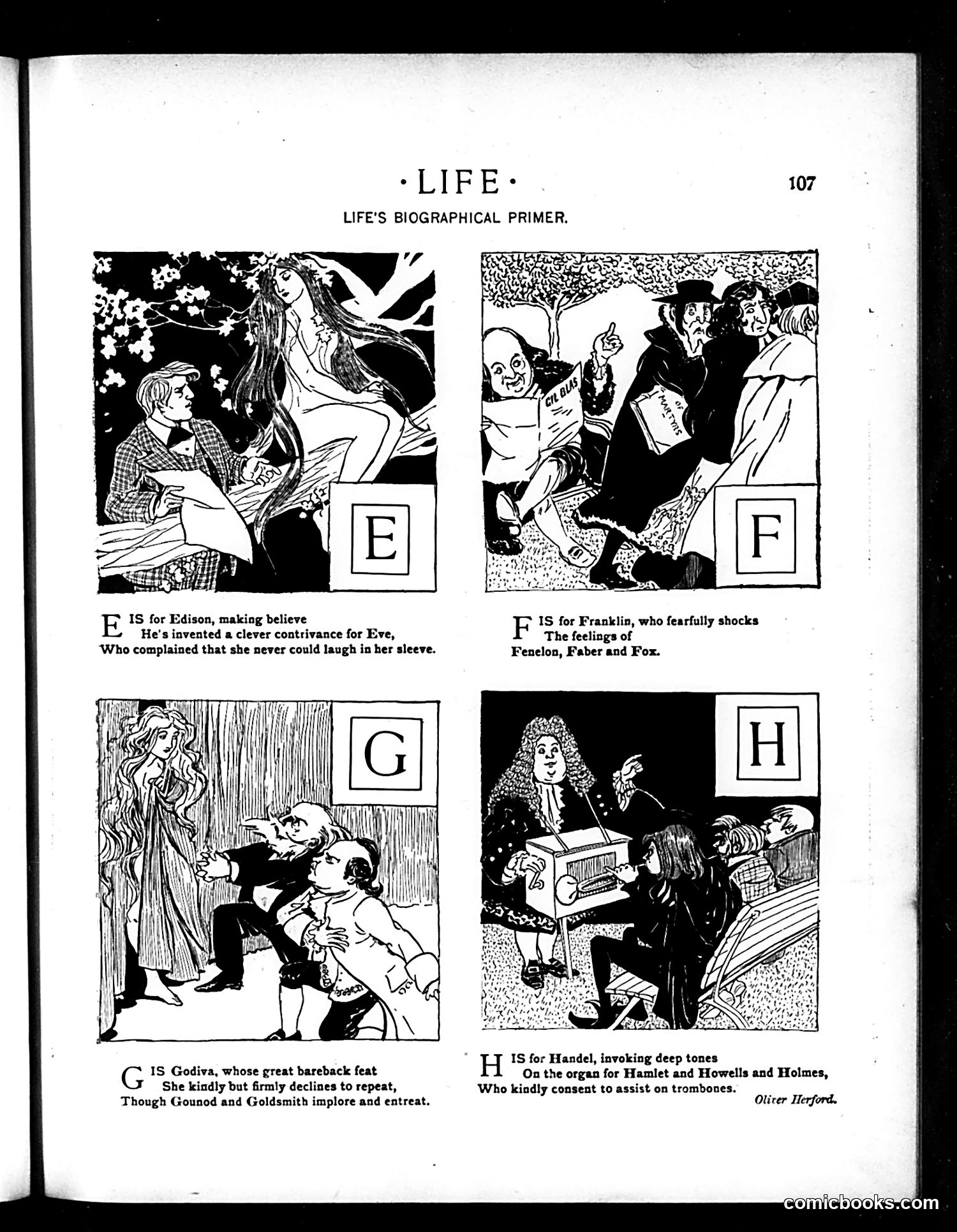
This is a satirical alphabet page featuring famous figures from theater, music, and popular culture. Each panel ridicules a notable person through caricature and verse: - **E (Edison)**: Mocks Thomas Edison's invention of a "contrivance for Eve," playing on the Adam-and-Eve myth. - **F (Franklin)**: Depicts Benjamin Franklin "fearfully shocking" three named figures—likely referencing his famous electricity experiments. - **G (Godiva)**: References the Lady Godiva legend, suggesting she "firmly declines to repeat" her famous naked horseback ride. - **H (Handel)**: Shows the composer at an organ with musicians, joking about his willingness to assist "on trombones." The page satirizes these historical and cultural figures through crude humor and visual exaggeration typical of Life magazine's irreverent style.
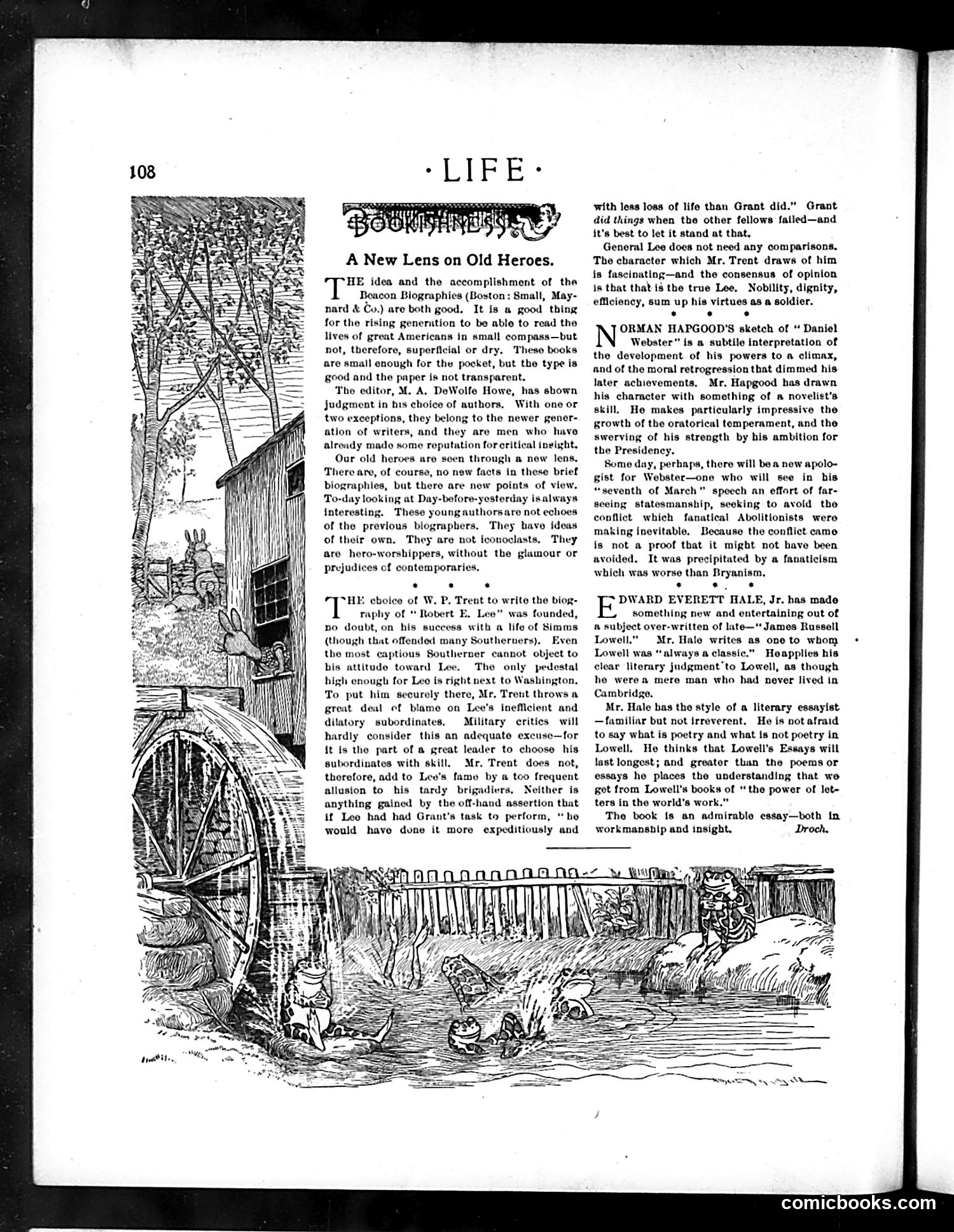
This page from *Life* magazine reviews new biographical works on historical American figures. The main illustration depicts a rustic cabin scene, likely referencing the frontier heritage of American heroes being discussed. The article "A New Lens on Old Heroes" critiques the *Beacon Biographies* series (published by Small, Maynard & Co.), praising the format while discussing how new authors interpret famous Americans. Specific reviews discuss W.P. Trent's biography of Robert E. Lee, Norman Hapgood's sketch of Daniel Webster, and Edward Everett Hale Jr.'s essay on James Russell Lowell. The satire targets how contemporary authors reimagine historical figures through modern perspectives rather than presenting straightforward facts—suggesting these "new" interpretations sometimes distort or overanalyze their subjects' characters and legacies.
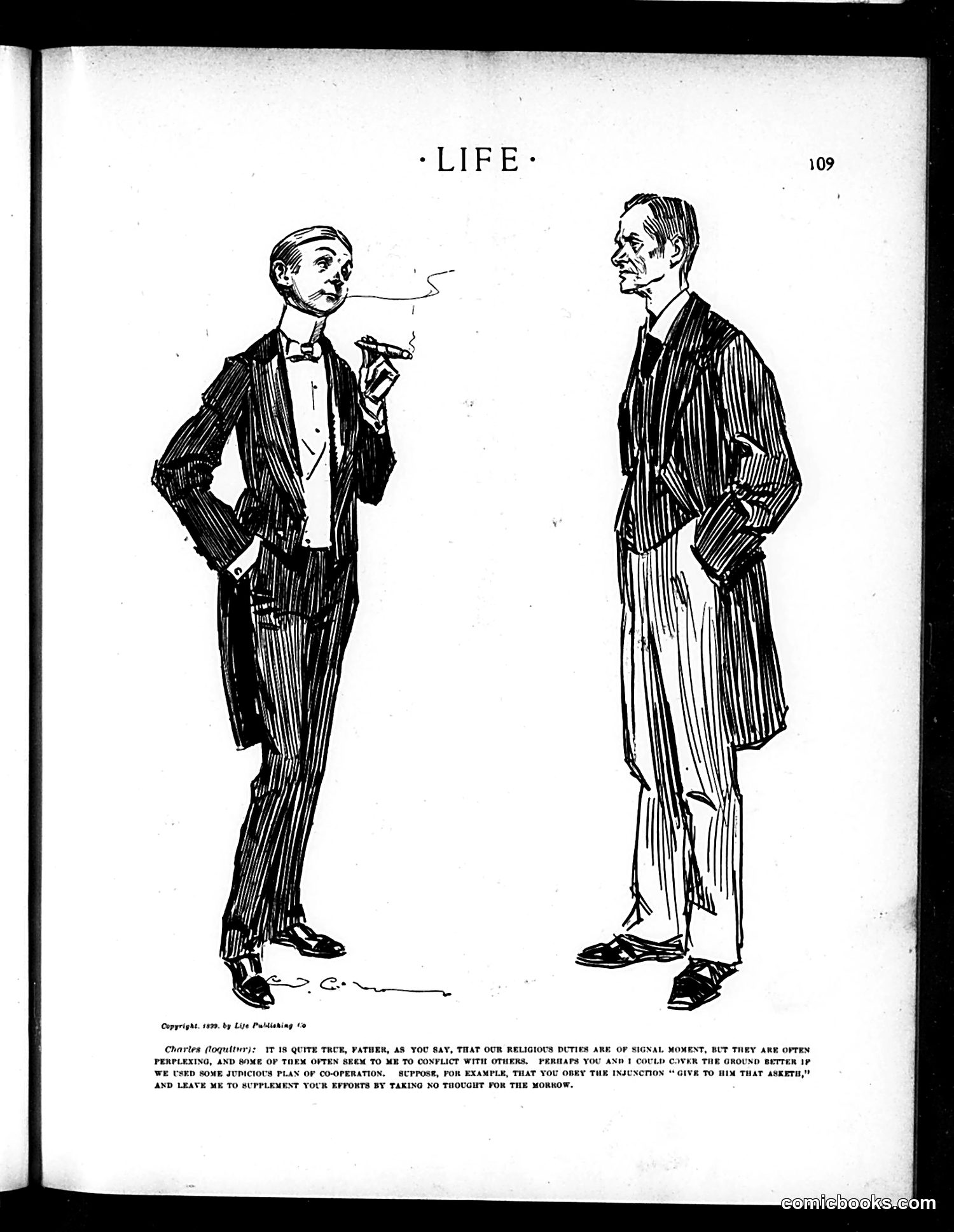
This page from *Life* magazine shows two men in formal attire engaged in conversation. The figure on the left, labeled "Charles (humorously)," is smoking a cigar and appears to be explaining something to a man on the right. The caption presents Charles arguing that religious duties and secular obligations can coexist without conflict. He suggests using "some judicious plan of cooperation" as an example—specifically that obeying a religious injunction to "give to him that asketh" need not interfere with business operations if one simply avoids hearing requests for aid. The satire targets hypocrisy: the cartoon mocks those who claim religious piety while conveniently ignoring its inconvenient demands through willful ignorance or semantic manipulation. It's a critique of selective morality among the well-to-do.
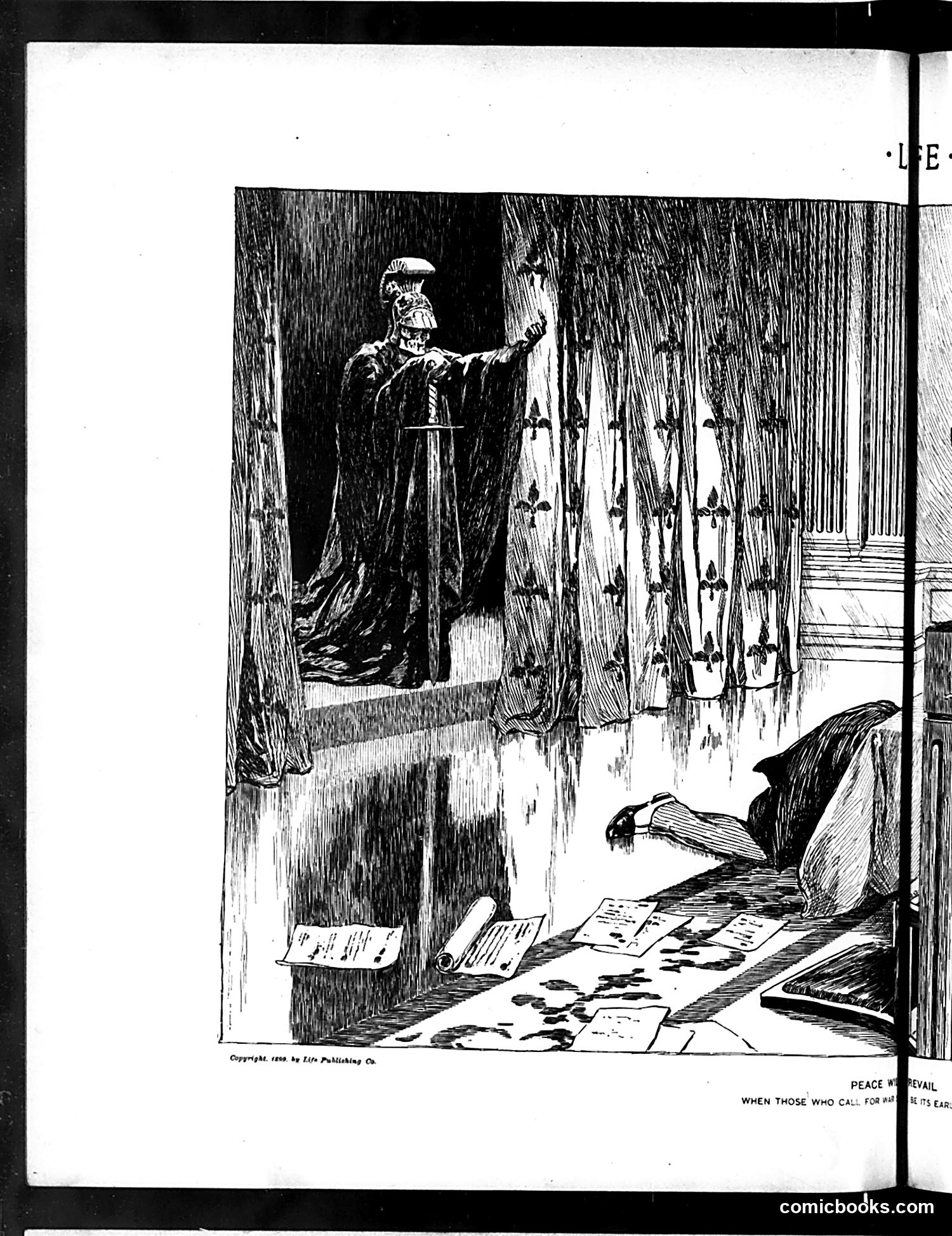
This is a political cartoon depicting a skeletal figure of Death or similar supernatural being, dressed in robes and pointing authoritatively at several banners or flags marked with fleur-de-lis symbols (French heraldry). The figure appears menacing and commanding. The caption reads "PEACE WILL PREVAIL / WHEN THOSE WHO CALL FOR AR[MS] / IS EARS" (text partially cut off). The cartoon appears to satirize French military or political leadership during a period of conflict, suggesting that those advocating for war will only find "peace" through death. The skeletal Death figure personifies the consequences of warmongering. Without a specific date visible, the exact historical context remains unclear, though the French symbols and anti-war message suggest this addresses early-20th-century European militarism.
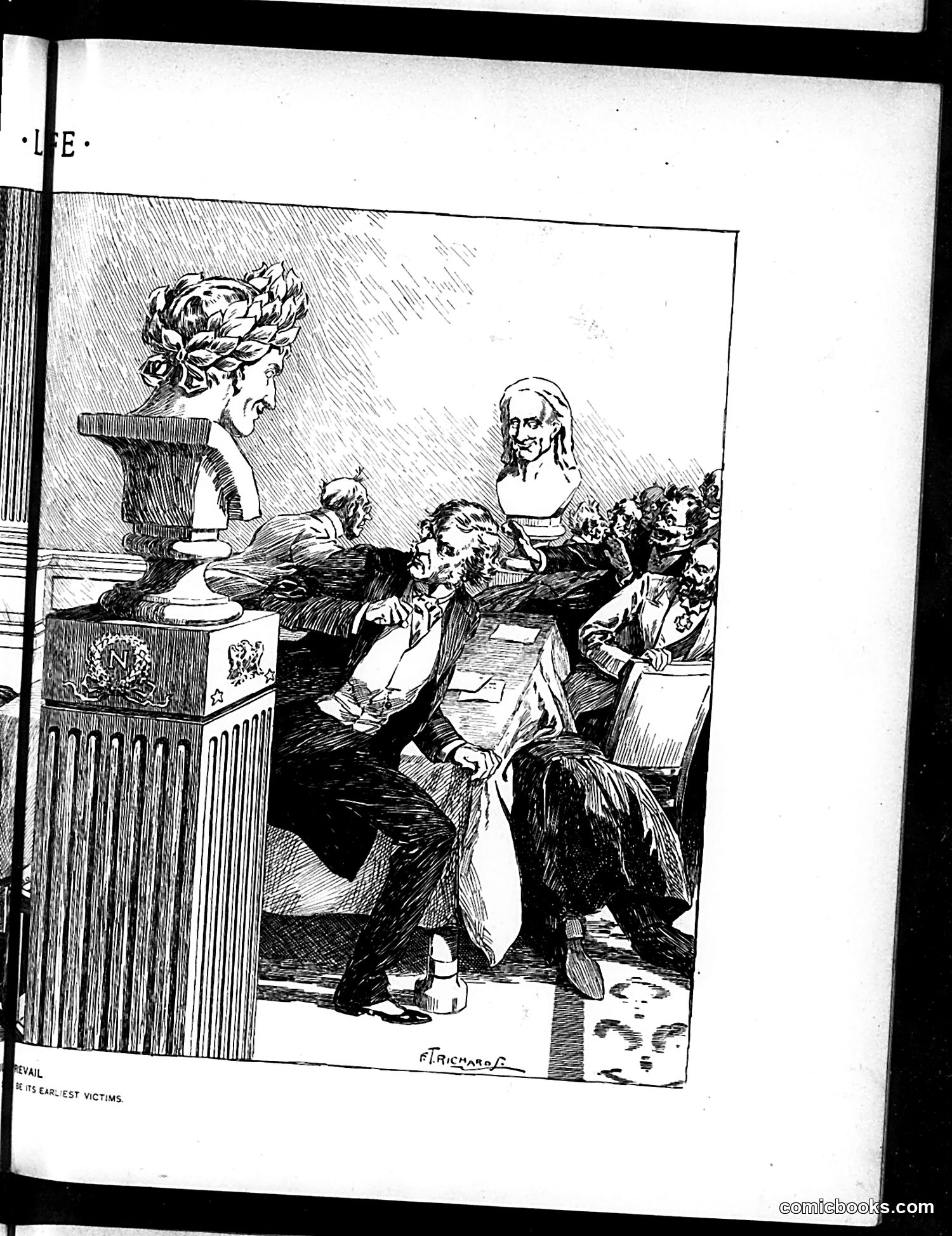
This appears to be a satirical courtroom or legal proceeding scene. A woman in elaborate dress and feathered hat stands at what looks like a podium or witness stand on the left. Several men in suits sit as observers or jurors, looking attentively at her testimony or statement. The caption reads "REVAIL" with subtitle "IL ITS EXE-EST VICTIMS" (possibly "IL ITS EXES-EST VICTIMS" - suggesting victims of ex-husbands or former relationships). The satire likely mocks either: legal proceedings involving alimony/divorce settlements, or commentary on women's victimhood claims. The woman's ostentatious appearance contrasts with her stated victim status, suggesting ironic commentary on frivolous or exaggerated legal claims by wealthy women. Without a specific date, precise identification of the artist beyond what's visible in the signature remains unclear.
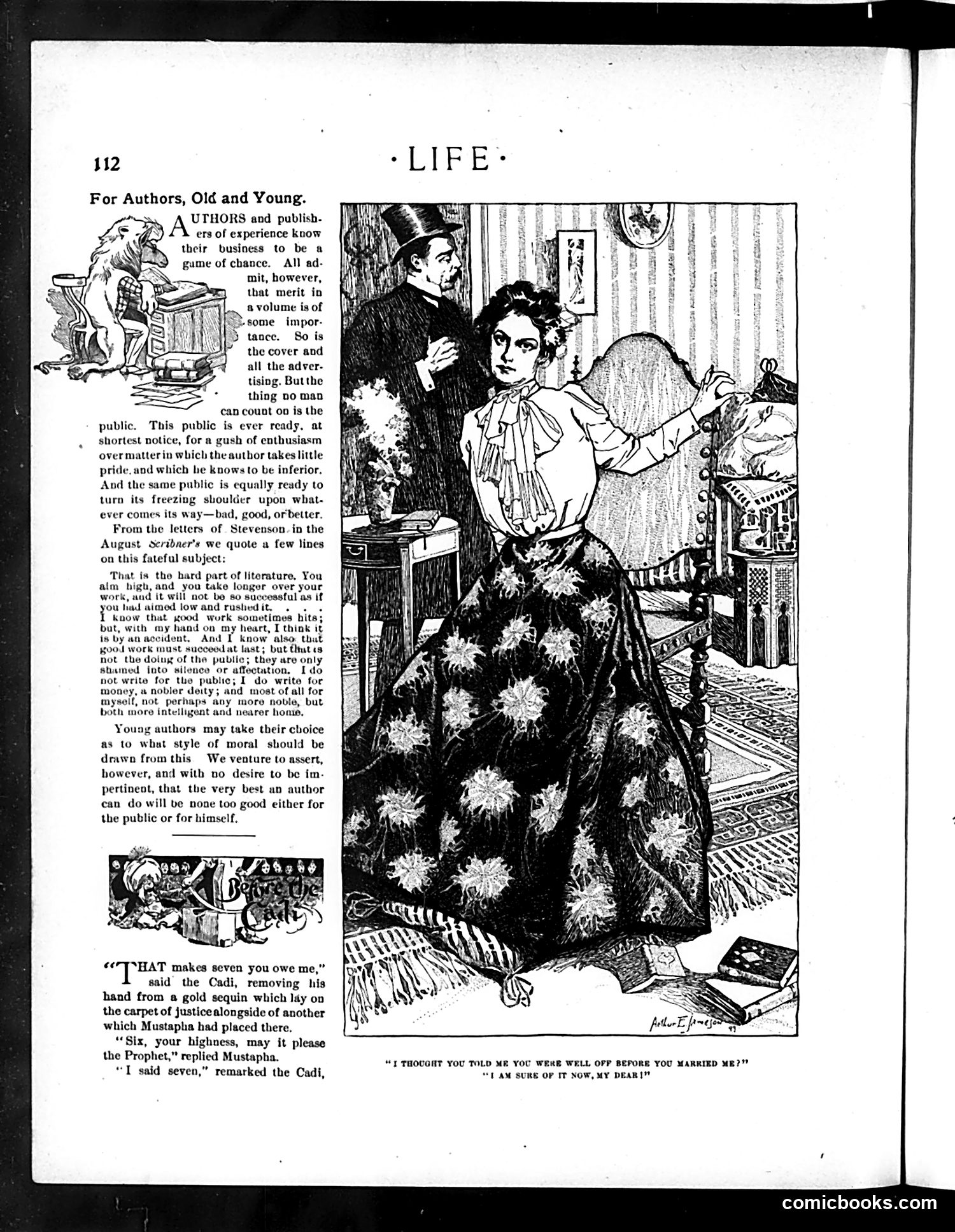
This page contains an essay titled "For Authors, Old and Young" discussing literary success and public taste. The left column features an illustration of a monkey at a desk with books, a visual metaphor for aspiring writers. The main illustration depicts a domestic scene: a woman in a patterned dress stands before a man in formal attire (top hat and coat) in what appears to be a bedroom. The caption reads: "I THOUGHT YOU TOLD ME YOU WERE WELL OFF BEFORE YOU MARRIED ME!" / "I AM SURE OF IT NOW, MY DEAR!" This is a marital satire joke about financial deception. The woman believed her husband was wealthy before marriage but has discovered otherwise. His response—claiming he's now "sure of it"—suggests he's become impoverished through the marriage, likely through her spending. The cartoon mocks both marital financial disputes and pre-marital misrepresentation common in early 20th-century social commentary.
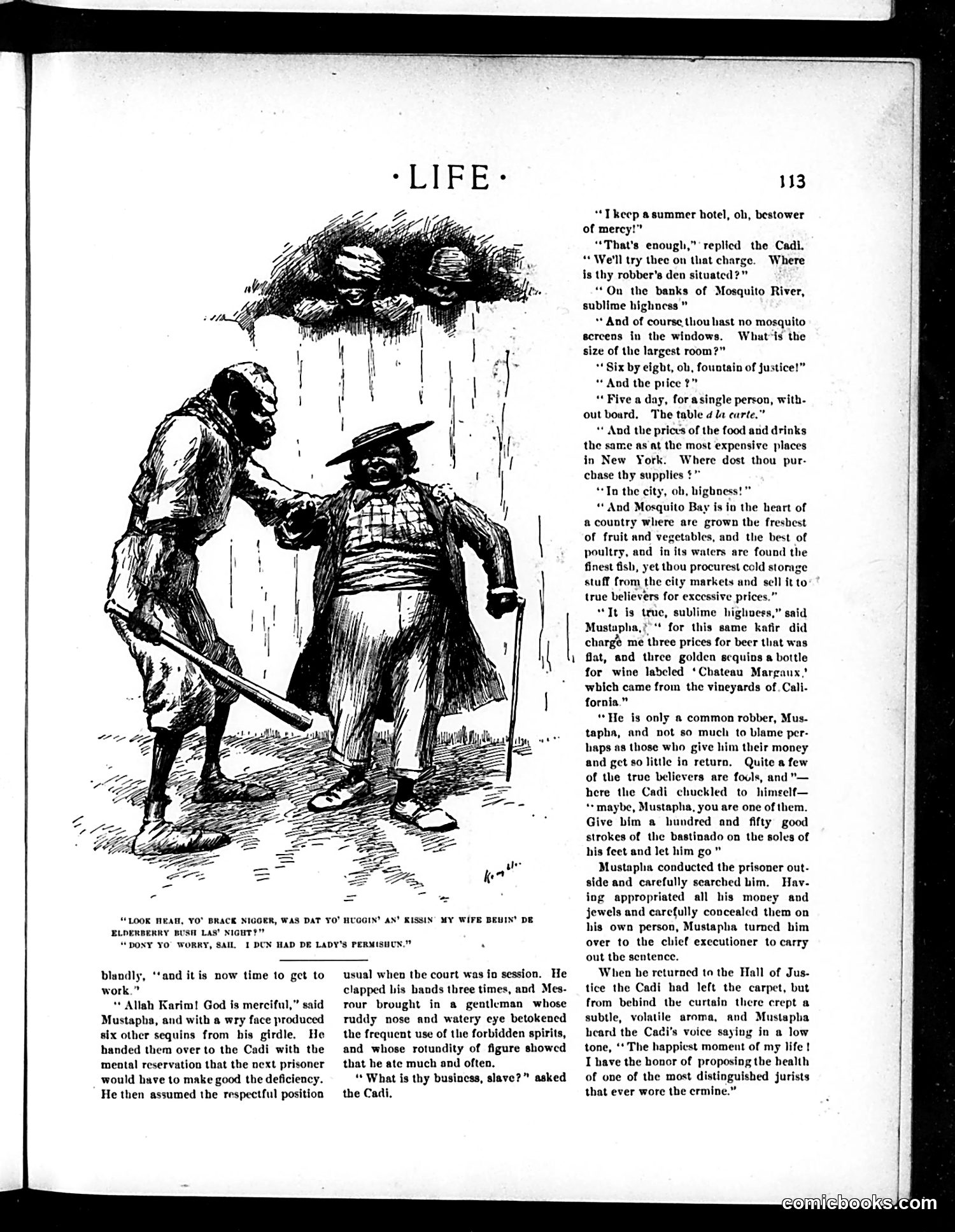
This Life magazine page satirizes American courtroom corruption by transposing it to an exotic colonial setting. The narrative follows Mustapha, a court official in what appears to be a fictionalized Middle Eastern or North African jurisdiction, prosecuting a hotel keeper for price-gouging. The satire's point: The corrupt judge (Cadi) extorts bribes from defendants disguised as "fines," then congratulates himself as a "distinguished jurist." Mustapha similarly steals from the convicted prisoner while executing sentence. The exotic setting allows American readers to mock their own legal system's hypocrisy—judges and officials who profit corruptly while maintaining appearances of justice and respectability. The top illustration depicts a racial confrontation (using contemporary racist language), likely representing American social attitudes the magazine also critiques through its broader satirical lens on institutional corruption.
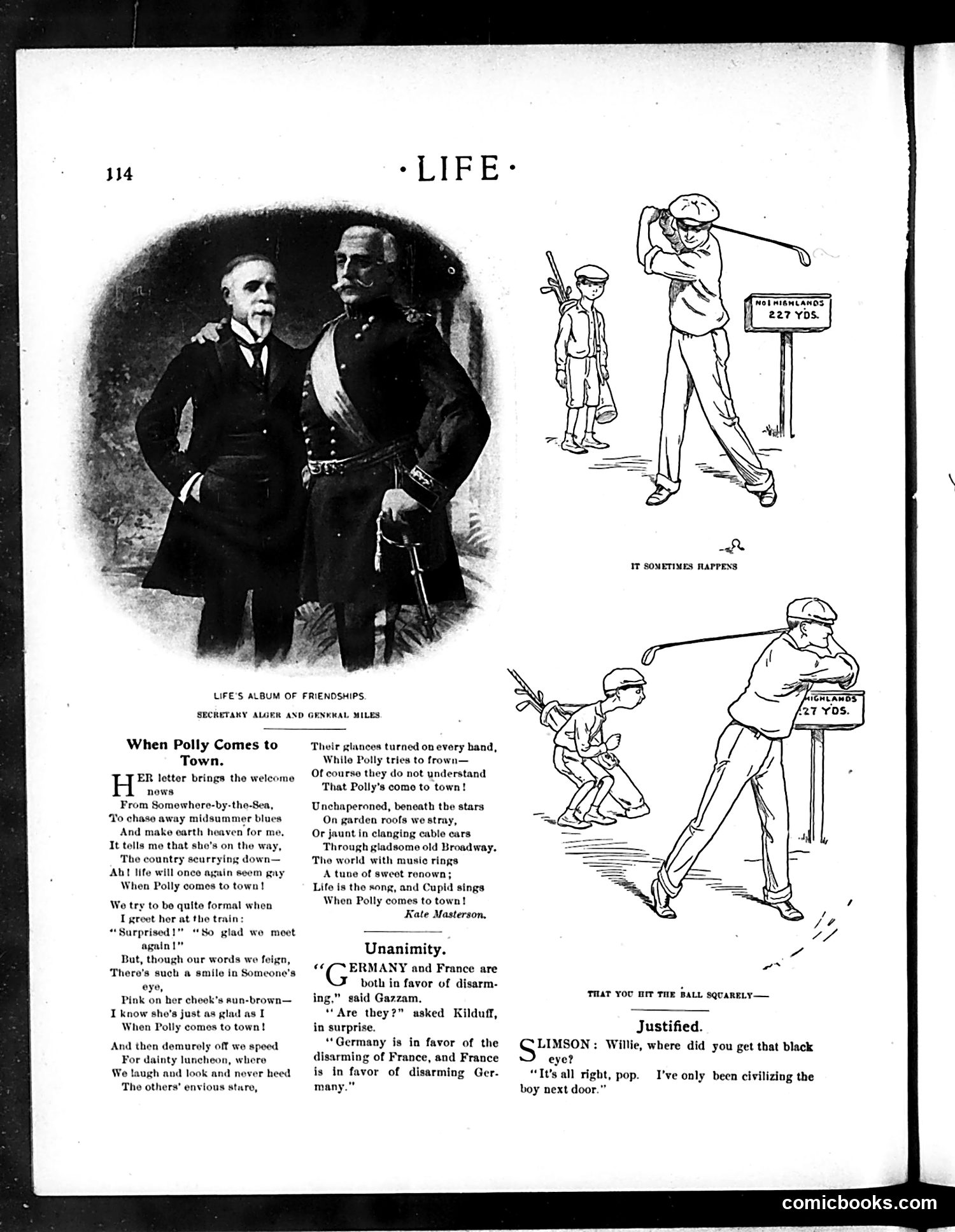
This page contains multiple distinct pieces: **Top Image**: "Life's Album of Friendships" shows Secretary Alger and General Miles—likely referring to Secretary of War Russell Alger and General Nelson Miles during the Spanish-American War era (context suggests early 1900s). **"When Polly Comes to Town"**: A sentimental poem about a romantic visit, unrelated to the political content. **"Unanimity"**: A brief satirical joke mocking the hypocrisy of international disarmament negotiations—Germany wants France disarmed while France wants Germany disarmed, creating false "agreement." **Golf Cartoon** ("That You Hit the Ball Squarely"): Three panels showing a golfer's improving technique at "Meadowlands" and "Highlands." **"Justified"**: A humor piece where a boy explains his black eye by claiming he's "civilizing the boy next door"—a joke playing on contemporary imperialist rhetoric about "civilizing" missions. The page blends sentimental verse, political satire about disarmament (likely post-WWI), and domestic humor reflecting early 20th-century American attitudes.
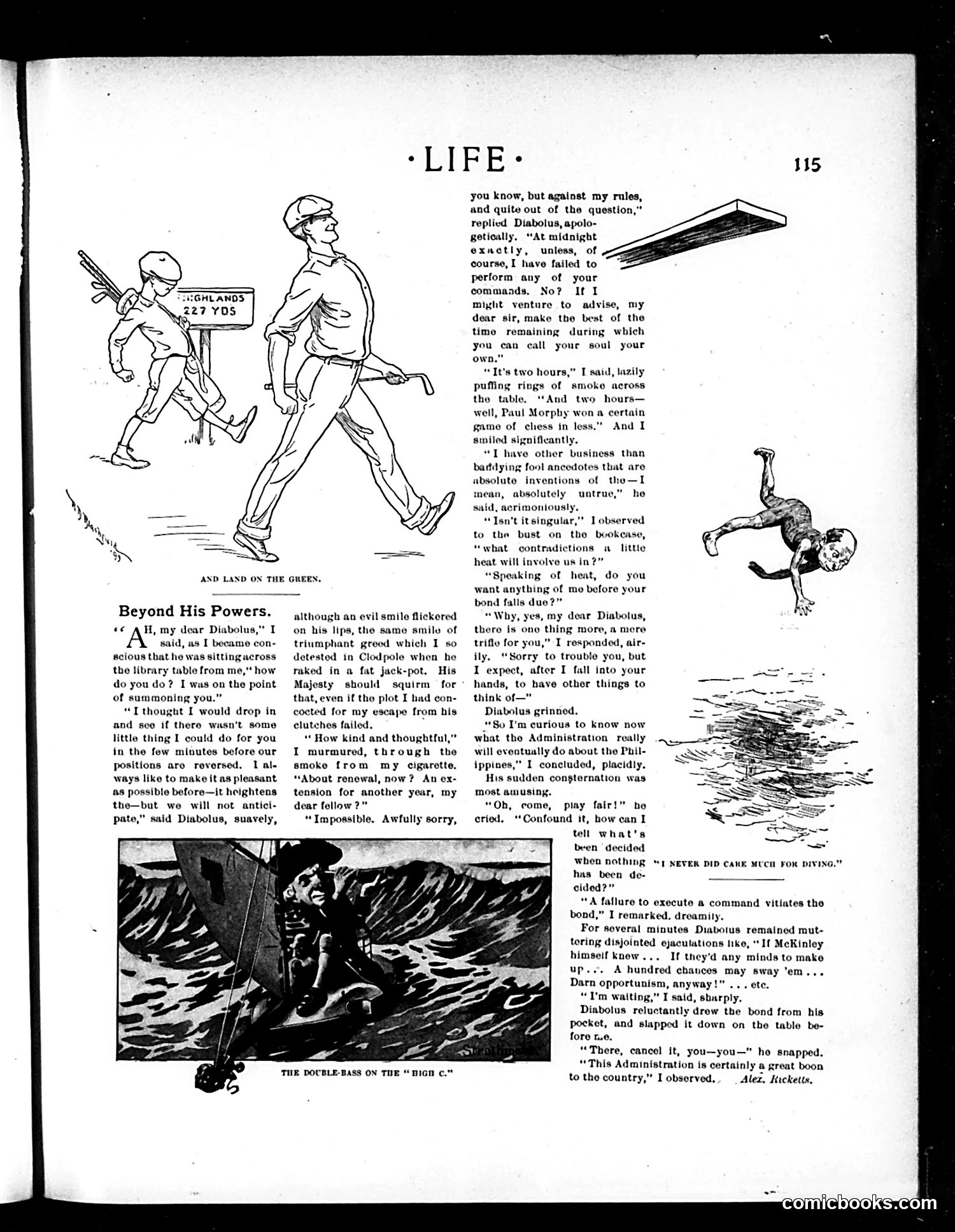
This is a Faustian dialogue between a man and "Diabolus" (the Devil), illustrated by Alex Hacketts. The unnamed protagonist has made a deal with the Devil, with his soul due at midnight—but he's devised a clever escape. The satire targets **President McKinley's Administration** and its handling of the **Philippine-American War** (1899-1902). The protagonist outwits the Devil by asking him to explain what the Administration will do about the Philippines—an impossible question, since McKinley's policy remained genuinely undecided and contradictory. By demanding the Devil answer an unanswerable question, the protagonist exploits a loophole: failure to execute commands voids the bond. The joke is that McKinley's Philippine policy is so confused and chaotic that even the Devil cannot navigate it—making government incompetence the ultimate escape clause. The cartoons above depict physical feats ("land on the green," acrobatics) as visual metaphors for attempting the impossible.
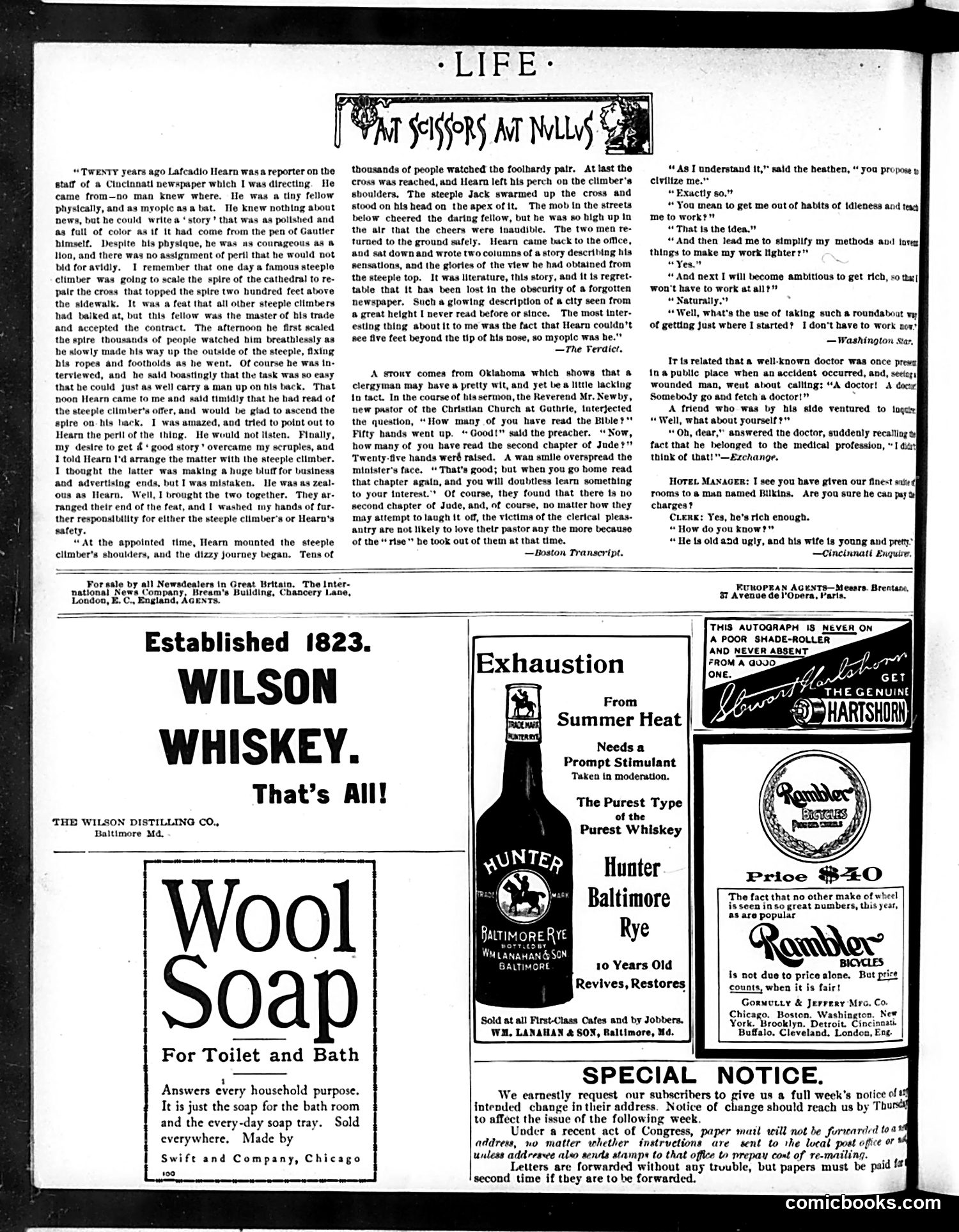
This page is primarily **not a political cartoon** but rather a literary/anecdotal magazine page featuring two stories about the writer Lafcadio Hearn and an Oklahoma clergyman. The first story recounts an anecdote from Hearn's journalism days: he was so myopic (nearsighted) that he couldn't see five feet ahead, yet he volunteered to ride a steeple climber's shoulders 200 feet up a cathedral spire to write a story. The satire targets **journalistic ambition and recklessness**—Hearn's willingness to risk death for copy, and the editor's willingness to permit it for a "good story." The second anecdote mocks a **preacher's poor judgment**: Reverend Newby asks his congregation who's read the Bible's second chapter of Jude—which doesn't exist. When fewer hands go up, he suggests they read it anyway, inadvertently revealing either his own ignorance or his attempt to trick his congregation. Both stories satirize professional figures (journalist, clergyman) through their foolishness or dishonesty. The page otherwise contains period advertisements (Wilson Whiskey, Wool Soap, Hunter Baltimore Rye).
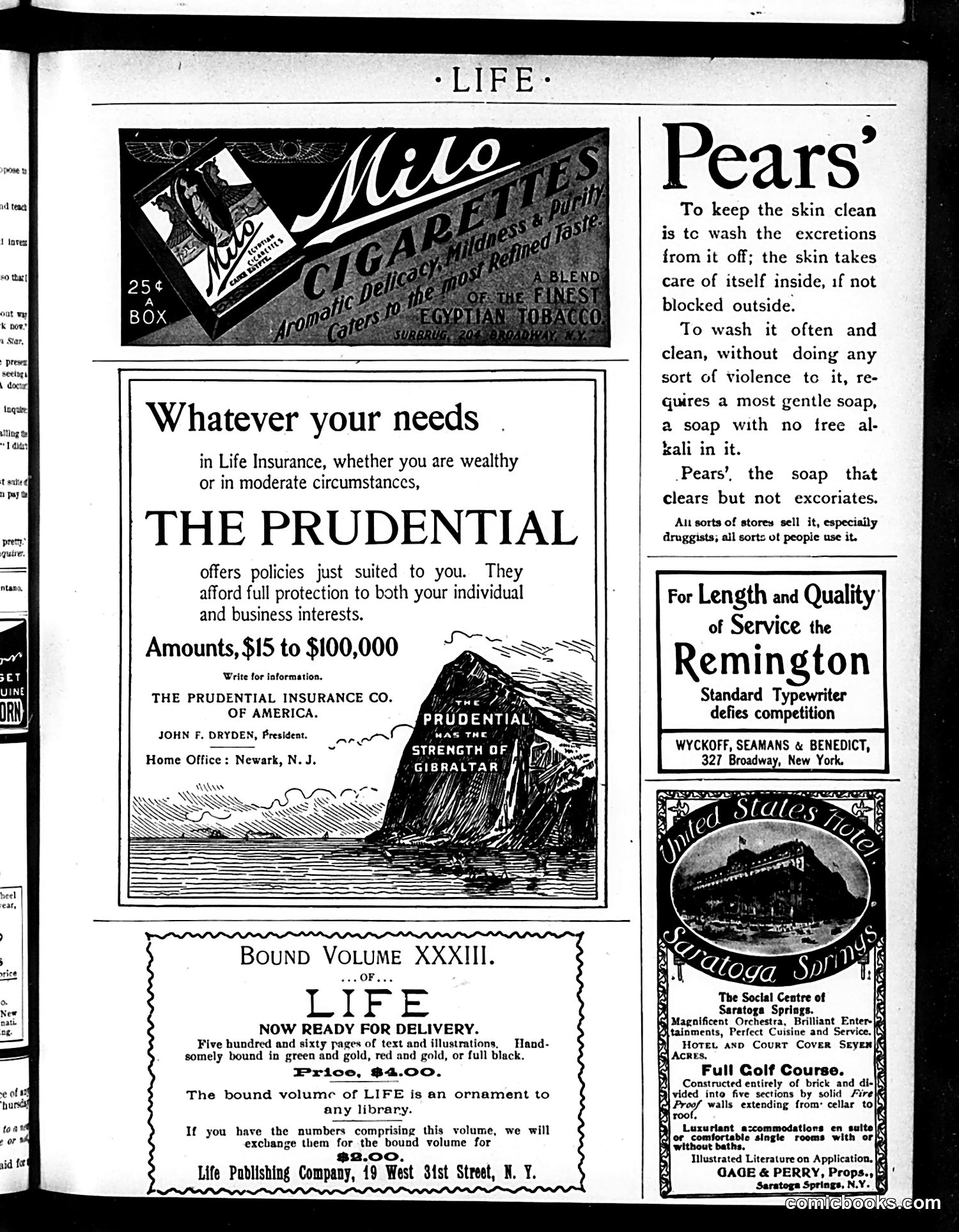
This is primarily an **advertising page** from Life magazine's bound Volume XXXIII, rather than satirical content. The page contains four distinct advertisements: 1. **Prudential Insurance**: Uses the Rock of Gibraltar as a strength metaphor—a common insurance industry trope suggesting stability and protection for policies ranging $15-$100,000. 2. **Pears' Soap**: Advertises gentle soap for skin care, emphasizing it won't damage skin with harsh alkali. 3. **Remington Typewriter**: Claims superiority in durability and performance. 4. **United States Hotel, Saratoga Springs**: Promotes luxury resort amenities including golf course and entertainment. The page also announces the bound volume itself is available for $4.00 (or $2.00 if exchanging loose issues). There is no visible political cartoon or satire on this page—it's a commercial product advertisement section typical of early 20th-century magazine publishing.
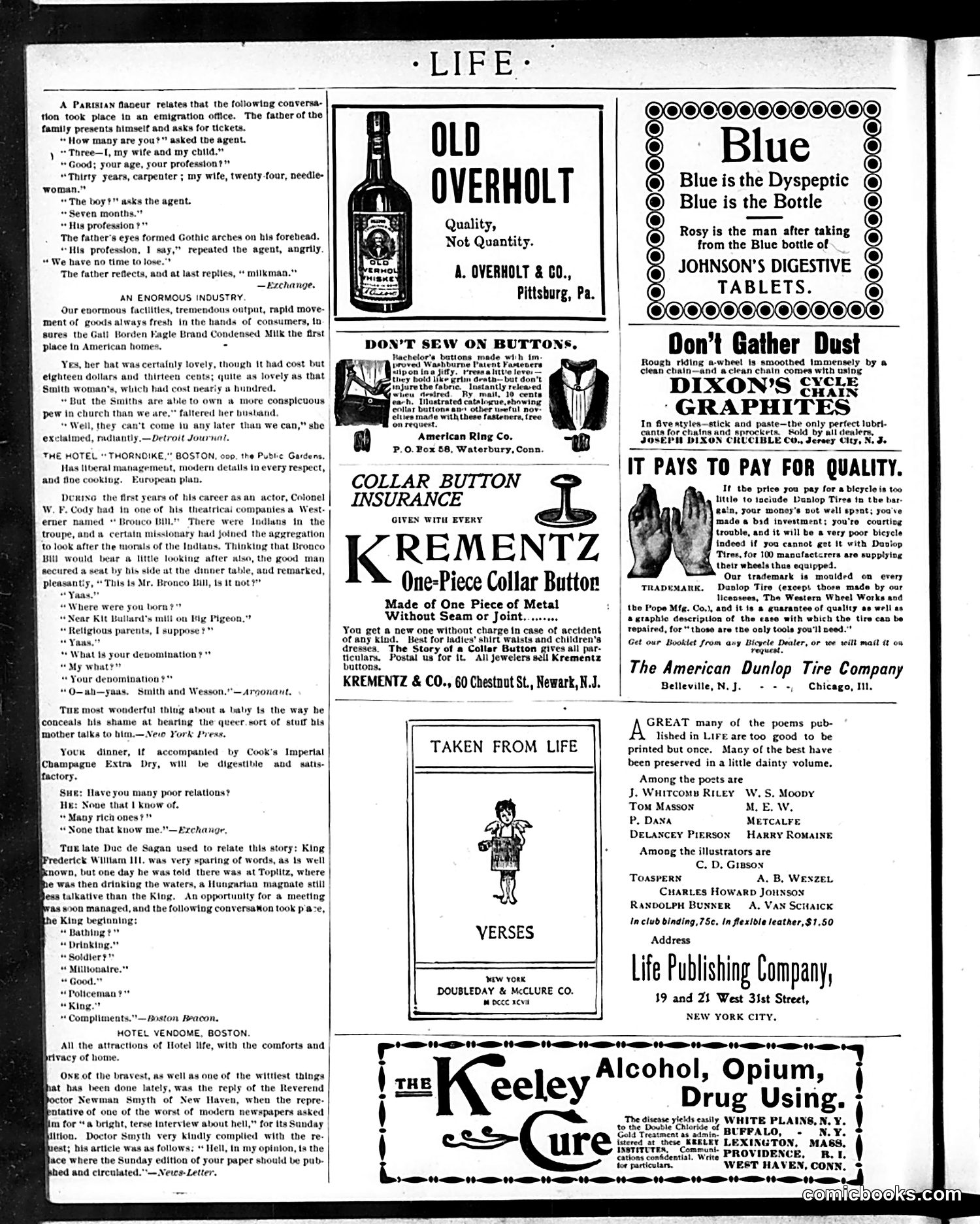
This page is primarily **advertising and humor columns**, typical of early 20th-century Life magazine. The main content includes: **Satirical Anecdotes:** - A Parisian emigration office joke where an agent demands the profession of a seven-month-old baby, and the father absurdly answers "milkman" - A story about Colonel Buffalo Bill's cast member "Bronco Bill," a barely-literate frontiersman whose "denomination" is "Smith and Wesson" (his guns) - An exchange between King Frederick William III and a taciturn Hungarian magnate, depicting aristocratic silence as virtue **The Satire:** These pieces mock human pretension, bureaucratic absurdity, class consciousness (the hat comparison), and frontier roughness—standard Life magazine humor targeting American social foibles. **Advertisements** dominate: Old Overholt whiskey, collar buttons, Johnson's Digestive Tablets, and Keeley Institute (addiction treatment)—reflecting period consumer culture and widespread patent medicine marketing. No specific political cartoons appear on this page.
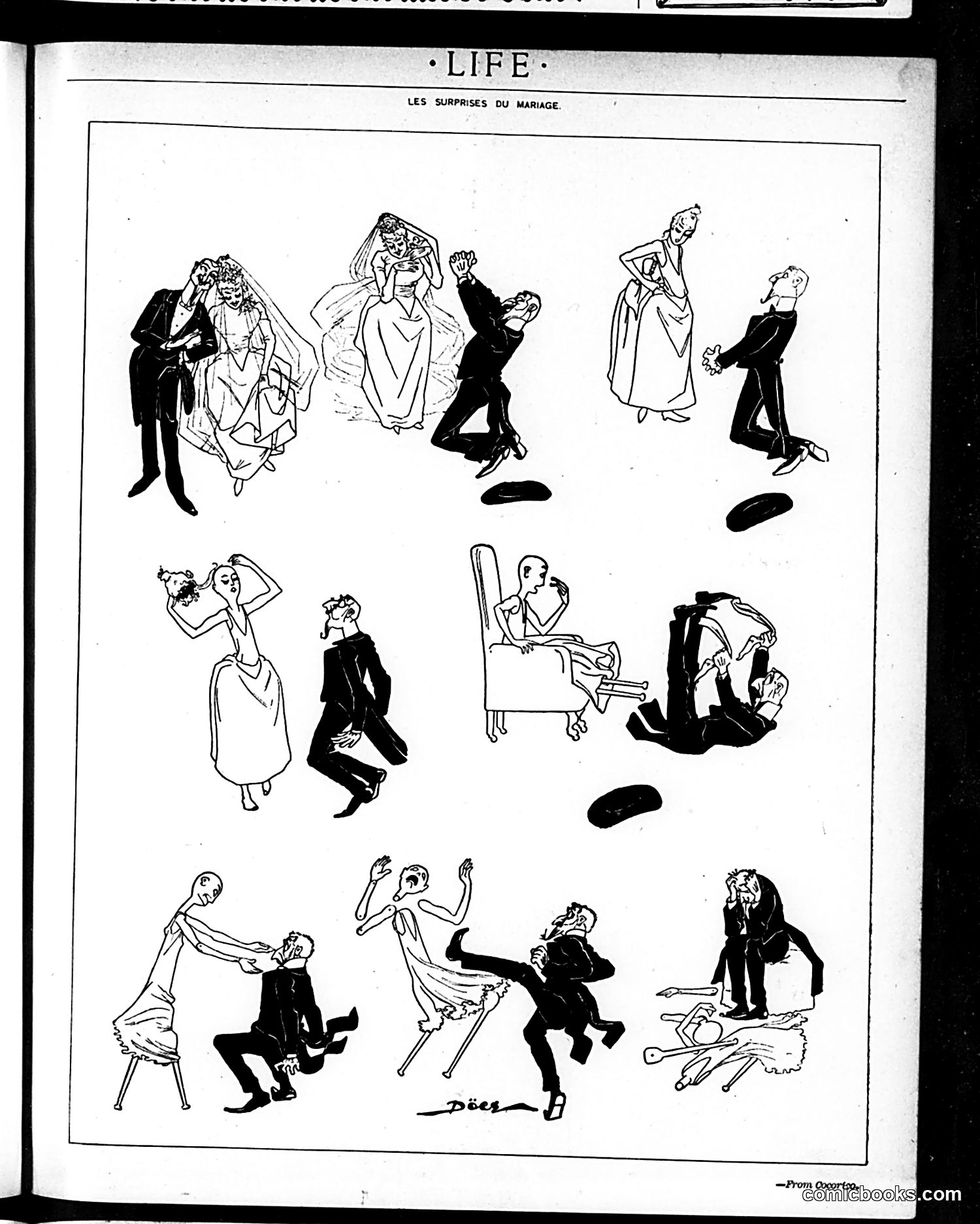
This is a humorous satirical cartoon series depicting the comic mishaps and indignities of married life. The title is in French, suggesting this may be a translation or inspired by French satirical traditions. The nine vignettes show various domestic disasters: a groom being attacked by the bride's relatives, a bride attacking the groom with a club, couples fighting, domestic chaos during intimate moments, and physical comedy involving furniture breaking. The cartoons mock the gap between wedding day expectations and the often chaotic reality of marriage. The stick-figure style and exaggerated violence are typical of early 20th-century satirical humor, presenting marriage as a battleground rather than romantic partnership—a common theme in period satire targeting both men and women's marital frustrations.
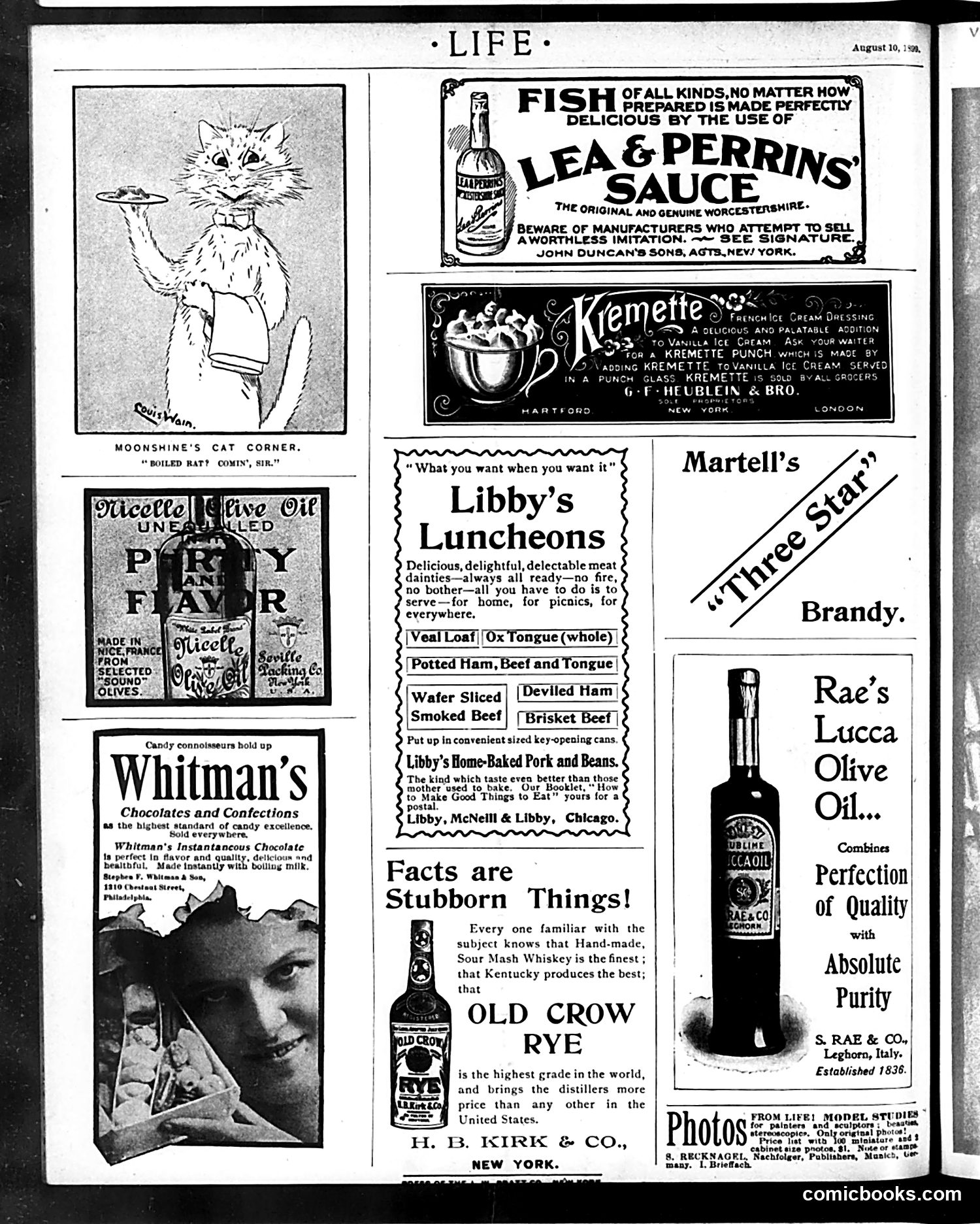
This page is primarily **advertising**, not political satire. The main cartoon—a whimsical drawing of a cat in formal dress holding a serving platter—appears to be "Moonshine's Cat Corner," likely a recurring humorous feature or mascot. The surrounding advertisements showcase early 1900s consumer products: Lea & Perrins sauce, Kremette ice cream dressing, Libby's canned meats, Whitman's chocolates, Old Crow Rye whiskey, Martell brandy, and Rae's olive oil. The only satirical element is the headline "Facts are Stubborn Things!"—an ironic caption accompanying the Old Crow Rye ad, perhaps mocking advertisers' exaggerated product claims. The phrase suggests that despite marketing language, certain truths (about product quality or superiority) remain unchanged. This reflects Life's dual function: satirical commentary mixed with lucrative advertising revenue.