
Life, 1899-08-10 · page 8 of 20
Life — August 10, 1899 — page 8: what you’re looking at
What you’re looking at
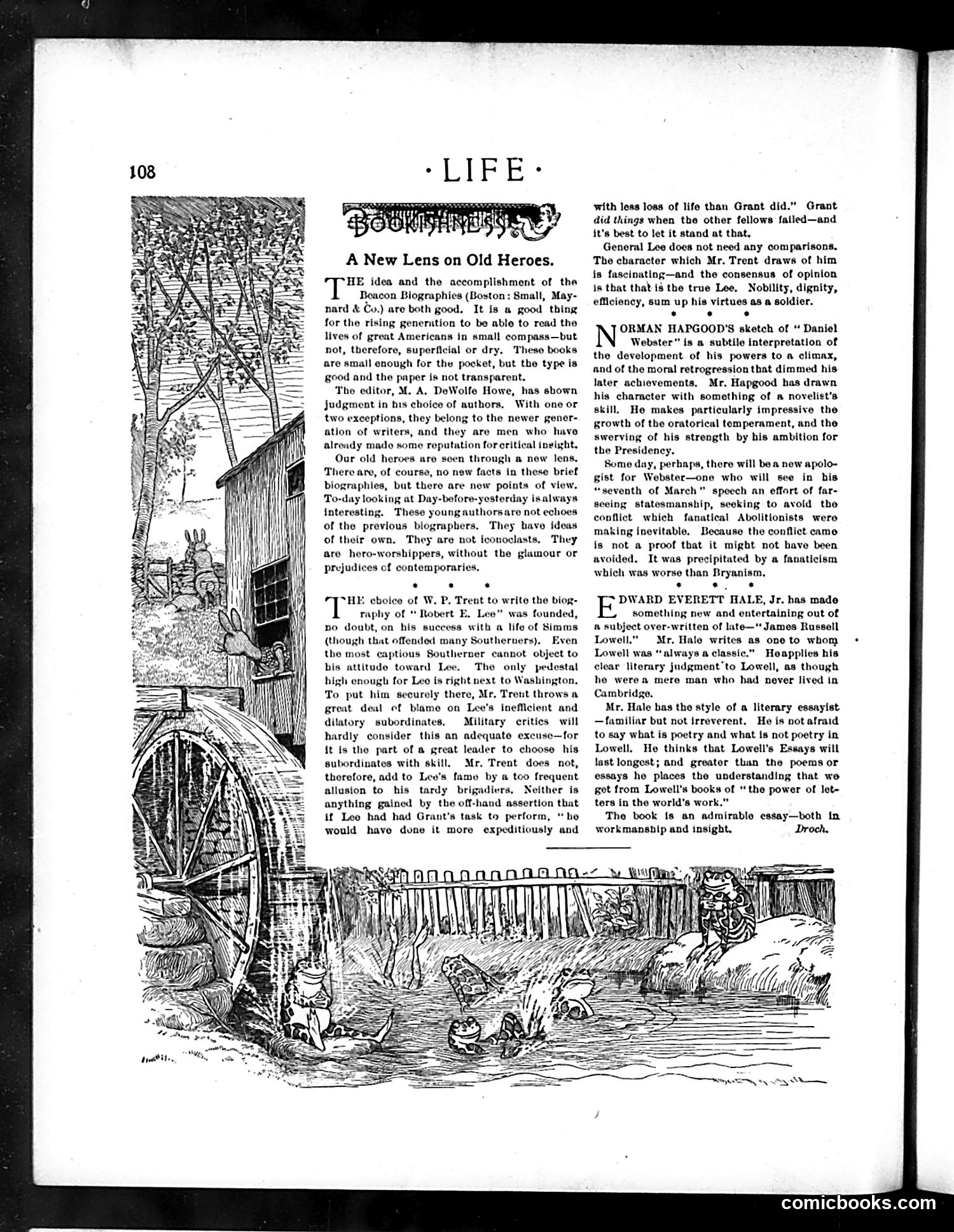
This page from *Life* magazine reviews new biographical works on historical American figures. The main illustration depicts a rustic cabin scene, likely referencing the frontier heritage of American heroes being discussed. The article "A New Lens on Old Heroes" critiques the *Beacon Biographies* series (published by Small, Maynard & Co.), praising the format while discussing how new authors interpret famous Americans. Specific reviews discuss W.P. Trent's biography of Robert E. Lee, Norman Hapgood's sketch of Daniel Webster, and Edward Everett Hale Jr.'s essay on James Russell Lowell. The satire targets how contemporary authors reimagine historical figures through modern perspectives rather than presenting straightforward facts—suggesting these "new" interpretations sometimes distort or overanalyze their subjects' characters and legacies.
📄 Transcribed text from this page (OCR, searchable)
Machine-transcribed from the original scan — historical spelling and the odd misread are preserved.
A New Lens on Old Heroes. HE idea and the accomplishment of the Beacon Biographies (Boston : Small, May- nard & Co.) are both good. It is a good thing for the rising generation to be able to read the lives of great Americans in small compass—but not, therefore, superficial or dry. These books are small enough for the pocket, but the type is good and the paper is not transparent, Tho editor, M. A, DeWolfe Howe, has shown judgment in his choice of authors, With one or two exceptions, they belong to the newer gener- ation of writers, and they are men who have alroudy mado some reputation for critical ineight. Our old heroes are soen through a new lens, There ary, of course, no new facts in these brief biographies, but there are new points of view. To-day looking at Day-before-yosterday is always interesting. These young authorsare not echoes of the previous biographers, They bavo ideas of their own, They are not iconoclasts, They are hero-worshippers, without the glamour or prejudices of contemporaries. * . . HE, choice of W. P. Trent to write the biog- T raphy of * Robert E, Lee” was founded, no doubt, on his success with a life of Simms (though that offended many Southervers), Even the most captious Southerner cannot object to bis attitude toward Lee. The only pedestal high cnough for Leo is right next to Washington, To put him securely there, Mr, Trent throws a great deal of blamo on Lee's inefMcient and dilatory subordinates, Military erities will hardly consider this an adequate excuse—for it Is tho part of a great leader to choose his subordinates with skill, Mr. Trent does not, therefore, add to Lee's fame by a too frequent allusion to his tardy brigadiers, Neither is anything gained by the off-hand assertion that if Lee had had Grant's task to perform, “he would havo done it more expeditiously and with less loss of life than Grant did.” Grant did things when the other fellows fatled—and it's best to let it stand at that, General Lee does not need any comparisons. The character which Mr. Trent draws of him is fascinating—and the consensus of opinion is that that is the true Lee, Nobility, dignity, efficiency, sum up his virtues as a soldier. . . . ORMAN HAPGOOD'S sketch of “ Daniel Webster” is a subtile interpretation of the development of his powers to a climax, and of the moral retrogression that dimmed his Jater achievements, Mr. Hapgood has drawn his character with something of a novelist’s skill. Ho makes particularly impressive the growth of the oratorical temperament, and the swerving of his strength by his ambition for the Presidency. Some day, perhaps, there will bea new apolo- gist for Webster—one who will see in bis “seventh of March” speech an effort of far- seeing statesmanship, seeking to avold tho conflict which fanatical Abolitionists wero making inevitable. Because the conflict came is not a proof that it might not have been avoided. It was precipitated by a fanaticism which was worse than Bryanism, . ele DWARD EVERETT HALE, Jr. has mado something new and entertaining out of a subject over-written of late—" James Russell Lowell.” Mr. Halo writes as one to whom. Lowell was “always a classic.” Hoapplies his clear literary judgment’to Lowell, as though he werea mere man who had never lived in Cambridge. Mr. Hale has the style of a literary essayist —familiar but not irreverent. He is not afraid to say what is poetry and what {s not poetry in Lowell. He thinks that Lowell's Essays will last longest; and greater than the poems or essays he places the understanding that wo got from Lowell’s books of “the power of let- ters in the world’s work.” The book is an admirable essay—both in workmansbip and insight, comicbooks.com