
Life, 1899-08-10 · page 4 of 20
Life — August 10, 1899 — page 4: what you’re looking at
What you’re looking at
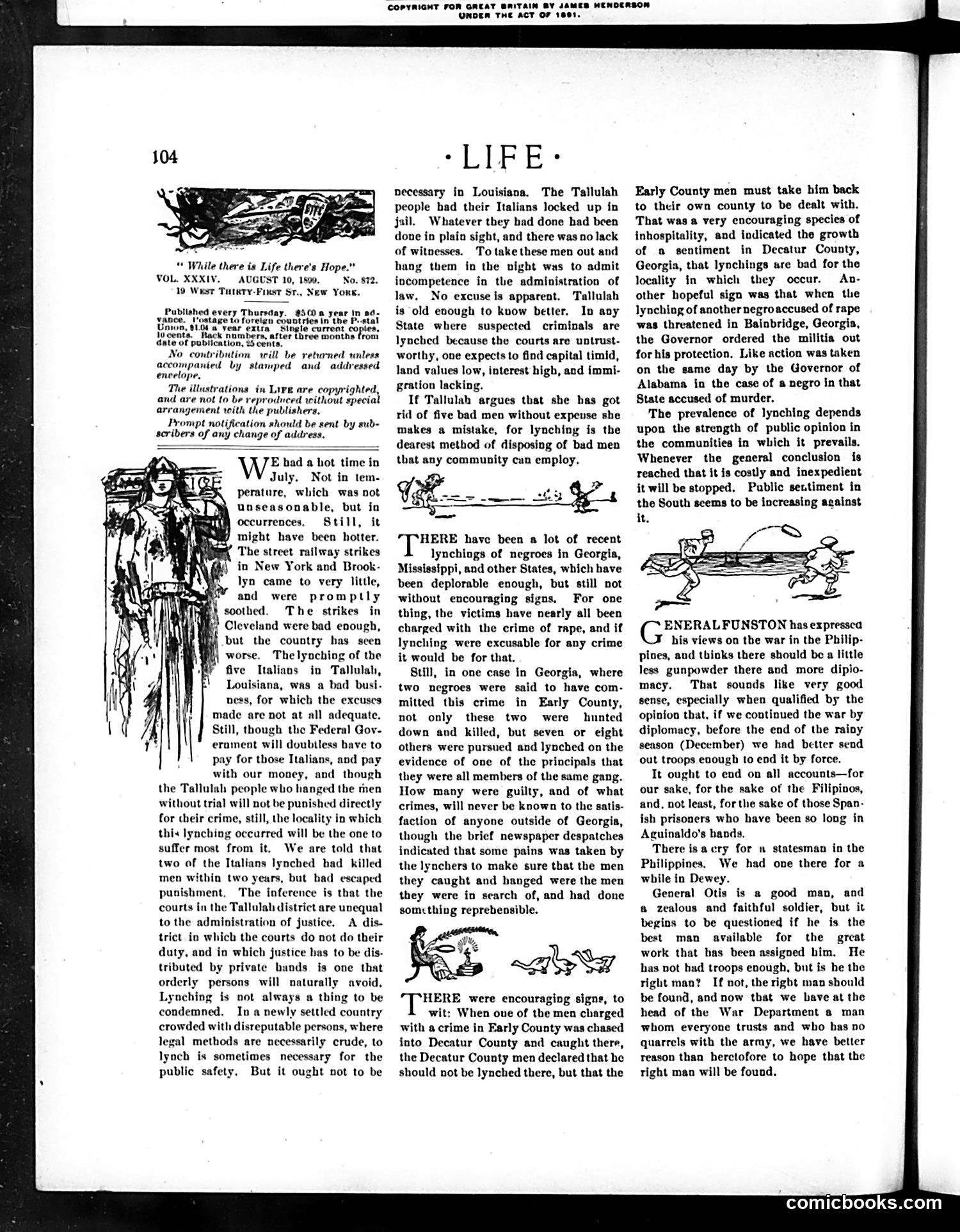
This page discusses recent lynchings of African Americans in Georgia, Mississippi, and other Southern states. The text argues that while lynching victims were often accused of rape, the punishment was disproportionate and undermined legal justice systems. The editorial acknowledges lynching as a response to serious crime but criticizes it as excessive and lawless. It notes that in one Georgia case, seven or eight men were lynched based on insufficient evidence, suggesting mob justice was indiscriminate. The accompanying illustrations appear to depict scenes of mob violence and flight, though specific figures aren't clearly identifiable. The overall message advocates for proper judicial proceedings rather than vigilante violence, reflecting Progressive Era concerns about rule of law and criminal justice reform.
📄 Transcribed text from this page (OCR, searchable)
Machine-transcribed from the original scan — historical spelling and the odd misread are preserved.
“ While there is Life there's Hope.” VOL. XXXIV. AU 19 West TutKry. Published every Thursday. #500 0 year In ad- ¥ Vostage to foreign countries in the P.stal 21.06 a year extra Single current copies, lucents. “Rack numbers, after three months from date of publication, 25 cents, No contribution will be retaned unless accompanied by stamped and addressed encelope. The illustrations in Live are copyrighted, and are not to be reproduced without special arrangement with the publishers. Prompt notification should be sent by sub- scribers of any change of address, WE bad a hot time in : July. Not in tem. perature, which was not unseasonable, but in KM occurrences. Still, it might have been hotter. The street railway strikes in New York and Brook- lyn came to very little, and were promptly i soothed. The strikes in Cleveland were bad enough, but the country has seen fl worse. The lynching of the five Italians in Tallulah, Louisiana, was a bad busi. ness, for which the excuscs made are not at all adequate. Still, though the Federal Gov- erament will doubtless bave to pay for those Italians, and pay with our money, and though the Tallulah people who hanged the men without trial will not be punished directly for cheir crime, still, the locality in which this lynching occurred will be the one to suffer most from it. We are told that two of the Italians lynched had killed men within two years, but bad escaped punishment, The inference is that the courts in the Tallulah district are unequal to the administration of justice, A dis- trict. in which the courts do not do their duty, and in which justice has to be dis- tributed by private bands is one that orderly persons will naturally avoid, Lynching is not always a thing to be condemned. In a newly settled country crowded with disreputable persons, where legal methods are necessarily crude, to lynch is sometimes necessary for the public safety. But it ought not to be MST ST., New Youre. ‘COPYRIGHT FOR GREAT BRITAIN BY UNDER THE ACT OF 1801. *LIPE necessary in Louisiana. The Tallulah people had their Italians locked up in jail. Whatever they bad done had been done in plain sight, and there was no lack of witnesses. To take these men out and hang them in the night was to admit incompetence in the administration of law. No excuse is apparent. Tallulah is old enough to know better. In any State where suspected criminals are lynched because the courts are untrust- worthy, one expects to find capital timid, land values low, interest high, and immi- gration lacking. If Tallulah argues that she has got rid of five bad men without expense she makes a mistake, for lynching is the dearest method of disposing of bad men that any community cun employ. HERE have been a lot of recent lynchings of negroes in Georgia, Mississippi, and other States, which have been deplorable enough, but still not without encouraging signs, For one thing, the victims have nearly all been charged with the crime of rape, and if lynching were excusable for any crime it would be for that. Still, in one case in Georgia, where two negroes were said to have com- mitted this crime in Early County, not only these two were hunted down and killed, but seven or eight others were pursued and lynched on the evidence of one of the principals that they were all members of the same gang. How many were guilty, and of what crimes, will never be known to the satis- faction of anyone outside of Georgia, though the brief newspaper despatches indicated that some pains was taken by the lynchers to make sure that the men they caught and hanged were the men they were in search of, and had done somthing reprebensible. "THERE were encouraging signs, to wit: When one of the men charged with a crime in Early County was chased into Decatur County and caught there, the Decatur County men declared that he should not be lynched there, but that the MENDERSON Early County men must take him back to their own county to be dealt with. That was a very encouraging species of inhospitality, and indicated the growth of a sentiment in Decatur County, Georgia, that lynchings are bad for the locality in which they occur. An- other hopeful sign was that when the lynching of another negroaccused of rape was threatened in Bainbridge, Georgia, the Governor ordered the militia out for his protection. Like action was taken on the same day by the Governor of Alabama in the case of 8 negro in that State accused of murder. The prevalence of lynching depends upon the strength of public opinion in the communities in which it prevails. Whenever the general conclusion is reached that it is costly and inexpedient it will be stopped. Public sentiment in the South seems to be increasing against ENERALFUNSTON has expressca his views on the war in the Philip- pines, and thinks there should be a little less gunpowder there and more dipio- macy. That sounds like very good sense, especially when qualified by the opinion that, if we continued the war by diplomacy, before the end of the rainy season (December) we had better send out troops enough to end it by force. It ought to end on all accounts—for our sake, forthe sake of the Filipinos, and, not least, forthe sake of those Span- ish prisoners who have been so long in Aguinaldo’s hands. There isacry for « statesman in the Philippines. We had one there for a while in Dewey. General Otis is a good man, and a zealous and faithful soldier, but it begins to be questioned if he is the best man available for the great work that bas been assigned bim. He has not had troops enough, but is he the right man? If not, the right man should be found, and now that we have at the head of the War Department a man whom everyone trusts and who bas no quarrels with the army, we have better reason than herctofore to hope that the right man will be found. comicbooks.com