
A complete issue · 20 pages · 1899
Life — June 22, 1899
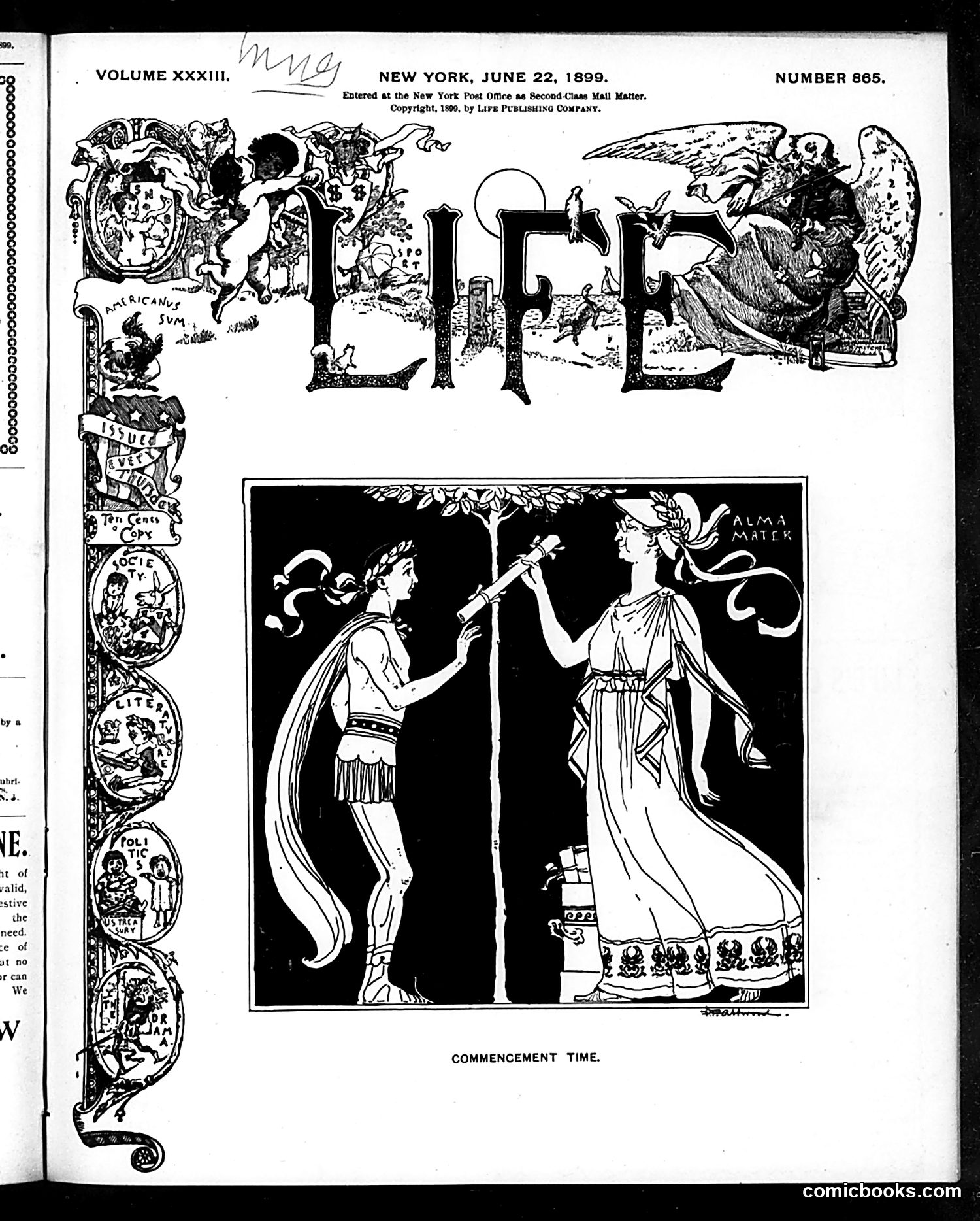
This appears to be a cover for Life magazine's commencement season issue. The main illustration, titled "Commencement Time," depicts two classical allegorical figures: a young woman (labeled "Alma Mater," the traditional personification of educational institutions) presenting a torch or staff to a younger figure in Roman/classical dress, likely representing a graduating student or youth entering the world. The satire likely comments on the ideals versus realities of education and preparation for adulthood. The classical styling suggests Life is making a point about whether institutions adequately prepare graduates for modern life. The decorative border on the left contains various emblematic symbols, typical of Life's ornate design aesthetic from this era.
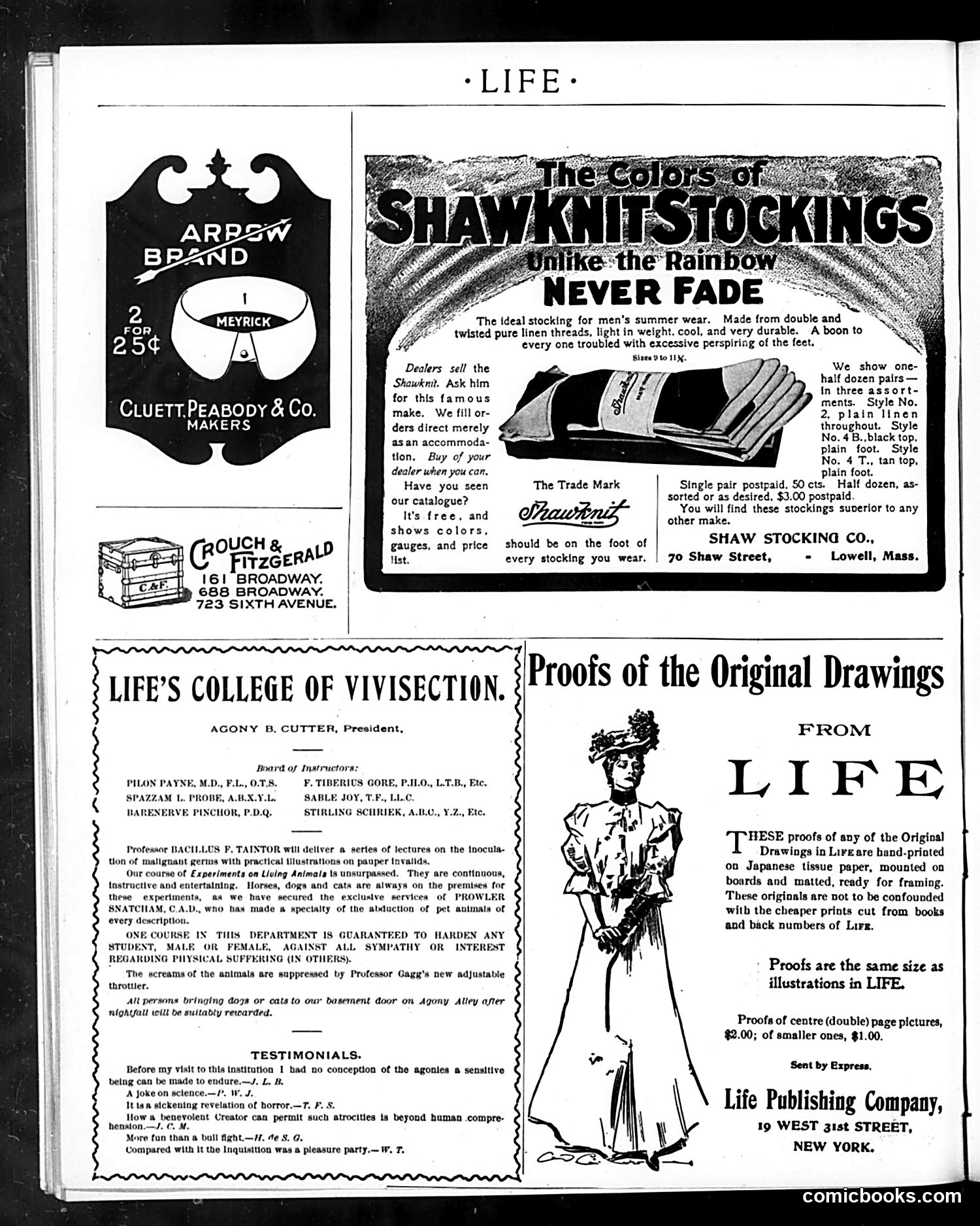
This page contains **advertisements rather than political cartoons**. The main content includes: 1. **Arrow Brand Collars** (top left) - a haberdashery ad 2. **Crouch & Fitzgerald trunks** (lower left) - luggage advertising 3. **Shawknit Stockings** (center-right) - the dominant ad, promoting men's summer hosiery with claims about color-fastness 4. **Life's College of Vivisection** (lower left) - an institutional advertisement for lectures on animal experimentation 5. **Life Publishing Company** (right) - promoting original artwork proofs from Life magazine illustrations There is **no political satire or social commentary** on this page. It's a straightforward commercial advertising page typical of early-20th-century magazines, mixed with institutional announcements from Life magazine itself.
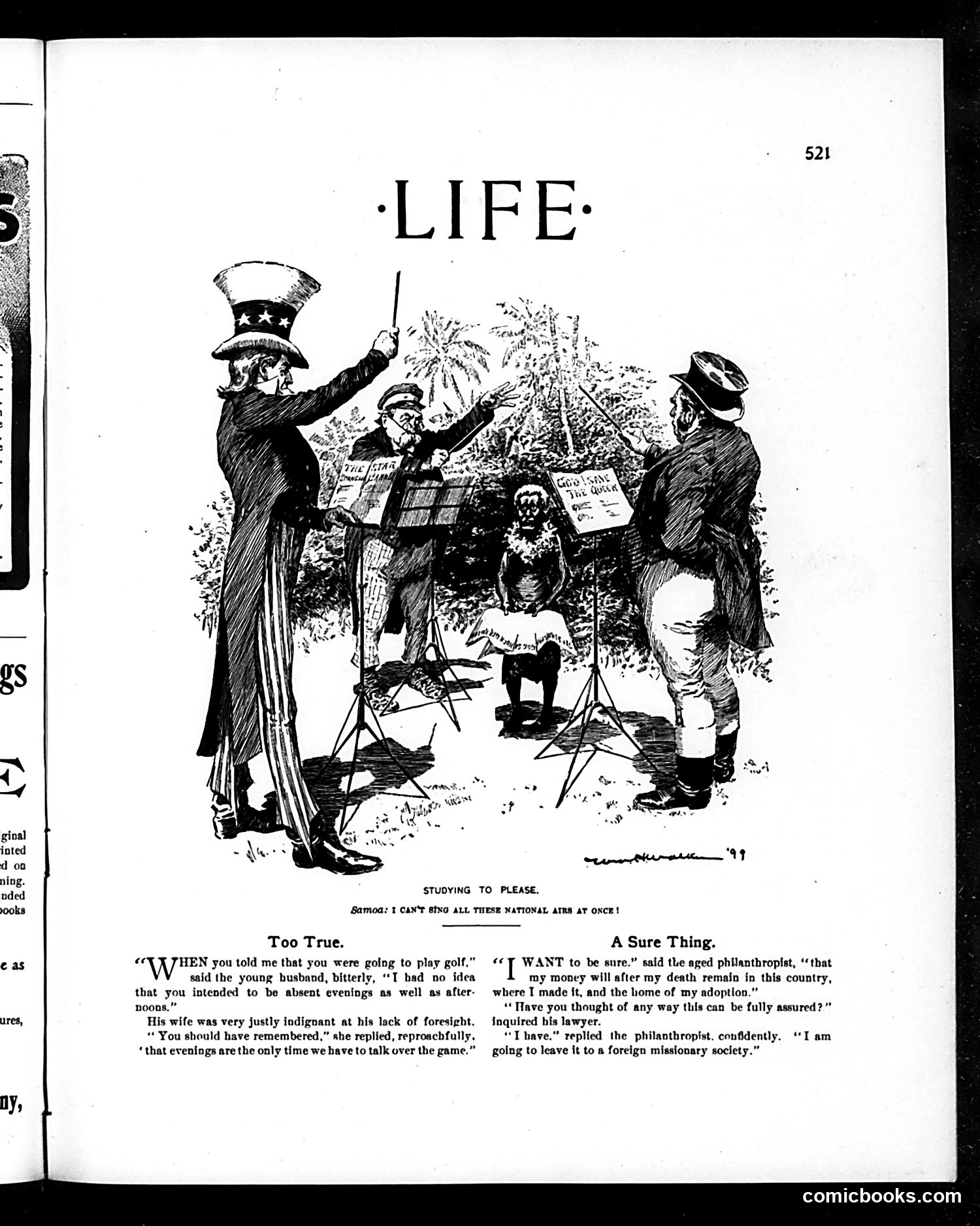
The main cartoon, titled "Studying to Please," depicts Uncle Sam (left, in starred top hat) attempting to juggle multiple "national airs" while military and civilian figures observe. The caption reads: "I CAN'T SING ALL THESE NATIONAL AIRS AT ONCE!" This satirizes American efforts to maintain diplomatic relations with multiple nations simultaneously, likely during a period of international tension (possibly WWI era, given the military uniforms). Uncle Sam's struggle represents the difficulty of pleasing all countries at once. Below are two brief humorous anecdotes: "Too True" concerns a husband's golf priorities over domestic conversation, and "A Sure Thing" features an aged philanthropist planning to leave his money to a foreign missionary society rather than his adopted daughter—satirizing both wealthy miserliness and naive charitable giving.
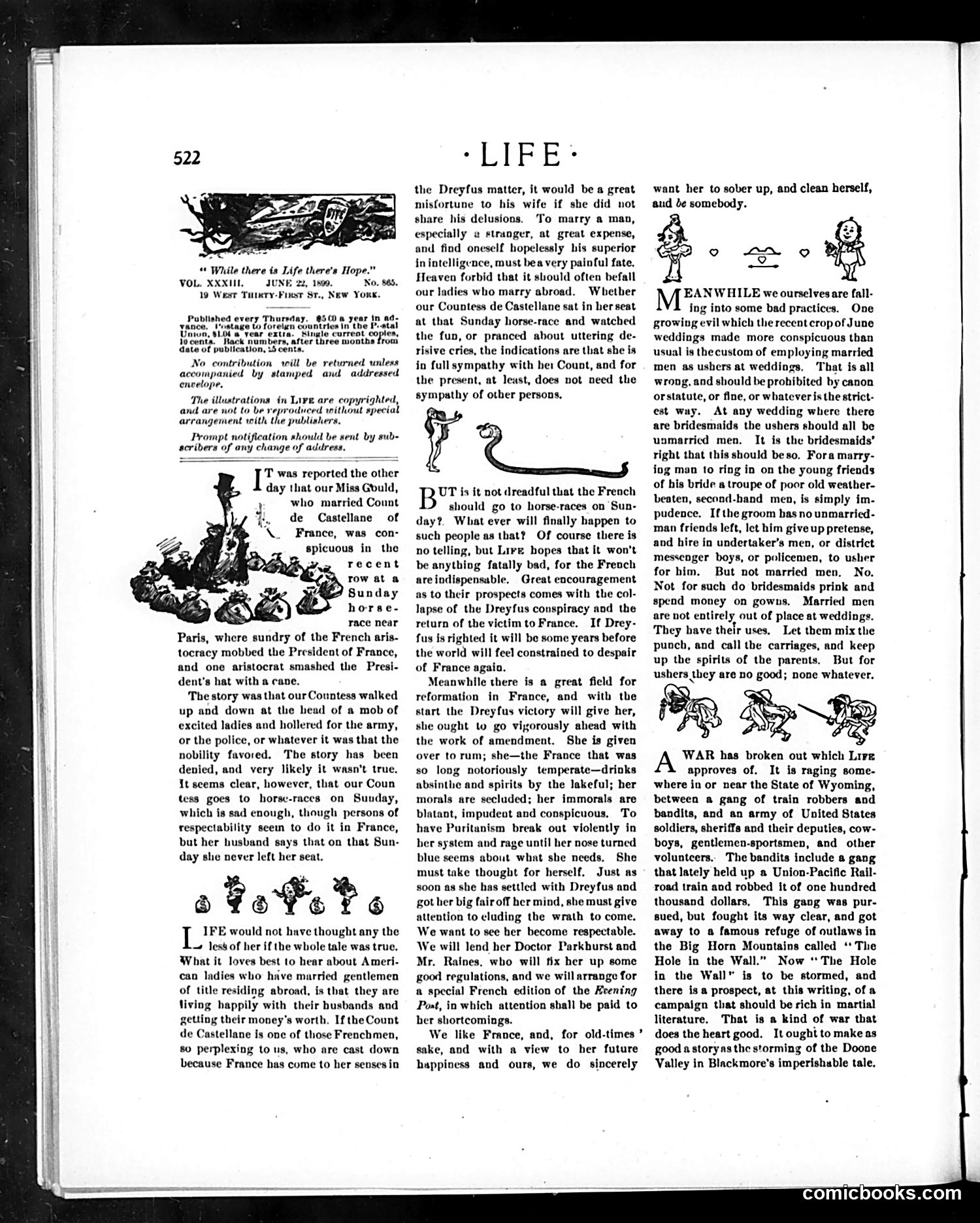
This page satirizes French aristocratic society and the Dreyfus Affair, a major scandal dividing France. The text references "Count de Castellane" and discusses French nobility marrying wealthy foreign women at great expense. The left cartoon depicts a chaotic scene at a Paris Sunday horse-race, likely showing the social tumult surrounding the Dreyfus case. The caption suggests French society is fracturing over the scandal. The main text criticizes French aristocrats—particularly Castellane—for marrying foreign heiresses for money while remaining morally corrupt. It argues they're unfit to be ushers at weddings, let alone social leaders. The page also mentions a recent gang robbery in Wyoming and a train robbery, connecting international crime to the theme of moral corruption among the supposedly elite.
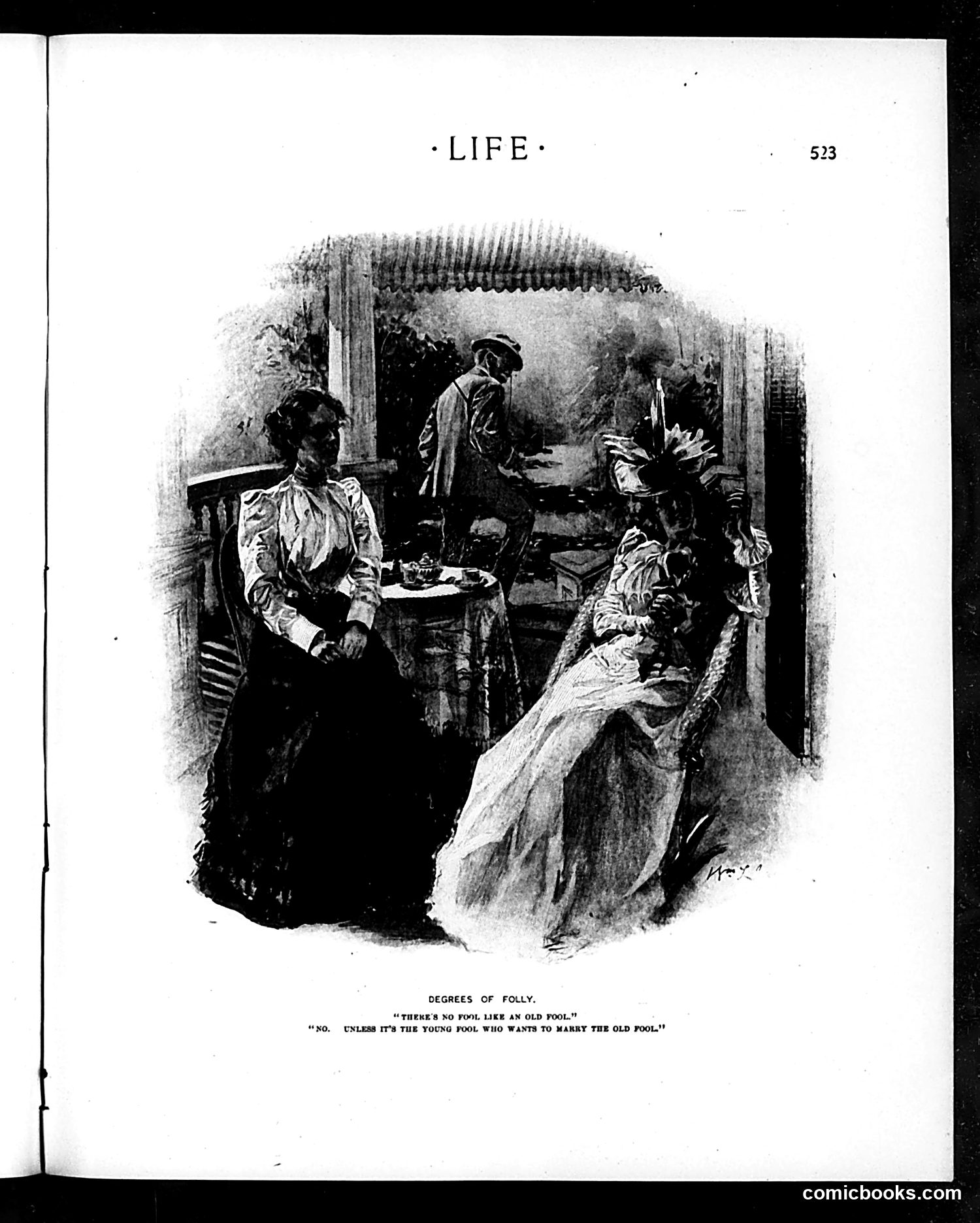
This satirical illustration depicts a Victorian-era social scene with the caption: "There's no fool like an old fool" / "No. Unless it's the young fool who wants to marry the old fool." The cartoon critiques May-December romances, specifically mocking the folly of young women pursuing marriage with older men for financial security or social advancement. The scene shows women in a drawing room, with the apparent elderly male suitor in the background. The satire targets both parties: the "old fool" seeking youth and the "young fool" seeking wealth or status through marriage. This reflects late 19th/early 20th-century anxieties about mercenary marriages and the desperation of unmarried women with limited economic options.
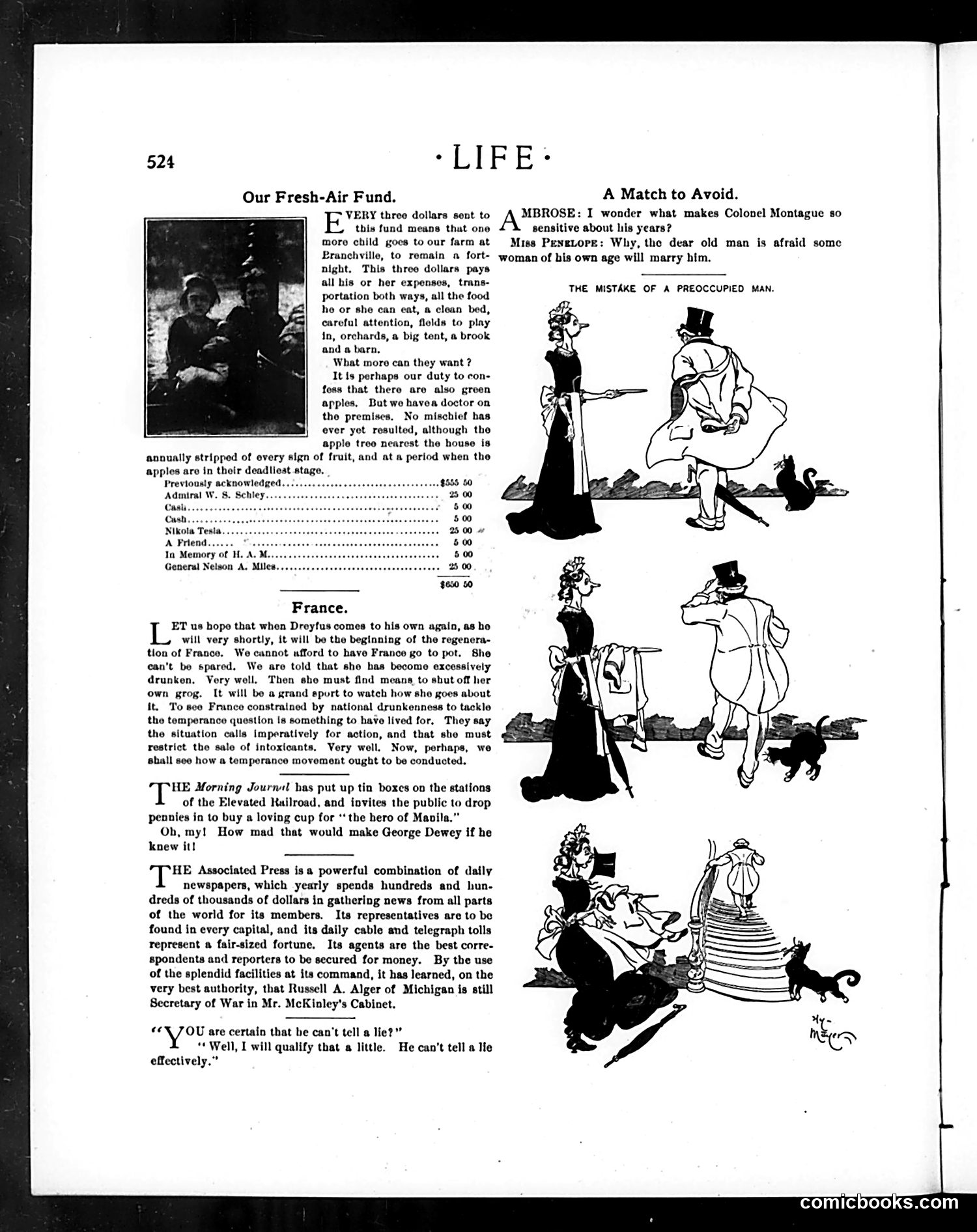
This six-panel comic satirizes a distracted gentleman, depicted through sequential illustrations. Each panel shows the man in progressively absurd situations—riding what appears to be a dog, sitting on a woman's lap, or being dragged by clothing—all apparently because he's lost in thought about something else. The joke hinges on the period concept that a "preoccupied" (absentminded) man becomes oblivious to social propriety and physical reality. The cartoonist uses exaggerated situations to mock male inattentiveness and the social chaos it causes. The page also contains unrelated editorial content about charity funds, France, and journalism. Without additional context, the specific "mistake" reference remains unclear.
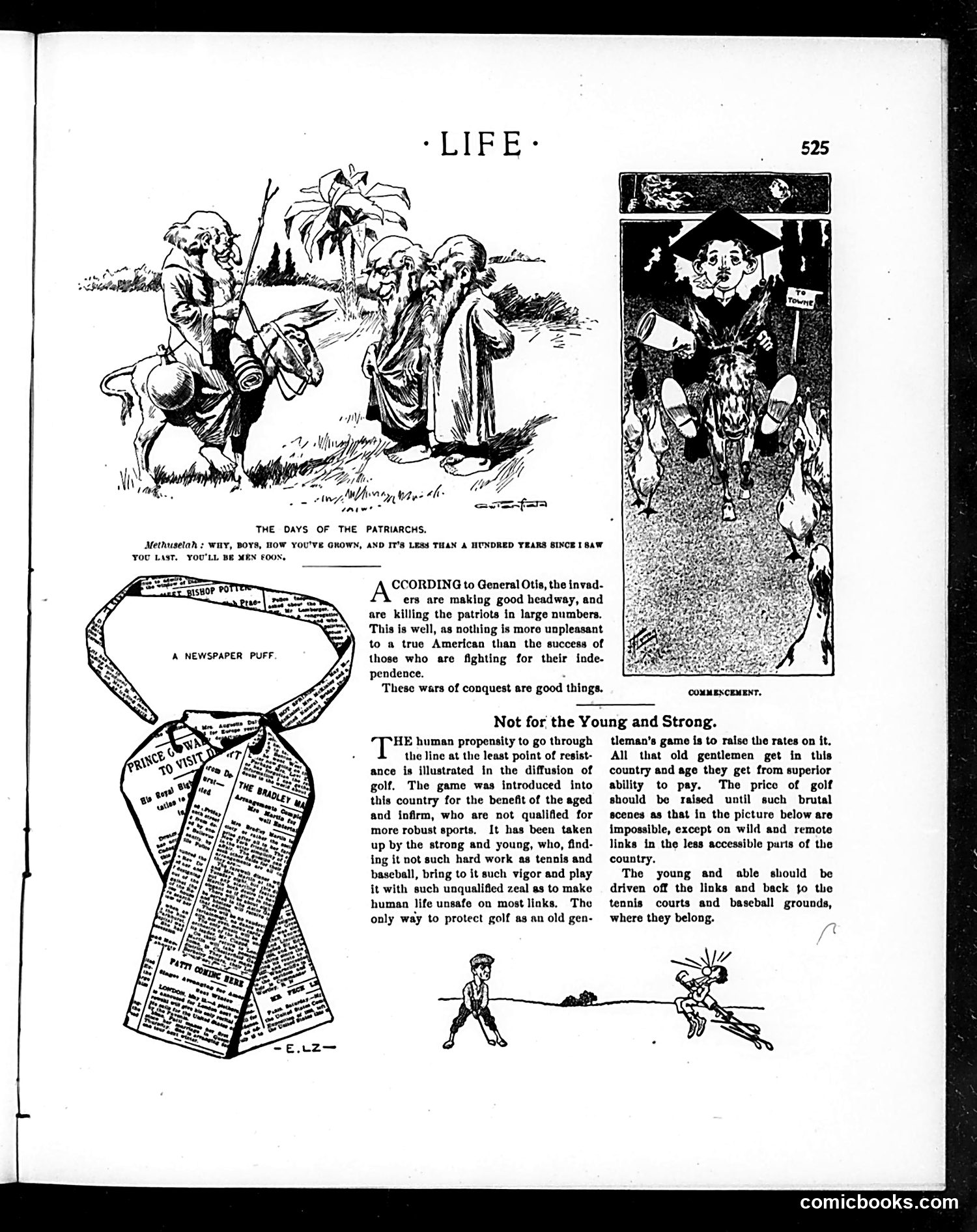
**"The Days of the Patriarchs"** (top left): A satirical cartoon mocking elderly military/political figures. The caption jokes that these men haven't changed in over a hundred years, suggesting their ideas are outdated. **"A Newspaper Puff"** (center): A critical diagram shaped like a bottle or vessel, labeled with newspaper mastheads and sections. It satirizes how newspapers are constructed—suggesting they're hollow vessels containing merely promotional puffery rather than substantive content. **"Not for the Young and Strong"** (main article): This piece argues golf should be restricted to elderly gentlemen, as younger, stronger people are making it too competitive and dangerous. It advocates keeping golf an "old gentlemen's game" and relegating athletic youth to tennis and baseball. The overall page criticizes both aging institutional authority and modern competitive excess.
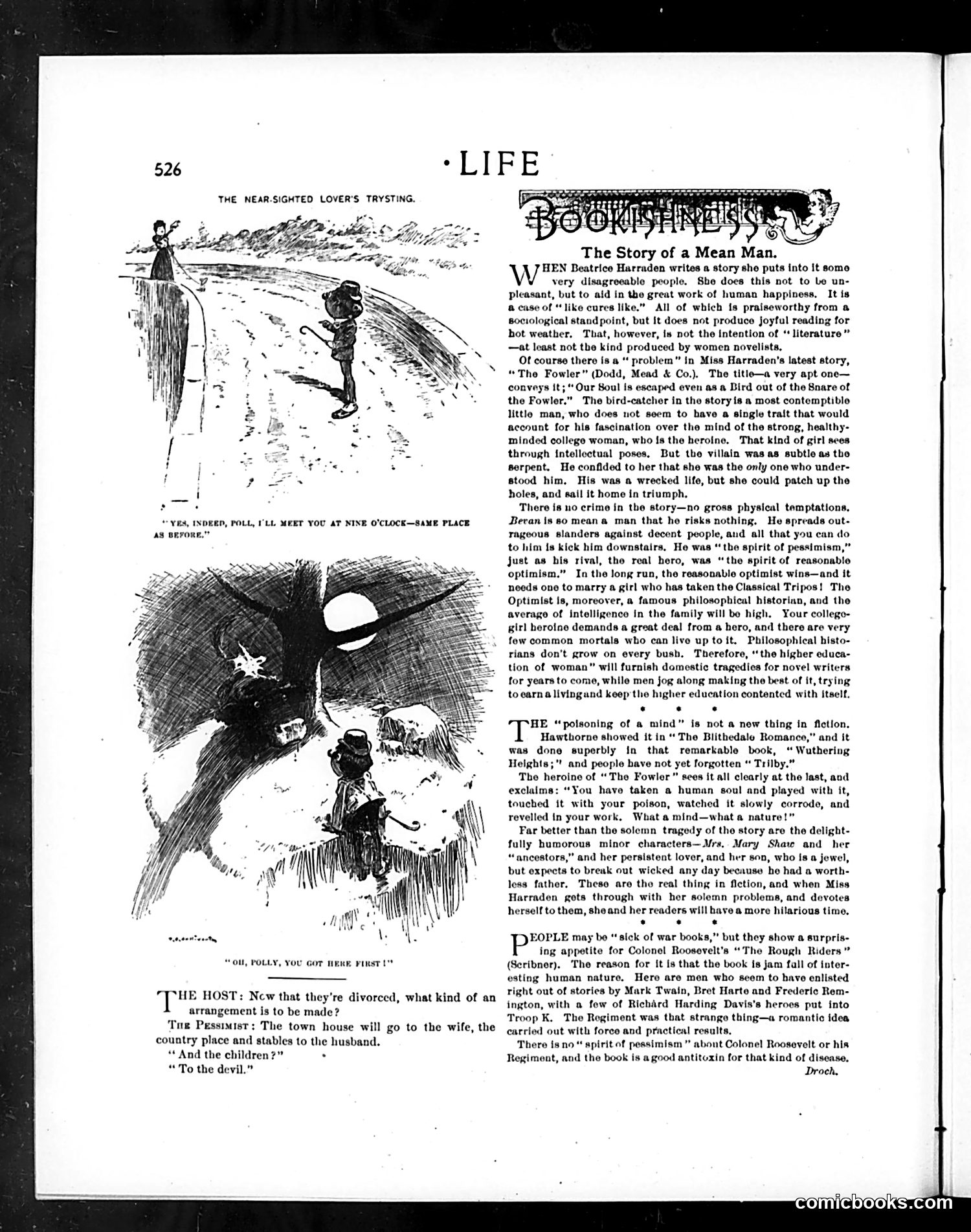
This page contains two distinct elements: **Top cartoon** ("The Near-Sighted Lover's Trysting"): Shows a man and woman meeting at a seaside location. The humor appears to rely on visual comedy—the man's near-sightedness creates a misunderstanding about their rendezvous, though the exact joke is unclear from the image alone. **Bottom section** titled "Bookishness" is a literary review essay (not a cartoon) discussing Beatrice Harraden's novel "The Fowler." The review analyzes the book's treatment of a "mean man" character and compares it to other philosophical fiction. It touches on women novelists' approaches to character and morality. The small dialogue snippet at page bottom appears to be an unrelated joke about divorce arrangements. This is primarily a literary criticism page with one cartoon illustration.
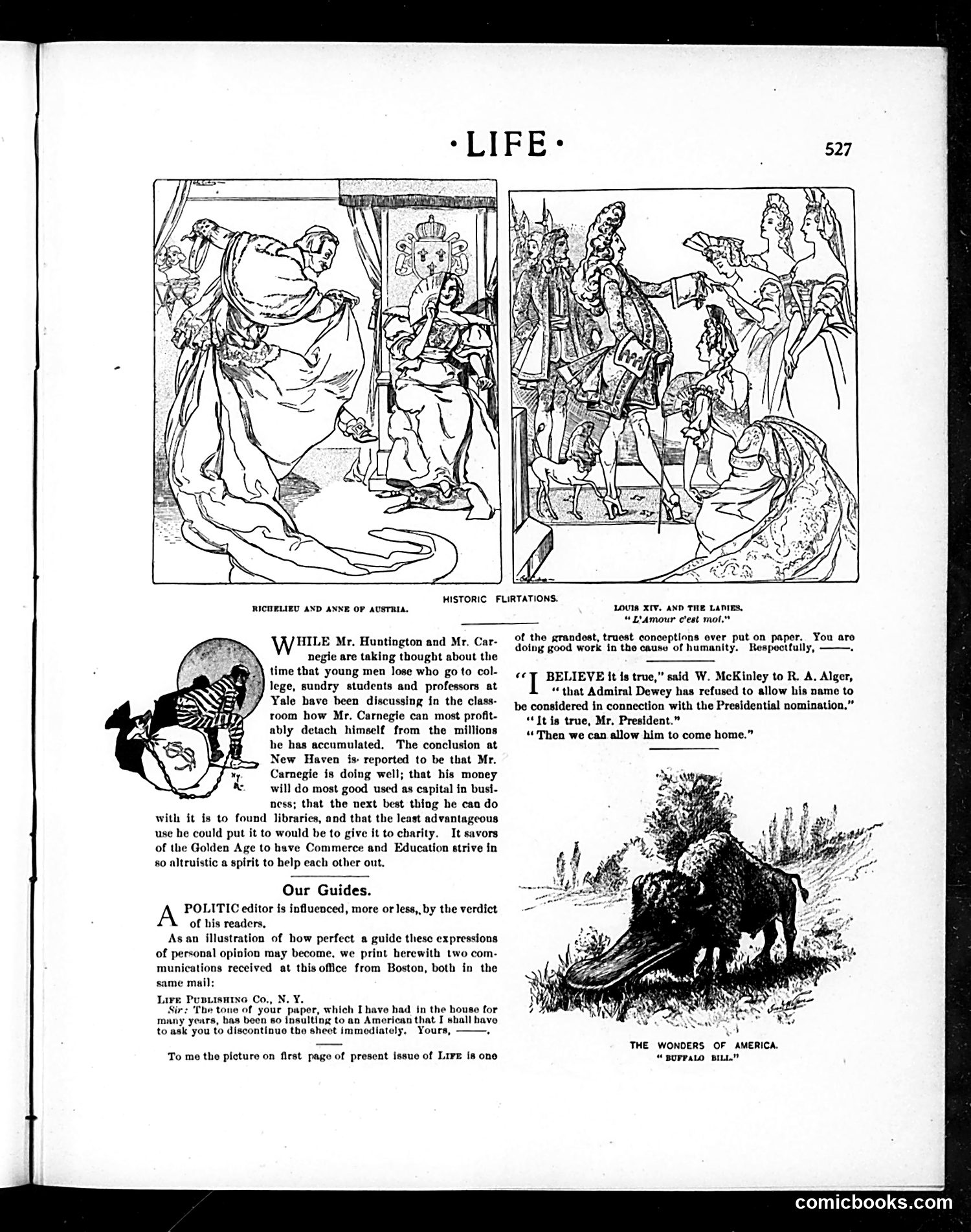
This page presents two historical reenactments of famous flirtations: **Left panel:** "Richelieu and Anne of Austria" - depicts the Cardinal in elaborate robes interacting with the Queen in a palace setting, referencing a rumored romantic intrigue between these historical figures. **Right panel:** "Louis XIV and the Ladies" - shows the French king surrounded by courtiers and noblewomen, captioned with the French phrase "L'amour c'est mol" (roughly, "Love is myself"), satirizing the Sun King's legendary romantic exploits and courtly excess. The cartoons mock historical figures through exaggerated period dress and romantic theatricality. Below, text discusses Andrew Carnegie's philanthropy and editorial reader responses. A sketch labeled "Buffalo Bill" appears at bottom right.
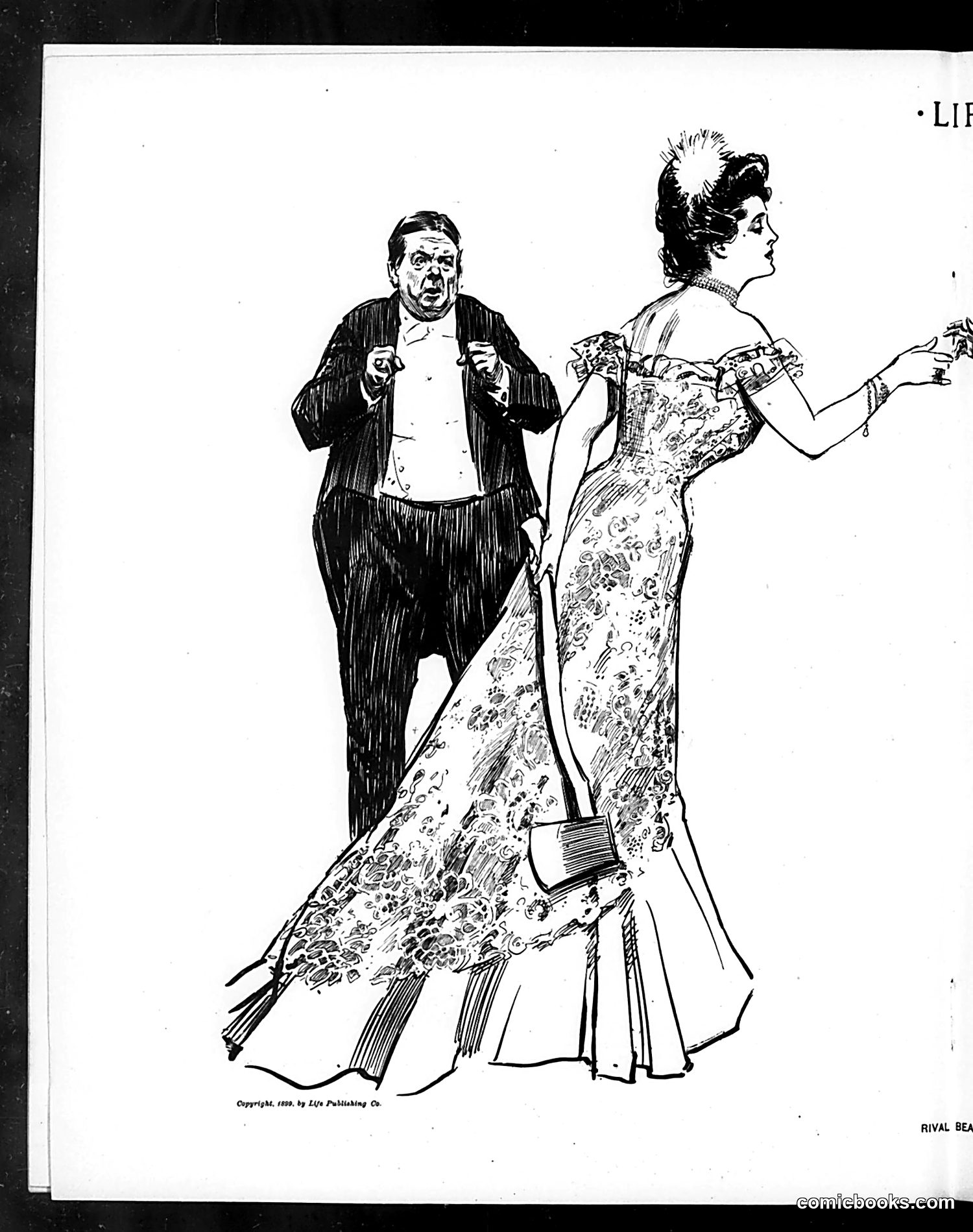
This is a satirical illustration from Life magazine (copyright 1908 by Life Publishing Co.) depicting a social commentary on marital dynamics or gender relations. The cartoon shows a woman in an elaborate, ornate gown with a long train being "painted" or decorated by a man in formal evening wear who appears anxious or distressed. The woman gestures dismissively while the man frantically adjusts her dress. The satire likely comments on **feminine extravagance in fashion** and **male anxiety about women's spending habits** or **the burden of supporting elaborate dress standards**. The woman's confident, oblivious posture contrasts with the man's worried expression—suggesting commentary on either spousal financial strain or the absurdity of ornate fashion requirements. The specific context or publication date would clarify whether this references a particular social debate of the 1908 era.
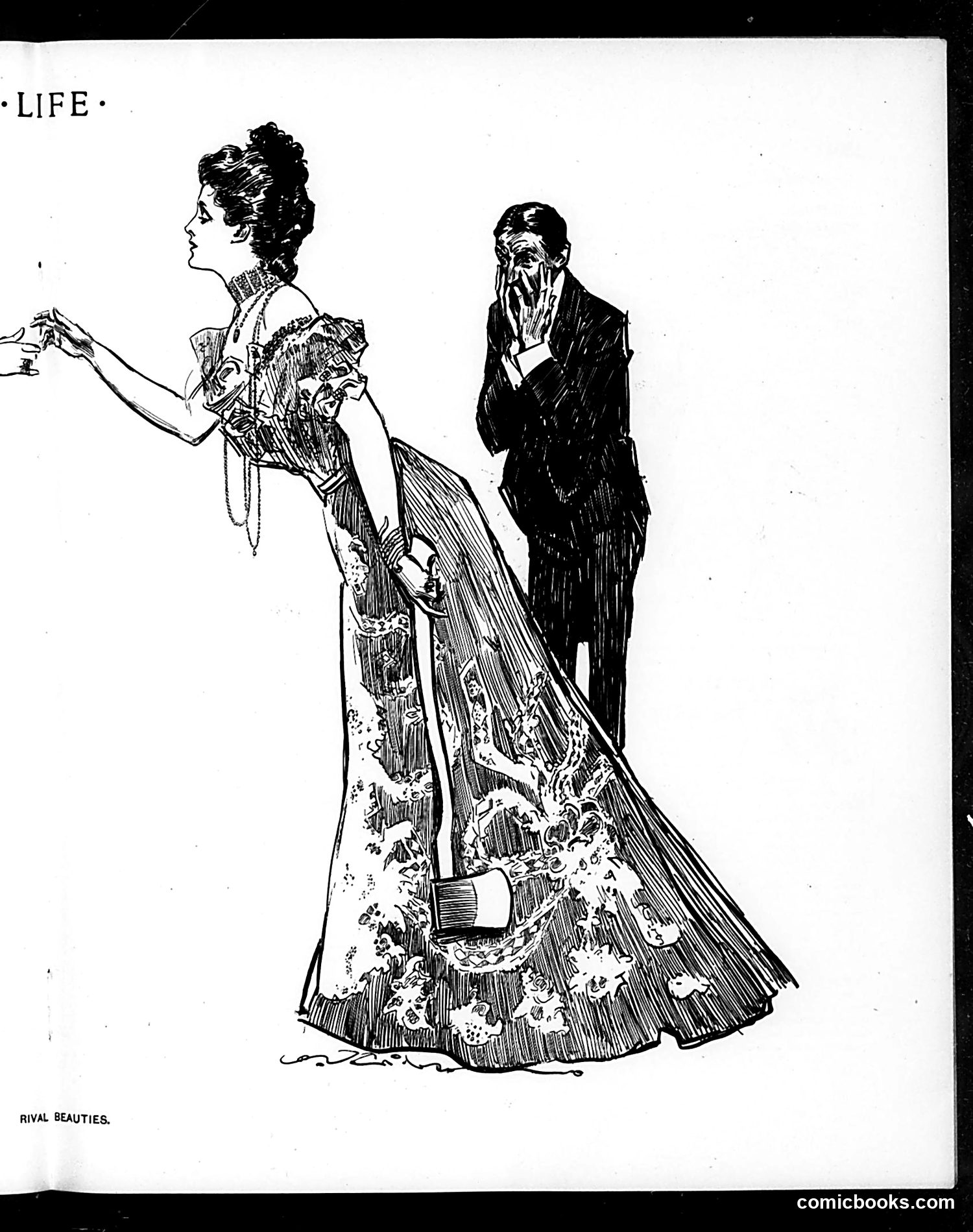
This is a satirical cartoon titled "Rival Beauties" from *Life* magazine. It depicts two figures: an elegantly dressed woman in an ornate gown with a long train, shown in profile and gesturing dismissively, and a man in formal attire behind her with his hand to his face in a gesture of dismay or concern. The satire appears to comment on romantic or social rivalry, likely between the woman's appearance/status and something else the man represents. The woman's confident, somewhat superior posture contrasts with the man's worried expression, suggesting he is losing out to a rival—possibly another suitor or the woman's own vanity. The cartoon satirizes courtship dynamics or romantic competition of the era, mocking both feminine vanity and masculine anxiety.
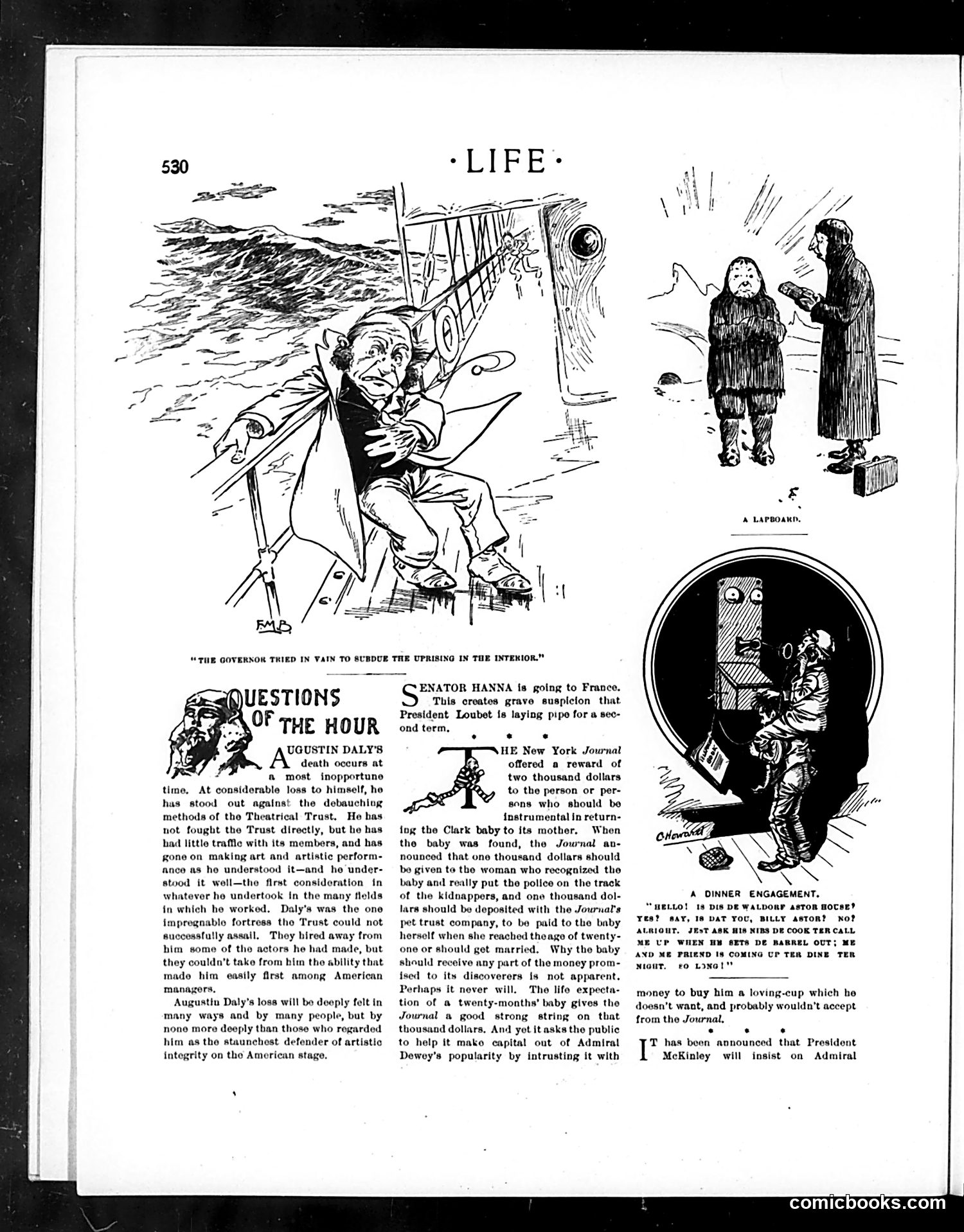
This page from *Life* magazine contains satirical commentary on early 20th-century theatrical and political matters. The top cartoon depicts "The Governor" attempting to suppress an uprising, likely referring to labor unrest or political dissent. The "Questions of the Hour" section critiques the Theatrical Trust's control over American theater, with an illustrated figure (appearing to be Augustus Daly based on context) defending artistic integrity against commercial managers who allegedly exploited performers. A separate article discusses Senator Hanna's trip to France and references a *New York Journal* reward for finding a kidnapped Clark baby, contrasting grand political intrigue with sensationalist journalism. The circular illustration labeled "Dinners" satirizes wealthy diners' pretensions. Overall, the page attacks monopolistic business practices, journalistic sensationalism, and corruption in American institutions.
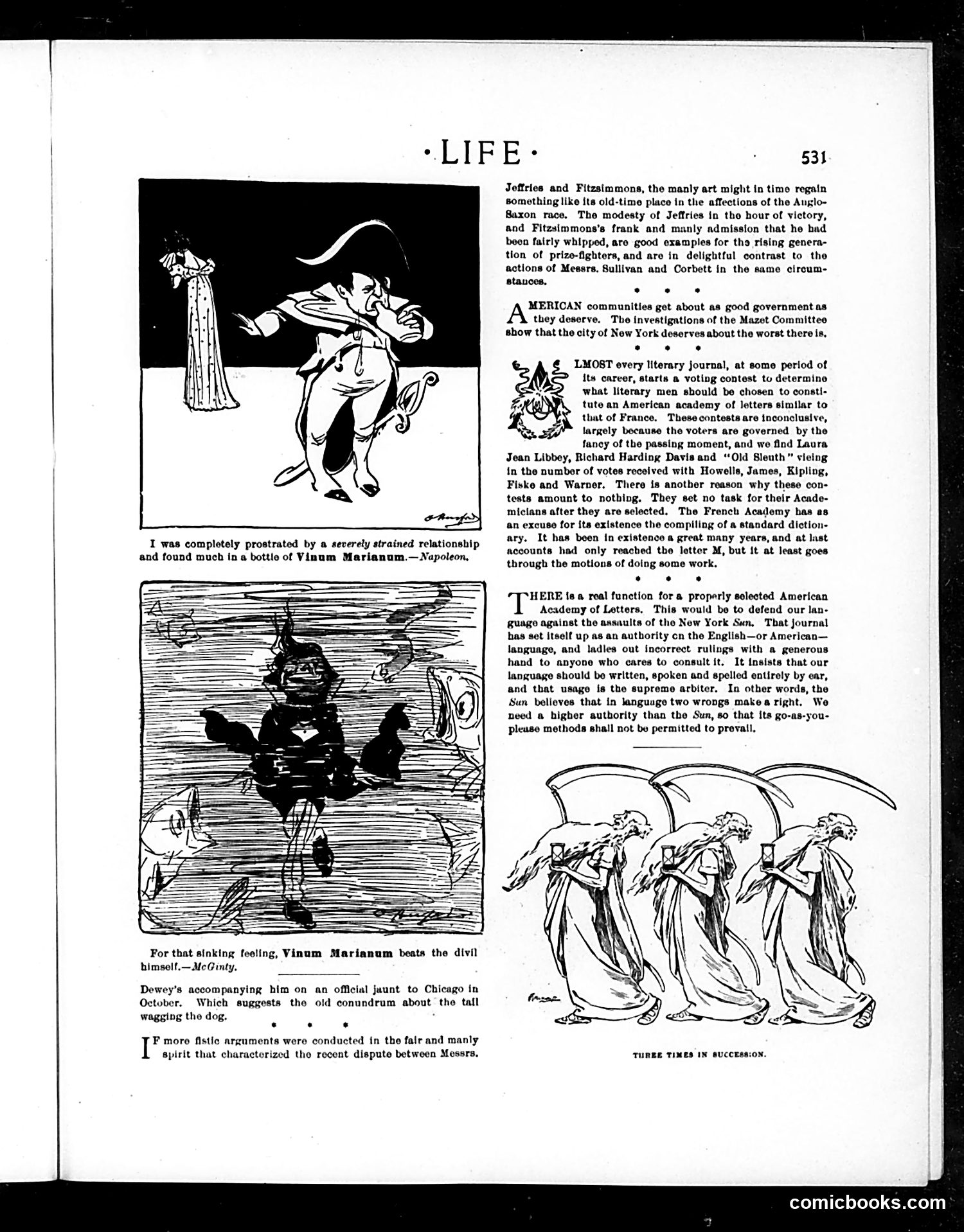
This *Life* magazine page contains satirical commentary on early 1900s American society: **Top cartoon:** A caricatured figure (likely a boxer or public figure) is depicted in an exaggerated pose, accompanying text about prize-fighter disputes and "Vinum Marianum" (a patent medicine). **Main text discusses:** 1. **Jeffries vs. Fitzsimmons boxing match**: Praised for the fighters' mannerly conduct, contrasted with earlier boxers Sullivan and Corbett's poor sportsmanship. 2. **NYC corruption**: References the Mazet Committee investigation, suggesting New York's government reflects public moral failings. 3. **American Academy of Letters**: Satirizes voting contests to select literary figures—contestants absurdly mix serious authors (Howells, James, Kipling) with popular/pulp writers (Laura Jean Libbey, "Old Sleuth"). The piece argues America needs an academy to defend proper English against the *New York Sun's* permissive language rules. The satire targets both democratic mediocrity (poor voting choices) and journalistic authority figures who allow linguistic standards to deteriorate.
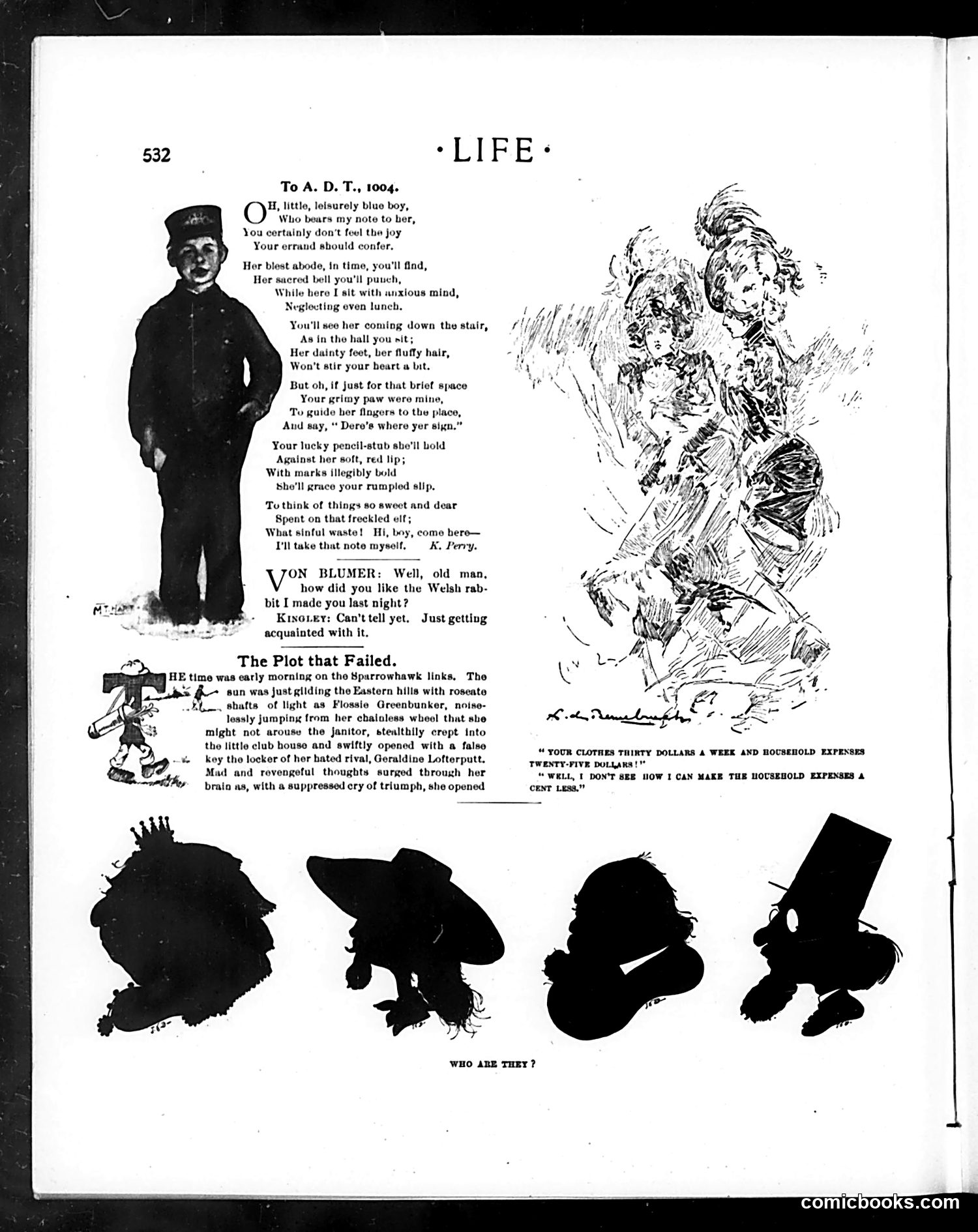
This page contains several distinct pieces of humor: **Top: "To A. D. T., 1904"** — A romantic poem by K. Perry mocking a young messenger boy (likely an Automatic Delivery Telegraph courier, given "A.D.T."). The joke: the sender is lovesick watching the boy deliver a note to a woman, fantasizing about the boy's role. The boy remains oblivious to the romantic drama surrounding his mundane errand. **Middle: "The Plot that Failed"** — A melodramatic serialized story opening about "Flossie Greenbunker" breaking into a golf club locker to sabotage her rival. This appears to be satirizing overwrought serialized fiction popular at the time. **Bottom:** Silhouettes asking "WHO ARE THEY?" — A guessing game feature, common in Life magazine. **Right illustration:** A domestic dispute about household budgeting—a wife cannot reduce expenses below twenty-five dollars weekly, satirizing the tension between husbands' salary constraints and wives' household spending. The overall tone mocks romantic sentimentality, melodrama, and marital financial tensions of Edwardian America.
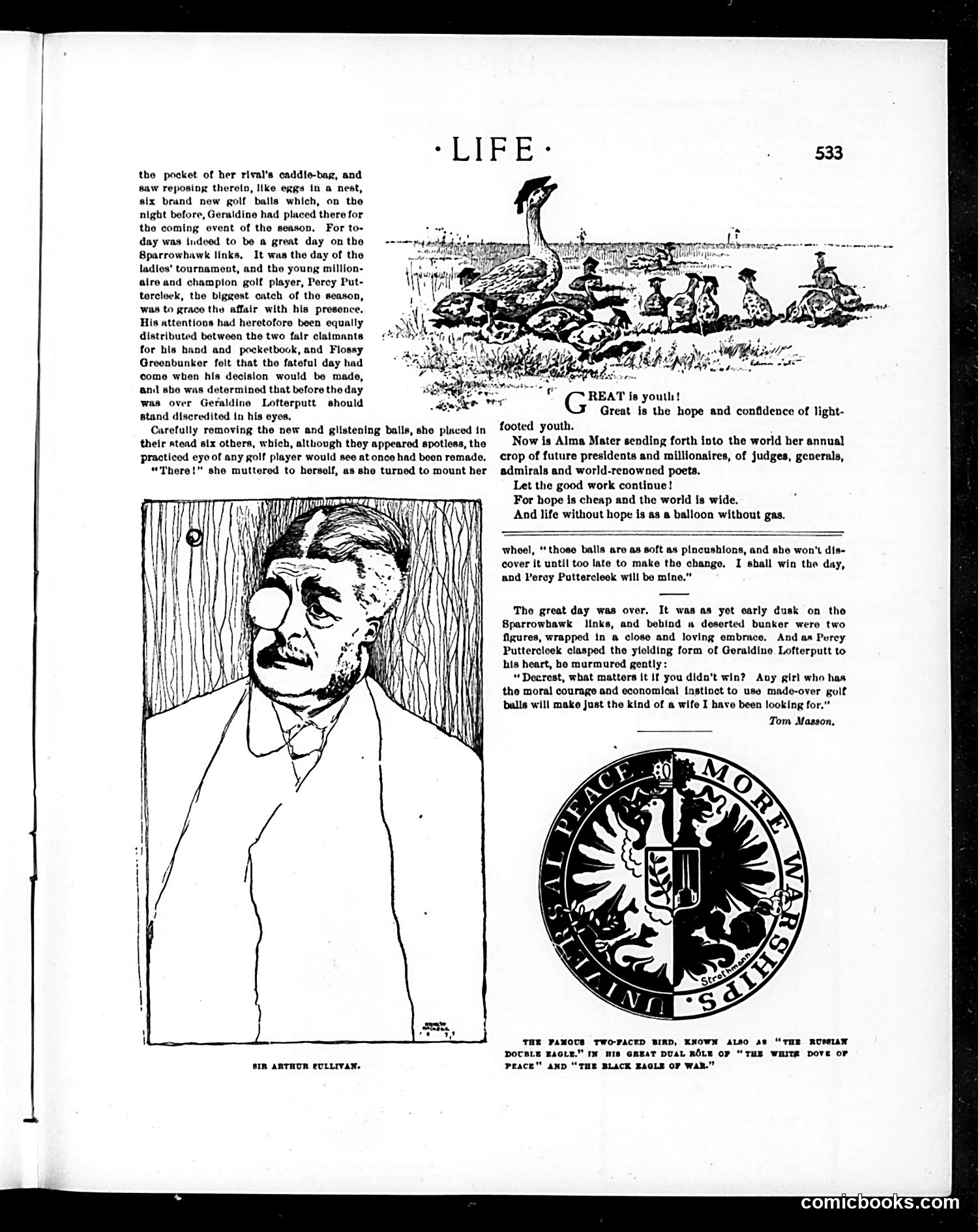
This page contains a satirical story about female golf competition and marriage prospects, paired with an unrelated portrait of Sir Arthur Sullivan. **The Main Narrative:** A story about two women competing in a ladies' golf tournament to win the attention of "Percy Puttercleek," a wealthy bachelor golfer. One rival, Flossy Greenbunker, sabotages her competitor Geraldine Lofterputt by replacing her new golf balls with worn ones. However, the scheme backfires: Geraldine wins anyway, and Puttercleek marries her precisely *because* she economically reused old balls—demonstrating the "moral courage and economical instinct" he values in a wife. **The Satire:** The piece mocks both women's desperate competition for a wealthy husband and celebrates thrift as a feminine virtue. It's simultaneously mocking female ambition and endorsing "practical" values. **The Portrait:** Shows Sir Arthur Sullivan, the famous composer, with a caption referencing "The Russian Double Eagle" and symbolic birds representing peace and war—likely commentary on Sullivan's public roles or reputation, though the specific reference is unclear without additional context.
This page features a biographical anecdote about **Horace Greeley**, the famous 19th-century editor of the *New York Tribune*, illustrating his sympathy for working-class poverty. The story depicts two underpaid women factory workers (earning $3.50/week) visiting Greeley to report a wage dispute. Despite prominent politicians waiting to see him, Greeley prioritizes the women, learning they have only 50 cents weekly after rent for all other necessities. Outraged by this exploitation, he promises newspaper exposure and secretly instructs his assistant to give them $20 from his own pocket—framing it as duty rather than charity, knowing they'd refuse if called assistance. The anecdote portrays Greeley as a champion of labor and the poor, willing to use his editorial power against factory owners while personally supporting struggling workers. His actions demonstrate both his moral conviction and his understanding of working-class dignity. The page's title likely references editorial scissors (cutting/editing) and nullification of worker rights.
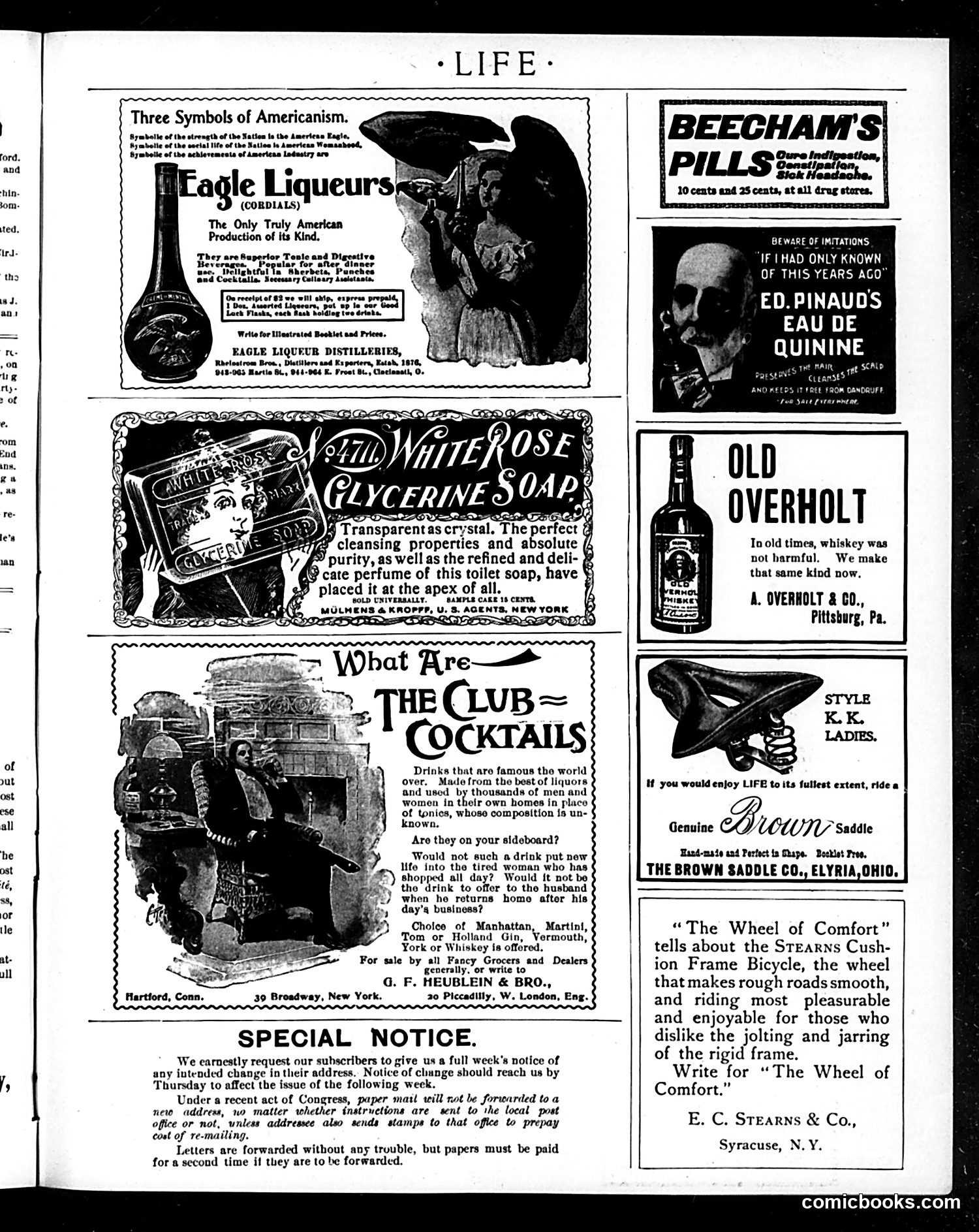
This is primarily an **advertising page** from an early 20th-century Life magazine, not a political cartoon. The page features the satirical opening claim that "Three Symbols of Americanism" are the Eagle, American Womanhood, and **liqueurs**—a tongue-in-cheek joke mocking American consumer culture by equating alcoholic beverages with national pride. The advertisements that follow are period-typical: Eagle Liqueurs, White Rose Glycerine Soap, Club Cocktails, Beecham's Pills, Ed. Pinaud's Eau de Quinine, Old Overholt whiskey, Brown Saddles, and Stearns bicycles. The Old Overholt ad notably claims whiskey was "not harmful" in "old times" and they make "that same kind now"—reflecting early 20th-century attitudes before Prohibition and modern health awareness. The page's satirical premise—that commercial products represent American values—is Life's commentary on consumer capitalism, though the ads themselves are presented straight.
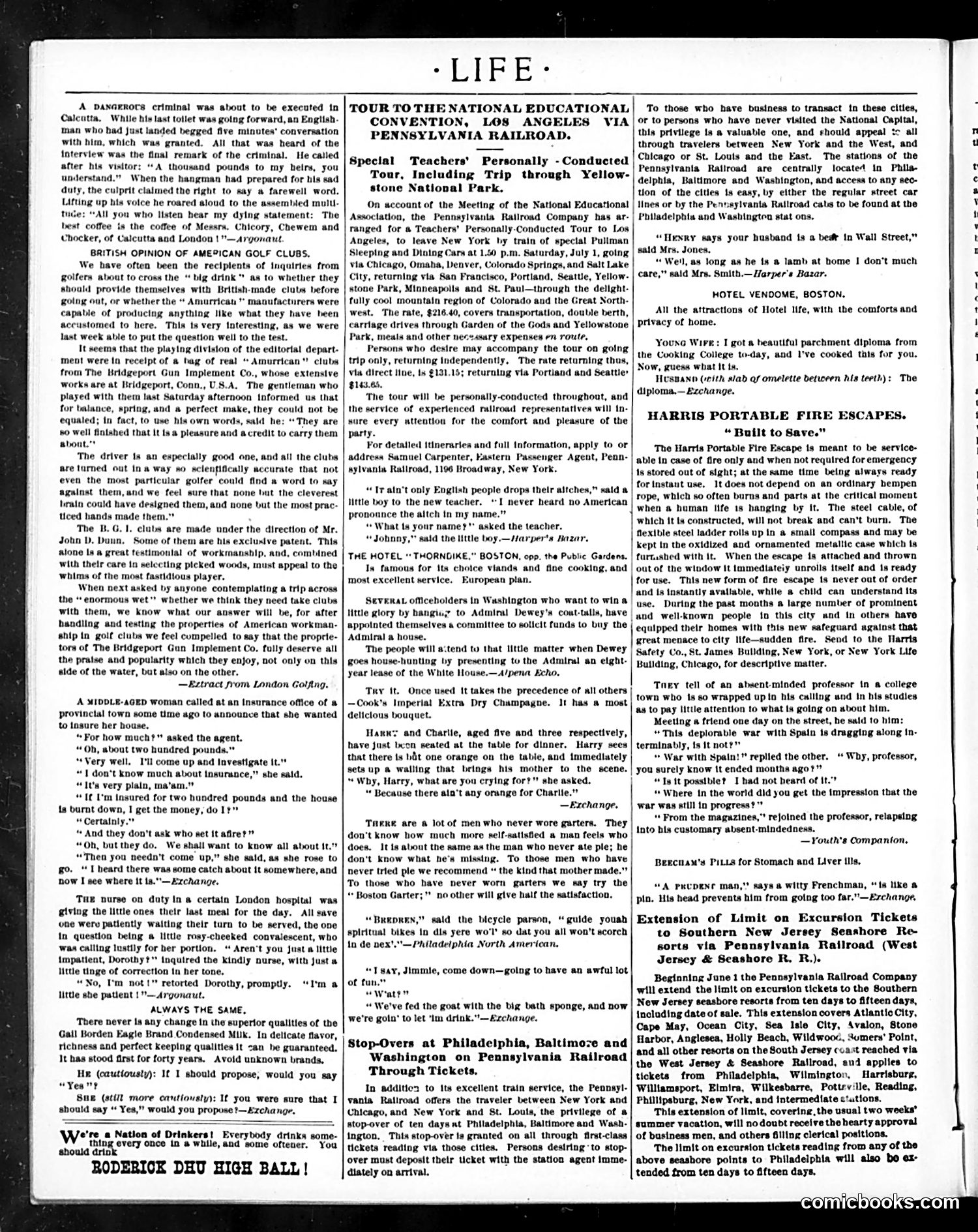
This page contains primarily **satirical short anecdotes and advertisements** rather than visual cartoons. The humor targets several early 20th-century subjects: 1. **Colonial advertising absurdity**: A condemned criminal in Calcutta uses his final words to endorse a coffee brand—mocking both exploitative advertising and colonial commerce. 2. **Anglo-American manufacturing rivalry**: British golfers skeptically question whether American golf clubs match British quality. The piece humorously validates American craftsmanship, undermining British presumptions of superiority. 3. **Insurance fraud**: A woman seeking to insure her house reveals she expected insurance companies wouldn't investigate arson, exposing both her criminal intent and period insurance practices. The page satirizes class attitudes, commercial manipulation, and Anglo-American industrial competition typical of the era. The humor relies on readers' familiarity with colonial hierarchies, transatlantic industrial competition, and Victorian social assumptions about insurance and property ownership.
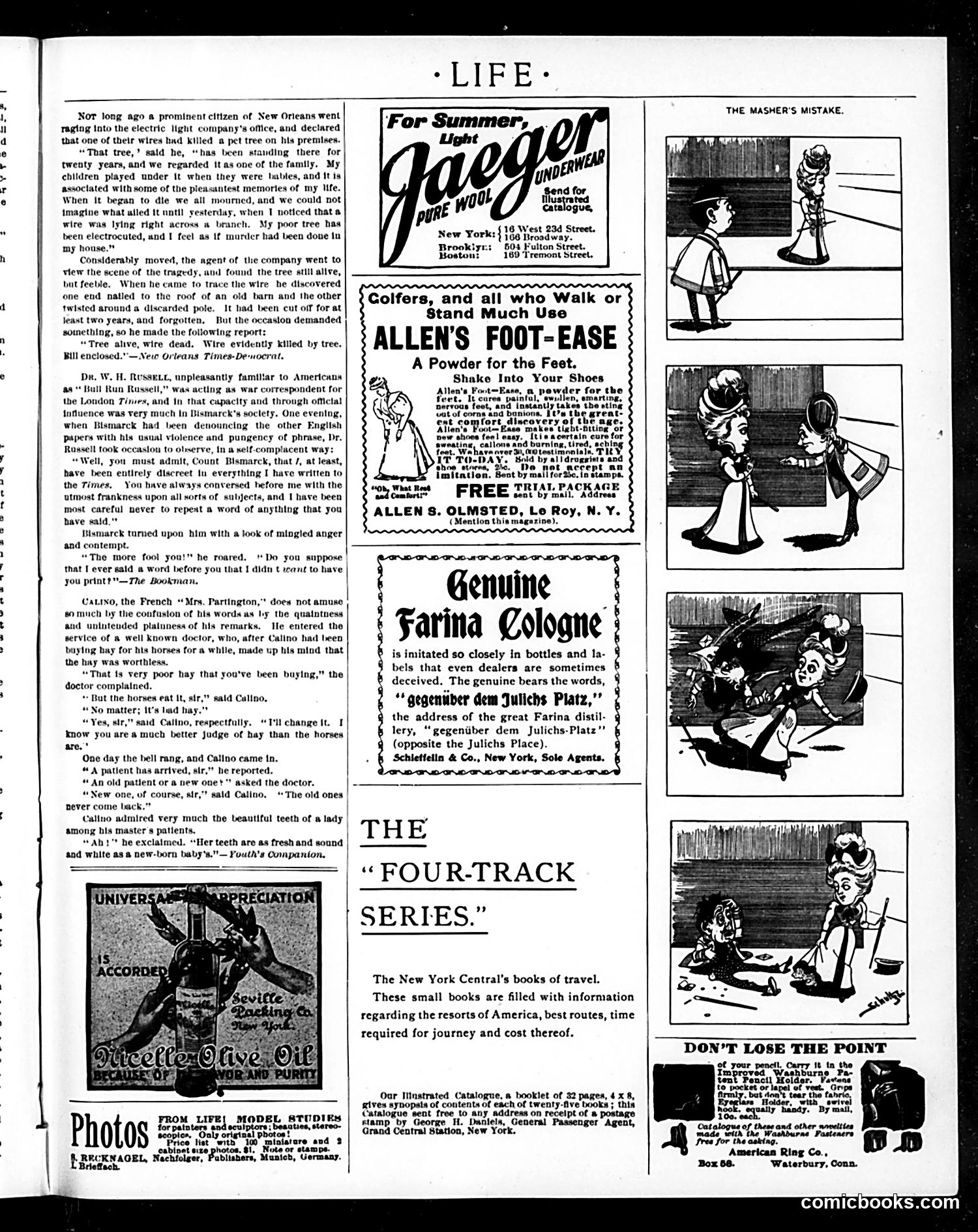
This page is primarily **advertising and humorous anecdotes** rather than political satire. **"The Master's Mistake"** (right column) is a four-panel comic strip depicting a domestic servant's mishap. The visual narrative shows a maid or housemaid apparently breaking or damaging something (likely a vase or household item), with the final panel titled "DON'T LOSE THE POINT"—suggesting the humor concerns both the servant's clumsiness and the master's reaction. The page's text consists of three comedic stories: one about a New Orleans man blaming an electric company for his tree's death (the wire was actually dead); anecdotes about war correspondent "Bull Run Russell" and Bismarck; and stories about a French servant named Calino whose literal-mindedness creates humor. The surrounding advertisements promote foot powder, cologne, and travel guides—typical early-20th-century magazine content. The humor throughout is genteel, relying on misunderstandings and class-based comedic situations rather than political commentary.
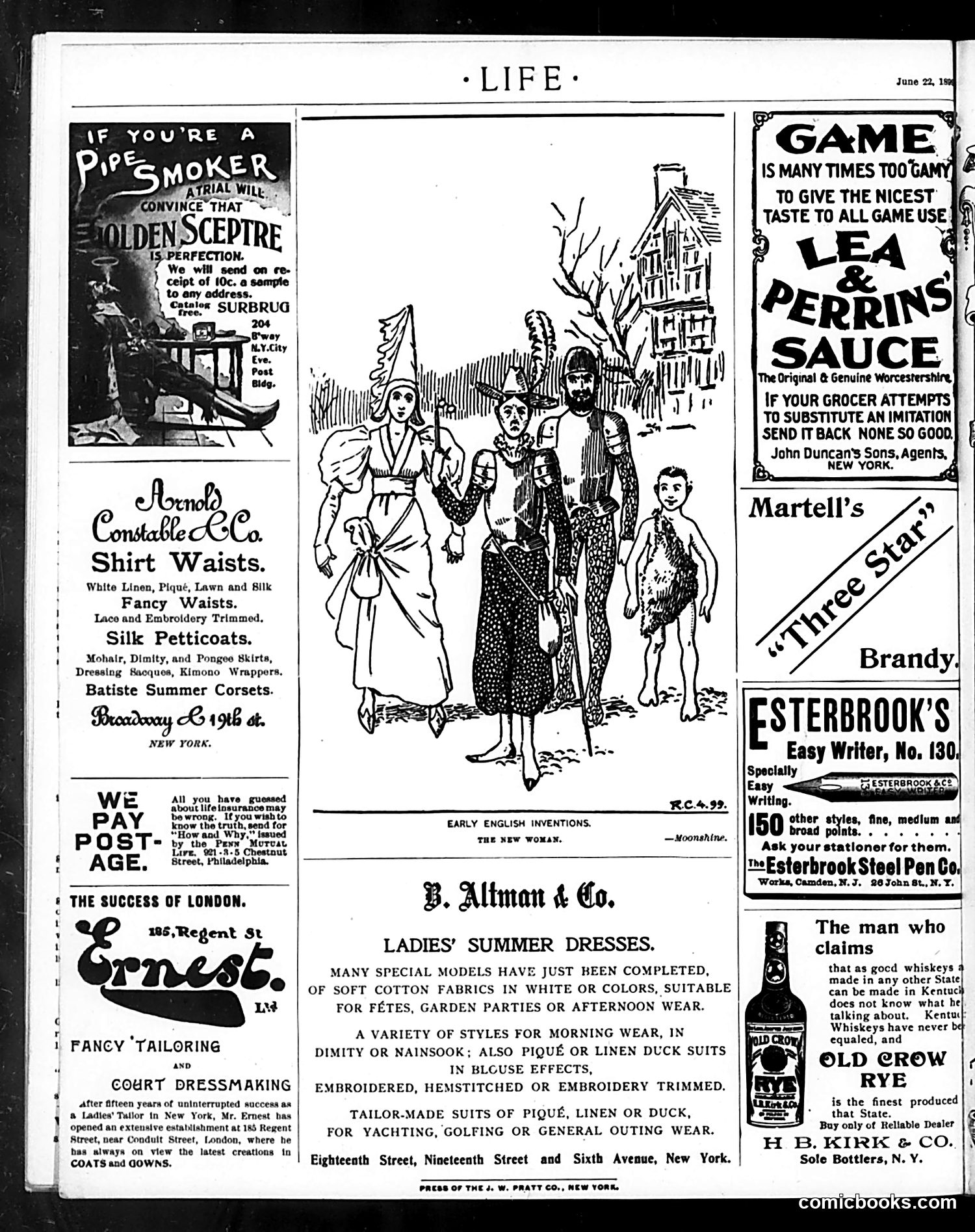
This page is primarily **advertising**, not editorial satire. However, the central cartoon titled "Early English Inventions: The New Woman" by Moonshine offers social commentary. The cartoon depicts five figures in exaggerated costume—pointy hats, outlandish dress—labeled as "inventions." This appears to satirize the "New Woman" movement of the 1890s, which advocated for women's education, property rights, and independence. The grotesque styling suggests the cartoonist views these progressive female figures as ridiculous or unnatural "inventions" rather than legitimate social evolution. The surrounding advertisements emphasize traditional feminine roles: shirt waists, summer dresses, corsets, and tailoring services—conventional products for women of the era. This juxtaposition implicitly contrasts "proper" femininity with the mocked "New Woman," reflecting late-Victorian anxiety about changing gender roles.