
Life, 1899-06-22 · page 4 of 20
Life — June 22, 1899 — page 4: what you’re looking at
What you’re looking at
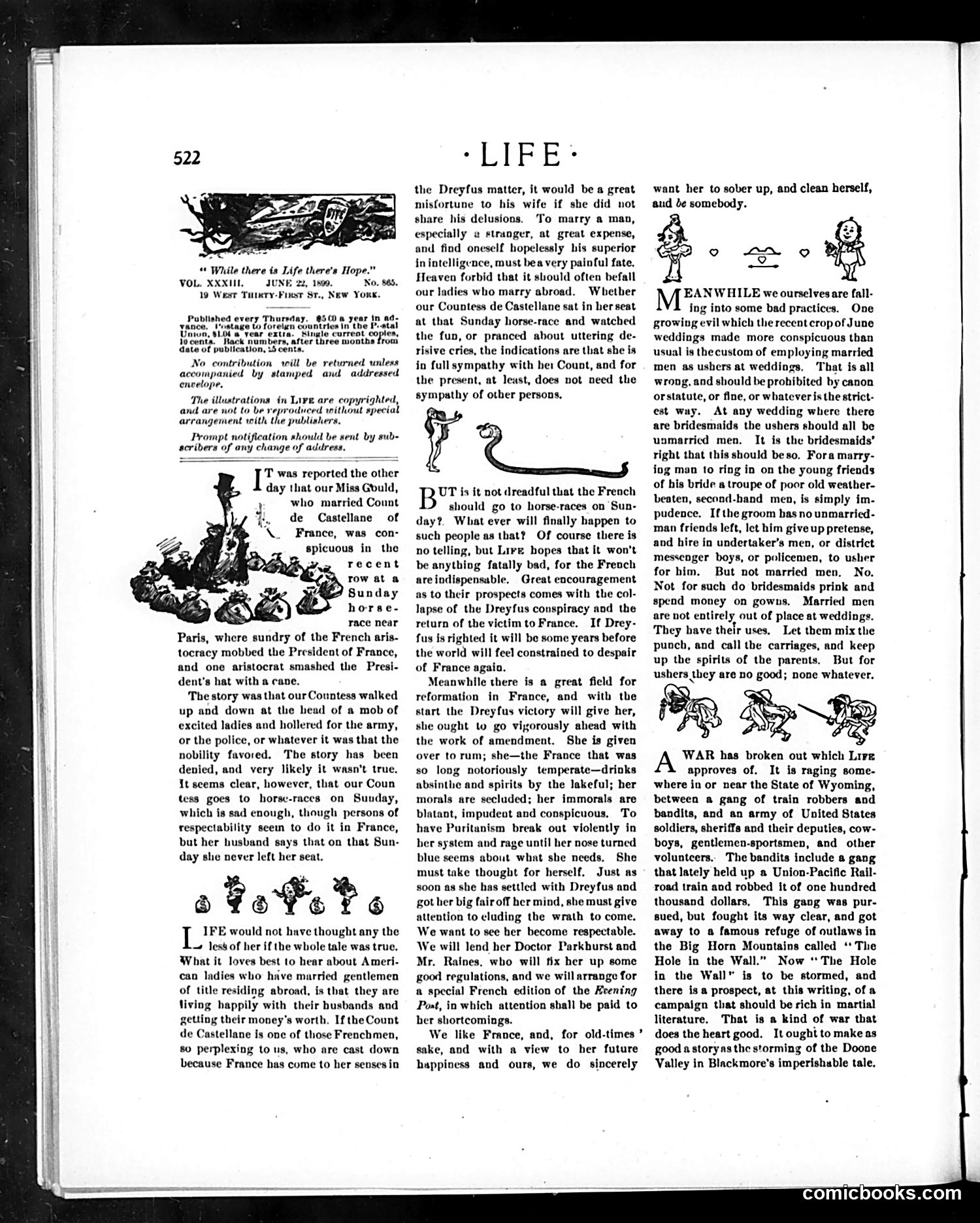
This page satirizes French aristocratic society and the Dreyfus Affair, a major scandal dividing France. The text references "Count de Castellane" and discusses French nobility marrying wealthy foreign women at great expense. The left cartoon depicts a chaotic scene at a Paris Sunday horse-race, likely showing the social tumult surrounding the Dreyfus case. The caption suggests French society is fracturing over the scandal. The main text criticizes French aristocrats—particularly Castellane—for marrying foreign heiresses for money while remaining morally corrupt. It argues they're unfit to be ushers at weddings, let alone social leaders. The page also mentions a recent gang robbery in Wyoming and a train robbery, connecting international crime to the theme of moral corruption among the supposedly elite.
📄 Transcribed text from this page (OCR, searchable)
Machine-transcribed from the original scan — historical spelling and the odd misread are preserved.
“« While there ia Life there's Hope.” VOL. XXXII. JU) No. 865. 19 West Tuixry- Fist ‘sr, New Yous. seceienes, every. 7porsany. 9500 a year in ad- e to foreign countries in the P.stal Tear extra. ‘single curreat copies, do numbers, after three months from date of ‘publication. Scents. No contribution will be returned unless accompanied by stamped and addressed envelope. The illustrations in Live are copyrighted, and are not to be reproduced without special arrangement with the publishers. Prompt notification should be sent by sub- scribers of any change of aiiress. T was reported th the other day that our Miss Gould, who married Count . de Castellane of ‘A. France, was con- spicuous in the recent SA. row at a pS Sunday horse- race near Paris, where sundry of the French aris- tocracy mobbed the President of France, and one aristocrat smashed the Presi- dent’s hat with a cane. ‘The story was that our Countess walked up and down at the head of a mob of excited ladies and hollered for the army, or the police, or whatever it was that the nobility favored, The story has been denied, and very likely it wasn’t true. It seems clear, however, that our Coun tess goes to horse-races on Sunday, which is sad enough, though persons of respectability seein to do it in France, but her husband says that on that Sun- day she never left her seat. a Foe? « IFE would not have thought any the ~ less of her if the whole tale was true. What it loves best to hear about Ameri- can ladies who have married gentlemen of title residing abroad, is that they are living happily with their husbands and getting their money's worth. Ifthe Count de Castellane is one of those Frenchmen, 80 perplexing to us, who are cast down because France has come to her senses in LIFE the Dreyfus matter, it would be a great misfortune to his wife if she did not share his delusions. To marry a man, especially u stranger, at great expense, and find oneself hopelessly his superior in intelligence, must bea very painful fate. Heaven forbid that it should often befall our ladies who marry abroad. Whether our Countess de Castellane sat in her seat at that Sunday horse-race and watched the fun, or pranced about uttering de- risive cries, the indications are that she is in full sympathy with he: Count, and for the present, at least, does not need the sympathy of other persons, <_ UT is it not dreadful that the French should go to horse-races on Sun- day?, What ever will finally happen to such people as that? Of course there is no telling, but Lire hopes that it won't be anything fatally bad, for the French areindispensable. Great encouragement as to their prospects comes with the col- lapse of the Dreyfus conspiracy and the return of the victim to France. If Drey- fus is righted it will be some years before the world will feel constrained to despair of France agaio. Meanwhile there is a great ficld for reformation in France, and with the start the Dreyfus victory will give her, she ought to go vigorously ahead with the work of amendment. She is given over to rum; she—the France that was so long notoriously temperate—drinks absinthe and spirits by the lakeful; her morals are secluded; her immorals are blatant, impudent and conspicuous, To have Puritanism break out violently in her system and rage until her nose turned blue seems about what she needs. She must take thought for herself. Just as soon as she has settled with Dreyfus and got her big fairoff her mind, she must give attention to cluding the wrath to come. We want to see her become respectable. We will lend her Doctor Parkburst and Mr. Raines, who will tix her up some good regulations, and we will arrange for a special French edition of the Krening Post, in which attention shall be paid to her shortcomings. We like France, and, for old-times ’ sake, and with a view to her future happiness and ours, we do sincerely want her to sober up, and clean herself, aud be somebody. EANWHILE we ourselves are fall- ing into some bad practices. One growing evil which the recent crop of June weddings made more conspicuous than usual is thecustom of employing married men as ushers at weddings. ‘That is all wrong. and should be prohibited by canon. orstatute, or fine, or whatever is the strict- est way. At any wedding where there are bridesmaids the ushers should all be unmarricd men. It is the bridesmaids’ right that this should beso. Fora marry- iog man to ring in on the young friends of his bride a troupe of poor old weather- beaten, second-hand men, is simply im- pudence. Ifthe groom bas no unmarried- man friends left, Ict him give up pretense, and hire in undertaker’s men, or district messenger boys, or policemen, to usher for him. But not married men, No. Not for such do bridesmaids prink and spend money on gowns. Married men are not entirely out of place at weddings. They have their uses, Let them mix the punch, and call the carriages, and keep up the spirits of the parents. But for ushers they are no good; none whatever. WAR has broken out which Lire approves of. It is raging some- where in or near the State of Wyoming, between a gang of train robbers and bandits, and an army of United States soldiers, sheriffs and their deputies, cow- boys, gentlemen-sportsmen, and other volunteers.. The bandits include a gang that lately held up a Union-Pacific Rail- road train and robbed it of one hundred thousand dollars, This gang was pur- sued, but fought its way clear, and got away to a famous refuge of outlaws in the Big Horn Mountains called ‘* The Hole in the Wall.” Now “The Hole in the Wall” is to be stormed, and there isa prospect, at this writing, of a campaign that should be rich in martial literature. That is a kind of war that does the heart good. It ought to make as good a storyasthe storming of the Doone Valley in Blackmore's imperishable tale. comicbooks.com