
Life, 1899-06-22 · page 8 of 20
Life — June 22, 1899 — page 8: what you’re looking at
What you’re looking at
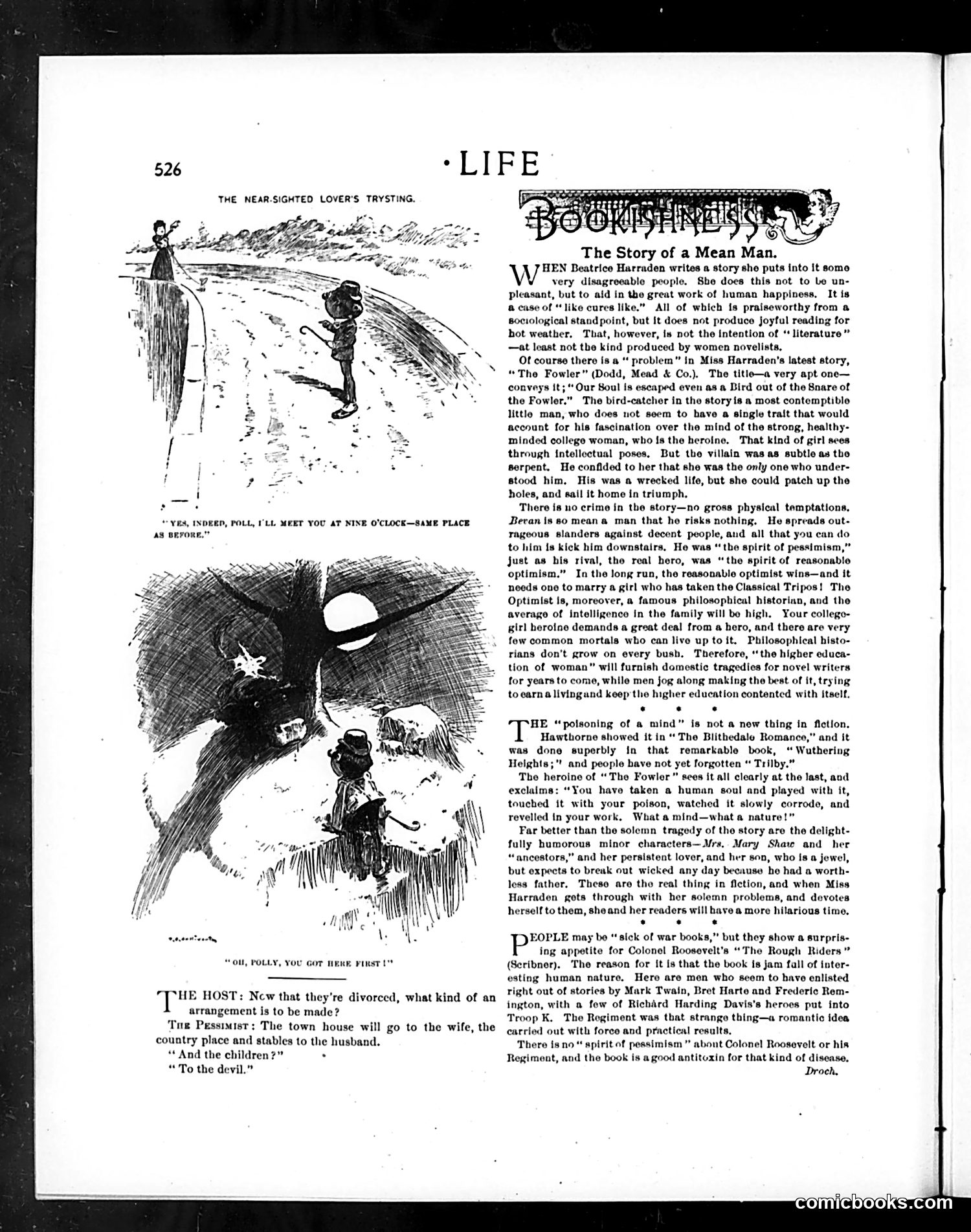
This page contains two distinct elements: **Top cartoon** ("The Near-Sighted Lover's Trysting"): Shows a man and woman meeting at a seaside location. The humor appears to rely on visual comedy—the man's near-sightedness creates a misunderstanding about their rendezvous, though the exact joke is unclear from the image alone. **Bottom section** titled "Bookishness" is a literary review essay (not a cartoon) discussing Beatrice Harraden's novel "The Fowler." The review analyzes the book's treatment of a "mean man" character and compares it to other philosophical fiction. It touches on women novelists' approaches to character and morality. The small dialogue snippet at page bottom appears to be an unrelated joke about divorce arrangements. This is primarily a literary criticism page with one cartoon illustration.
📄 Transcribed text from this page (OCR, searchable)
Machine-transcribed from the original scan — historical spelling and the odd misread are preserved.
“YES, INDRED, POLL, I'LL MEET YOU AT NINE O'CLOCE—SAME PLACE As oRFoRE.” “ou, POLL TH HOST: New that they're divorced, what kind of an arrangement is to be made? ‘Tne Pessimtsr: The town house will go to the wife, the country place and stables to the husband. “ And the children?” : The Story of a Mean Man. HEN Beatrico Hurraden writes a story sho puts into It somo V very disagreeable people. Sho does this not to Le un- pleasant, but to aid in the great work of human happiness. It is a case of “like cures like.” All of which is praiseworthy from a sociological standpoint, but it does not produce Joyful reading for hot weather. That, however, is not the Intention of “ literature” —at least not the kind produced by women novelists, Of course there is a“ problem” in Miss Harraden’s latest story, “The Fowler” (Dodd, Mead & Co.), The title—a very apt one— conveys it; "Our Soul is escaped even as a Bird out of the Snare of the Fowler.” The bird-catcher in the story is a most contemptiblo Uttle man, who does not seem to have a single trait that would account for his fascination over the mind of the strong, healthy- minded collego woman, who {s the heroine. That kind of girl sees through Intellectual poses, But tho villain was as subtle as tho serpent. He confided to her that she was the only one who under- stood him, His was a wrecked life, but she could patch up the holes, and sail it home in triumph. There is no crime in the story—no gross physical temptations, Bevan is 80 mean a man that ho risks nothing. He spreads out- rageous slanders against decent people, and all that you can do to him is kick him downstairs. He was “the spirit of pessimism,” juet as bis rival, tho real hero, was “the spirit of reasonable optimism.” In the long run, the reasonable optimist wins—and it needs one to marry a girl who has taken the Classical Tripos! The Optimist 1s, moreover, a famous philosophical historian, and the averago of intelligence In the family will bo high, Your collego- girl heroine demands a great deal from a hero, and there are very few common mortals who can live up to it, Philosophical histo- rians don’t grow on every bush, Therefore, “the higher educa- tion of woman” will furnish domestic tragedies for novel writers for years to come, while men jog along making the best of it, trying to carn a livingund keep tho higher education contented with itself. * e« HE “poisoning of a mind” {s not @ now thing in fiction. Hawthorne showed it in “* The Blithedalo Romance,” and it was done superbly in that remarkable book, “ Wuthering Heights ;" and people have not yet forgotten “ Trilby.” The heroine of “The Fowler” sees it all clearly at the last, and exclaims: “You have taken a human soul and played with it, touched it with your poison, watched it slowly corrode, and revelled in your work, What a mind—what a nature!” Far better than the solemn tragedy of tho story are the delight- fully humorous minor characters—Mrs. Mary Shaw and her “ancestors,” and her persistent lover, and her son, who Is a jewel, but expects to break out wicked any day because he had a worth- less father, Theso are tho real thing in fiction, and when Miss Harraden gets through with her solemn problems, and devotes herself to them, she and her readers will have a more hilarious time, . ee e EOPLE may be “sick of war books,” but they show a surpris- ing appetite for Colonel Roosevelt's “The Rough Riders” (Scribner), The reason for it is that the book is jam fall of inter- esting human nature. Here are men who seem to have enlisted right out of stories by Mark Twain, Bret Harte and Frederic Rem- ington, with a fow of Richird Harding Davis's heroes put into Troop K. The Regiment was tbat strange thing—a romantic idea carried out with force and practical results, There is no“ spirit of pessimism ” about Colonel Roosevolt or hia. Regiment, and the book is a good antitoxin for that kind of disease, Droch,