
A complete issue · 20 pages · 1899
Life — June 15, 1899
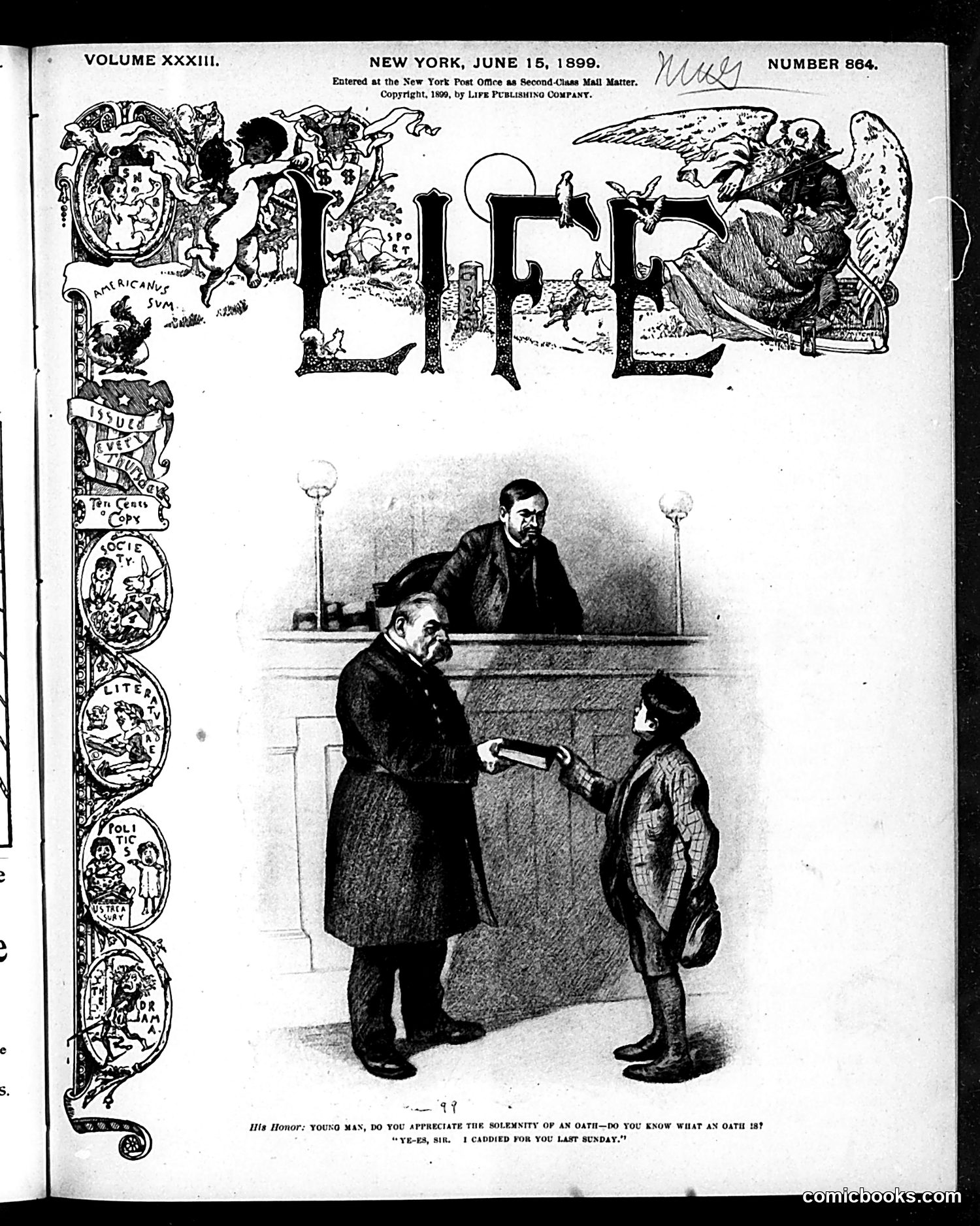
The main cartoon depicts a courtroom scene with a judge presiding, a man in the dock being addressed by what appears to be a lawyer or court official, and a young boy standing nearby. The caption reads: "His Honor: Young man, do you appreciate the solemnity of an oath—do you know what an oath is? 'Yes-es, sir. I carried for you last Sunday.'" The satire targets judicial pomposity and class divisions. The joke hinges on the boy's innocent misunderstanding: he thinks "oath" refers to "oats" (animal feed), revealing his lower-class background and limited education. The humor mocks both the judge's verbose formality and highlights the social gap between the bench and working-class youth, suggesting the legal system's disconnect from ordinary people's lives and language.
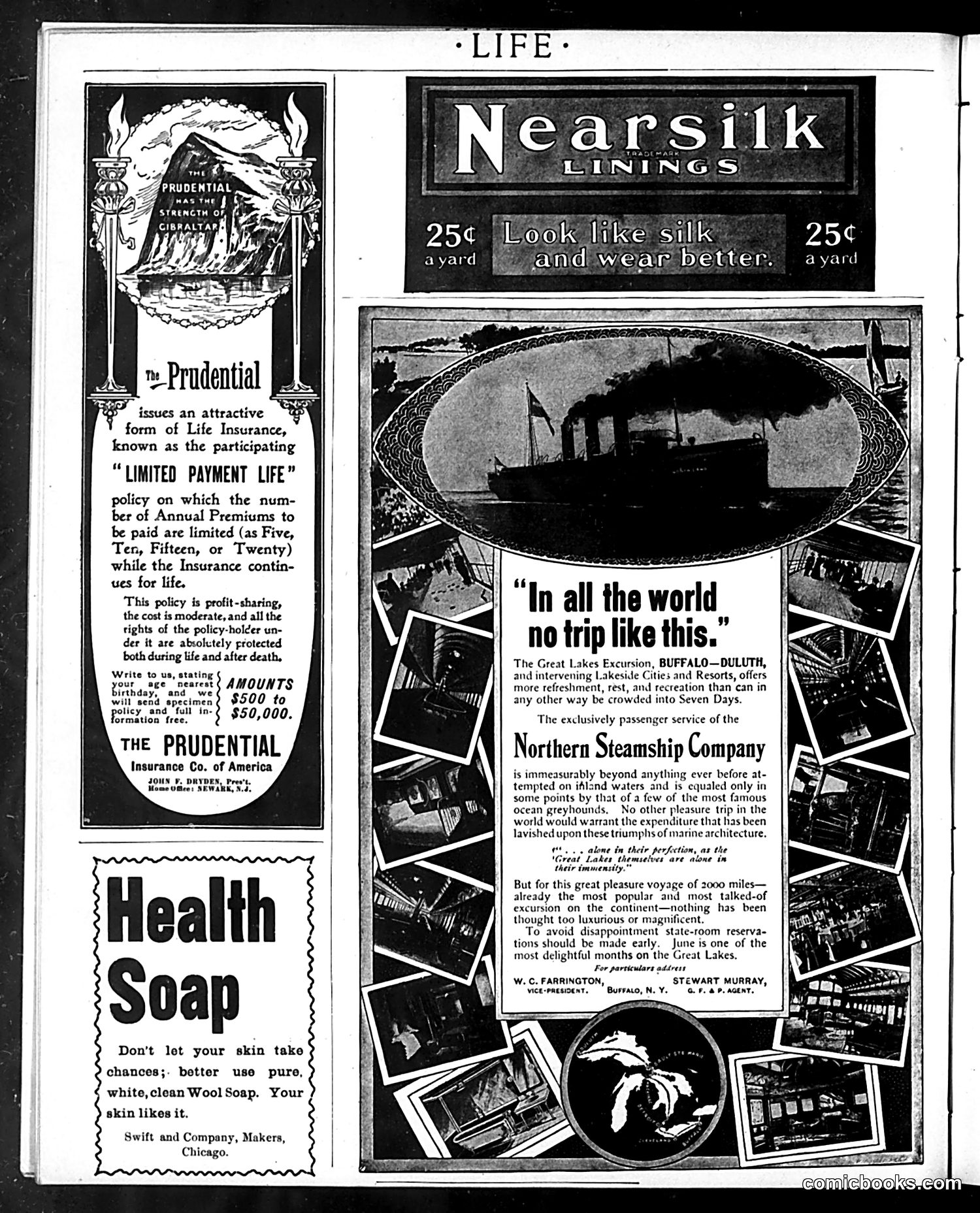
This page is primarily **advertising**, not satire or political commentary. It contains three distinct ads: 1. **The Prudential Insurance Co.** (top left): Promotes "Limited Payment Life" insurance policies with flexible premium schedules ($500-$60,000). 2. **Nearsilk Linings** (top right): A fabric product marketed at 25¢ per yard, claiming to look like silk while being more practical. 3. **Northern Steamship Company** (center-right): Advertises Great Lakes luxury cruises (Buffalo-Duluth route, 2,000 miles) as the premier travel experience. 4. **Health Soap** (bottom left): Swift and Company's wool soap, emphasizing skin safety and purity. There is no political cartoon or social satire present. The page represents typical early 20th-century magazine advertising targeting middle-class consumers with insurance, textiles, travel, and personal care products.
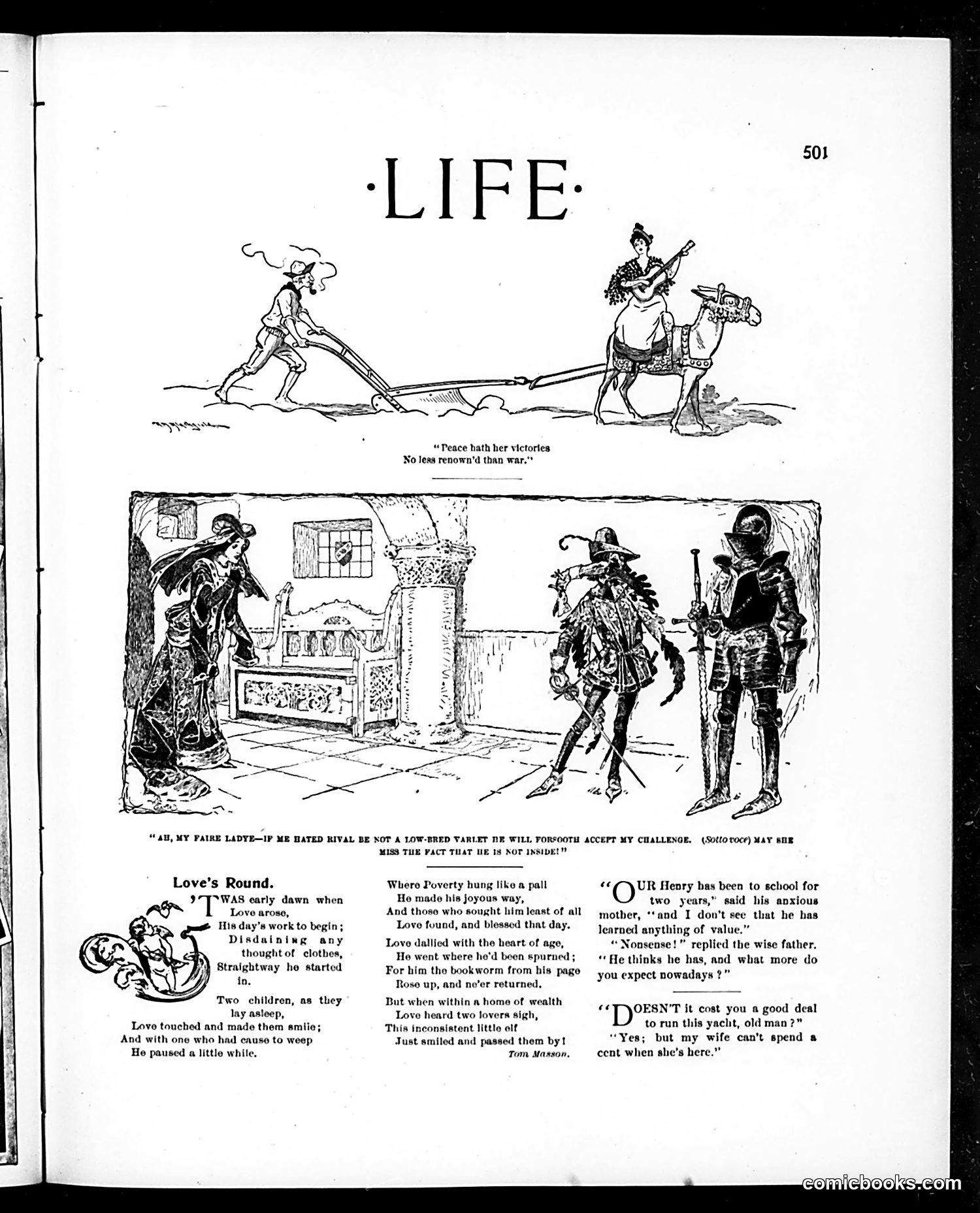
**Top Cartoon:** Depicts a figure pulling a rope attached to a camel-rider, illustrating the caption "Peace hath her victories / No less renown'd than war." This appears to satirize peaceful achievement as equivalent to military conquest—possibly commenting on diplomatic or commercial victories during a period when martial success was culturally celebrated. **Bottom Section:** Contains "Love's Round," a poem about love's transformative power, alongside two brief humorous dialogues about domestic economics—a husband questioning yacht expenses and a wife's retort about her spending. These represent typical satirical commentary on marriage and household finances, common humor in early-to-mid 20th century American magazines. The page blends political allegory with domestic comedy, characteristic of Life's satirical approach.
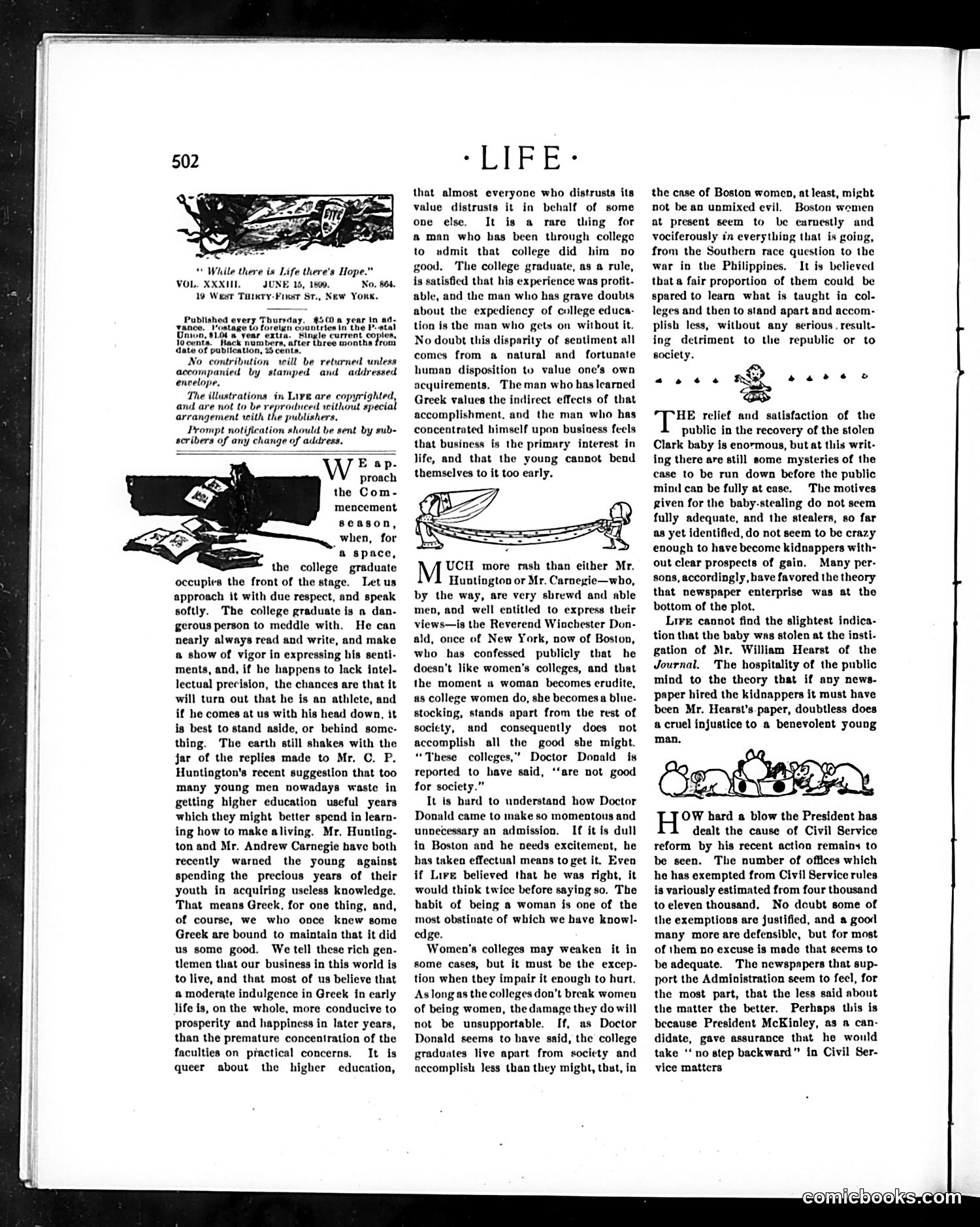
This page contains editorial commentary on women's higher education rather than cartoons. The text debates whether college attendance harms women socially and morally—a significant concern among the era's elite. The author references **Reverend Winchester Donald of New York** and **Doctor Donald** (likely the same person), who publicly claimed that college makes women "crude" and damages their marriageability and social standing. The piece criticizes this view while acknowledging legitimate concerns about women's education weakening domestic roles. The commentary also discusses **President McKinley's** Civil Service reform and references **Mr. Carnegie** and **Mr. Huntington**, suggesting broader debates about education and social reform among wealthy industrialists. The satire targets outdated attitudes toward educated women during the Progressive Era.
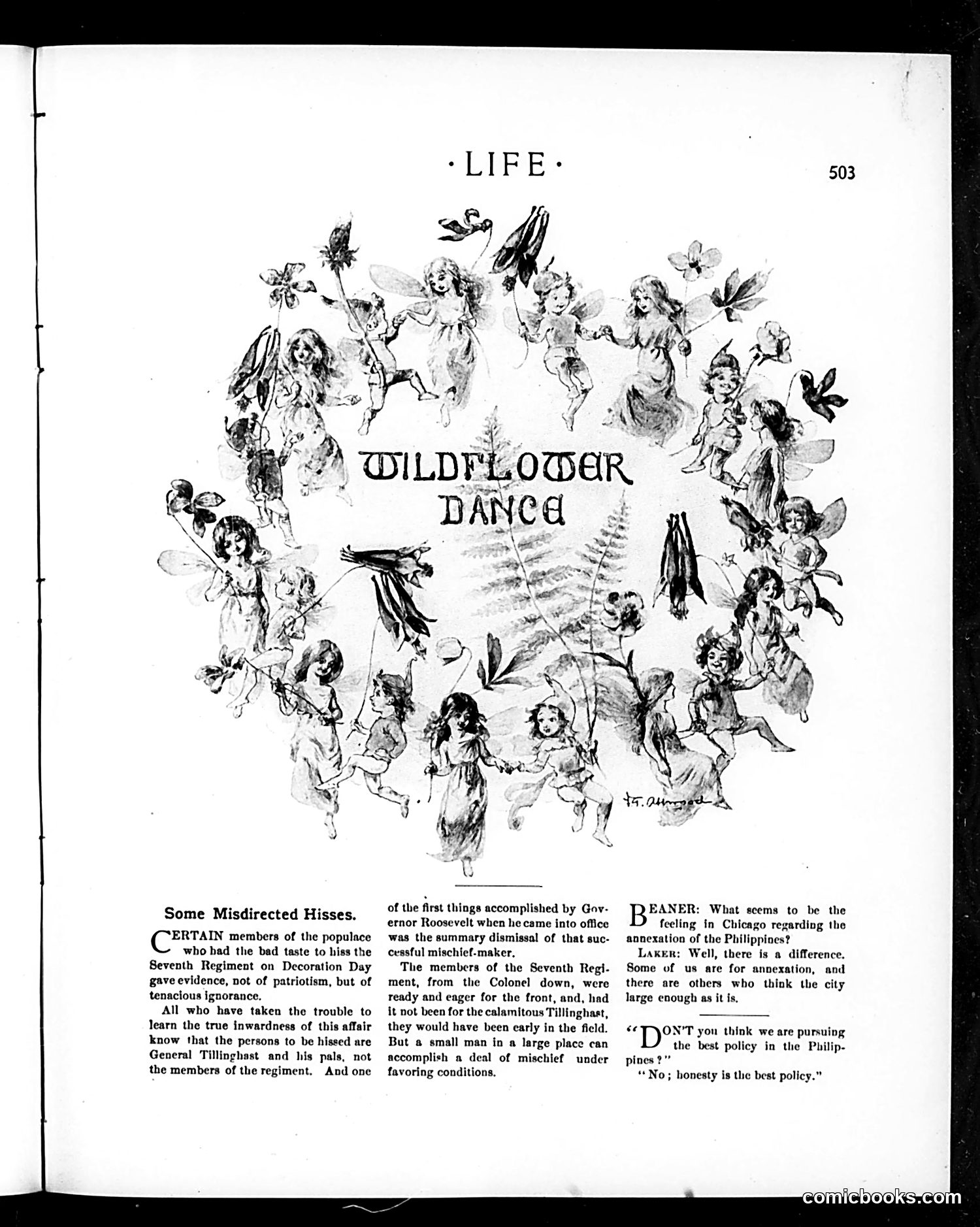
This page features a whimsical illustration of fairies and cherubs dancing around wildflowers, titled "Wildflower Dance." The artistic centerpiece has little satirical content itself. The substantive commentary appears below in "Some Misdirected Hisses," which criticizes members of the populace who hissed at the Seventh Regiment on Decoration Day (May 30), claiming this was unpatriotic. The text defends General Tillinghast and his regiment against accusations of mischief during the Seventh Regiment's early mobilization. A separate dialogue between "Beaner" and "Laker" discusses Chicago's annexation policy regarding the Philippines, with Laker arguing "honesty is the best policy"—likely referencing American imperialism debates of the early 1900s. The page mixes decorative art with political commentary on patriotism and foreign policy.
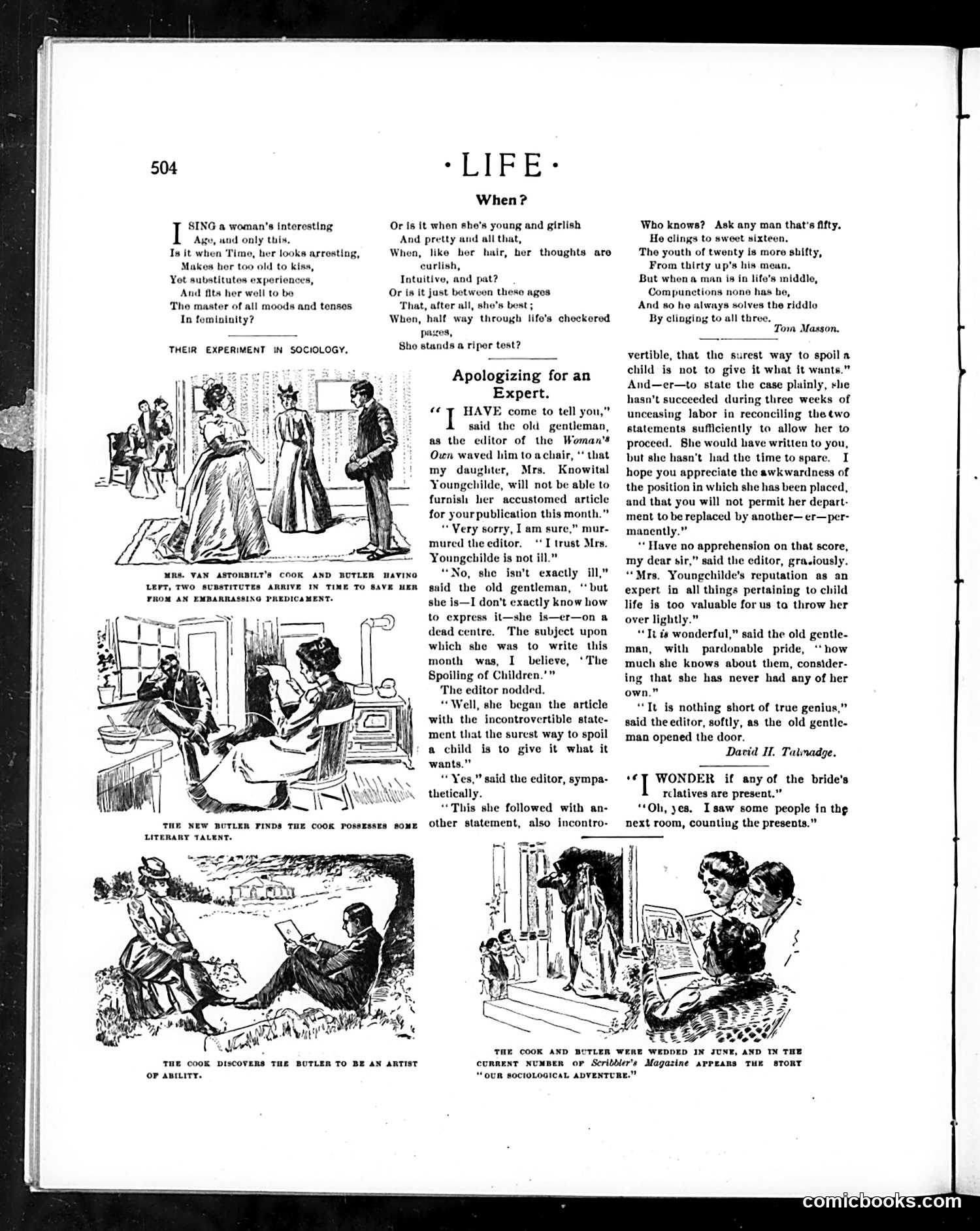
This page from *Life* magazine satirizes early 20th-century domestic service and social anxieties. The central narrative "Apologizing for an Expert" mocks a magazine editor's dilemma: a renowned child-rearing expert (Mrs. Youngchilde) cannot deliver her promised article because she's dealing with her own unruly child. The humor stems from the hypocrisy of expertise—the "expert" cannot control her own offspring. The surrounding illustrations humorously document household chaos: servants substituting for absent staff, a cook and butler discovering hidden artistic talents, and domestic misadventures. The satire targets both the era's faith in "scientific" child-rearing advice and the servant-management challenges facing middle-class households. The underlying joke: real-world parenting and household management resist expert systematization.
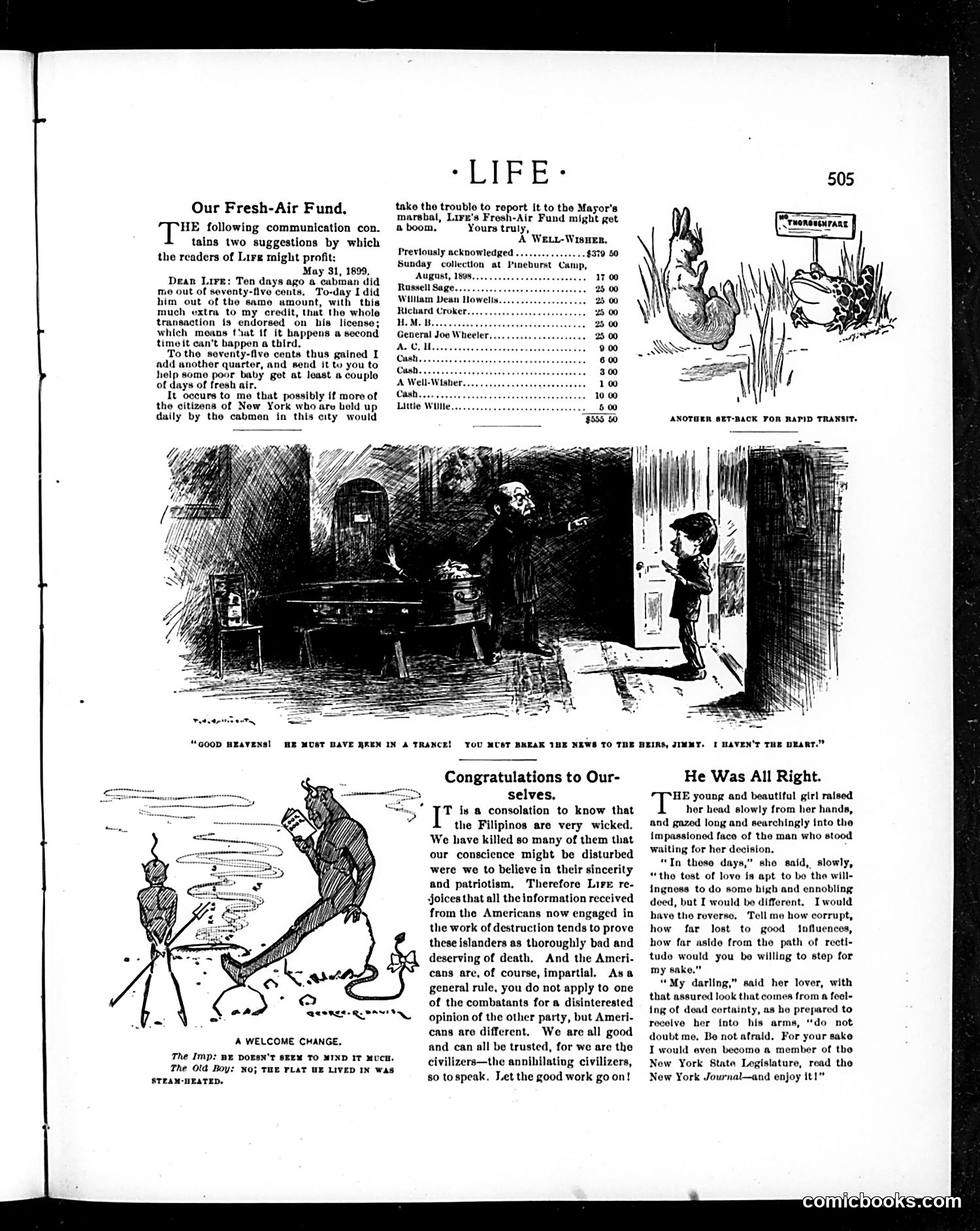
This page contains three distinct items: 1. **"Our Fresh-Air Fund"** — A letter column listing donations to a charitable fund providing outdoor recreation for New York children, totaling $352.50. 2. **"A Welcome Change"** — A political cartoon depicting an ape (representing the Philippines, labeled "The Imp") refusing to mind a bird cage, with caption text criticizing American military actions in the Philippine-American War. The satire suggests the U.S. has become destructively militaristic. 3. **"He Was All Right"** — A sentimental romantic story where a young woman initially doubts her suitor but ultimately accepts him after he offers her a political position in the New York State Legislature. The page primarily satirizes American imperialism in the Philippines while mixing social commentary with lighter human-interest content typical of early 1900s Life magazine.
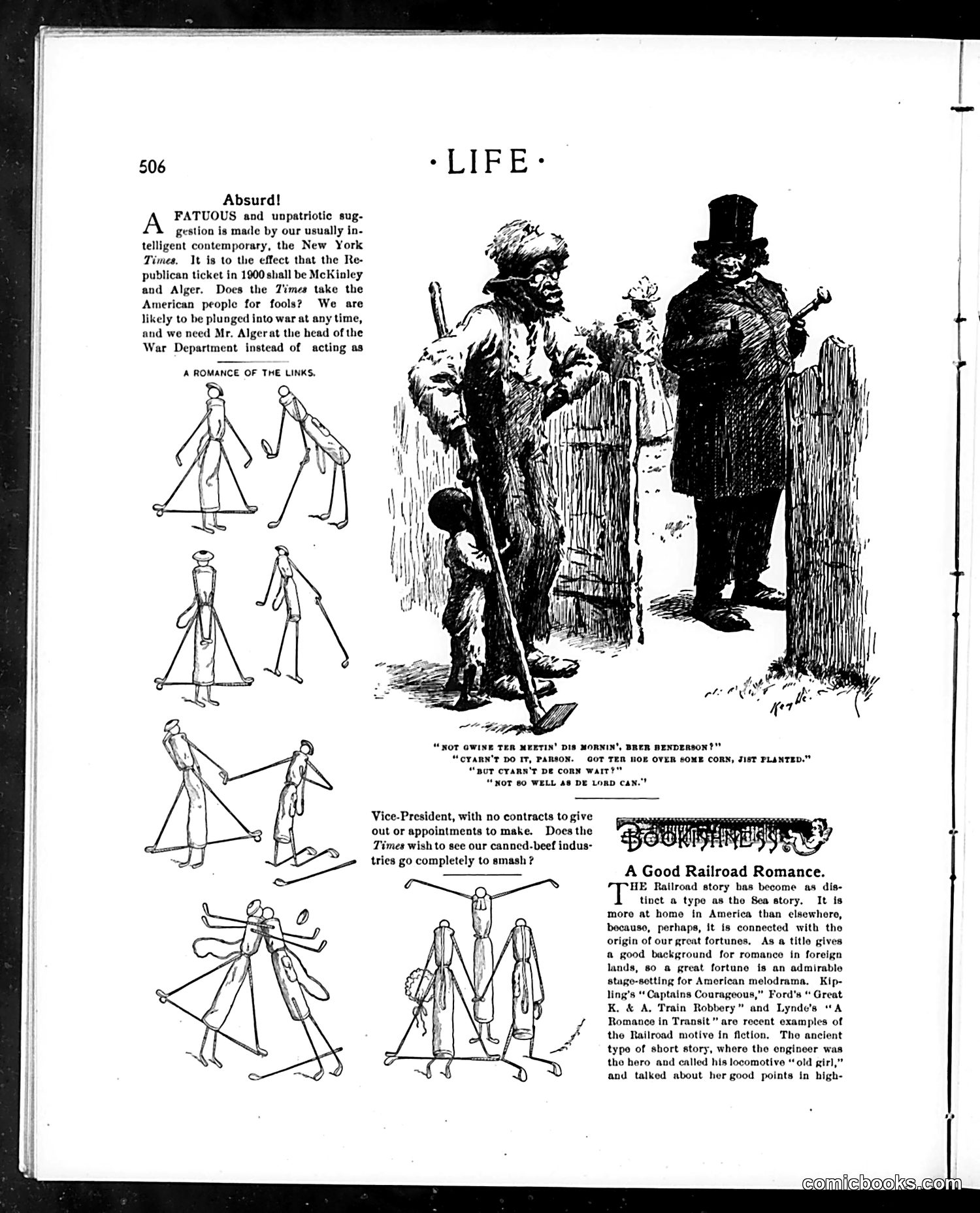
**Main Editorial Cartoon ("Absurd!"):** The top right illustration satirizes the *New York Times'* suggestion that Republican ticket-holder Belichley and Alger should head the War Department if America enters conflict. The cartoon depicts a scraggly, unkempt man (representing one of these figures) speaking with a well-dressed gentleman and woman, with dialogue about farming ("corn," "hoe"). The satire mocks the Times' proposal as absurd—suggesting these men are unqualified for such serious military responsibility. **"Romance of the Links" (Left Side):** Simple stick-figure sketches humorously depicting golf swings and positions—visual wordplay on romantic "links" versus golf links. **"Good Railroad Romance" (Bottom Right):** Brief article discussing how railroad stories have become popular American fiction, citing recent literary works using railroad settings and characters.
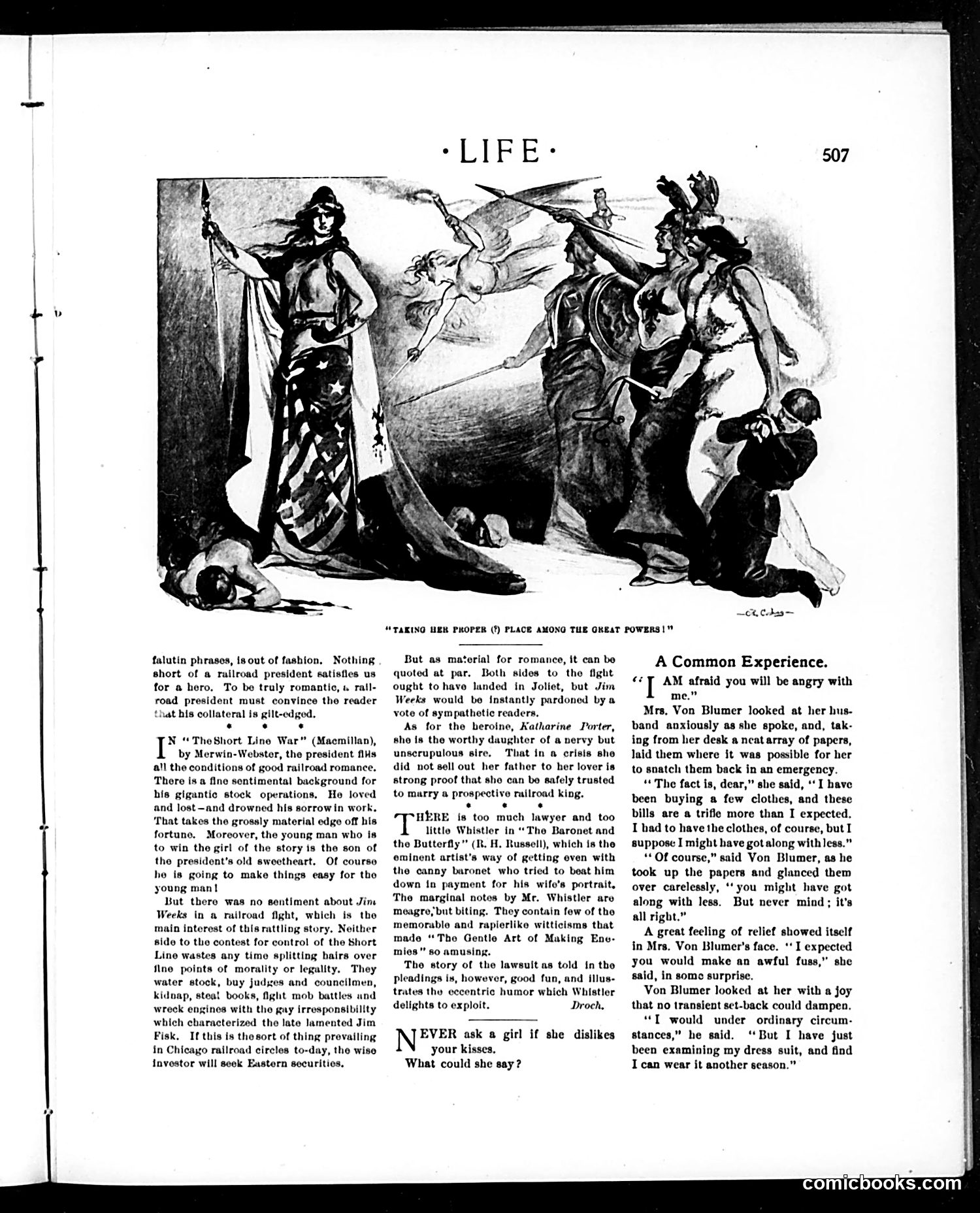
The page features a satirical illustration titled **"Taking Her Proper (?) Place Among the Great Powers!"** depicting a woman in classical dress standing among armed military figures representing various nations or powers. The satire appears to address **women's political status and representation**. The caption's question mark around "Proper" suggests irony about whether women actually hold legitimate power or authority comparable to established political/military powers. The woman's classical allegorical appearance contrasts with the armed, aggressive figures surrounding her, implying women are positioned as decorative or symbolic rather than genuinely powerful. The accompanying text discusses railroad romance narratives and social conventions, suggesting broader commentary on **women's constrained roles** in early 20th-century society despite claims of progress or equality.
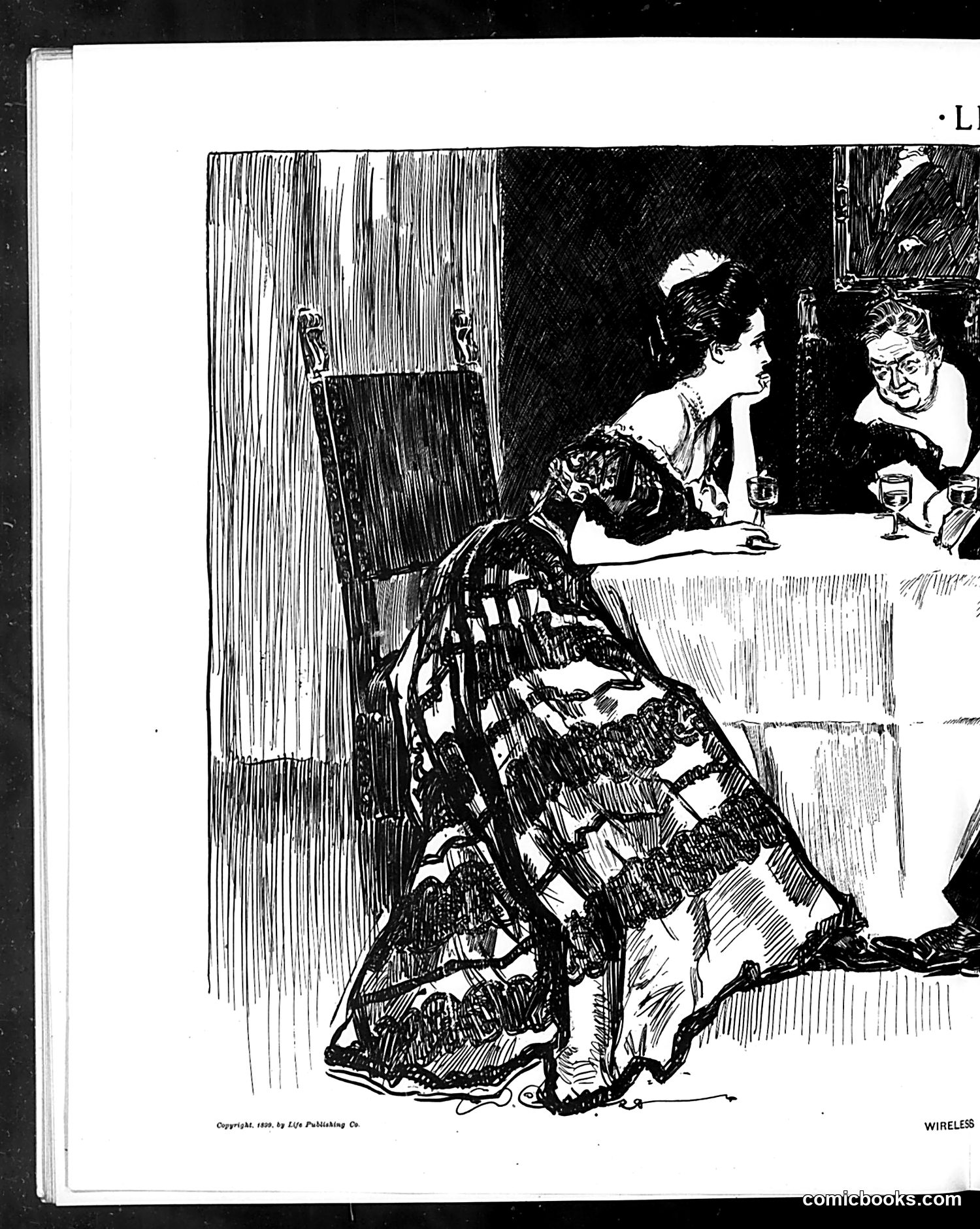
This appears to be a social satire illustration from *Life* magazine (copyright 1909, per the visible text). The drawing depicts an elegant dinner scene with three well-dressed figures at a table. A woman in an ornate, heavily-patterned dress sits prominently in the foreground, while two other figures converse at the table behind her. The satire likely targets **excessive or ostentatious fashion** among wealthy women of the Edwardian era—the elaborate, heavily-decorated gown receives exaggerated detailed rendering, suggesting the cartoonist mocks such excessive ornamentation. The woman's prominent, somewhat unflattering posture and positioning may ridicule fashionable pretension or vanity among high society. Without additional caption text visible, the specific social commentary remains somewhat unclear, though the tone is clearly mocking of upper-class fashion excess.
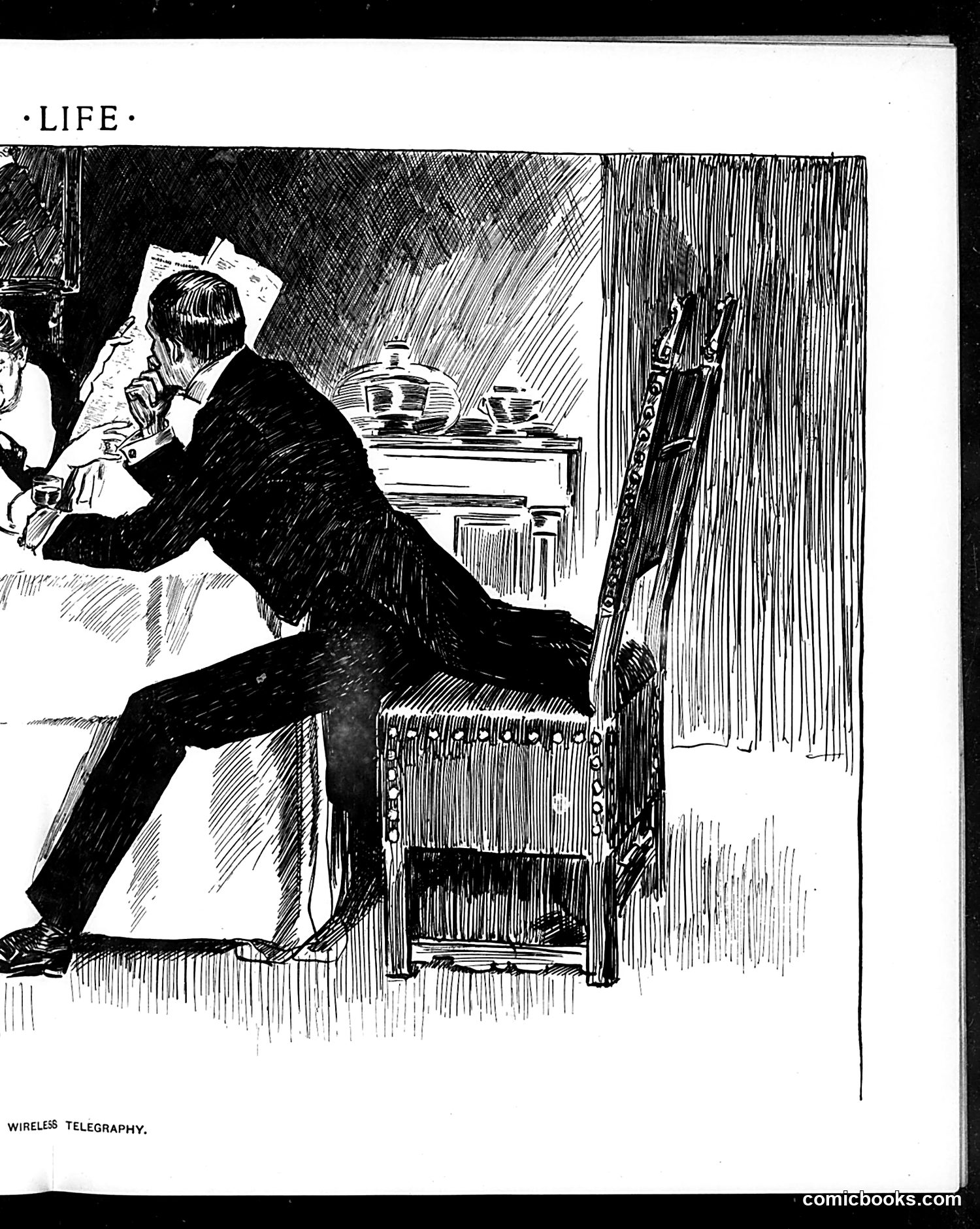
This satirical cartoon depicts a man in formal attire reclining on a bed while reading what appears to be a letter or document. The caption "Wireless Telegraphy" is the joke's setup. The satire plays on the term "wireless telegraphy"—a cutting-edge technology of the early 1900s for transmitting messages without wires. The cartoon's humor derives from a visual pun: the man is literally receiving a *wireless* message (a letter delivered through the mail) while lying in bed, suggesting lazy or domestic communication rather than the technological marvel the phrase implies. The scene mocks both the pretentiousness of modern technology's grand terminology and perhaps the leisurely lifestyle of comfortable society figures who receive correspondence while abed.
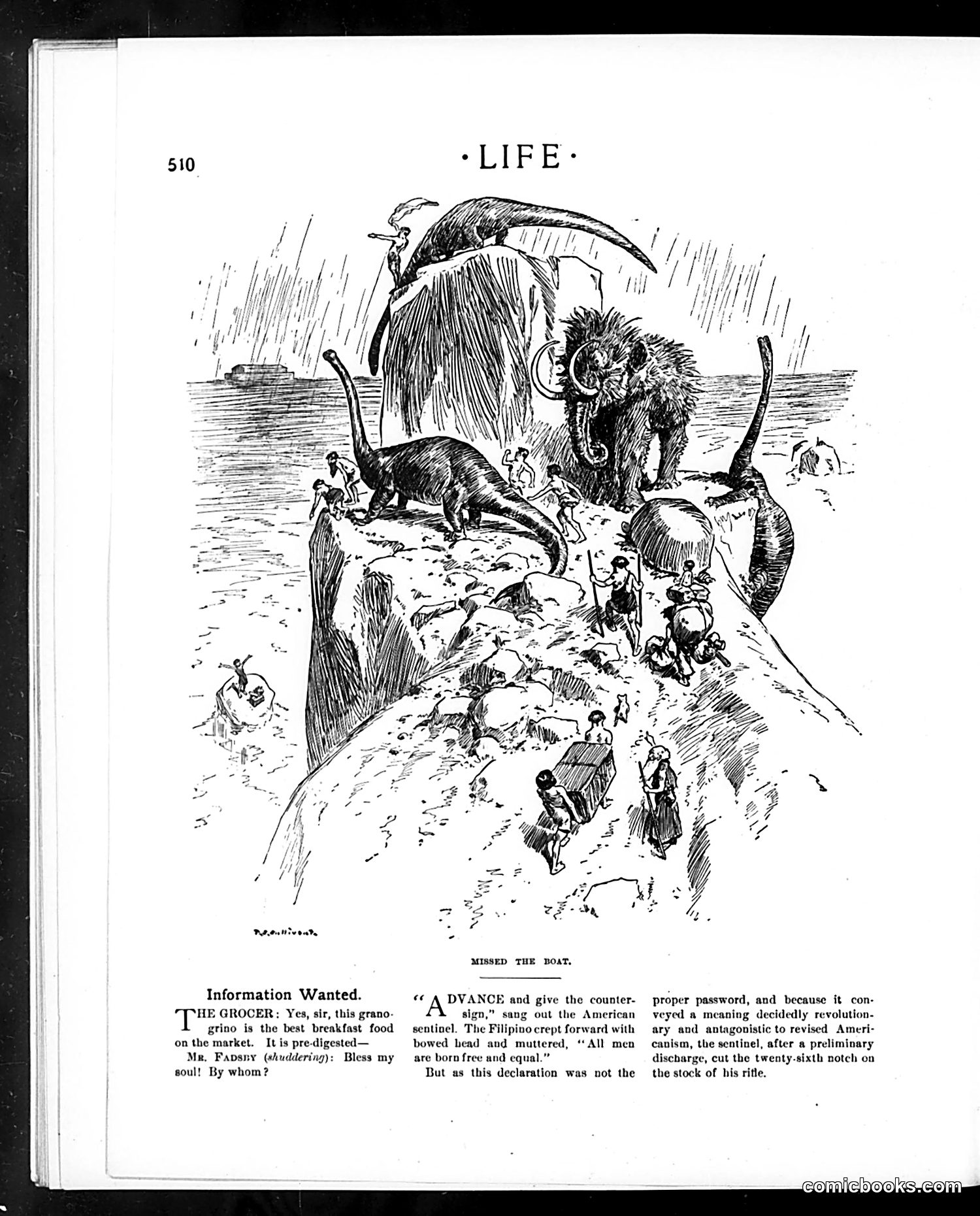
**The Main Cartoon ("Missed the Boat"):** This illustration depicts various animals and human figures on a beach or shore. The satire appears to comment on political exclusion or missed opportunities, likely referencing American imperialism or foreign policy debates of the period (the reference to "the American sentinel" and "the Philippine" in the text suggests Philippine-American relations). **The Text Section ("Information Wanted"):** A grocer claims that his granino is "the best breakfast food on the market," dismissing it as indigestible. Mr. Fadsny replies that he needs something to "bless my soul." The page satirizes both food marketing claims and broader political declarations about equality ("All men are born free and equal"), suggesting such rhetoric masks hypocritical practices—likely commentary on American colonial policies contradicting stated democratic ideals.
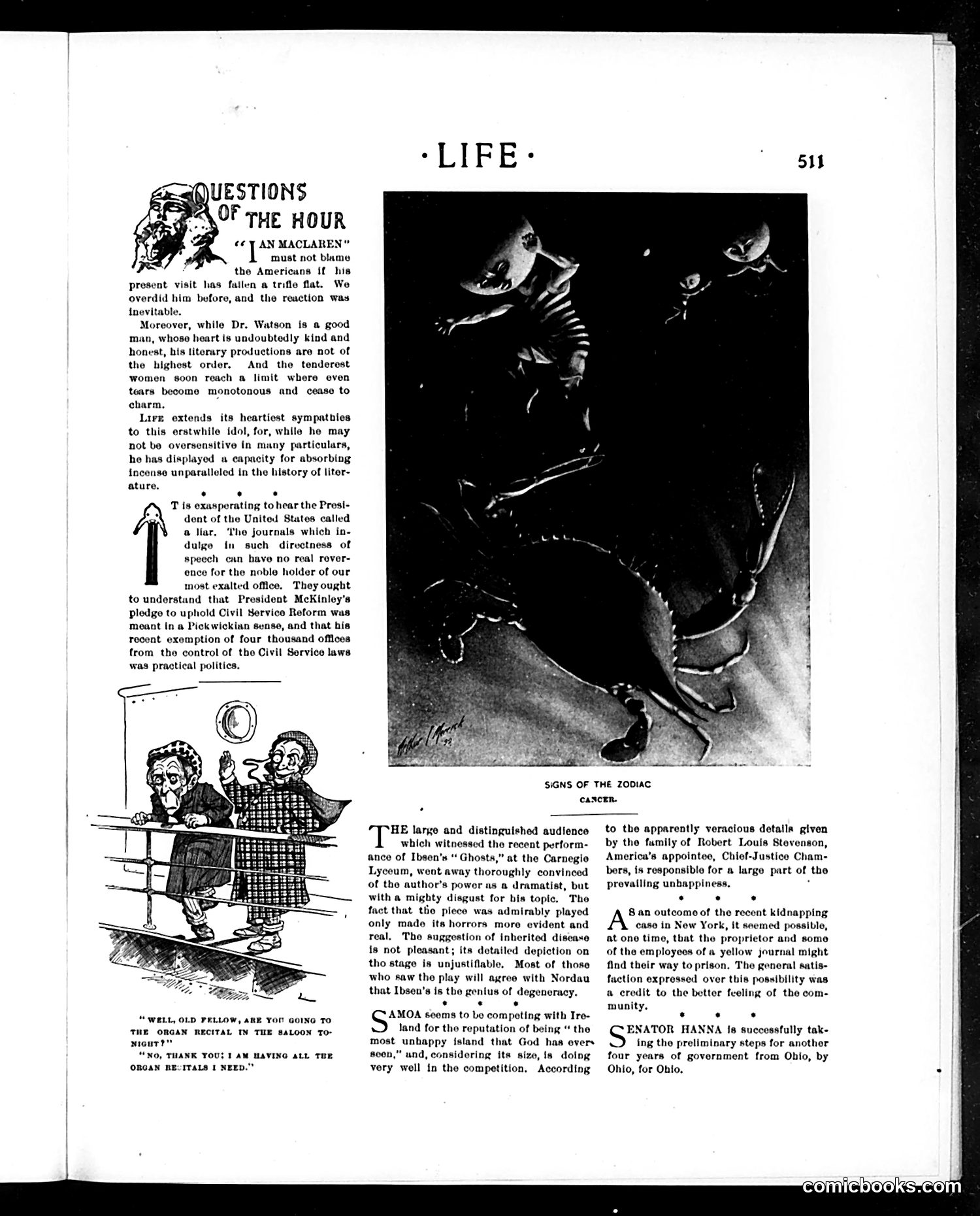
This page contains several satirical commentary pieces typical of American satirical journalism circa 1900: **"An Maclaren" reference**: Critiques a visiting Scottish author whose previous popularity has waned. The satire suggests Americans over-praised him initially, making disappointment inevitable. **McKinley Civil Service critique**: Mocks President McKinley for claiming to support Civil Service Reform while exempting 4,000 offices from its rules—calling this "practical politics" rather than honest governance. The cartoon below (two figures at an organ) appears to satirize hypocrisy or empty rhetoric. **Ibsen's "Ghosts" review**: Criticizes the play's depiction of inherited disease as artistically powerful but morally objectionable, reflecting Victorian squeamishness about such topics. **"Cancer" zodiac illustration**: A dramatic image accompaniment, likely symbolic of social decay. **Yellow journalism reference**: Expresses satisfaction that a newspaper proprietor involved in a recent kidnapping case faced potential prosecution—critiquing sensationalist journalism ethics. **Hanna/Ohio politics**: Senator Mark Hanna is mocked for controlling government "from Ohio, by Ohio, for Ohio"—suggesting regional political favoritism.
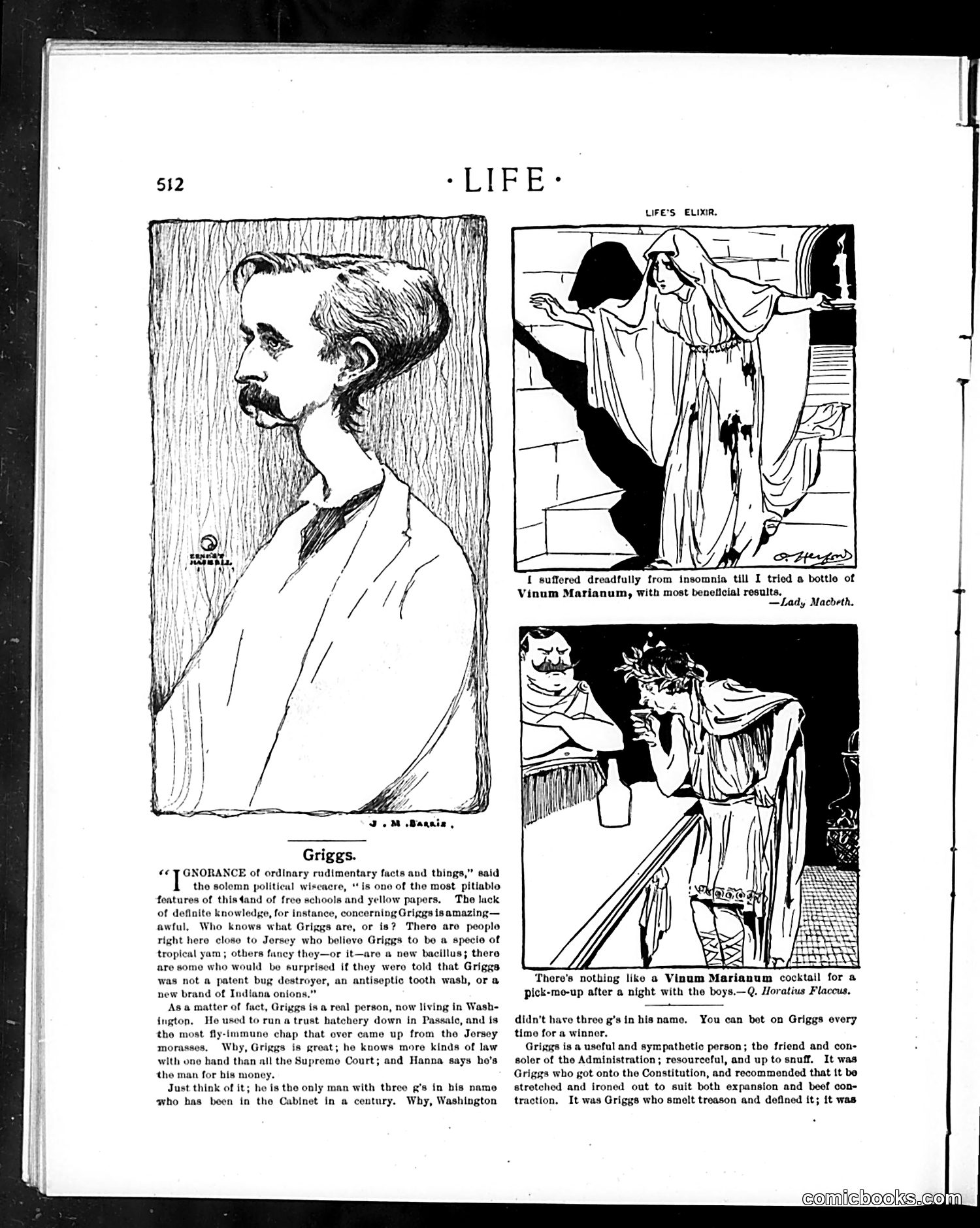
This page satirizes **Richard Olney Griggs**, apparently a cabinet official (likely Attorney General) in the McKinley administration. The left portrait and main text mock public ignorance about who Griggs is, suggesting ordinary citizens confuse him with products (bug spray, toothwash) or natural phenomena. The satire praises Griggs as a loyal administration functionary—resourceful, useful to the government, and notably the only cabinet member in a century with three g's in his name. The barbed compliment suggests he'll defend whatever policies the administration pursues, including imperial "expansion" and constitutional flexibility. The right-side cartoons labeled "Life's Elixir" mock patent medicines through fake testimonials (Lady Macbeth, Horace), paralleling how Griggs is presented as a cure-all for administrative problems—satirizing both quack remedies and blind party loyalty.
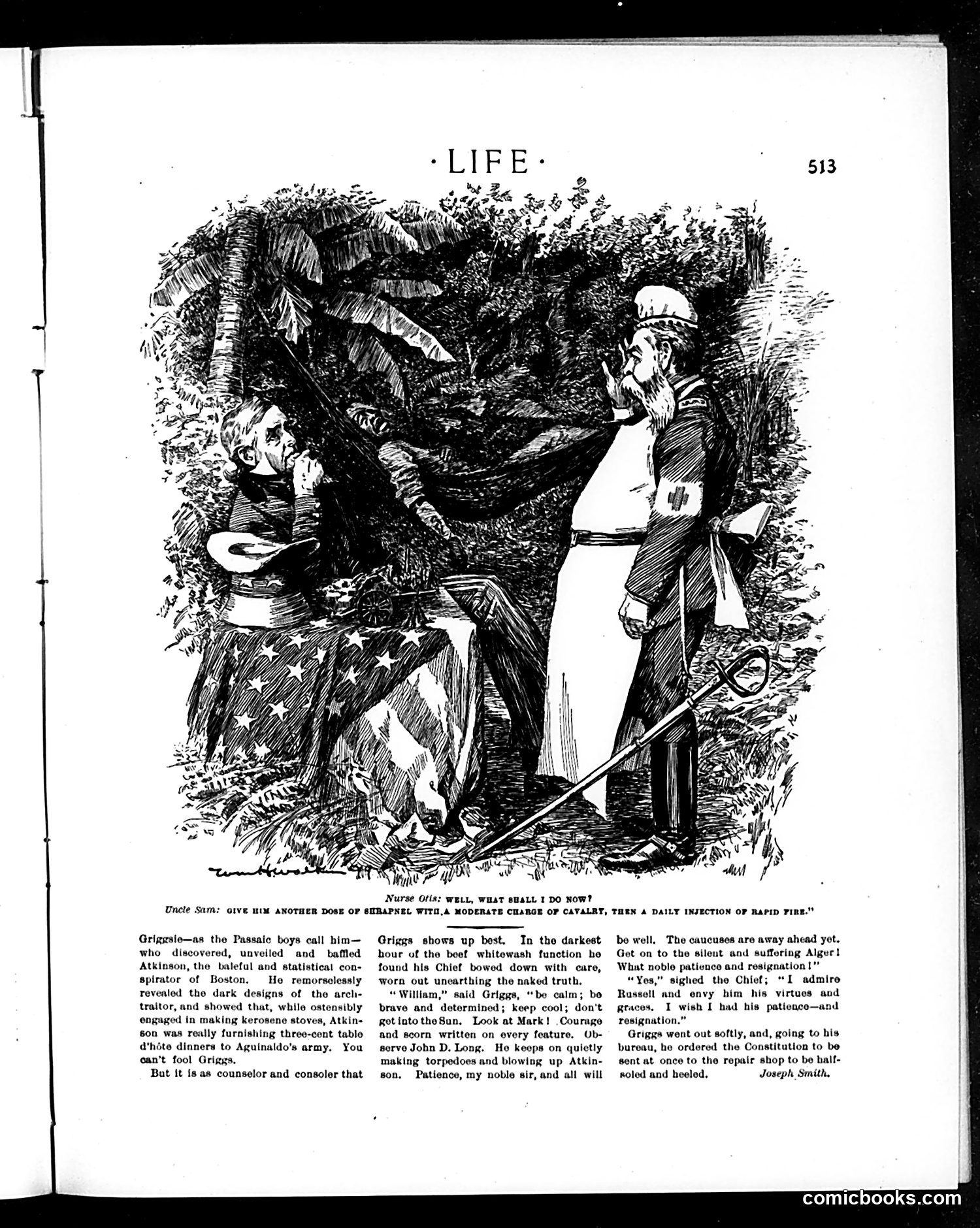
This is a satirical cartoon criticizing the McKinley administration's handling of the Philippine-American War and domestic scandals. **Main Figures:** - "Nurse Otis" (likely Secretary of the Navy John D. Long) treats "Uncle Sam" (America) as a patient - The prescription mockingly suggests treating the nation's ailments with "shrapnel" and "cavalry charges"—literal war **Context and Satire:** The cartoon attacks multiple administration scandals: the "Atkinson" conspiracy (a Boston official accused of secretly supplying the Filipino insurgent Aguinaldo), and "Alger" (likely Secretary of War Russell Alger, facing criticism over war management). The text mocks Republican operative Griggs as a spineless enabler who offers platitudes rather than solutions. The satire suggests McKinley's team diagnoses national problems through military aggression abroad while ignoring corruption at home. The final line about sending "the Constitution...to the repair shop to be half-soled and heeled" implies the administration is literally wearing out America's fundamental document.
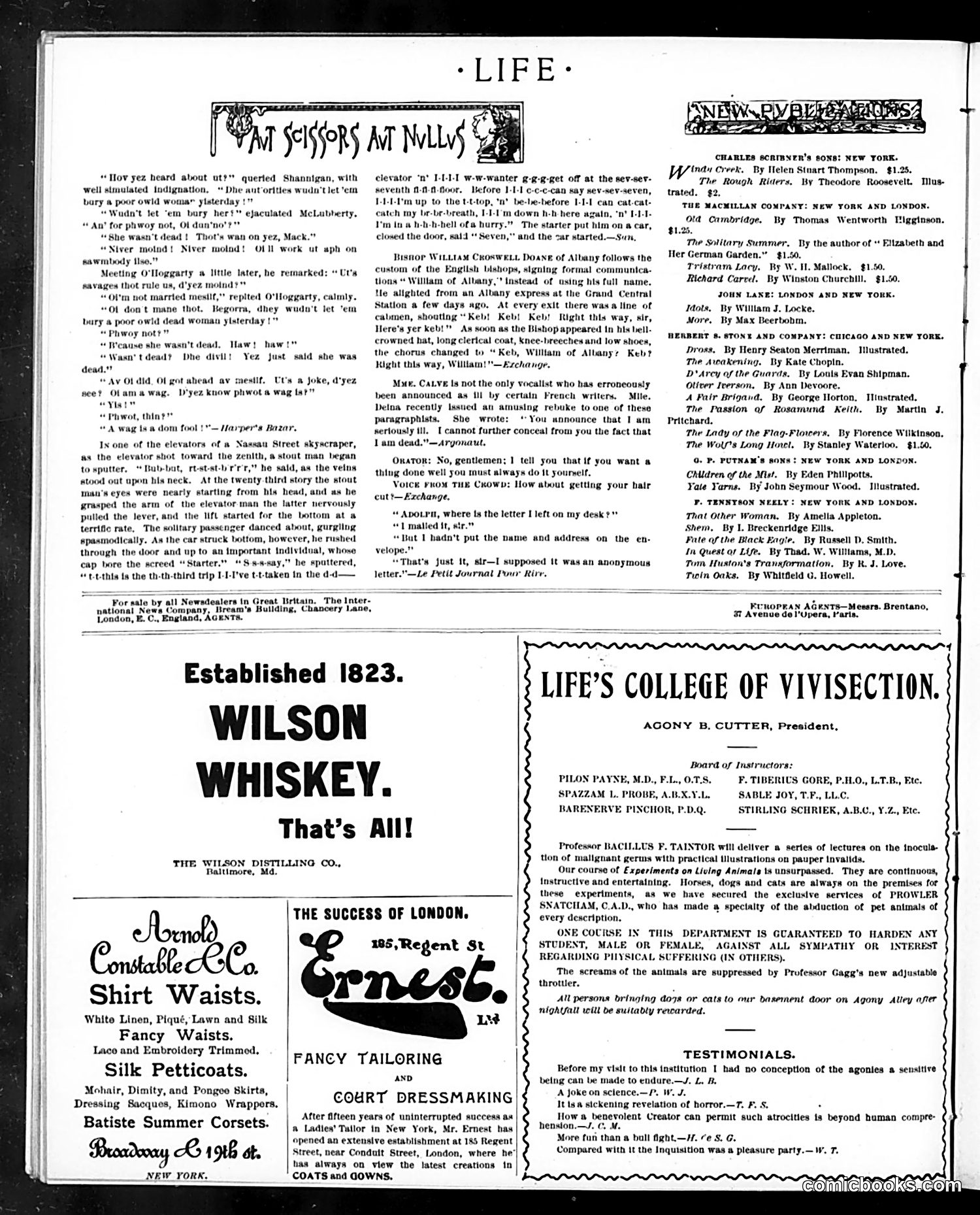
This page contains **three separate jokes** written in exaggerated Irish-American dialect, reflecting early 20th-century American humor: 1. **The Dead Woman**: Shannigan and McLubherty joke about authorities refusing to bury a woman—the twist being she wasn't actually dead. The humor relies on wordplay and the audience's expectation. 2. **The Elevator Panic**: A stout man repeatedly rides an elevator to the 23rd floor and back, stuttering nervously each time. He eventually confesses he simply wants to exit at the seventh floor—the joke being his own anxiety caused the chaos. 3. **Bishop William of Albany**: When the formally-titled bishop appears at a train station, cab drivers recognize him by his ecclesiastical dress and shout "Keb, William of Albany?"—satirizing both the bishop's pretentious formal signatures and working-class recognition of his status. The dialect and characterizations reflect period attitudes toward Irish-Americans. The page is primarily **advertising** (whiskey, corsets, tailoring services), with humor filler between ads.
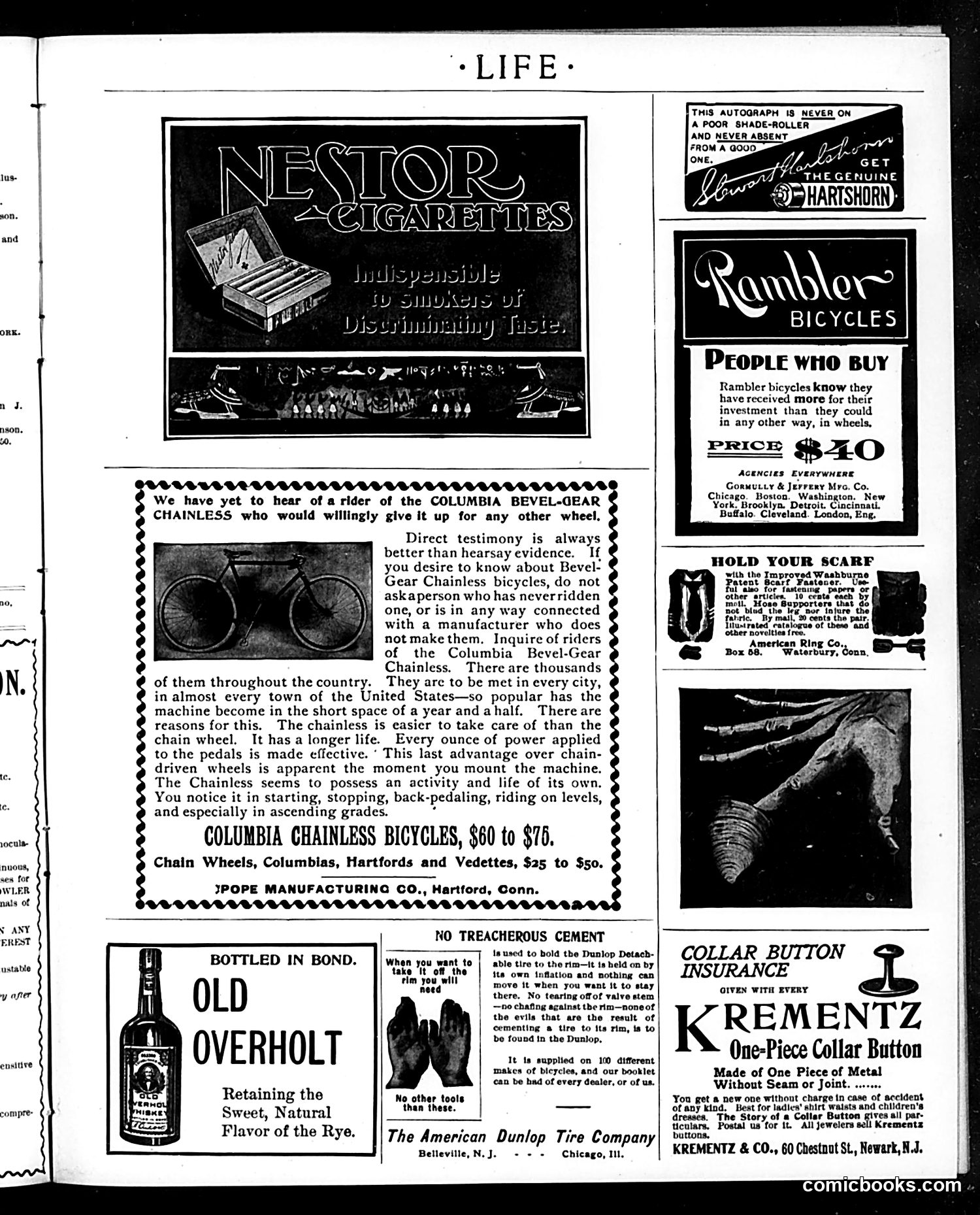
This is primarily an **advertising page**, not a satirical cartoon. It contains multiple product advertisements typical of early 1900s American consumer magazines. The main content features ads for: - **Columbia Chainless Bicycles** ($60-75): The largest ad emphasizes the bike's superiority by claiming thousands of satisfied users exist nationwide. It argues the chainless design is easier to maintain, more durable, and more efficient than chain-driven wheels—a genuine technological competition of that era. - **Rambler Bicycles** ($40): A competing bicycle brand offering value. - **Dunlop Detachable Tires**: Marketed as superior because they use inflation rather than cement to attach to rims, avoiding damage. - **Old Overholt Whiskey**: Advertised as "bottled in bond," emphasizing quality. - Various smaller products: Havishorn autographs, scarf holders, and Krementz collar buttons (offering replacement insurance). The page reflects a period when bicycles were major consumer goods and intense competition drove marketing claims about durability and innovation. There is **no political satire or caricature**—this is straightforward commercial advertising from Life's business section.
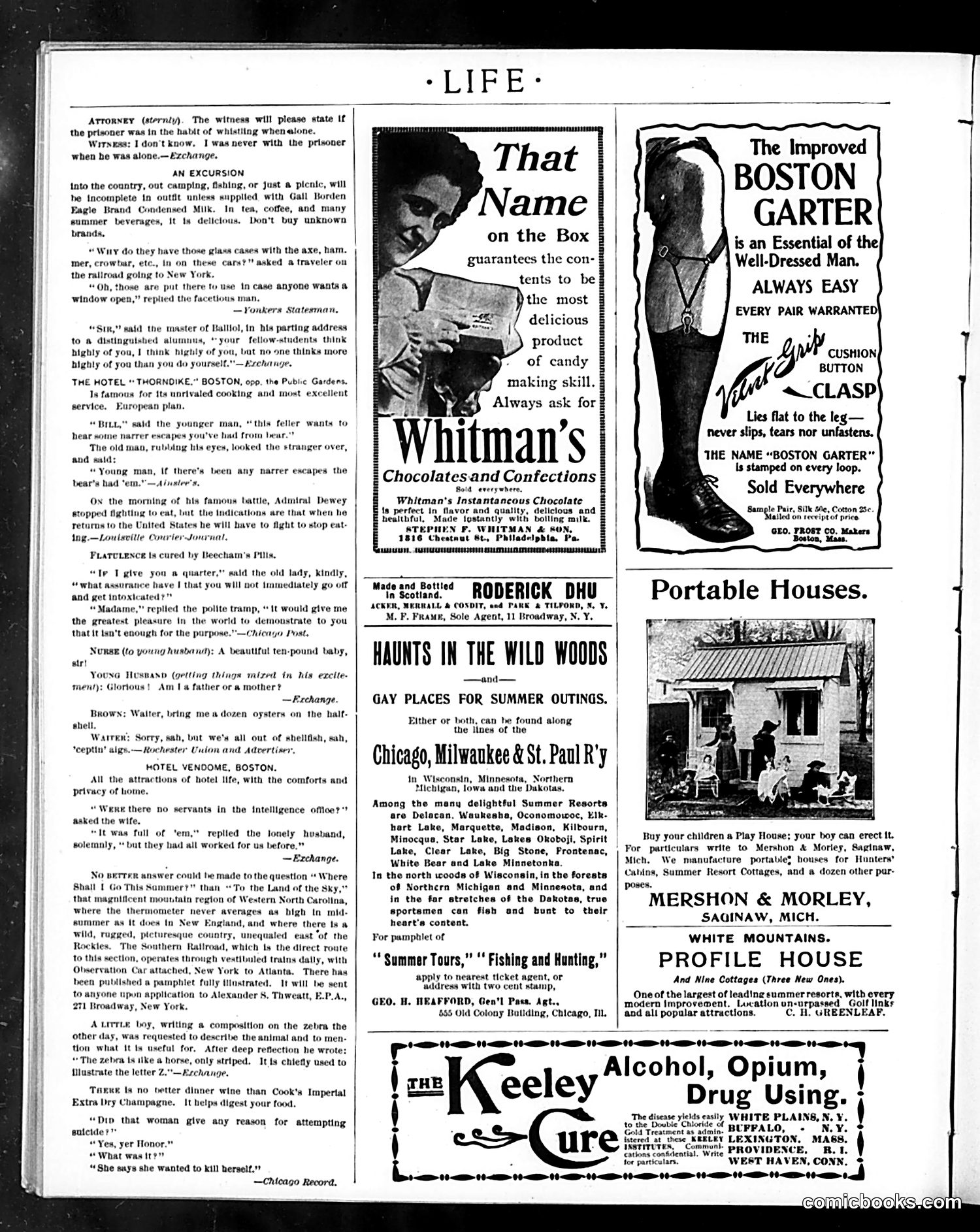
This page is primarily **advertising and humor**, not political cartoons. The content consists of: **Main elements:** - A legal joke (top): An attorney asks if a prisoner whistled alone—the witness's logical response that they were never with the prisoner alone satirizes courtroom absurdity. - Multiple brief humorous anecdotes about travel, dining, and social situations, typical of Life's satirical humor format. - Several product advertisements (Whitman's Chocolates, Boston Garter, Portable Houses, The Keeley Cure for addiction). **Social context for modern readers:** The jokes reflect early 20th-century concerns: train travel safety, servants' reliability, excessive eating (Admiral Dewey reference), and alcohol/drug addiction treatment (The Keeley Cure). The humor is gentle, relying on wordplay and situational irony rather than sharp political critique. **No identifiable political figures** are caricatured on this page. It's primarily lifestyle and consumer-oriented content typical of Life magazine's entertainment function during this era.
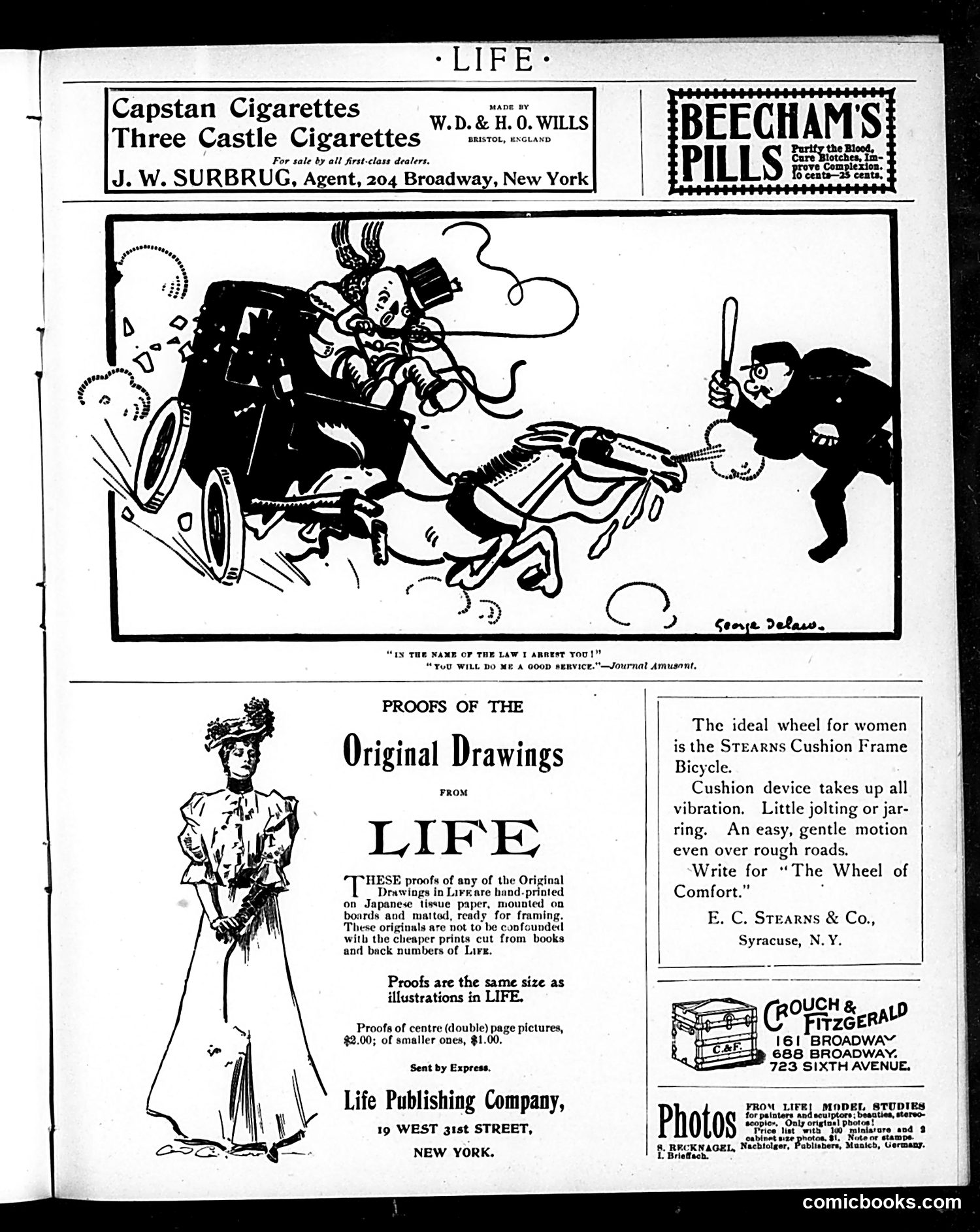
The main cartoon depicts a comic chase scene: a disheveled demon or devil-like figure in a carriage is being pursued by a policeman wielding a club, with the caption "In the name of the law I arrest you!" followed by "You will do me a good service." **The satire likely references law enforcement chasing vice or crime**—the demonic figure suggests moral evil or lawlessness (possibly corruption, crime, or a social vice the era associated with supernatural malevolence). The policeman's promise that the arrest will be a "good service" adds ironic humor, suggesting that removing this figure benefits society. The cartoon's style and the attribution to *Journal Amusant* suggest it's a reprinted European satirical work, typical of Life's content mixing American and international humor. **The rest of the page is advertising** for cigarettes, bicycle cushion frames, art proofs, and photography services—standard Life magazine commercial content from this period.
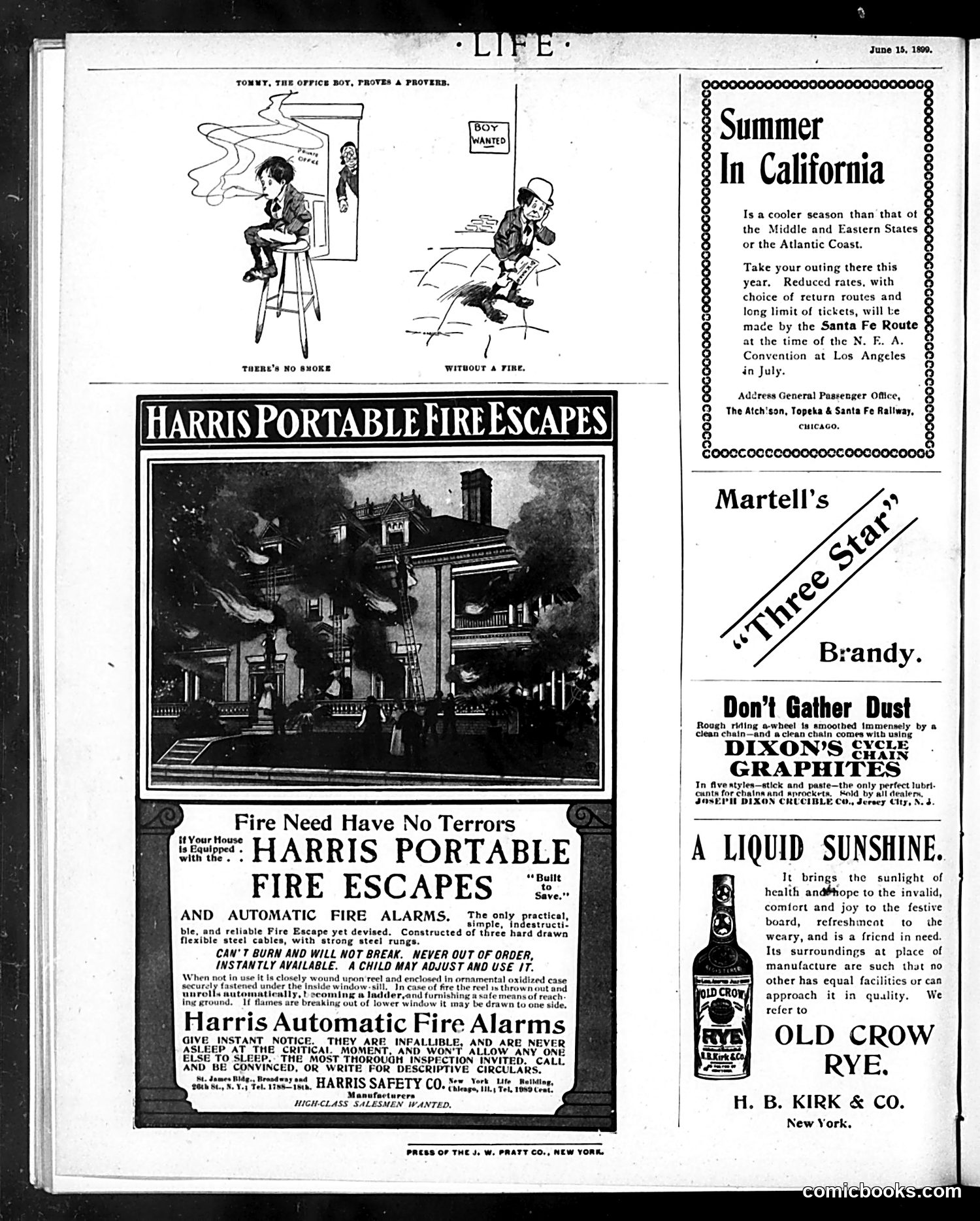
This page combines political/satirical cartoons with period advertisements. **The Cartoons:** "Tommy, the Office Boy, Proves a Proverb" illustrates the saying "there's no smoke without a fire" through two scenes. In the first, Tommy sits at a desk producing smoke from a pipe; in the second, he races away from a fire. The joke is a visual pun: Tommy literally demonstrates the proverb by creating actual smoke (from his pipe) and then an actual fire, treating the familiar saying as literal fact. **The Advertisements:** The page is dominated by Harris Portable Fire Escapes and Automatic Fire Alarms—industrial safety equipment marketed to building owners and managers. The other ads promote travel (Santa Fe Railway's California route), brandy (Martell's "Three Star"), bicycle lubricant (Dixon's Graphites), and whiskey (Old Crow Rye). The juxtaposition of fire-safety equipment advertising with a humorous cartoon about fire suggests the page ironically plays on contemporary anxieties about workplace fire hazards, a genuine concern in 1900s America.