
Life, 1899-06-15 · page 4 of 20
Life — June 15, 1899 — page 4: what you’re looking at
What you’re looking at
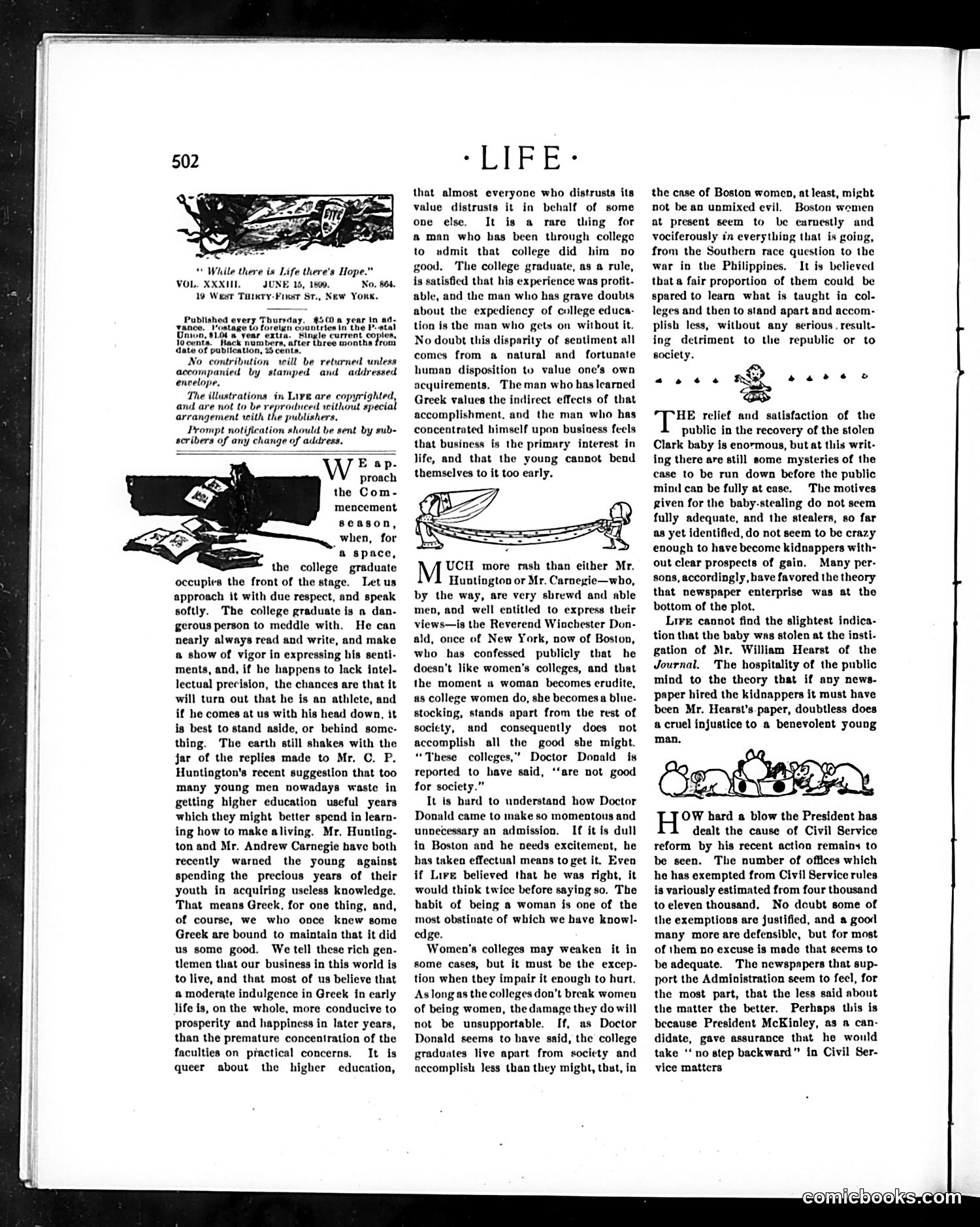
This page contains editorial commentary on women's higher education rather than cartoons. The text debates whether college attendance harms women socially and morally—a significant concern among the era's elite. The author references **Reverend Winchester Donald of New York** and **Doctor Donald** (likely the same person), who publicly claimed that college makes women "crude" and damages their marriageability and social standing. The piece criticizes this view while acknowledging legitimate concerns about women's education weakening domestic roles. The commentary also discusses **President McKinley's** Civil Service reform and references **Mr. Carnegie** and **Mr. Huntington**, suggesting broader debates about education and social reform among wealthy industrialists. The satire targets outdated attitudes toward educated women during the Progressive Era.
📄 Transcribed text from this page (OCR, searchable)
Machine-transcribed from the original scan — historical spelling and the odd misread are preserved.
“ While there is Life there's Hope.” VOL. XXXL. JUNE 15, 1899, No, 864. 19 West Tatkry-Fiesr St., New YOR«. = Published every ‘Thurvaay. 8500 0 year in ad- re to foreign by sep in the P-atal Banoo, stot @ year extia. le current coptes, l0cents. Back rwambers: after bree months from date of publication, % cents. No contribution will be returned unless accompanied by stamped and addressed encelope. The illustrations in Live are copyrighted, aud are not t0 be reproduced without special arrangement with the publishers, Prompt notification should be sent by sub- soribers of any change of aildress. E ap- proach the Com- mencement scason, when, for "a space, the college graduate occupies the front of the stage. Let us approach it with due respect, and speak softly. The college graduate is n dan- gerous person to meddle with. He can nearly always read and write, and make a show of vigor in expressing his senti- ments, and, if he happens to lack intel- lectual precision, the chances are that it will turn out that he is an athlete, and if he comes at us with his head down, it is best to stand aside, or behind some- thing. The earth still shakes with the jar of the replies made to Mr. C. P. Huntington's recent suggestion that too many young men nowadays waste in getting higher education useful years which they might better spend in learn- ing how to make aliving. Mr. Hunting- ton and Mr. Andrew Carnegie have both recently warned the young against spending the precious years of their youth in acquiring uscless knowledge. That means Greek, for one thing, and, of course, we who once knew some Greek are bound to maintain that it did us some good. We tell these rich gen- tlemen that our business in this world is to live, and that most of us believe that a moderate indulgence in Greek in early life is, on the whole, more conducive to prosperity and happiness in later years, than the premature concentration of the faculties on practical concerns. It is queer about the higher education, LIFE that almost everyone who distrusts its value distrusts it in behalf of some one else. It is a rare thing for a man who has been through college to admit that college did him no good. The college graduate, as a rule, is satisfied that his experience was protit- able, and the man who has grave doubts about the expediency of college educa- tion is the man who gets on without it. No doubt this disparity of sentiment all comes from a natural and fortunate human disposition to value one’s own acquirements. The man who haslIcarned Greek values the indirect effects of that accomplishment, and the man who has concentrated himself upon business feels that business is the primary interest in life, and that the young cannot bend themselves to it too early. UCH more rash than either Mr. Huntington or Mr. Carnegie—who, by the way, are very shrewd and able men, and well entitled to express their views—is the Reverend Winchester Don- ald, once of New York, now of Boston, who has confessed publicly that he doesn't like women’s colleges, and that the moment a woman becomes erudite, as college women do, she becomesa blue- stocking, stands apart from the rest of society, and consequently does not accomplish all the good she might. “These colleges,” Doctor Donald is reported to have said, ‘‘are not good for society.” It is hard to understand how Doctor Donald came to make so momentous and unnecessary an admission. If it is dull in Boston and he needs excitement, he has taken effectual means to get it. Even if Live believed that he was right, it would think twice before saying so. The habit of being a woman is one of the most obstinate of which we have knowl- edge. Women's colleges may weaken it in some cases, but it must be the excep- tion when they impair it enough to hurt, As long as the colleges don’t break women of being women, the damage they do will not be unsupportable. If, as Doctor Donald seems to have said, the college graduates live apart from society and accomplish less than they might, tbat, in the case of Boston women, at least, might not be an unmixed evil. Boston wemen at present seem to be earnestly and vociferously in everything that is going, from the Southern race question to the war in the Philippines. It is believed that a fair proportion of them could be spared to learn what is taught in col- leges and then to stand apart and accom- plish less, without any serious. result- ing detriment to the republic or to society. wee RQ saree a> HE relief and satisfaction of the public in the recovery of the stolen Clark baby is enormous, but at this writ- ing there are still some mysteries of the case to be run down before the public mind can be fully at ease. The motives given for the baby-stealing do not seem fully adequate, and the stealers, so far as yet identified, do not seem to be crazy enough to have become kidnappers with- out clear prospects of gain. Many per- sons, according|y, have favored the theory that newspaper enterprise was at the bottom of the plot. Lire cannot find the slightest indica- tion that the baby was stolen at the insti- gation of Mr. William Hearst of the Journal, The hospitality of the public mind to the theory that if any news. paper hired the kidnappers it must have been Mr. Hearst’s-paper, doubtless does a cruel injustice to a benevolent young OW hard a blow the President bas dealt the cause of Civil Service reform by his recent action remains to be seen. The number of offices which he has exempted from Civil Service rules is variously estimated from four thousand to eleven thousand, No doubt some of the exemptions are justified, and a good many more are defensible, but for most of them no excuse is made that ecems to be adequate. The newspapers that sup- port the Administration seem to feel, for the most part, that the less said about the matter the better. Perhaps this is because President McKinley, as a can- didate, gave assurance that he would take ‘no step backward” in Civil Ser- vice matters