
A complete issue · 20 pages · 1899
Life — May 18, 1899
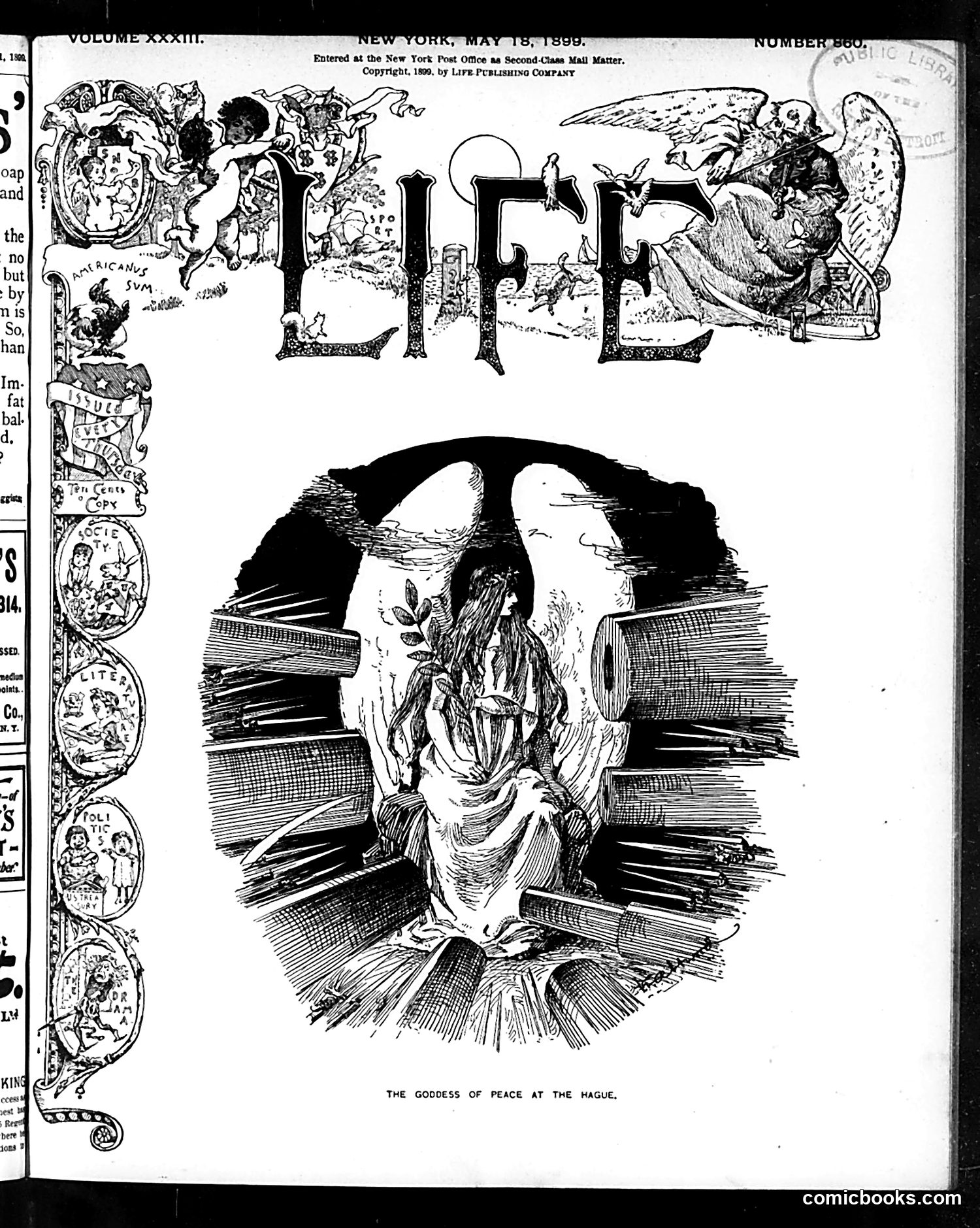
This page features the title "LIFE" with decorative Art Nouveau styling. The main illustration below is captioned "THE GODDESS OF PEACE AT THE HAGUE." The image depicts a robed female figure (representing Peace) appearing gaunt and hollow-eyed, seated between what appear to be wooden logs or barriers. The artistic style emphasizes her distressed, skeletal appearance through heavy cross-hatching. This cartoon likely comments on peace negotiations occurring at The Hague in 1898—possibly related to the Spanish-American War or broader international tensions of that period. The "Goddess of Peace" rendered as hollow and trapped suggests satirical commentary that genuine peace was impossible or illusory amid contemporary conflicts. The decorative left border contains various emblems and figures typical of Life's period design.
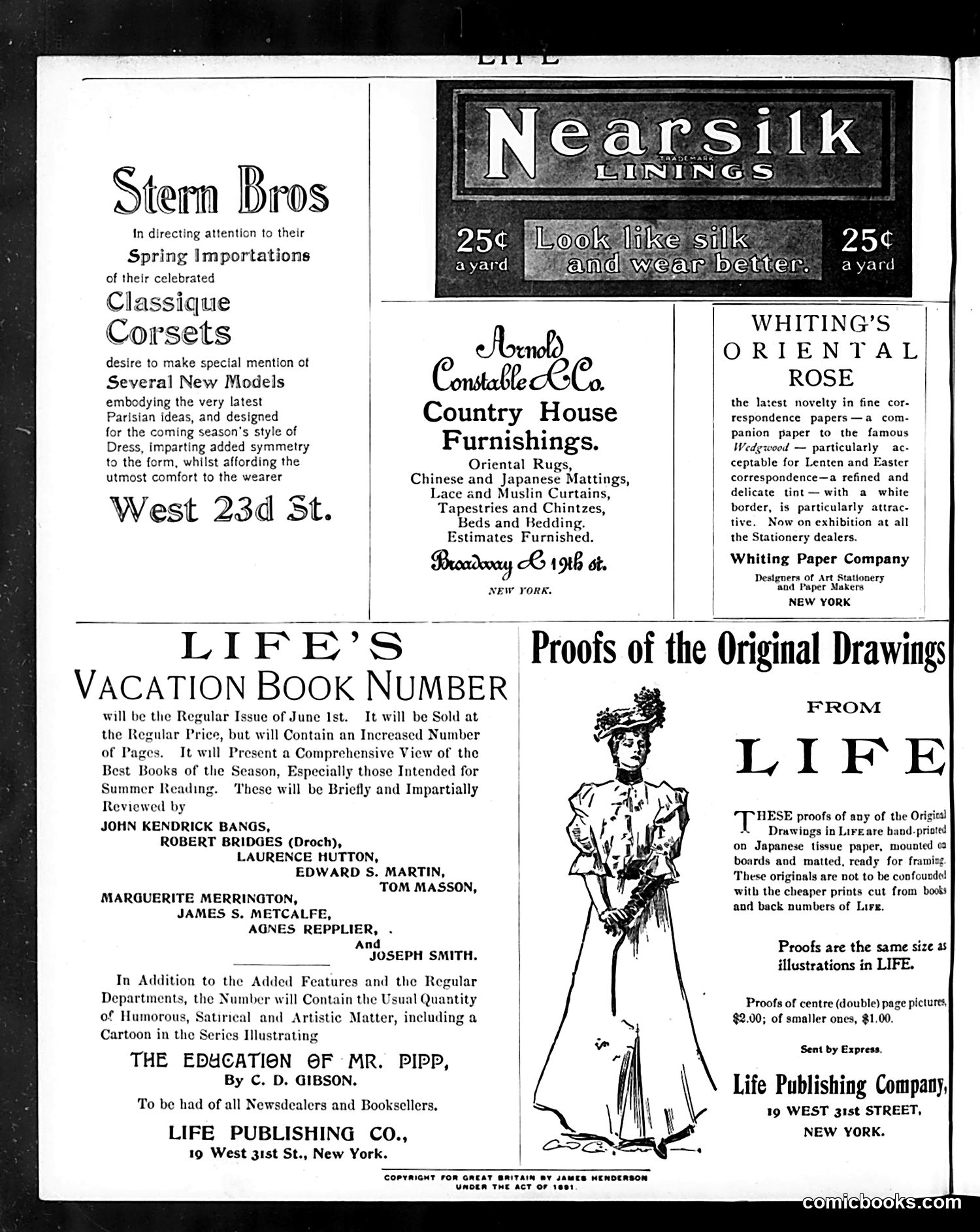
This page is **primarily advertising**, not political satire. The content includes: - **Stern Bros** corset advertisement (West 23rd St.) - **Nearsilk Linings** ad (25¢/yard) - **Arnold Constable & Co.** furniture announcement - **Whiting's Oriental Rose** stationery ad - **Life's Vacation Book Number** announcement for June 1st issue - **Life Publishing Company** promotion of original artwork proofs The only illustration is a **fashion sketch** of a woman in an elegant Edwardian-era dress with a large feathered hat—standard commercial fashion imagery for the period, not political commentary. There are no political cartoons, caricatures, or satirical content on this page. It represents typical early 1900s magazine advertising and publishing announcements.
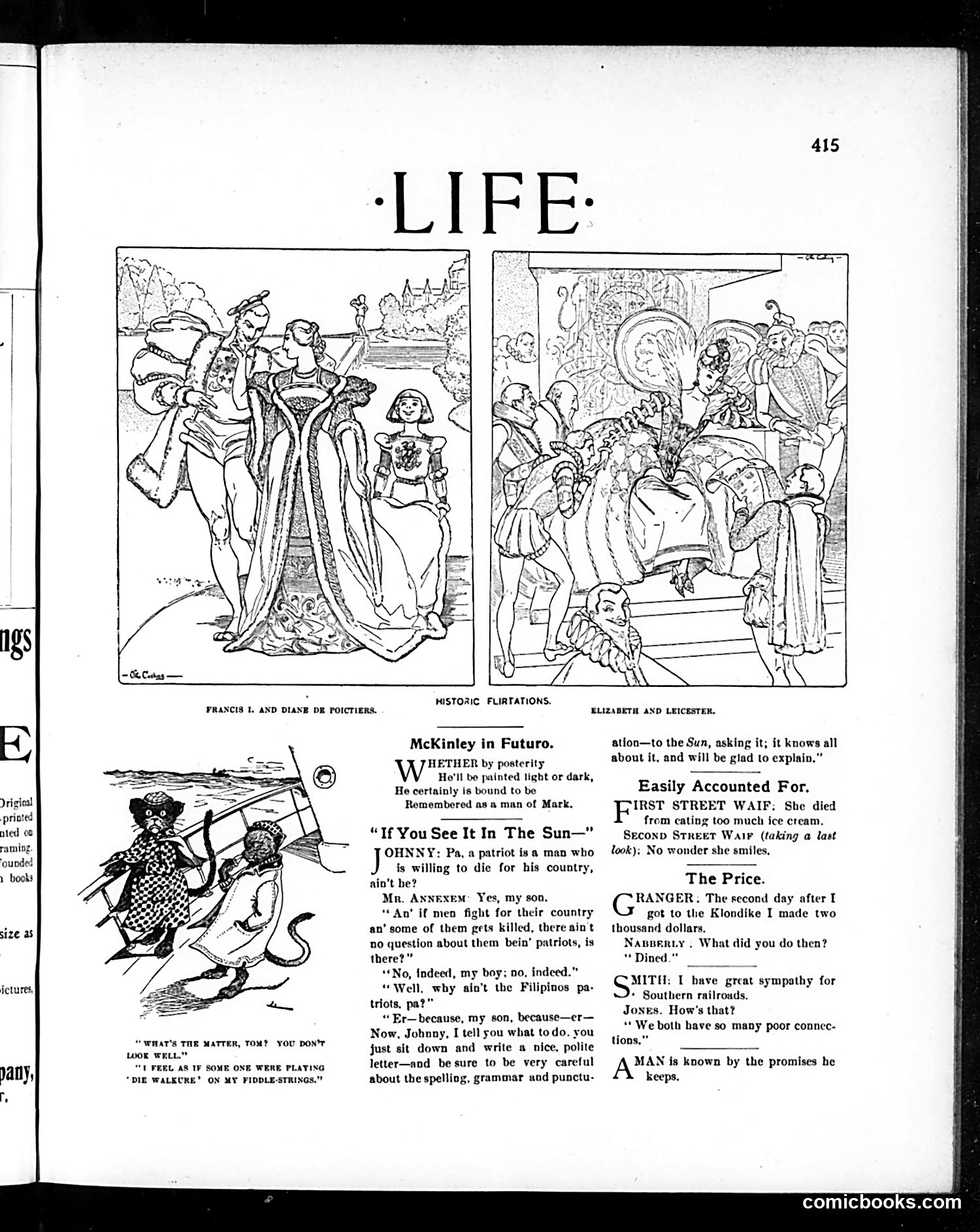
This page contains three distinct satirical pieces: 1. **Top illustrations** ("Francis I and Diane de Poitiers" / "Historic Flirtations" / "Elizabeth and Leicester"): Historical romantic pairings, likely commentary on courtly behavior or power dynamics. 2. **"McKinley in Futuro"**: A cartoon depicting what appears to be President McKinley as a future statue or monument, with accompanying dialogue about patriotism and fighting for one's country. The piece seems to satirize patriotic rhetoric. 3. **"What's the Matter, Tom?"**: A humorous musical dialogue where someone plays "Die Waltzer" on fiddle strings, with jokes about spelling and letter-writing etiquette. The overall tone is light satirical humor mixing historical references with contemporary American political and social commentary, typical of Life's editorial approach.
This page discusses American policy toward the Philippines and Cuba, likely from the early 1900s (Philippine-American War era). The text references **General Russell A. Alger** and **General Joseph Wheeler**, both prominent military figures of that period. The article criticizes the tendency to romanticize military leadership while ignoring practical governance. It argues against keeping troops in the Philippines indefinitely, warning that prolonged occupation could undermine American credibility and encourage independence movements. The satirical point appears to target the gap between **military heroism** and **administrative competence**—suggesting that celebrated generals may not be suited for colonial administration. The page advocates for withdrawing from the Philippines to prevent further costly entanglement, reflecting anti-imperialist sentiment of the era.
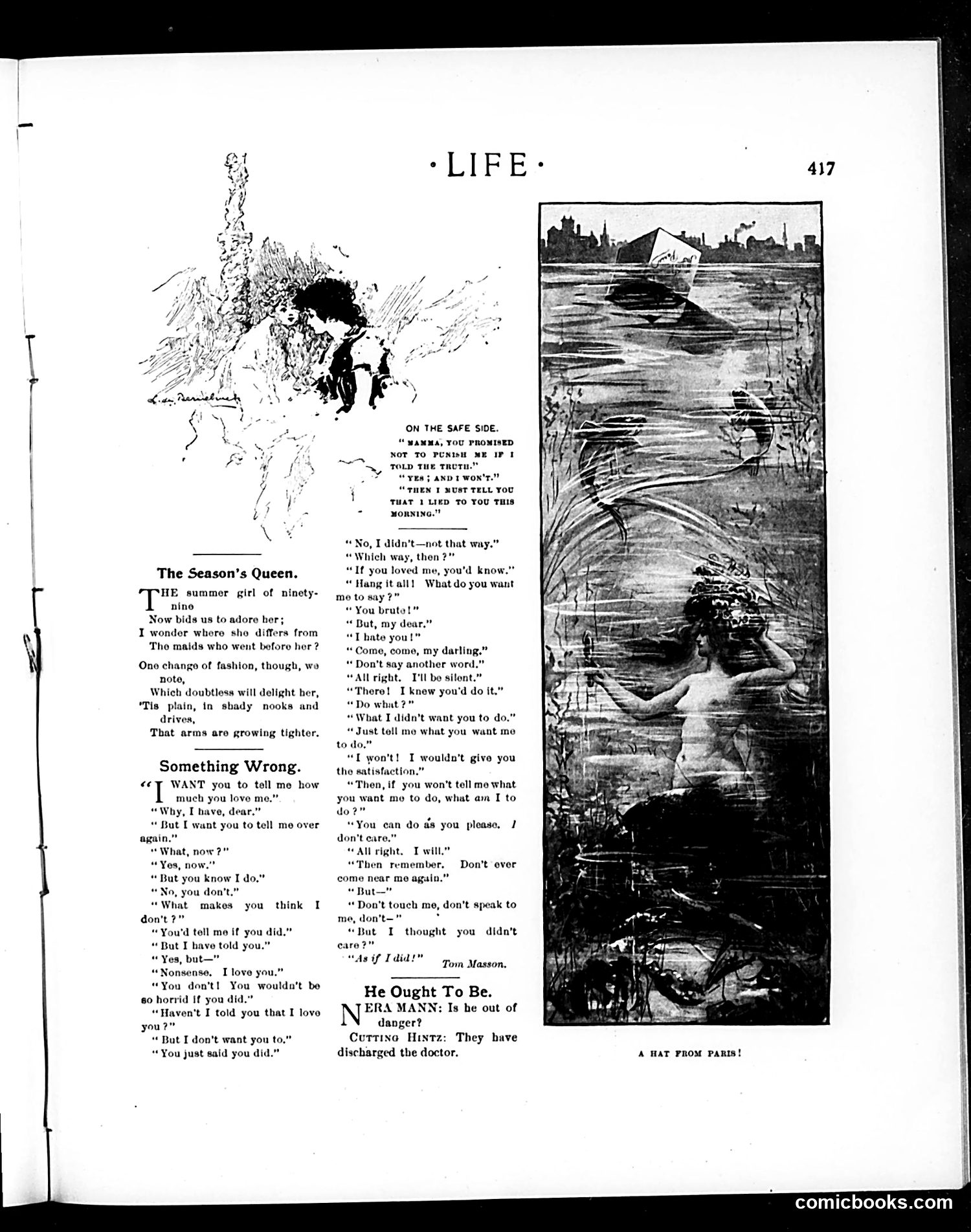
This page contains three literary pieces rather than political cartoons: 1. **"The Season's Queen"** — A poem celebrating the "summer girl of ninety-nine," describing fashionable young women of that era. 2. **"Something Wrong"** — A romantic dialogue between a couple in conflict. He demands she explain her love; she refuses; he threatens to leave. It explores relationship tension through witty repartee typical of late-19th-century satirical magazines. 3. **"He Ought To Be"** — A brief dramatic scene mentioning "Nera Mann" and "Cutting Hintz," discussing a doctor's discharge. The page's right side features a photograph labeled "A Hat From Paris!" showing a woman in a boat. This represents Life's mixed content: poetry, short comedic dialogues, and fashion commentary rather than editorial satire.
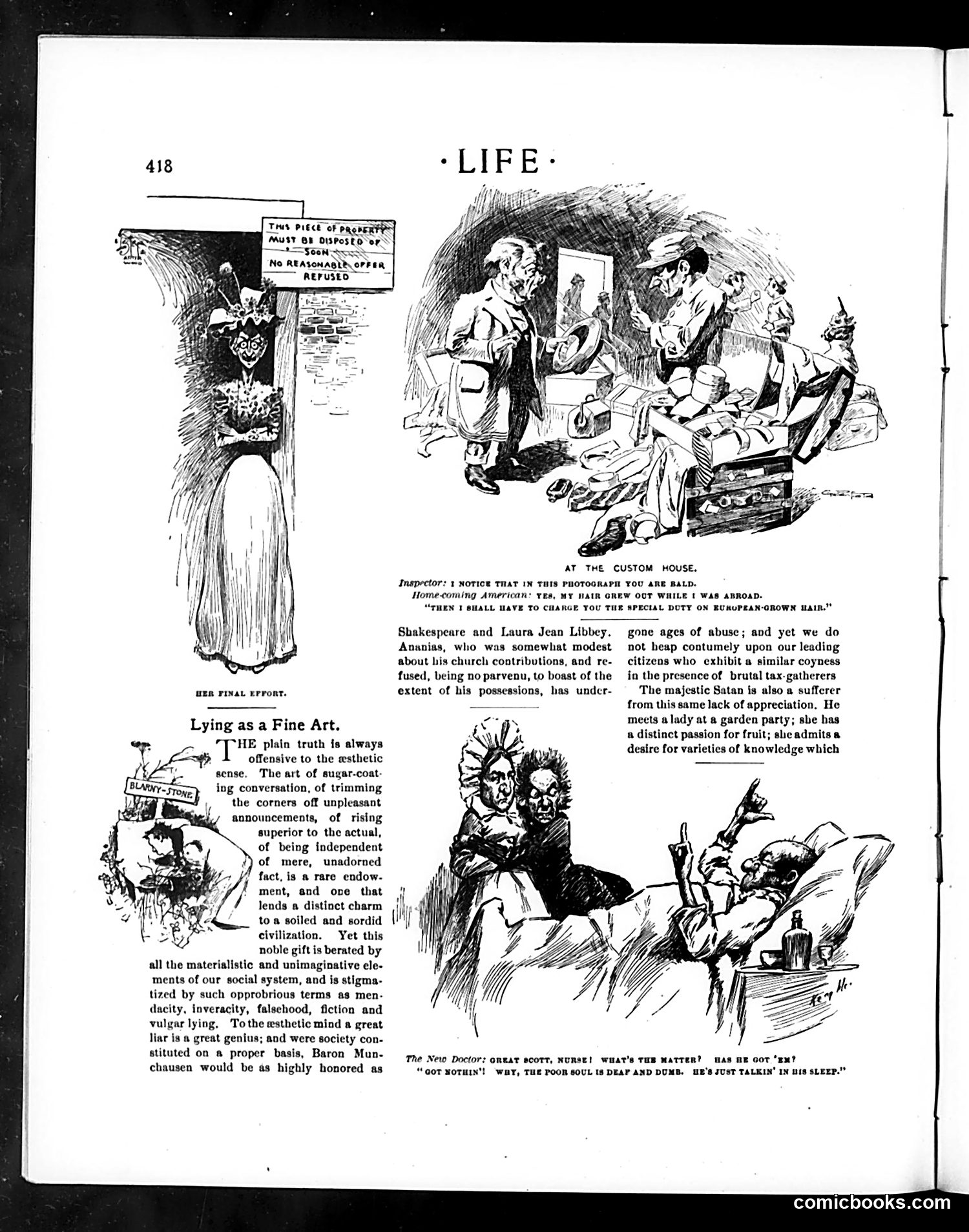
This page satirizes dishonesty as a social problem. The top cartoon "At the Custom House" mocks officials who overlook contraband, with an inspector praising a returning American's hair growth while ignoring illegal goods. The section "Lying as a Fine Art" argues that dishonesty pervades society—from "sugar-coating conversations" to "rising superior to the actual"—and is stigmatized by materialism and social climbing. The text suggests lying is treated as an admirable skill rather than condemned, noting that "to the aesthetic mind a great liar is a genius." The bottom cartoon depicts a doctor assuring a nurse that a comatose patient will recover, despite the patient appearing dead—another example of comforting falsehoods. The satire criticizes widespread acceptance of deception in American life.
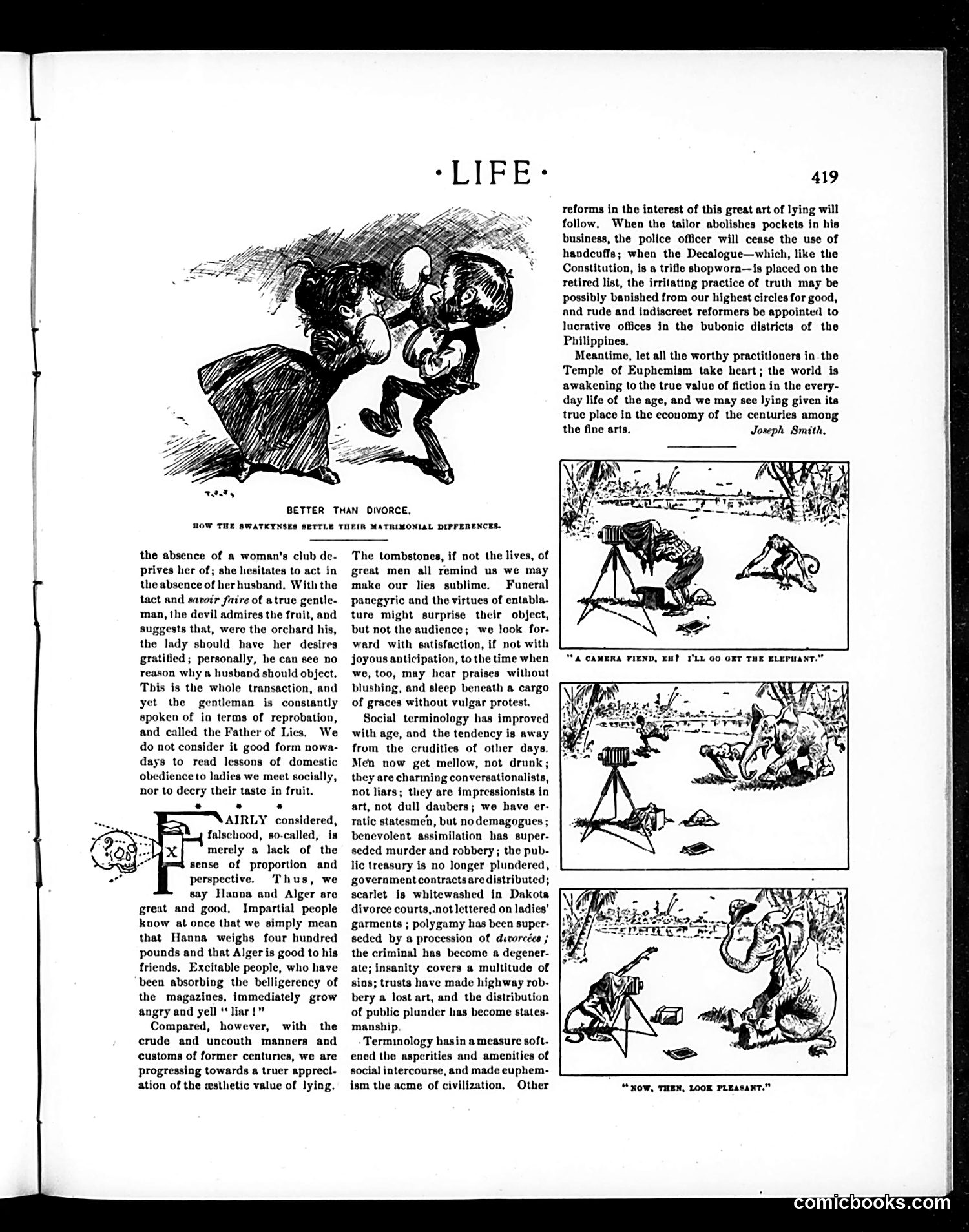
This page from *Life* magazine contains an essay titled "Better Than Divorce" discussing matrimonial differences and lying, attributed to Joseph Smith. The main illustration shows a figure carrying what appears to be multiple women or children, satirizing domestic burdens. The three sequential cartoons on the right ("A Camera Fiend, Ert I'll Go Get the Elephant," "Now, Then, Look Pleasant") depict a photographer struggling with an uncooperative elephant during a portrait session. The humor derives from the clash between the photographer's civilized intentions and the animal's unpredictable behavior—a visual metaphor for managing difficult subjects, possibly commenting on the challenges of controlling nature or difficult personalities, consistent with the page's themes about human relations and compromise.
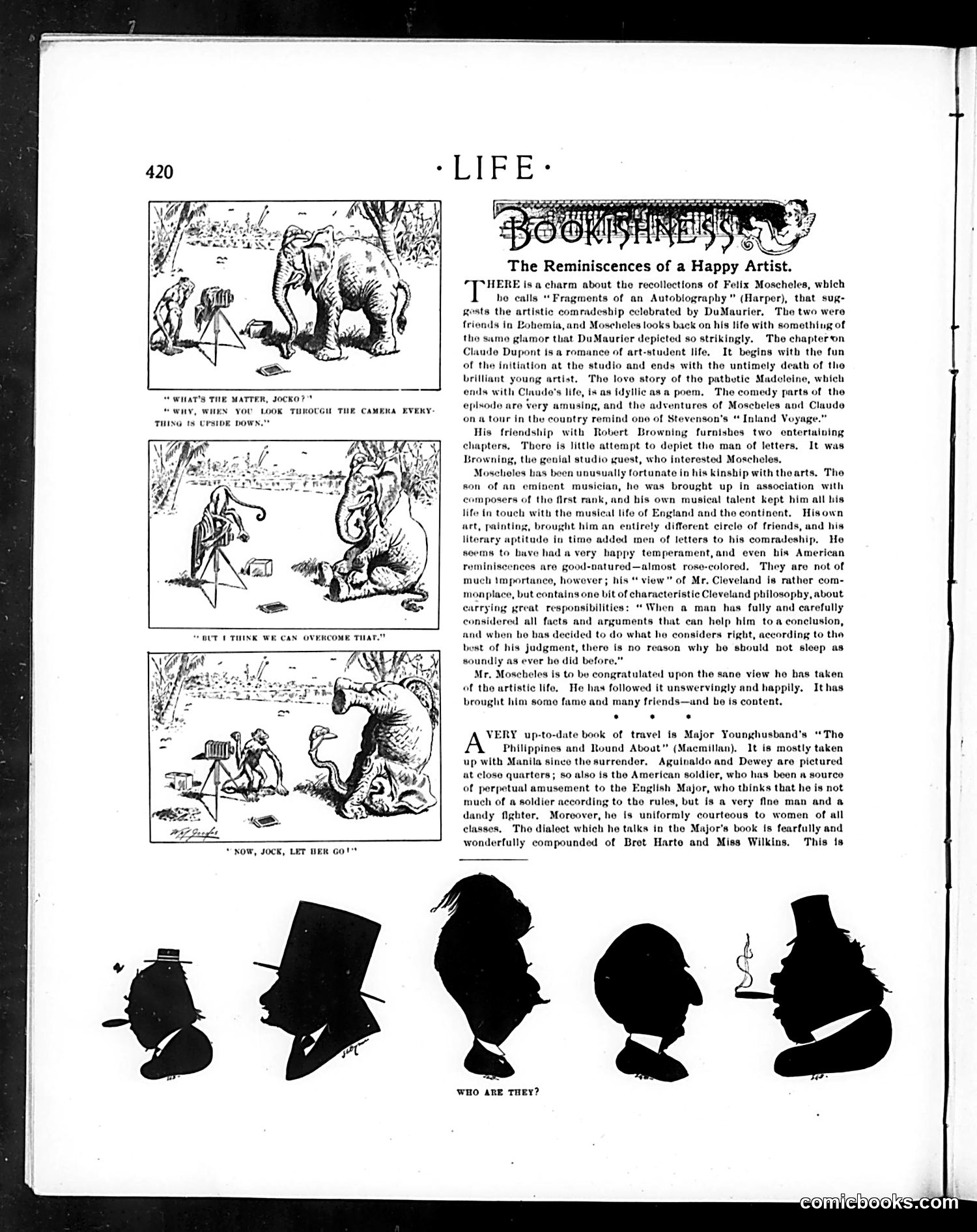
This page from *Life* magazine features two distinct sections: **Top Section**: Three comic panels depicting animals (appears to be an elephant and monkey) with captions like "What's the matter, jockey?" and "Now, jock, let her go!" These seem to be humorous animal sketches with no obvious political content. **Bottom Section**: A book review titled "Bookishness" discussing "The Reminiscences of a Happy Artist" by Felix Moscheles, praising the author's memoir and his friendship with Robert Browning and other cultural figures. The review celebrates Moscheles' artistic life and temperament. **Silhouettes**: Below the review are five black silhouette portraits labeled "Who Are They?" - a common *Life* magazine feature where readers were challenged to identify notable public figures from their profile shapes alone. Without additional context, I cannot definitively identify these specific individuals.
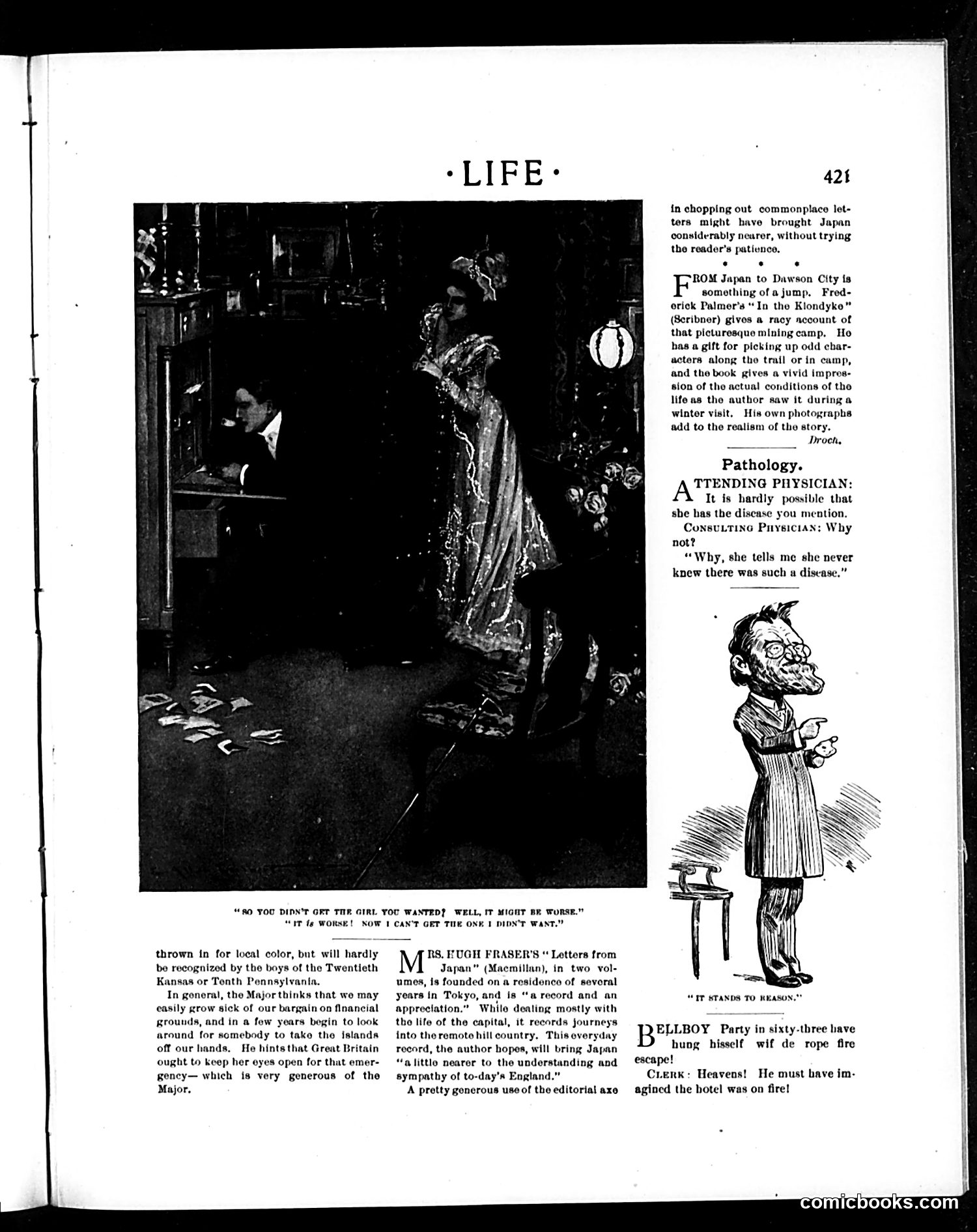
The page contains a book review section discussing Mrs. Ugoh Fraser's "Letters from Japan." The large photograph shows what appears to be a Japanese interior scene with figures in traditional dress, illustrating the book's content about Japanese life. Below the photo is a caption quoting dialogue: "So you didn't get the girl you wanted? Well, it might be worse." / "It is worse! Now I can't get the one I didn't want!" The small cartoon depicts a caricatured man labeled "It stands to reason," likely a generic representation of masculine frustration or romantic confusion—a common satirical subject in early 20th-century humor magazines. The page uses the book review and accompanying illustrations to present cultural observations about Japan while incorporating contemporary comedic commentary on relationships and human nature.
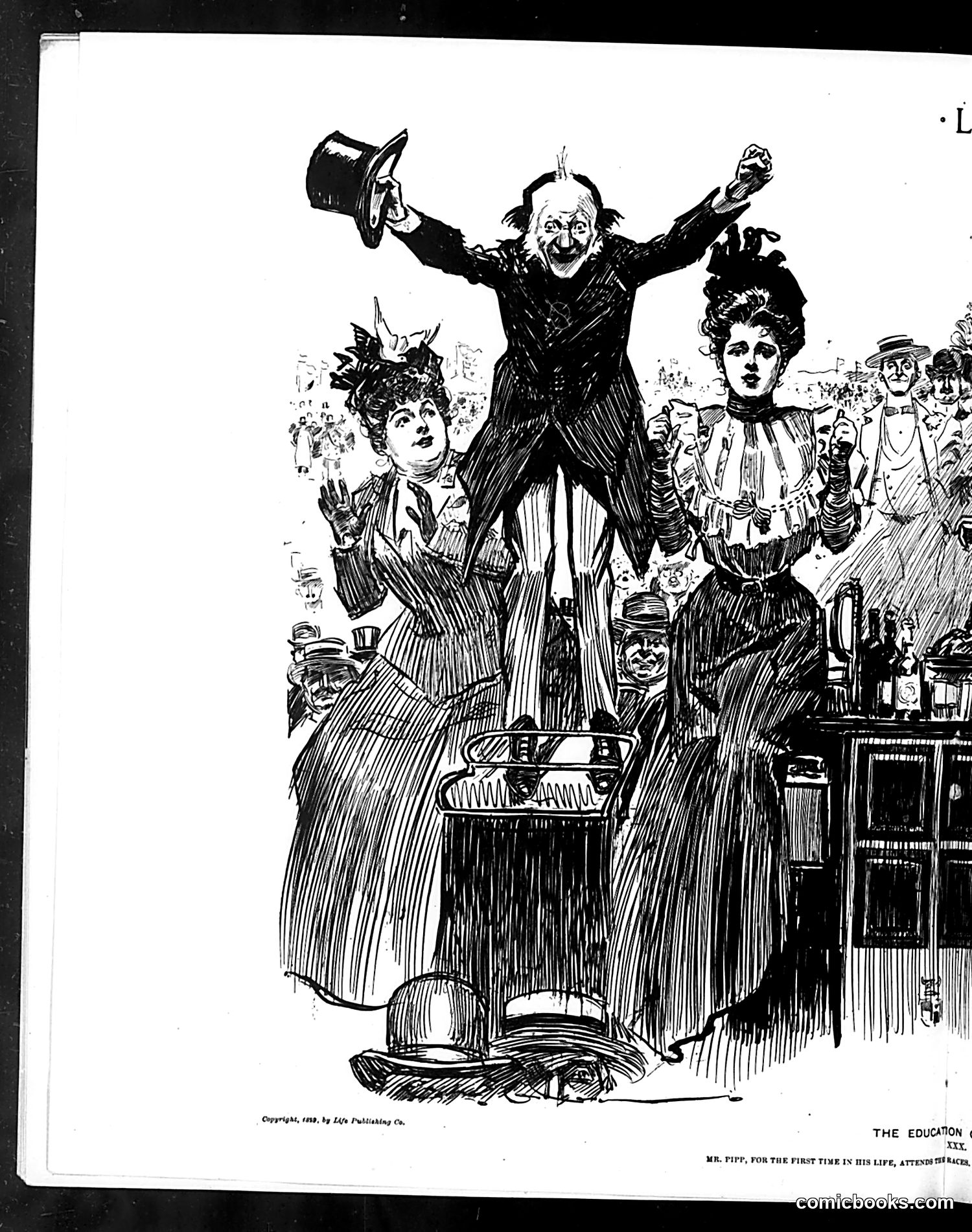
This appears to be a satirical illustration from *Life* magazine titled "The Education of Mr. Pipp" (visible at bottom right). The caption indicates "Mr. Pipp, for the first time in his life, attends a ____" (the word is cut off). The central figure is a man in formal attire with an exaggerated, gleeful expression, arms raised triumphantly while holding a top hat. He's surrounded by well-dressed women in Edwardian-era clothing, suggesting a social gathering or public event. The detailed linework and crowded background typical of early 1900s magazine illustration indicates this satirizes someone's first attendance at what appears to be a fashionable social occasion. The joke likely mocks Mr. Pipp's overexcited reaction to attending high society, suggesting cultural pretension or social climbing. Without the complete caption, the specific event remains unclear.
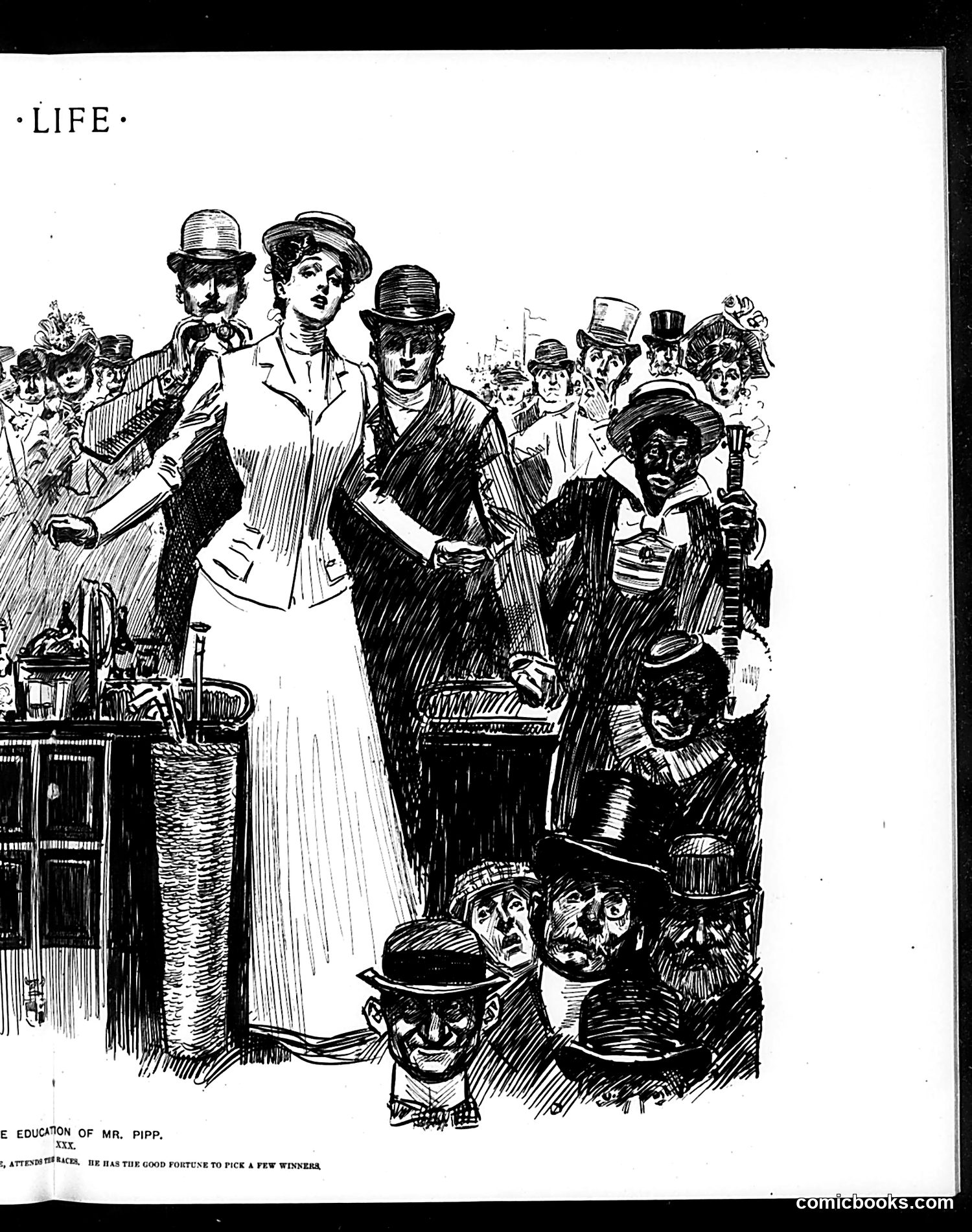
This appears to be a satirical illustration titled "The Education of Mr. Pipp" from *Life* magazine. The partially visible caption suggests Mr. Pipp "has the good fortune to pick a few winners"—likely referring to gambling or lottery success. The cartoon depicts a man in dark clothing surrounded by a diverse crowd of figures wearing hats, including what appear to be working-class men and a figure with darkened features (reflecting period stereotypes). The composition suggests a commentary on how sudden wealth or good fortune attracts opportunists and hangers-on seeking to benefit from Mr. Pipp's luck. The satire appears to target themes of social climbing, get-rich-quick schemes, or how fortune attracts unsavory characters—common satirical subjects in early 20th-century American magazines.
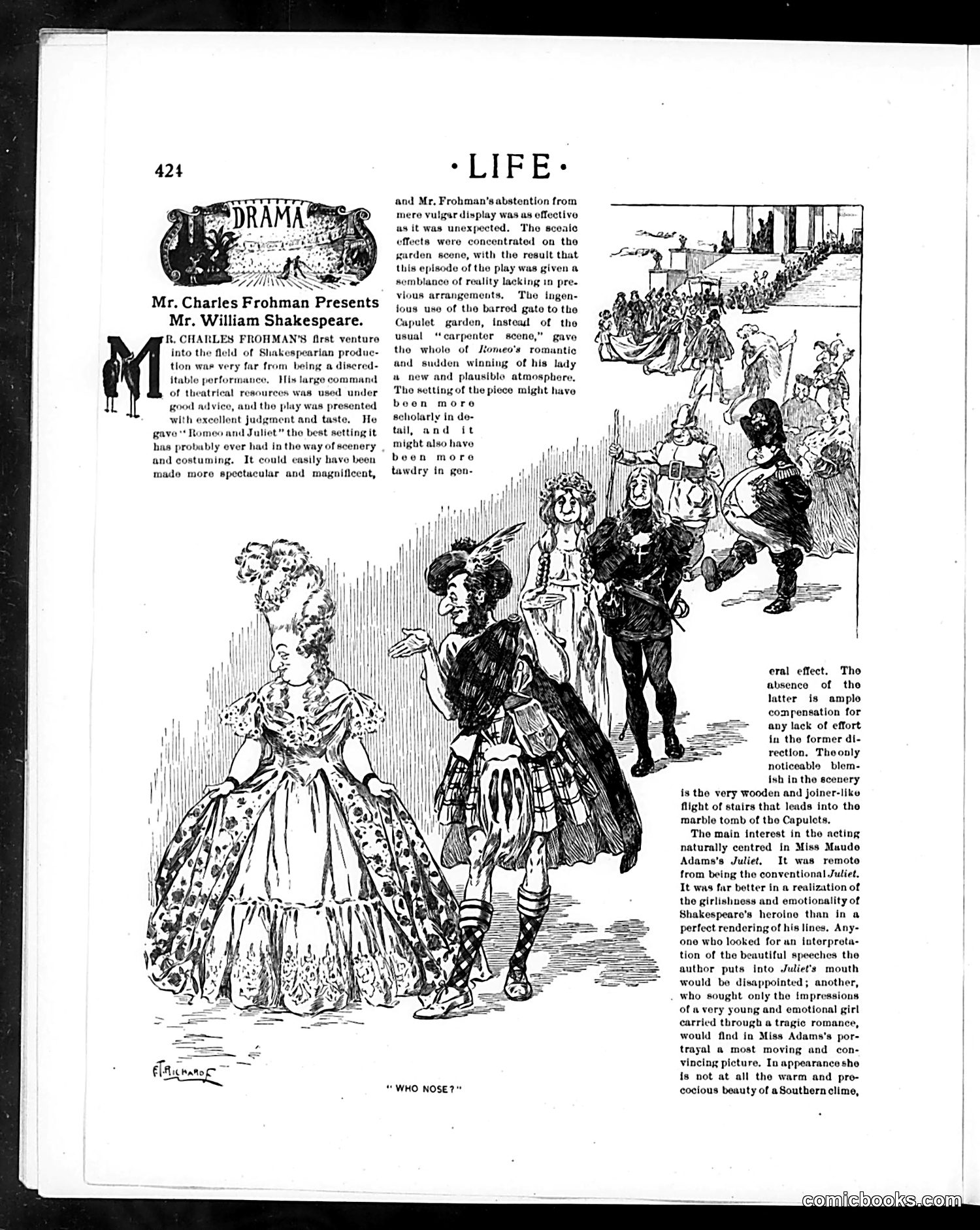
This page reviews Charles Frohman's theatrical production of Shakespeare's *Romeo and Juliet*, starring (apparently) Miss Maude Adams as Juliet. The illustration captioned "WHO NOSE?" depicts characters in period costume, likely mocking some aspect of the production. The text criticizes the staging choices—particularly Mr. Frohman's decision to set scenes in a garden rather than use traditional carpenter's scenery, and his omission of the Capulet garden display. The reviewer notes these choices gave the play an unexpectedly realistic quality. The review praises Adams's emotional performance but critiques her appearance as insufficiently "warm and precocious" for the role of Shakespeare's passionate heroine.
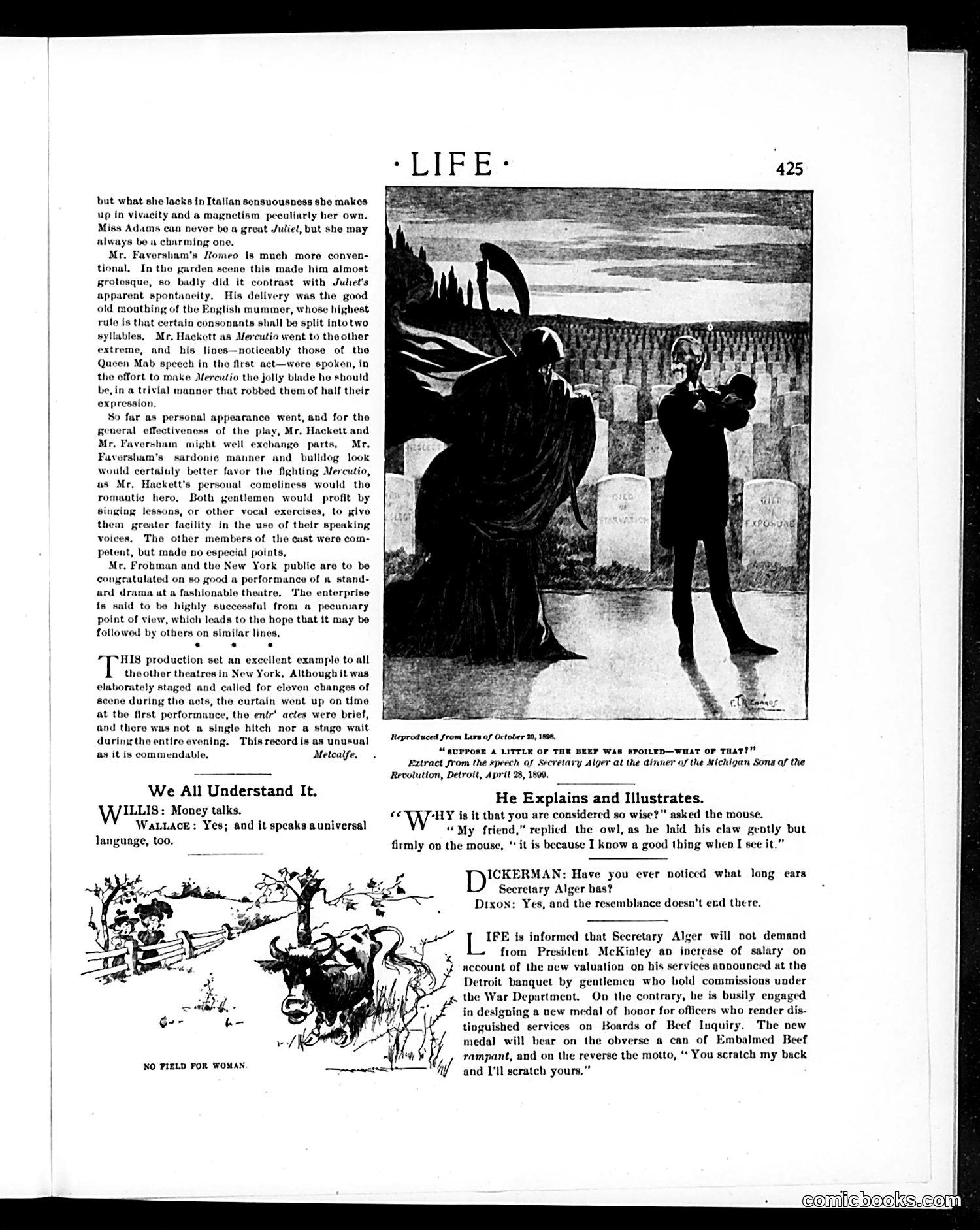
This page contains theater criticism and political cartoons satirizing Secretary of War Russell Alger. The main target is Alger's infamous involvement in the "Embalmed Beef" scandal—during the Spanish-American War, the War Department distributed chemically-preserved beef to soldiers, causing widespread illness. When questioned about spoiled supplies, Alger allegedly dismissed concerns ("what of that?"). The cartoons mock Alger's apparent indifference to soldiers' welfare. One compares him to an owl catching a mouse—a predator who profits from others' misfortune. Another caricature criticizes his "long ears," suggesting he hears complaints but ignores them. The final item sarcastically proposes awarding Alger a medal featuring a can of "Embalmed Beef," mocking the corrupt reciprocal relationship ("you scratch my back and I'll scratch yours") between the War Department and military contractors. The satire exposes governmental corruption and callousness toward soldiers.
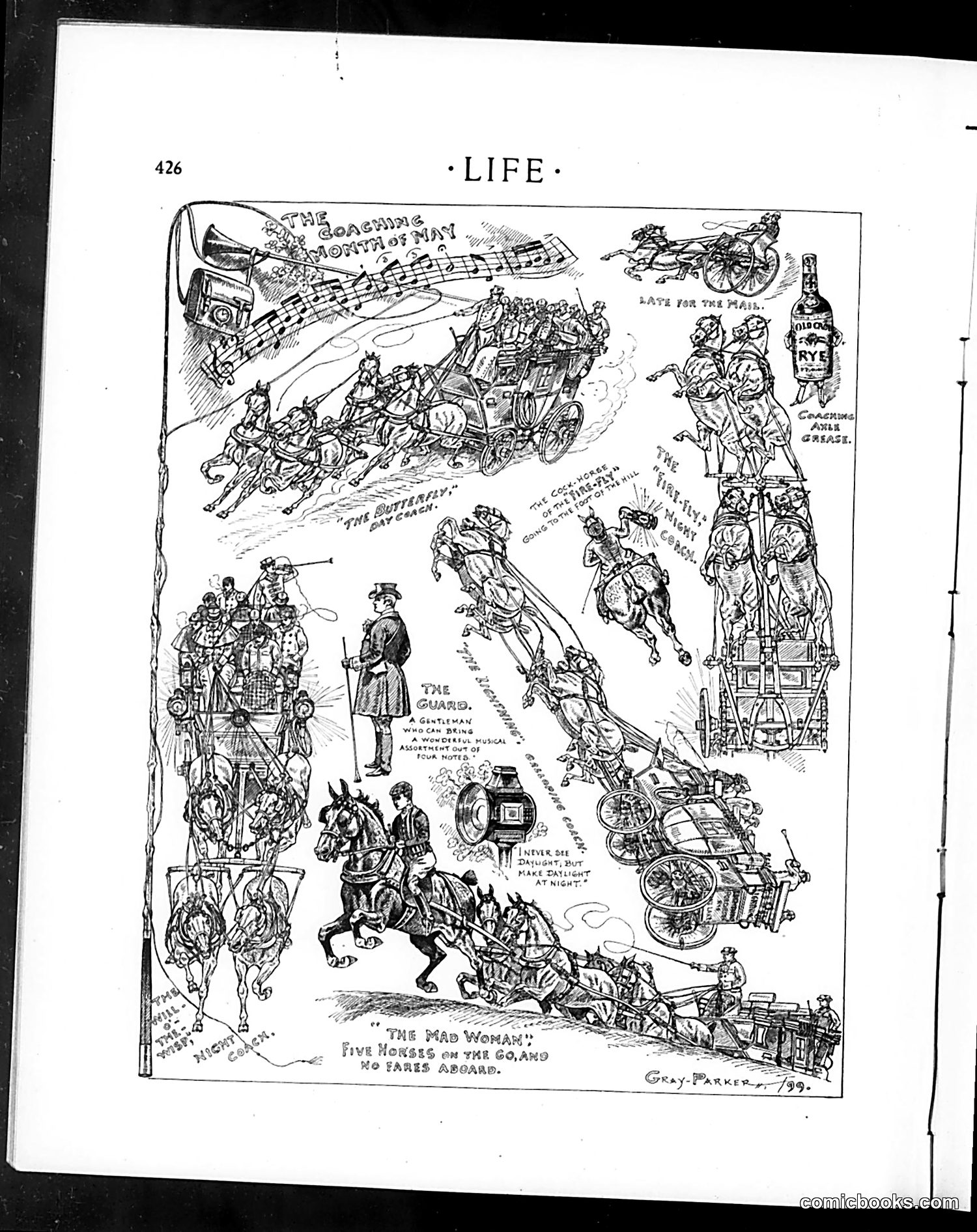
This appears to be a satirical cartoon by Gray Parker mocking an out-of-control, chaotic situation. The central image shows a wild "mad woman" driving an absurdly overloaded vehicle pulled by five horses, with passengers and cargo spilling everywhere in disarray. The phrase "no fares aboard" suggests this is political satire about governance or management—someone steering recklessly while collecting no revenue or benefit. The various vignettes surrounding the main scene illustrate different aspects of chaos: musicians, guards, cyclists, and elaborate contraptions all in disorder. The overall point appears to be criticizing incompetent leadership or mismanagement causing widespread confusion and waste. Without more historical context, the specific target remains unclear, but the visual metaphor of a careening vehicle with no control or purpose is unmistakable.
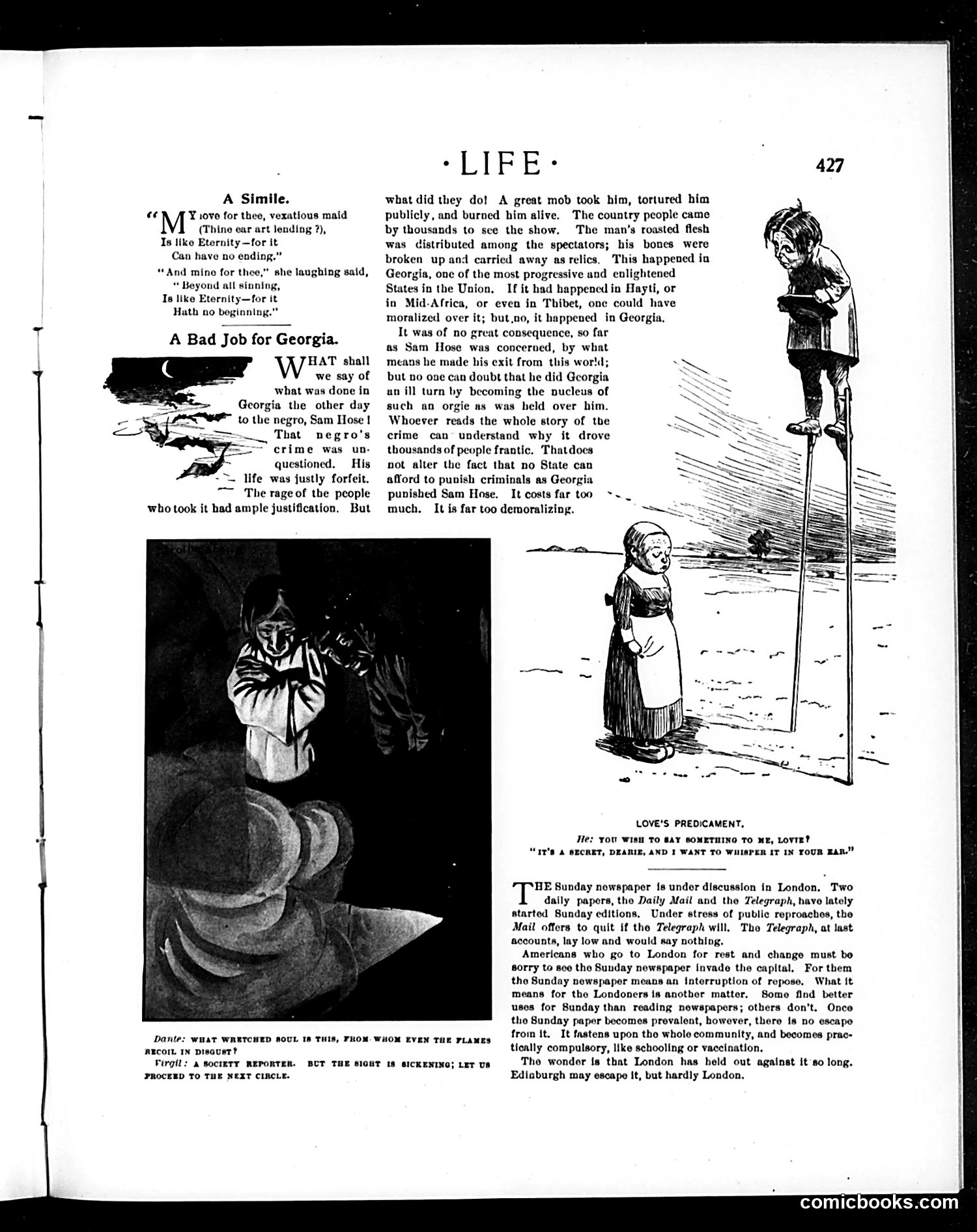
This page contains two distinct satirical pieces: **"A Bad Job for Georgia"** addresses the lynching of Sam Hose, a Black man executed by mob burning in Georgia. The article criticizes not the public's rage (which it acknowledges) but Georgia's failure to execute justice through legal means. The satire's point: a "progressive" state allowing such barbaric punishment undermines civilization itself. The reference to Hayti, Africa, and Thibet suggests irony—suggesting readers would expect such violence elsewhere, not in an "enlightened" American state. **The cartoons below** depict scenes of torment, likely illustrating the broader theme of suffering and moral compromise. **"Love's Predicament"** satirizes the British debate over Sunday newspapers invading London. The joke: like a lover's secret whispered in an ear, the Sunday paper, once introduced, becomes inescapable and invasive—"practically compulsory, like schooling or vaccination." Both pieces critique institutions (mob justice, mass media) that erode personal freedom and decency.
This page consists primarily of **three humorous anecdotes** rather than political cartoons: 1. **"Commodore Schley's First Command"**: A biographical story about a young naval officer who, while temporarily commanding a ship, locks his drunken captain in his cabin and takes command. When reprimanded by a superior officer, Schley is told not to rush into command—a lesson in military hierarchy and restraint. 2. **"Spoken Reed"**: Anecdotes about Speaker of the House Thomas B. Reed (identifiable from context), whose reputation for eloquent, lengthy speeches precedes him so thoroughly that a local tour guide boasts about his abilities without knowing who he is. 3. **"Irish Schoolboys"**: A joke about Irish students' supposed willingness to fight, contrasting with English and Scottish reluctance. These are lighthearted social humor pieces typical of *Life* magazine's satirical content. The page also contains period advertisements for Wilson Whiskey and Life magazine subscriptions—the latter offering a year's subscription plus special holiday issues for $5.00.
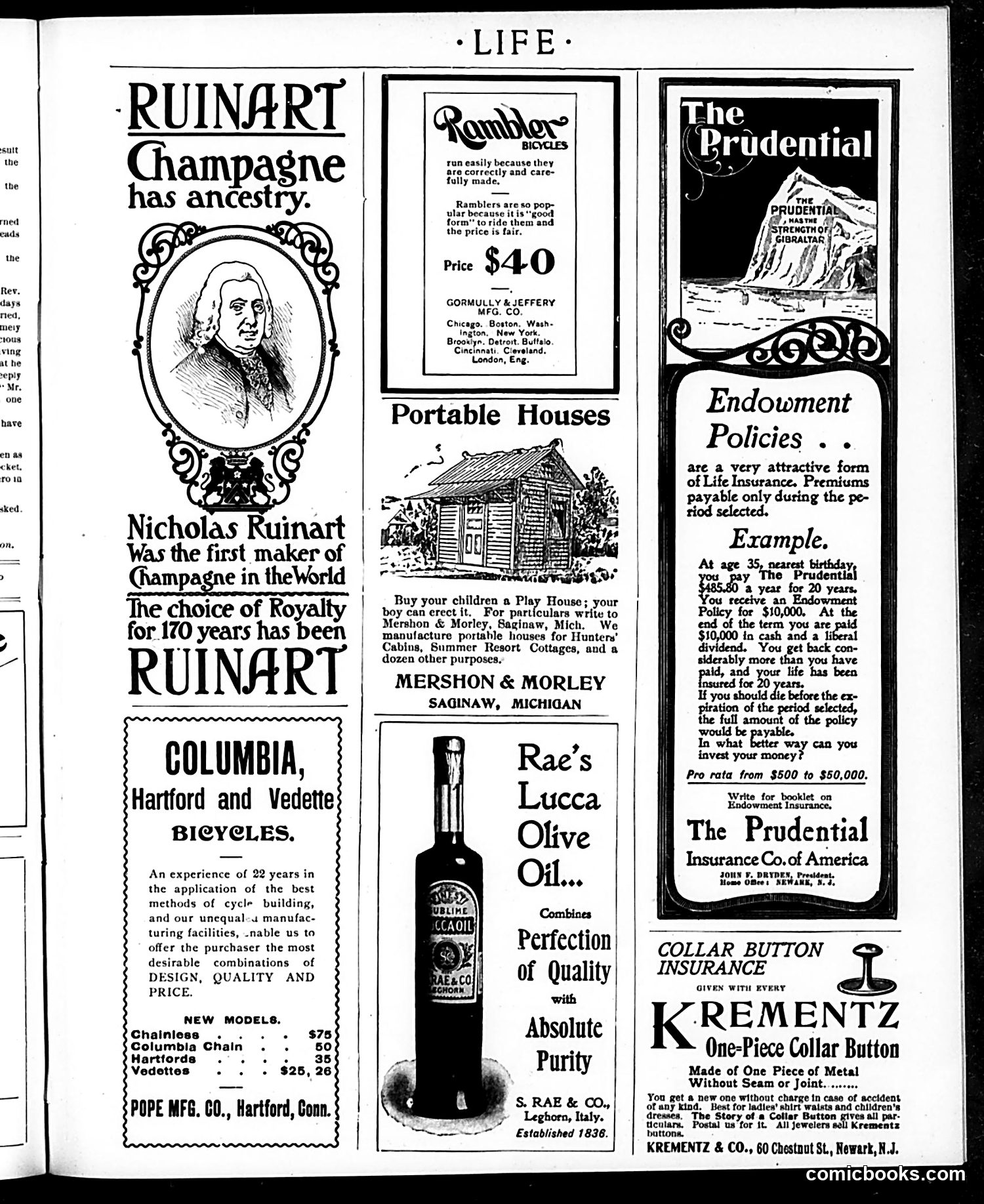
This is primarily an **advertising page** with no political cartoons or satire—just vintage product promotions from approximately the 1890s-early 1900s. The page features six advertisements: 1. **Ruinart Champagne** — Uses historical cachet, claiming the founder was "the first maker of Champagne in the world" and appealing to luxury/royalty. 2. **Rambler Bicycles** — Emphasizes quality manufacturing at $40. 3. **Columbia/Hartford/Vedette Bicycles** — Lists models and prices ($25-80). 4. **Portable Houses** — Prefabricated cabins marketed to families. 5. **Rae's Lucca Olive Oil** — Italian import stressing purity and quality. 6. **The Prudential Insurance** and **Krementz Collar Buttons** — Financial services and haberdashery. The page reflects Gilded Age consumer culture: products marketed through appeals to tradition, quality, and respectability. No satire is evident—these are straightforward commercial pitches targeting middle/upper-class readers.
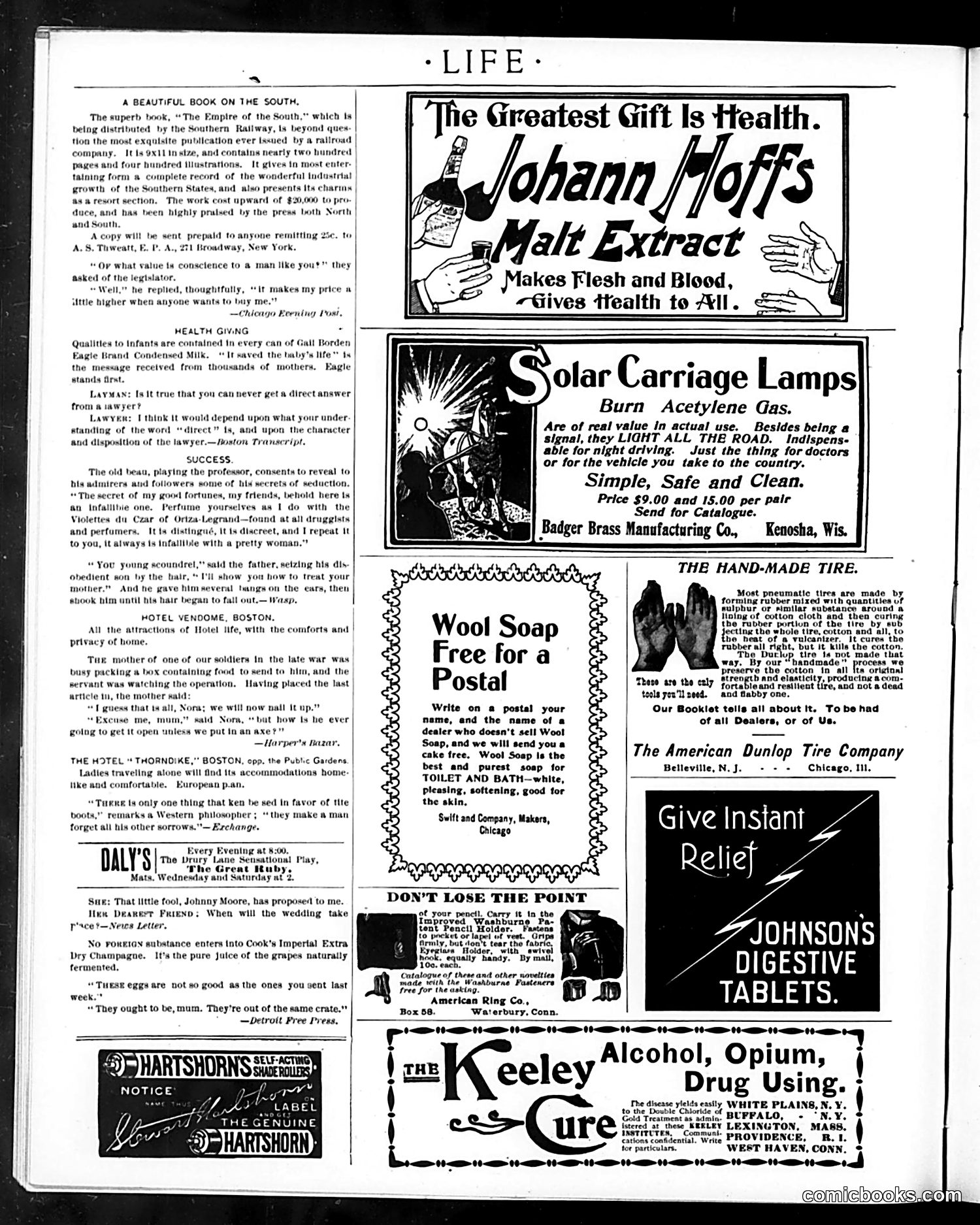
This page is primarily **advertising**, not political satire. It contains vintage print ads and brief humorous anecdotes rather than editorial cartoons. The upper portion includes short jokes and anecdotes typical of early 20th-century Life magazine's humor column—quips about legislators, lawyers, and domestic life that rely on period conventions (e.g., servants, social hierarchies) rather than specific political references. The advertisements are for now-obsolete products: **Johann Moff's Malt Extract** (a health tonic), **Solar Carriage Lamps** (acetylene gas lights for vehicles), **Wool Soap**, and **Johnson's Digestive Tablets**—remedies reflecting the era's patent-medicine culture. The lower ad for **"The Keeley Cure"** addresses alcohol and opium addiction, indicating these were marketed as treatable diseases. The page reflects **turn-of-the-century consumer culture** and quack medicine rather than political commentary. No identifiable political figures or events are referenced.
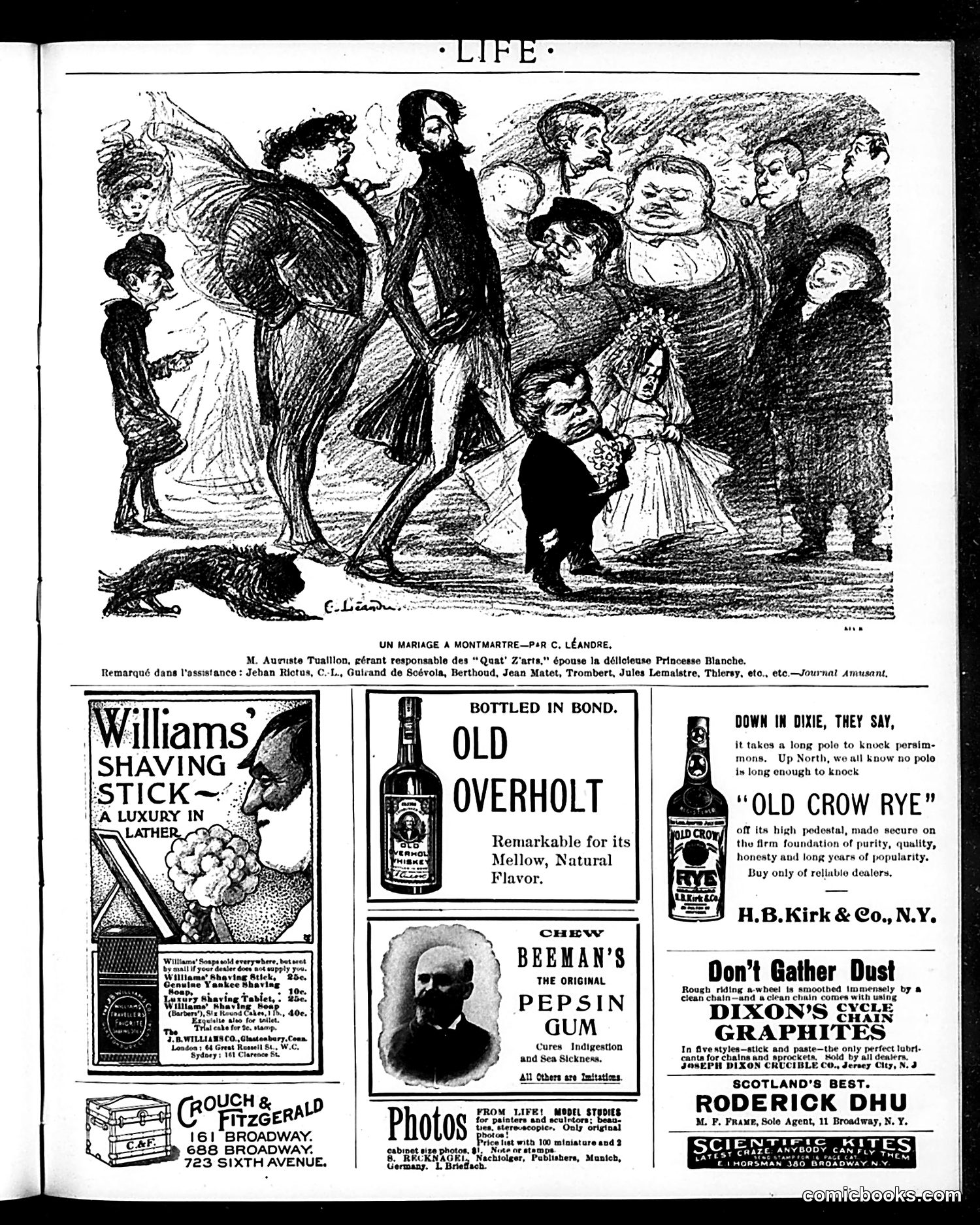
The top illustration is a French satirical cartoon from *Journal Amusant* depicting a Montmartre wedding. It shows M. Auguste Tuaillon (manager of the bohemian arts publication "Quat' Z'arts") marrying "the delicious Princess Blanche." The cartoon caricatures Parisian bohemian and artistic society figures of the era, likely mocking the pretensions of artists and intellectuals who frequented Montmartre's artistic circles. The exaggerated facial features and poses suggest satire of their affected mannerisms. The remaining content is **advertising**—mostly product advertisements (shaving cream, whiskey, chewing gum, photographs, bicycle lubricant) typical of *Life* magazine's revenue model. These ads have no connection to the cartoon above.
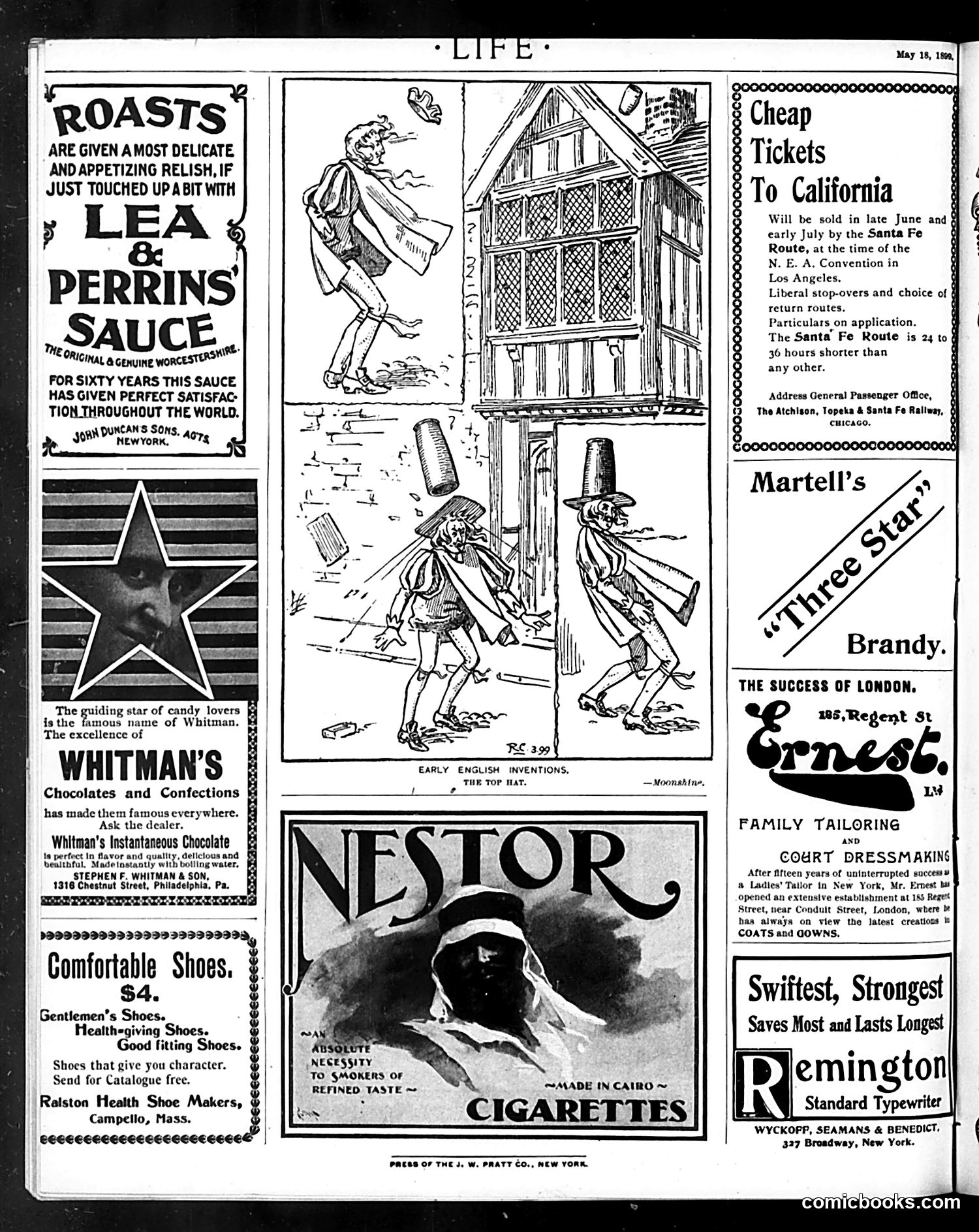
This cartoon satirizes the invention of the top hat through three figures dressed in period clothing, appearing to be from the 18th or 19th century. The comic depicts the hat's "invention" as a comedic accident or necessity—the figures seem disheveled and are interacting with the tall structure in exaggerated, bumbling ways, suggesting the hat was an absurd or impractical creation. The caption "Early English Inventions" frames this as mock-historical humor, poking fun at English fashion and refinement. The joke plays on the pretension of the top hat as a symbol of dignity and formality, treating it instead as a ridiculous contraption that real people would struggle with. The satirical point mocks both the garment itself and, by extension, English pomposity about fashion and tradition. This reflects Life magazine's irreverent humor about social conventions.