
Life, 1899-05-18 · page 7 of 20
Life — May 18, 1899 — page 7: what you’re looking at
What you’re looking at
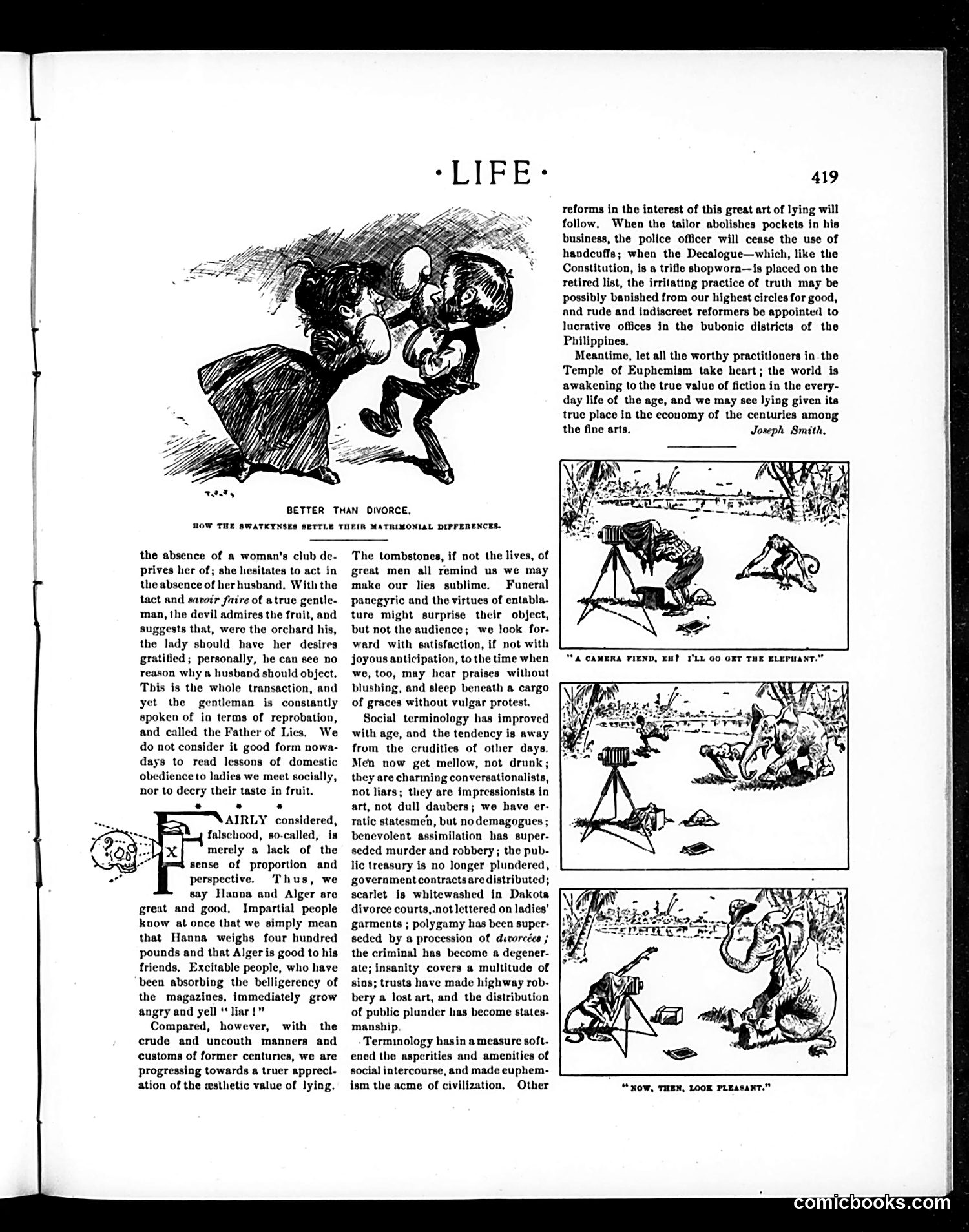
This page from *Life* magazine contains an essay titled "Better Than Divorce" discussing matrimonial differences and lying, attributed to Joseph Smith. The main illustration shows a figure carrying what appears to be multiple women or children, satirizing domestic burdens. The three sequential cartoons on the right ("A Camera Fiend, Ert I'll Go Get the Elephant," "Now, Then, Look Pleasant") depict a photographer struggling with an uncooperative elephant during a portrait session. The humor derives from the clash between the photographer's civilized intentions and the animal's unpredictable behavior—a visual metaphor for managing difficult subjects, possibly commenting on the challenges of controlling nature or difficult personalities, consistent with the page's themes about human relations and compromise.
📄 Transcribed text from this page (OCR, searchable)
Machine-transcribed from the original scan — historical spelling and the odd misread are preserved.
BETTER THAN DIVORCE, HOW THE SWATKYNSES SETTLE THEIR MATRIMONIAL DIFFERENCES. the absence of a woman's club de- prives her of; she hesitates to act in the absence of herhusband. With the tact and savoir faire of atrue gentle- man, the devil admires the fruit, and suggests that, were the orchard his, the lady should have her desires gratified; personally, he can see no reason why a husband should object. This is the whole transaction, and yet the gentleman is constantly spoken of in terms of reprobation, and called the Father of Lics, We do not consider it good form nowa- days to read lessons of domestic obedience to ladies we meet socially, nor to decry their taste in fruit. * . . AIRLY considered, falschood, so-called, is merely a lack of the sense of proportion and perspective. Thus, we say Hanna and Alger are great and good, Impartial people know at once that we simply mean that Hanna weighs four hundred pounds and that Alger is good to his friends, Excitable people, who have “been absorbing the belligerency of the magazines, immediately grow angry and yell “liar!” Compared, however, with the crude and uncouth manners and customs of former centurics, we are progressing towards a truer appreci- ation of the wsthetic value of lying. 419 reforms in the interest of this great art of lying will follow. When the tailor abolishes pockets in his business, the police officer will cease the use of handcuffs; when the Decalogue—which, like the Constitution, is a trifle shopworn—is placed on the retired list, the irritating practice of truth may be possibly banished from our highest circles for good, and rude and indiscrect reformers be appointed to lucrative offices in the bubonic districts of the Philippines, Meantime, let all the worthy practitioners in the Temple of Euphemism take heart; the world is awakening to the true value of fiction in the every- day life of the age, and we may see lying given its true place in the economy of the centuries among the fine arts. Joseph Smith, The tombstones, if not the lives, of great men all remind us we may make our lies sublime. Funeral panegyric and the virtues of entabla- ture might surprise their object, but not the audience; we look for- ward with satisfaction, if not with joyous anticipation, to the time when we, too, may hear praises without Dlushing, and sleep beneath a cargo of graces without vulgar protest. Social terminology has improved with age, and the tendency is away from the crudities of other days. Men now get mellow, not drunk; they are charming conversationalists, not liars; they are impressionists in art, not dull daubers; we have er- ratic statesmen, but no demagogues ; benevolent assimilation has super- seded murder and robbery ; the pub- lic treasury is no longer plundered, government contractsaredistributed; scarlet is whitewashed in Dakota divorce courts,.not lettered on ladies’ garments ; polygamy has been super- seded by a procession of ducorcées ; the criminal has become a degener- ate; insanity covers a multitude of sins; trusts have made highway rob- bery a lost art, and the distribution of public plunder has become states- manship. Terminology basin a measure soft- ened the aspcrities and amenities of social intercourse, and made euphem- ism the acme of civilization, Other “ NOW, THEN, LOOK PLEASANT.”