
Life, 1899-05-18 · page 4 of 20
Life — May 18, 1899 — page 4: what you’re looking at
What you’re looking at
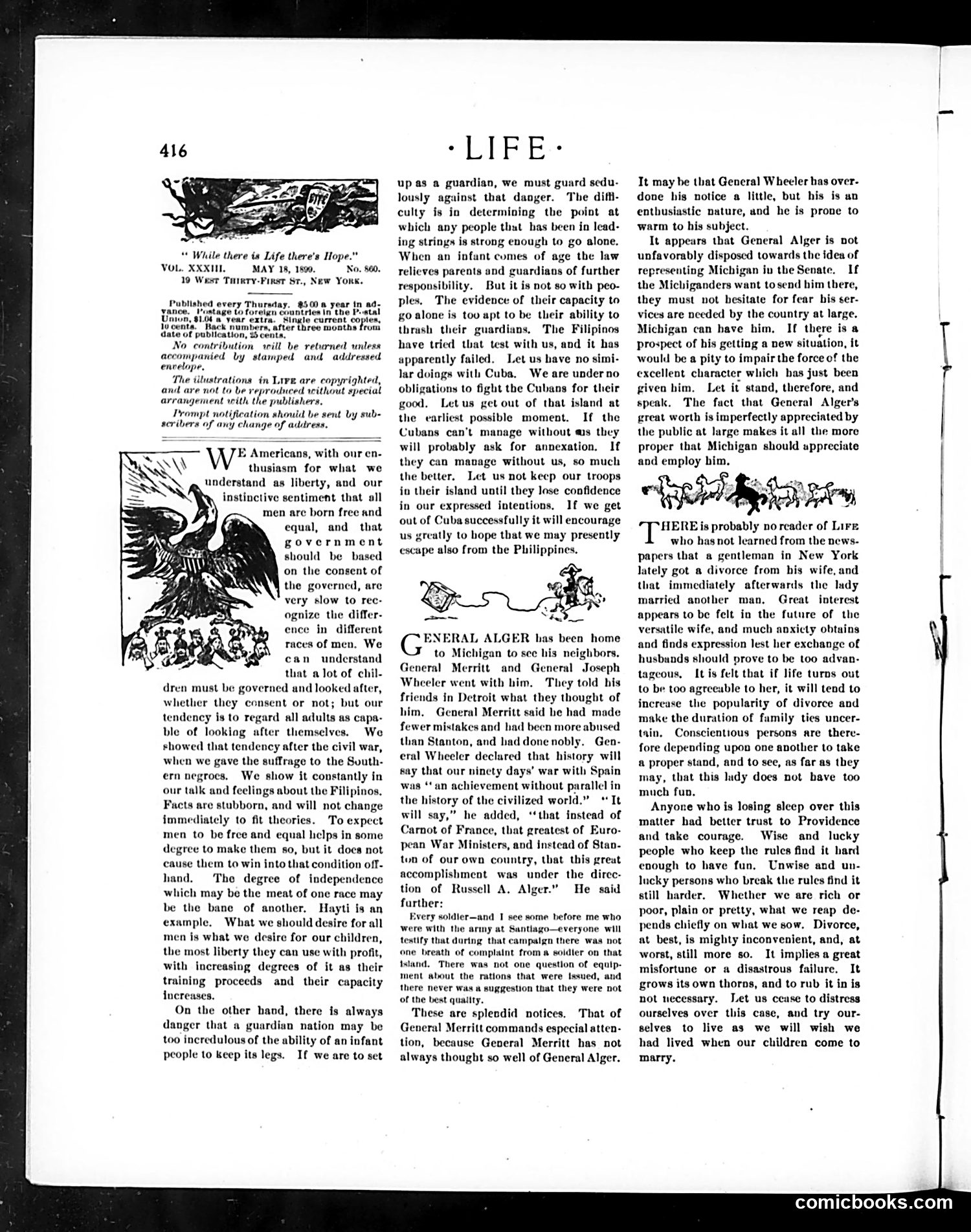
This page discusses American policy toward the Philippines and Cuba, likely from the early 1900s (Philippine-American War era). The text references **General Russell A. Alger** and **General Joseph Wheeler**, both prominent military figures of that period. The article criticizes the tendency to romanticize military leadership while ignoring practical governance. It argues against keeping troops in the Philippines indefinitely, warning that prolonged occupation could undermine American credibility and encourage independence movements. The satirical point appears to target the gap between **military heroism** and **administrative competence**—suggesting that celebrated generals may not be suited for colonial administration. The page advocates for withdrawing from the Philippines to prevent further costly entanglement, reflecting anti-imperialist sentiment of the era.
📄 Transcribed text from this page (OCR, searchable)
Machine-transcribed from the original scan — historical spelling and the odd misread are preserved.
“ While there is Life there's Hope.” VOL. XXXII. MAY 18, 1899. No, 860, 19 West Taiery-Finst St., New Yor«. ed every Thursday. $500 a year in ‘oatage to foreign countries In the P: . Year extra, Single current copies, lcenta. “Back numbers, after three months fro date of publication, % cen No contribution will be returned unless accompanied by stamped and addressed envelope, The illustrations in Live are copyrighted, anit are not to be reproduced without special arrangement with the publishers. Prompt ne scribers ifte ny ion shouid be sent by sub= ange of address, We? Americans, with our cn- thusiasm for what we understand as liberty, and our Ny, instinctive sentiment that all men are born free and equal, and that government should be based on the consent of the governed, are very slow to rec- ognize the differ- ence in different races of men, We can understand that a lot of chil- dren must be governed and looked after, whether they consent or not; but our tendency is to regard all adults as capa- ble of looking after themsel: We showed that tendency after the civil war, when we gave the suffrage to the Suuth- ern negroes, We show it constantly in our talk and feelings about the Filipinos, Facts are stubborn, and will not change immediately to fit theories. To expect men to be free and equal helps in some degree to make them so, but it docs not cause them to win into that condition off- hand. The degree of independence which may be the meat of one race may be the bane of another. Hayti is an example. What we should desire for all men is what we desire for our children, the most liberty they can use with profit, with increasing degrees of it as their training proceeds and their capacity increases. On the other hand, there is always danger that a guardian nation may be too incredulous of the ability of an infant people to keep its legs. If we are to set - LPB up as a guardian, we must guard sedu- lously against that danger. The diffi- culty is in determining the point at which any people that bas been in lead- ing strings is strong enough to go alone. When an infant comes of age the law relieves parents and guardians of further responsibility. But it is not so with peo- ples. The evidence of their capacity to go alone is tov apt to be their ability to thrash their guardians, The Filipinos have tried that test with us, and it has apparently failed. Let us have no simi- lar doings with Cuba, We are under no obligations to fight the Cubans for their good. Letus get out of that island at the earliest possible moment. If the Cubans can't manage without ms they will probably ask for annexation, If they can manage without us, so much the better, Let us not keep our troops in their island until they lose confidence in our expressed intentions, If we get out of Cuba successfully it will encourage us greatly to hope that we may presently escape also from the Philippines. _— Gar ALGER has been home to Michigan to see his neighbors. General Merritt. and General Joseph Wheeler went with him. They told his friends in Detroit what they thought of him, General Merritt said he had made fewer mistakes and had becn more abused than Stanton, and had done nobly, Gen- eral Wheeler declared that history will say that our ninety days’ war with Spain was ‘an achievement without parallel in the history of the civilized world.” “It will say,” he added, ‘‘that instead of Carnot of France, that greatest of Euro- pean War Ministers, and instead of Stan- ton of our own country, that this great accomplishment was under the direc- tion of Russell A. Alger.” He said further: Every soldier—and I see some before me who were with the army at Santiago—everyone will testify that during that campaign there was not ‘one breath of complaint from a soldier on that island. There was not one question of equip- ment about the mations that were Issued, and there never was a suggestion that they were not of the best quality, These are splendid notices. That of General Merritt commands especial atten- tion, because General Merritt has not always thought so well of General Alger. It may be that General Wheeler has over- done his notice a little, but his is an enthusiastic nature, and he is prone to warm to his subject. It appears that General Alger is pot unfavorably disposed towards the idea of representing Michigan iv the Senate, If the Michiganders want tosend him there, they must not hesitate for fear bis ser- vices are needed by the country at large. Michigan can have him, If there is a prospect of his getting a new situation, it would be a pity to impair the force of the excellent character which bas just been given him. Let it stand, therefore, and speak, The fact that General Alger’s great worth is imperfectly appreciated by the public at large makes it all the more proper that Michigan should appreciate and employ him. HERE is probably no reader of Lire who has not learned from the news- papers that a gentleman in New York lately got a divorce from his wife, and that immediately afterwards the lady married another man, Great interest appears to be felt in the future of the versatile wife, and much anxicty obtains and finds expression lest her exchange of husbands should prove to be too advan- tagcous, It is felt that if life turns out to be too agreeuble to her, it will tend to increase the popularity of divorce and make the duration of family ties uncer- tain, Conscientious persons are there- fore depending upon one another to take a proper stand, and to see, as far as they may, that this lidy does not bave too much fun, Anyone who is losing sleep over this matter had better trust to Providence and take courage. Wise and lucky people who keep the rules find it hard enough to have fun, Unwise and un- lucky persons who break the rules find it still harder. Whether we are rich or poor, plain or pretty, what we reap de- pends chiefly on what we sow. Divorce, at best, is mighty inconvenient, and, at worst, still more so. It implies a great misfortune or a disastrous failure. It grows its own thorns, and to rub it in is not necessary. [Let us cease to distress ourselves over this case, and try our- selves to live as we will wish we had lived when our children come to marry, comicbooks.com