
A complete issue · 20 pages · 1899
Life — April 6, 1899
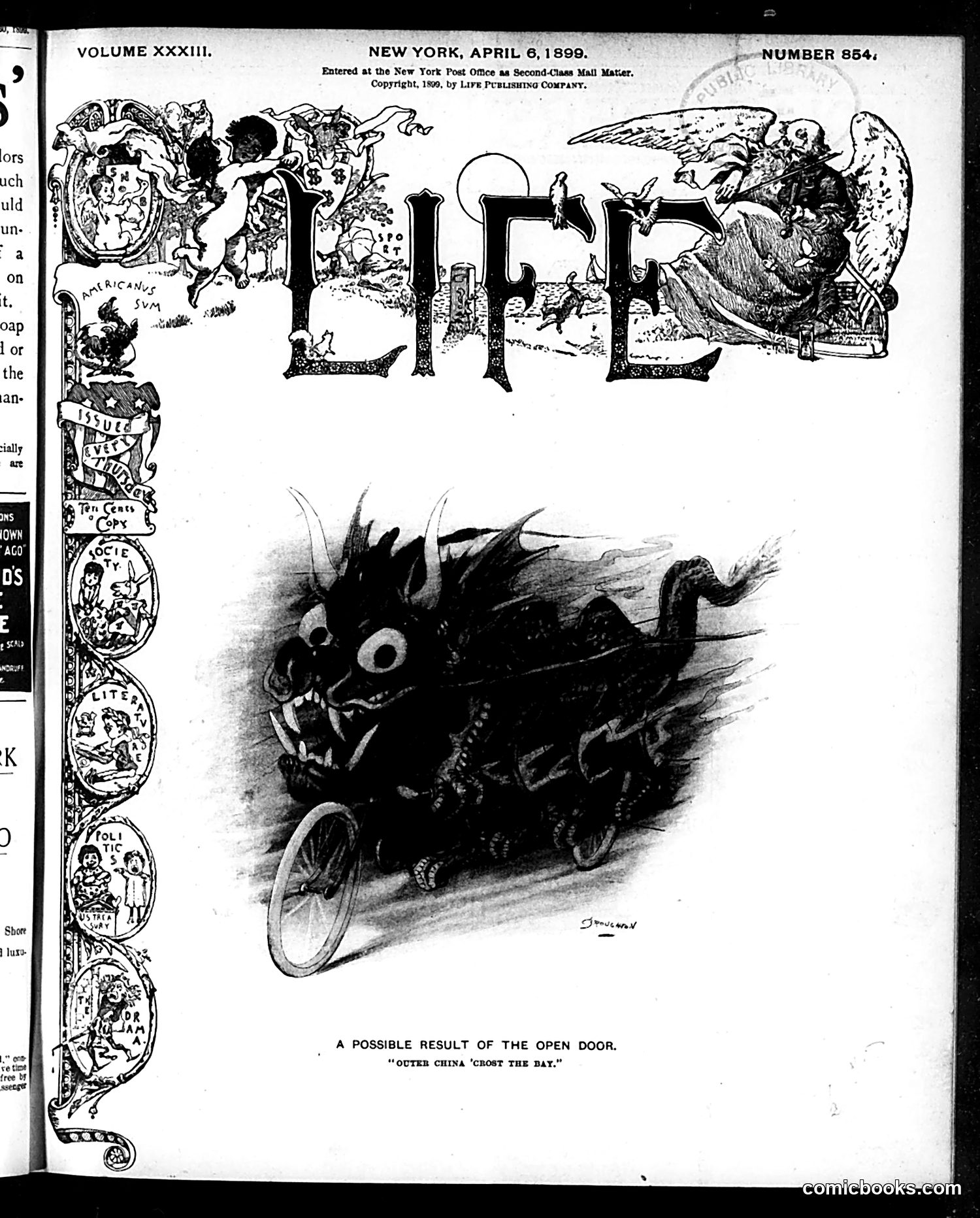
This page features a satirical illustration titled "A Possible Result of the Open Door: 'Outer China 'Cross the Bay.'" The cartoon depicts a grotesque, demon-like creature on a wheeled vehicle, appearing to arrive by sea. The "Open Door" reference concerns the Open Door Policy toward China, debated in American politics at this time. The imagery suggests xenophobic anxiety about Chinese immigration and the consequences of unrestricted trade/access. The monstrous caricature represents inflammatory anti-Chinese sentiment prevalent in 1899 America. The decorative border on the left contains smaller vignettes, typical of Life's design. The overall composition mocks both the open-door advocates and expresses period racism toward Chinese people and their potential arrival in America.
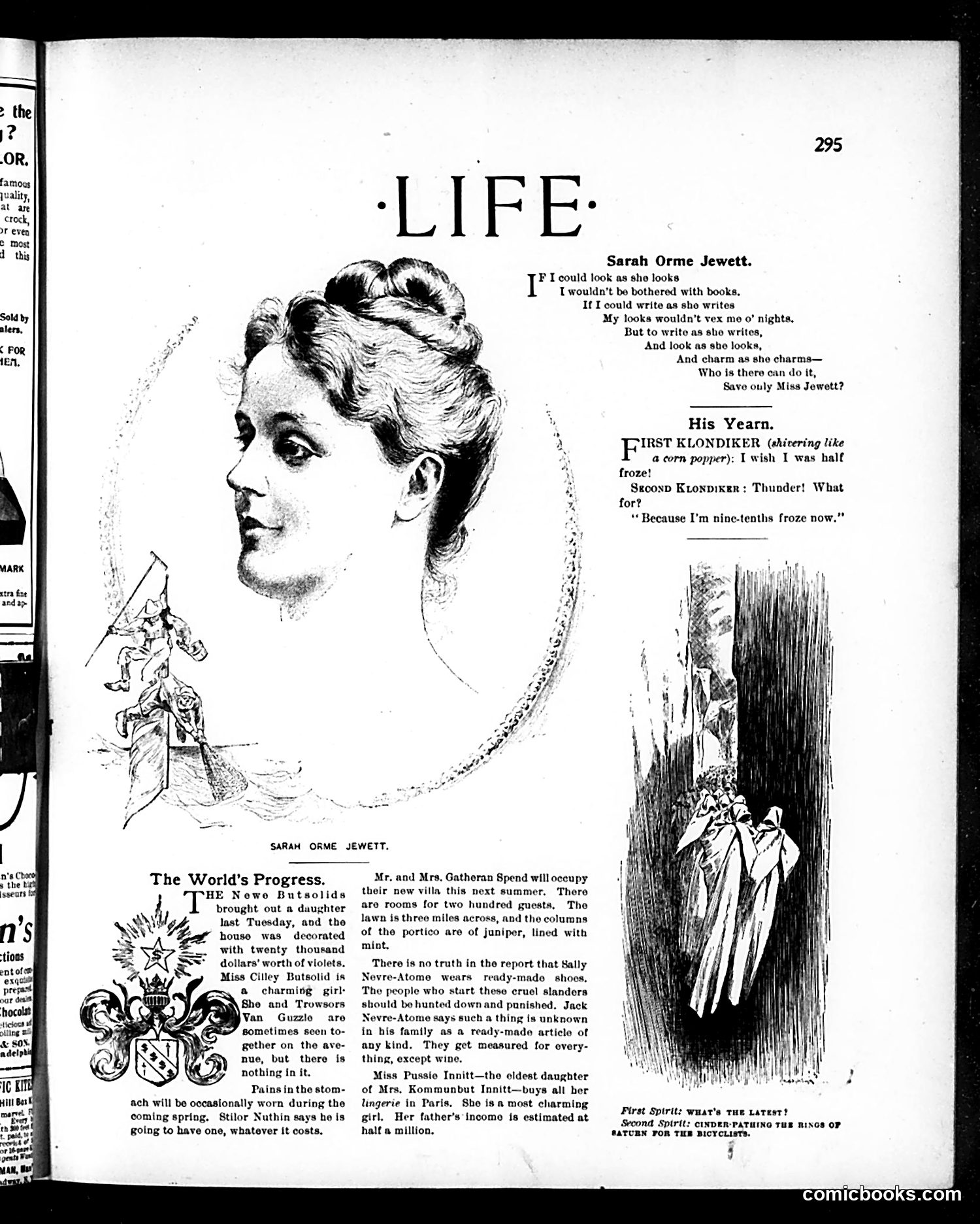
**Main Content:** This page features Sarah Orme Jewett, a prominent American writer. The poem "Life" praises her literary talents, suggesting she alone possesses the charm to make books come alive. **"His Yearn" Section:** A brief comedic dialogue between two Klondike prospectors during the Gold Rush era (the reference to being "nine-tenths froze" indicates harsh Arctic conditions). The joke plays on the contrast between their frozen circumstances and romantic longing. **"The World's Progress":** A gossip column reporting on wealthy New Yorkers—the Gatherams building a villa, Miss Cissie Innitt studying in Paris. The heraldic emblem suggests society pages mocking the pretensions of the wealthy. The page blends literary celebration with satirical social commentary typical of Life's approach to American culture and class.
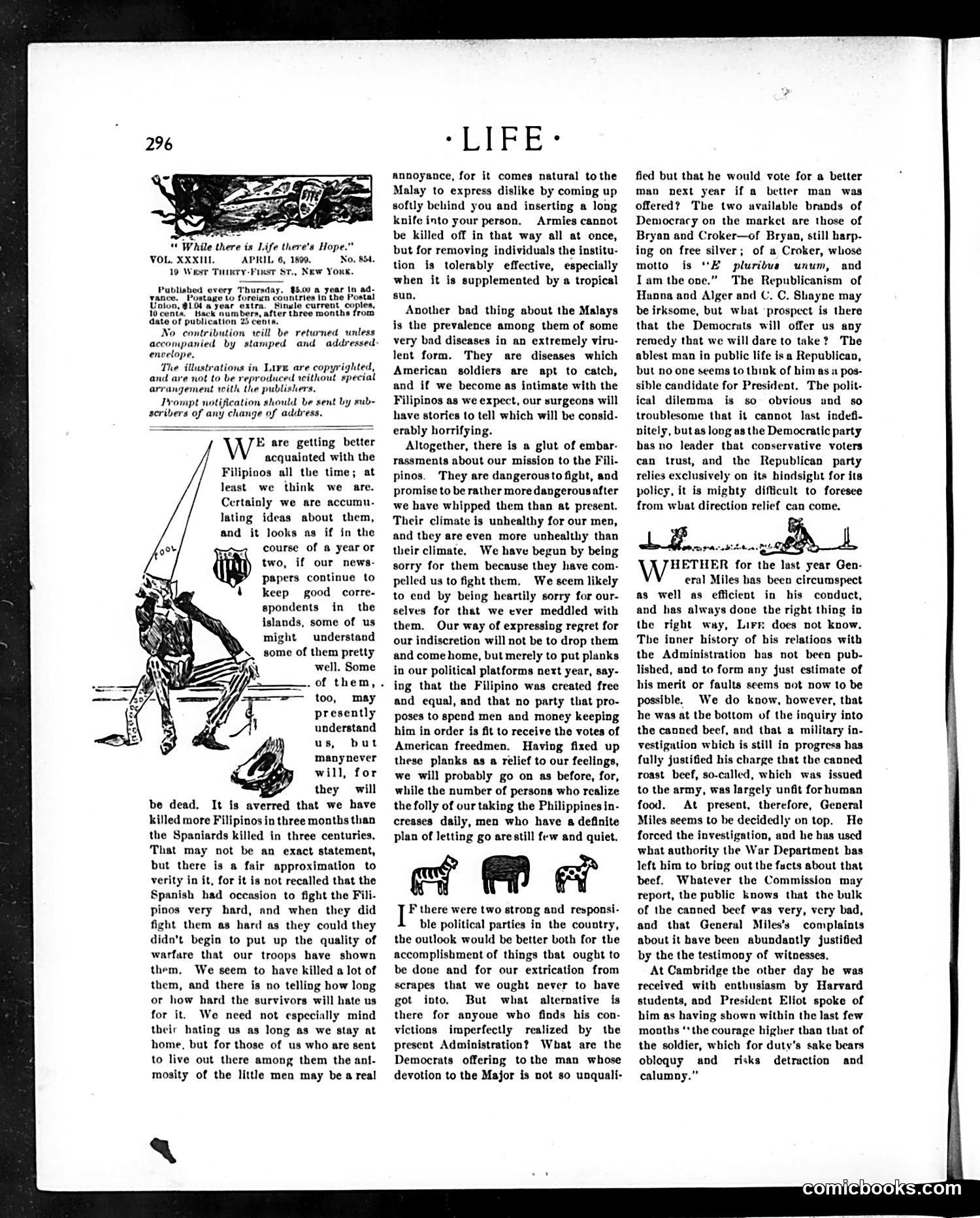
The main illustration depicts a Filipino soldier or fighter in traditional dress, shown in an active combat pose. This cartoon relates to the **Philippine-American War** (1899-1902), referenced explicitly in the article discussing American military involvement in the Philippines. The accompanying text critiques the conflict, expressing regret over American soldiers fighting Filipinos and noting the unhealthy climate. It discusses two competing Democratic political figures—**Bryan and Croker**—debating their party's direction on Philippine policy. The satire targets American imperial ambitions while also mocking Democratic Party leadership's inability to present a unified alternative to Republican policy. The cartoon uses the Filipino fighter to visualize the ongoing conflict that troubled the magazine's editors.
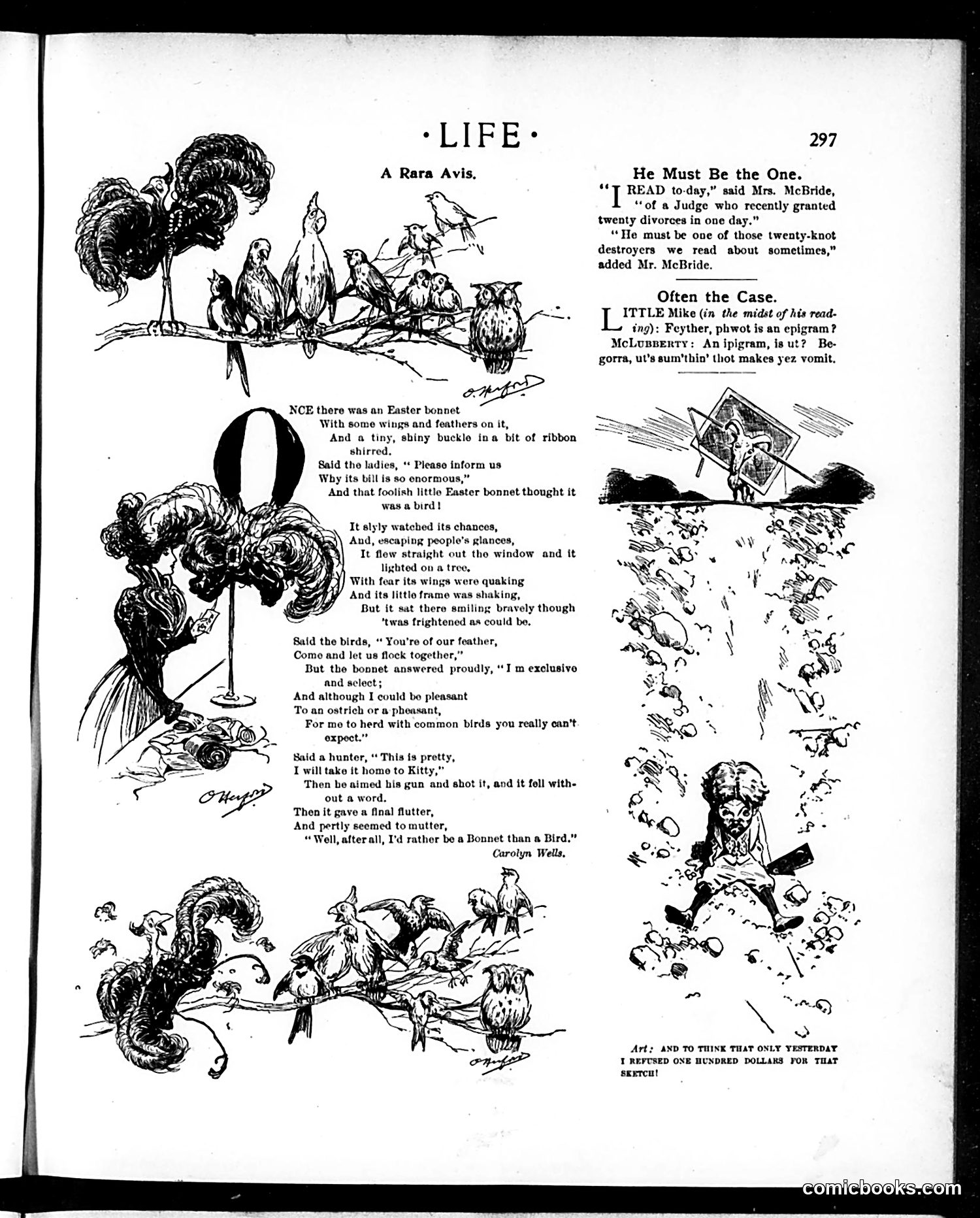
This page contains three satirical pieces: 1. **"A Rara Avis"** (top left): An illustrated poem about an Easter bonnet mistaken for a bird, then shot by a hunter. The satire targets the extravagant women's fashion of wearing elaborate, feathered hats—so ornate they resembled actual birds. This mocks both the fashion excess and the absurdity of the trend. 2. **"He Must Be the One"** (top right): A brief joke about a judge granting twenty divorces in one day, with commentary that such a person must be "one of those twenty-knot destroyers." This satirizes both judicial efficiency in divorce cases and perhaps judges' perceived indifference to marital dissolution. 3. **"Often the Case"** (right): A dialogue between characters named Mike and McLumberrry, discussing whether an epigram qualifies as literature—likely mocking pretentious literary criticism. The illustrations throughout employ exaggerated, humorous drawings typical of Life's style.
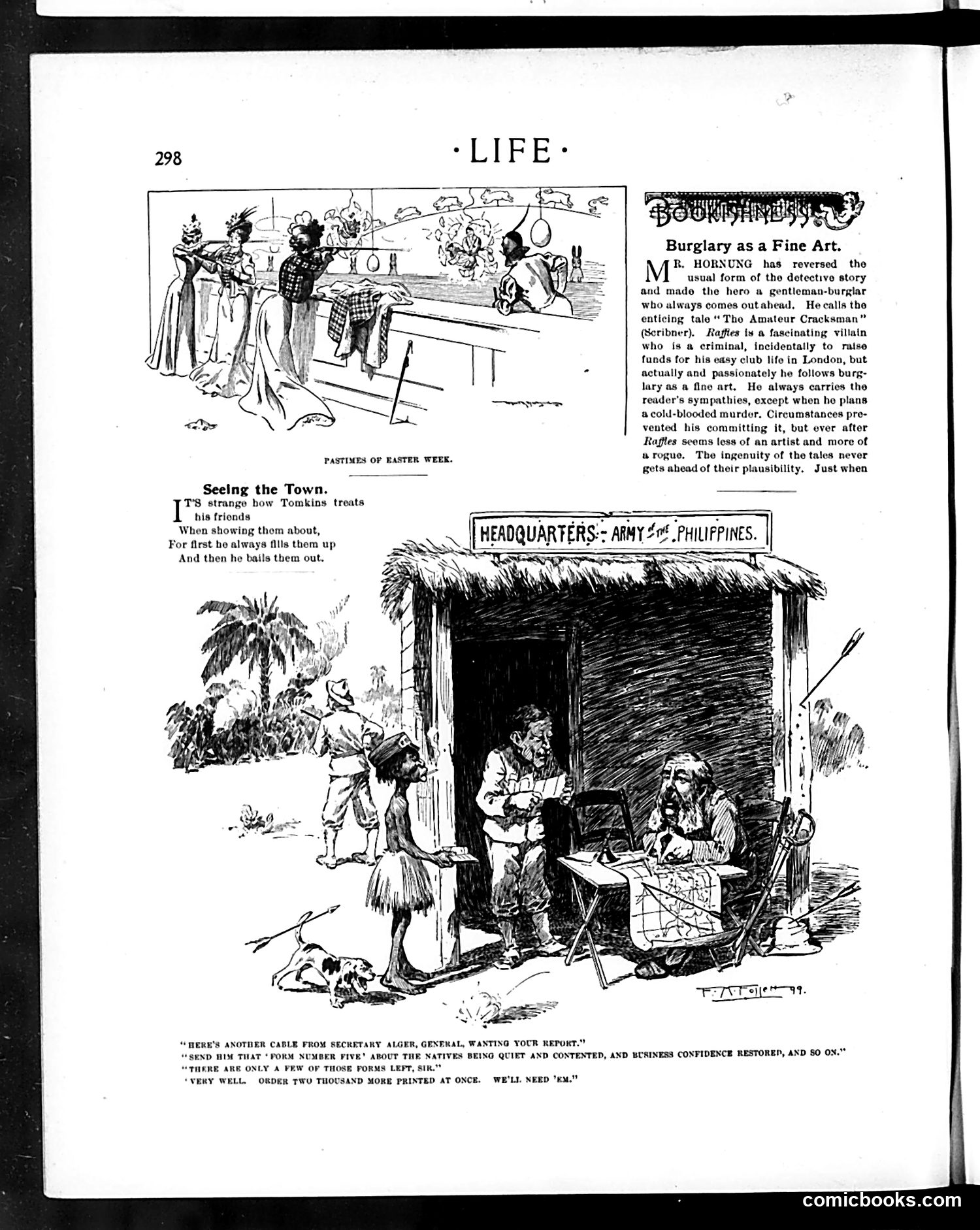
**Top illustration ("Pastimes of Easter Week"):** Shows women in Easter finery at what appears to be a social gathering or promenade, satirizing the fashion and social rituals surrounding Easter celebrations among the wealthy. **"Seeing the Town" poem:** A brief satirical verse mocking how visitors treat their hosts—appearing grateful while actually seeking entertainment and novelty. **Main cartoon:** Depicts a military headquarters in the Philippines with officers and enlisted men. The caption references Secretary Tager, General [name unclear], supply forms, and maintaining troop discipline. This appears to satirize bureaucratic inefficiency and communication problems within the U.S. military during the Philippine-American conflict period, likely critiquing excessive paperwork and administrative confusion affecting military operations. The right column discusses a literary work about burglary, unrelated to the cartoons.
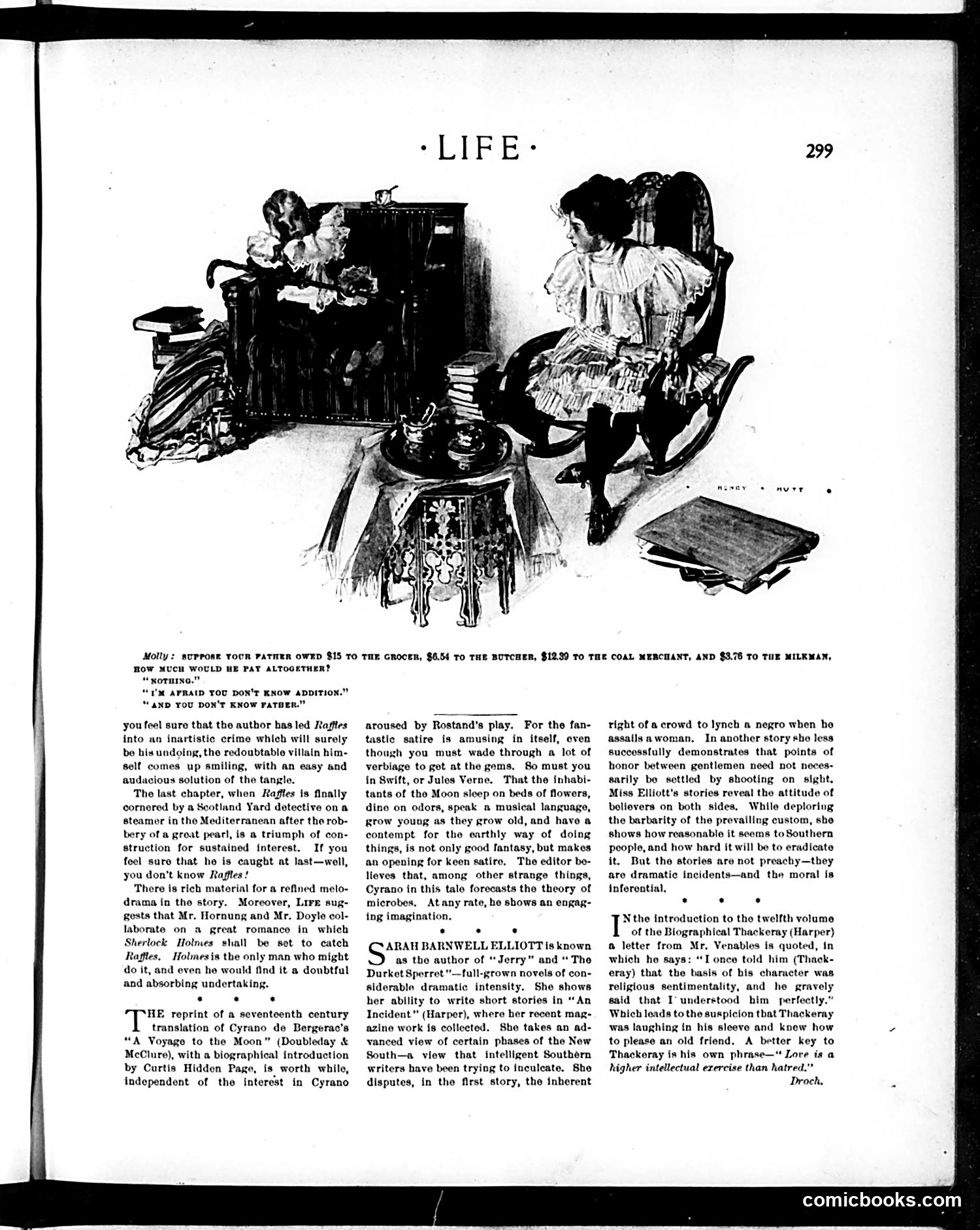
This page from *Life* magazine features a domestic satirical cartoon about family finances. The illustration shows a woman in a rocking chair confronting a man (presumably her husband) about unpaid debts. The caption lists specific amounts owed to various tradespeople: a grocer ($15), butcher ($6.54), coal merchant ($13.20), and milkman ($3.75). The joke centers on the husband's inability to account for these expenses, with dialogue suggesting he claims ignorance of the bills. This reflects early 20th-century middle-class anxiety about household debt and domestic financial management—a satirical commentary on how husbands often avoided responsibility for domestic expenses while their wives managed household accounts.
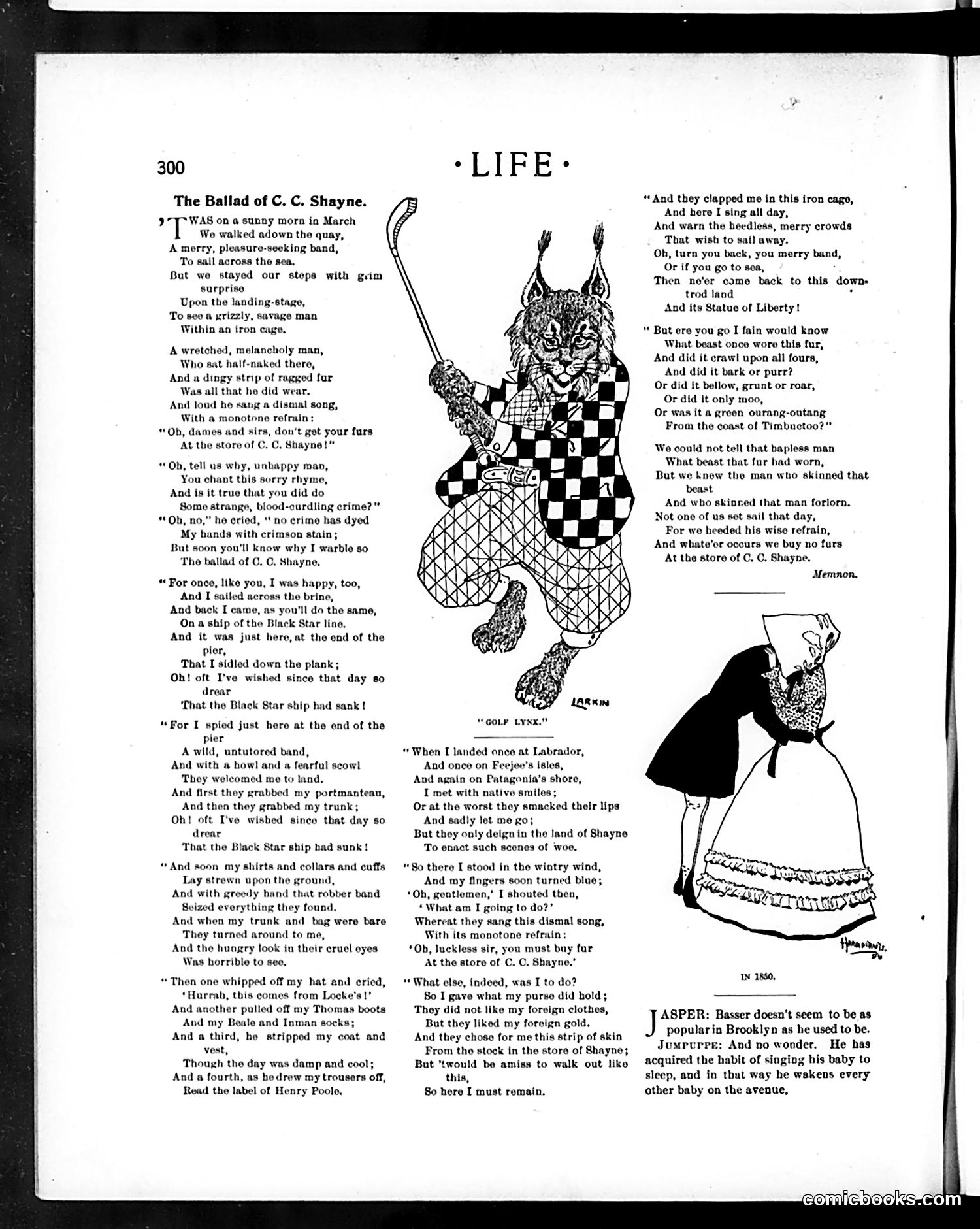
This page presents a narrative poem mocking an unnamed man (C. C. Shayne) who worked at a fur store. The illustrated "Golf Lynx" character—depicted as an anthropomorphic lynx wearing patterned clothing—appears to represent the fur trade or perhaps satirizes wealthy consumers. The ballad recounts Shayne's misadventures: he sailed on the "Black Star" ship, was stripped and robbed by natives in Labrador and Patagonia, and lost his employer's goods. The satirical humor targets both colonial exploitation and the fur trade's brutality. A brief dialogue at page bottom suggests Shayne has become a baby-singer on Brooklyn avenues—a comedown implying karmic punishment for his role in the fur industry's cruelties. The satire appears to critique early 20th-century imperialism and animal exploitation through mock-heroic verse.
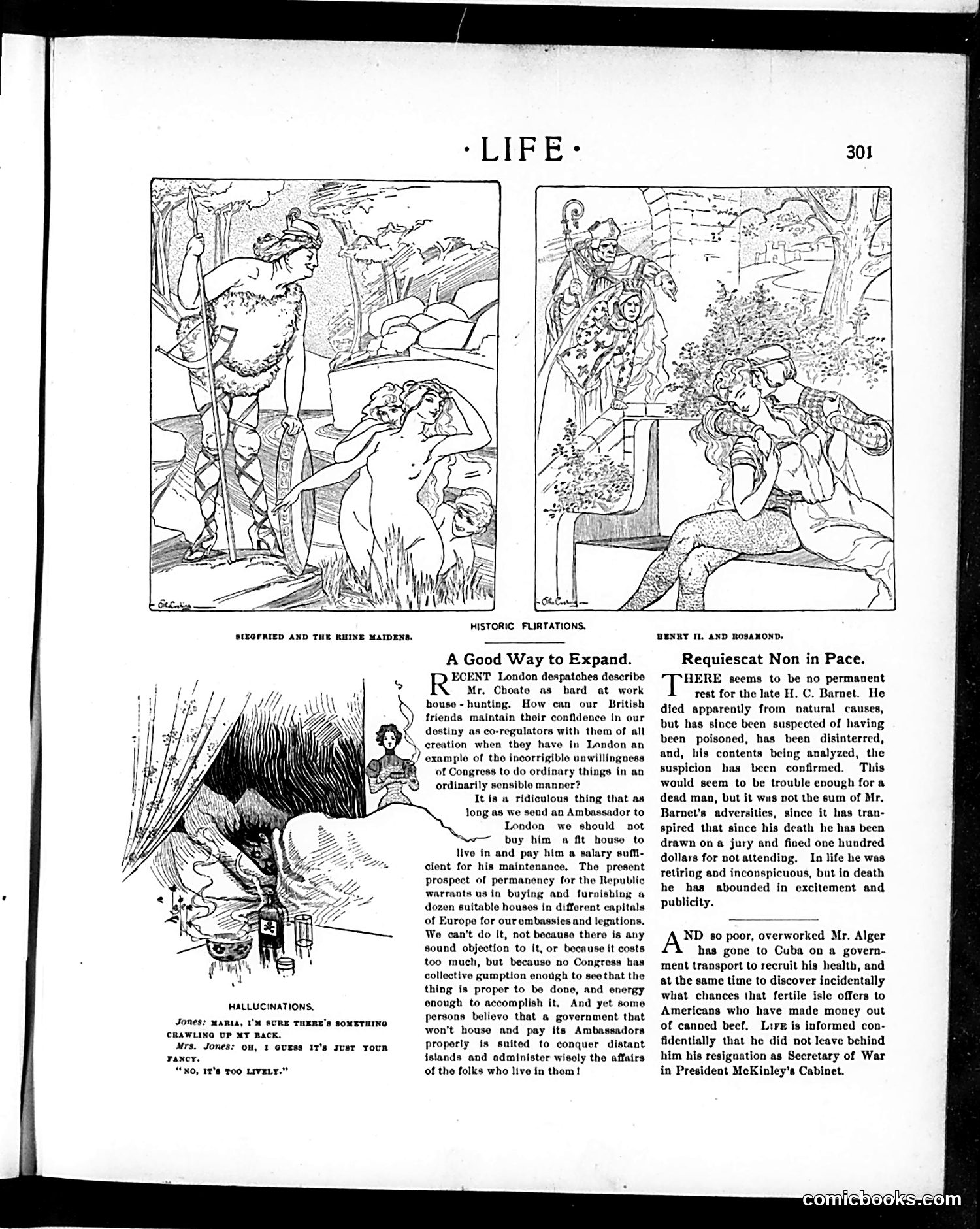
This page contains three illustrated segments satirizing early 20th-century politics and society: **Top illustrations** ("Historic Flirtations"): Period-costume drawings depicting classical/historical romantic scenarios—likely allegorical commentary on diplomatic or political relationships of the era. **"A Good Way to Expand"**: Criticizes Congress's reluctance to properly fund and house U.S. Ambassadors abroad. The article mocks the contradiction: Americans expect diplomatic influence globally while refusing to provide adequate resources. The satire suggests this penny-pinching undermines American credibility and power projection. **"Requiescat Non in Pace"**: Reports on a figure's (appears to be H. Barnet's) death, noting his prominence in life contrasted with his quiet passing—suggesting his death received less public attention than his controversial career warranted. **Bottom cartoon** ("Hallucinations"): A domestic humor piece about marital miscommunication.
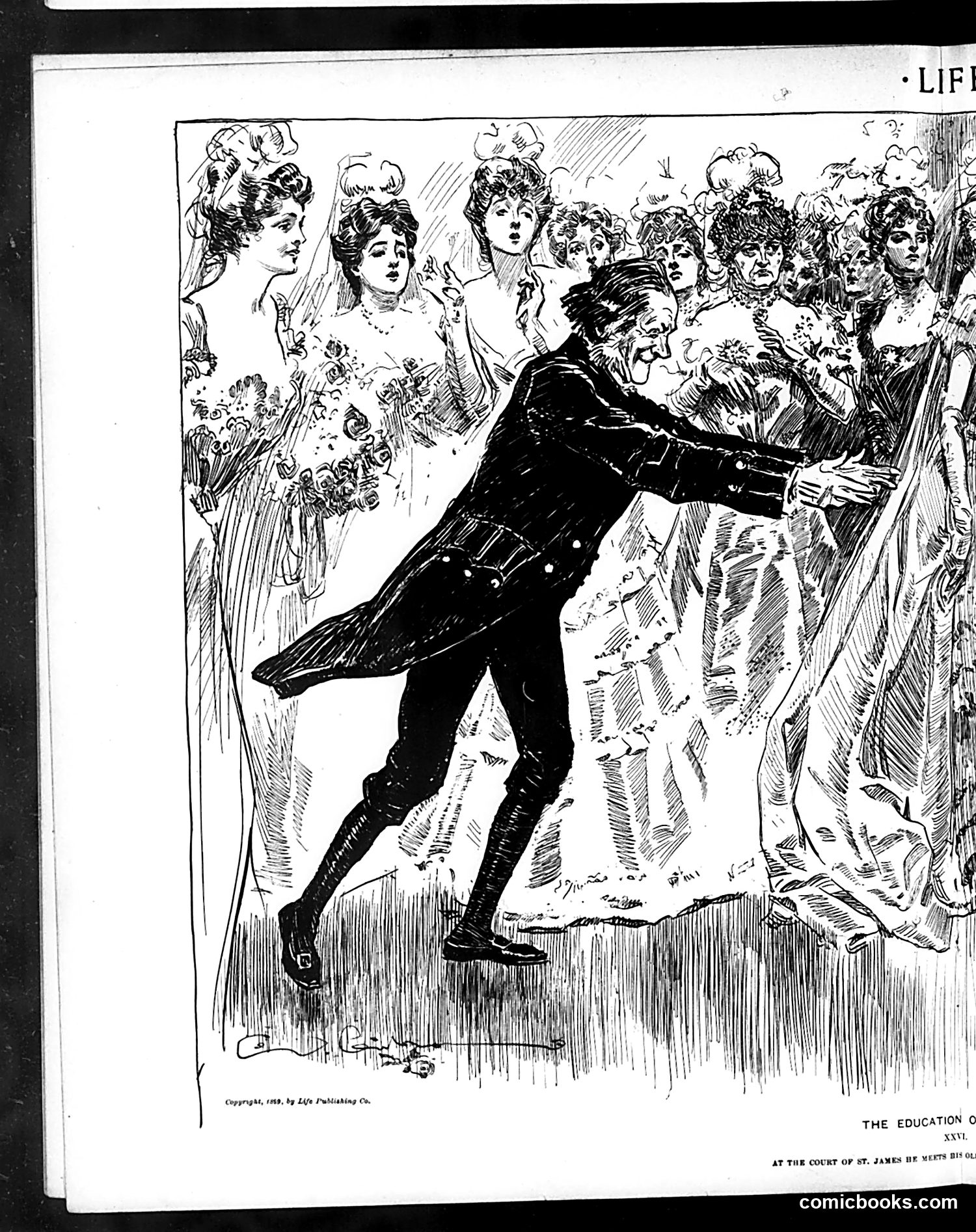
This is a satirical illustration from *Life* magazine (copyright 1908, per the visible credit). The cartoon depicts a man in formal military dress performing an exaggerated, acrobatic pose—appearing to leap or somersault—before a gathering of elegantly dressed women at what appears to be a formal court event. The caption references "THE EDUCATION OF..." and "AT THE COURT OF ST. JAMES" (the British royal court), suggesting this satirizes diplomatic or court behavior. The man's theatrical, undignified physical contortion contrasts sharply with the formal setting and the women's composed expressions, indicating the satire mocks either a specific public figure's attempt at courtly impression-making or the absurdity of performative behavior in high society. The specific identity of the caricatured figure remains unclear from the visible text.
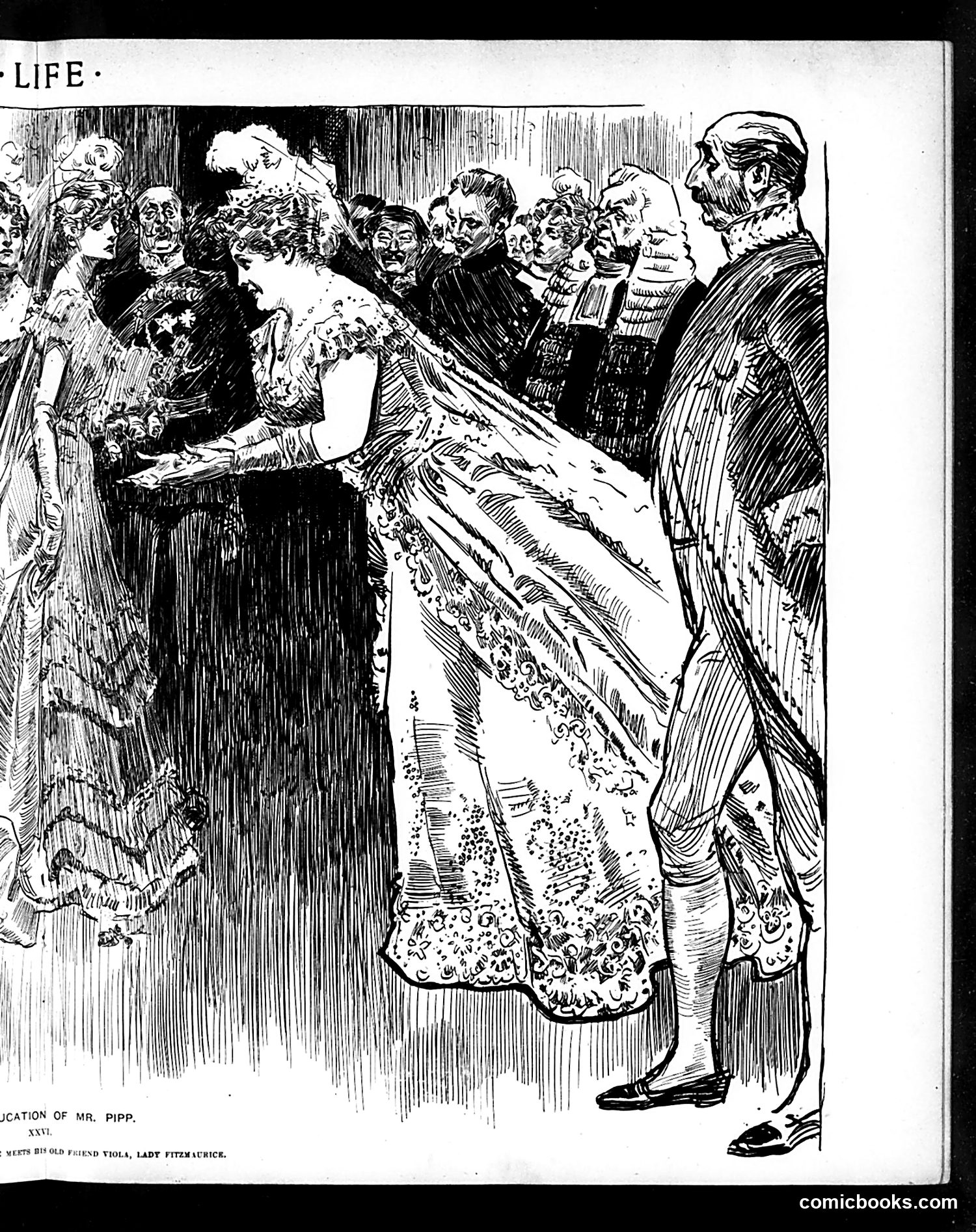
This appears to be a satirical illustration from *Life* magazine depicting a formal royal or diplomatic reception. The caption references "Mr. Pipp" and mentions "Lady Fitzaurice," suggesting this satirizes specific contemporary figures or social situations, though the exact identities are unclear without additional context. The drawing shows elaborately dressed attendees in formal evening wear and military uniforms gathered around a woman in an ornate gown with an extensive train. The style of caricature and exaggerated facial features typical of *Life*'s satirical approach suggests mockery of high society pretension, possibly commenting on aristocratic or diplomatic excess during the early 20th century. Without clearer identification of the named figures, the specific satirical target remains uncertain.
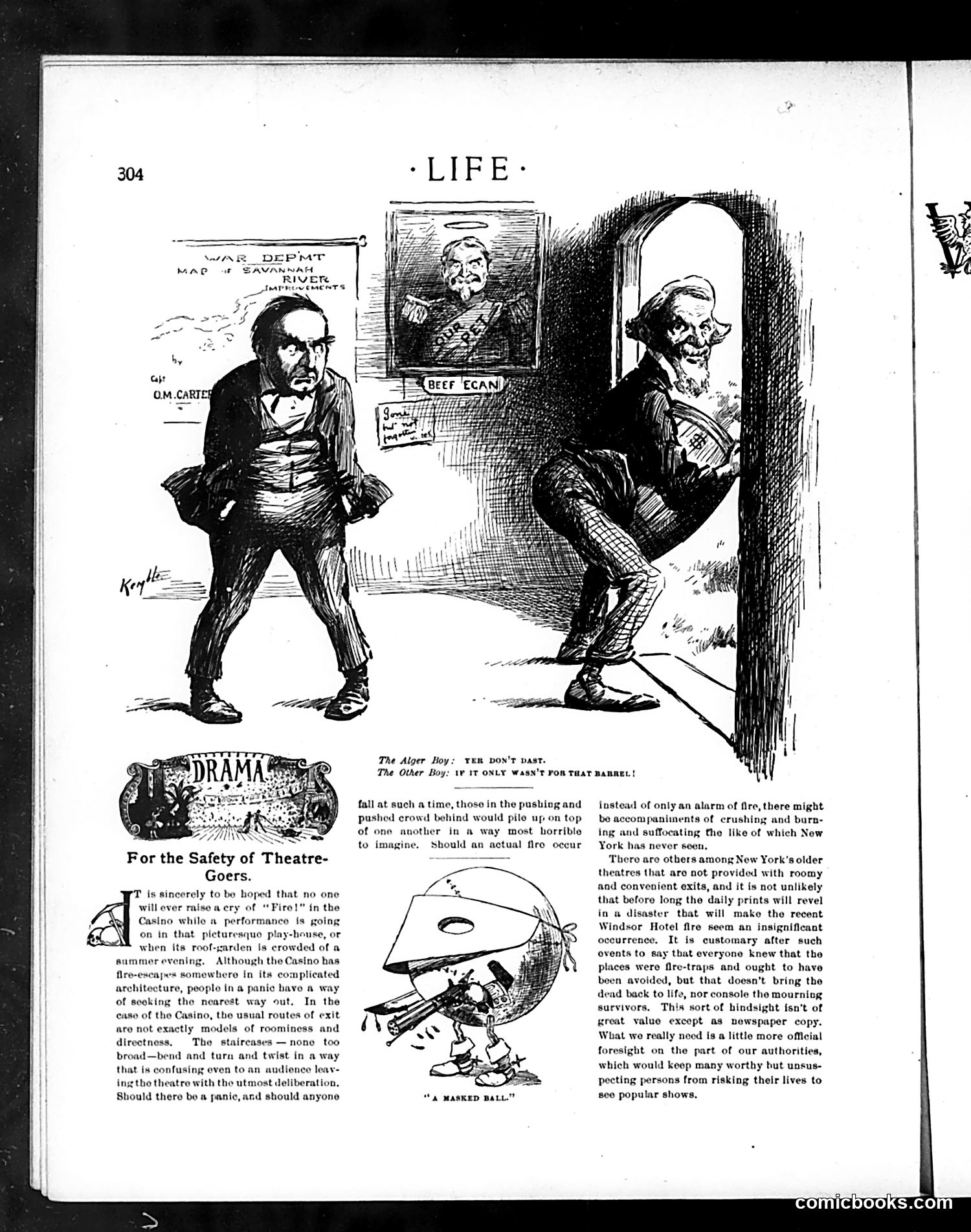
This page from *Life* magazine contains two distinct pieces: **Top cartoon**: Shows two men in a room with a portrait labeled "BEEF ECAN" on the wall. The left figure appears to be a military or government official examining a map. The caption suggests a comedic exchange about daring and "that saber." The reference to "Beef Ecan" (likely a misspelling in OCR) is unclear without additional context. **Bottom section**: "For the Safety of Theatre-Goers" discusses theater fire safety, criticizing inadequate emergency exits and procedures at theaters including the Casino. A cartoon labeled "A MASKED BALL" shows a figure in distress. The article advocates for better official oversight to prevent theater disasters and protect patrons from preventable tragedy. The satire targets theater management negligence and regulatory failures.
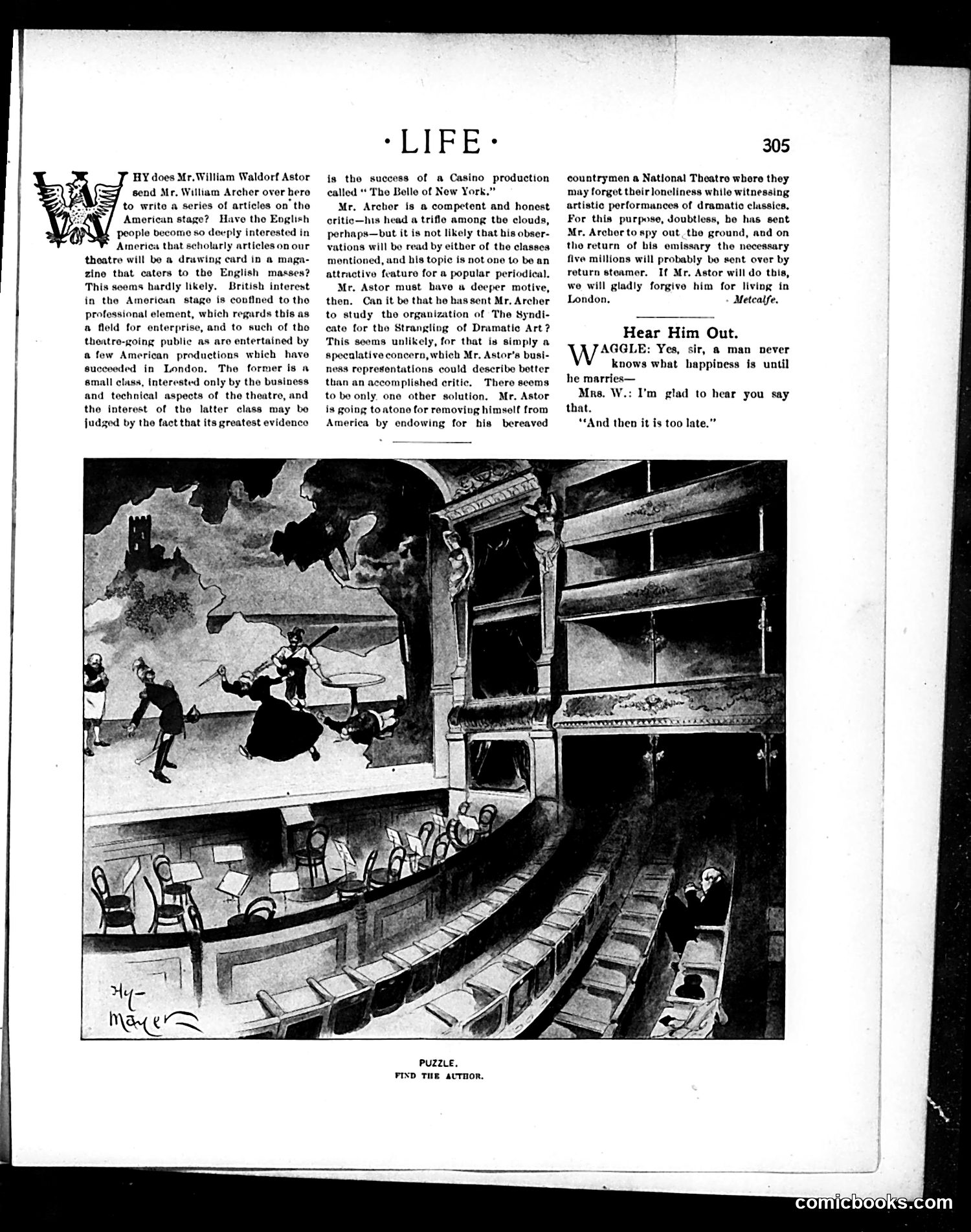
This page contains satirical commentary on American theatre and a brief comic dialogue. **Main Article:** Critic William Archer (a real British theater critic) has been sent to America by wealthy magnate William Waldorf Astor to write articles about the American stage for a British magazine. The author (Metcalfe) sarcastically questions Astor's motives, suggesting Astor—who lives in London—is either trying to profit from American theatre or atone for his absence by funding a National Theatre. The piece mocks both Astor's presumed business calculations and the limited British interest in American drama beyond *The Belle of New York*. **Comic Strip ("Hear Him Out"):** A man tells a woman that marriage reveals true happiness—but admits "it is too late," implying marriage has destroyed his happiness. The woman dryly agrees. This is a conventional domestic joke about marital disillusionment. **Puzzle Illustration:** Below the text is a theater interior diagram labeled "Find the Author"—likely a visual puzzle for readers to solve.
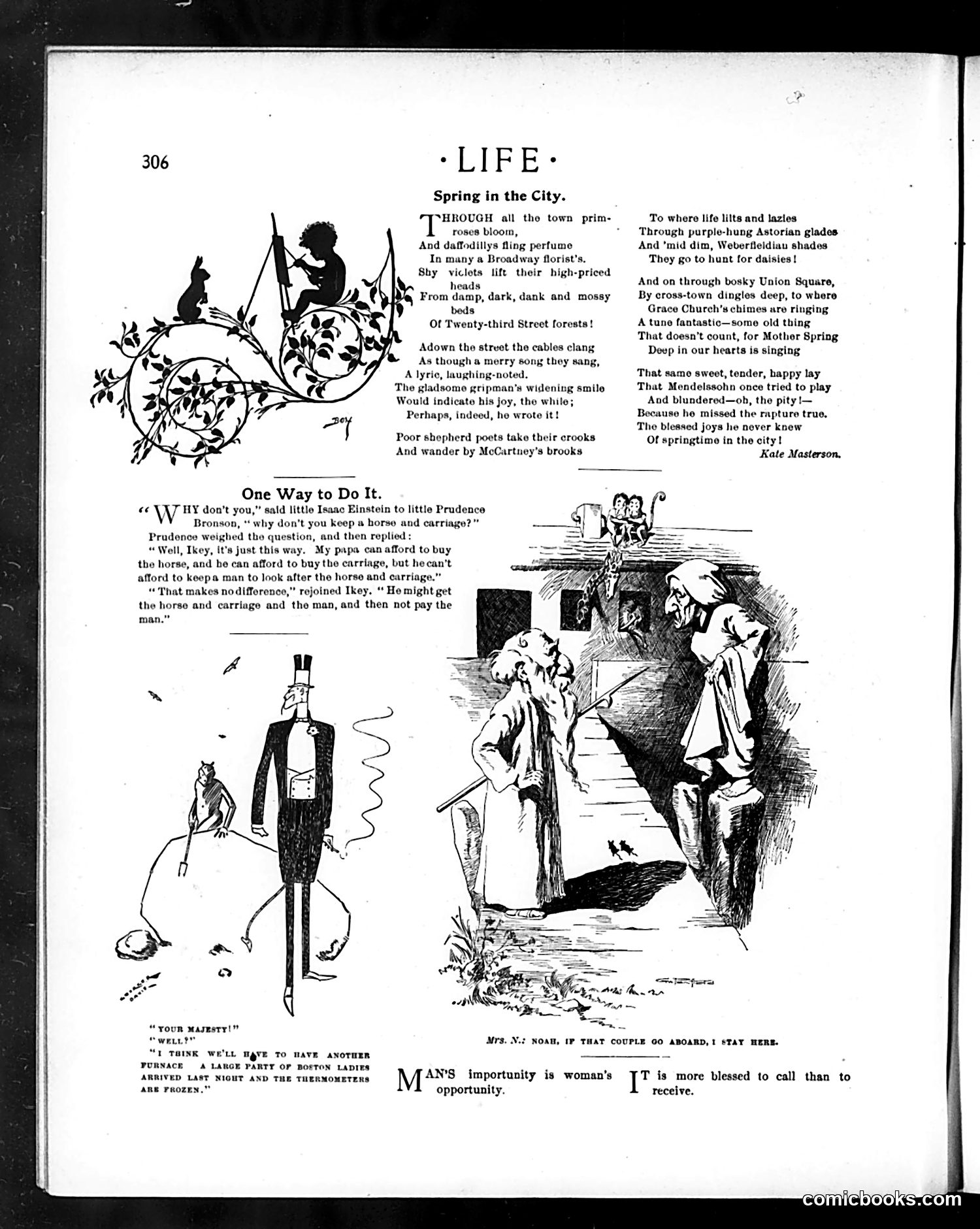
This page contains three distinct pieces of early 20th-century American humor: **"Spring in the City"** (poem by Kate Masterson): A romantic satire contrasting idealized nature poetry with gritty urban reality. It mocks both poor "shepherd poets" wandering city streets and wealthy tourists searching for natural beauty amid Broadway florists and concrete—suggesting spring's authentic joy cannot exist in the city. **"One Way to Do It"**: A joke playing on Jewish immigrant stereotypes. Young "Isaac Einstein" and "Prudence Bronson" discuss horse ownership; the punchline relies on the ethnic caricature of shrewd Jewish negotiation—Ikey suggests hiring a man without paying him, embodying an antisemitic trope about dishonesty. **Illustration captioned "Your Majesty"/"Mrs. N"**: Depicts wealthy Boston ladies overheating a mansion with excessive furnace use, satirizing the extravagance and poor judgment of the wealthy elite. **Bottom aphorisms**: Generic observations on gender relations and charity—"man's importunity is woman's opportunity" and "it is more blessed to call than to receive." The page reflects period attitudes combining class satire with casual ethnic stereotyping.
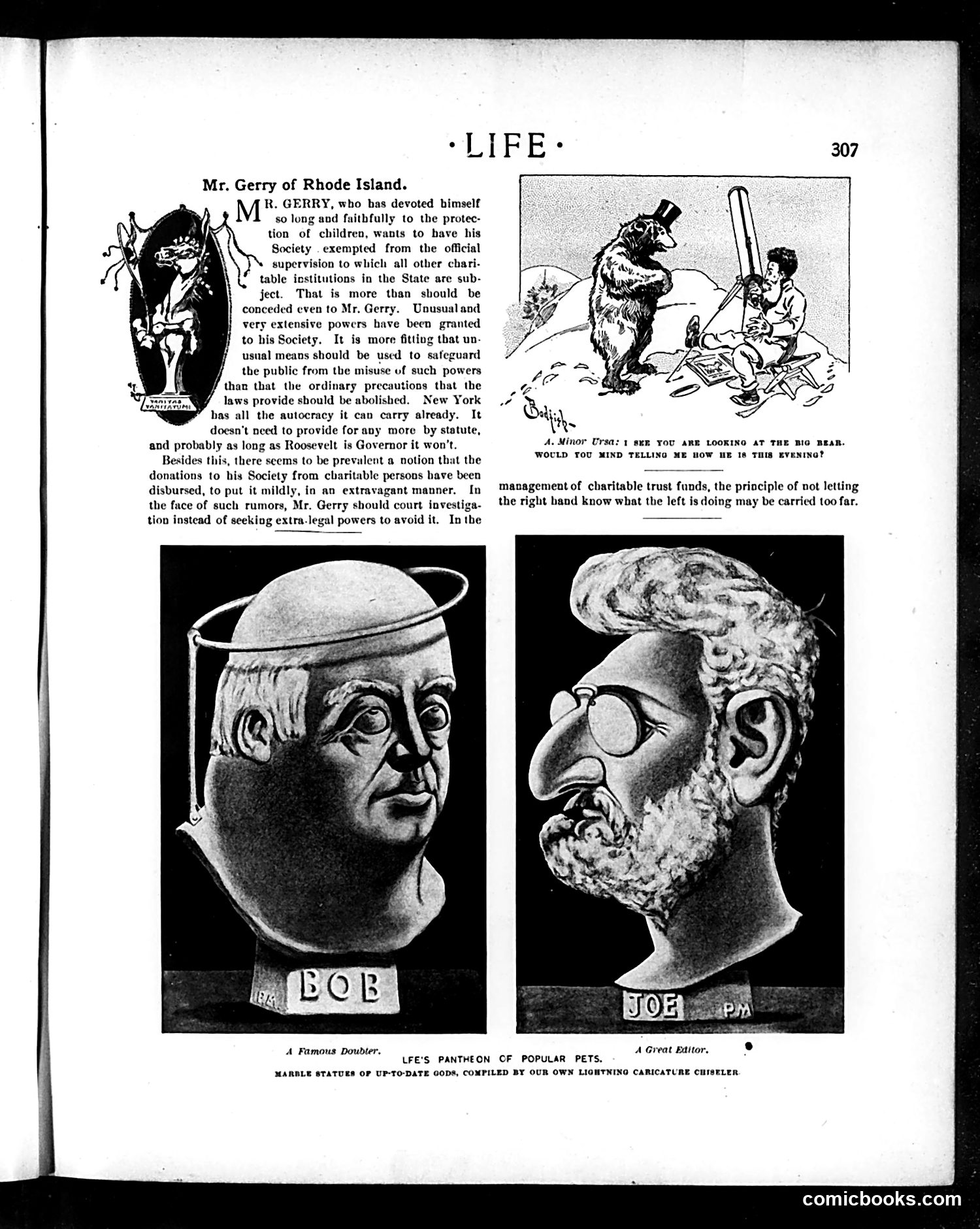
This 1910s *Life* magazine page satirizes **Mr. Gerry of Rhode Island**, likely Elbridge Gerry Jr., who ran a children's protection society. The text criticizes his request for exemption from state oversight of his charitable organization, arguing that organizations with "unusual and very extensive powers" need *more* scrutiny, not less—especially given rumors of extravagant spending. The upper cartoon shows a child encountering a large bear (representing the powerful, unsupervised organization), with the caption suggesting naïveté about the "big bear's" true nature. The lower section features caricature busts labeled "Bob" (A Famous Doubter) and "Joe" (A Great Editor)—likely mocking specific public figures who supported or opposed Gerry's exemption request. Without clearer identification, the specific targets remain unclear, though the satire emphasizes accountability in charitable institutions, even—or especially—those with noble missions.
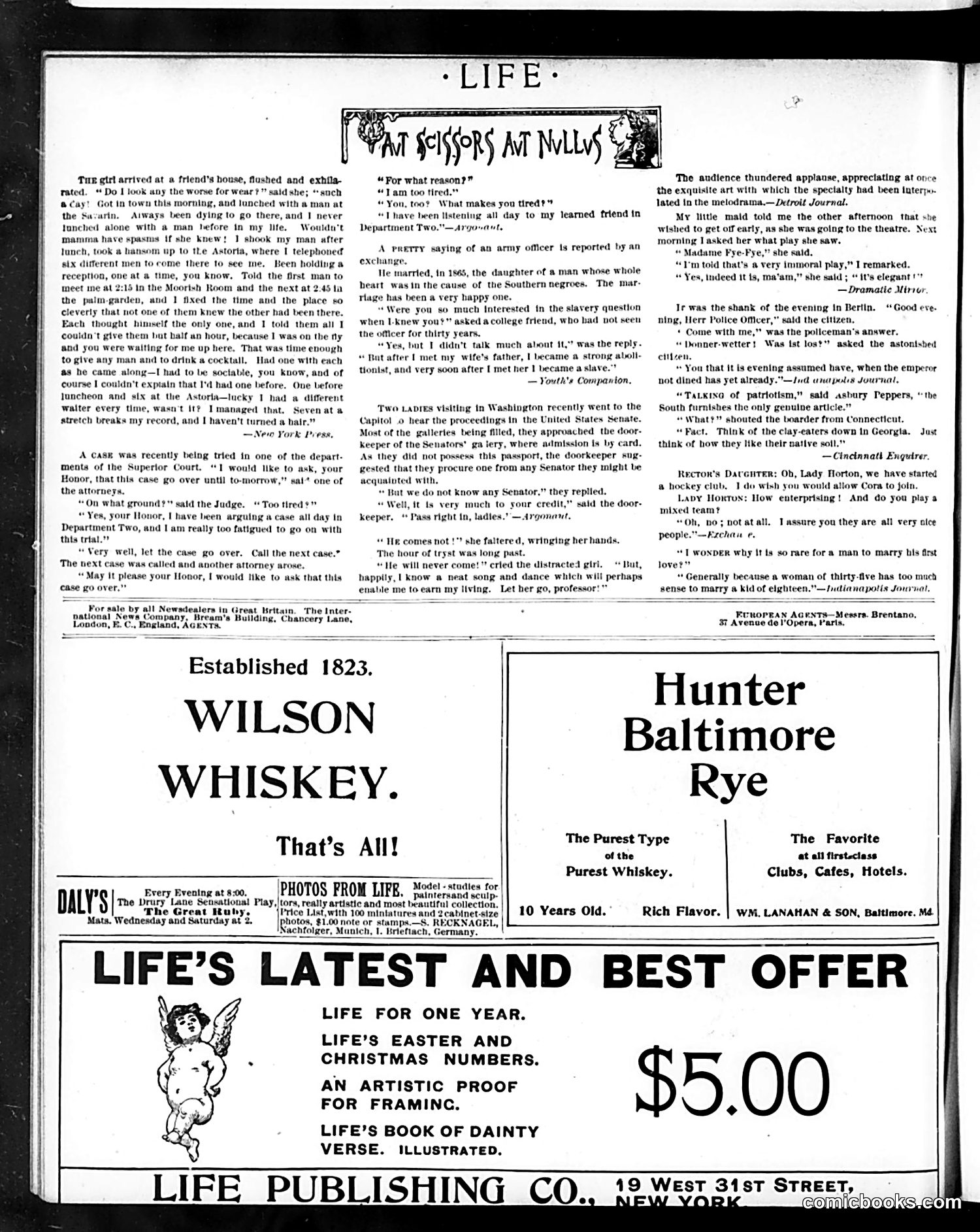
This page contains multiple brief humorous anecdotes typical of early 20th-century American satire, plus advertisements. **The cartoons/jokes address:** 1. **Women's changing social roles**: A young woman boasts of lunching alone with men and hosting multiple male visitors at a hotel—behavior shocking to her mother's generation. The humor targets anxieties about female independence and unchaperoned socializing. 2. **Lawyer fatigue**: Two attorneys request trial postponements because they're "too tired," with one admitting he's exhausted from listening to opposing counsel. This satirizes judicial inefficiency and legal verbosity. 3. **Abolitionist conversion**: An officer married the daughter of an anti-slavery activist; he jokes he became an abolitionist through her father's influence, then "a slave" through marrying her. This plays on gender dynamics in marriage. 4. **Women in politics**: Two women gain Capitol gallery access by claiming ignorance of senators, exploiting the doorkeeper's chivalry. The satire suggests women use social conventions strategically. The page is mostly **advertisements** (Wilson Whiskey, Hunter Baltimore Rye, Life subscriptions) interspersed with these brief satirical pieces.
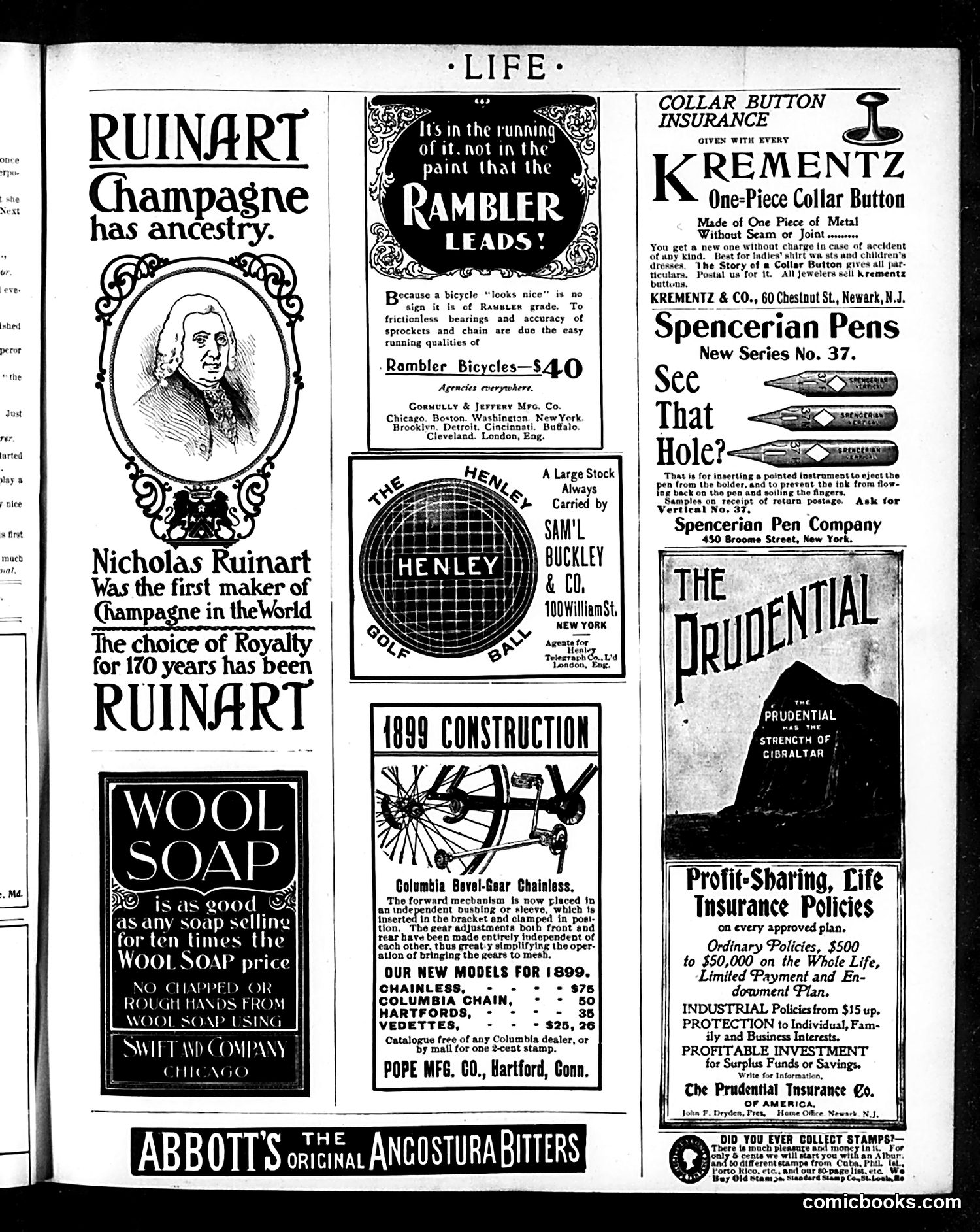
This is **primarily an advertising page** from Life magazine (circa 1899, based on "1899 Construction" reference). It contains no political cartoons or satire—it's a collection of commercial advertisements typical of the era. Notable ads include: - **Ruinart Champagne**: Claims ancestral legitimacy by invoking Nicholas Ruinart, the "first maker of Champagne in the world," appealing to tradition and prestige - **Rambler Bicycles**: Emphasizes engineering quality ("frictionless bearings") over mere appearance - **Krementz Collar Buttons**: Promises durability and replacement guarantees for professional dress - **Spencerian Pens**: Technical writing instruments - **Prudential Insurance**: Profit-sharing life insurance policies The page reflects **turn-of-the-century commercial concerns**: reliability in new technologies (bicycles, pens), insurance security for growing urban professionals, and appeals to heritage and quality. The ads assume educated, prosperous readers concerned with respectability and proper appearance.
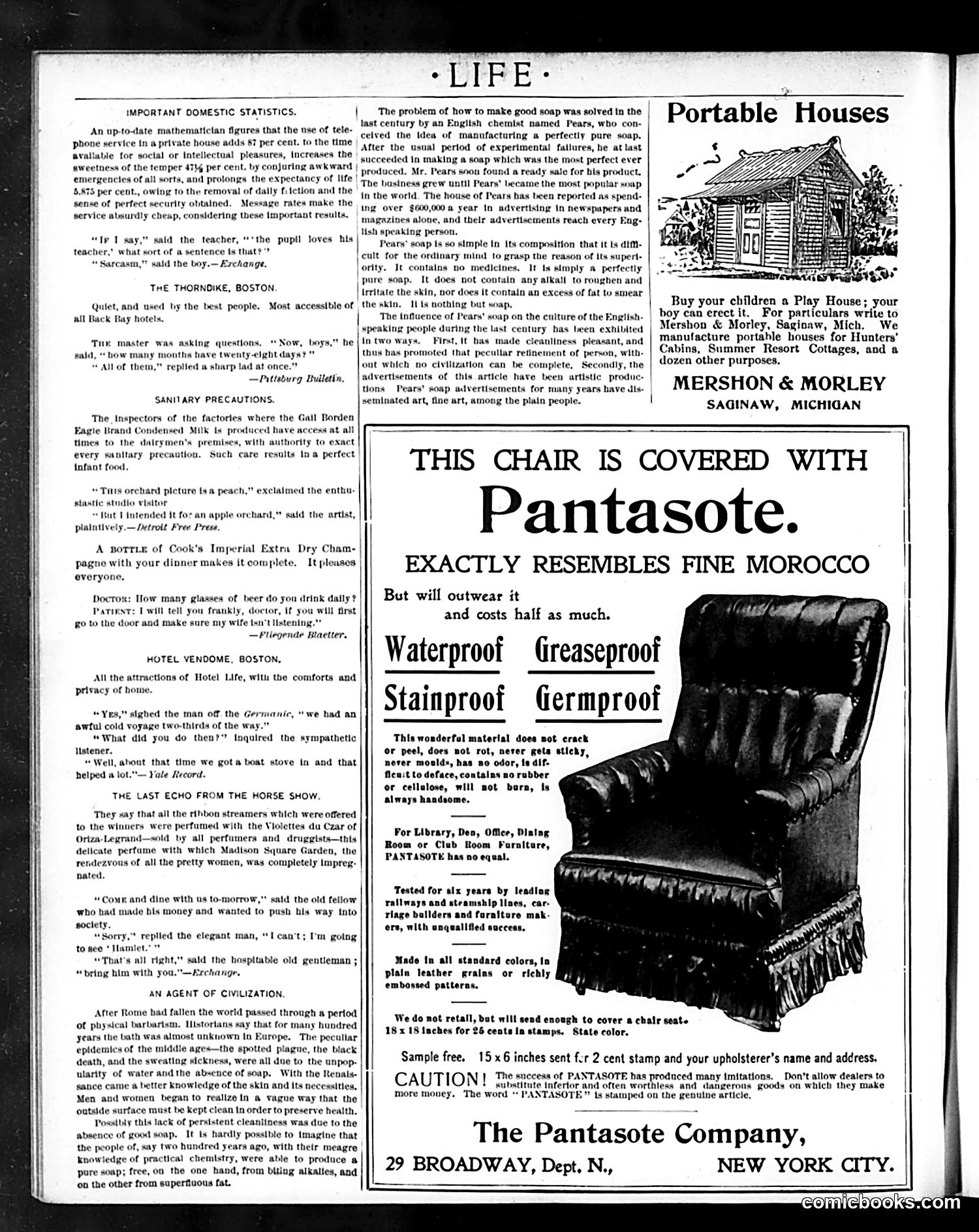
This page from *Life* magazine is primarily **advertising and humor content**, not political satire. The layout mixes short comedic anecdotes with commercial notices. The "humor" reflects early 1900s sensibilities: jokes about wives nagging husbands about drinking, a student's clever wordplay about months, a social climber's failed attempt to join high society. These skits mock everyday domestic annoyances and social pretension. The advertisements promote products positioning themselves as marks of civilization and progress: condensed milk (sanitary), telephone service (modern efficiency), and notably, *Pantasote* fabric—marketed as superior to leather for furniture because it's waterproof, stainproof, and doesn't crack or mold. The Pantasote ad explicitly claims to "resemble fine Morocco" while costing less, appealing to consumers wanting affordable luxury. The editorial content about soap's historical role frames cleanliness and manufactured goods as agents of civilization—a common Progressive Era argument that commercial products represented social advancement and hygiene.
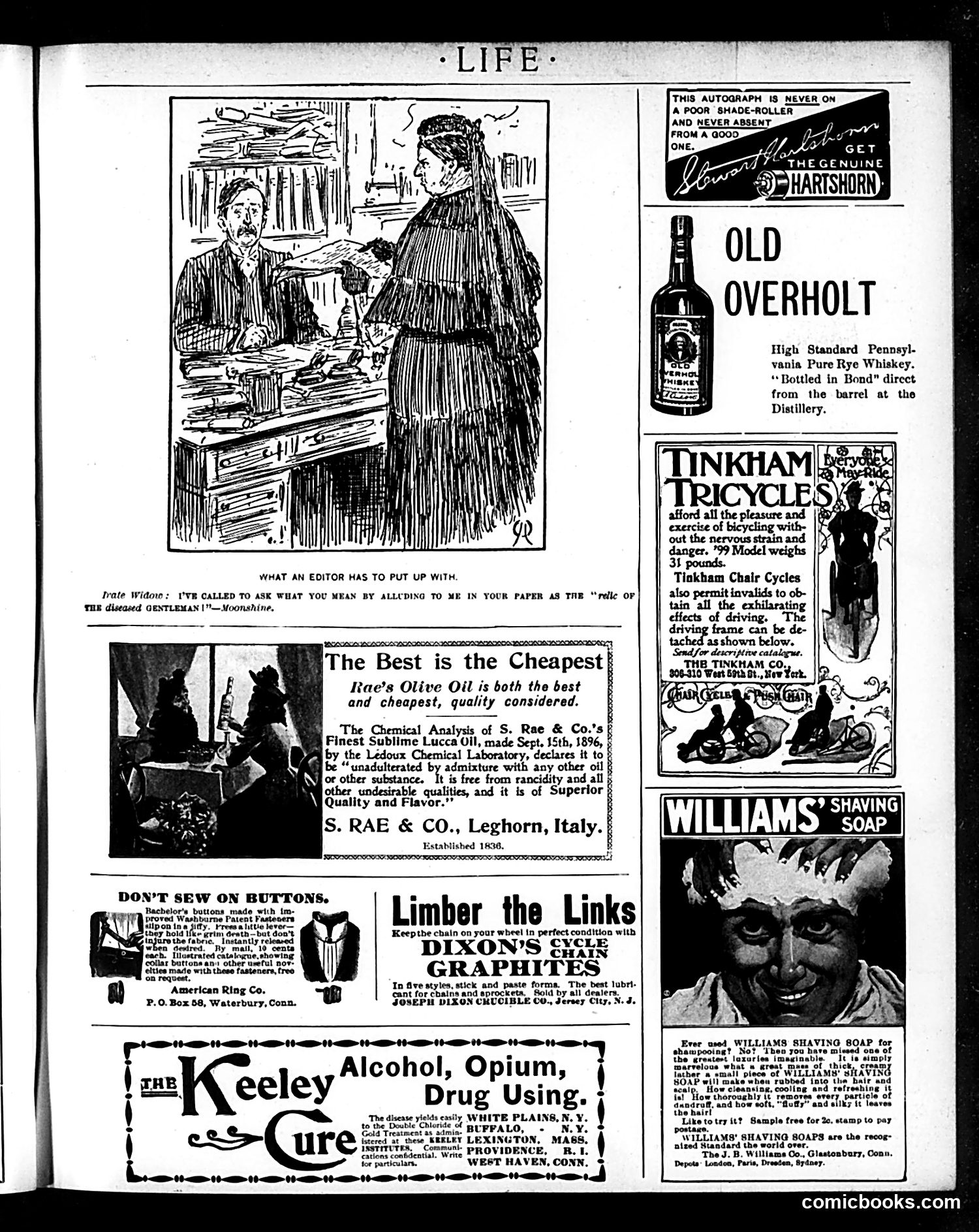
The main cartoon depicts an editor at his desk confronted by an angry widow. She's complaining that he referred to her in the newspaper as "the wife of the diseased gentleman"—a humorous malapropism where she likely meant to say "deceased" but said "diseased" instead. The joke satirizes both the widow's verbal mistake and the editor's predicament: he must deal with irate readers upset about how they or their relatives are portrayed in print. This reflects early 20th-century journalism tensions—editors fielding complaints from subjects of news stories. The cartoon gently mocks the widow's linguistic error while sympathizing with editors' thankless task managing public complaints about editorial content. The page is otherwise filled with period advertisements (whiskey, bicycles, olive oil, shaving soap, drug addiction cures), typical of *Life* magazine's revenue model.
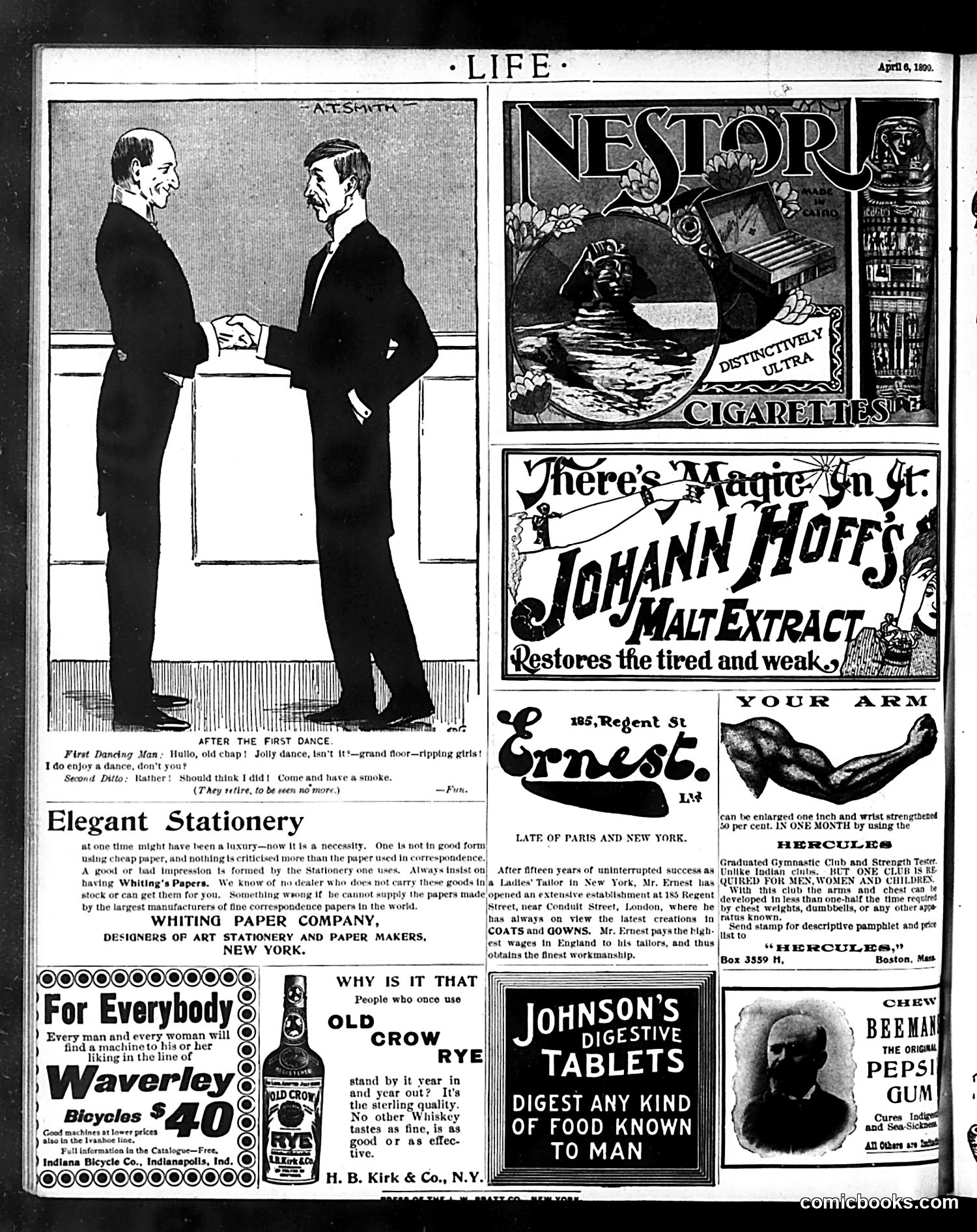
The main cartoon shows two well-dressed men at a social event. The joke is about male behavior at dances: they enthusiastically greet each other ("Jolly dance, isn't it!"), then immediately abandon the dancing and women to retire for smoking and conversation—"to be seen no more." This satirizes the social customs of the era, where men used dances as obligatory social functions but preferred male company and activities (smoking, talk) to actually dancing with women. The humor lies in the predictability and transparency of this behavior, and possibly a gentle critique of how men treated such events as tedious social obligations rather than genuine enjoyment. The page is otherwise filled with period advertisements for products like bicycles, rye whiskey, stationery, and digestive tablets—typical magazine filler of the era.