
Life, 1899-04-06 · page 4 of 20
Life — April 6, 1899 — page 4: what you’re looking at
What you’re looking at
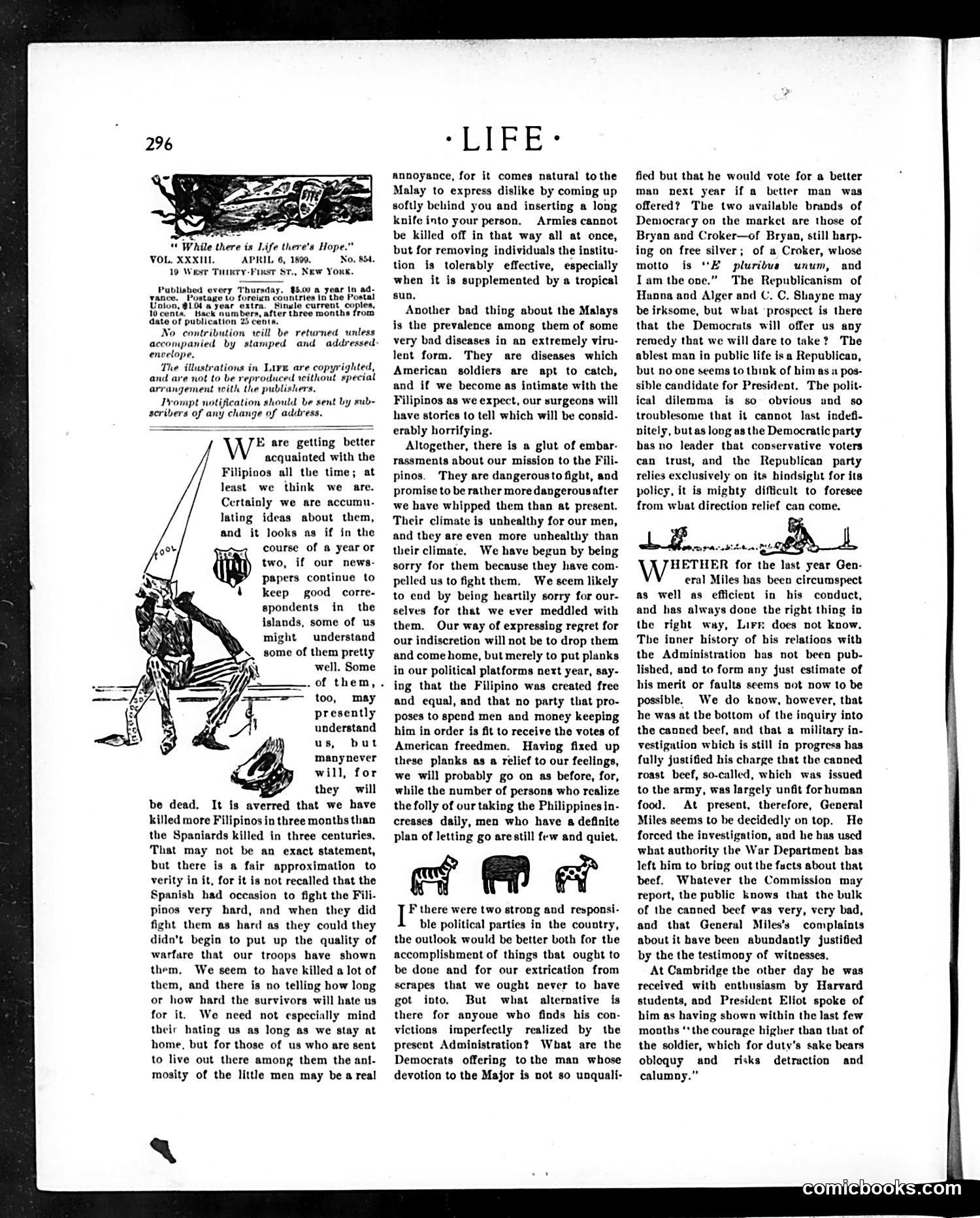
The main illustration depicts a Filipino soldier or fighter in traditional dress, shown in an active combat pose. This cartoon relates to the **Philippine-American War** (1899-1902), referenced explicitly in the article discussing American military involvement in the Philippines. The accompanying text critiques the conflict, expressing regret over American soldiers fighting Filipinos and noting the unhealthy climate. It discusses two competing Democratic political figures—**Bryan and Croker**—debating their party's direction on Philippine policy. The satire targets American imperial ambitions while also mocking Democratic Party leadership's inability to present a unified alternative to Republican policy. The cartoon uses the Filipino fighter to visualize the ongoing conflict that troubled the magazine's editors.
📄 Transcribed text from this page (OCR, searchable)
Machine-transcribed from the original scan — historical spelling and the odd misread are preserved.
“| While there is Life there's Hope.” VOL. XXXII. APRIL 6, 1899. No, 19 West Tuiery-Finsr New York. Puplished every Thursday. $5.00 0 year | vance. sree foreige countries ie the Postal . year extra. Single current coples, . Back oumbers, after three months from date of publication 25 cents, No contribution will be returned unless accompanied by stamped and addressed envelope. The illustrations in Live are copyrighted, and are not to be reproduced without special arrangement twith the publishers. Prompt notification should be sent by sub- scribers of any change of address. E are getting better acquainted with the Filipinos all the time; at least. we think we are. Certainly we are accumu- lating ideas about them, and it looks as if in the course of @ year or two, if our news- papers continue to keep good corre- spondents in the islands, some of us might understand some of them pretty x well. Some of them,. too, may presently understand us, but manynever will, for they will be dead. It is averred that we have killed more Filipinos in three months than the Spaniards killed in three centuries. That may not be an exact statement, but there is a fair approximation to verity in it, for it is not recalled that the Spanish had occasion to fight the Fili- pinos very hard, and when they did fight them as hard as they could they didn't begin to put up the quality of warfare that our troops have shown them, We seem to have killed a lot of them, and there is no telling how long or how hard the survivors will hate us for it. We need not especially mind their hating us as long as we stay at home, but for those of us who are sent to live out there among them the anf- mosity of the little men may be a real “ LIFE annoyance, for it comes natural tothe Malay to express dislike by coming up softly behind you and inserting a long knife into your person, Armies cannot be killed off in that way all at once, but for removing individuals the institu- tion is tolerably effective, especially when it is supplemented by a tropical sun, Another bad thing about the Malays is the prevalence among them of some very bad diseases in an extremely viru- lent form. They are diseases which American soldiers are apt to catch, and if we become as intimate with the Filipinos as we expect, our surgeons will have stories to tell which will be consid- erably horrifying. Altogether, there is a glut of embar- rassments about our mission to the Fili- pinos. They are dangerousto fight, and promise to be rather more dangerousafter we have whipped them than at present. Their climate is unhealthy for our men, and they are even more unhealthy than their climate. We have begun by being sorry for them because they have com- pelled us to fight them. We scem likely to end by being heartily sorry for our- selves for that we ever meddled with them. Our way of expressing regret for our indiscretion will not be to drop them and come home, but merely to put planks in our political platforms next year, say- ing that the Filipino was created free and equal, and that no party that pro- poses to spend men and money keeping him in order is fit to receive the votes of American freedmen. Having fixed up these planks as a relief to our feelings, we will probably go on as before, for, while the number of persons who realize the folly of our taking the Philippines in- creases daily, men who have a definite plan of letting go are still few and quiet. cl I’ there were two strong and responsi- ble political parties in the country, the outlook would be better both for the accomplishment of things that ought to be done and for our extrication from scrapes that we ought never to have got into, But what alternative is there for anyoue who finds his con- victions imperfectly realized by the present Administration? What are the Democrats offering tothe man whose devotion to the Major is not so unquali- fied but that he would vote for a better man next year if a better man was offered? The two available brands of Democracy on the market are those of Bryan and Croker—of Bryan, still harp- ing on free silver; of a Croker, whose motto is “EZ pluribue unum, and Tam the one.” The Republicanism of Hanna and Alger and C. C. Shayne may be irksome, but what ‘prospect is there that the Democrats will offer us any remedy that we will dare to take? The ablest man in public life isa Republican, but no one seems to think of him as a pos- sible candidate for President. The polit- ical dilemma is so obvious und so troublesome that it cannot last indefl- nitely, butas long as the Democratic party has no leader that conservative voters can trust, and the Republican party relies exclusively on its hindsight for its policy, it is mighty difficult to foresee from what direction relief can come. HETHER for the last year Gen- eral Miles has been circumspect as well as efficient in his conduct, and has always done the right thing in the right way, Lirr does not know. The inner history of his relations with the Administration bas not been pub- lished, and to form any just estimate of his merit or faults seems not now to be possible. We do know, however, that he was at the bottom of the inquiry into the canned beef, and that a military in- vestigation which is still in progress has fully justified his charge that the canned roast beef, so-called, which was issued to the army, was largely unfit forhuman food. At present, therefore, General Miles seems to be decidedly on top. He forced the investigation, and he has used what authority the War Department bas left him to bring out the facts about that beef. Whatever the Commission may report, the public knows that the bulk of the canned beef was very, very bad, and that General Miles’s complaints about it have been abundantly justified by the the testimony of witnesses, At Cambridge the other day he was received with enthusiasm by Harvard students, and President Eliot spoke of bim as having shown within the last few months ‘*the courage higher than that of the soldier, which for duty’s sake bears obloquy and risks detraction and calumny.”