
Life, 1899-04-06 · page 7 of 20
Life — April 6, 1899 — page 7: what you’re looking at
What you’re looking at
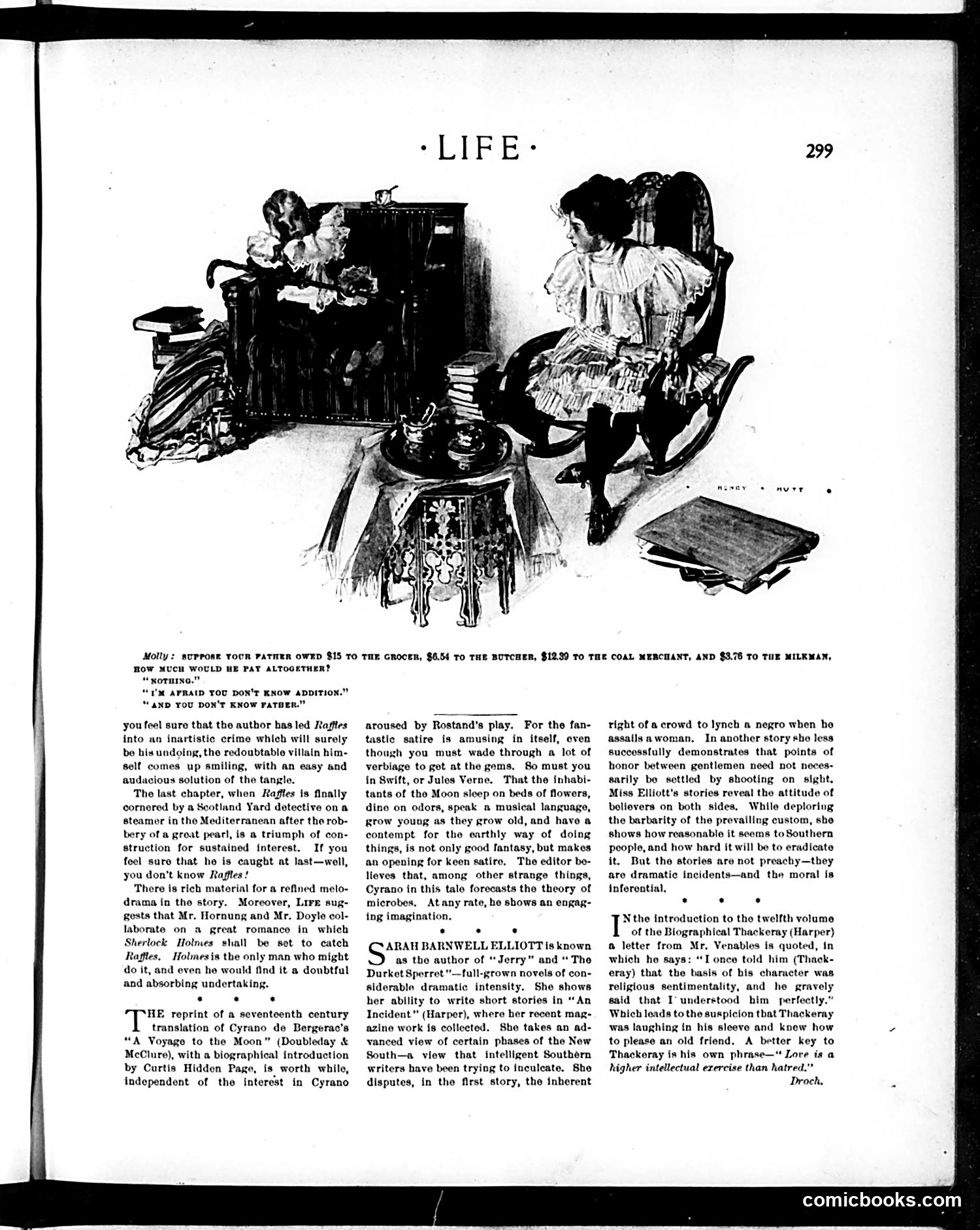
This page from *Life* magazine features a domestic satirical cartoon about family finances. The illustration shows a woman in a rocking chair confronting a man (presumably her husband) about unpaid debts. The caption lists specific amounts owed to various tradespeople: a grocer ($15), butcher ($6.54), coal merchant ($13.20), and milkman ($3.75). The joke centers on the husband's inability to account for these expenses, with dialogue suggesting he claims ignorance of the bills. This reflects early 20th-century middle-class anxiety about household debt and domestic financial management—a satirical commentary on how husbands often avoided responsibility for domestic expenses while their wives managed household accounts.
📄 Transcribed text from this page (OCR, searchable)
Machine-transcribed from the original scan — historical spelling and the odd misread are preserved.
Molly: SUPPOSE YOUR FATHER OWED $15 To THE GRoceR, $6.54 To THE BUTCHER, $12.89 To THE COAL MERCHANT, AND $3.76 TO THE MILKMAN, HOW MUCH WOULD UE PAY ALTOGETHER? * NoTmING."” I'M APRAID YOU DON'T KNOW ADDITION.” “AND YOU DON'T KNOW PATBER.” you feel suro that the author bas led Raftes into an inartistic crime which will surely be bis undoing, the redoubtable villain him- self comes up smiling, with an easy and audacious solution of the tangle. Tho last chapter, whon Rafles is finally cornered by a Scotland Yard detective on a steamor in tho Mediterranean after the rob- bery of a groat pearl, is a triumph of con- struction for sustained interest. If you fool sure that he is caught at last—well, you don’t know Raflles ! Thore is rich matorial for a refined melo- drama in tho story. Moreover, Lire sug- gests that Mr. Hornung and Mr. Doyle col- laborate on a great romanco in which Sherlock Holmes shall be set to catch Raffles. Holmesis the only man who might do it, and even he would find it a doubtful and absorbing undertaking. . . . HE roprint of a seventeenth century translation of Cyrano de Bergerac’s “A Voyage to the Moon” (Doubleday & McClure), with a biographical introduction by Curtis Hidden Page, is worth while, independent of the interest in Cyrano aroused by Rostand’s play. For tho fan- tastic satire is amusing in itself, oven though you must wade through a lot of verbiage to get at the goms, So must you in Swift, or Jules Verne. That the Inhabi- tants of tho Moon sleep on beds of flowers, dine on odors, speak a musical language, grow young as they grow old, and havo a contempt for tho earthly way of doing things, is not only good fantasy, but makes an opening for keen satire. The editor bo Neves that, among other strange things, Cyrano in this talo forecasts tho theory of microbes, Atany rate, he shows an engag- ing imagination. . . oe ARAH BARNWELL ELLIOTT is known, as tho author of “Jerry” and “Tho Durket Sporret "full-grown novels of con- siderable dramatic intensity. Sho shows her ability to write short stories in “An Incident” (Harper), where her recent mag- azino work {s collected. Sho takes an ad- vanced view of certain phases of the New South—a view that intelligent Southorn writers have been trying to {uculcate. She disputes, in tho first story, the inherent right of a crowd to lynch a negro when ho assailsawoman, In another story sho less successfully demonstrates that points of honor between gentlemen need not neces- sarily bo settled by shooting on sight. Miss Elliott's stories reveal the attitude of bolievers on both sides, While deploring the barbarity of the prevailing custom, sho shows how reasonable it seems to Southern people, and how hard it will be to eradicate it, But the stories are not preachy—they are dramatic incidents—and the moral is inferential, . . . N the introduction to tho twelfth volume I of the Biographical Thackeray (Harper) a letter from Mr, Venables is quoted, in which ho says: “I once told him (Thack- eray) that the basis of bis charucter was religious sentimentality, and he gravely said that I’ understood him perfectly. Which loads to tho suspicion that Thackeray was laughing in his sleeve and know how to please an old friend. A better key to Thackeray is his own phrase—“' Lore is a higher intellectual exercise than hatred.” Droch. comicbooks.com