
A complete issue · 20 pages · 1899
Life — March 30, 1899
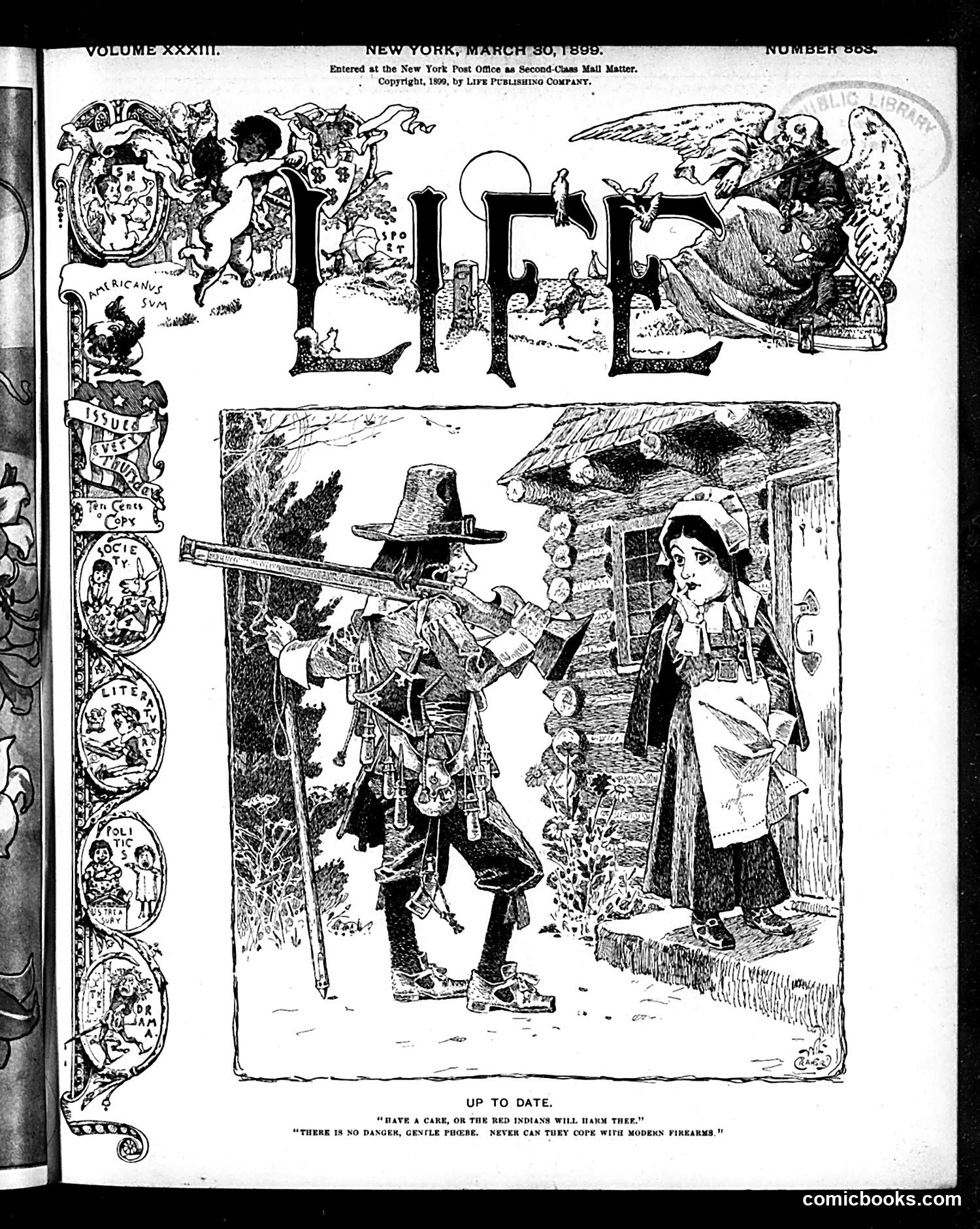
This Life magazine cover from March 30, 1899 presents a cartoon titled "Up to Date" with the caption: "Have a care, or the Red Indians will harm thee" / "There is no danger, gentle finger. Never can they cope with modern firearms." The image shows a soldier or hunter with a rifle confronting what appears to be a Native American figure at a cabin door. The satire critiques the false confidence of European/American settlers who believed modern weaponry made them invulnerable to Indigenous resistance. The joke is bitterly ironic: it mocks the arrogant assumption that superior firepower guarantees safety and dominance, even as this period coincided with violent colonial expansion and the final stages of Indian Wars. The decorative border contains additional period vignettes, typical of Life's ornamental style from this era.
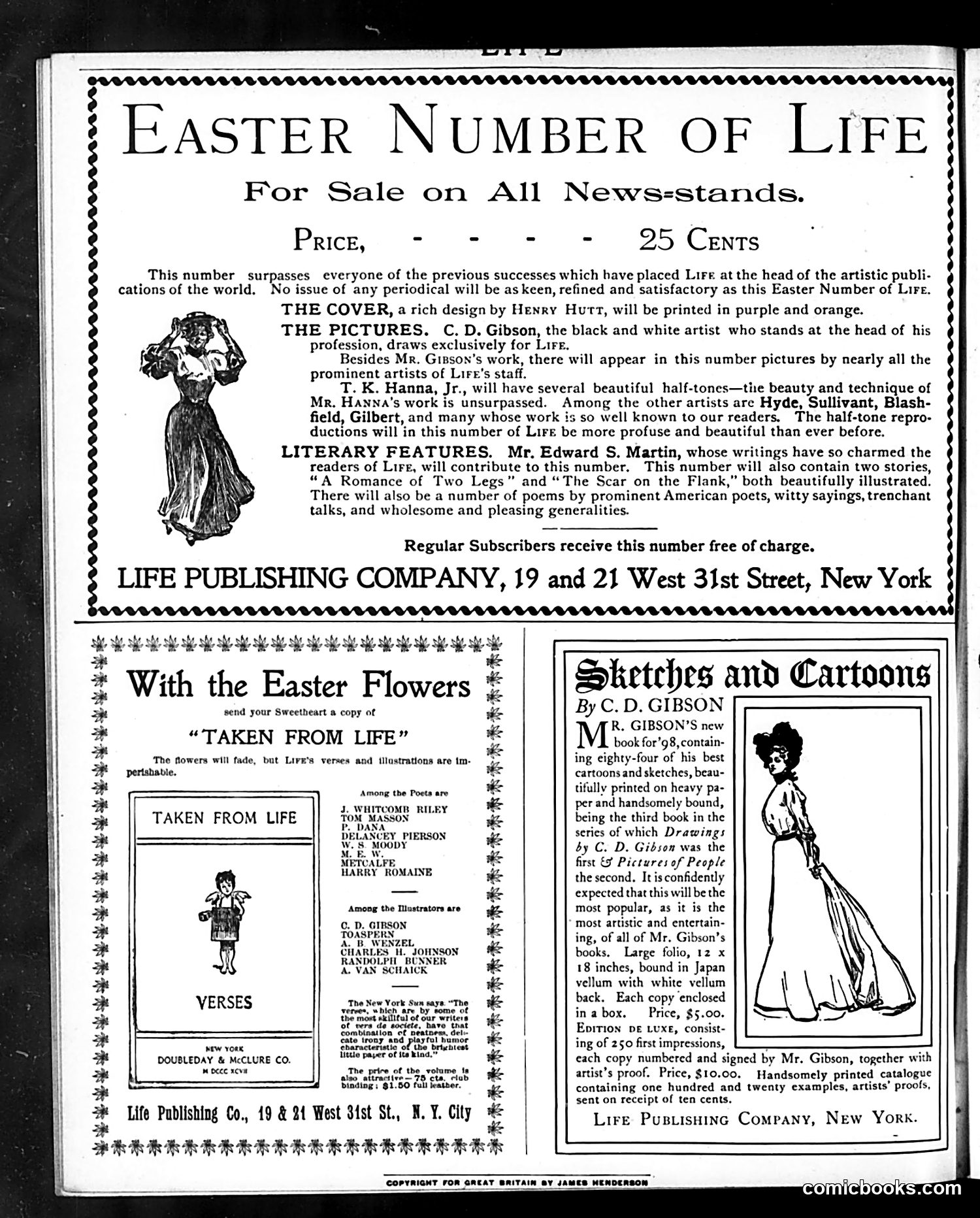
This page is primarily **advertising**, not political satire. It announces Life Publishing Company's Easter Number special issue (25 cents), available on newsstands. The ads promote three products: 1. **"Taken from Life"** — a poetry book featuring verses by prominent American poets (Riley, Massey, Pierson, Moody, etc.) with illustrations by C.D. Gibson and others. 2. **"Sketches and Cartoons by C.D. Gibson"** — Gibson's new book of his best work, described as his third in a series called *Drawings by C.D. Gibson*. It's a large-format volume (12 x 18 inches) printed in Japan, priced at $5.00. The page emphasizes Gibson's prominence as Life's lead artist. No specific political commentary or satirical targets are evident—this is straightforward commercial promotion for Easter-season publications.
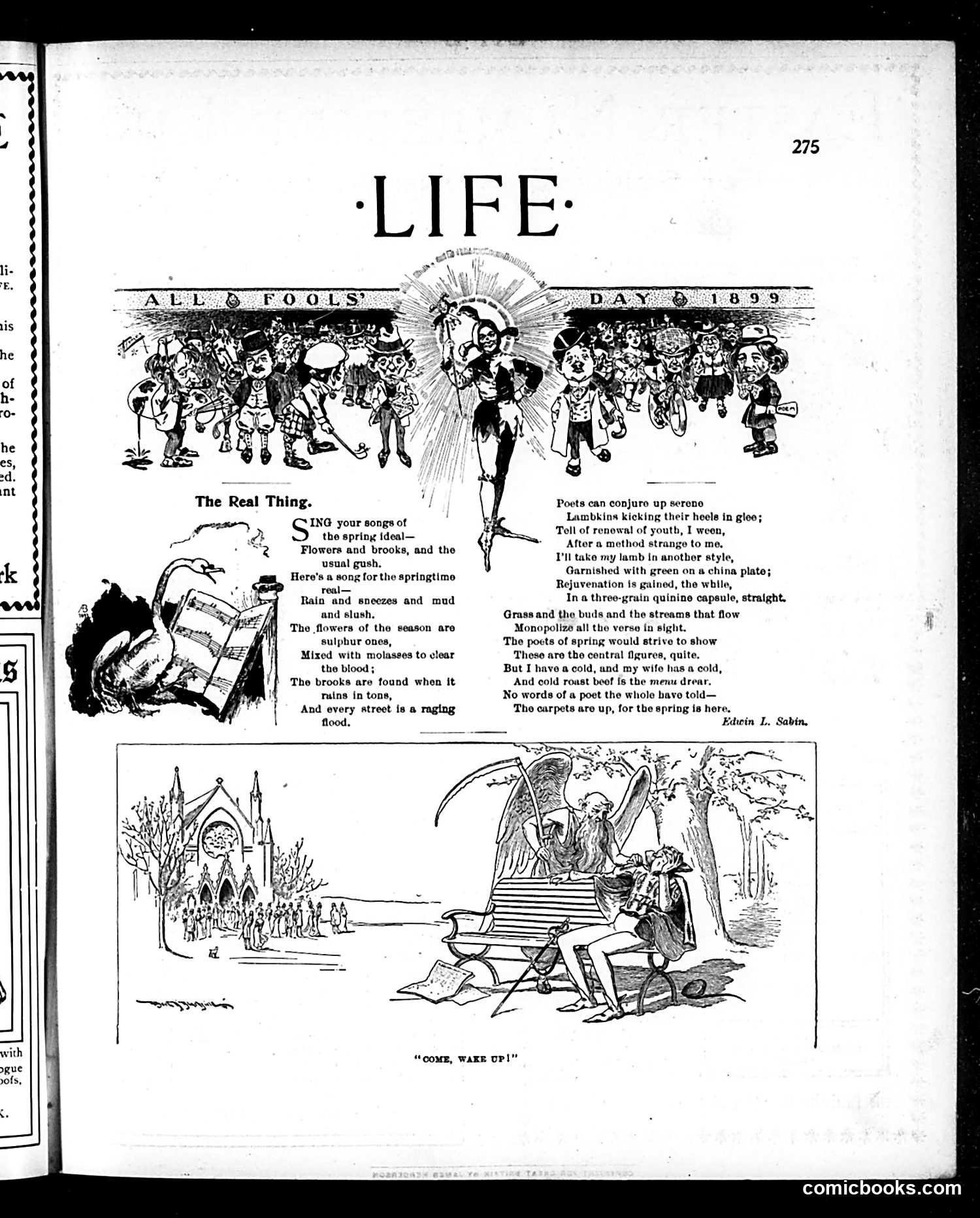
This is an **All Fools' Day (April 1st) satirical issue**. The header shows various fool characters surrounding a central jester figure—a traditional April Fools' theme. "The Real Thing" poem mocks spring's romantic idealization, contrasting flowery verse with unglamorous reality: mud, sneezes, flooding streets, and cold roast beef. The satire deflates sentimentality about springtime. The two illustrations appear to depict spring-related scenes—one showing a Gothic cathedral (possibly a fantasy or religious parody), the other labeled "Come, Wake Up!" showing figures in nature, likely mocking people's enthusiastic response to spring's arrival. The overall message: Life ridicules both sentimental spring poetry and people's foolish enthusiasm for the season, using April Fools' Day as the framework for this gentle mockery of pretense and naïveté.
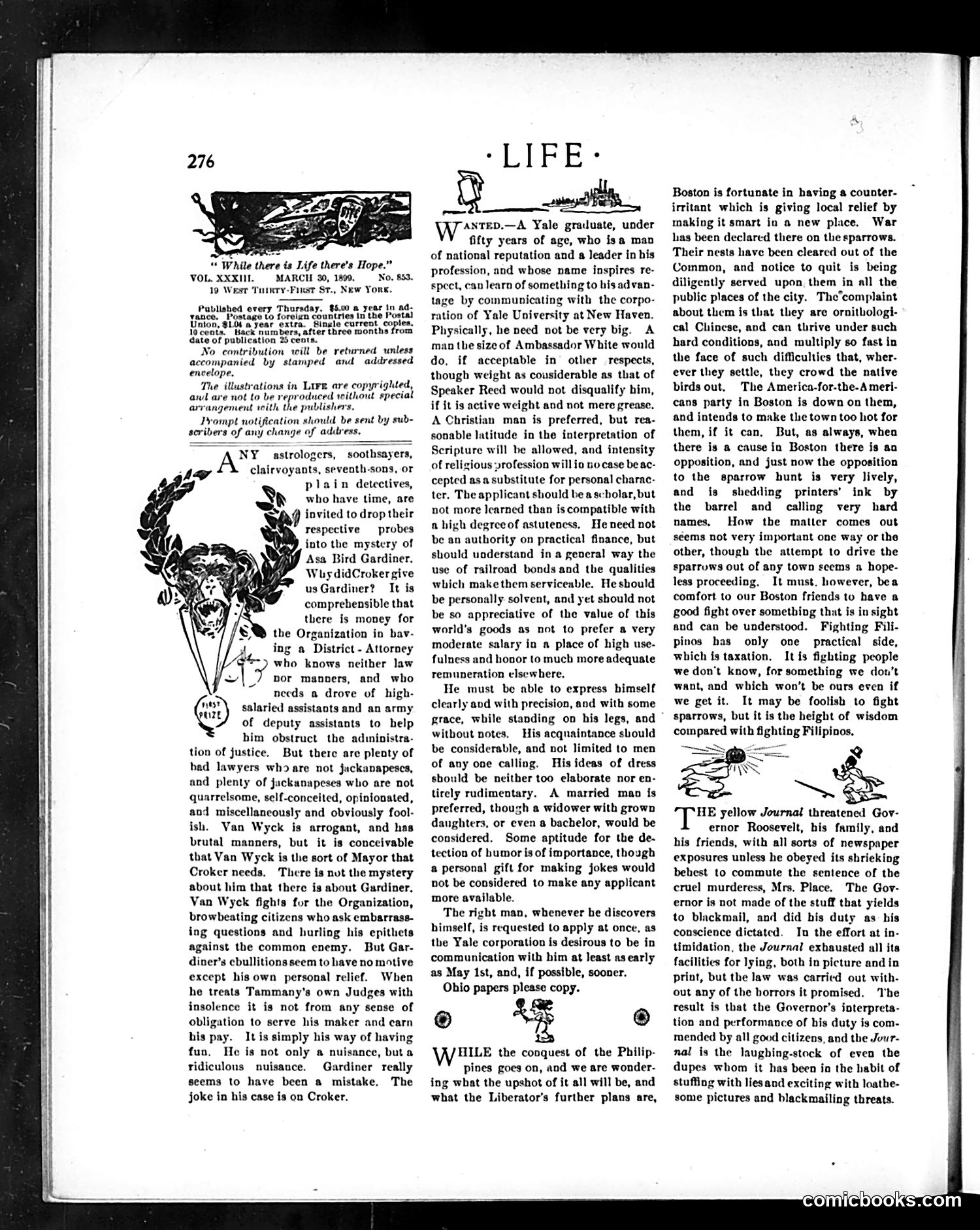
This page contains three distinct satirical pieces addressing early 20th-century American issues: 1. **Yale Graduate Advertisement**: Mocks the pretentiousness of Ivy League credentials, satirizing applicants who overestimate their qualifications for prestigious positions while lacking practical ability. 2. **Astrologers/Soothsayers Cartoon**: Critiques fraudulent fortune-tellers and charlatan "clairvoyants" who exploit gullible clients, framing them as parasites on society. 3. **Van Wyck and Tammany Hall**: References New York political corruption, specifically attacking District Attorney Van Wyck's apparent hypocrisy in prosecuting corruption while being complicit in Tammany Hall's schemes. 4. **Roosevelt and the Philippines**: Discusses Governor Roosevelt's threatened actions regarding Philippine colonial affairs, debating the legitimacy of his administrative authority over colonial governance. The page reflects Progressive Era anxieties about institutional corruption and fraud.
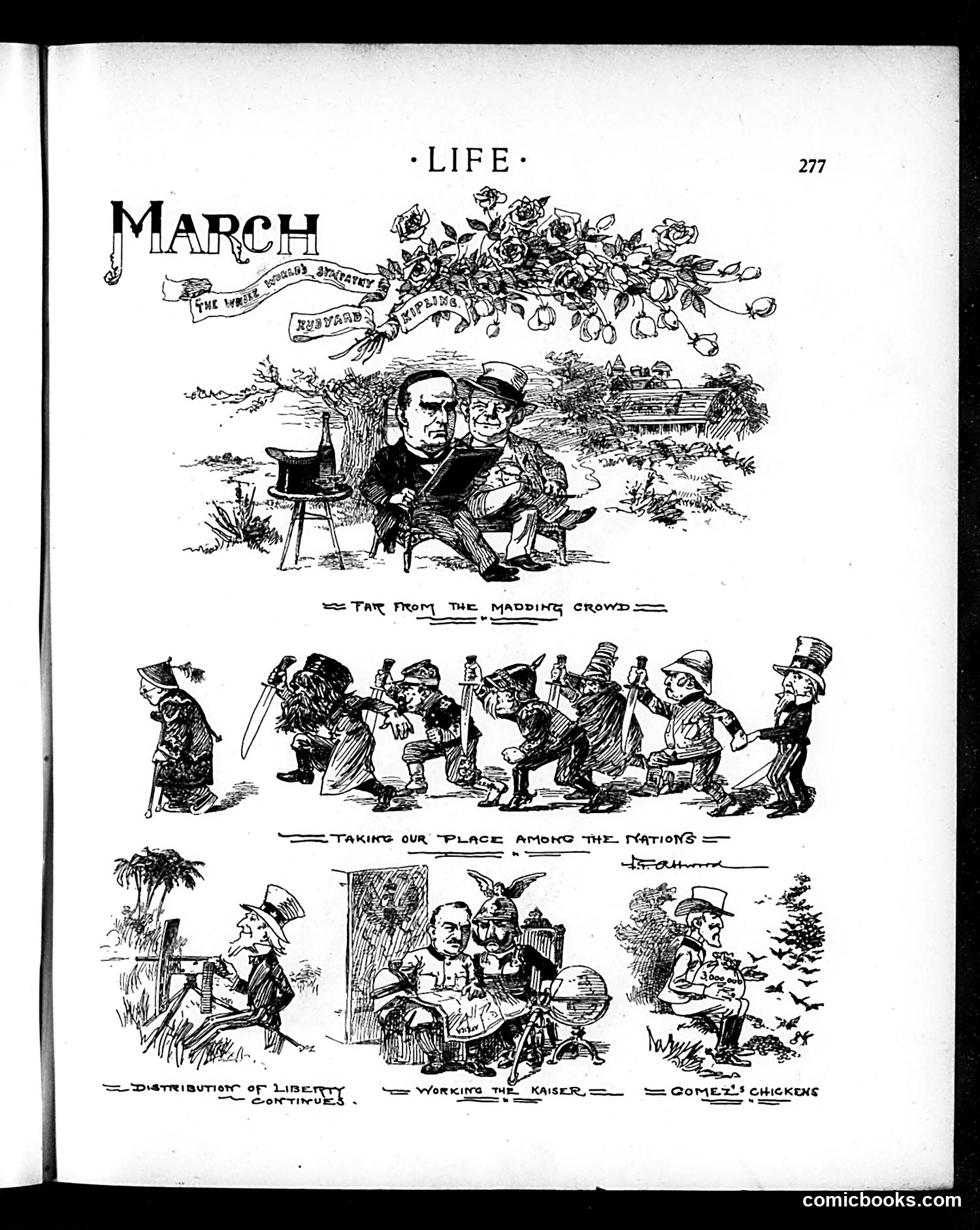
This page presents four political cartoons satirizing events around March (year unclear from image). The top panel, "Tact from the Madding Crowd," shows two figures in conversation—likely political figures or diplomats. Below, "Taking Our Place Among the Nations" depicts a line of caricatured international figures, suggesting commentary on America's diplomatic standing or entry into global affairs. The bottom three panels address domestic matters: "Distributing Liberty's Continuity" (unclear reference), "Working the Kaiser" (suggesting WWI-era politics, likely satirizing how American politicians were leveraging German affairs), and "Gomez Chickens" (appears to reference poultry farming or agricultural policy, though the specific meaning is unclear). The overall tone criticizes political hypocrisy and questionable foreign policy maneuvering.
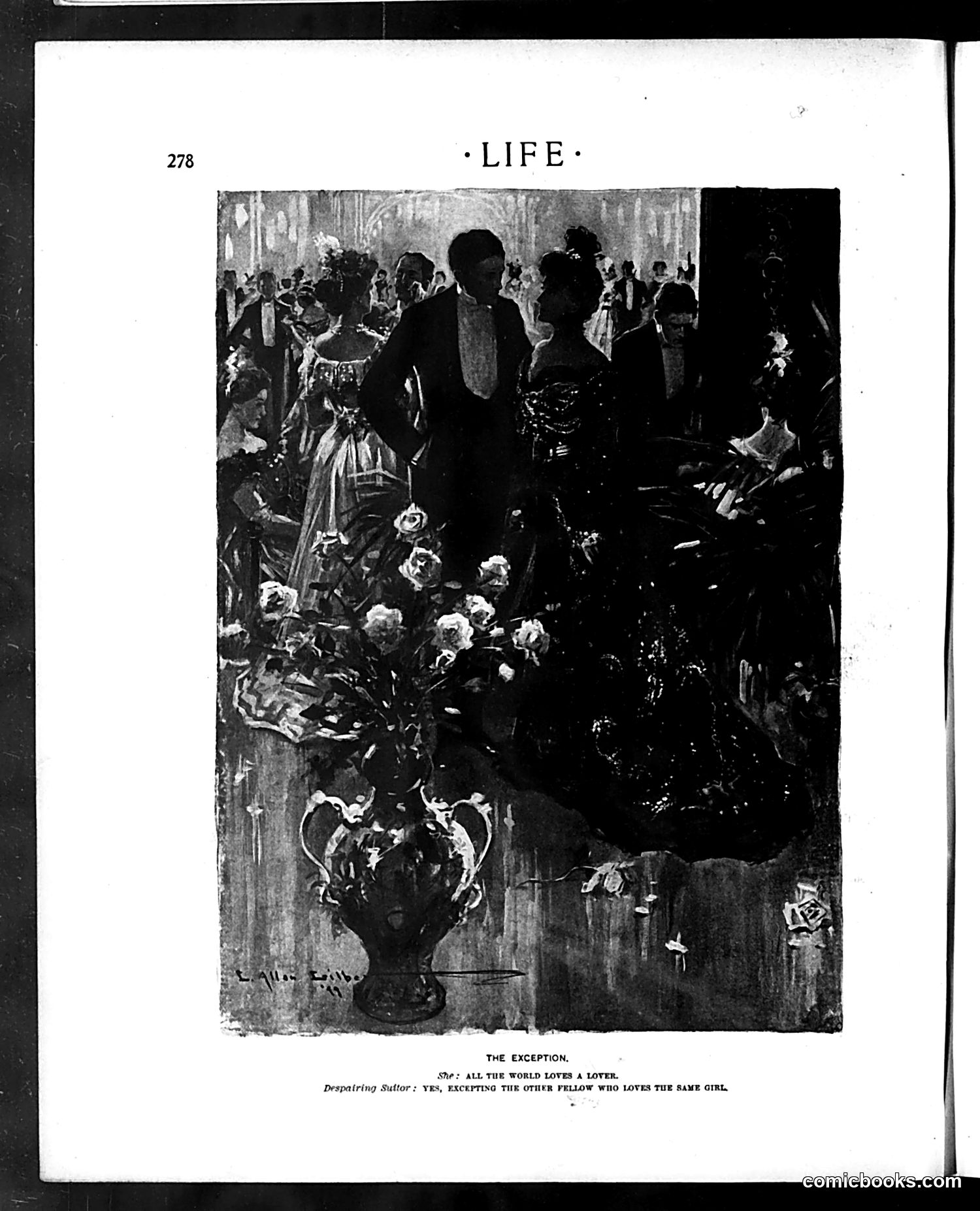
This illustration titled "The Exception" satirizes romantic hypocrisy. The caption reads: "She: ALL THE WORLD LOVES A LOVER. / Departing Sailor: YES, EXCEPTING THE OTHER FELLOW WHO LOVES THE SAME GIRL." The image depicts an elegant formal gathering or ball, with a uniformed sailor departing while a well-dressed couple (likely representing a woman and another man) remain. The ornate floral arrangement in the foreground emphasizes the romantic setting. The satire mocks the common saying that "the world loves a lover"—suggesting this sentiment has a clear exception: a rival in love. The humor lies in exposing how romantic idealism breaks down when multiple people compete for the same affection, making the departing sailor the unwelcome third party.
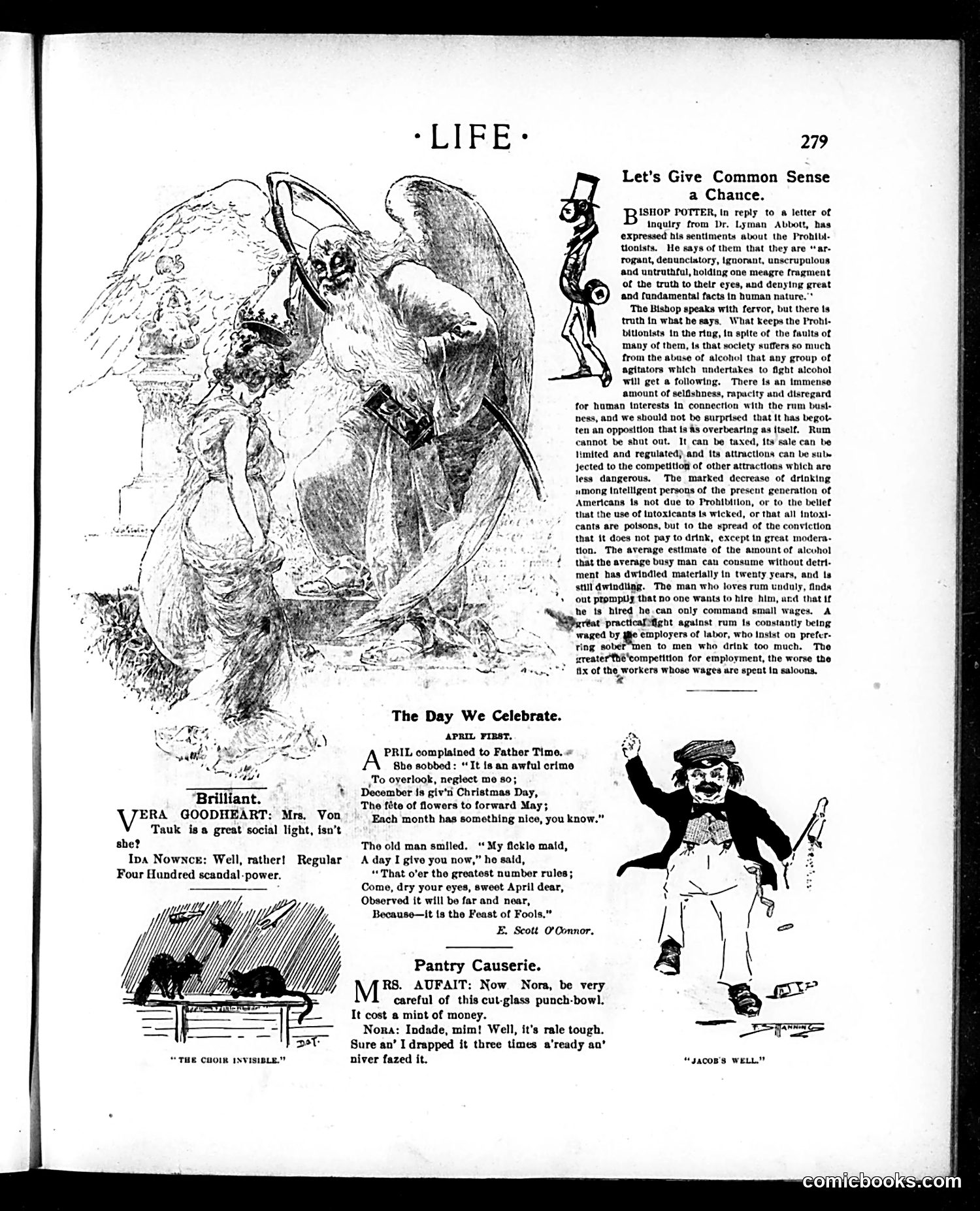
The main illustration depicts **Death (as a skeletal figure with wings and scythe)** collecting victims, likely representing alcohol-related harm. This supports Bishop Potter's essay "Let's Give Common Sense a Chance," which argues against Prohibition by claiming it creates more social problems than it solves. Potter contends that moderate drinking isn't inherently harmful, and that attempting to eliminate alcohol entirely causes economic disruption and criminal activity. The smaller cartoons mock daily life absurdities: "The Choir Invisible" shows mice in a bowl, while "Jacob's Well" features a cheerful drunk. These illustrate Life magazine's satirical approach to contemporary issues, particularly the ongoing alcohol debate of the Prohibition era (1920s America).
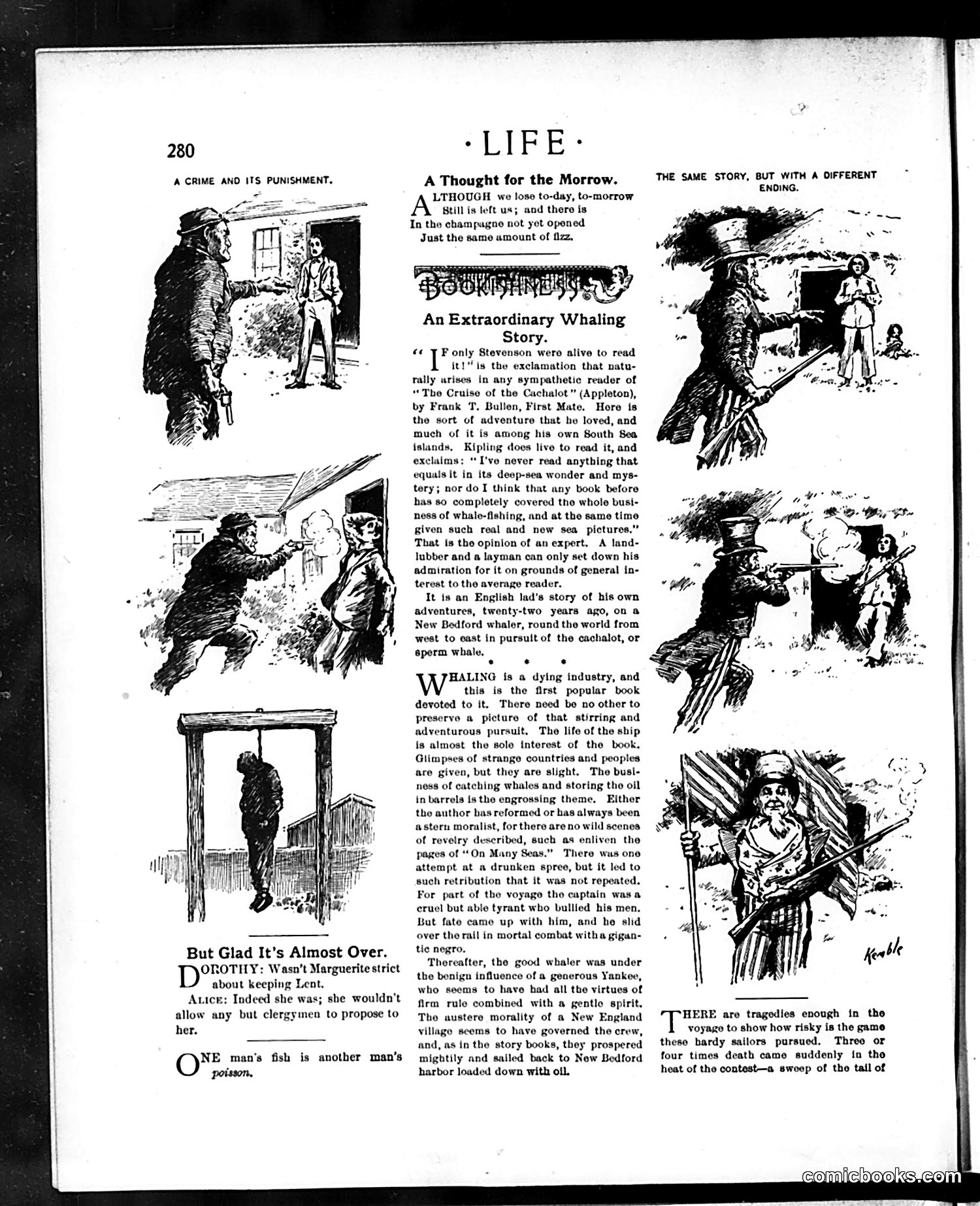
This page contains literary reviews and satirical cartoons rather than political commentary. The main content discusses "An Extraordinary Whaling Story"—a review of Frank T. Bullen's *The Cruise of the Cachalot*, praising its adventure narrative and detailed whaling descriptions. The accompanying cartoons illustrate humorous social scenarios: "A Crime and Its Punishment" (appears to show a domestic dispute), "But Glad It's Almost Over" (depicting reluctant Lent observance), and "The Same Story, But with a Different Ending" (showing contrasting outcomes to similar situations). The satirical humor targets everyday social conventions—marital dynamics, religious observance, and life's ironies—rather than specific political figures or events. The whaling book review reflects period interest in exotic adventure literature.
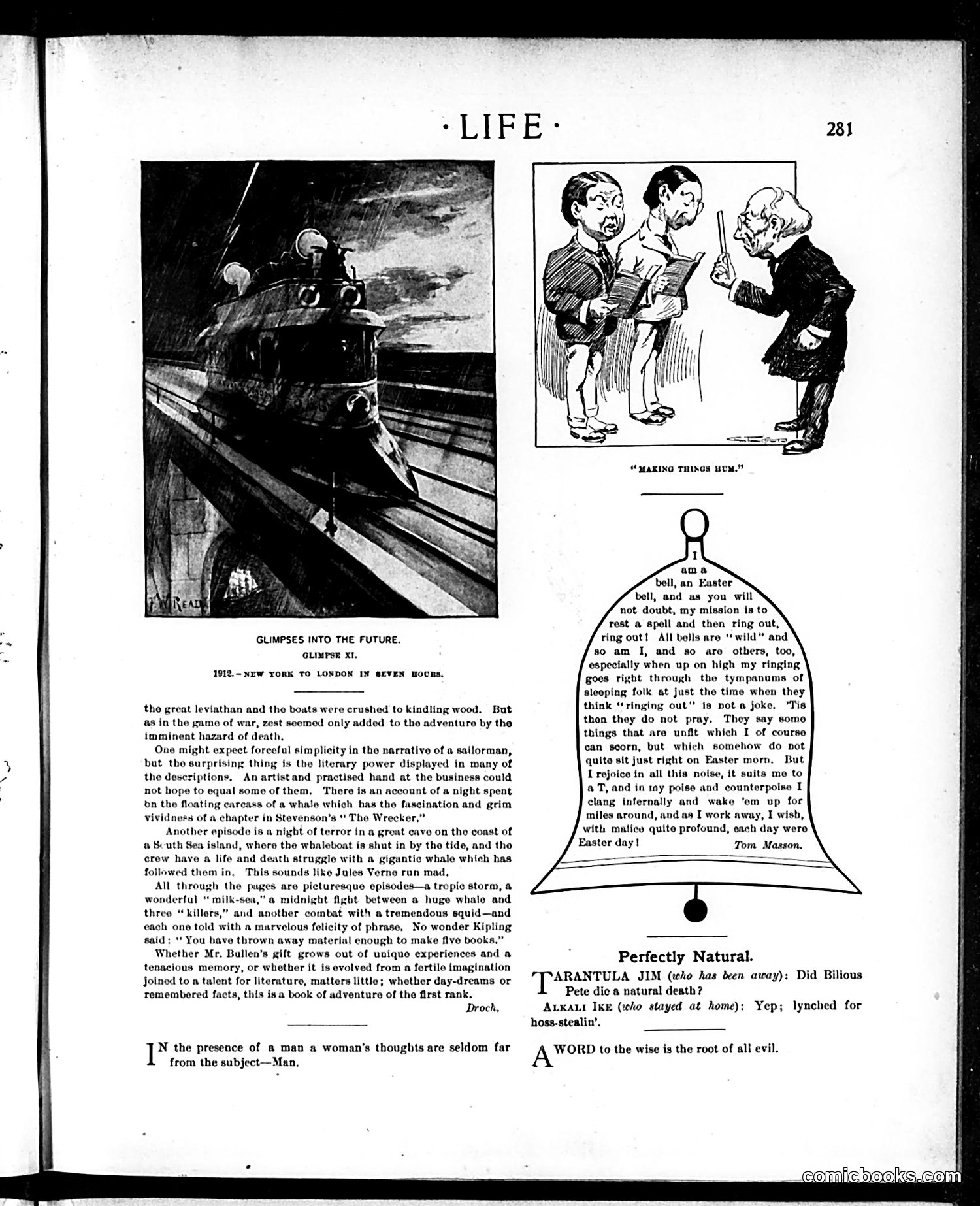
**Top Cartoon ("Making Things Hum"):** An elderly man with a cane confronts two younger men holding papers. The caption suggests the older figure is attempting to instruct or scold them about making noise or disruption—likely social commentary on generational conflict or workplace discipline, though the specific reference is unclear. **Bottom Section:** Contains a passage from what appears to be a literary work (possibly Jules Verne, referenced in the text), followed by a humorous exchange labeled "Perfectly Natural" between characters Billous Jim and Alkali Ike regarding a natural death. The page primarily features a book review or literary commentary rather than political satire. The satirical tone is gentle and domestic rather than explicitly political.
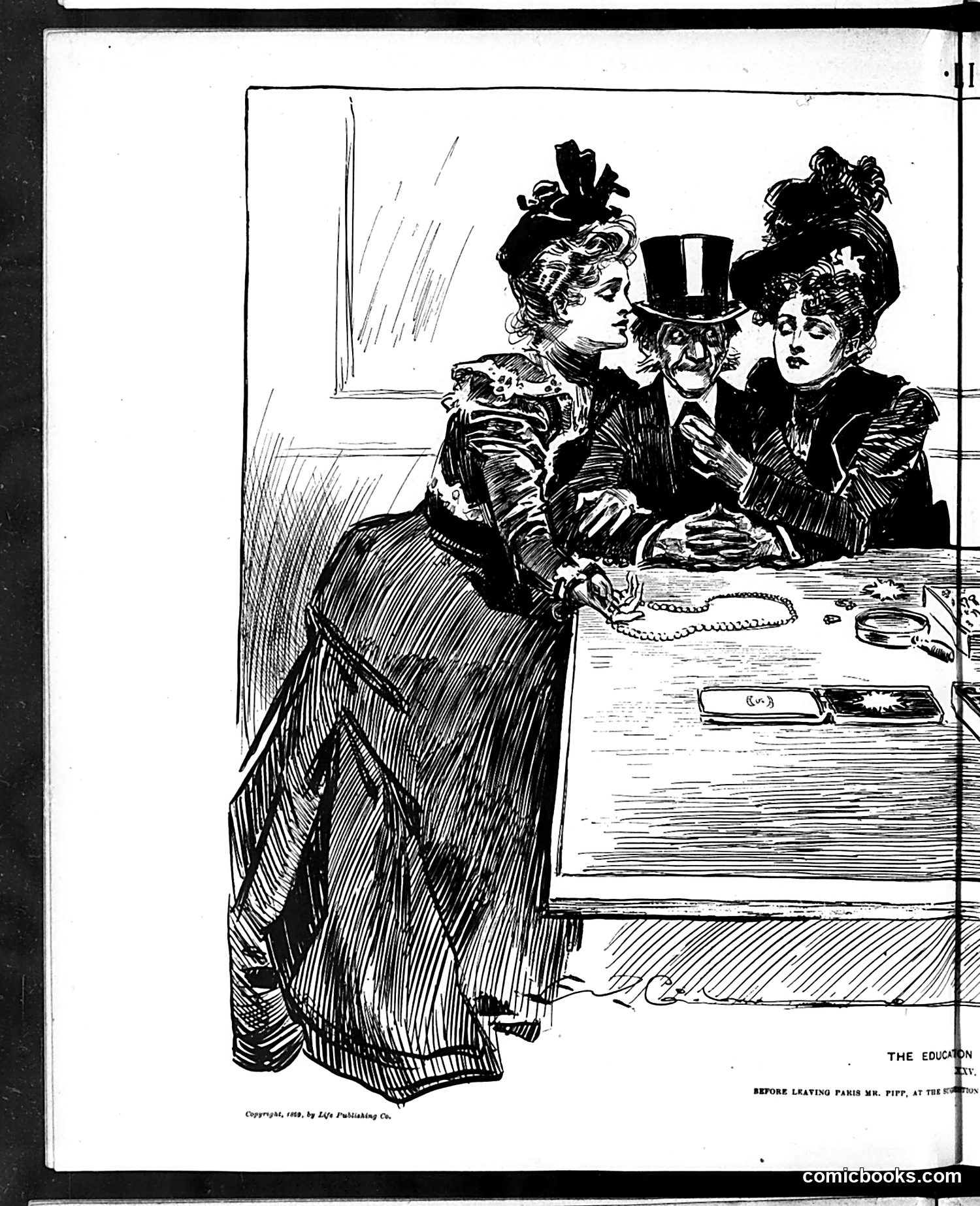
This is a sketch depicting what appears to be a social scene, likely from early 20th-century Life magazine. The image shows three elegantly dressed figures at a table—a woman on the left viewed from behind, and two others (a man in a top hat and another woman) seated across from her. The partial caption visible reads "THE EDUCATION" and "BEFORE LEAVING PARIS M. PIFF, AT THE" (text cuts off). This suggests satire about a French character (possibly "M. Piff") receiving some kind of education or instruction before departing Paris. Without the complete caption, the exact satirical point remains unclear, though the scene appears to mock upper-class European social customs or romantic intrigues. The drawing style is typical of Life's early satirical social commentary.
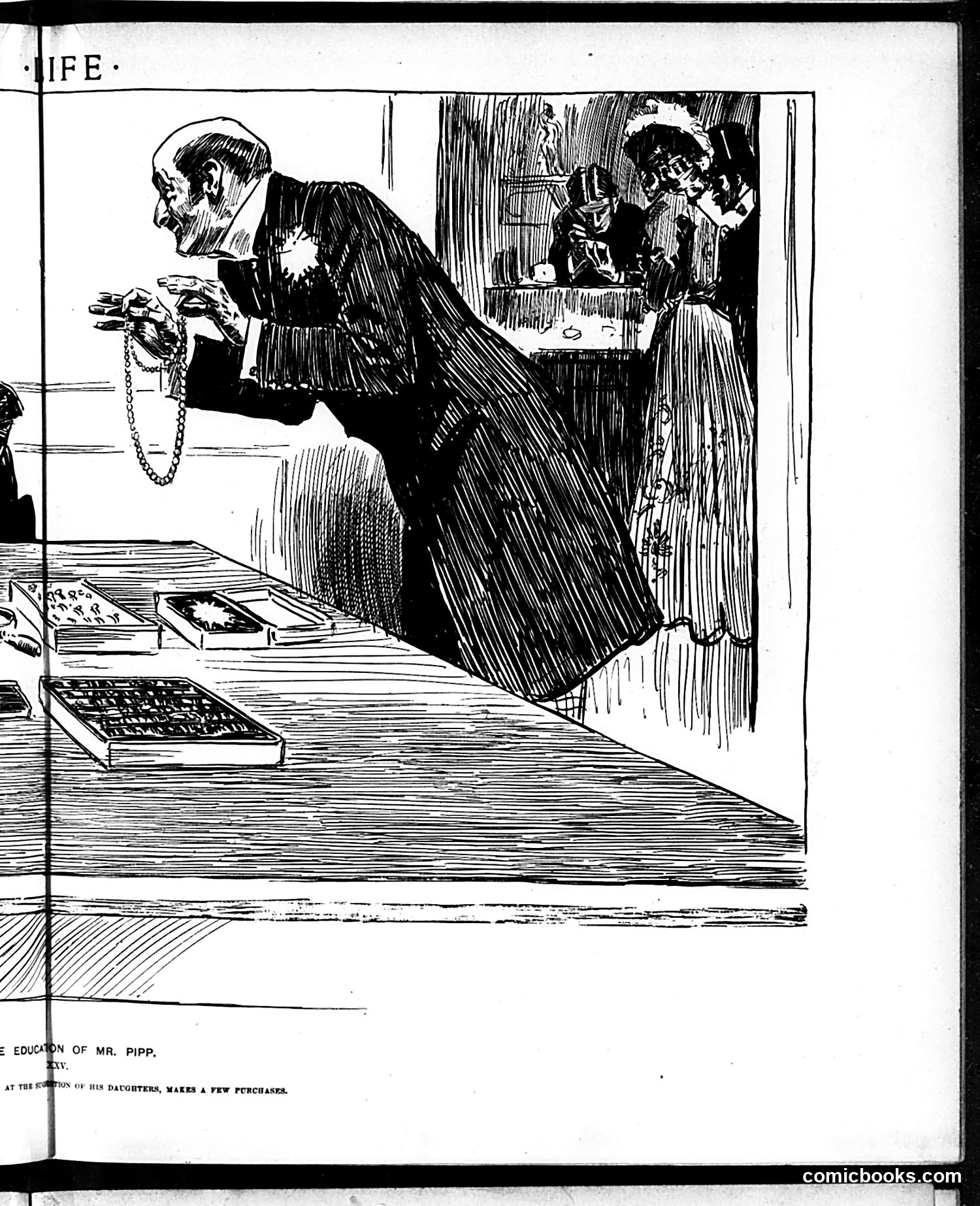
This cartoon satirizes a wealthy man (Mr. Pipp, likely a fictional character representing the nouveau riche or privileged class) shopping at what appears to be a jewelry store. The caption indicates he's making purchases "at the suggestion of his daughters." The satire mocks the financial control that daughters—or wives—could exert over wealthy men through shopping and consumer spending. The man is depicted as submissive, holding items while appearing somewhat foolish, suggesting he's being led by female relatives' materialism rather than exercising independent judgment. The cartoon reflects early-20th-century anxieties about women's consumer power and changing gender dynamics in wealthy households, portraying it as comedic emasculation.
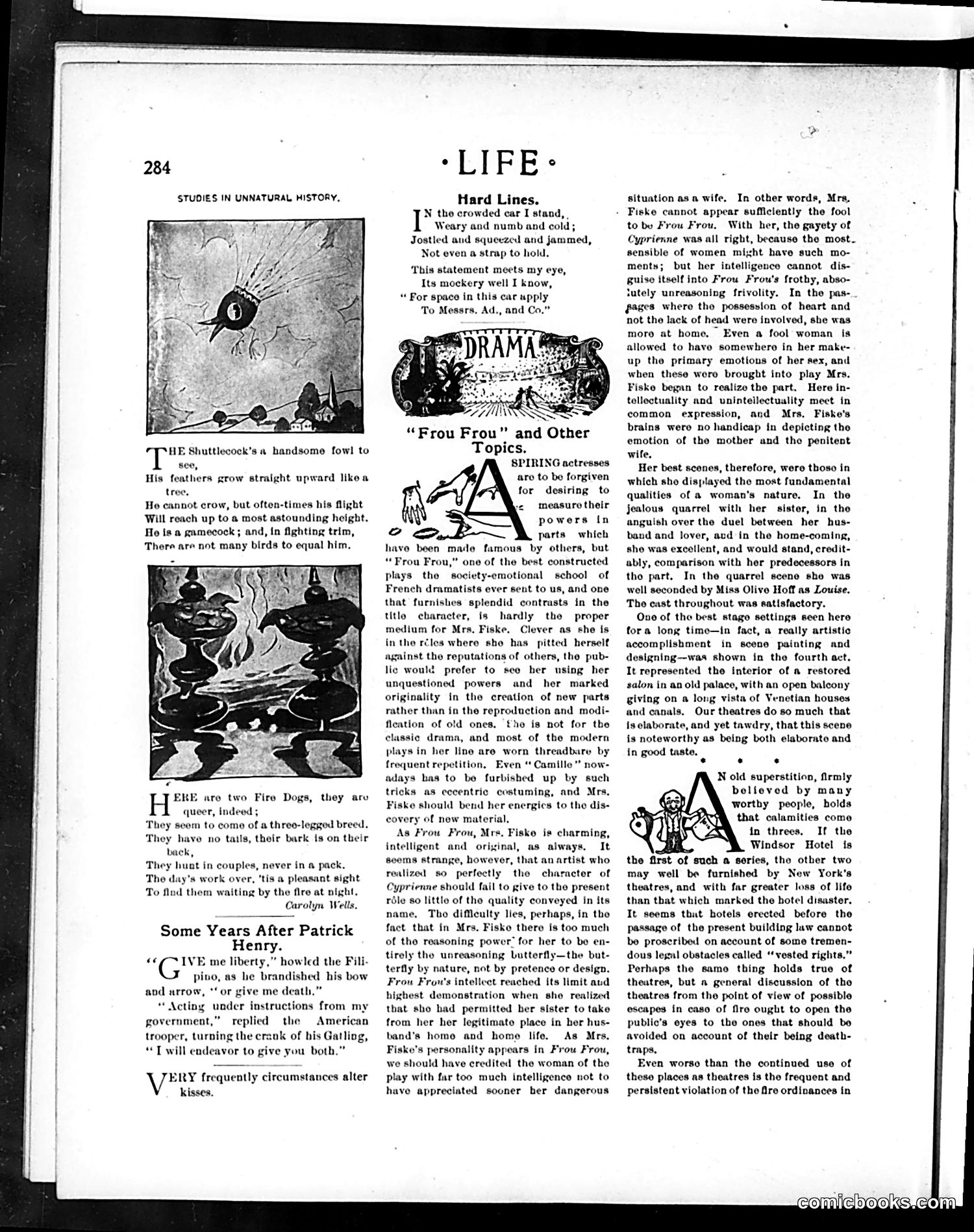
This page contains literary and theatrical criticism rather than political cartoons. The main article discusses **"Frou Frou,"** a French play performed by actress **Mrs. Fiske**. The text critiques the play's emotional depth, praising Mrs. Fiske's performance while noting the work relies on "unreasoning butterfly" sentimentality rather than genuine character development. The author argues the play succeeds through Mrs. Fiske's talent despite the material's limitations. The illustrations show **Fire Dogs** (decorative fireplace ornaments shaped like dogs) and appear designed to complement the theatrical discussion with period-appropriate imagery. This represents Life magazine's cultural coverage—drama criticism and literary commentary—rather than political satire. The piece evaluates Victorian-era theatrical conventions for an educated American audience interested in contemporary stage productions.
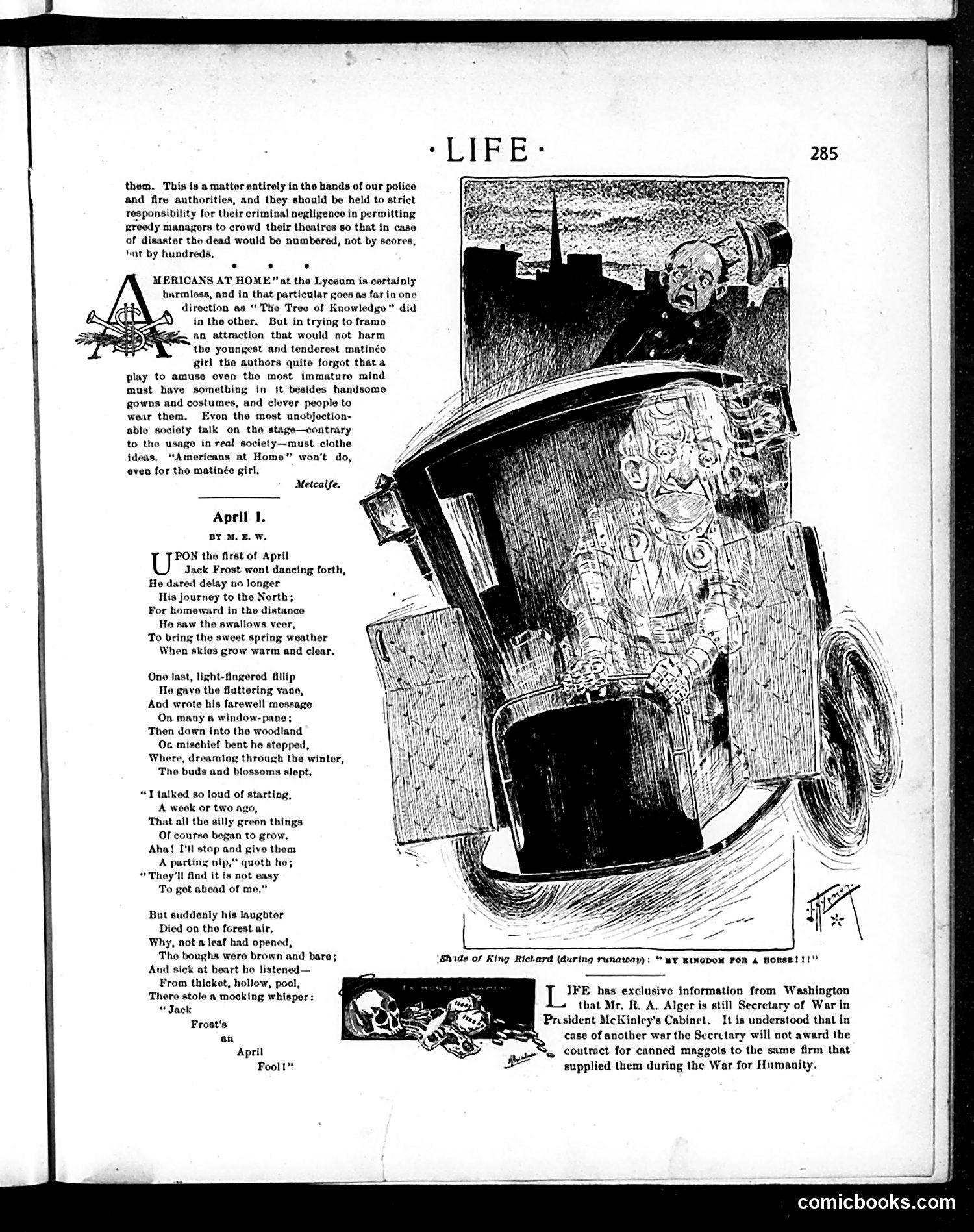
This page contains theater criticism and seasonal poetry rather than political cartoons, though it includes one satirical news item. The **main illustration** shows a car careening wildly with grotesque passengers—a reference to the play "My Kingdom for a Horse!!!" (likely a contemporary theatrical production being reviewed). The **text criticizes** "Americans at Home" at the Lyceum Theatre as harmless but dramatically inert—too focused on costumes and scenery rather than actual plot or ideas suitable even for matinee audiences. The **brief satirical item** at bottom mocks Secretary of War **R. A. Alger** (who served under President McKinley), implying his incompetence during the Spanish-American War. The joke references "canned maggots"—likely alluding to widespread complaints about spoiled food supplied to troops during the "War for Humanity" (their ironic term for the 1898 war). The satire suggests Alger remains in office despite this scandal. The **poem** is seasonal verse about Jack Frost departing spring, a traditional April Fool's theme.
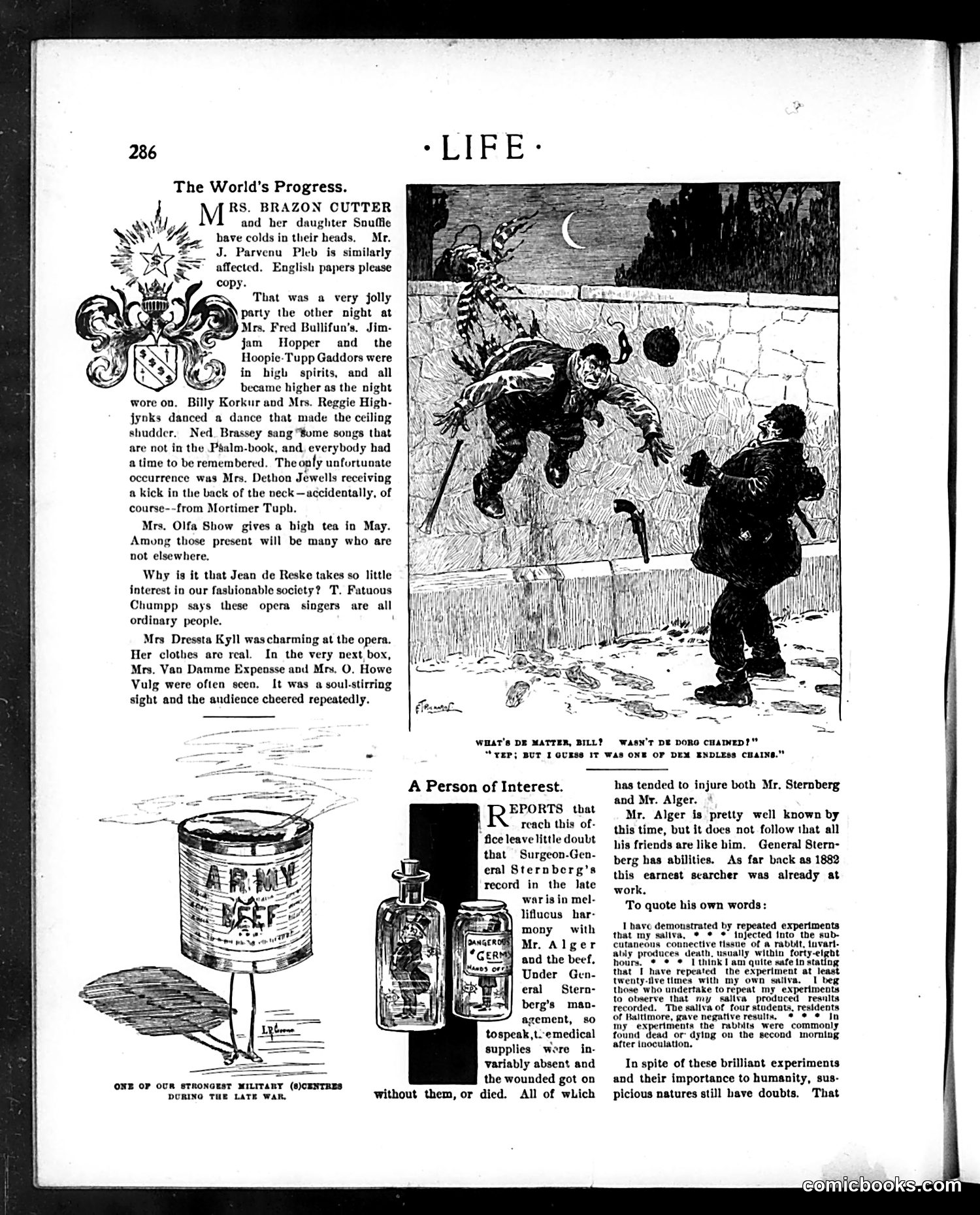
This page satirizes high society gossip and military incompetence during the Spanish-American War. **Upper section ("The World's Progress"):** Mocks society reporting—listing absurd names (Mrs. Brazon Cutter, J. Parvenu Pleb) with trivial complaints, party anecdotes, and social events. The humor lies in treating gossip as "world progress." **Lower cartoon:** Shows an accident where a dog was chained. The joke plays on "endless chains"—a contemporary product—as an ironic explanation for the mishap. **Main article ("A Person of Interest"):** Directly attacks **Surgeon-General Sternberg** for his wartime medical failures. The text quotes his own bizarre 1882 experiments injecting saliva into rabbits—presented to mock his credibility. Life implies his incompetence led to soldiers dying from lack of medical supplies during the war, damaging both Sternberg and Secretary of War **Alger**. The satire suggests his "scientific" credentials mask actual negligence.
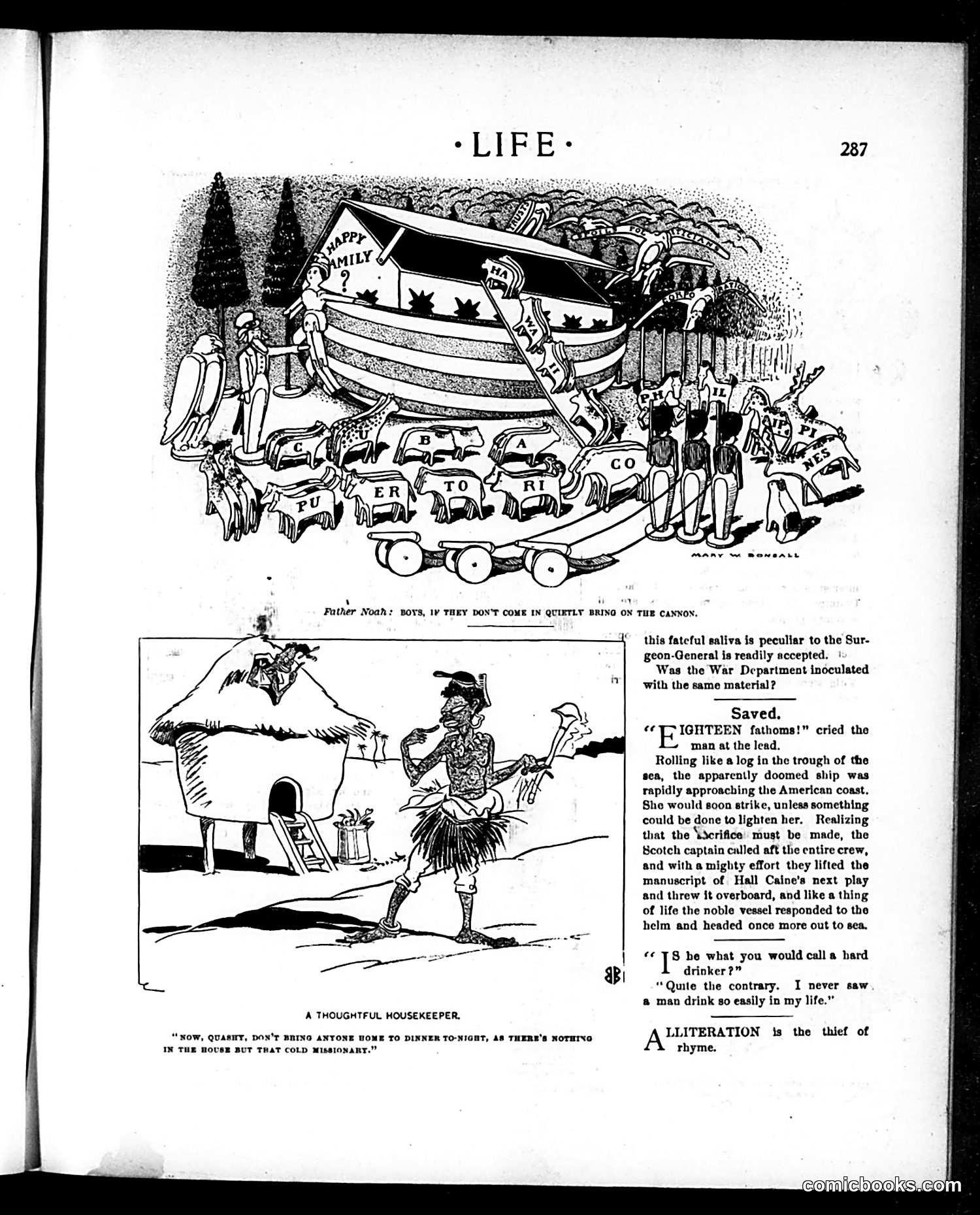
This Life magazine page contains three distinct satirical pieces: **Top cartoon**: A "Happy Family" scene depicting various state abbreviations (ER, TO, RI, CO) as animals in a cannon, satirizing American state politics and unity during what appears to be a military/patriotic context. **Middle cartoon**: A joke about a ship's manuscript being thrown overboard to lighten the vessel. This mocks playwright Hall Caine, whose work was apparently considered so worthless that jettisoning it could literally save a ship—a cutting literary insult. **Bottom cartoons**: Two brief humor items. One questions whether the War Department was "inoculated" with suspect material (likely referencing a military scandal or health controversy). Another jokes about a man who drinks "easily" rather than heavily, playing on word ambiguity. The page's overall theme appears to be satirizing contemporary American politics, military affairs, and literary figures through absurdist humor typical of early 20th-century Life magazine's irreverent style.
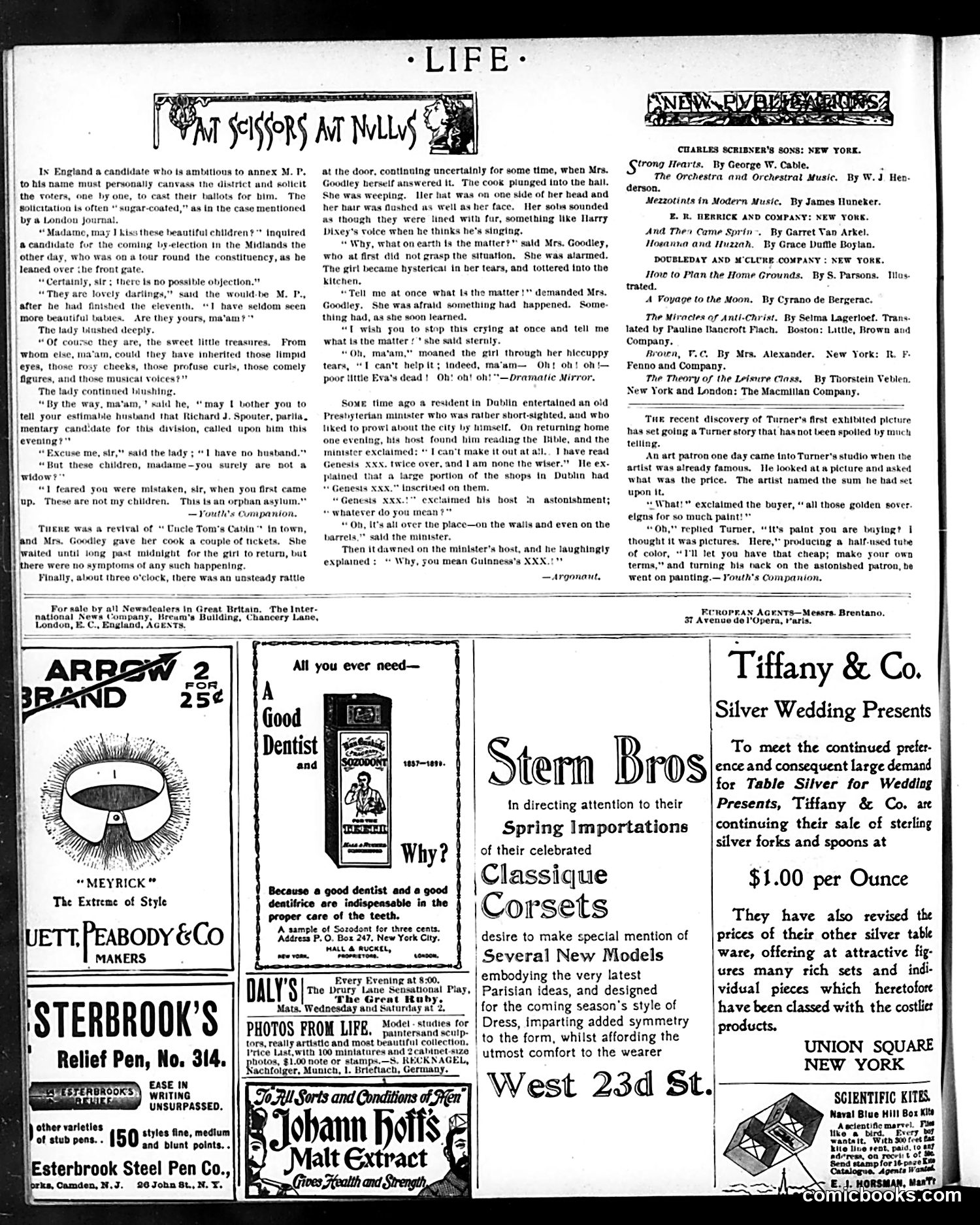
This page contains three satirical anecdotes rather than traditional political cartoons: 1. **"I'm Scissors at Nulls"**: A British parliamentary candidate awkwardly attempts to curry favor by kissing children at a constituent's gate. The joke's payoff—he's kissing orphans, not the woman's own children—mocks politicians' performative, insincere campaigning tactics during door-to-door canvassing. 2. **"Uncle Tom's Cabin" story**: A cook returns distraught from the theater, weeping over "poor little Eva's dead"—the fictional character's death from the play, not grasping the distinction between theater and reality. This satirizes working-class sentiment and emotional theater attendance. 3. **"Genesis XXX" anecdote**: A nearsighted Dublin minister mistakes shop advertisements for "Guinness's XXX" (their beer brand) as Biblical references, mocking both his poor eyesight and advertising's ubiquity in urban landscapes. All three target contemporary social foibles: political phoniness, naive emotionalism, and commercial saturation—through gentle humor rather than pointed social critique.
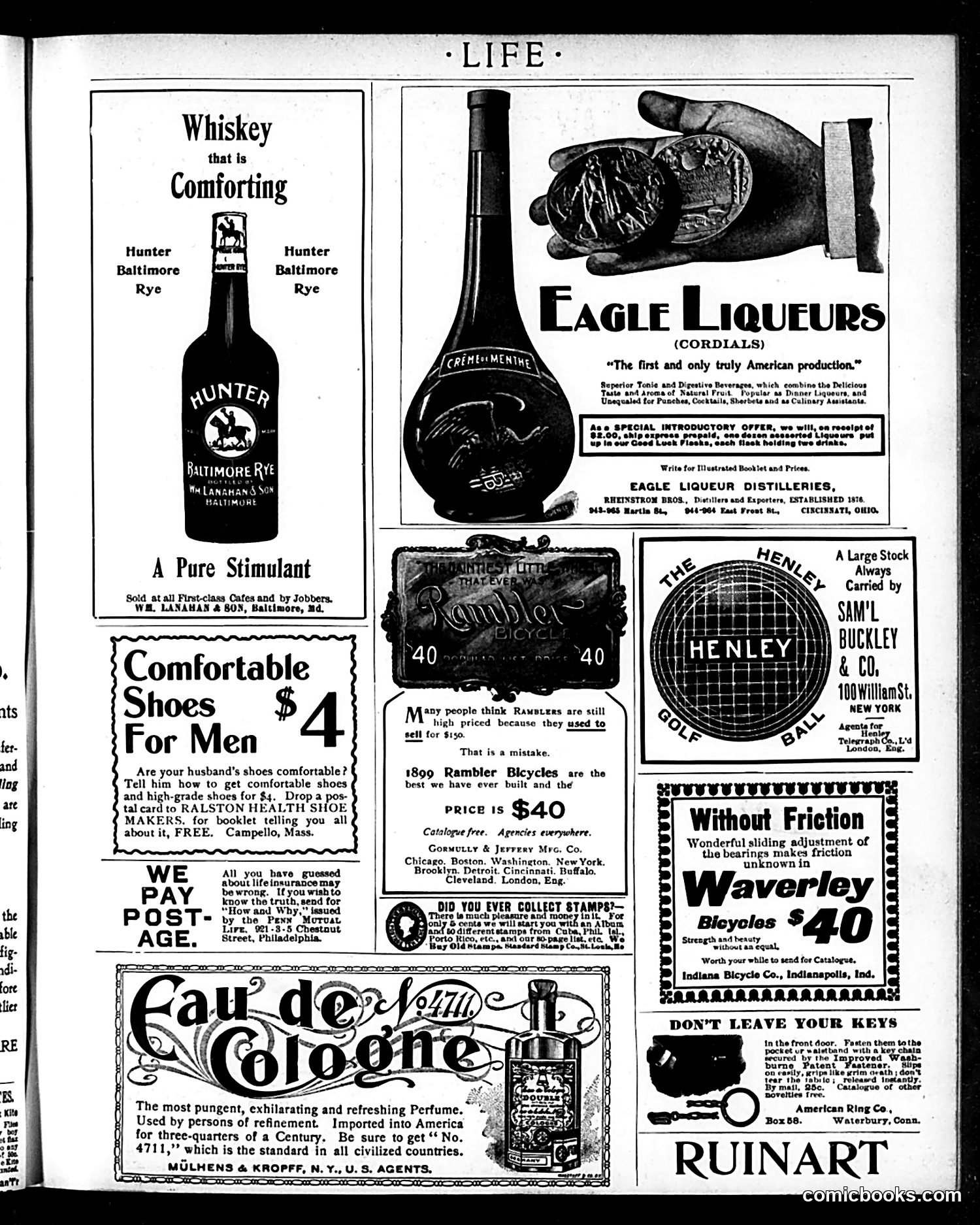
This is primarily an **advertising page** from Life magazine (circa 1899, based on bicycle and product references). Rather than political satire, it showcases period consumer goods: **Key advertisements include:** - **Hunter Baltimore Rye whiskey** - marketed as a "pure stimulant" - **Eagle Liqueurs** - claiming to be "the first and only truly American production" - **Rambler Bicycles** ($40) and **Waverley Bicycles** ($40) - competing products - **Ralston Health Shoes** ($4 for men) - emphasizing comfort - **Eau de Cologne No. 4711** - a luxury imported perfume - Various smaller items (stamps, key holders, golf balls) The page reflects **Gilded Age consumer culture**: bicycles as new technology, imported European luxuries, patent medicines and tonics, and middle-class aspiration. Products are marketed to "persons of refinement" while emphasizing affordability and modern innovation. The only quasi-satirical element is the insurance company's cryptic "How and Why" pitch, typical of period advertising's vague appeals.
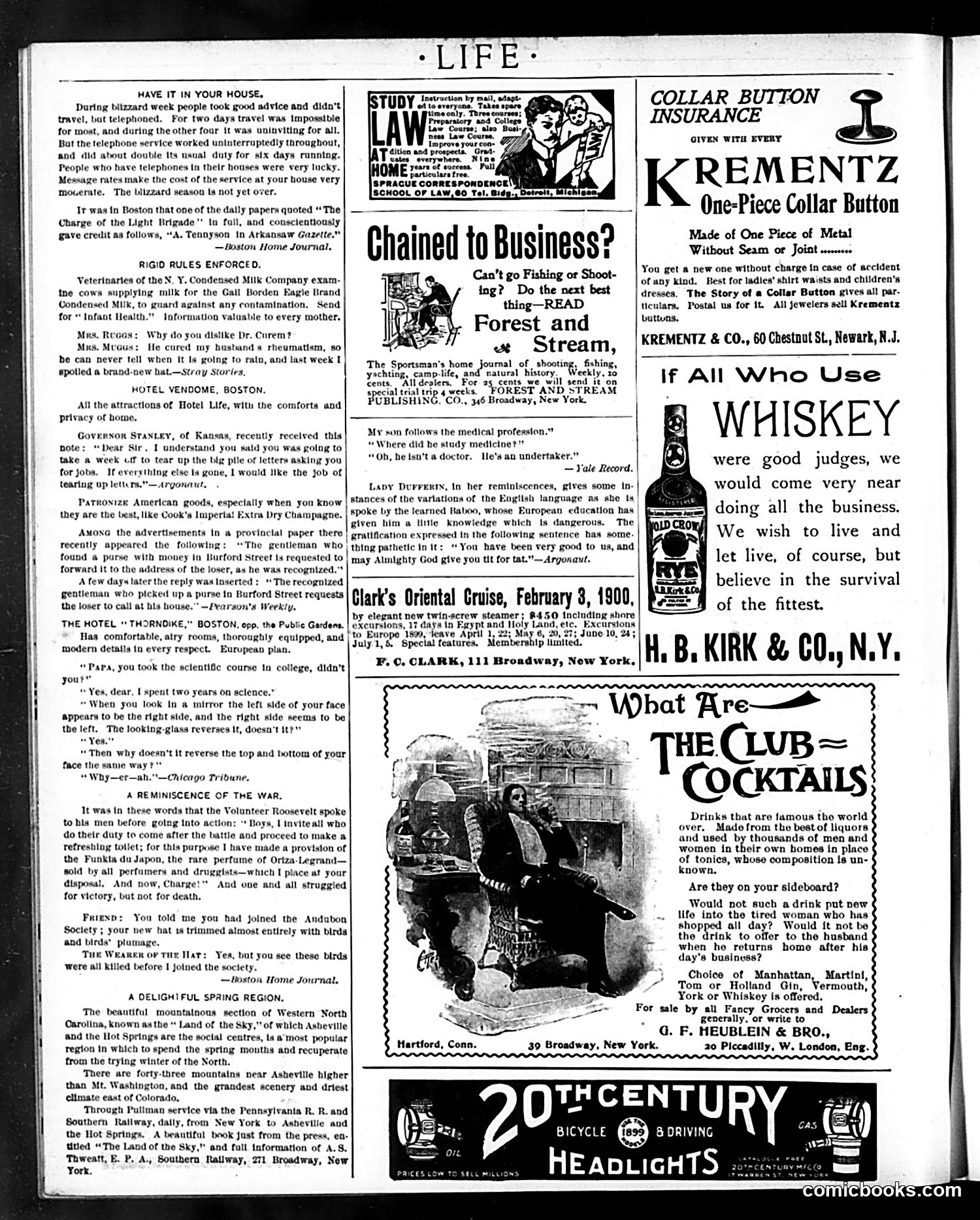
This page from *Life* magazine (circa 1900, based on advertising dates) is primarily **advertising and humorous anecdotes** rather than political cartoons. The main visual element is a small illustration for "Clark's Oriental Cruise" promoting Egyptian and Holy Land excursions—a common leisure activity for wealthy Americans of that era. The humor pieces are **social satire** targeting everyday absurdities: - A joke about telephone service during a blizzard (praising modern infrastructure) - Ironic observations about doctors, mirrors, and mirrors' physics - A fabricated anecdote mocking government bureaucracy (a lost-and-found purse mix-up) - A satirical "reminiscence" about Theodore Roosevelt using flowery French perfume before battle—mocking his "Rough Rider" masculine image by contrasting it with refinement The advertisements promote luxury goods (condensed milk, champagne, hotels, bicycles, whiskey, collar buttons) to upper-class readers. Overall, this reflects *Life*'s focus on satirizing genteel society and consumer culture rather than hard political commentary.
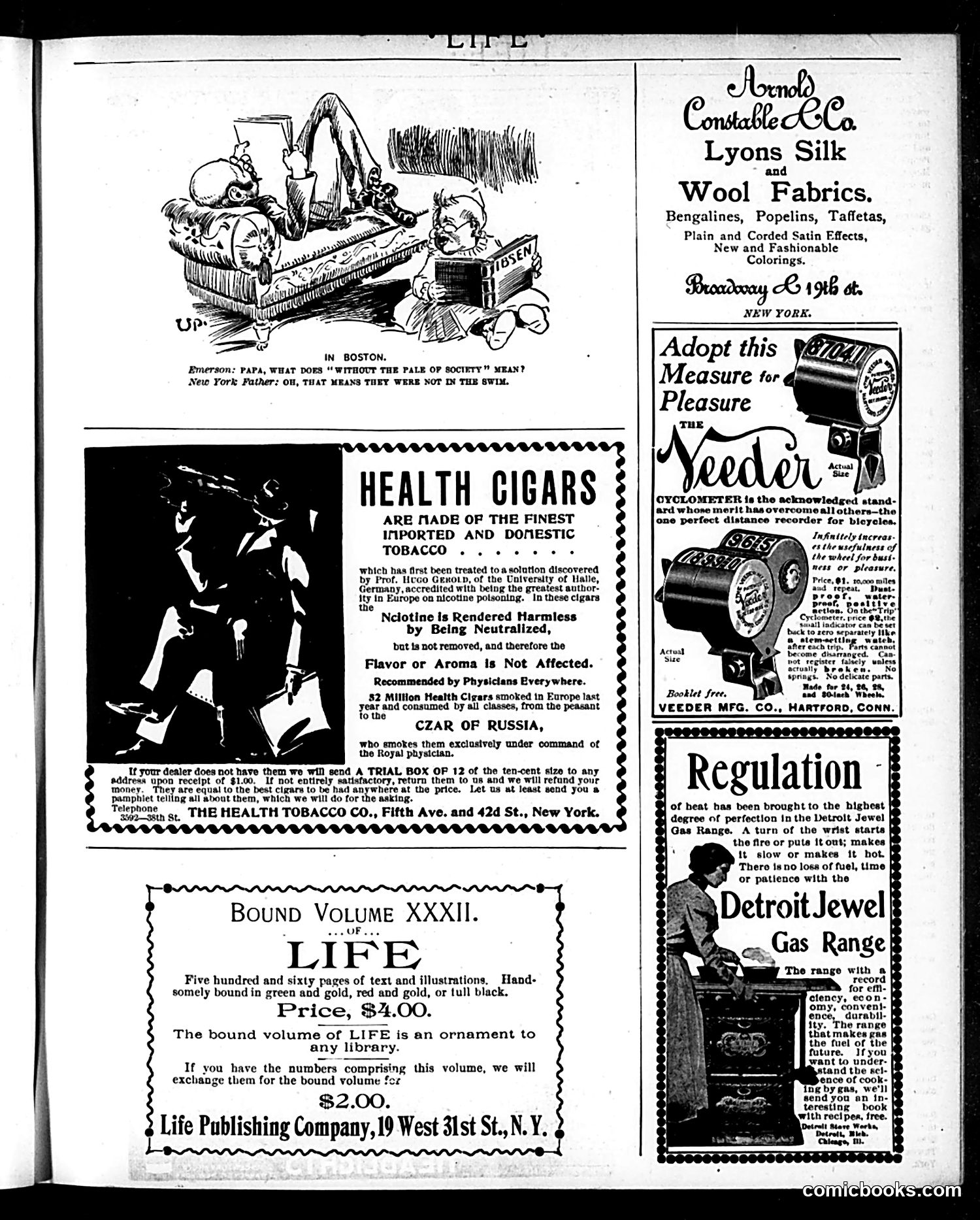
**Main Cartoon:** A Boston dialogue between a child (Emerson) and his New York father illustrates class consciousness. The father explains "without the pale of society" means they were "not in the swim"—colloquial language suggesting social exclusion or being outside fashionable circles. The humor targets the pretentiousness of discussing social status through slang while explaining refined concepts. **Context:** This reflects early 1900s American anxiety about social standing and the emerging use of casual phrases to describe class hierarchies. "The pale" (boundary) and "the swim" (fashionable society) were period expressions for social acceptance. **Page Content:** The cartoon occupies minimal space; the page is primarily **advertisements**—health cigars (claiming nicotine neutralization), a bound Life magazine volume, silk fabrics, bicycle cyclometers, and gas ranges. These ads suggest the magazine's affluent readership and period concerns (health claims, domesticity, leisure).
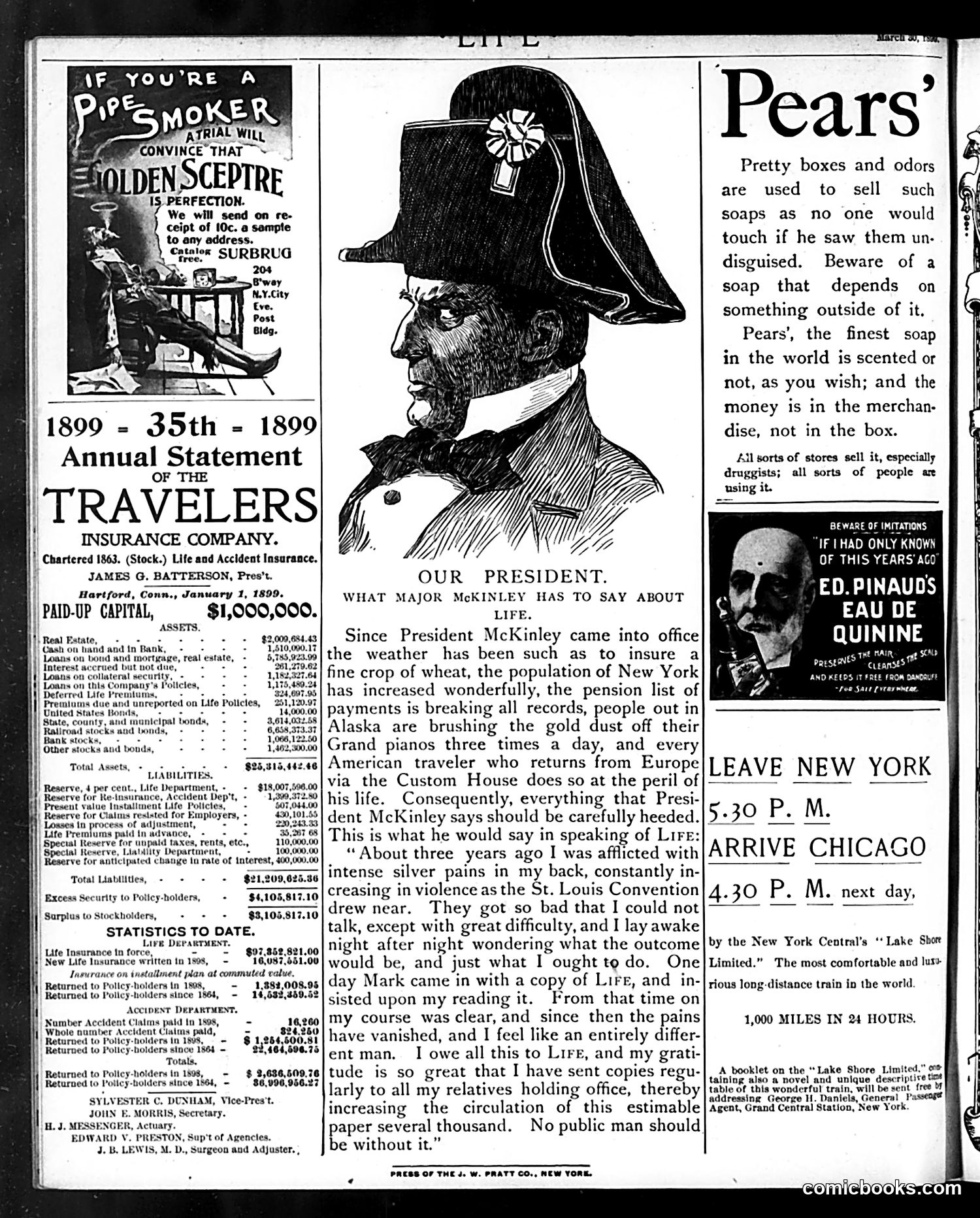
This page mixes insurance/financial notices with political satire. The main cartoon features **President William McKinley** (identifiable by the bicorne hat and period dress) under the heading "OUR PRESIDENT." The satire is brutal: Life mocks McKinley by fabricating a fake testimonial attributing miraculous outcomes to his presidency—good wheat crops, population increases, pension payments rising, Alaskans so wealthy they dust gold off pianos daily. The "quote" attributed to McKinley then absurdly claims that reading Life magazine cured his back pain from the 1896 election ("St. Louis Convention"), and that he now distributes copies to all his relatives in office. **The joke:** It's savage mockery of McKinley's supporters' tendency to credit him with unrelated good fortune, while sardonically suggesting Life magazine itself has near-magical properties. The cartoonist suggests both McKinley's vanity and the gullibility of political cheerleaders. The rest of the page contains standard period advertising and an insurance company's annual financial statement—typical of Life's mixed content model.