
Life, 1899-03-30 · page 7 of 20
Life — March 30, 1899 — page 7: what you’re looking at
What you’re looking at
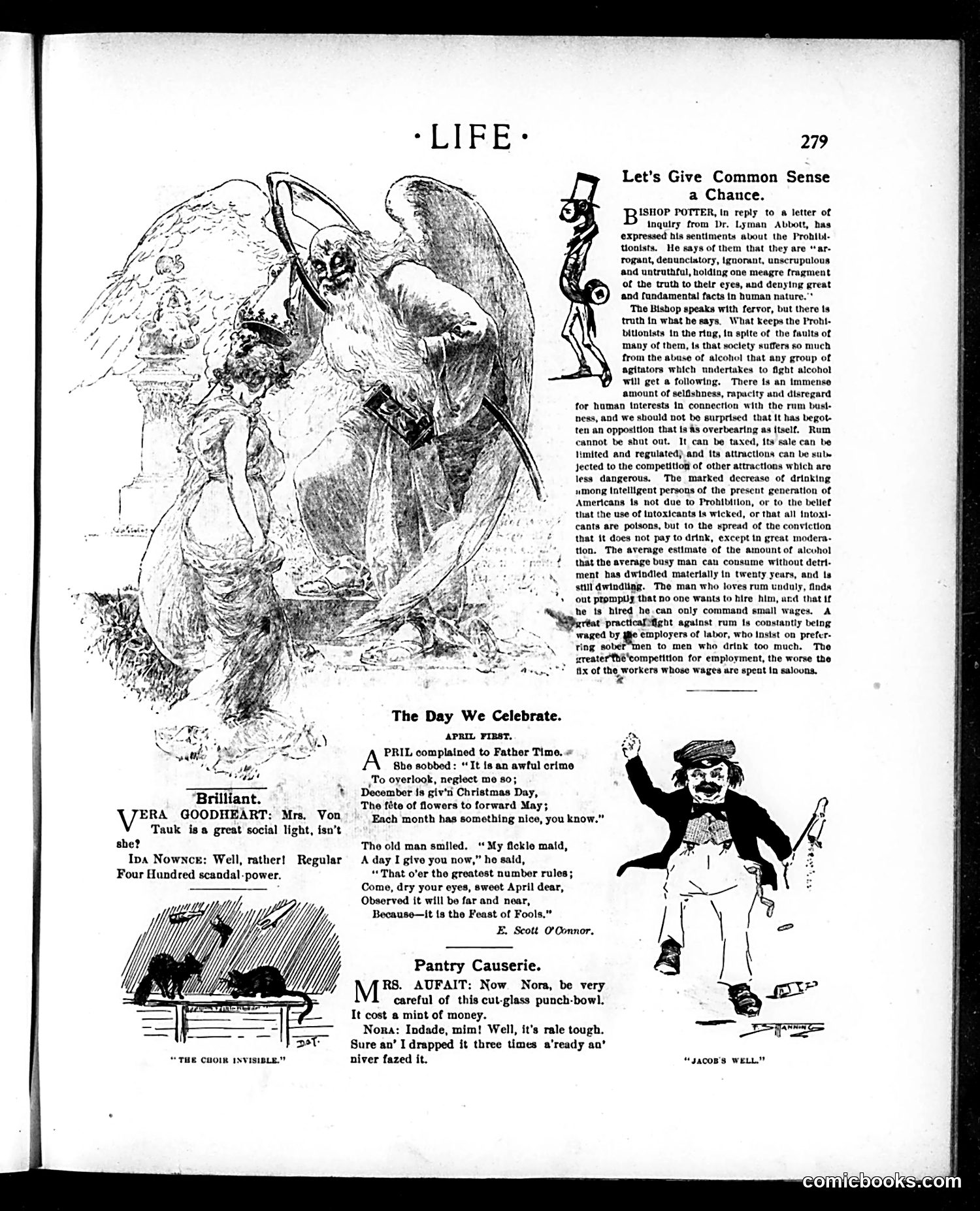
The main illustration depicts **Death (as a skeletal figure with wings and scythe)** collecting victims, likely representing alcohol-related harm. This supports Bishop Potter's essay "Let's Give Common Sense a Chance," which argues against Prohibition by claiming it creates more social problems than it solves. Potter contends that moderate drinking isn't inherently harmful, and that attempting to eliminate alcohol entirely causes economic disruption and criminal activity. The smaller cartoons mock daily life absurdities: "The Choir Invisible" shows mice in a bowl, while "Jacob's Well" features a cheerful drunk. These illustrate Life magazine's satirical approach to contemporary issues, particularly the ongoing alcohol debate of the Prohibition era (1920s America).
📄 Transcribed text from this page (OCR, searchable)
Machine-transcribed from the original scan — historical spelling and the odd misread are preserved.
279 Let's Give Common Sense a Chance. BP '8HoP POTTER, in reply to a letter of inquiry from Dr. Lyman Abbott, has. expressed his sentiments about the Probibl- tloatsts. He says of them that they are “ar- rogant, denunciatory, ignorant, unscrupulous: and untruthful, holding one meagre fragment of the truth to thelr eyes, and denying great and fundamental facts in human nature."* ‘The Bishop speaks with fervor, but there ts, truth in what he says. What keeps the Probt- bitiontsts tn the ring, In spite of the faults of many of them, ts that society suffers so much from the abuse of alcohol that any group of agitators which undertakes to fight alcohol will get a following. There ts an tmmenso Amount of selfishness, rapactty und disregard for human Interests in connection with the rum busl- ness, and we should not be surprised that It has begot- ten an opposition that iss overbearing as {tself. Rum cannot be shot out. It can be taxed, its sale can be Nmited and regulated).and {ts attractions can be suls Jected to the competition of other attractions which are less dangerous. The marked decrease of drinking among tntelligent persons of the present generation of Americans 18 not due to Prohibition, or to the bellet that the use of intoxicants ts wicked, or that all intox!- cants are polsons, but to the xpread of the conviction that {t does not pay to drink, except in great modera- tion, The average estimate of the amount of alcohol that the average busy man cau consume without detri- ment has dwindled materially in twenty years, and Is still dwindiing. The man who loves rum unduly, flnda out ptompuy that no one wants to hire him, urd that tf he {s hired he.can only command small wages. A bs practicaMMight aguinst rum Is constantly being - waged by ge employers of labor, who Insist on prefer: ting sober'men to men who drink too much. The greater thé'competition for employment, the worse the x of the workers whose wages are spent In saloons, * The Day We Celebrate. APRIL FIRST. PRIL complained to Fathor Timo. Sho sobbed : “It is an awful crime To oyerlook, neglect me 80; December is giv’ Christmas Day, “ The féte of flowers to forward May; ERA GOODHEART: Mrs. Von) gach month has something nice, you know.” Tauk isa great social light, isn’t she? Tho old man smiled. “ My fickle maid, Ipa Nownce: Well, rather! Regular A day I give you now,” he said, Four Hundred scandal-power. “That o'er tho greatest number rules; OE as aE Come, dry your eyes, sweot April dear, ; Obsorved it will be far and near, Vy Because—it {s the Feast of Fools.” E, Scott O'Connor. Pantry Causerie. RS. AUFAIT: Now Nora, be very — careful of this cut-glass punch-bowl. It cost a mint of money. Nora: Indade, mim! Well, it’s rale tough. Sure an’ I drapped it three times a’ready an’ “THE CHOIR INVISIBLE." niver fazed it. “gacoB’s WELL.”