
Life, 1899-03-30 · page 12 of 20
Life — March 30, 1899 — page 12: what you’re looking at
What you’re looking at
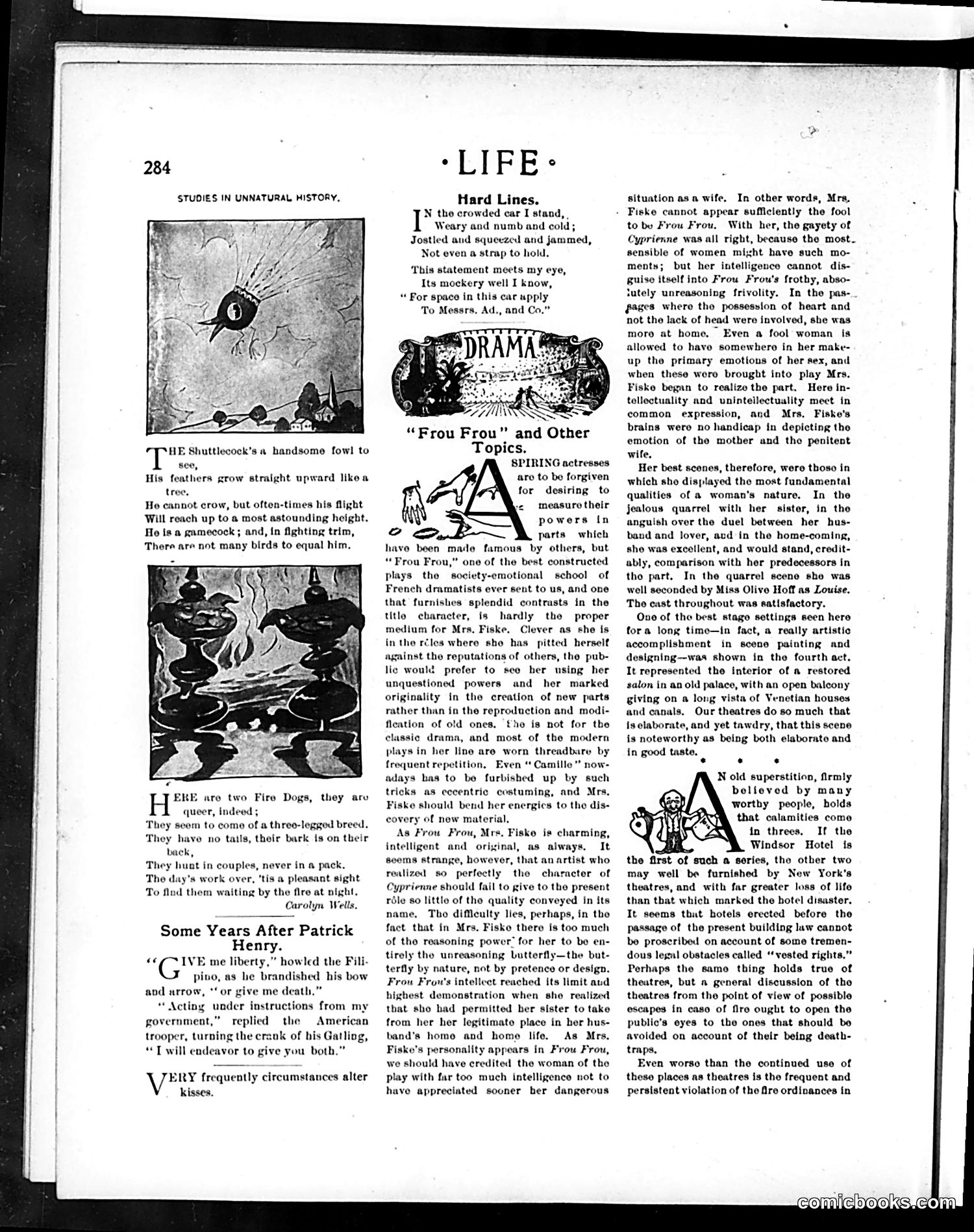
This page contains literary and theatrical criticism rather than political cartoons. The main article discusses **"Frou Frou,"** a French play performed by actress **Mrs. Fiske**. The text critiques the play's emotional depth, praising Mrs. Fiske's performance while noting the work relies on "unreasoning butterfly" sentimentality rather than genuine character development. The author argues the play succeeds through Mrs. Fiske's talent despite the material's limitations. The illustrations show **Fire Dogs** (decorative fireplace ornaments shaped like dogs) and appear designed to complement the theatrical discussion with period-appropriate imagery. This represents Life magazine's cultural coverage—drama criticism and literary commentary—rather than political satire. The piece evaluates Victorian-era theatrical conventions for an educated American audience interested in contemporary stage productions.
📄 Transcribed text from this page (OCR, searchable)
Machine-transcribed from the original scan — historical spelling and the odd misread are preserved.
STUDIES IN UNNATURAL HISTORY, HE Shuttlecock’s a handsome fowl to see, His feathers grow straight upward like a tr He cannot crow, but often-times his flight Will reach up to a most astounding height. Ho is a gamecock ; and, in fighting trim, Thora are not many birds to equal him, ERE aro two Fire Dogs, they aro queer, indeed ; They seem to como of a three-legged breed. They havo no tails, their bark is on their back, They huat in couples, never in a pack. The day's work over, ‘tis a pleasant sight To flod them waiting by the fire at night, Carolyn Wells. Some Years After Patrick Henry. ée IVE me liberty,” howled the Fili- pino, as be brandished his bow and urrow, “Cor give me death,” “Acting under instructions from my government,” replied the American trooper, turning the crank of bis Gatling, “ Twill endeavor to give you both.” V ERY frequently circumstances alter kisses. “LIFEs Hard Lines. lr the crowded car I stand,, Weary and numb and cold; Jostled and squeezed and jammed, Not even a strap to hold, ‘This statement meets my eye, Its mockery well I know, “ For space in this car apply To Messrs. Ad., and Co,” “Frou Frou” and Other Topics. SPIRING actresses aro to be forgiven for desiring to -< measuro their powers In om parts which have been made famous by others, but one of the best constructed plays the society-emotional school of French dramatists ever sent to us, and one that furnishes splendid contrasts in the Utlo character, 1s hardly the proper medium for Mrs, Fiske. Clever as she is in tho réles where sho has pitted herself against the reputations of others, the pub- lic would prefer to seo her using her unquestioned powers and her marked originality in tho creation of new parts rather than in the reproduction and modi- fleation of old ones, tho is not for the classic drama, and most of the modern plays in her lino aro worn threadbare by frequent repetition, Even “ Camille” now- adays bas to be furbished up by such tricks as eccentric costuming, and Mrs, Fiske should bend her energics to the dis- covery of new material, As Frou Frou, Mrs, Fiske is charming, intelligent and orizinal, as always, It seems strange, however, that an artist who. realized so perfectly the character of Cyprienne should fail to give to the present rile so little of tho quality conveyed in its name, Tho diffleulty lies, perhaps, in tho fact that in Mrs. Fiske thero 1s too much of tho reasoning power” for her to be en- tiroly tho unreasoning Lutterfly—the but- terfly by nature, not by pretence or design. Frou Frow's intellect reached its limit aud highest demonstration when she realized that sho had permitted ber sister to take from her her legitimato place in her hus- band’s homo and home life. As Mrs. Fiske’s personality appears in Frou Frou, we should have credited the woman of the play with far too much intelligence not to have appreciated sooner ber dangerous situation asa wife, In other words, Mra, . Fiske cannot appear sufficiently the fool to be Frou Frou, With her, the gayety of Cyprienne was all right, because the most. sensible of women mizht have such mo- ments; but her intelligence cannot dis- guise itself into Frou Frou's frothy, abso- lutely unreasoning frivolity. In the pas- pages where tho possession of heart and not the lack of head were involved, she was moro at home, Even a fool woman is allowed to havo somewhero in her make- up the primary emotions of her sex, and when these wore brought into play Mrs. Fiske began to realizo the part. Here in- tellectuality and unintellectuality mect in common expression, and Mrs. Fiske's brains wero no handicap in depicting tho emotion of the mother and the penitent wife, Her best scones, therefore, wero thoso in which sho displayed the most fundamental qualities of a woman's nature. In the jealous quarrel with her sister, in the anguish over the duel between her hus- band and lover, and in the home-coming, she was excollent, and would stand, credit- ably, comparison with her predecessors in tho part, In the quarrel scene sho was well seconded by Miss Olive Hoff as Louise. Tho cast throughout was satisfactory. One of tho best stago settings seen here fora long timo—in fact, a really artistic accomplishment in scene painting and designing—was shown in the fourth act. It represented tho interior of a restored salon in an old palace, with an open balcony giving on a long vista of Venetian houses and canals. Our theatres do so much that isolaborate, and yet tawdry, that this scene is noteworthy as being both elaborato and in good taste, . . . N old superstition, firmly believed by many worthy people, holds that calamities como in threes, If the ¢ Windsor Hotel is the first of such a series, the other two may well be furnished by New York's theatres, and with far greater loss of lifo than that which marked the hotel disaster. It seems that hotels erected before the passage of the present building law cannot be proscribed on account of some tremen- dous legnl obstacles called ‘vested rights.” Perhaps the samo thing holds true of theatres, but a general discussion of tho theatres from the point of view of possible escapes in caso of fire ought to open the public’s eyes to the ones that should bo avoided on account of their being death- traps, Even worso than the continued use of theso places as theatres is the frequent and persistent violation of tho fre ordinances in