
A complete issue · 20 pages · 1899
Life — February 16, 1899
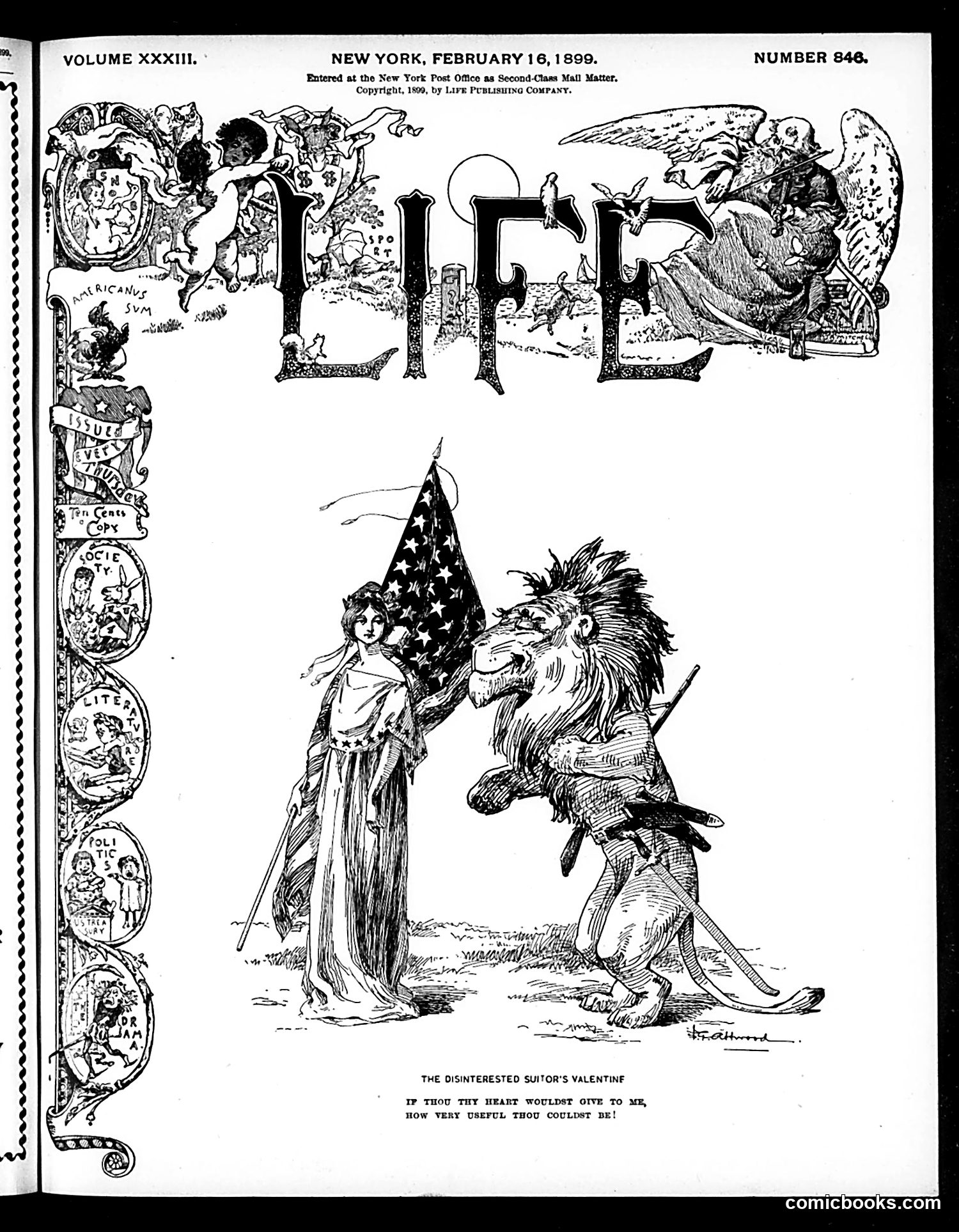
This 1899 *Life* magazine cartoon depicts a lion in military dress holding an American flag, courting a woman representing Liberty or Columbia (the allegorical figure for America). The caption reads: "If thou thy heart wouldst give to me, / How very useful thou couldst be!" The lion appears to represent European imperial powers—likely Britain or another major nation—pursuing America for strategic alliance or advantage. The satire mocks such foreign courtship as self-interested rather than genuinely romantic: the suitor views America merely as a useful tool for imperial ambitions, not as valued for its own merit. The cartoon reflects 1890s American anxieties about foreign interference during a period of expanding U.S. global ambitions and debates over American imperialism.
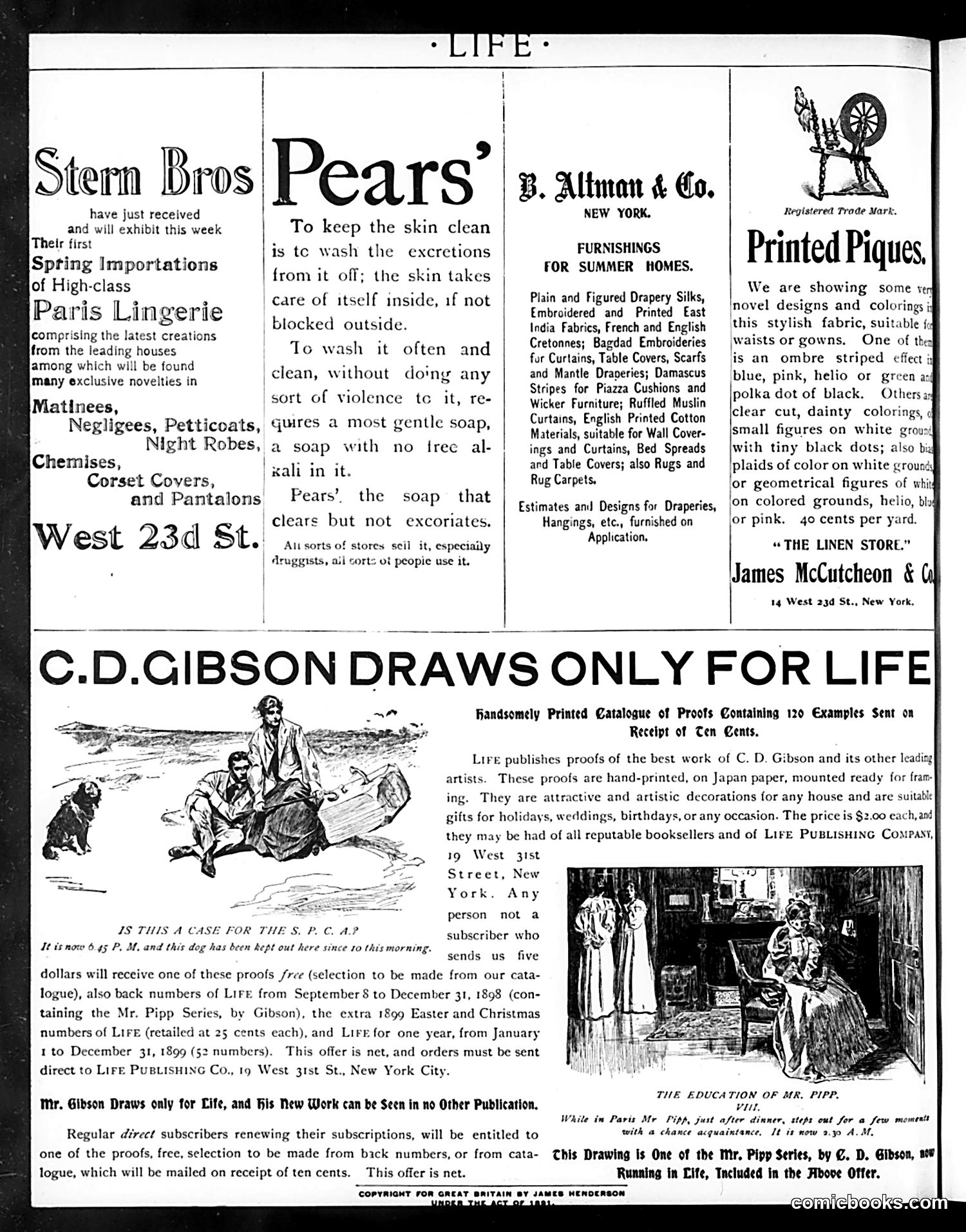
This page is primarily **commercial advertising** rather than satirical content. The top third contains three ads for luxury goods (Stern Bros. lingerie, Pears' soap, B. Altman furnishings, and James McCutcheon linens). The main feature is a **promotional announcement for C.D. Gibson's artwork** published in *Life* magazine. Gibson was a famous illustrator known for his "Gibson Girl" drawings. The ad offers subscribers free proofs of his illustrations in exchange for payment, plus back issues and extended subscriptions. The small illustration labeled "The Education of Mr. Pipp" appears to be an example of Gibson's work, showing domestic/social scenes typical of his style. The S.P.C.A. reference (Society for the Prevention of Cruelty to Animals) in the beach scene likely indicates satirical content about animal welfare, a common Gibson subject.
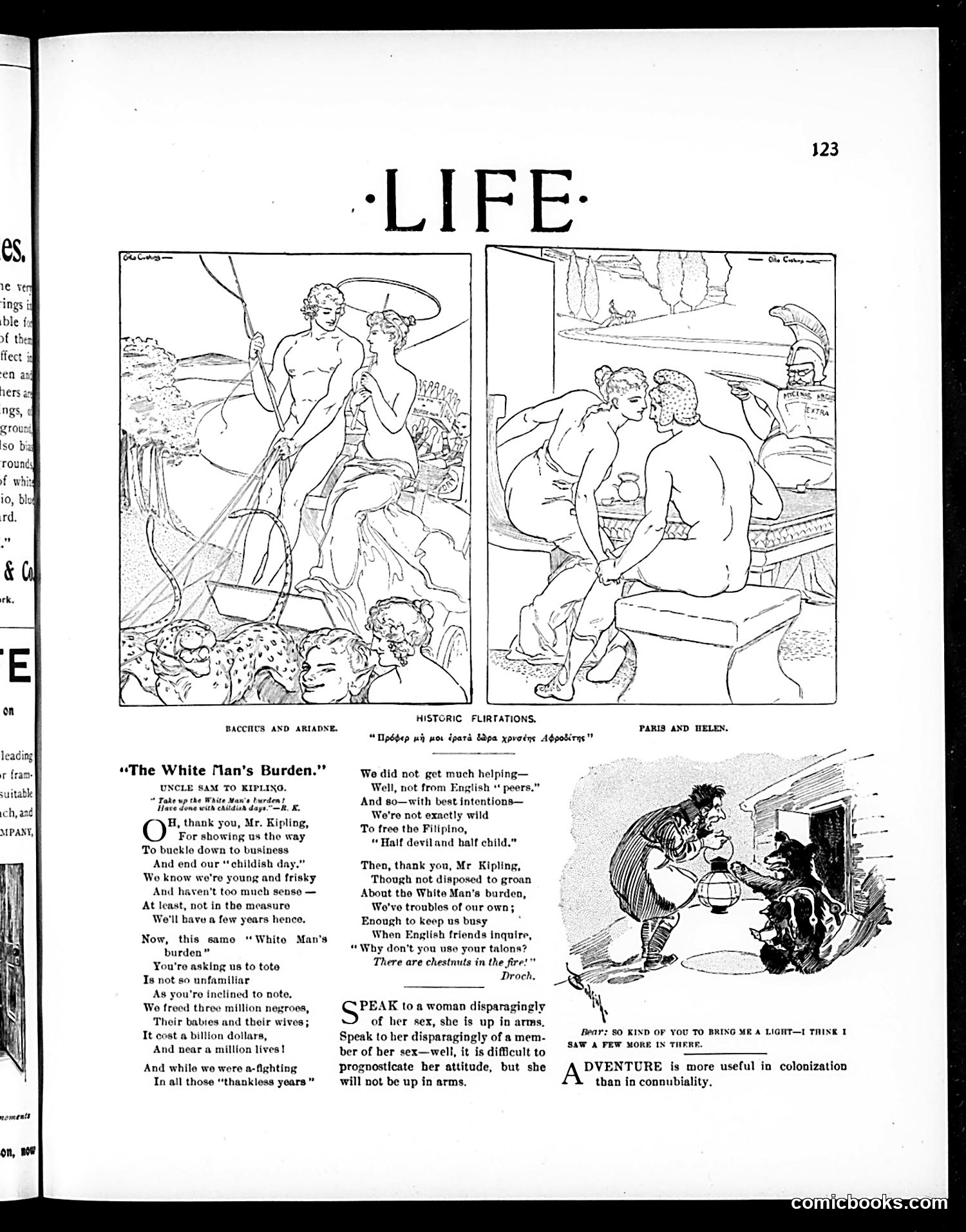
This page contains satirical commentary on American imperialism circa the early 1900s. "The White Man's Burden" references Kipling's famous poem justifying colonial expansion. The piece sarcastically presents Uncle Sam's rationale for occupying the Philippines—claiming moral duty while admitting the actual costs: "three million negroes," "billion dollars," and countless lives lost. The two classical engravings above ("Bacchus and Ariadne" and "Paris and Helen") are labeled "Historic Flirtations," likely contrasting ancient mythological seductions with modern colonial "adventures." The accompanying dialogue critiques how colonizers romanticize imperial conquest while dismissing legitimate concerns about the Filipino population. The final aphorism—"Adventure is more useful in colonization than inconvenability"—appears darkly satirical of justifications for imperial expansion.
This page discusses General Miles's conduct during WWI, criticizing his public statements against the War Department. The text notes Miles sought to appeal to newspapers rather than work through official channels. The small decorative cartoons (ornamental vignettes) scattered throughout are typical period flourishes, not political commentary. The main illustrated sections appear to be: - **Top left**: A decorative header illustration - **Middle**: What appears to be a small emblem or seal - **Bottom**: Another decorative element The substantive content critiques Miles for undermining military leadership through press campaigns, suggesting he should face consequences for his conduct. The page also discusses other wartime issues—Mrs. Maybrick's imprisonment, school salaries, and tariff exemptions for foreign travelers—indicating this is general editorial commentary rather than focused political satire.
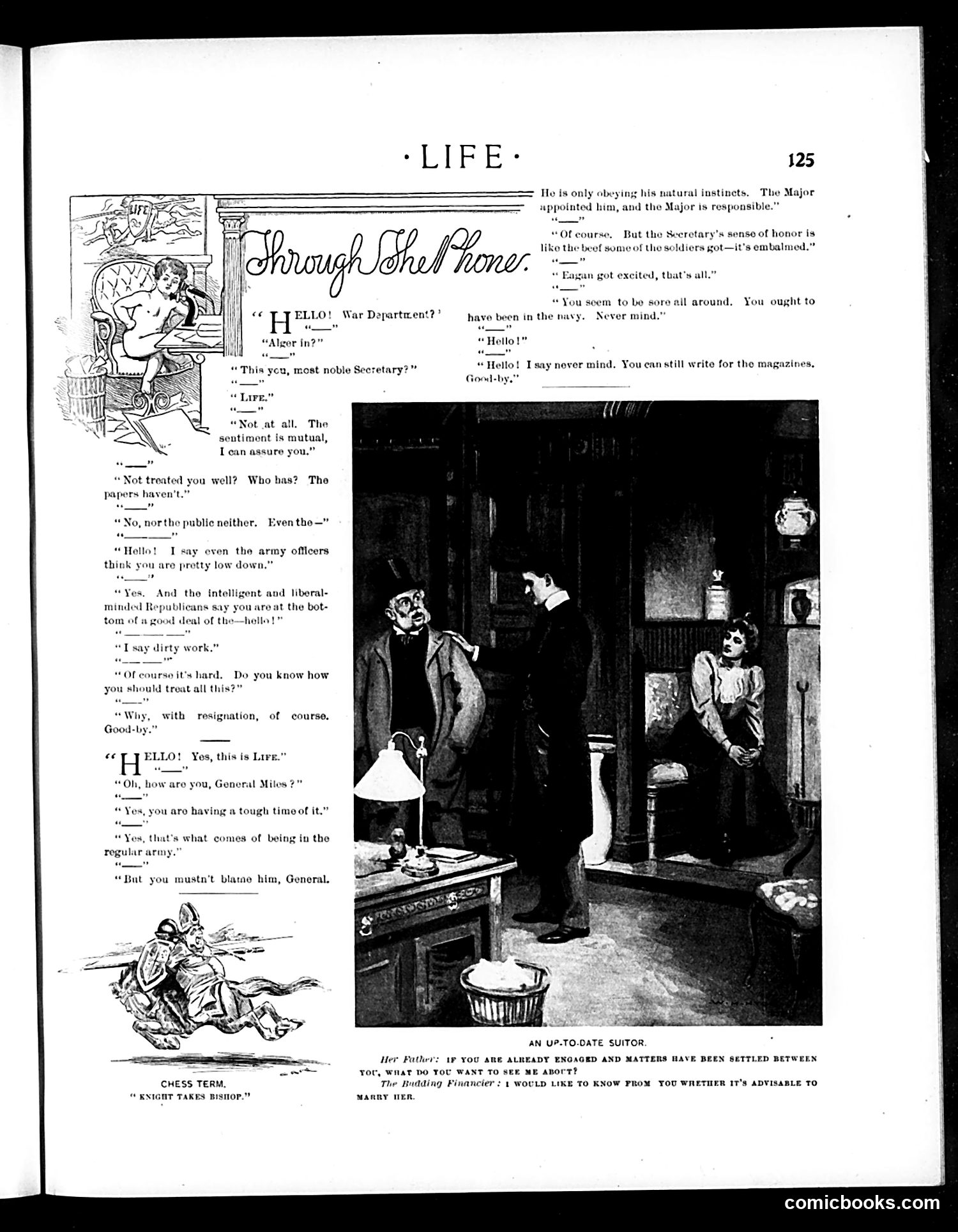
This page contains a humorous dialogue titled "Through Shell Phone" where a War Department official is being called by someone named "Life." The conversation satirizes bureaucratic attitudes toward wartime service—the caller complains about poor treatment, papers being lost, and low regard from army officers and the public. The chess term illustration at bottom ("Knight Takes Bishop") provides visual wordplay commentary. The large photograph shows what appears to be a domestic scene with a suitor being interrogated by a father figure about his intentions toward a young woman—captioned as commentary on engagement propriety. Together, these pieces satirize institutional indifference (military bureaucracy) and social conventions (courtship), reflecting post-WWI American anxieties about duty, respect, and proper conduct.
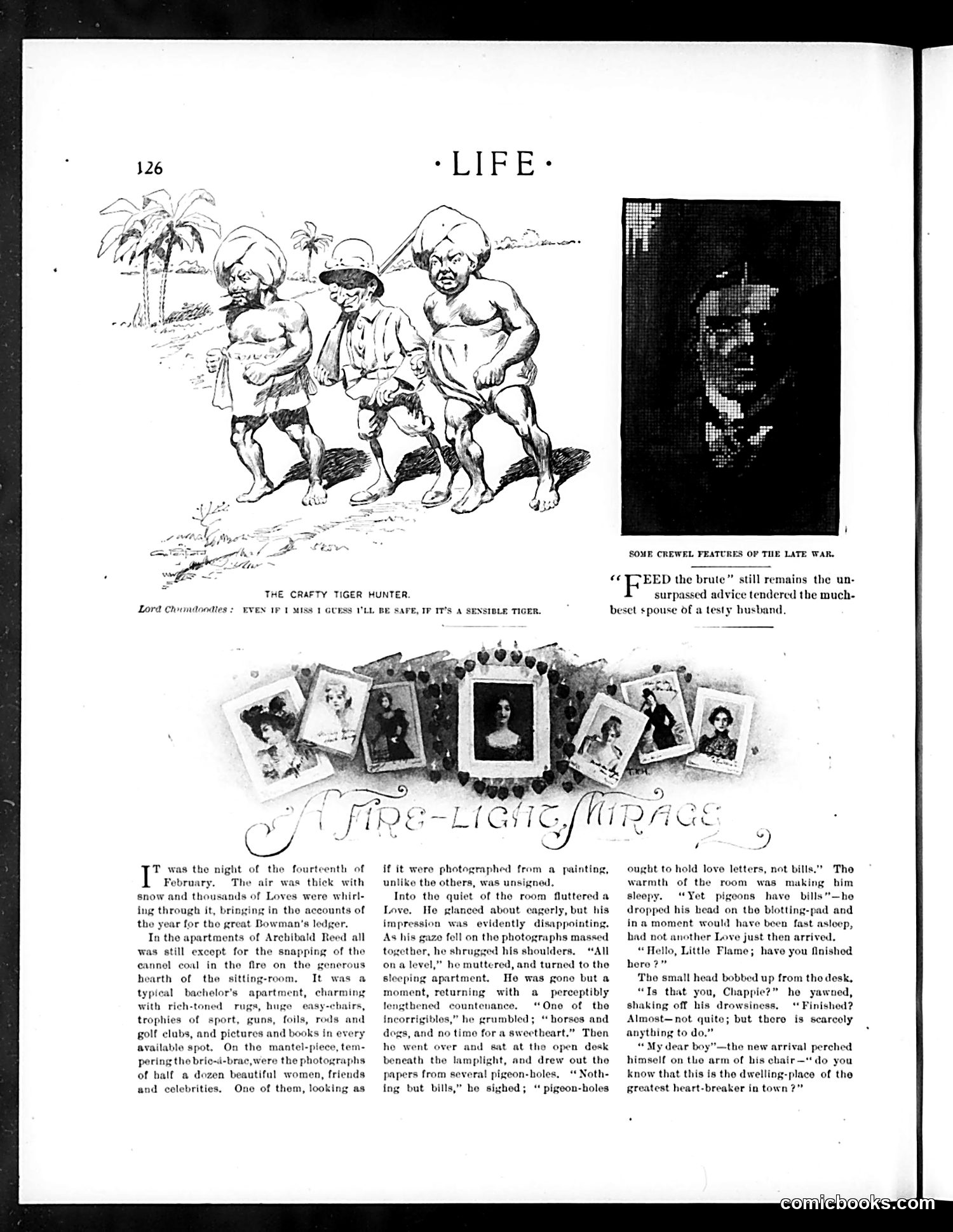
**Top cartoon ("The Crafty Tiger Hunter"):** Three figures in colonial dress hunt a tiger in an exotic landscape. The caption quotes "Lord Chunderbox": "Eyes! If I miss I guess I'll be safe, if it's a sensible tiger." This appears to satirize British colonial attitudes—suggesting that even when facing danger (the tiger), colonizers relied on assumptions of their own superiority or the "sensibility" of their opponents. The humor mocks overconfident imperial presumption. **Bottom section ("Three-Light Marriage"):** A story about Valentine's Day with photographs of women. The narrative describes a man receiving love letters while dealing with domestic complaints about bills and housekeeping. The satire targets marriage dynamics and male hypocrisy—contrasting romantic idealization with mundane marital reality. Both pieces reflect early 20th-century social commentary on gender relations and colonial attitudes.
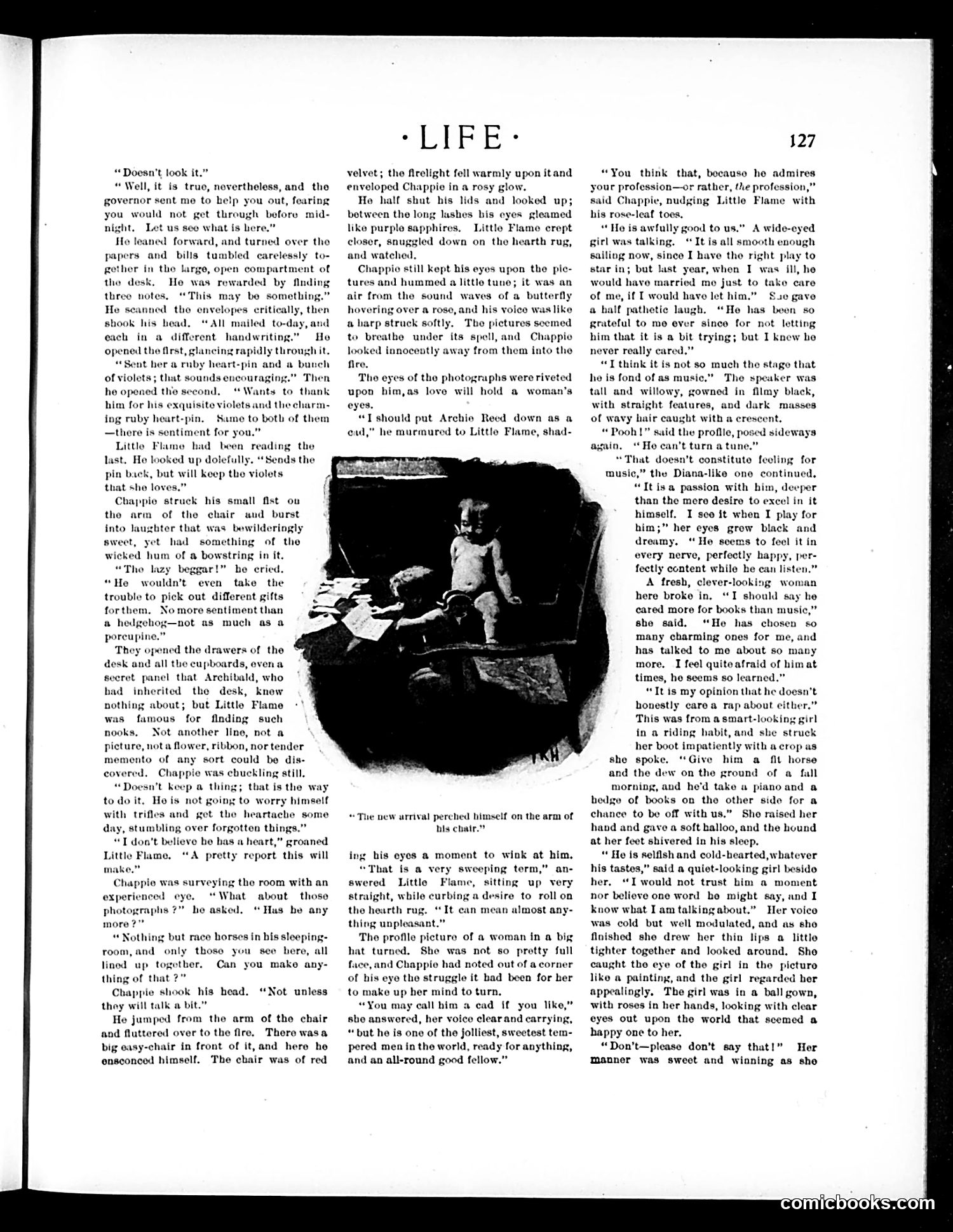
This page from *Life* magazine contains a serialized fiction story with an embedded illustration. The image shows a domestic interior scene with figures seated in a parlor or sitting room, consistent with the narrative text surrounding it. The story appears to be a romantic or sentimental tale involving characters named "Little Flame," "Chappie," and others. The dialogue discusses courtship, marriage prospects, and character judgments—typical themes of early 20th-century popular fiction. The illustration caption reads: "The new arrival perched himself on the arm of his chair." This is **not political satire or social commentary**—it's domestic fiction entertainment typical of *Life*'s content during this period, when the magazine published substantial amounts of serialized stories alongside its famous humor and cartoons.
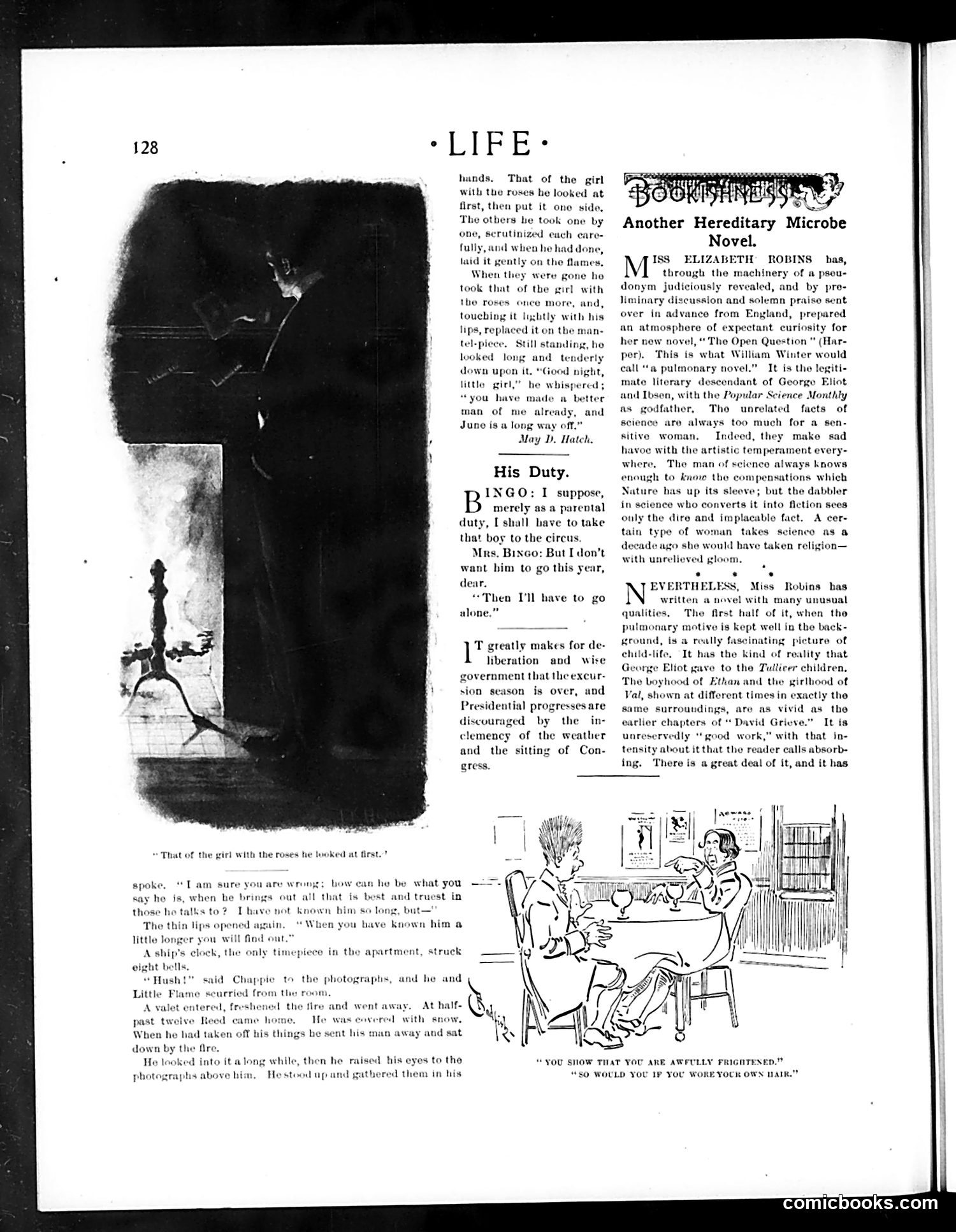
This page contains a book review titled "Another Hereditary Microbe Novel" discussing Elizabeth Robins's novel *The Open Question*. The review criticizes the work as unoriginal—a derivative descendant of George Eliot and Ibsen—comparing it unfavorably to genuinely artistic literature. The cartoon at bottom depicts two people at a social gathering. The caption reads: "You show that you are awfully frightened." "So would you if you wore your own hair." This is a period satirical joke about women's fashion. The humor relies on the era's practice of women wearing elaborate false hair pieces or wigs. The joke suggests that wearing fake hair would naturally make someone anxious about its visibility or displacement—mocking both the artificiality of women's fashions and women's concern with appearance.
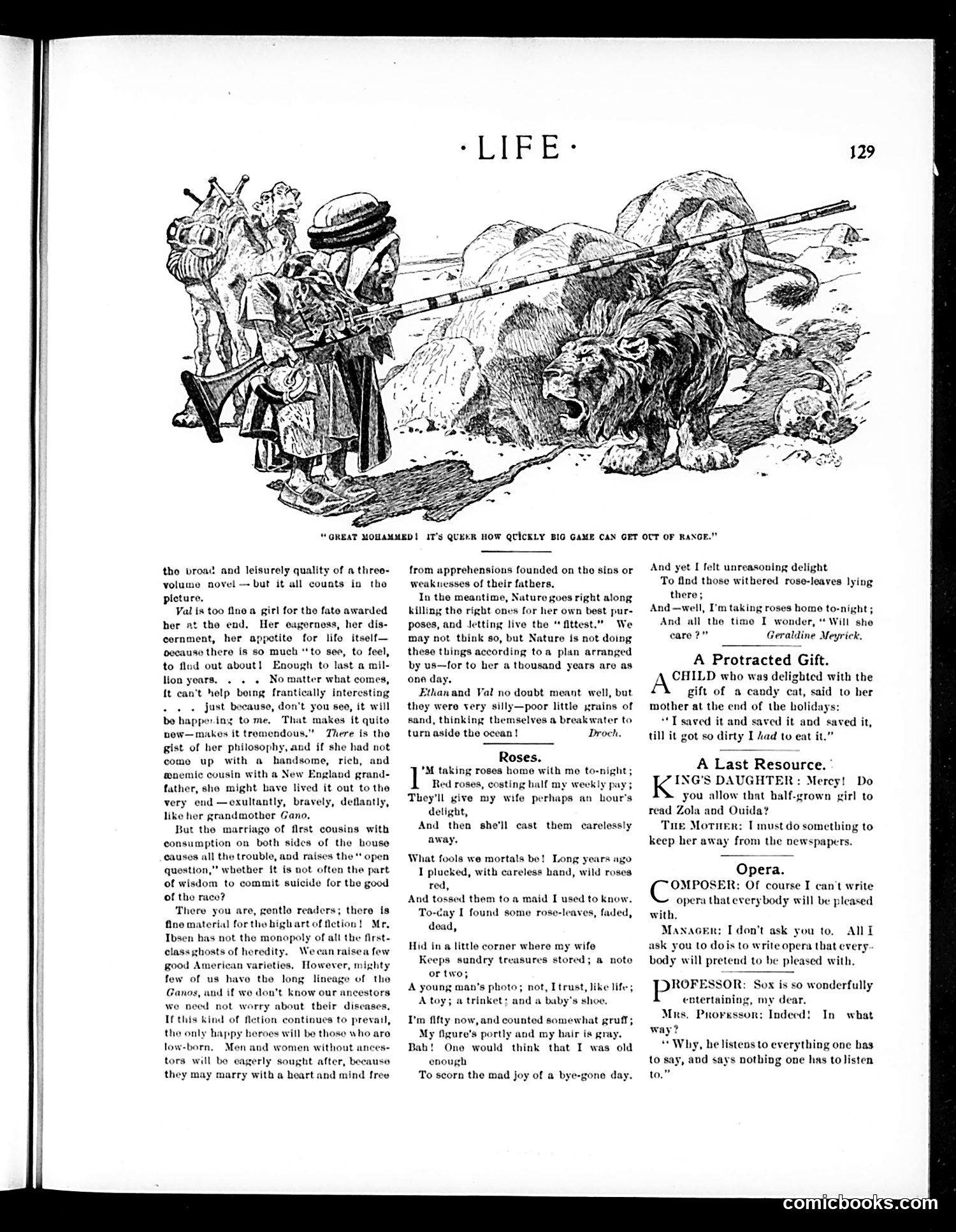
The main cartoon depicts hunters with rifles confronting a large, aggressive lion. The caption reads: "Great Mohammed! It's queer how quickly big game can get out of range." This appears to be satirizing **big-game hunting**, a popular pastime among wealthy Western sportsmen in the late 19th/early 20th century. The joke seems to mock hunters' difficulty in successfully killing dangerous prey—the lion's aggressive stance suggests it poses a genuine threat, making the hunters' boasting about marksmanship appear foolish. The page also contains several short humorous pieces on unrelated topics (roses, candy gifts, opera composition), typical of Life's miscellaneous satirical content. Without more historical context, the specific hunting reference remains unclear, though it likely comments on the era's romanticization of dangerous African expeditions.
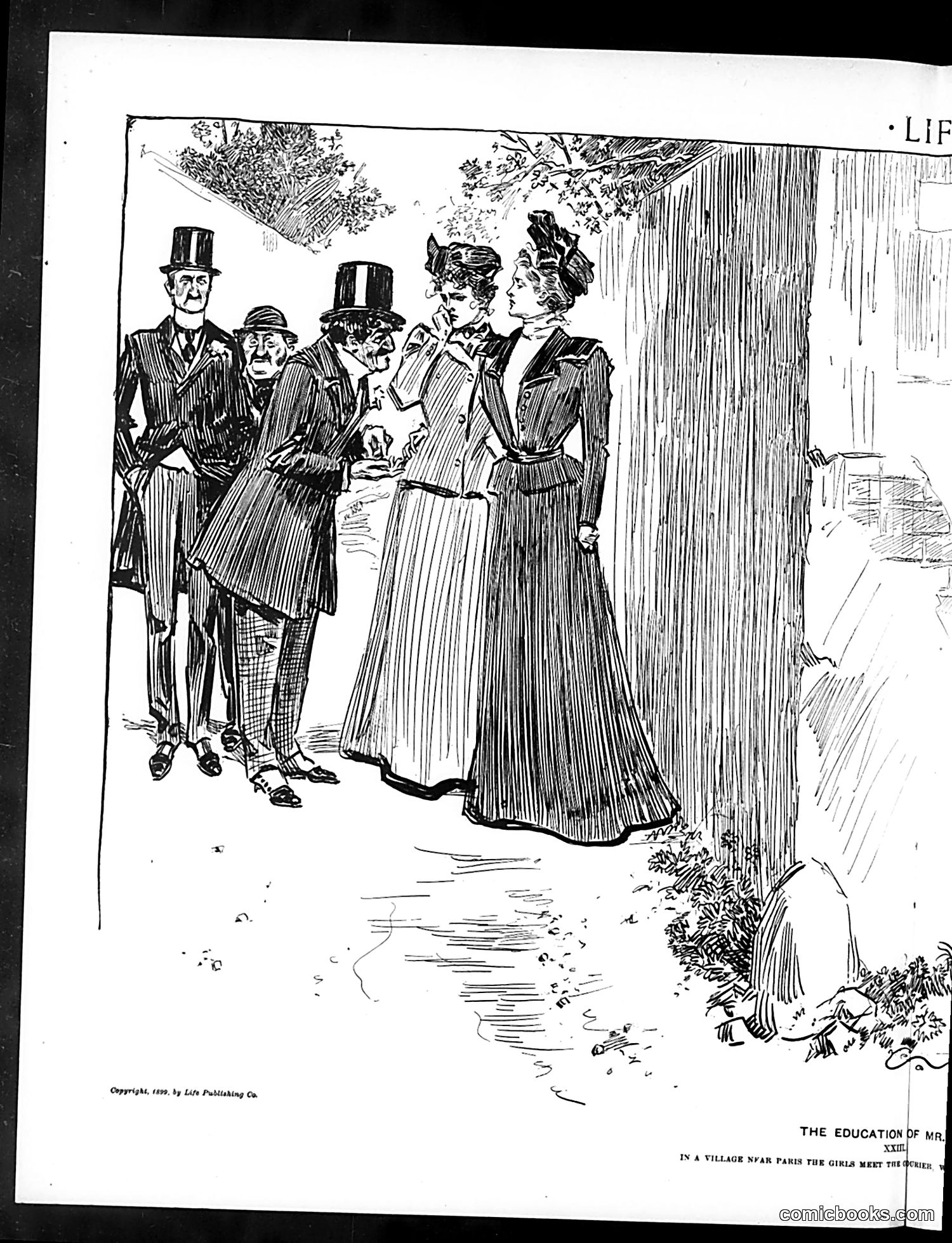
This satirical cartoon depicts a scene "in a village near Paris" where five well-dressed figures—men in top hats and suits, women in long Edwardian gowns—appear to be instructing or confronting a smaller figure (likely a child or servant, visible at right). The title suggests someone numbered "XXIII" is receiving an "education." The satire likely mocks French provincial social customs or class instruction of the era. The formal attire and outdoor village setting suggest mockery of how the wealthy impose manners or values on their social inferiors. Without additional context about which specific person or event "Mr. XXIII" references, the exact political target remains unclear, though the humor derives from the contrast between the stern instructors and their subject.
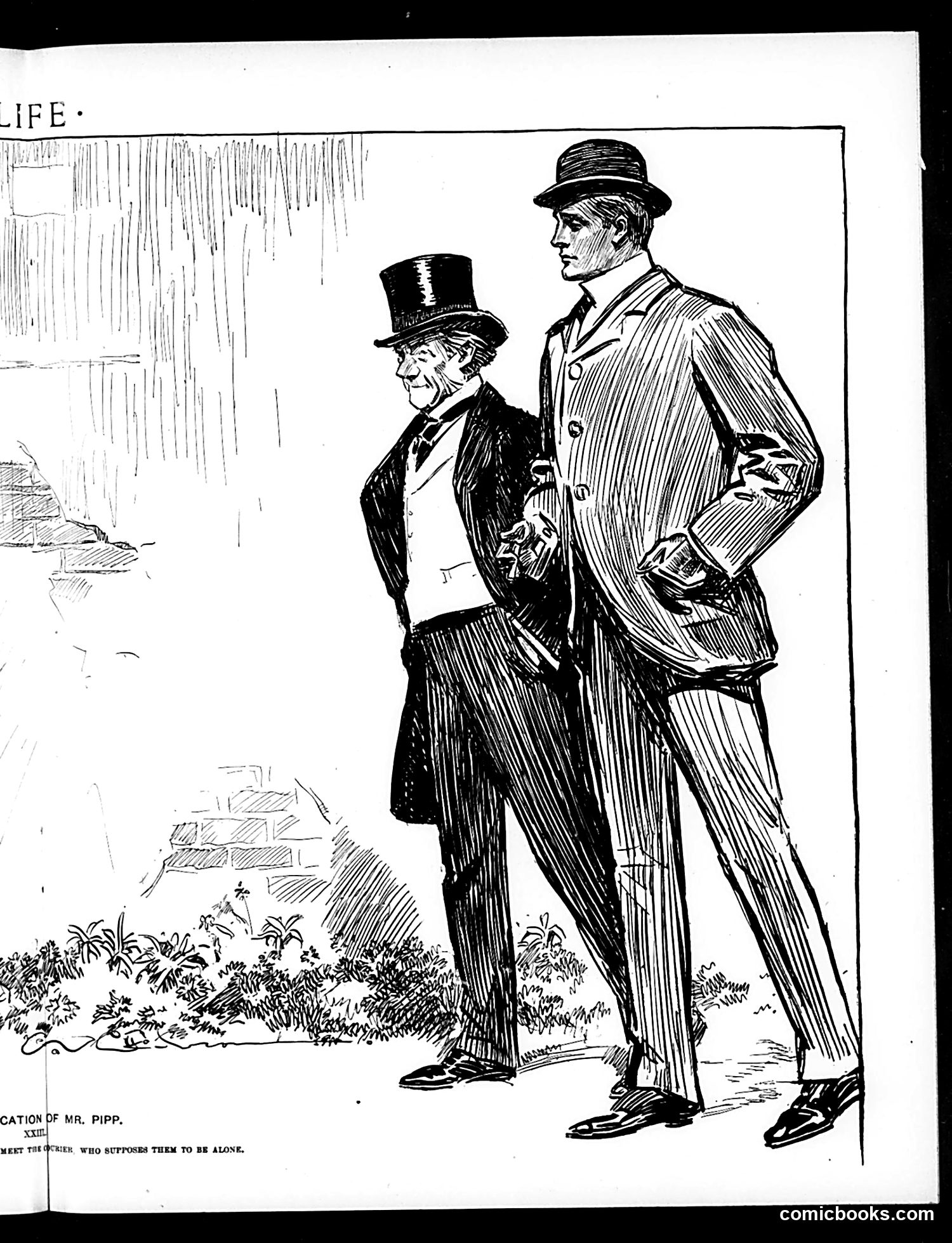
This appears to be a political cartoon titled "A Question of Mr. Pipp" (or similar—OCR is unclear). The caption references "met the maker, who supposes them to be alone," suggesting a private meeting between two figures. The image shows two well-dressed men in top hats and formal attire from what appears to be the late 19th or early 20th century. One is notably shorter and older-looking (caricatured with exaggerated features), while the other is taller and younger. The cartoon likely satirizes a political or social encounter, possibly involving corruption, hypocrisy, or backroom dealings—common themes in Life magazine's satirical work. Without additional context about "Mr. Pipp" or the specific historical moment, the exact target remains unclear.
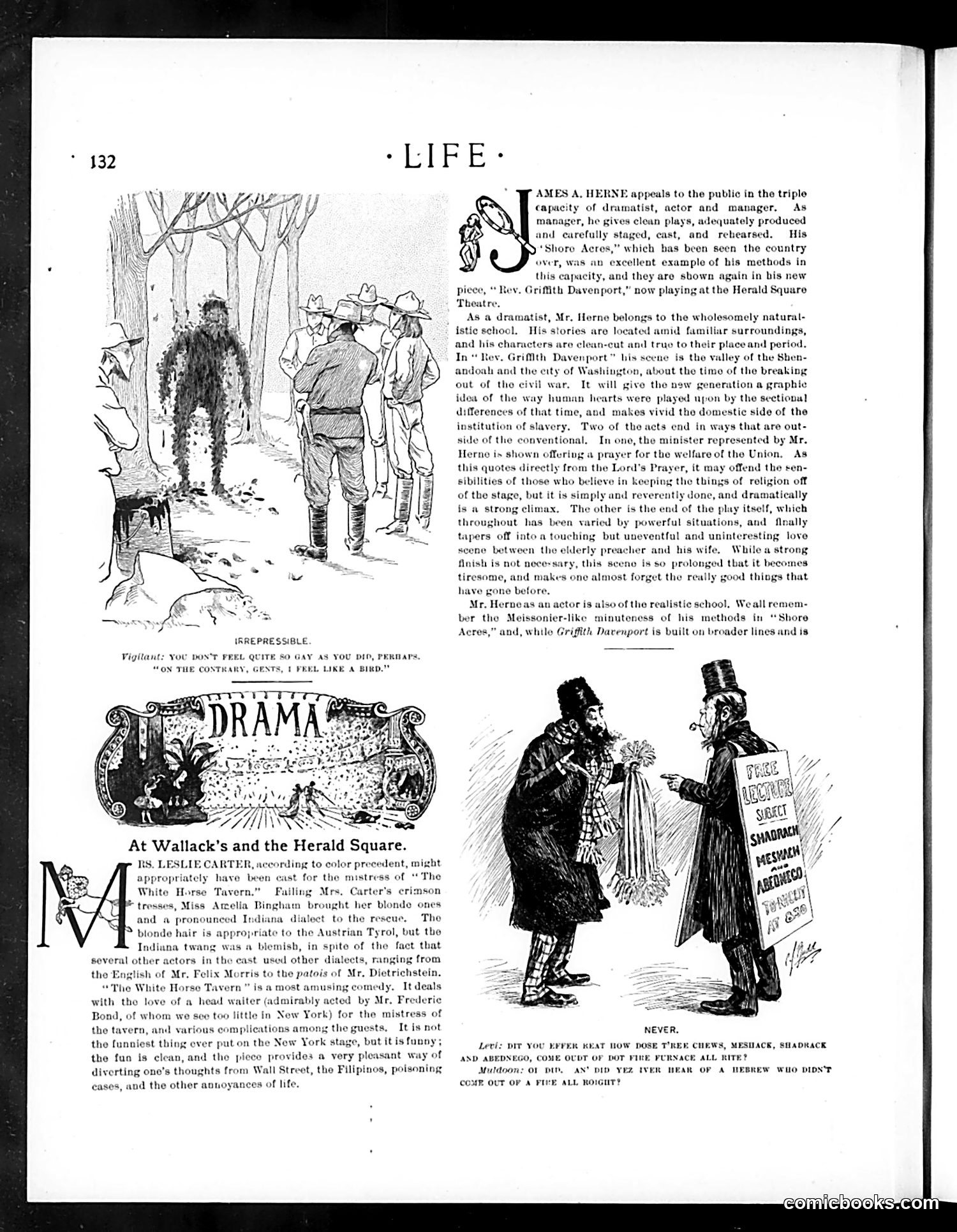
This page reviews theatrical productions, focusing on James A. Herne's play "Rev. Griffith Davenport" at the Herald Square Theatre. The upper sketch depicts a Civil War–era scene of soldiers, illustrating the play's setting during the war's end and its treatment of slavery. The lower cartoon titled "Never" shows two well-dressed men in top hats exchanging words about "free cigars" and other items, with one man appearing to reject the other's offerings. The joke appears to mock pretentious social interactions or false generosity among the wealthy—the "never" suggesting the speaker will not accept or participate in such exchanges. The page exemplifies *Life* magazine's combination of theater criticism and satirical commentary on contemporary manners.
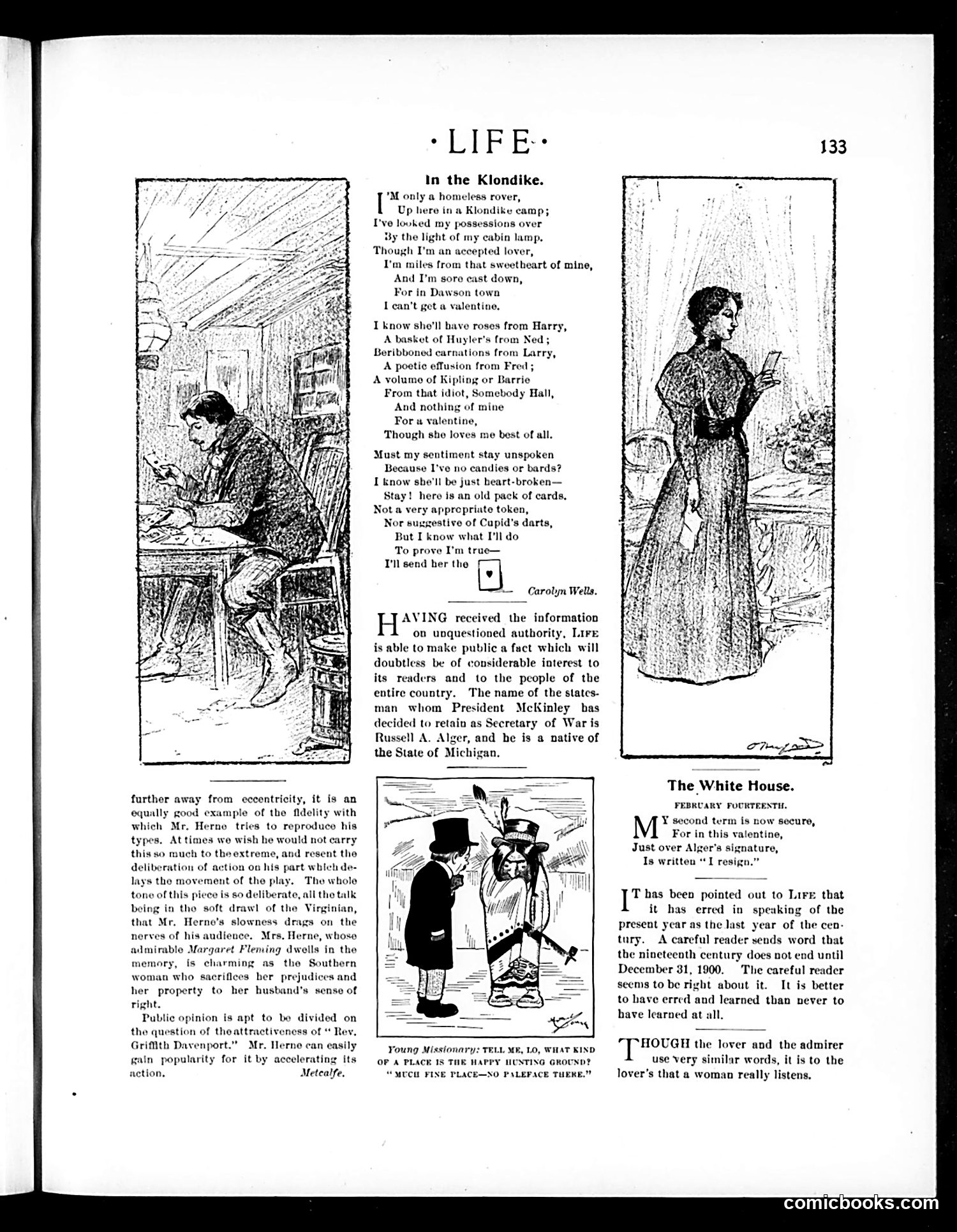
This page contains three satirical pieces from an 1890s Life magazine: **"In the Klondike"** (poem by Carolyn Wells): A humorous complaint from a gold prospector unable to send his sweetheart a Valentine's Day gift from the remote Yukon during the Klondike Gold Rush. The joke is his desperation—reduced to sending a pack of playing cards to prove his devotion while rivals send roses and books. **"The White House" (Valentine section)**: Political satire regarding Secretary of War Russell A. Alger. The joke is that President McKinley receives a Valentine from Alger bearing the resignation message "I resign"—suggesting Alger's tenure was so unpopular that his departure would be McKinley's ideal Valentine gift. **Bottom cartoon**: A young missionary asks a Native American about the "happy hunting ground," receiving the response "much fine place—no paleface there"—a satirical jab at missionary work and racial attitudes. The page also includes a theater review by Metcalfe and a correction about the century's end date.
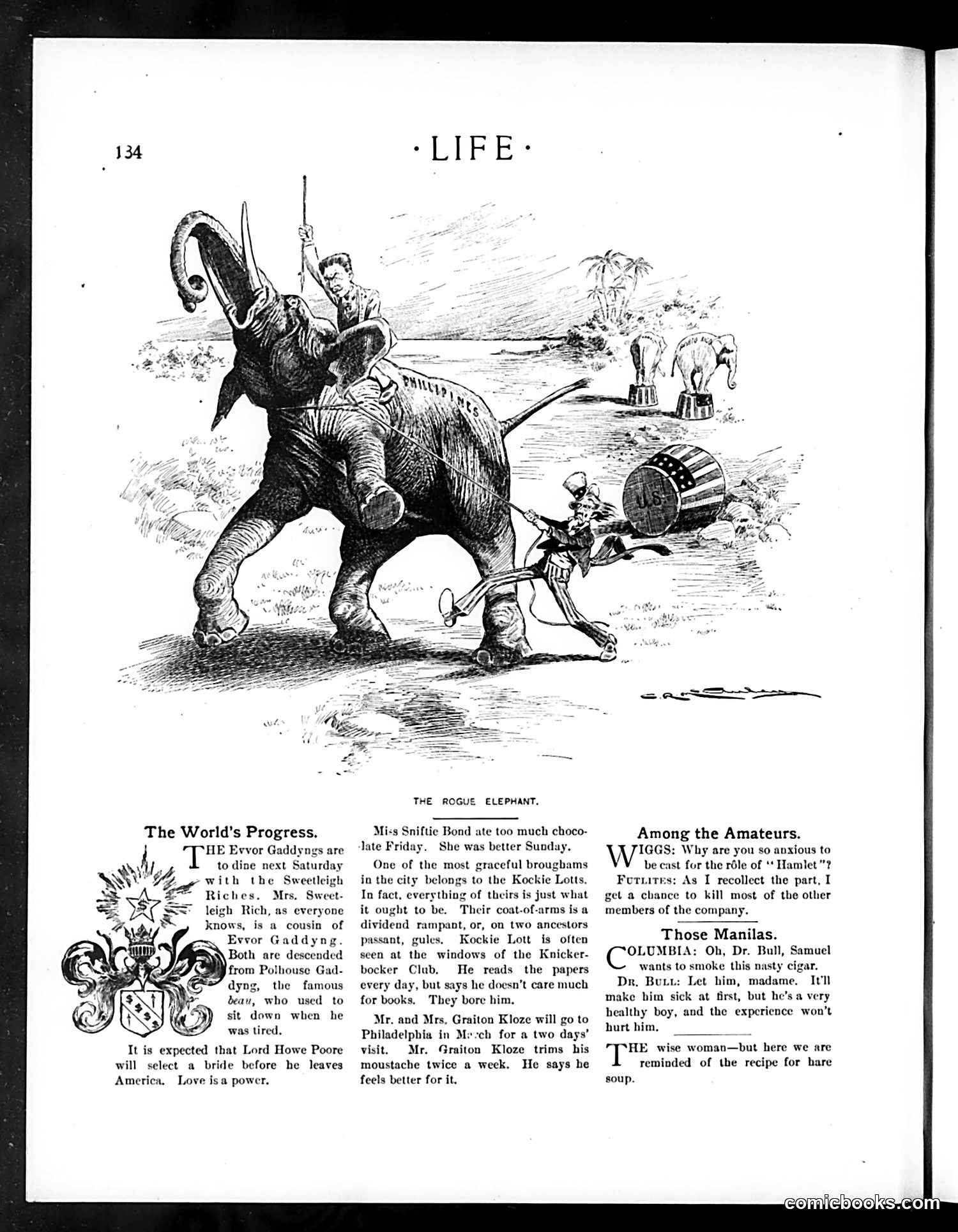
This page from *Life* magazine combines a satirical cartoon with gossipy social commentary. **The main cartoon** shows a man riding an elephant labeled "The Rogue Elephant"—likely a visual pun on upper-class social pretension or a specific scandal (the exact reference is unclear without additional context). **The text sections** mock wealthy New York society families through deliberately inane observations: the Sweetleighs dining together, the Kockie Lotts' fashionable carriage, Kockie Lott reading newspapers but scorning books, and Mr. Graiton Kloze's meticulous moustache maintenance. The humor lies in *Life's* satirical elevation of trivial details into mock-serious social reportage—treating wealthy people's mundane habits and shallow concerns as if they were momentous news. The final non-sequiturs ("recipe for bare soup") suggest the absurdity of such gossip columns. This reflects *Life's* role as satirical magazine skewering Gilded Age Manhattan society pretension.
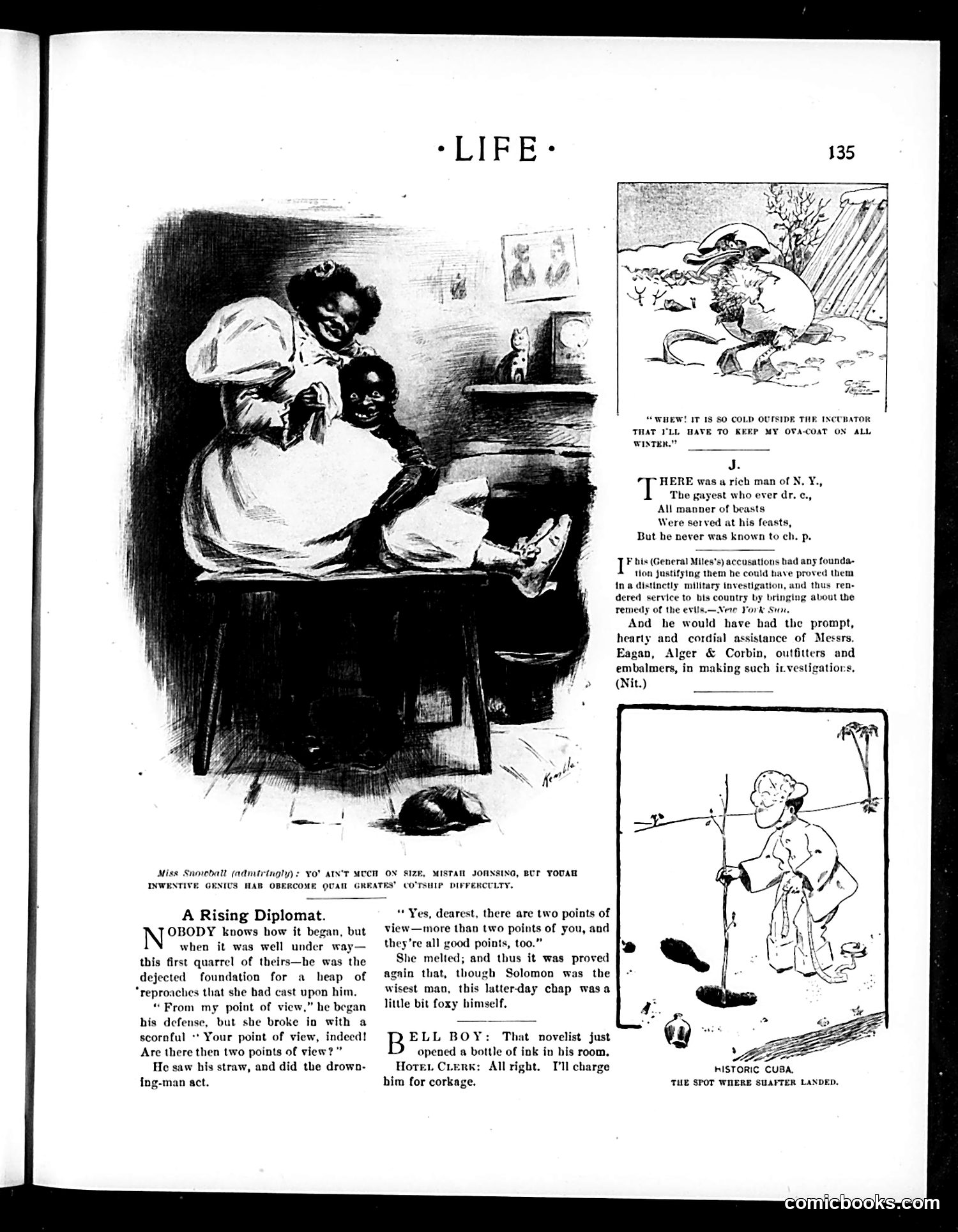
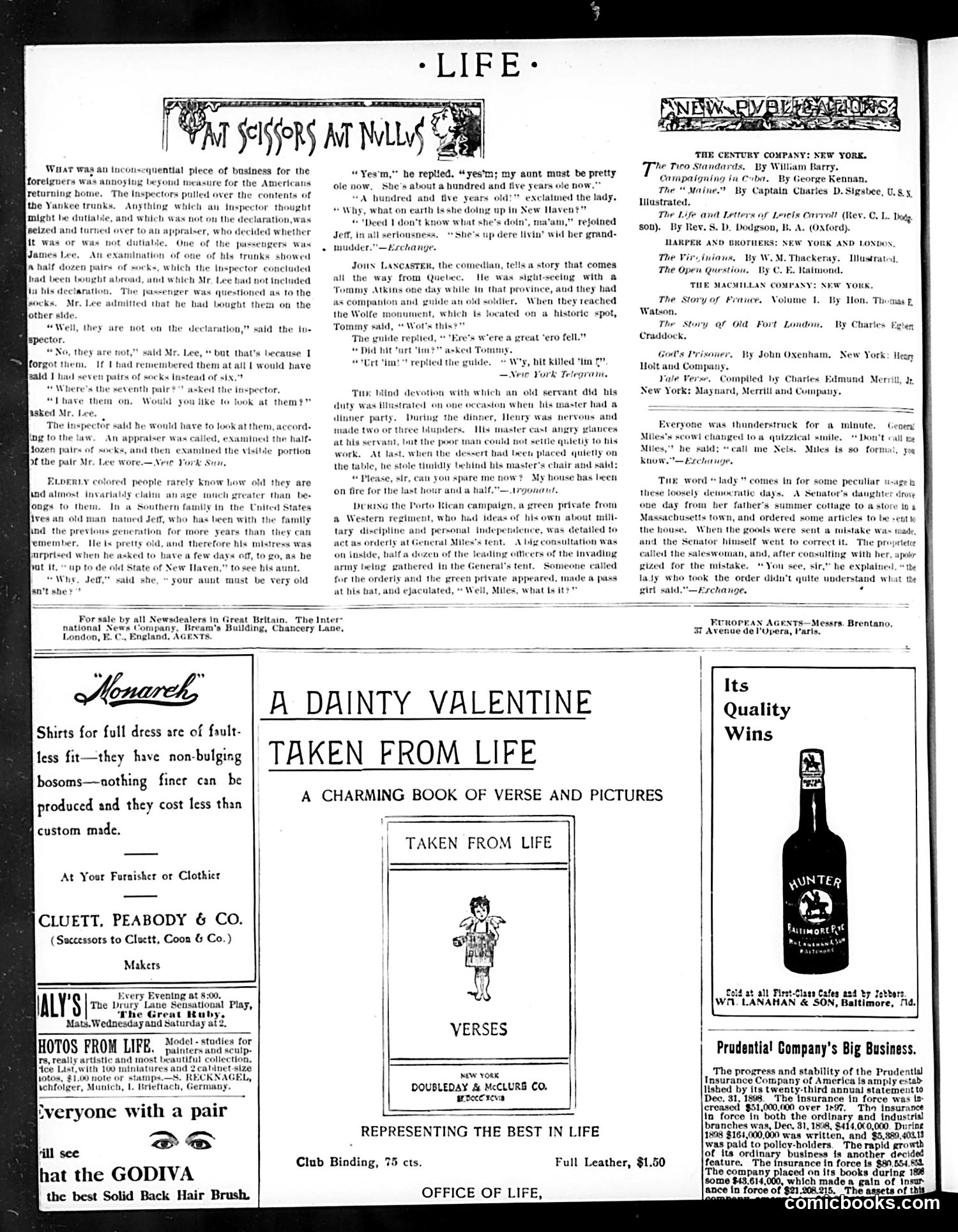
This page contains several humorous anecdotes typical of Life magazine's satirical content. The primary jokes exploit period racial and ethnic stereotypes: 1. **The customs inspection story**: A passenger smuggles undeclared socks past inspectors by wearing one pair, claiming he "forgot" them. The humor relies on the inspector's literal-minded bureaucracy. 2. **The elderly Black servant anecdote**: An elderly enslaved/formerly enslaved woman is so old she lives with her grandmother—an absurdist impossibility used for comedic effect, reflecting the casual racism of the era. 3. **The Wolfe monument joke**: A British soldier mishears "Wolfe fell" (General Wolfe died at Quebec) as "Wolfe killed him," creating wordplay humor. 4. **The nervous servant story**: A servant's anxiety during dinner causes comedic mishaps, playing on class dynamics. The page is primarily **advertising and book promotion** (Valentine's Day book, shirts, hair brushes, insurance), with these humor pieces interspersed—typical of Life's early 20th-century format mixing editorial content and commerce.
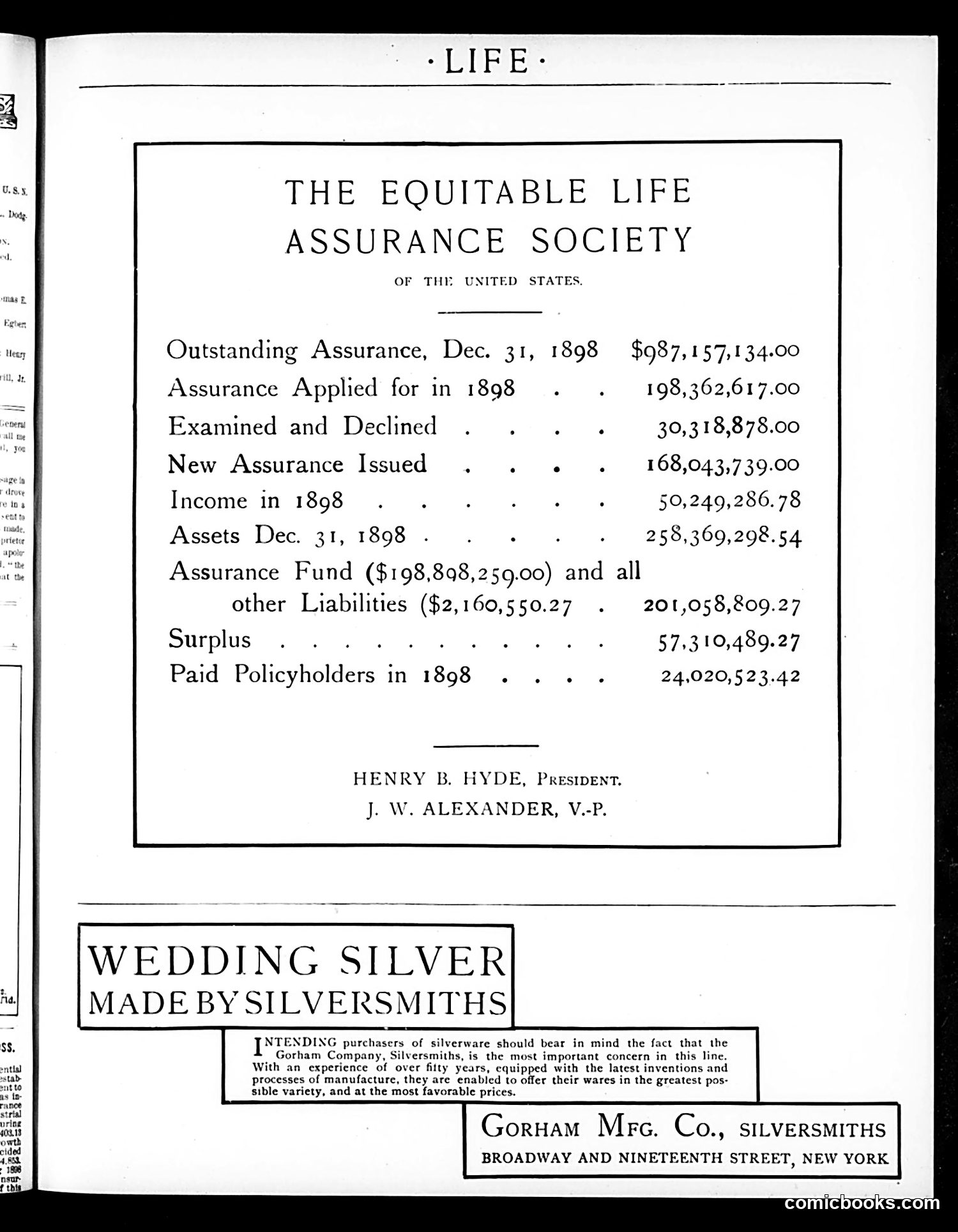
This page contains **no cartoon or satire** — it is purely **advertising and financial reporting**. The upper section is a straightforward advertisement for the Equitable Life Assurance Society, presenting 1898 financial statistics (assets, income, policies issued, payments to policyholders). The company's President (Henry B. Hyde) and Vice President are listed. Below that are two related advertisements: one promoting "Wedding Silver" made by silversmiths, emphasizing Gorham Manufacturing Company's fifty years of experience and product variety. The second ad provides Gorham's address in New York. This appears to be a standard magazine page mixing corporate and commercial advertising with no political or satirical content visible. The financial data simply demonstrates the insurance company's fiscal health to potential customers.
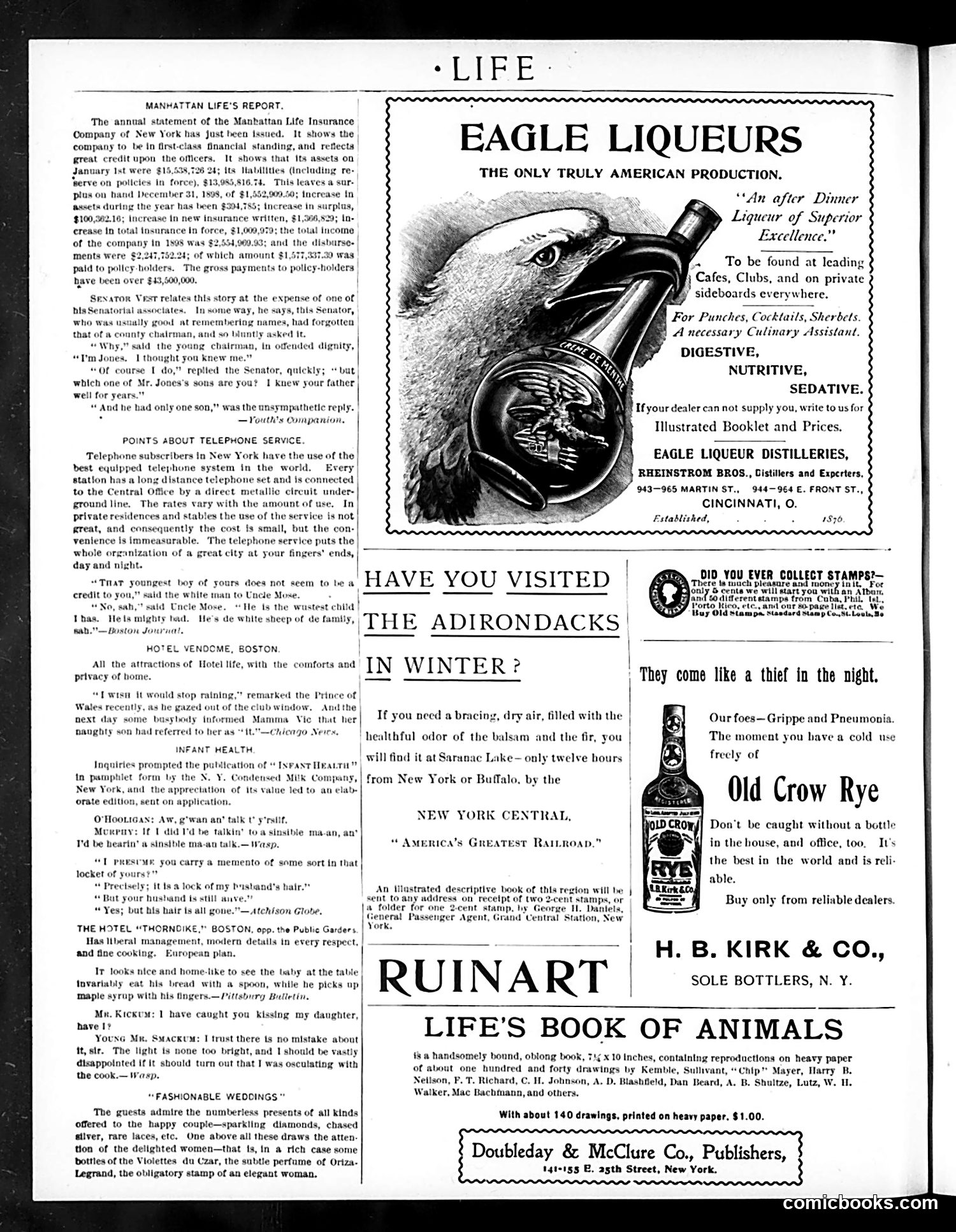
This page is primarily **advertising and miscellaneous content** rather than political satire or comics. The main elements include: **Editorial/News Content:** - Financial report on Manhattan Life Insurance Company - Brief anecdotes (Senator Vest's story about "Mr. Jones," dialogue about telephone service) - Notes on hotels and social observations **Advertisements:** The page features several liquor and product ads: - **Eagle Liqueurs** (Cincinnati distillery) - marketed as "The Only Truly American Production" for after-dinner use - **Old Crow Rye** whiskey (H.B. Kirk & Co.) - **Ruinart** (champagne) - **Life's Book of Animals** (publisher advertisement) **Social Context:** One anecdote includes a racial stereotype ("Uncle Mose" dialogue), reflecting common period prejudices in American humor. **Overall:** This appears to be a typical *Life* magazine page from circa 1898-1900, mixing light humor, financial news, and commercial advertising without significant political commentary.
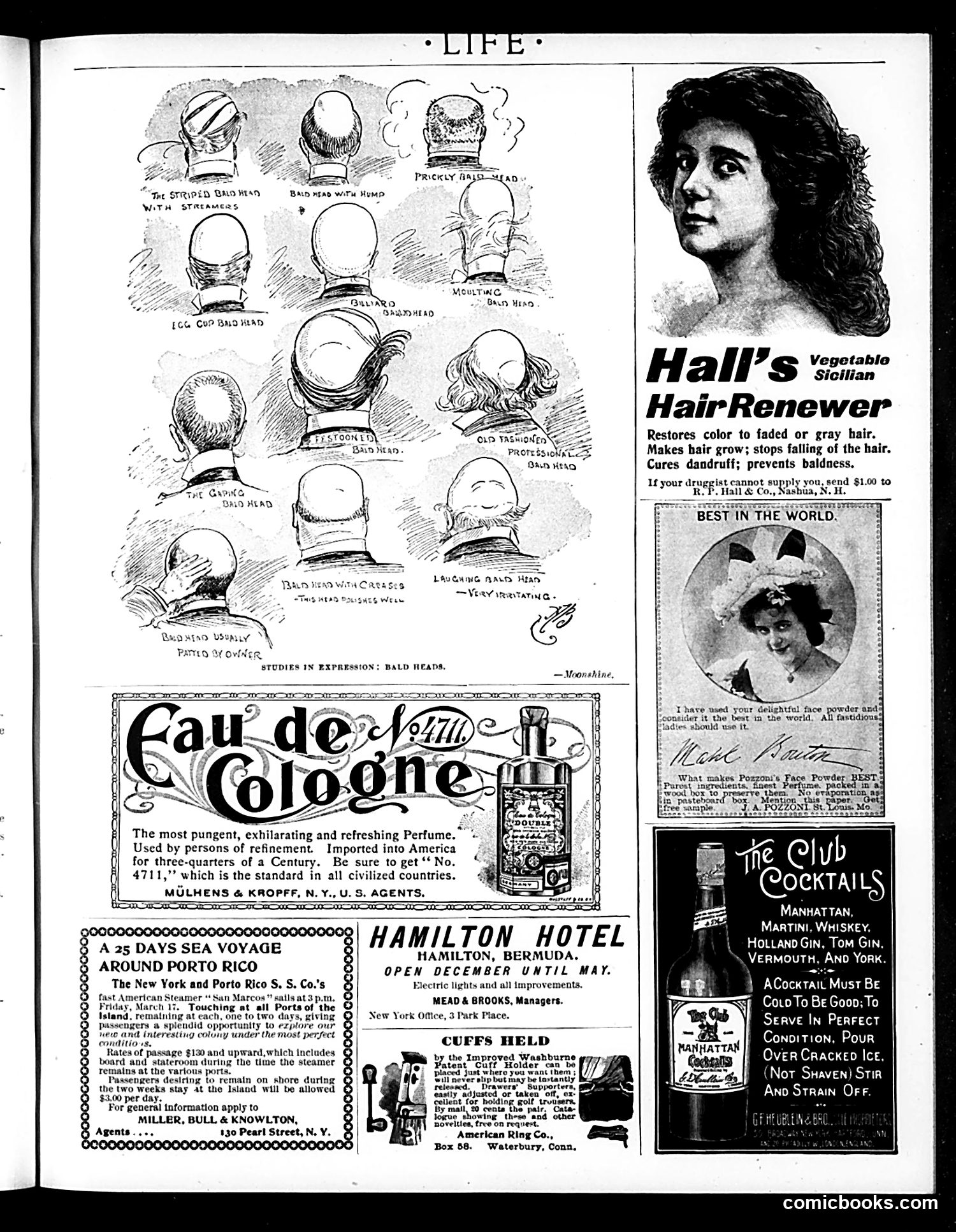
The top-left cartoon, titled "Studies in Expression: Bald Heads," is a humorous illustrated guide depicting various exaggerated facial expressions and conditions associated with baldness—anger, smugness, prickliness, egg-like smoothness, typhoons, and laughing. It's satire mocking men's vanity about hair loss and the absurd emotional states baldness supposedly produces. The remainder is primarily **advertising**, not editorial content. Notable ads include Hall's Hair Renewer (claiming to restore color and stop hair loss), Eau de Cologne perfume, sea voyage packages to Puerto Rico, hotel accommodations, and cocktail recipes. The Pozzoni's face powder ad features a testimonial from an unnamed woman. This page reflects early 1900s concerns: male baldness anxiety, beauty product marketing to women, leisure travel promotion, and the emerging cocktail culture. The ads target middle-class consumers with disposable income for luxury goods and travel.
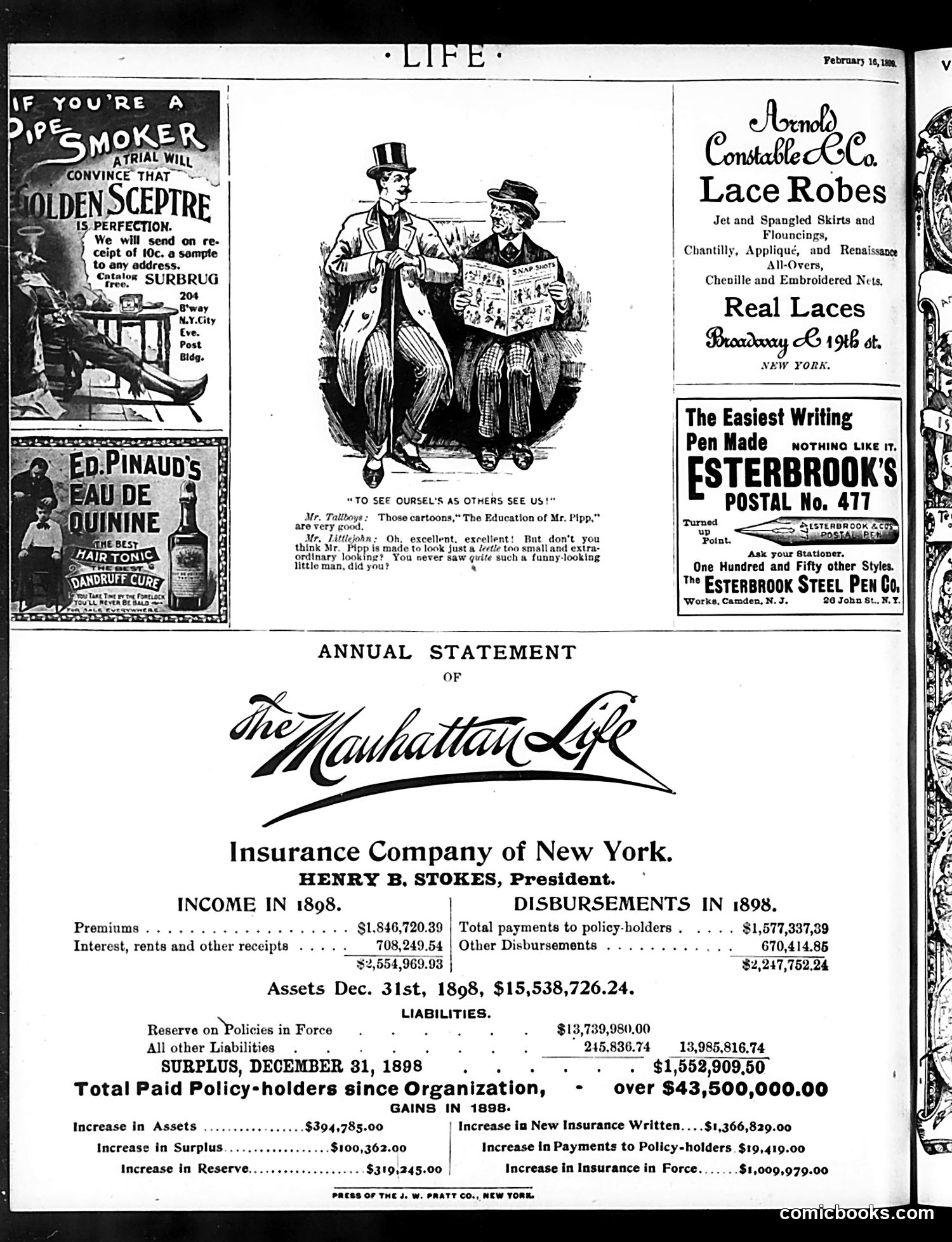
This page contains primarily **advertisements and corporate financial statements** rather than political satire. The central cartoon depicts two well-dressed gentlemen discussing "The Education of Mr. Pipp"—an apparent series of cartoons one character finds excellent but thinks exaggerates the protagonist's small stature and odd appearance. The joke centers on visual caricature and physical comedy: the characters debate whether the cartoon accurately or unfairly portrays this "funny-looking little man." The surrounding ads promote consumer goods (lace robes, fountain pens, pipe tobacco, medicinal tonics) typical of 1890s Life magazine. The bulk of the page comprises The Manhattan Life Insurance Company's annual financial statement for 1898, showing substantial assets and policyholder payouts. **No specific political figures or major satirical commentary** appears evident on this page—it reflects Life's mixed format of light humor, advertising, and corporate notices rather than pointed social critique.