
Life, 1899-02-16 · page 4 of 20
Life — February 16, 1899 — page 4: what you’re looking at
What you’re looking at
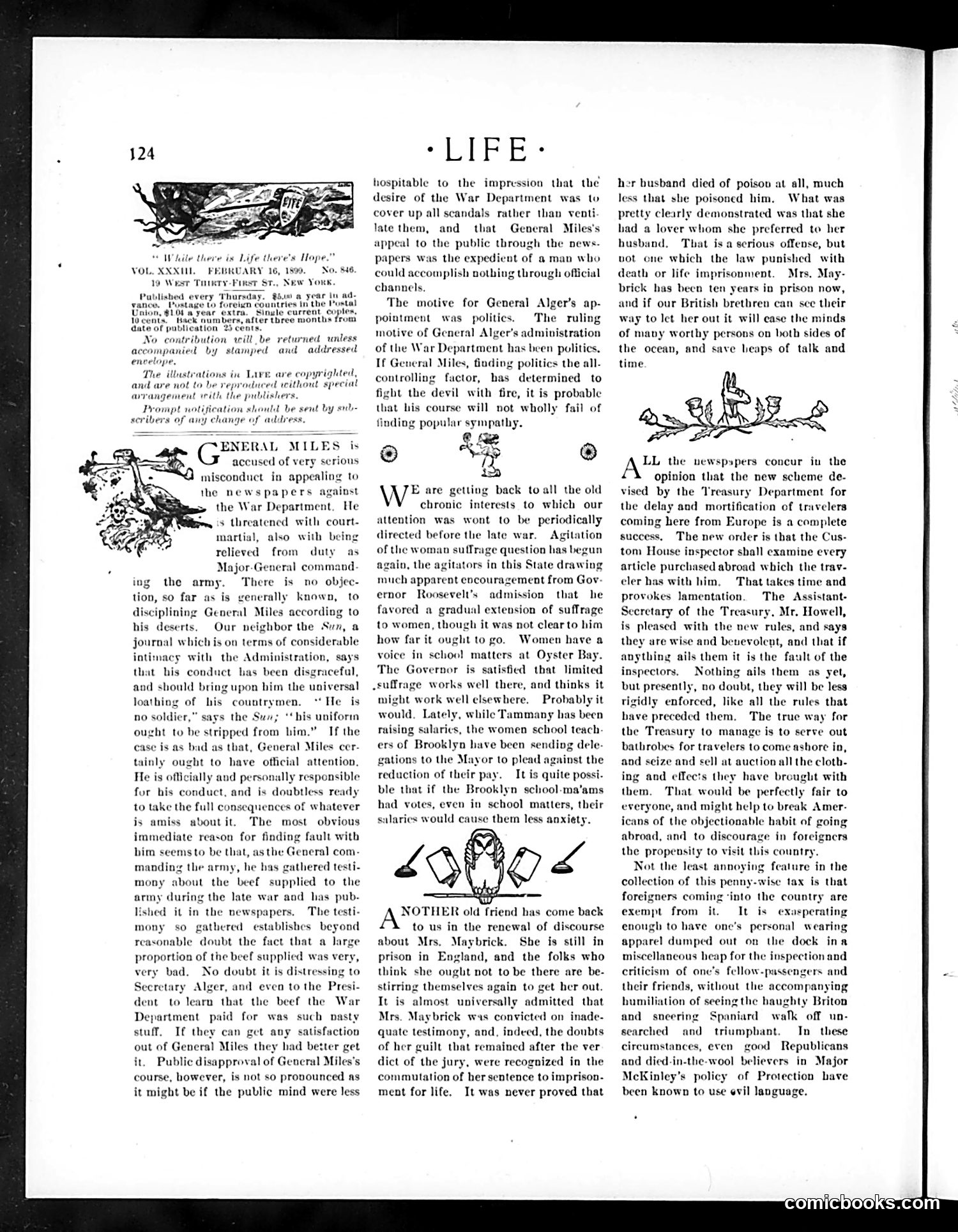
This page discusses General Miles's conduct during WWI, criticizing his public statements against the War Department. The text notes Miles sought to appeal to newspapers rather than work through official channels. The small decorative cartoons (ornamental vignettes) scattered throughout are typical period flourishes, not political commentary. The main illustrated sections appear to be: - **Top left**: A decorative header illustration - **Middle**: What appears to be a small emblem or seal - **Bottom**: Another decorative element The substantive content critiques Miles for undermining military leadership through press campaigns, suggesting he should face consequences for his conduct. The page also discusses other wartime issues—Mrs. Maybrick's imprisonment, school salaries, and tariff exemptions for foreign travelers—indicating this is general editorial commentary rather than focused political satire.
📄 Transcribed text from this page (OCR, searchable)
Machine-transcribed from the original scan — historical spelling and the odd misread are preserved.
+ While there is L VOL. XXXII FEBRUARY 16, 1899, 19 West Taiery-Finst & contribution will be returned un npanied by stamped and addressed envelope. The illustrations in Lave. are copyrighted, and are not to be reproduced without speciat arrangement with the publishers. Gey MILES accused of very se! misconduct in appealing to the newspapers against the War Department. He 3 threatened with court- martial, also with being telieved from duty as Major-General command- ing the army. There is no objec- tion, so far as is venerally known, to disciplining General Miles according to his deserts. Our neighbor the Sun, a journal which is on terms of considerable intimacy with the Administration, says that his conduct bas been disgraceful, and should bring upon him the universal loathing of his countrymen. “He is no soldier,” says the Sw; ‘bis uniforin ought to be stripped from him.” If the ase is as bad as that, General Miles cer- inly ought to have official attention, He is officially aud personally responsible fur bis conduct, and is doubtless ready to take the full consequences of whatever is amiss aboutit. The most obvious immediate reason for finding fault with him seems to be that, asthe General com- manding the army, he has gathered testi- mony about the beef supplied to the army during the late war aod has pub- lished it in the newspapers. The testi- mony so gathered establishes beyond reasonable doubt the fact that a larg proportion of the beef supplied was very, very bad. No doubt it is distressing to Secretary Alger, and even to the Presi- dent to learn that the beef the War Department paid for was such pasty stuff. If they can get any satisfaction out of General Miles they had better get it, Public disapproval of General Miles’s course, bowever, is not so pronounced as it might be if the public mind were less * LIFE * hospitable to the impression that the desire of the War Department was to cover up all scandals rather than venti late them, and that General Miles's appeal to the public through the news- papers was the expedient of a man who could accomplish nothing through official channels. The motive for General Alger’s ap- pointment was politics. The ruling motive of General Alger’s administration of the War Department has been polities If General Miles, finding politics the all- controlling factor, bas determined to fight the devil with fire, it is probable that bis course will not wholly fail of finding popular sympathy, & Se V E are getting back to all the old chronic interests to which our attention was wont to be periodically directed before the late war. Agitation of the woman suffrage question has begun again, the agitators in this State drawing much apparent encouragement from Gov. ernor Roosevelt's admission that he favored a gradual extension of suffrage to women, though it was not clear to him how far it ought to go. Women have a voice in school matters at Oyster Bay. The Governor is satisfied that limited .suffrage works well there, and thinks it might work well elsewhere. Probably it would. Lately, while Tammany has been raising salaries, the women school teach ers of Brooklyn have been sending dele gations to the Mayor to plead against the reduction of their pay. It is quite possi- ble that if the Brooklyn school-ma’ams 1 votes, even in school matters, their salaries would cause them less anxiety. Lyfe < NOTHER old friend has come back to us in the renewal of discourse about Mrs. Maybrick. She is still in prison in England, and the folks who think she ought not to be there are be- stirring themselves again to get her out. It is almost universally admitted that Mrs. Maybrick was convicted on inade- quate testimony, and, indeed, the doubts of her guilt that remained after the ver dict of the jury, were recognized in the commutation of her sentence to imprison- ment for life. It was never proved that her husband died of poison at all, much less that she poisoned him. What was pretty clearly demonstrated was that she had a lover whom she preferred to her husband. That is a serious offense, but vot one which the law punished with death or life imprisonment. Mrs. May- brick has becn ten years in prison now, and if our British brethren can sce their way to Iet her out it will ease the minds of many worthy persons on both sides of the ocean, and save beaps of talk and time L the vewspspers concur iu the opinion that the new scheme de- ed by the Treasury Department for the delay and mortification of travelers coming here from Europe is a complete success, The new order is that the Cus- tom House inspector shall examine every article purchased abroad which the trav- eler has with him, That takes time and provokes Jamentation. The Assistant- Secretary of the Treasury, Mr. Howell, is pleased with the new rules, and says they are wise and beuevolent, and that if anything ails them it is the fault of the inspectors, Nothing ails them as yet, but presently, no doubt, they will be less rigidly enforced, like all the rules that have preceded them. The true way for the Treasury to manage is to serve out bathrobes for travelers to come ashore in, and seize and sell at auction all the cloth- ing and effects they have brought with them. That would be perfectly fair to everyone, and might help to break Amer- icans of the objectionable habit of going abroad, and to discourage in foreigners the propensity to visit this country, Not the least annoying feature in the collection of this penny-wise tax is that foreigners coming ‘into the country are exempt from it. It is exasperating enough to have one’s personal wearing apparel dumped out on the dock ina miscellaneous heap for the inspection and criticism of one’s fellow-passengers and. their friends, without the accompanying humiliation of seeing the haughty Briton and sneering Spaniard walk off un- searched and triumpbant. In these circumstances, even good Republicans and died-in-the-wool believers in Major McKinley's policy of Protection have been known to use evil language.