
A complete issue · 20 pages · 1899
Life — February 9, 1899
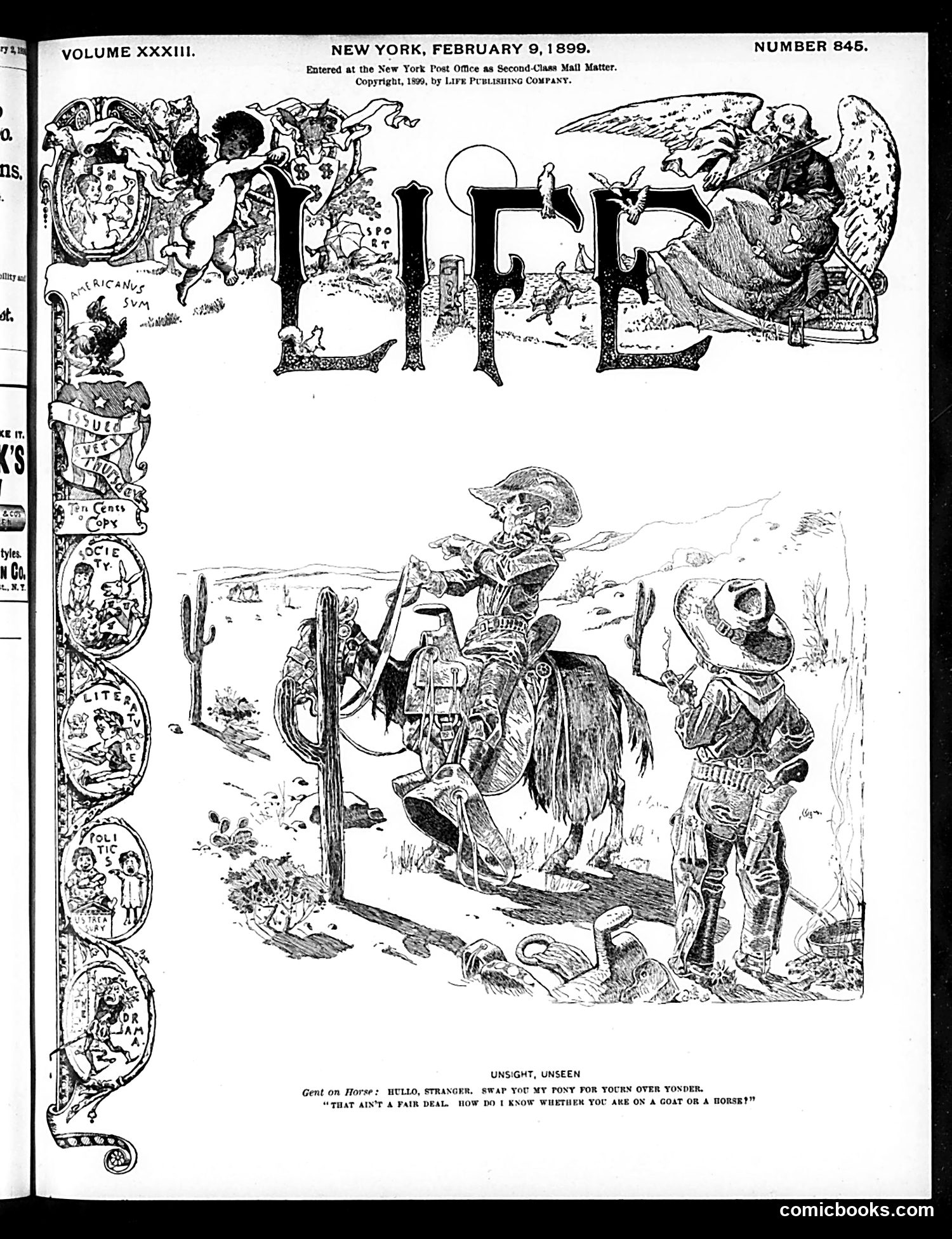
This page features a satirical cartoon titled "Unsight, Unseen" depicting two figures in a desert landscape with cacti. The central figure appears to be a mounted rider (possibly representing a military officer or adventurer) speaking with a standing figure, with the dialogue: "Hello, Stranger, swap yer nix pony for yonder horse? 'That ain't a fair deal. How do I know whether you are on a goat or a horse?'" The joke plays on the absurdity of making an unseen trade in a remote setting—the humor lies in the uncertainty and risk of such a bargain. The desert setting and Western attire suggest this satirizes frontier commerce or blind dealing. The elaborate decorative border on the left contains small seasonal vignettes typical of Life's design aesthetic from this era.
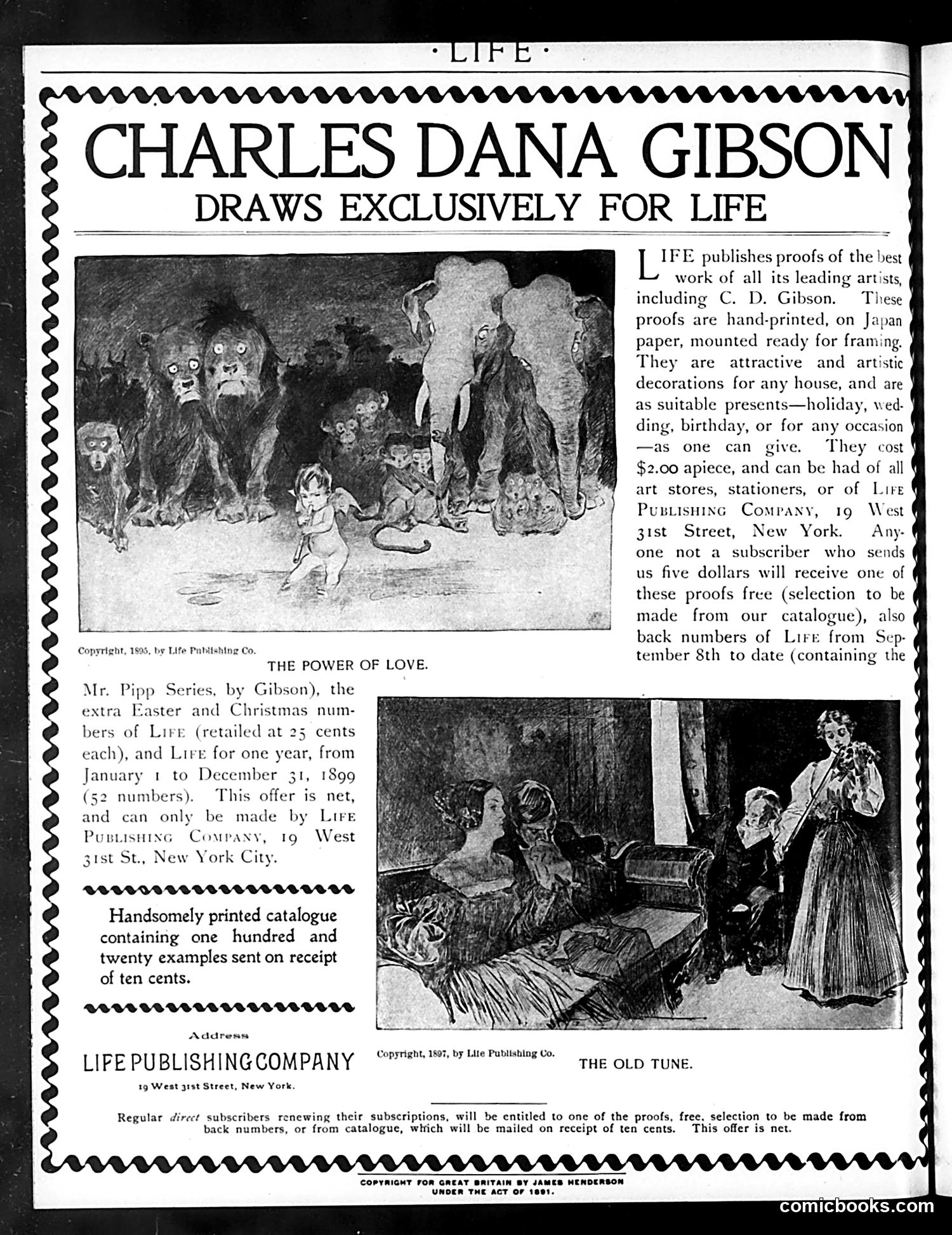
This page is primarily **advertising**, not political satire. It promotes Charles Dana Gibson's artwork available through Life Publishing Company. The two illustrations titled "The Power of Love" and "The Old Tune" appear to be examples of Gibson's drawing style—likely featuring his famous "Gibson Girl" aesthetic popular in the 1890s. The first shows figures (possibly depicting romantic or social dynamics), while the second depicts an interior domestic scene with a woman performing or speaking to an audience. The text offers Gibson's proofs for sale ($2 per piece) and promotes a subscription deal to Life magazine, which would include back issues from September 8th onward. A catalogue of 120 Gibson examples is available for ten cents. This represents **commercial promotion** of Gibson's work rather than editorial commentary.
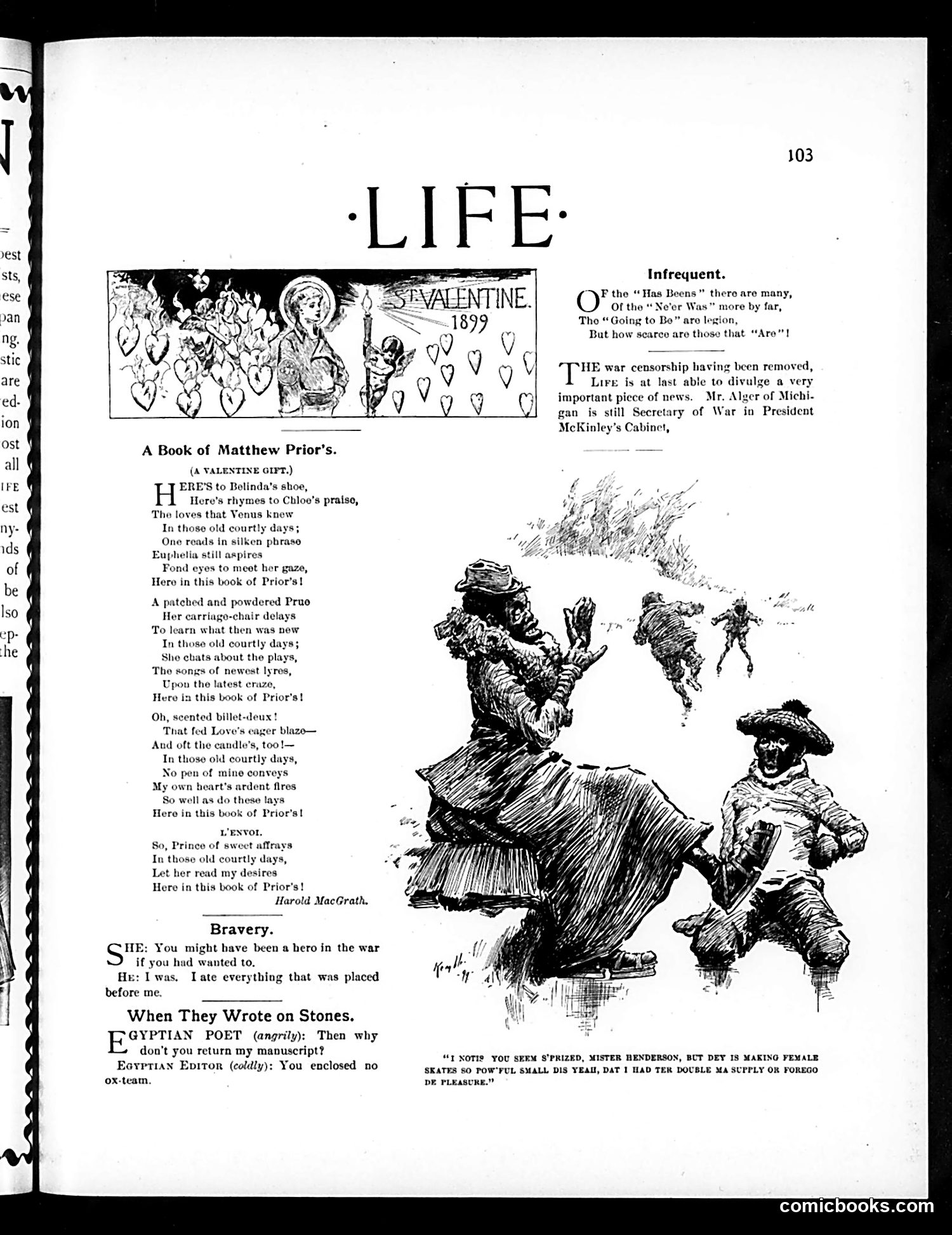
This page from *Life* magazine (dated 1899, based on the Valentine's Day header) contains three distinct pieces: 1. **"A Book of Matthew Prior's"** — A romantic poem celebrating women from literary history, presented as a Valentine's gift. 2. **"Bravery"** — A brief satirical dialogue joking that a war hero's bravery consisted merely of eating everything available, mocking hollow war narratives. 3. **"When They Wrote on Stones"** — A humorous exchange between an "Egyptian Poet" and "Egyptian Editor" about manuscript rejection, using ancient Egypt as a stand-in to satirize contemporary publishing frustrations. The cartoon illustration depicts a woman disciplining misbehaving children, with a caption about inadequate seating for female skaters—likely satirizing Victorian-era public accommodations or gender-specific constraints. The page blends romance, wartime mockery, and publishing humor typical of *Life*'s satirical approach.
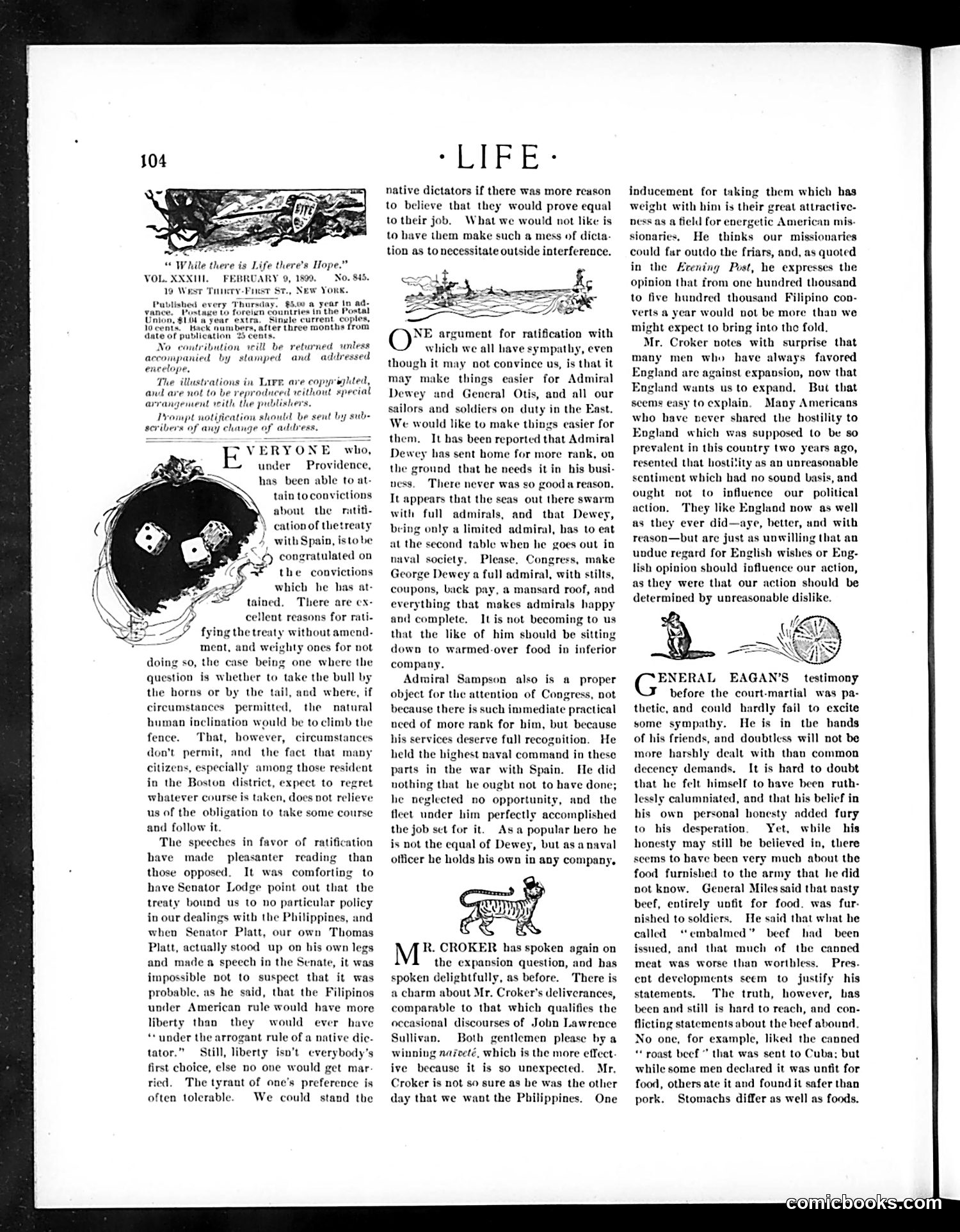
This page discusses American naval expansion and the Philippines debate, likely from the Spanish-American War era (1898). The text critiques arguments for Philippine annexation while defending Admiral Dewey and other military figures. **The cartoons** show dice and a cat—apparently satirizing chance and risk-taking in imperial policy decisions. **Key references**: Mentions Admiral Dewey (victor at Manila Bay), General Otis, and Senator Lodge's pro-expansion stance. The text argues that English hostility toward American expansion shouldn't influence U.S. policy, and defends Dewey and Admiral Sampson against critics questioning their rank and compensation. **The satire's point**: Mocking both expansionist arguments and critics' complaints about military leadership during imperial debates.
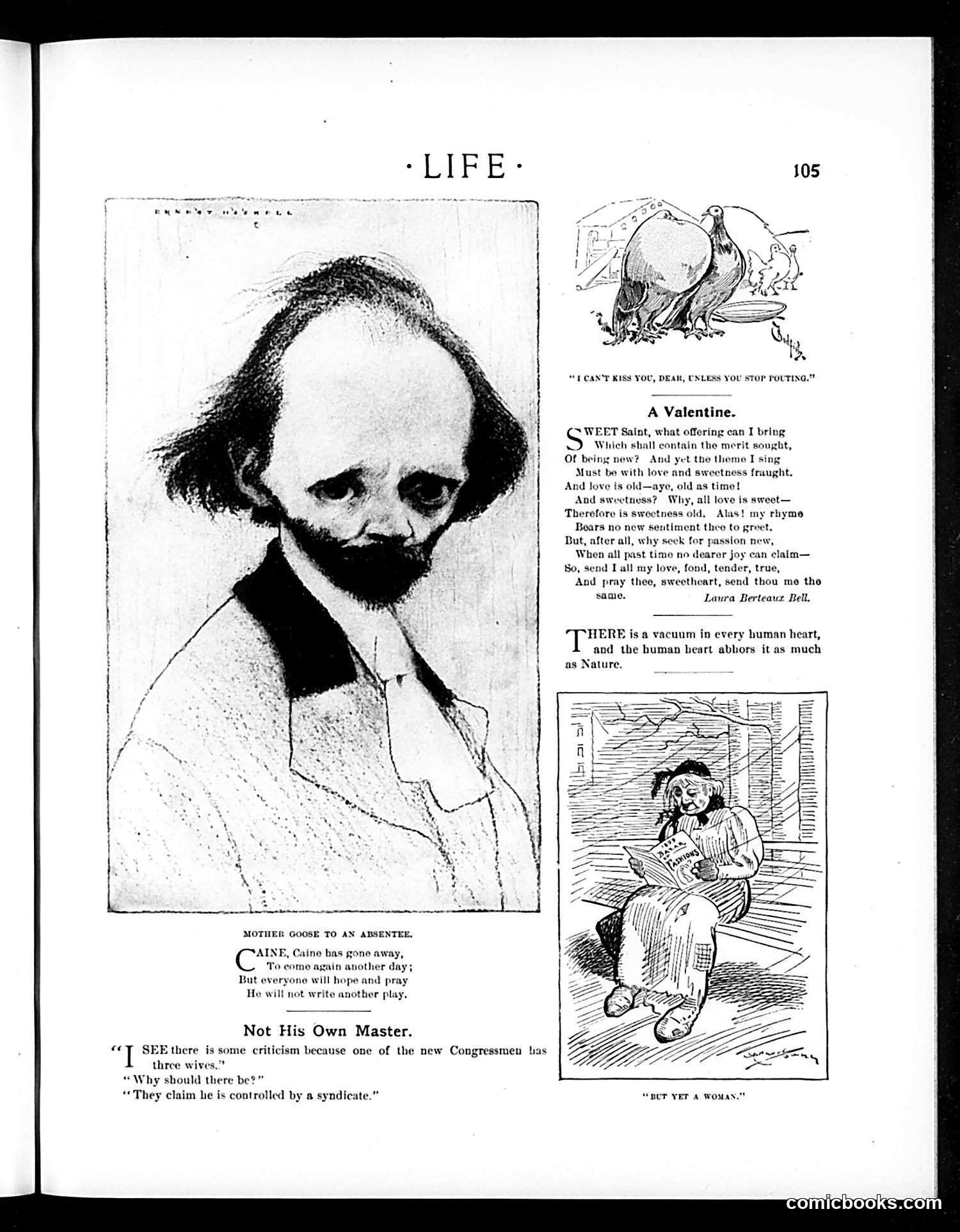
**Main Content:** The left portrait appears to be a caricature of a bearded man, labeled "Mother Goose to an Absentee," suggesting a literary or political figure. The accompanying poem "Caine" references someone named Caine who has gone away. **"Not His Own Master" Cartoon:** This section satirizes a new Congressman with three wives, mocking him as controlled by a "syndicate" rather than being independent. This appears to be commentary on political corruption or the influence of special interests over elected officials. **Other Elements:** "A Valentine" poem explores romantic themes. Two cartoon vignettes show domestic/relationship scenarios with humorous captions ("I can't kiss you, dear, unless you stop pouting" and "But yet a woman"). The satire critiques loss of political autonomy and questions who truly controls elected representatives.
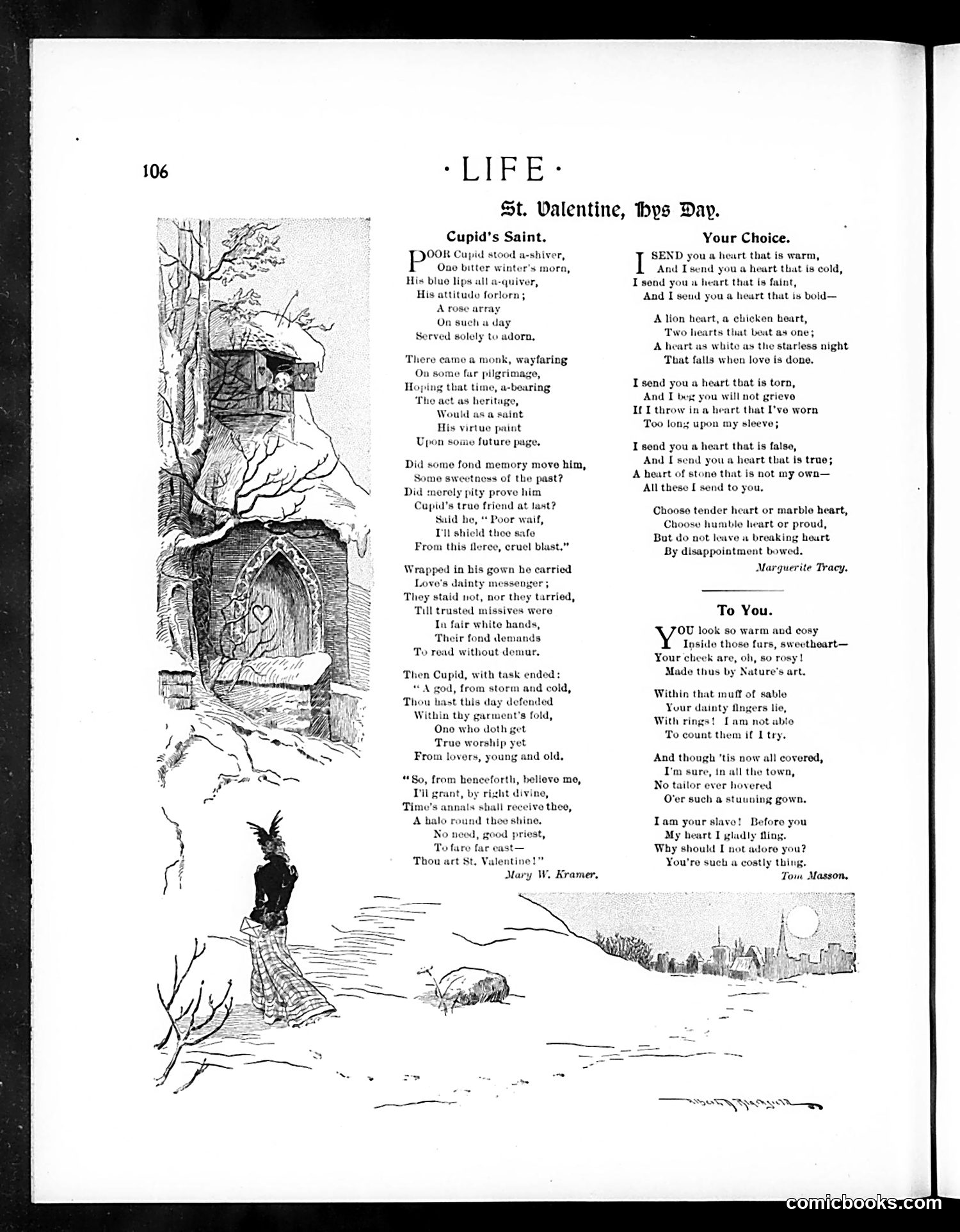
This page from *Life* magazine presents three romantic poems for St. Valentine's Day (February 14th). The content is entirely literary rather than satirical or political. "Cupid's Saint" by Mary W. Kramer presents a sentimental narrative about Cupid delivering love messages. "Your Choice" by Margarette Tracy offers women options for the type of heart to send ("tender," "marble," or "bold"). "To You" by Tom Mason expresses romantic admiration. The accompanying illustrations—showing a figure in winter clothing, a bird, and a cityscape—are decorative rather than caricatural. This appears to be straightforward Valentine's Day entertainment for the magazine's readers, focused on romantic sentiment rather than social commentary or satire.
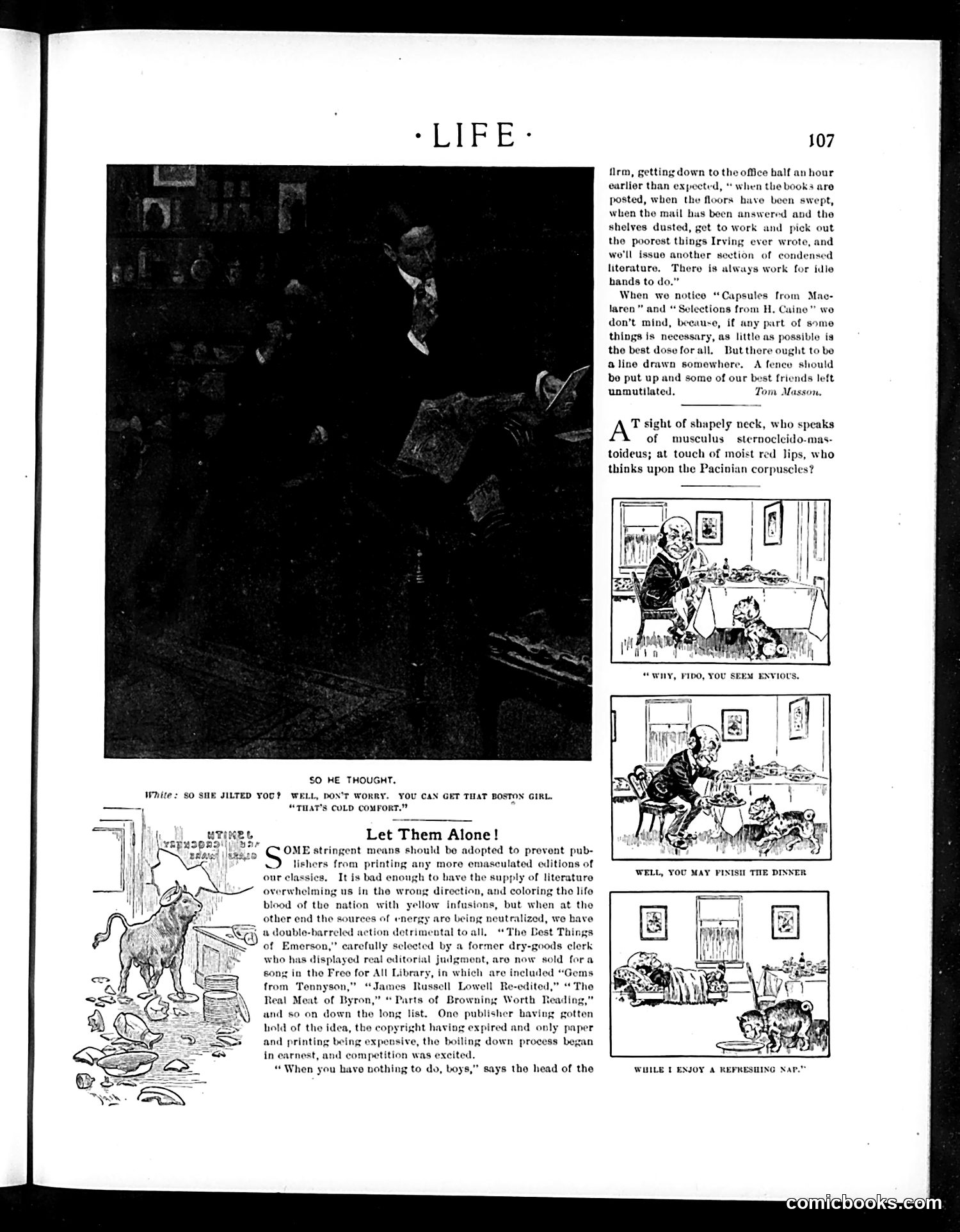
This page contains editorial commentary and comic strips satirizing American publishing practices. **Main Article ("Let Them Alone!")**: Criticizes publishers for reprinting condensed or abridged versions of classic literature—including works by Tennyson, Lowell, and Browning—in cheap formats. The satirist argues this dilutes literature's quality and accuses publishers of prioritizing profit over cultural value. The accompanying cartoon shows a dog destroying a library, suggesting such "boiled down" editions are themselves wasteful. **Comic Strips (right side)**: Depict a domestic scene where a child asks his mother "Why, Fido, you seem envious," presumably commenting on the dog's apparent frustration—likely a visual pun reinforcing the article's point about degraded literary products. The satire mocks commercialized literature aimed at mass audiences rather than serious readers.
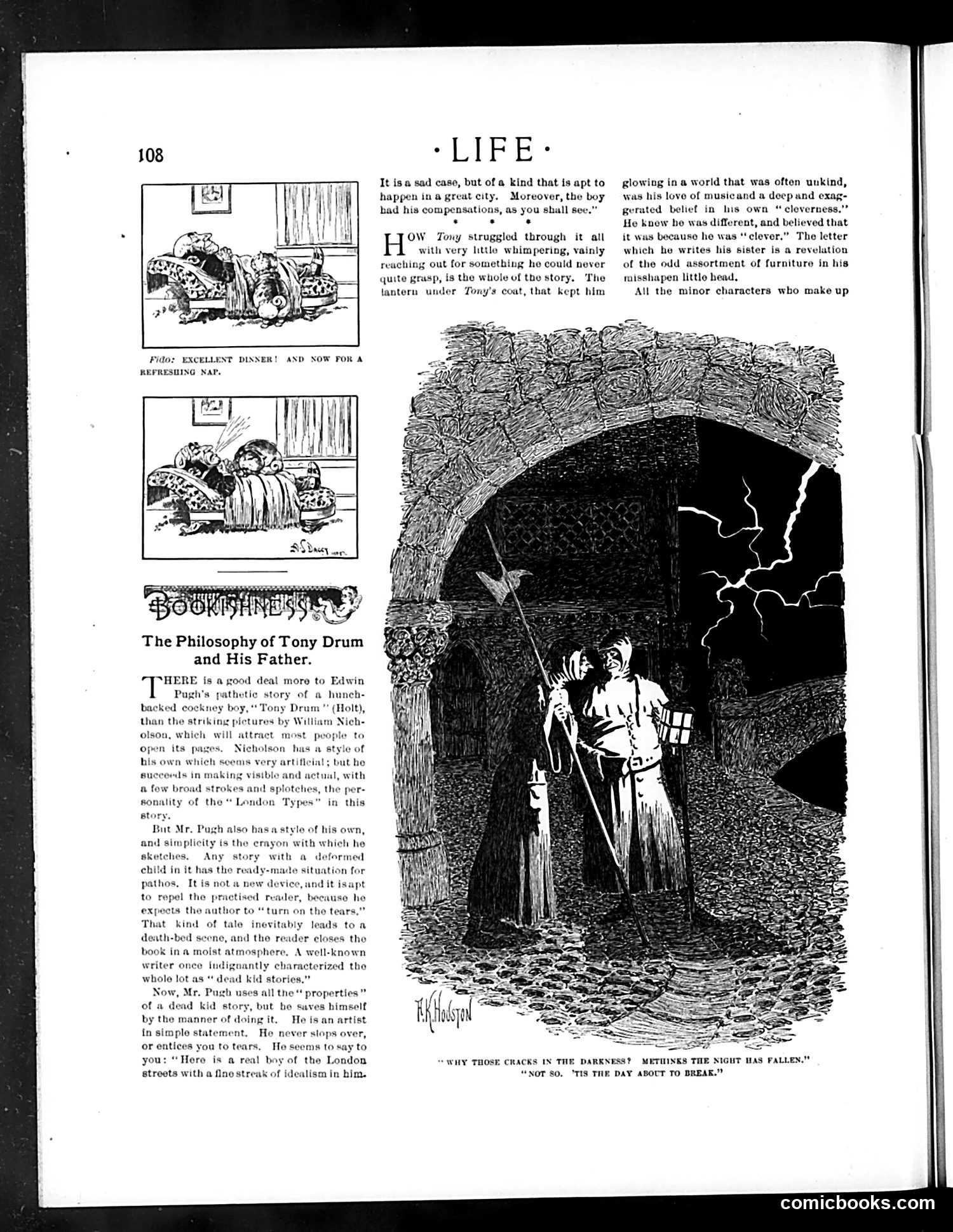
This page reviews a serialized story by William Nicholson about "Tony Drum," a working-class London boy and his father. The text praises Nicholson's artistic style—his ability to convey pathos and realism through simple, bold crayon sketches that capture "dead-lit stories" and authentic London street life with "a firestruck idealism." The large illustration shows a figure in a doorway during a thunderstorm, with the caption referencing "cracks in the darkness" and "the night has failed" suggesting hardship and despair. The smaller sketches above depict domestic scenes—meals and rest—emphasizing the story's focus on humble, ordinary working-class life rendered with emotional depth rather than sentimentality.
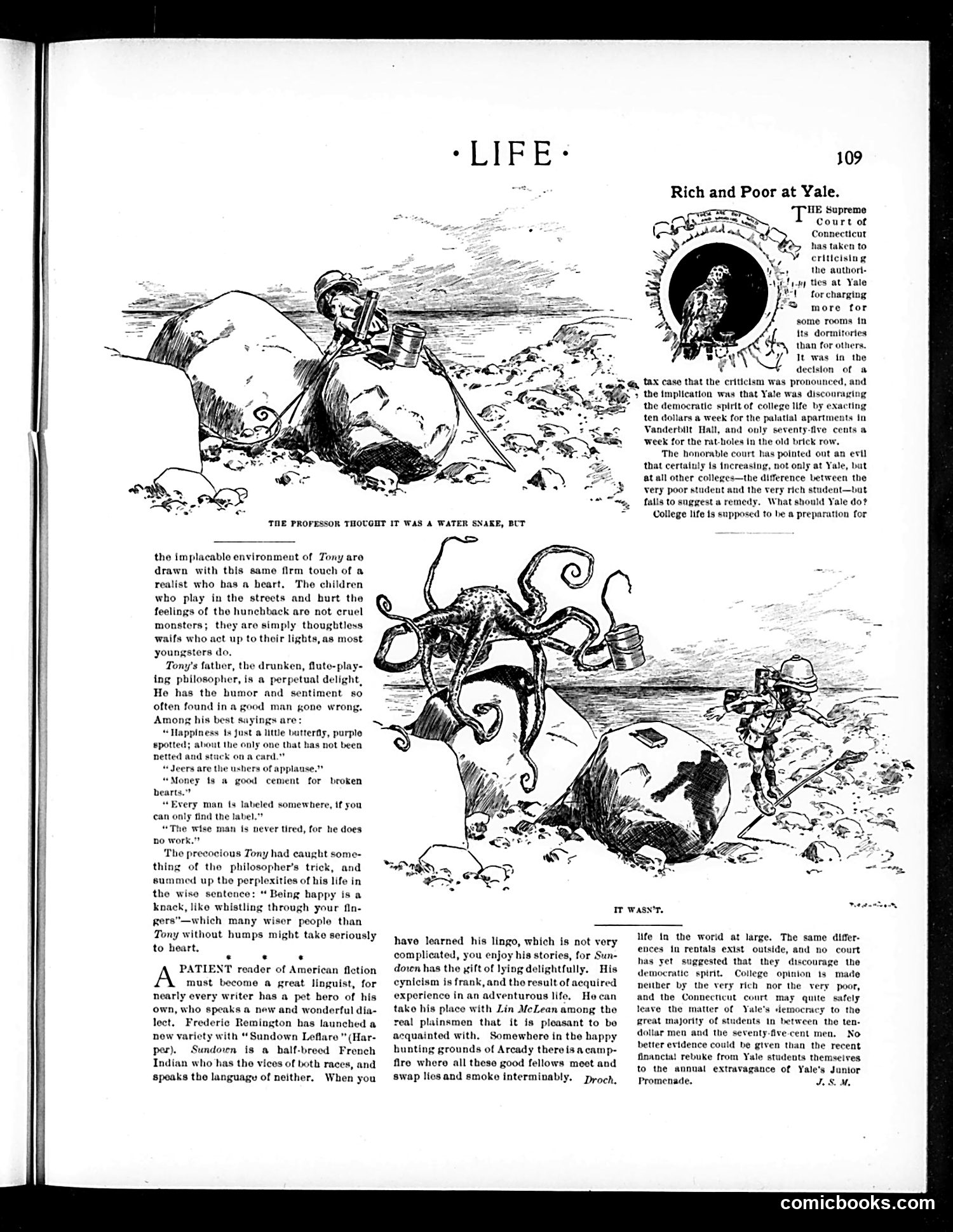
This page critiques wealth inequality at Yale University through satirical illustrations and text. The top cartoon shows a disheveled poor student mistaking a water snake for a common object, suggesting the desperation of poverty. The lower cartoon depicts an octopus labeled "It Wasn't," likely representing some institutional problem or entanglement. The accompanying article discusses how Yale's democratic ideals supposedly clash with the stark differences between wealthy and poor students. It references a Connecticut Supreme Court case criticizing Yale for this disparity, arguing the university discourages democratic spirit by exacting such economic divisions. The text suggests college life should prepare students for broader society, implying Yale's wealth gap creates an unrealistic, privileged bubble disconnected from real-world conditions most Americans face.
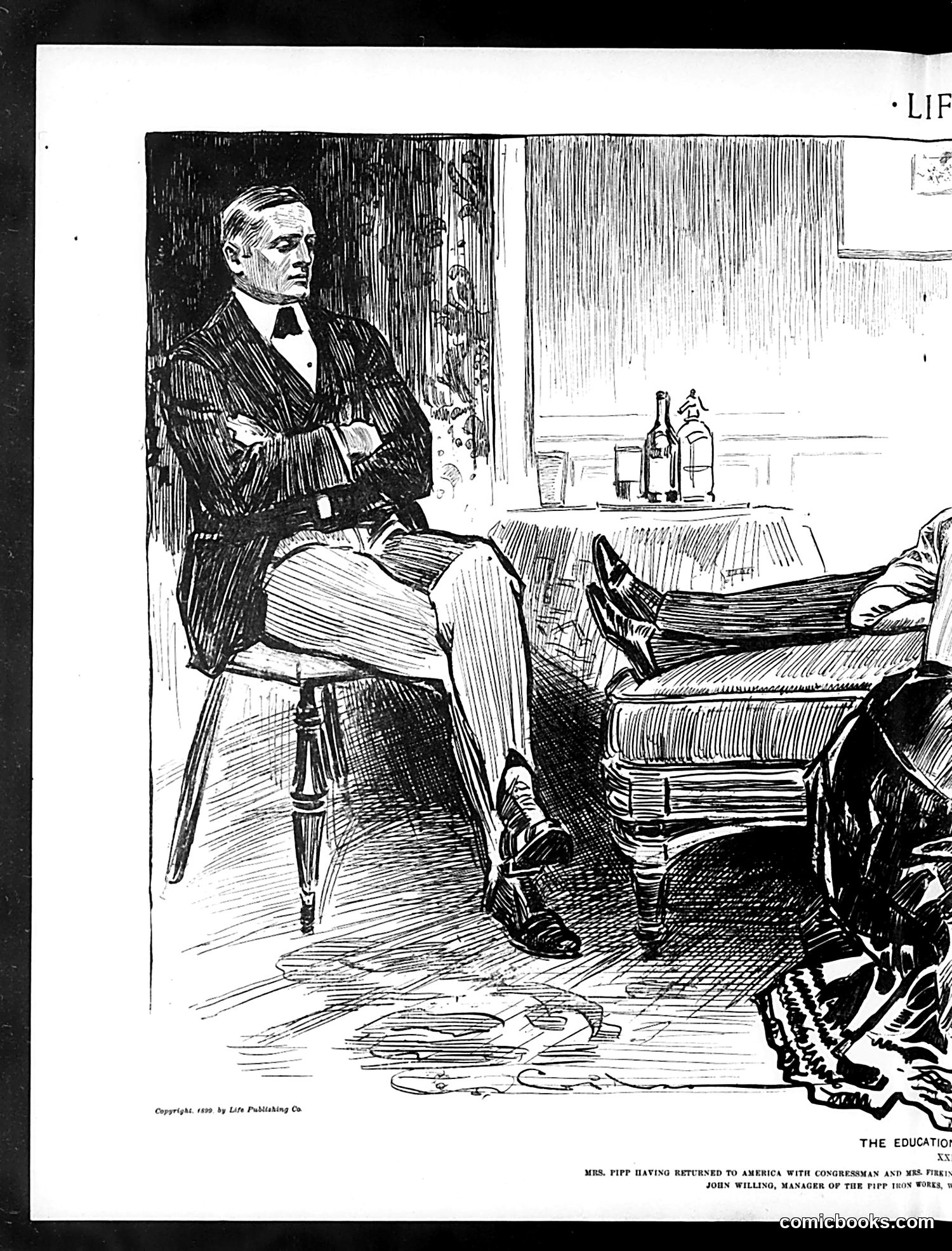
This is a satirical illustration from Life magazine (copyright 1898) depicting a scene titled "MRS. PIPP HAVING RETURNED TO AMERICA WITH CONGRESSMAN AND MR. PIPP'S FRIEND JOHN WILLING, MANAGER OF THE PIPP IRON WORKS." The cartoon shows a well-dressed man seated in what appears to be a parlor, with bottles on a side table and another figure visible on the right. The satire appears to mock domestic or social pretensions—likely Mrs. Pipp's return from abroad with her companions. The presence of bottles suggests commentary on drinking habits or social indulgence among the wealthy or business class. The specific political or social scandal referenced is unclear without additional context, though the involvement of a congressman and an iron works manager suggests criticism of business-political connections or marital/romantic impropriety among the upper classes.
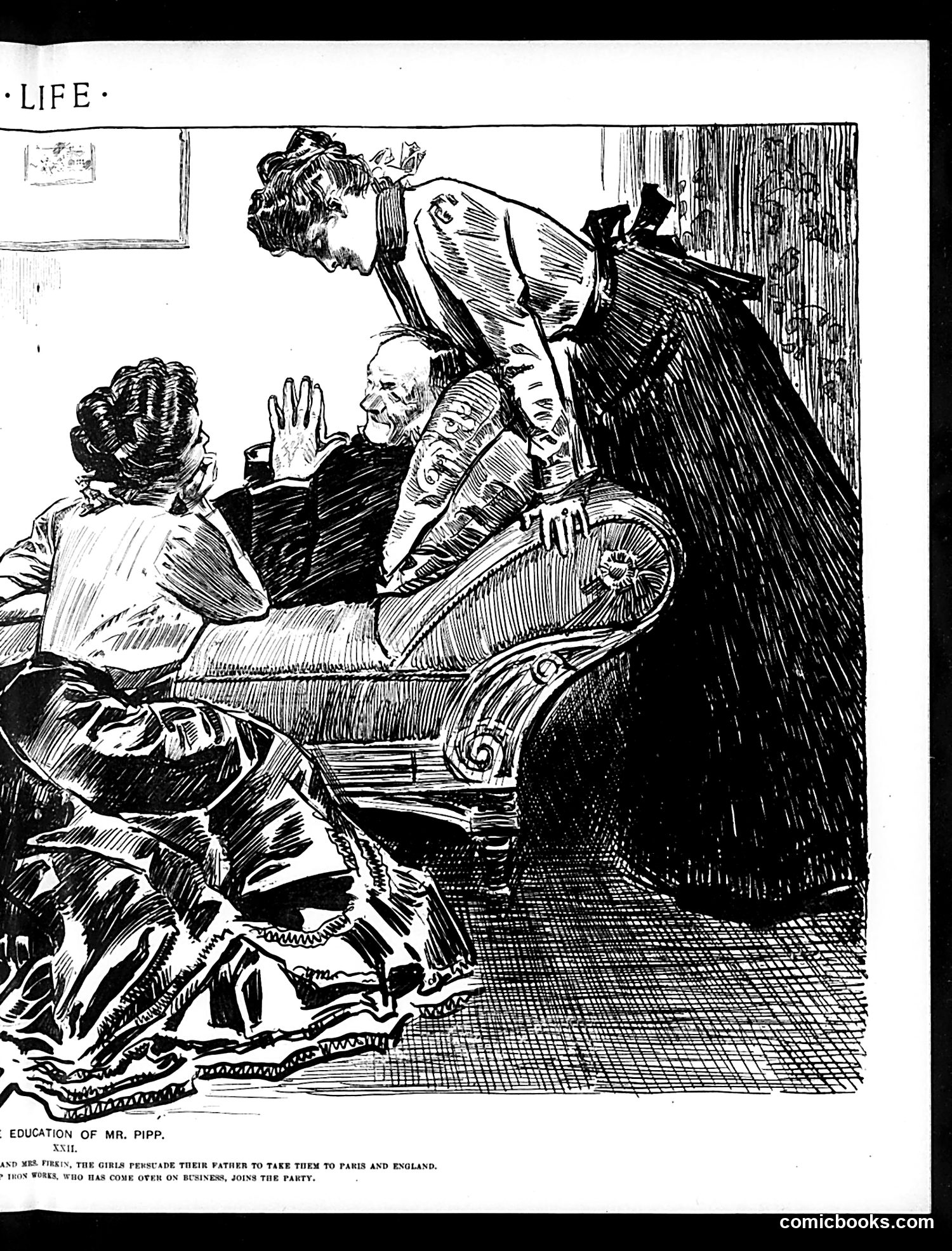
This satirical cartoon depicts a wealthy man (Mr. Pipp) in an interior setting with elegantly dressed women and another gentleman. The caption indicates that "Mr. Pipp, the girls persuade their father to take them to Paris and England" and mentions "Iron Works, who has come over on business, joins the party." The satire appears to target nouveau riche industrialists—specifically someone in iron manufacturing—whose social pretensions and willingness to be manipulated by family members into extravagant European travel serves as the joke. The cartoon mocks both his lack of sophistication and his apparent eagerness to finance his daughters' continental aspirations, suggesting he's being "educated" (figuratively schooled/fleeced) through his family's social ambitions.
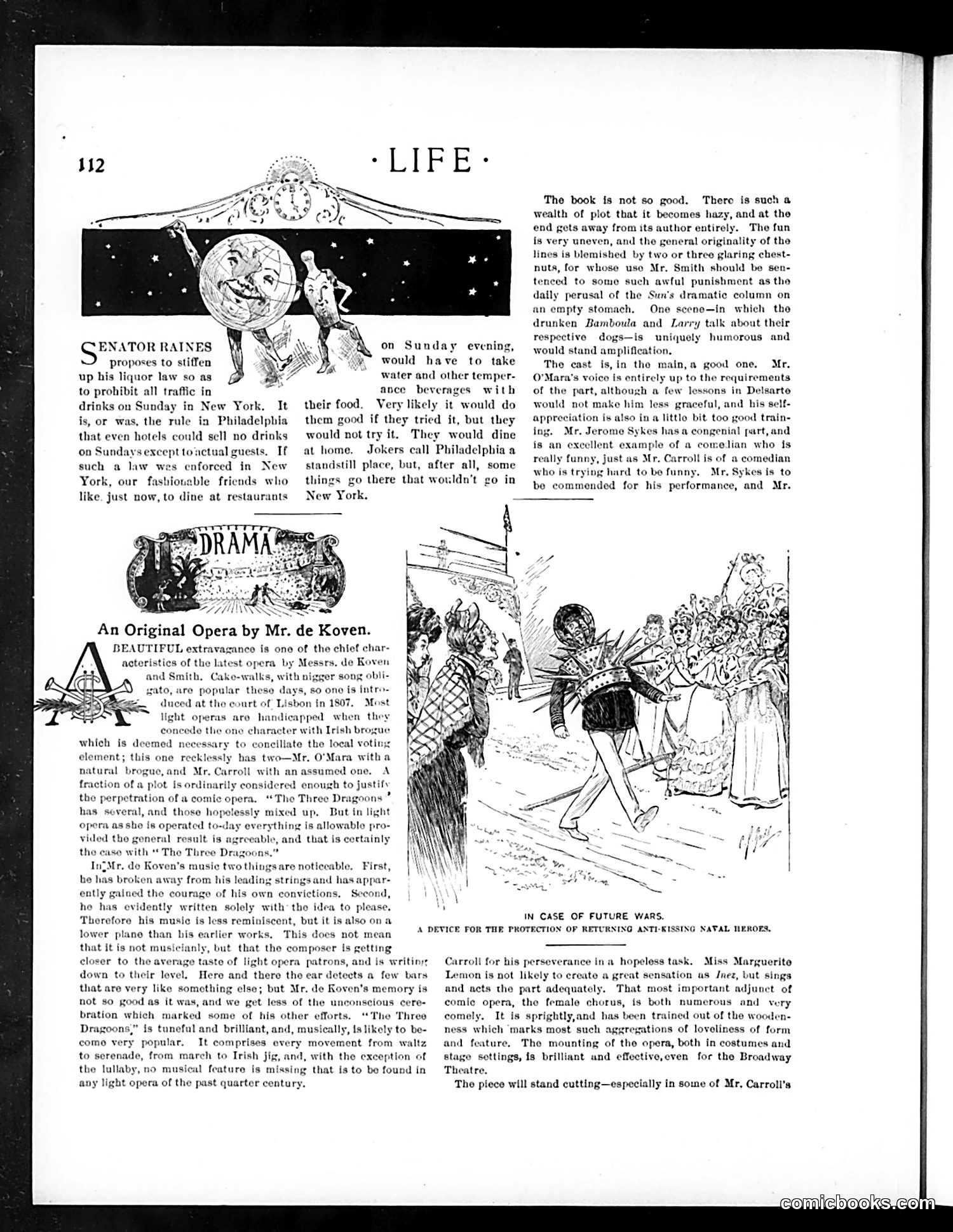
This page contains two distinct items: **Top section**: A satirical piece about Senator Raines proposing to stiffen liquor laws on Sundays in New York. The accompanying cartoon mocks the hypocrisy—showing well-dressed diners at restaurants who would circumvent such laws by dining out instead of at home. The joke targets the futility of prohibition measures that the wealthy could easily evade. **Bottom section**: A theater review of "The Three Dragons," an original opera by Mr. de Koven. The review discusses the work's musical qualities and cast performances. An illustration shows a comedic scene labeled "In Case of Future Wars: A Device for the Protection of Returning Anti-Kissing Naval Heroes"—likely satirizing post-war romantic complications. Both items reflect early 20th-century American concerns about Prohibition, class privilege, and social customs.
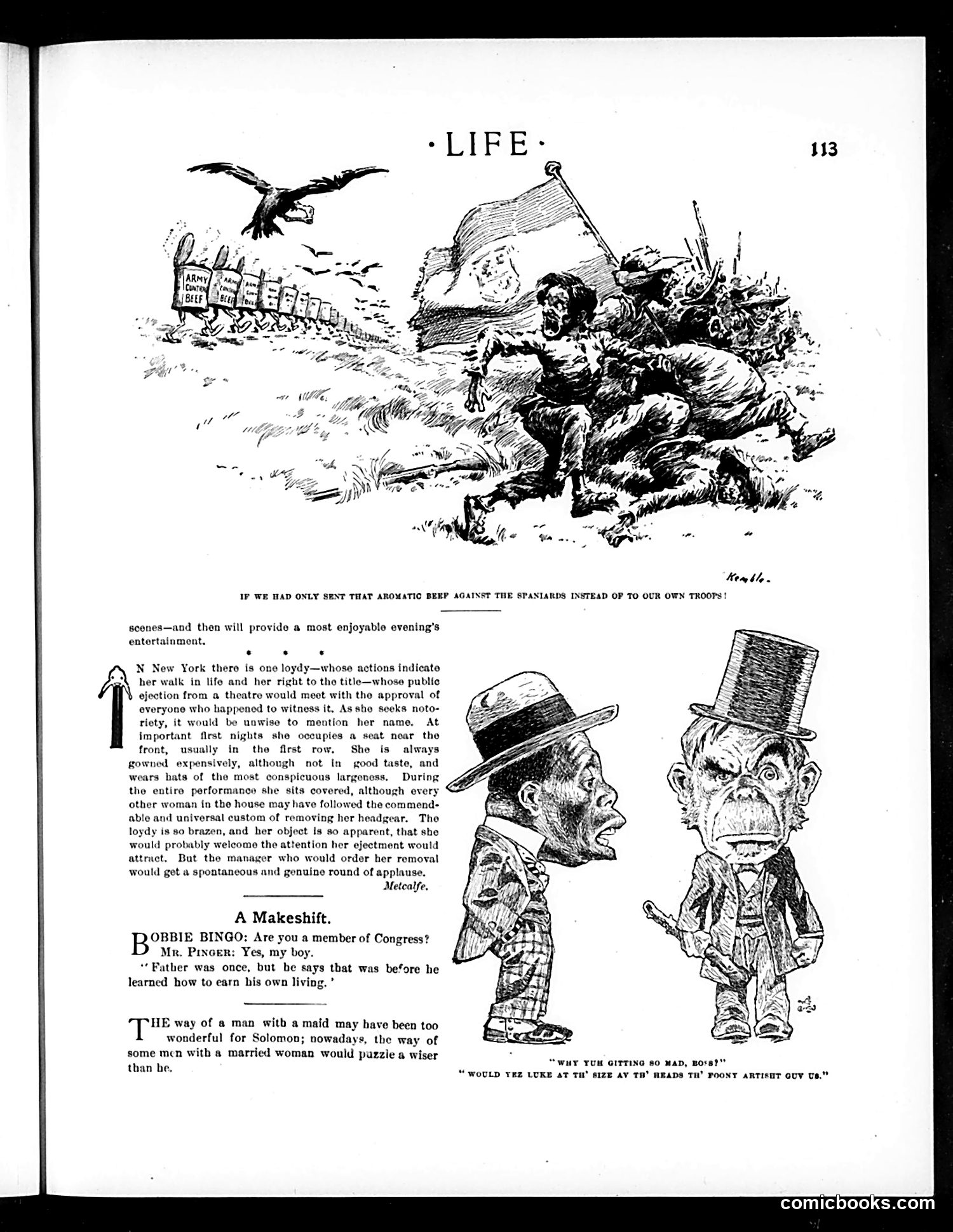
**Top Cartoon (by Kemble):** Depicts soldiers in combat, with the caption sarcastically suggesting that if America had sent "aromatic beef" (canned meat rations) against the Spanish instead of to its own troops, it would have been more effective as a weapon. This references the Spanish-American War (1898) and the notorious scandal over spoiled or low-quality provisions supplied to American soldiers—a major public complaint during the conflict. **Middle Section (by Metcalfe):** Describes a wealthy New York woman who deliberately wears conspicuously large hats to theater performances and refuses to remove them, blocking other patrons' views. She seeks notoriety through disruption. The author suggests her ejection would earn applause, mocking attention-seeking behavior among the social elite. **Bottom Dialogue:** A brief joke where "Mr. Pincer" boasts his father was in Congress but "learned how to earn his own living"—implying congressmen don't actually work or earn honestly, a common contemporary jab at political corruption. **Caricatures (right side):** Appear to be exaggerated political or social figures, though specific identities are unclear.
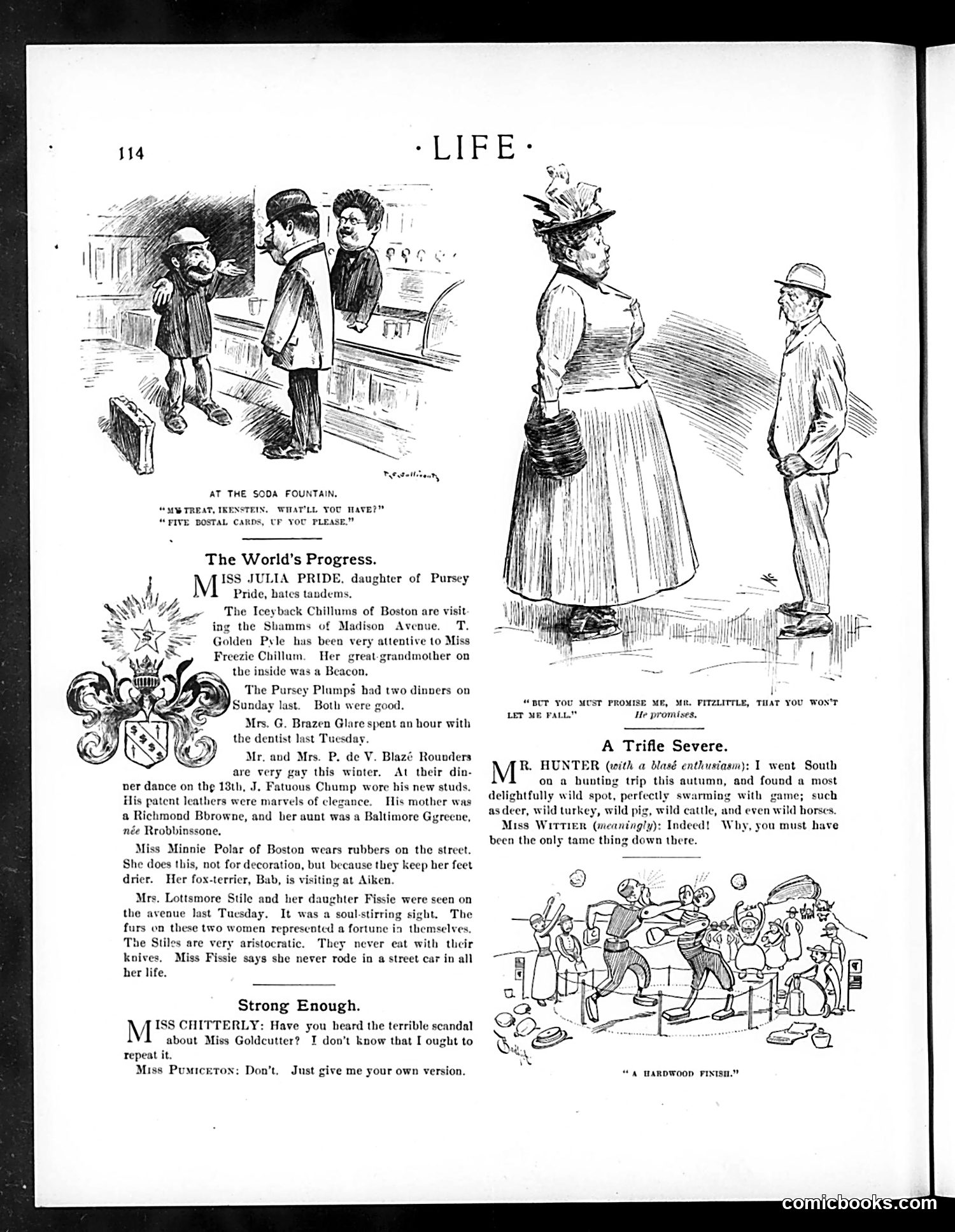
This page from *Life* magazine contains several satirical pieces mocking high society pretensions and social climbing: **"At the Soda Fountain"**: A working-class child asks a soda fountain attendant for "five royal cards" (likely "royal" being a mistaken pronunciation), revealing linguistic/class differences that comedians of the era exploited. **"The World's Progress"**: A gossip column with deliberately absurd names (*Pursey Pride*, *Freezie Chillum*, *Fatuous Chump*) satirizing society's obsession with genealogy, wealth display, and trivial social events. References to Boston and Madison Avenue suggest old money versus new money tensions. **"Strong Enough"**: A brief joke about how scandal-mongering society women claim moral reluctance while eagerly spreading gossip anyway. **"A Trifle Severe"**: A hunter's boast about wildlife is deflated when a woman suggests the only "tame thing" in the South was him—a sexual innuendo joke. The cartoons mock Gilded Age class consciousness, aristocratic pretension, and social hypocrisy typical of early 20th-century American satire.
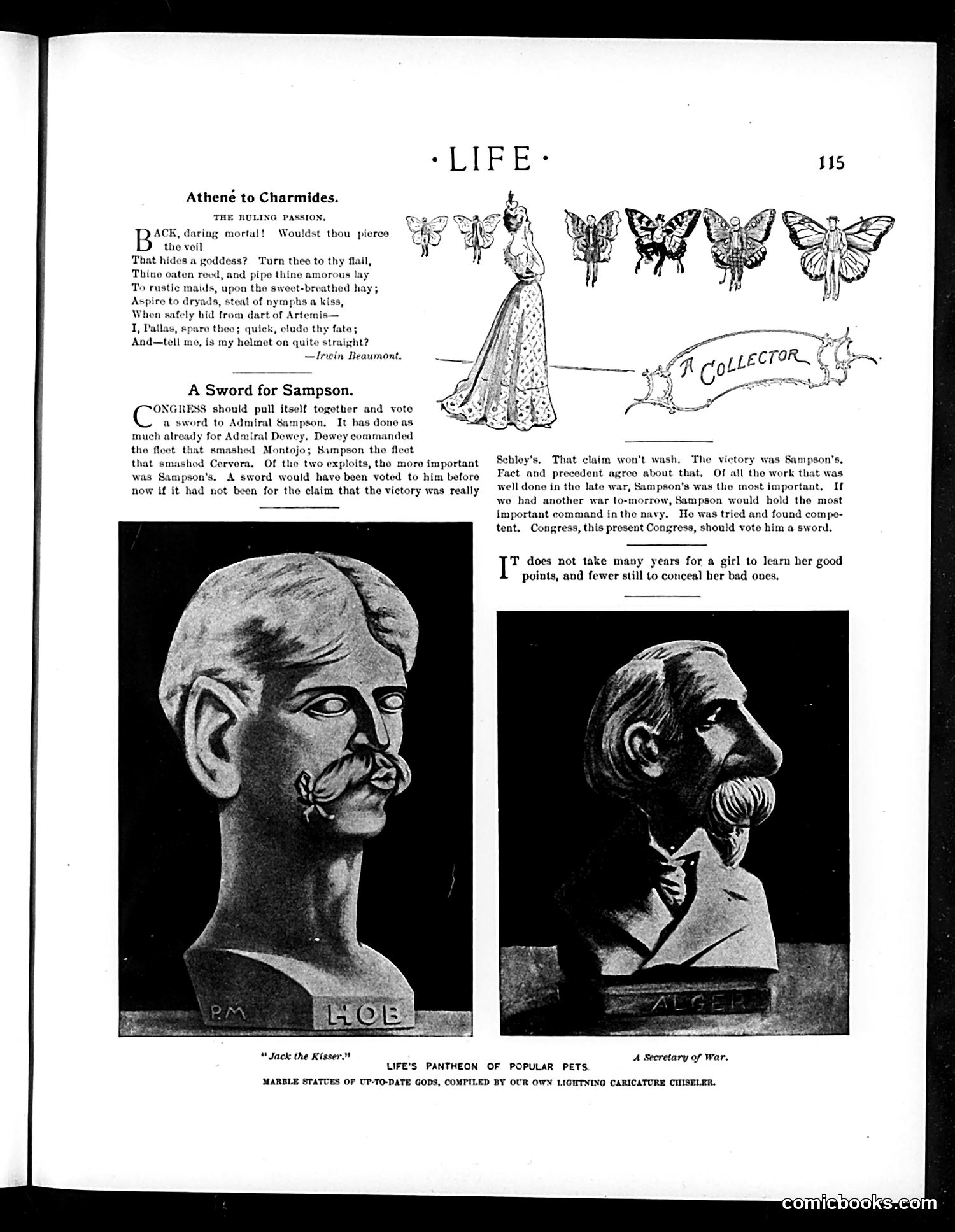
This page contains two main satirical pieces from Life magazine's early period (likely 1890s-1900s, based on references). **"A Sword for Sampson"** argues that Admiral Sampson deserves Congressional recognition equal to Admiral Dewey for his naval victories. The satire critiques Congress for delaying Sampson's sword while awarding one to Dewey, suggesting the delay stems from a dispute over credit—possibly involving Commodore Schley. The piece uses mock-heroic language to pressure Congress into honoring military achievement consistently. **"Life's Pantheon of Popular Pets"** shows marble busts labeled "Jack the Kisser" and "A Secretary of War." These appear to be caricatured contemporary figures whose identities aren't entirely clear from the image alone. The "pantheon" format satirizes how the public elevates certain public figures to near-heroic status. The butterflies and classical poem at top provide decorative, ironic contrast—suggesting elevated artistic taste amid mundane political squabbling.
This page contains three humorous anecdotes typical of Life's satirical content: 1. **The Jelly Guarantee**: A clerk refuses to guarantee a customer's homemade jelly, only the store's products—a joke about commercialism and the dismissal of domestic goods in favor of branded merchandise. 2. **The Canon/Conan Mix-up**: A convent mistakenly reads Sir Arthur Conan Doyle's romantic fiction instead of Canon Doyle's religious work. The humor lies in the shocked nuns discovering they've been enjoying love stories, yet the mother superior pragmatically decides not to waste paid-for material. 3. **The Opera Singer's Polyglot Solo**: A French opera performer, confused by having multiple names on the program (Charles Maurel/Señor Maurelli), forgets his Italian lyrics mid-performance and improvises in mixed languages—poking fun at both the opera world's pretensions and immigrant linguistic confusion. The page also advertises bound volumes of *Life* magazine and various commercial products.
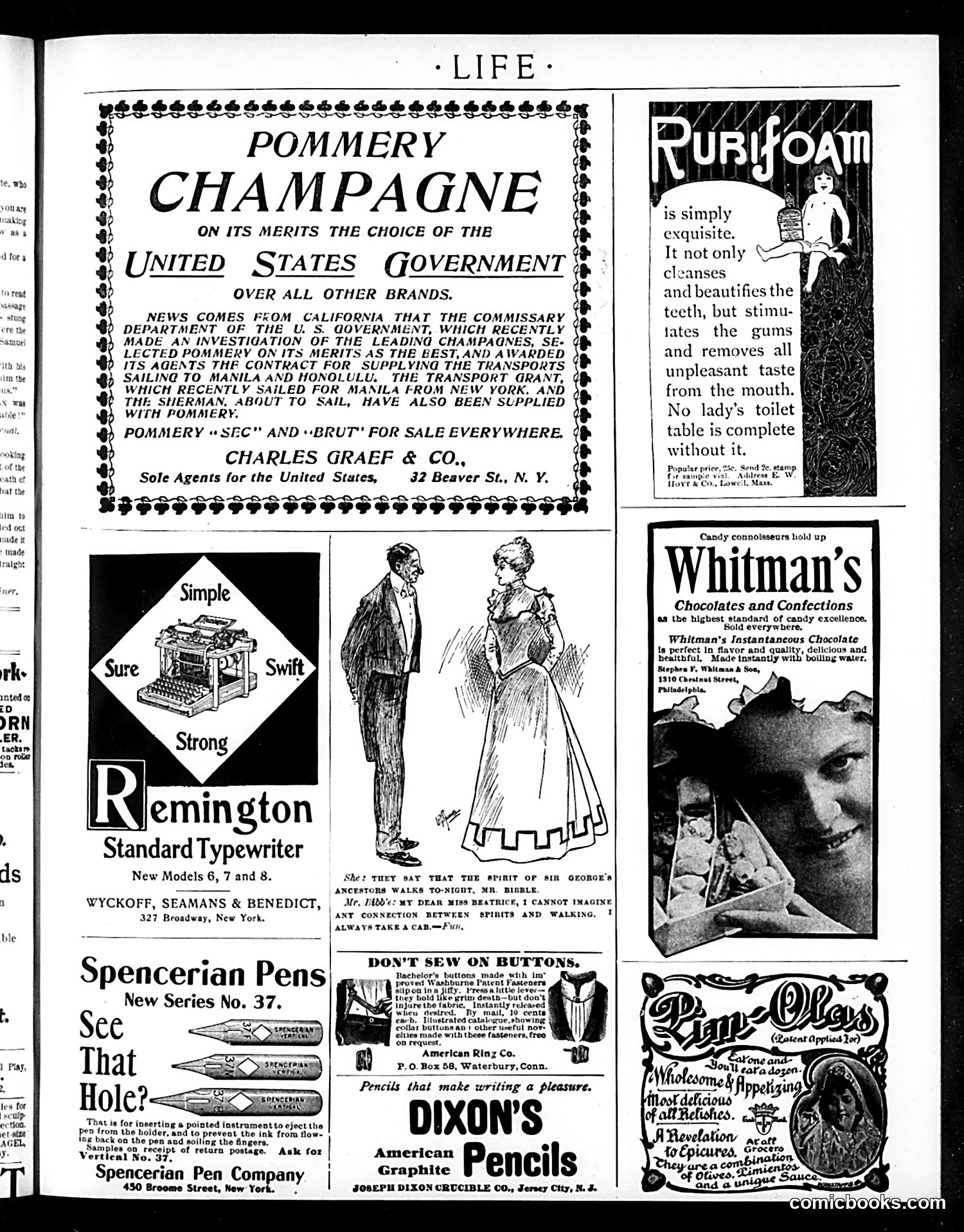
This page is primarily **advertising**, not political satire. The dominant content consists of product advertisements typical of early 1900s American magazines. The **one cartoon** present depicts a man and woman in evening dress. The caption references "spirits" walking at night—a genteel Victorian-era joke playing on double meaning: the woman alludes to ghosts ("the spirit of Sir George's ancestors"), while the man deliberately misinterprets this as referring to alcohol ("spirits"), making a joke about needing a cab ride home after drinking. The **Pommery Champagne advertisement** at top references the Spanish-American War, mentioning U.S. government contracts for transports sailing to Manila and Honolulu, suggesting this page dates to circa 1898-1900. This is historical context rather than satire—advertising legitimacy through official government selection. The remaining content—typewriters, pens, pencils, chocolate, toothpaste—represents standard product marketing without satirical commentary.
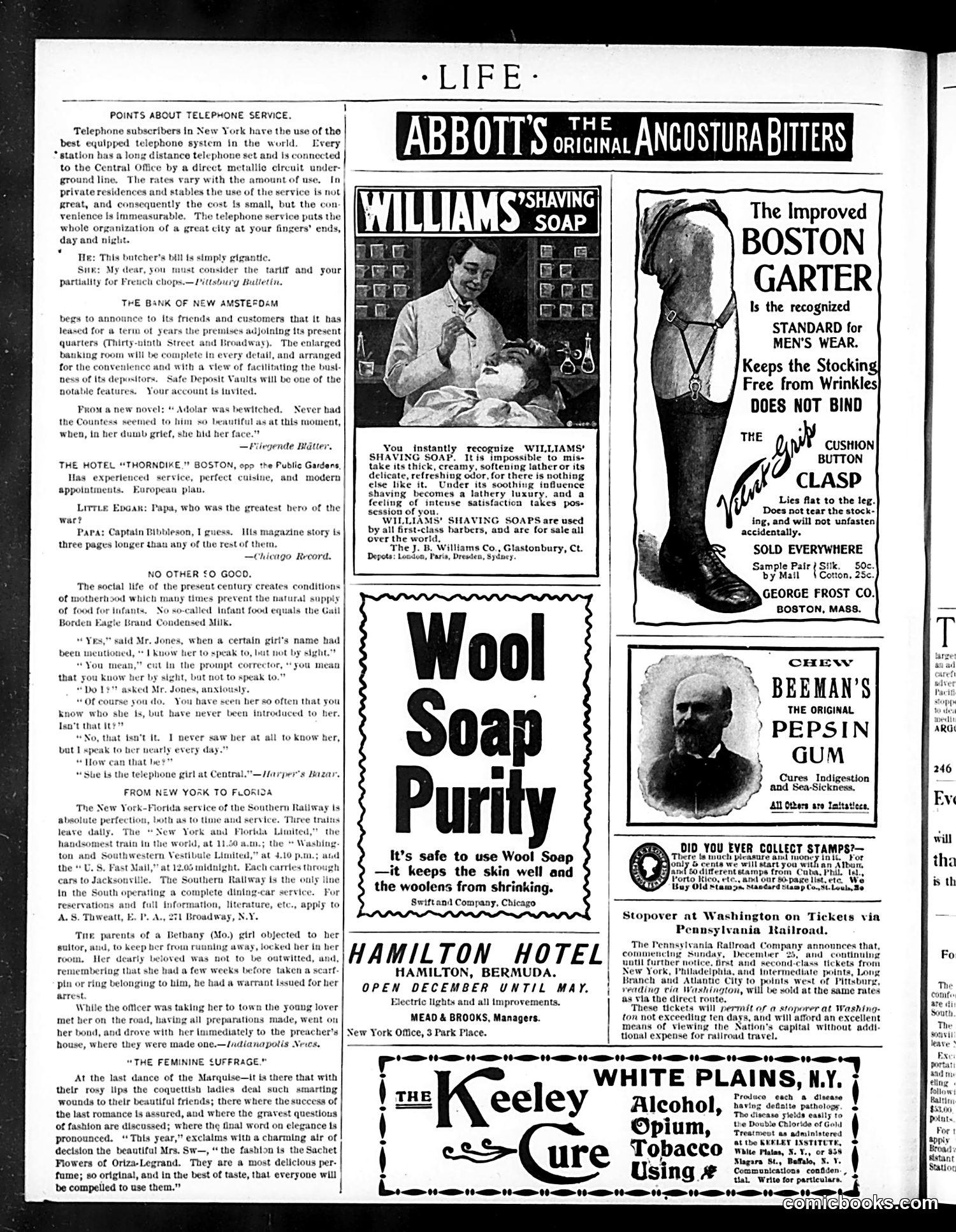
This page is primarily **advertising with brief satirical jokes and news items** — not a political cartoon. The advertisements promote consumer products (Williams' Shaving Soap, Boston Garter, Wool Soap Purity, Beeman's Pepsin Gum, and The Keeley Cure for alcohol/opium addiction). These reflect turn-of-century concerns: grooming standards, proper dress, personal hygiene, and substance abuse. The small jokes scattered throughout are typical *Life* magazine humor. One jokes about a butcher's bill and tariffs; another plays on the telephone operator as an unseen acquaintance. A third notes that a magazine story's hero's popularity derives from page count rather than merit. **Key historical context for modern readers:** These ads reveal what anxieties preoccupied Americans then—addiction treatment was openly advertised, garters were essential menswear, and product purity was a selling point (suggesting food/medicine safety concerns). The tone is lighthearted, not satirizing specific political figures or events.
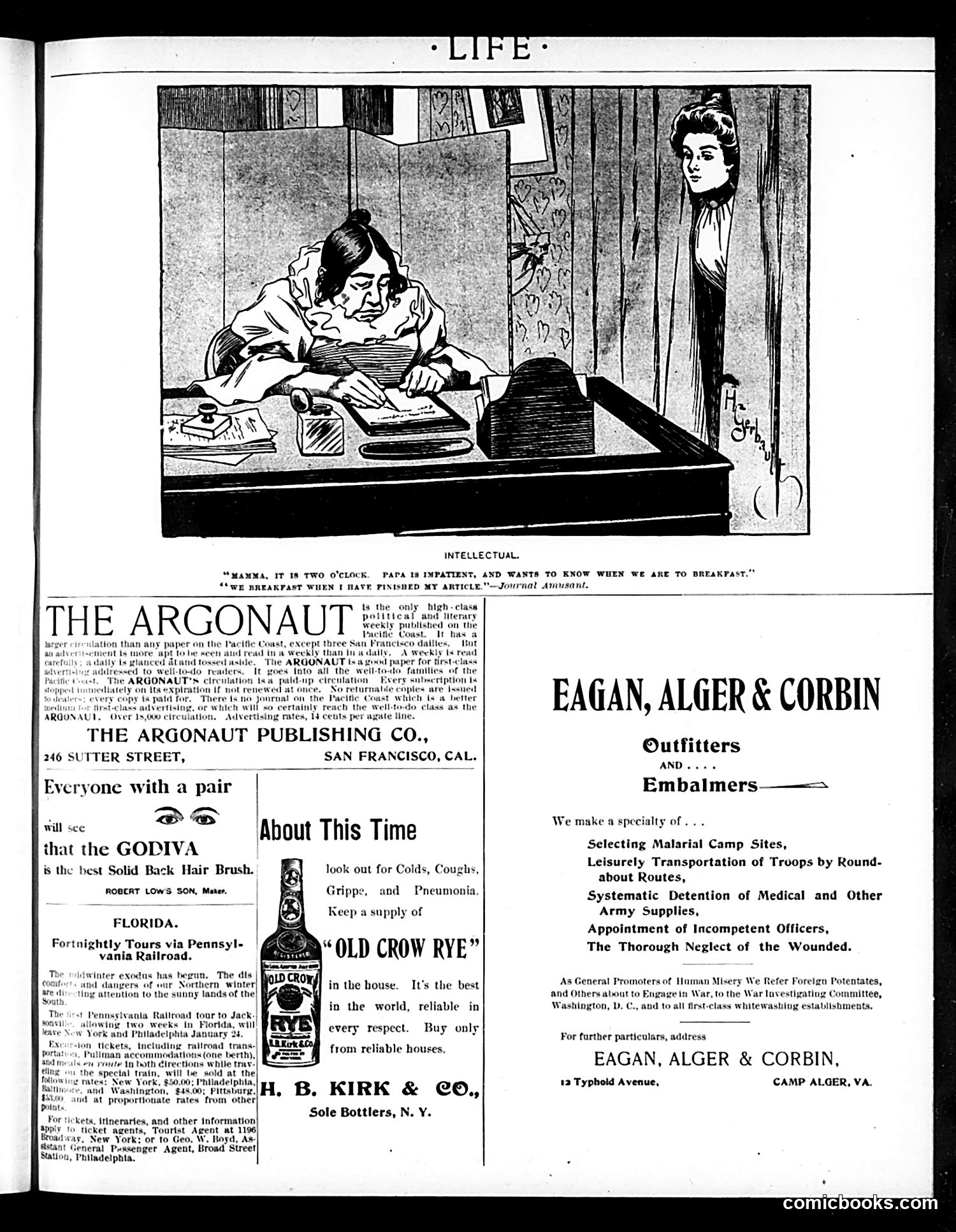
**The Cartoon:** The titled illustration "Intellectual" satirizes absent-minded scholars. A man sits hunched at his desk, absorbed in writing an article, while a woman (presumably his wife) stands in the doorway reporting that their father is impatient and asking when breakfast will be served. The man's response—"We breakfast when I have finished my article"—exemplifies the stereotype of the impractical intellectual so absorbed in his work that he neglects basic domestic responsibilities and family needs. The satire targets the self-absorbed academic, suggesting that intellectual pursuits create social friction and absurd household dysfunction. This reflects a common turn-of-the-century cultural anxiety about "too much" education making people unworldly and irresponsible. **The Page Content:** The remainder consists primarily of advertisements and notices for *The Argonaut* (a San Francisco weekly), hair brushes, railroad tours, whiskey, and funeral services—typical period advertising with no apparent satirical intent.
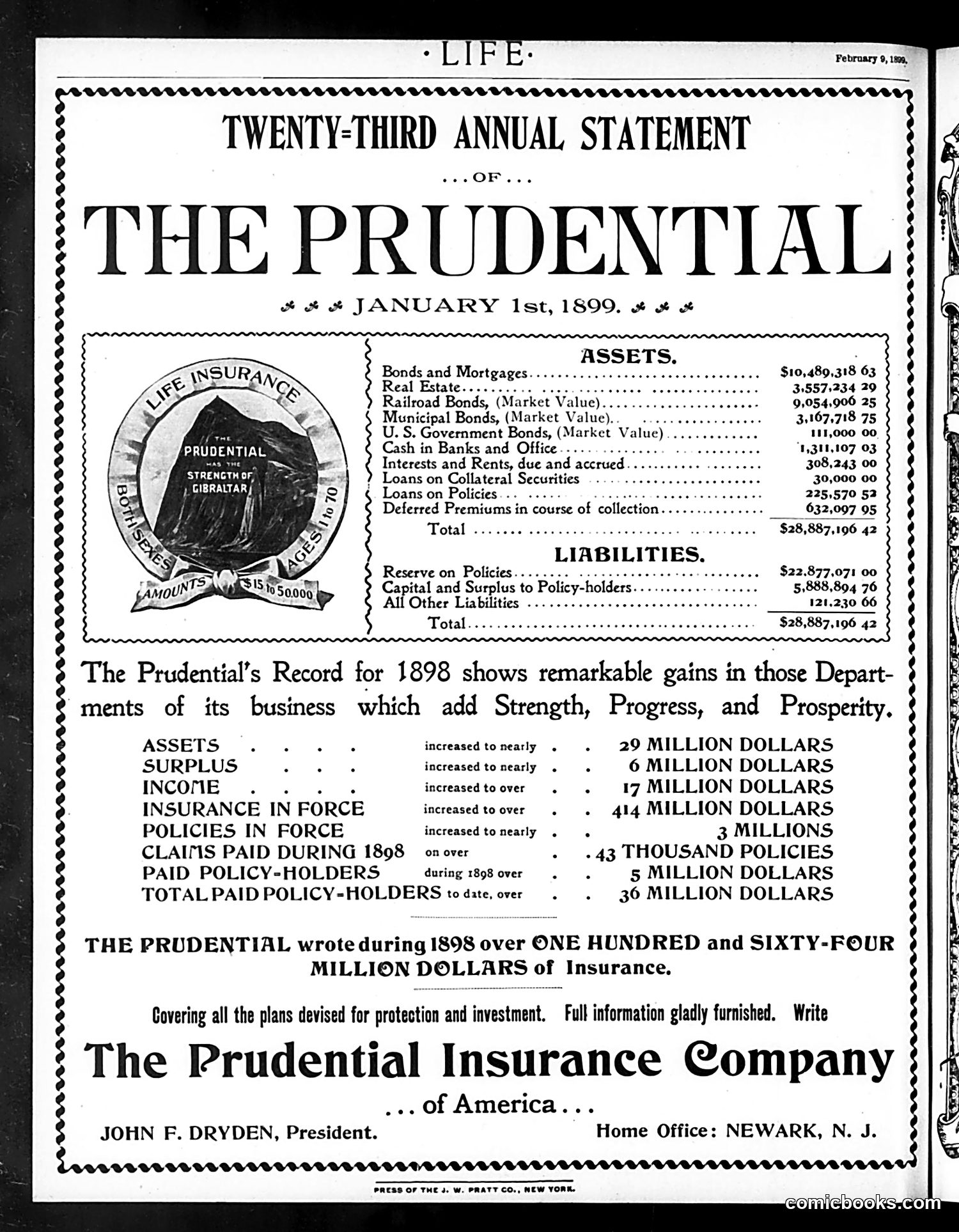
This is primarily a **corporate advertisement**, not political satire. The Prudential Insurance Company of America presents its twenty-third annual financial statement as of January 1, 1899. The company's seal depicts **Gibraltar**—a symbol of strength and stability—with the motto "Strength of Gibraltar," establishing the insurer's reliability to potential customers. The advertisement emphasizes impressive growth statistics: assets approaching $29 million, $414 million in insurance in force, and $36 million paid to policyholders to date. The claim that Prudential wrote over $164 million in new insurance during 1898 alone underscores rapid expansion during America's post-depression economic recovery. This appears in *Life* magazine because such financial announcements were standard advertising in major publications, targeting middle and upper-class readers seeking investment and protection products. The detailed balance sheet and growth figures serve as a confidence-building tool for potential policy-holders in an era before modern financial regulation.