
Life, 1899-02-09 · page 4 of 20
Life — February 9, 1899 — page 4: what you’re looking at
What you’re looking at
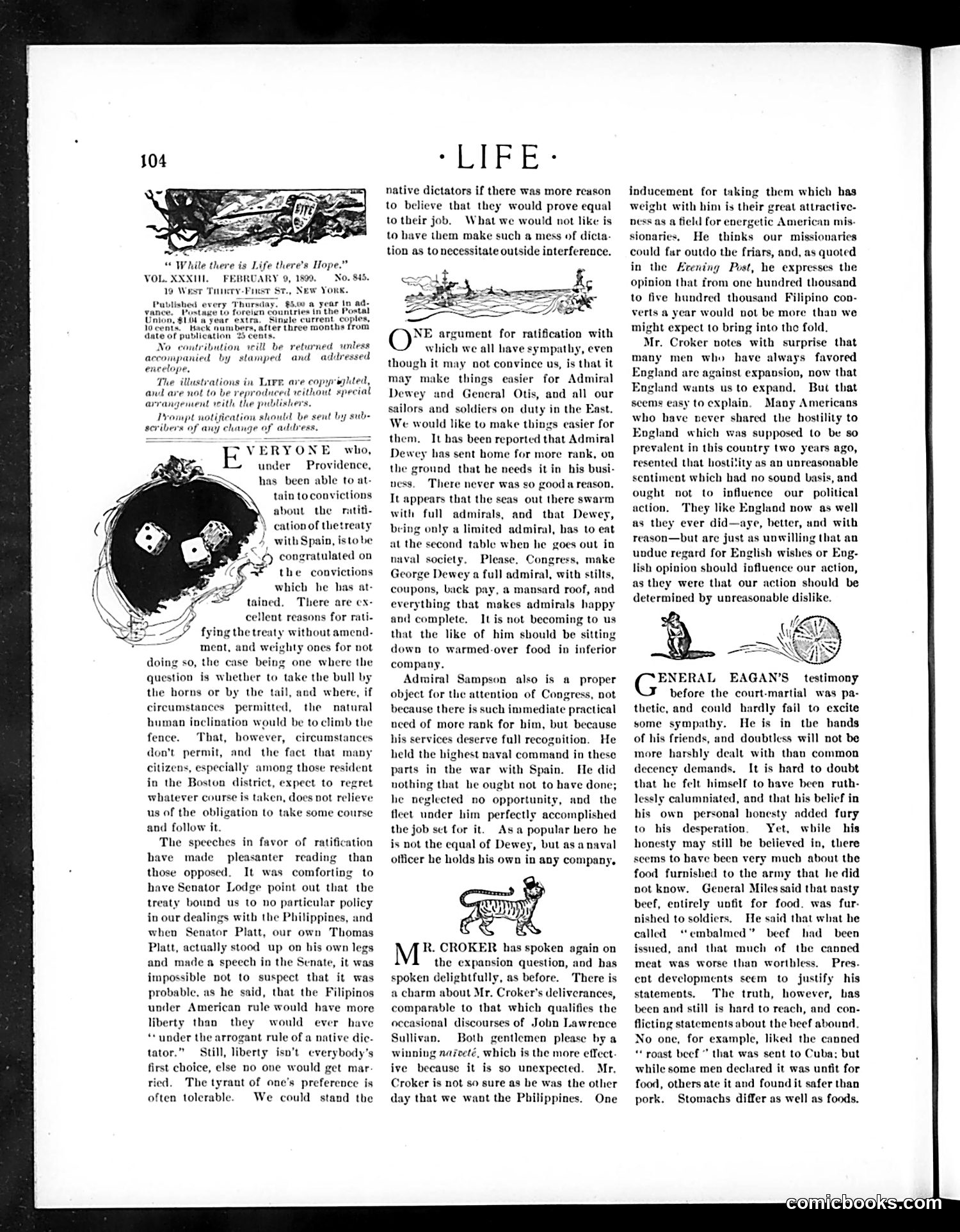
This page discusses American naval expansion and the Philippines debate, likely from the Spanish-American War era (1898). The text critiques arguments for Philippine annexation while defending Admiral Dewey and other military figures. **The cartoons** show dice and a cat—apparently satirizing chance and risk-taking in imperial policy decisions. **Key references**: Mentions Admiral Dewey (victor at Manila Bay), General Otis, and Senator Lodge's pro-expansion stance. The text argues that English hostility toward American expansion shouldn't influence U.S. policy, and defends Dewey and Admiral Sampson against critics questioning their rank and compensation. **The satire's point**: Mocking both expansionist arguments and critics' complaints about military leadership during imperial debates.
📄 Transcribed text from this page (OCR, searchable)
Machine-transcribed from the original scan — historical spelling and the odd misread are preserved.
is Life ther 8 Hope.” VoL. 19 West Ti Published every Thursday. $5. a pee \- untries in the mule current ter three months from No contribution will be companied by stamped lope. The illustrations in Lxre ave copyreghted, and are not to be reproduced without special arrangement with the publishers. Prompt not returned unless and addressed cation should be sent by sub- of address, 7VERYONE who, E under Providence, has been able to at- tain toconvictions about the raititi- cation of thetreaty with Spain, isto be 6) congratulated on the convictions which he has at- tained. There are ex- a dp cellent reasons for rati- ga 4 fying the treaty without amend- meat, and weighty ones for not doing so, the being one where the question is whether to take the bull by the horns or by the tail, and where, if circumstances permitted, the natural human inclination would be to climb the fence. That, however, circumstances don't permit, and the fact that many citizens, especially among those resident in the Boston district, expect to regret whatever course is taken, does pot relieve us of the obligation to take some course and follow it The speeches in favor of ratification have made pleasanter reading than those opposed. It was comforting to have Senator Lodge point out that the tre bound us to no particular policy in our dealings with the Philippines, and when Senator Platt, our own Thomas Platt, actually stood up on bis own legs and made a speech in the Senate, it was impossible not to suspect that it was probable, as he said, that the Filipinos under American rule would have more liberty than they would ever have ‘under the arrogant rule of a native dic- tator.” Still, liberty isn’t’ everybody's first choice, else no one would get mar: ried. The tyraut of one’s preference is often tolerable. We could stand the FO5S LIFE native dictators if there was more reason to believe that they would prove equal to their job. What we would not like is to have them make such a mess of dicta- tion as to necessitate outside interference. ZS NE argument for ratification with which we all have sympathy, even though it may not convince us, is that it may make things easier for Admiral Dewey und General Otis, and all our sailors and soldiers on duty in the East. We would like to make things easier for them. It has been reported that Admiral Dewey has sent home for more rank, on the ground that he needs it in his bu: uess, There never was so good a reason, It appears that the seas out there swarm with full admirals, and that Dewey, being only a limited admiral, has to eat at the second table when he goes out in naval society. Please, Congress, make George Dewey a full admiral, with stilts, coupons, back pay, a mansard roof, and everything that makes admirals happy and complete. It is not becoming to us that the like of him should be sitting down to warmed-over food in inferior company. Admiral Sampson also is a proper object for the attention of Congress, not because there is such immediate practical need of more rank for him, but because his services deserve full recognition. He held the highest naval command in these parts in the war with Spain. He did nothing that he ought not to have done; he neglected no opportunity, and the fleet under him perfectly accomplished the job set for it. Asa popular hero he is not the equal of Dewey, but as a naval olficer he holds his own in any company, San R. CROKER has spoken again on the expansion question, and has spoken delightfully, as before. There is a charm about Mr. Croker’s deliverances, comparable to that which qualifies the occasional discourses of Jobn Lawrence Sullivan, Both gentlemen please by a winning nafeeté, which is the more effect. ive because it is so unexpected. Mr. Croker is not so sure as be was the other day that we want the Philippines. One inducement for taking them which bas weight with him is their great attractive- ness as a field for energetic American mis. sionaries, He thinks our missiovaries could fur outdo the friars, and, as quoted in the Evening Post, he expresses the opinion that from one hundred thousand. to five hundred thousand Filipino con- verts a year would not be more than we might expect to bring into the fold. Mr. Croker notes with surprise that many men who have always favored England are against expansion, now that England wants us to expand, But that seems easy to explain. Many Americans who bave never shared the hostility to England which was supposed to be so prevalent in this country two years ago, resented that hostitity as an unreasonable sentiment which had no sound Uasis, and ought not to influence our political action. ‘They like England now as well as they ever did—aye, better, und with reason—but are just as unwilling that an undue regard for English wishes or Eng- lish opinion should influence our action, as they were that our action should be determined by unreasonable dislike. ENERAL EAGAN’S | testimony before the court-martial was pa- thetic, and could hardly fail to excite some sympathy. He is in the hands of his friends, and doubtless will not be more harshly dealt with than common decency demands. It is hard to doubt that he felt himself to have been ruth- lessly calumniated, and that his belief in his own personal honesty added fury to his desperation, Yet, while his honesty may still be believed in, there scems to have been very much about the food furnished to the army that he did not know. General Miles said that nasty beef, entirely unfit for food. was fur- nished to soldiers. He said that what he called “embalmed” beef had been issued, and that much of the canned meat was worse than worthless. Pres. evt developments seem to justify his statements. The truth, however, bas been and still is hard to reach, and con- flicting statements about the beef abound. No one, for example, liked the canned ‘roast beef ” that was sent to Cuba: but while some men declared it was unfit for food, others ate it and found it safer than pork. Stomachs differ as well as foods.