
Life, 1899-02-09 · page 8 of 20
Life — February 9, 1899 — page 8: what you’re looking at
What you’re looking at
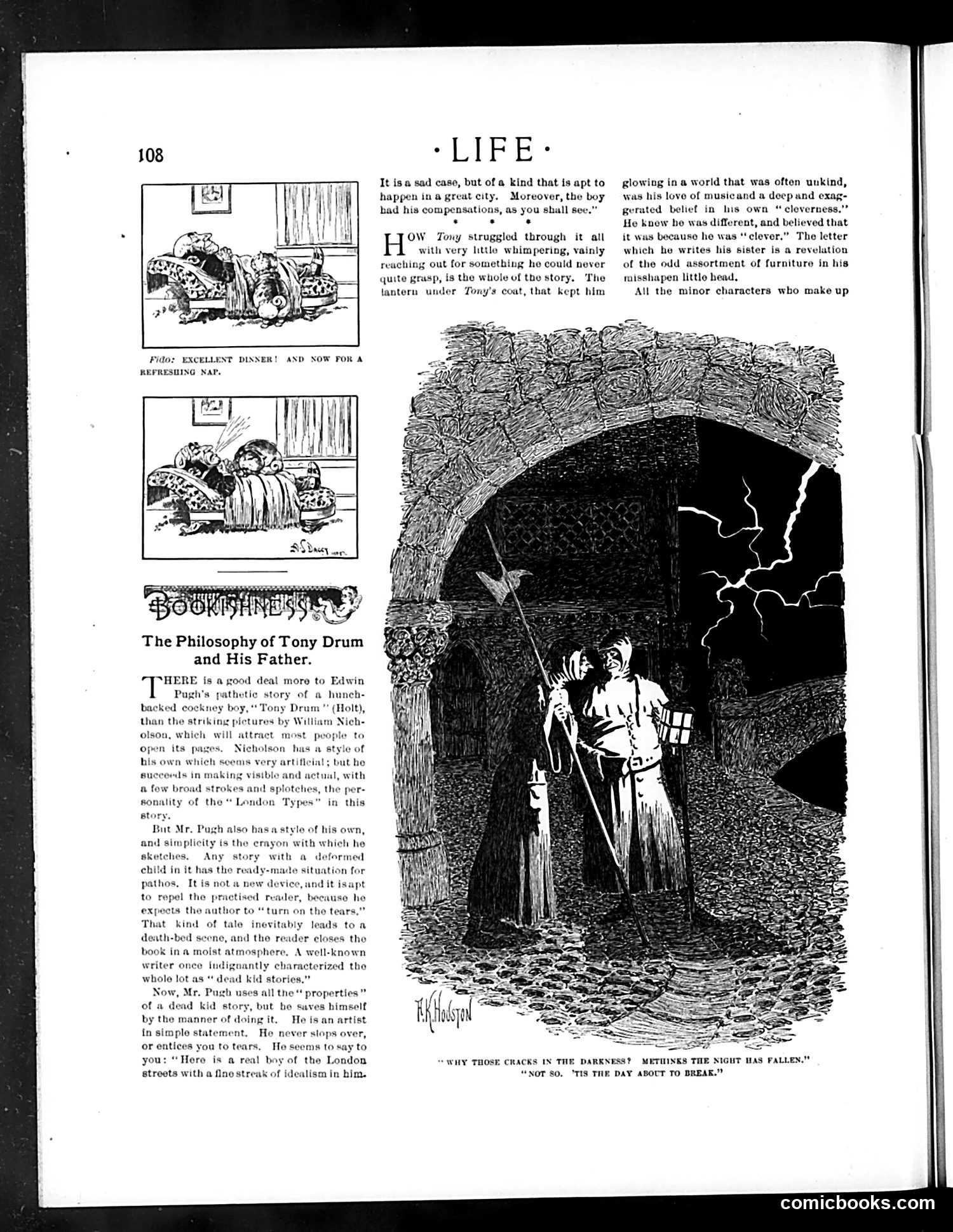
This page reviews a serialized story by William Nicholson about "Tony Drum," a working-class London boy and his father. The text praises Nicholson's artistic style—his ability to convey pathos and realism through simple, bold crayon sketches that capture "dead-lit stories" and authentic London street life with "a firestruck idealism." The large illustration shows a figure in a doorway during a thunderstorm, with the caption referencing "cracks in the darkness" and "the night has failed" suggesting hardship and despair. The smaller sketches above depict domestic scenes—meals and rest—emphasizing the story's focus on humble, ordinary working-class life rendered with emotional depth rather than sentimentality.
📄 Transcribed text from this page (OCR, searchable)
Machine-transcribed from the original scan — historical spelling and the odd misread are preserved.
Fido? EXCELLENT DINNER! REPRESIING N AND NOW POR A The Philosophy of Tony Drum and His Father. i age is a good deal more to Edwin Pugh’s pathetic story of a hunch- backed cockney boy, “Tony Drum " (Holt), than the striking pictures by William olson, which will attract: m: open its pa Nich his ow ns very suc a fow broad strokes and splot. sonality of the story. But Mr. Pa and simplicit sketches, Any story child in it has the ready-made situation for It is not a new device, and it isapt to repel the practised reader, because he expects the author to “turn on the tears.” That kind of tale inevitably leads to a death-bed scene, and the reader eloses tho moist atmosphere, A well-known son has a st rtifleial; but be sin making visible and actual, with 8, the per- in this whieh ondon Types” h also bi is the astyle of his own, crayon with which he with a deformed pathos, properties” 1 kid story, but bo suves himself anner of doing in simple statement, Ho never stops over, or entices you to tears, He seems to say to you: “Hero is a real boy of the London streets with a flnostreak of idealism in him. He fs an artist : Lal PE * It isa sad case, but of a kind that is apt to happen ina great city. Moreover, the boy bad his compensations, as you shall see.” . . . OW Tony struggled through it all with very little whimpering, vainly reaching out for something he could never quite grasp, is the whole of the story. The lantern under Tony's coat, that kept him “WHY THOSE CRACKS IN THE DARKNESS? “NOT 80. glowing in a world that was often uukind, was his love of musicand a deep and exag- gerated belief in his own “ cleverness.”” He know ho was different, and believed that it was because he was “clever.” The letter which he writes his sister is a revelation of the odd assortment of furniture in his hapen little head, All the minor characters who make up METHINKS THE NIGHT IAS FALLEN." ‘T18 THE DAY ABOUT TO BREAK.” comicbooks.com