
A complete issue · 20 pages · 1899
Life — January 26, 1899
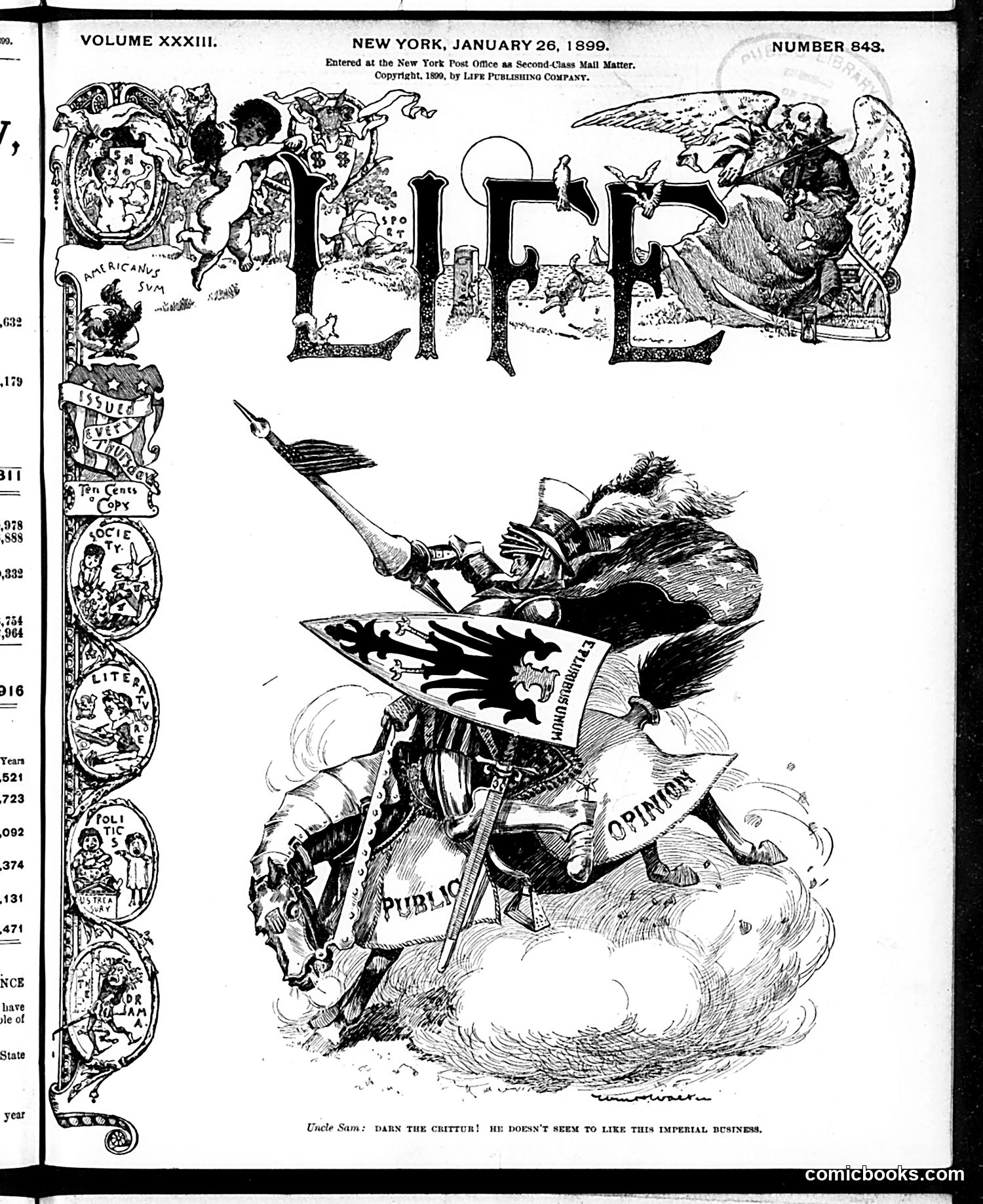
**The Main Cartoon:** Uncle Sam (identifiable by his characteristic appearance) sits astride clouds, holding a flag labeled "IMPERIAL BUSINESS" while riding what appears to be a horse or beast. The figure is depicted as uncomfortable or struggling with this "imperial" venture. The caption reads: "DARN THE CRITTER! HE DOESN'T SEEM TO LIKE THIS IMPERIAL BUSINESS." **Historical Context:** This satirizes American imperialism in 1899, likely referencing the Philippine-American War (1899-1902) following the Spanish-American War. The cartoon suggests Uncle Sam is forcibly imposing imperial expansion, and the beast's resistance represents public or practical opposition to these colonial ambitions. The satire critiques America's newfound imperial pretensions as problematic and unwelcome—even the vehicle of expansion "doesn't like" the business.
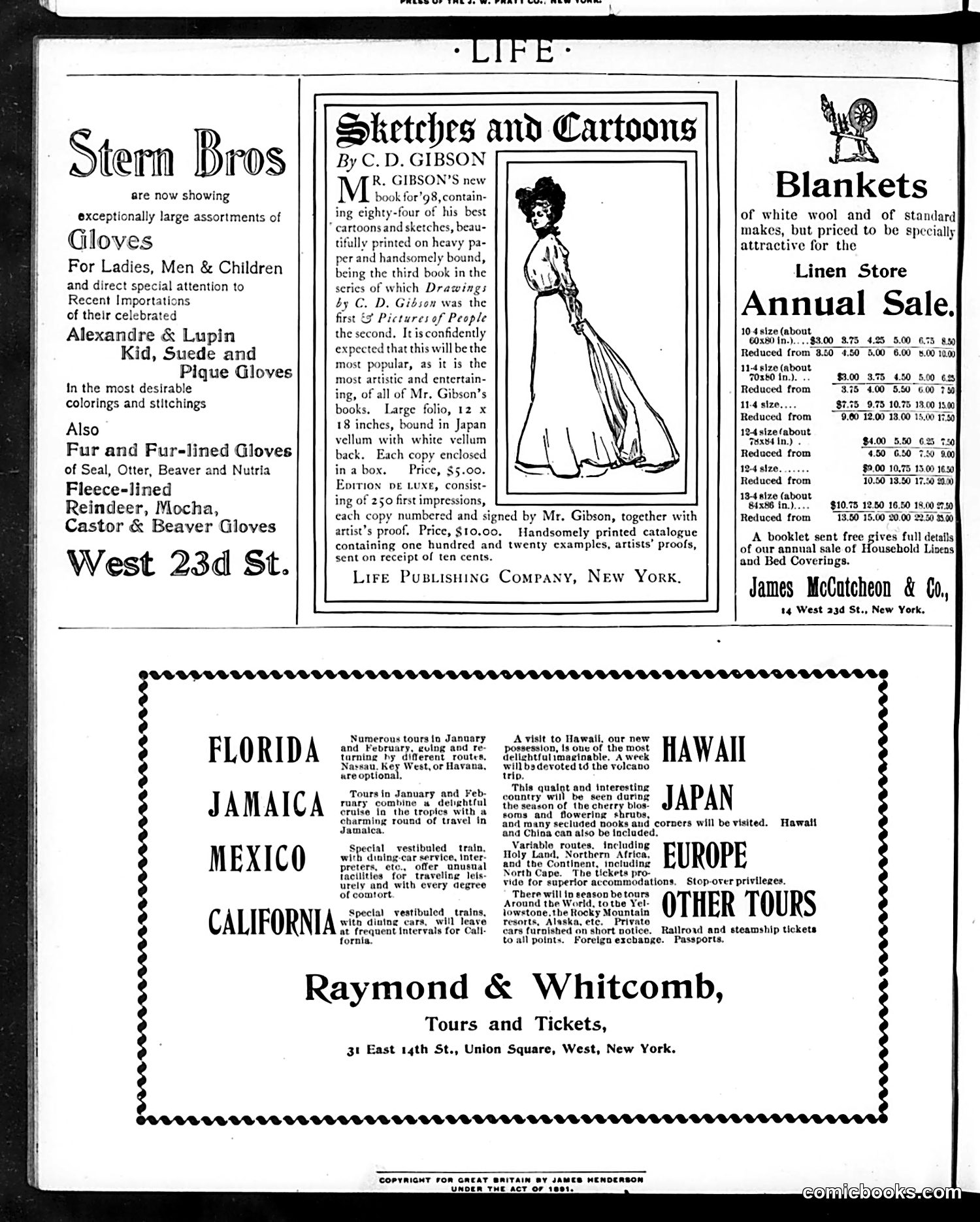
This page is primarily **advertising**, not political satire. The central cartoon by C.D. Gibson illustrates his new book of sketches—it depicts a fashionable woman in an elegant gown, typical of Gibson Girl imagery popular in early 1900s American culture. The image serves as promotional material for the Life Publishing Company. The surrounding ads advertise gloves (Stern Bros), blankets (Linen Store Annual Sale), and travel tours (Raymond & Whitcomb). The page contains no political commentary or satirical content targeting specific events or figures. It reflects early 20th-century consumer culture and Gibson's status as a celebrated illustrator of idealized American femininity.
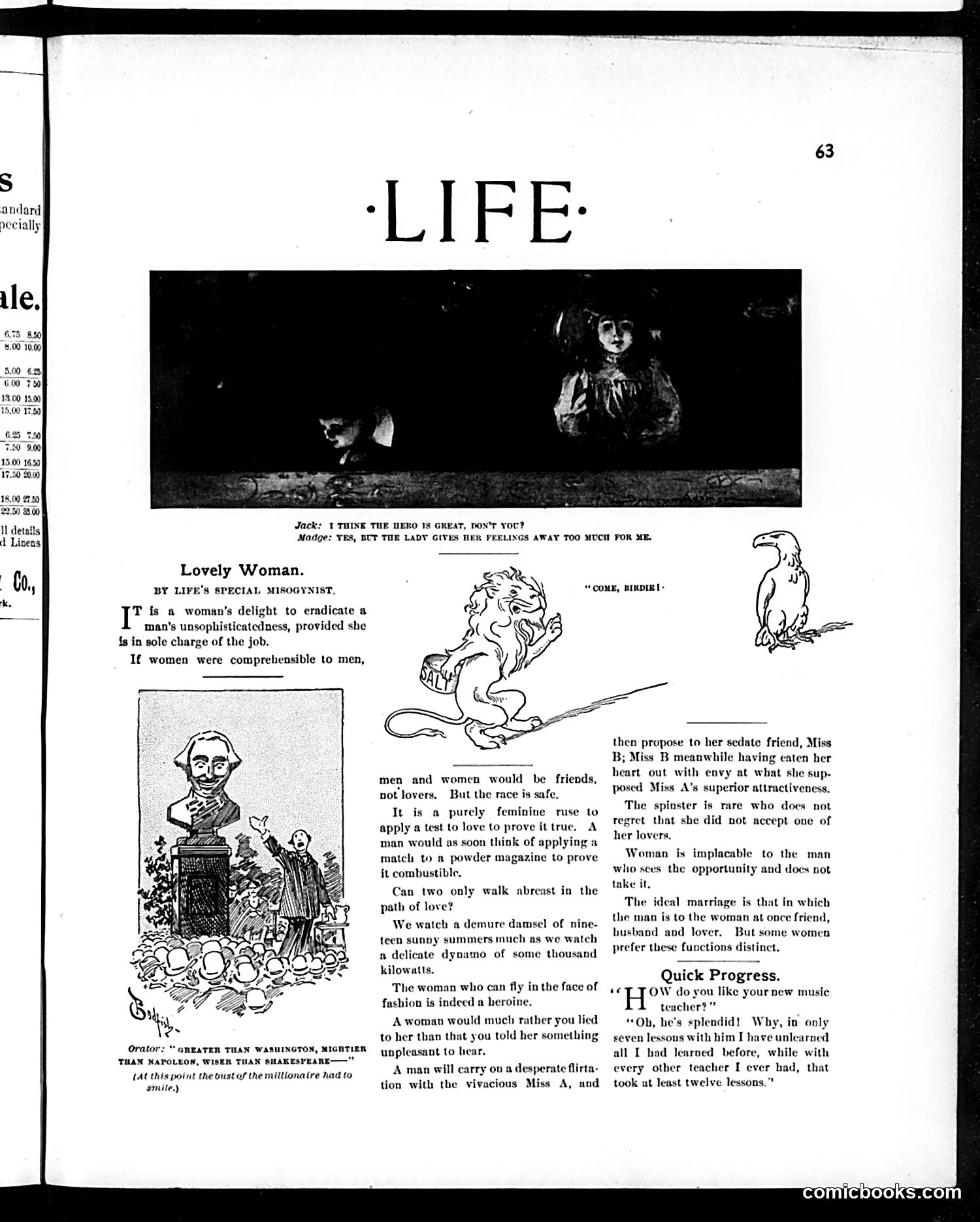
This page satirizes gender relations and courtship customs of the early 20th century. **"Lovely Woman"** article mocks the idealization of women while critiquing their actual power in relationships. The accompanying bust sculpture labeled "Greater than Washington, mightier than Napoleon, wiser than Shakespeare" ironically elevates women—yet the text argues women use emotion rather than reason, and that men should pursue romance cautiously. **The film still at top** (showing characters "Jack" and "Madge") depicts a romantic scene, illustrating the article's themes about courtship. **"Quick Progress"** joke comments on modern piano instruction, where rapid progress with a new teacher surprises the student—a light commentary on teaching standards or perhaps changing social interactions. The overall tone is tongue-in-cheek misogyny typical of the era's humor magazines, presenting women as simultaneously powerful and irrational.
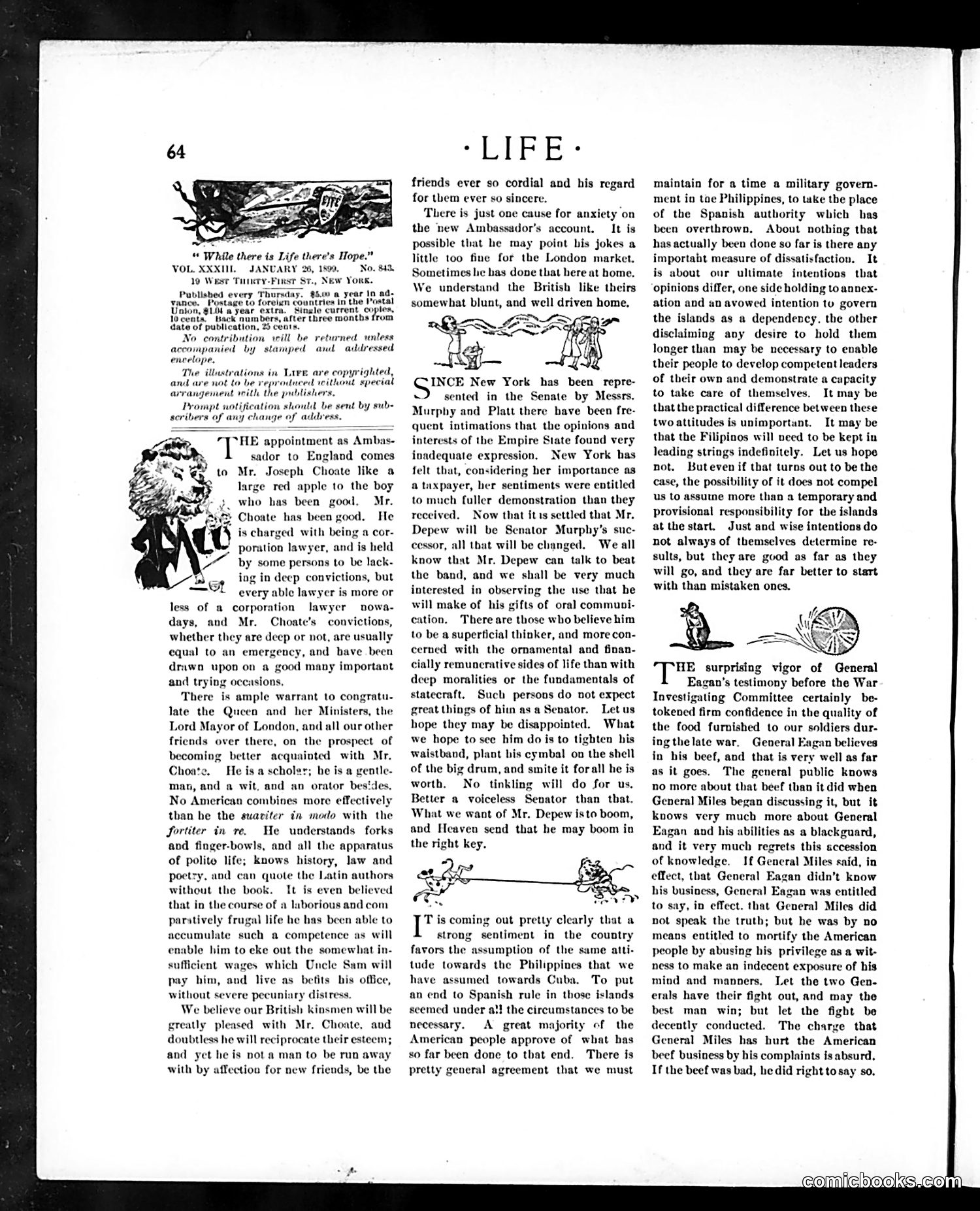
This page contains political commentary on early 20th-century American politics, particularly regarding the Philippines and Senate appointments. **Main Cartoon**: The illustration labeled "While there is Life there's Hope" depicts what appears to be a caricatured figure (likely meant to represent a political figure being criticized), shown in an exaggerated, unflattering style typical of Life's satirical approach. **Political Context**: The text discusses Mr. Choate's appointment as Ambassador to England and critiques Mr. Depew's anticipated Senate position. The commentary expresses concern about American intentions in the Philippines, debating whether the U.S. should maintain colonial control or grant independence. **The Satire**: Life mocks both the politicians involved and broader American imperial ambitions, using humor to question whether these appointments serve genuine interests or merely ornamental political positions.
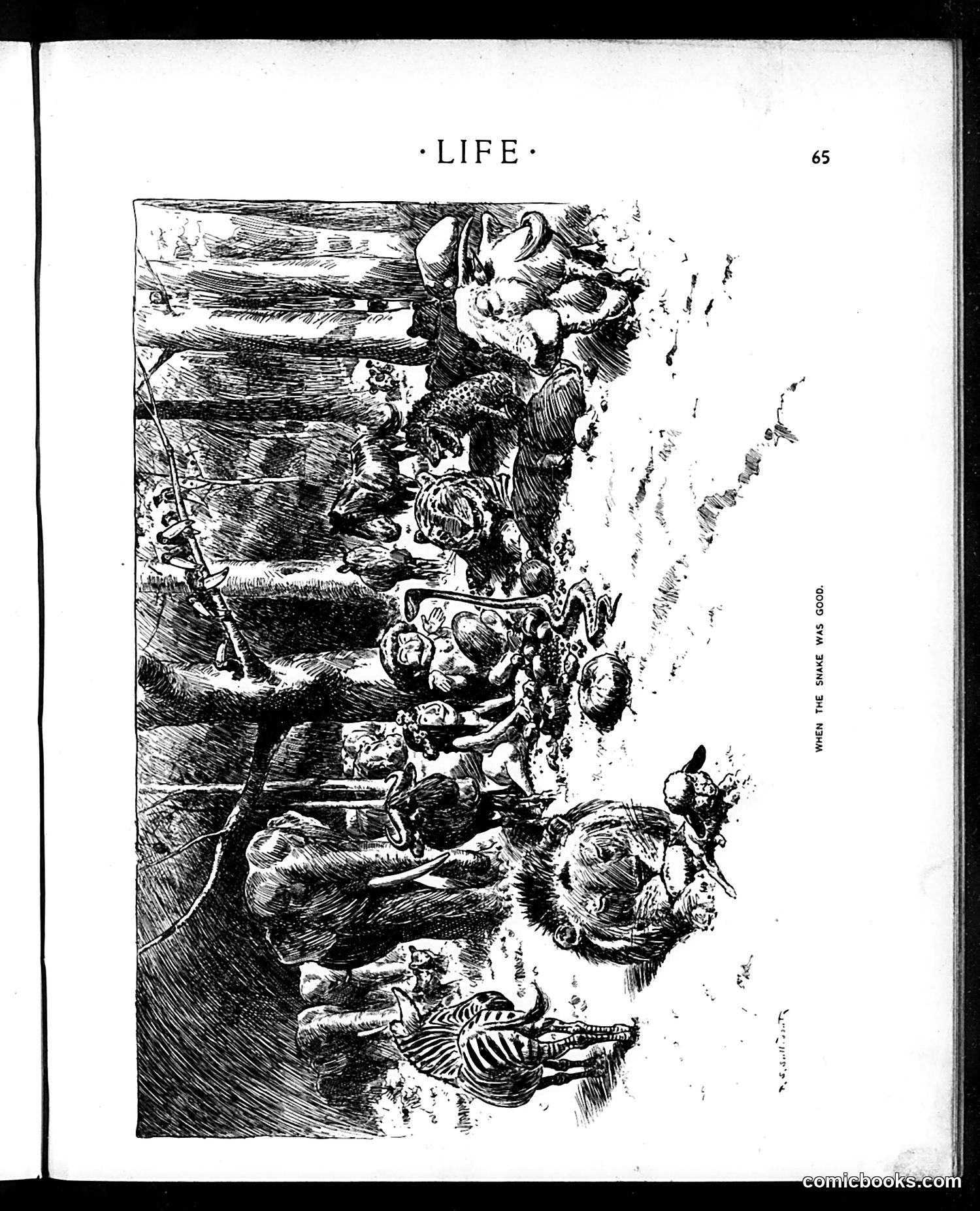
This satirical engraving depicts a chaotic tavern or public house scene, likely from the 18th or 19th century based on the style. The title suggests nostalgia for an earlier era of smoking and drinking culture. The crowded composition shows multiple figures in various states of revelry and intoxication—some smoking pipes, others drinking, fighting, or carousing. The dense, frantic linework emphasizes disorder and excess. The satire appears to mock either: - Romanticized memories of "the good old days" of tavern culture - The effects of tobacco and alcohol consumption - Public behavior and social decorum of a previous generation Without clearer OCR text or additional context, the precise political target remains unclear, though it likely critiques nostalgic attitudes toward past social habits.
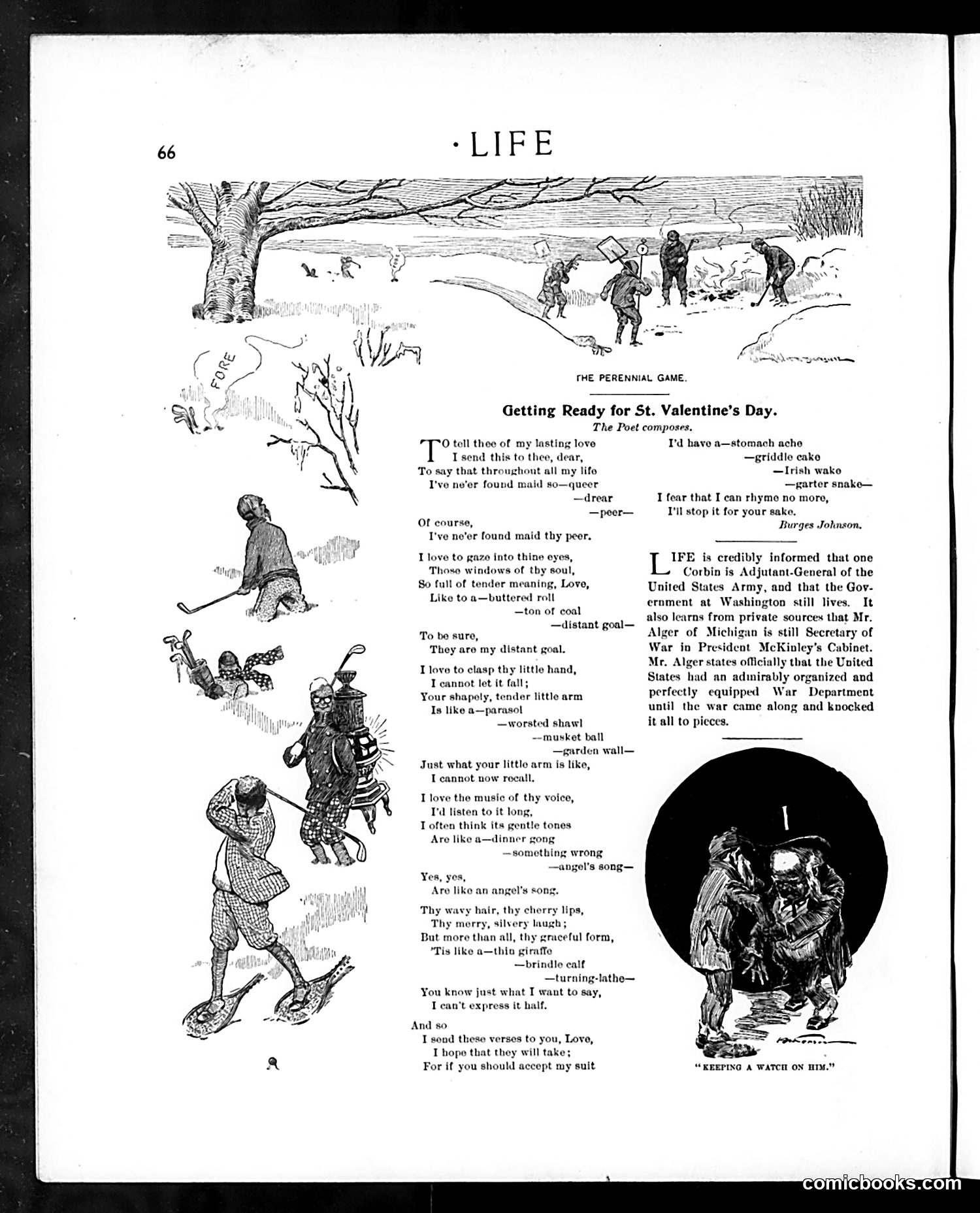
This page contains two distinct items: **"The Perennial Game"** (top): A winter scene showing figures engaged in what appears to be sledding or snow activities—likely satirizing recurring seasonal pastimes or social behaviors that repeat annually. **"Getting Ready for St. Valentine's Day"** (center/right): A humorous poem by Burgess Johnson playfully listing romantic frustrations—stomach aches, griddle cakes, garter snakes—mixed with genuine romantic sentiments. The verses mock the difficulty of expressing love convincingly. **"Keeping a Watch on Him"** (bottom right): An illustration showing two figures in what appears to be a domestic scene, likely satirizing spousal surveillance or relationship dynamics—a common humor subject of the era. The overall page blends seasonal humor (Valentine's Day preparation) with domestic social commentary typical of early 20th-century Life magazine's satirical approach.
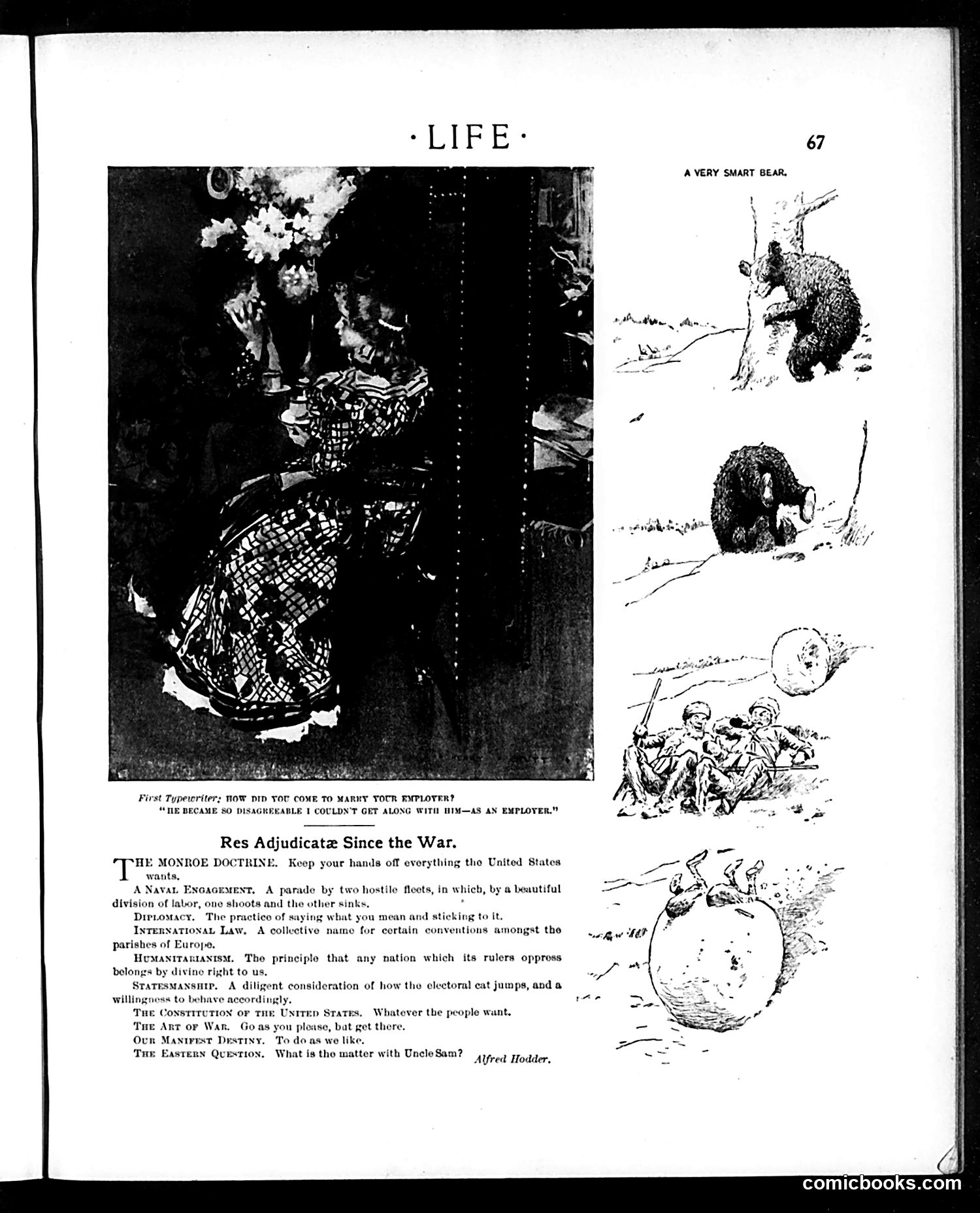
This page from *Life* magazine contains a large photograph (top left) captioned with dialogue about employment disputes, followed by a satirical article titled "Res Adjudicatæ Since the War." The article uses Latin legal terminology to mock post-WWI American political debates. It sarcastically defines concepts like "Naval Engagement" (two hostile fleets where one shoots while the other sinks), "Diplomacy" (saying what you want while sticking to it), and references "Humanitarianism," "Statesmanship," and "The Constitution" as hollow concepts. The right side features whimsical drawings titled "A VERY SMART BEAR"—sketches of bears in various poses, appearing unrelated to the political satire. The overall point mocks American leadership's contradictory principles and empty rhetoric in post-war politics, suggesting their stated ideals don't match their actual behavior.
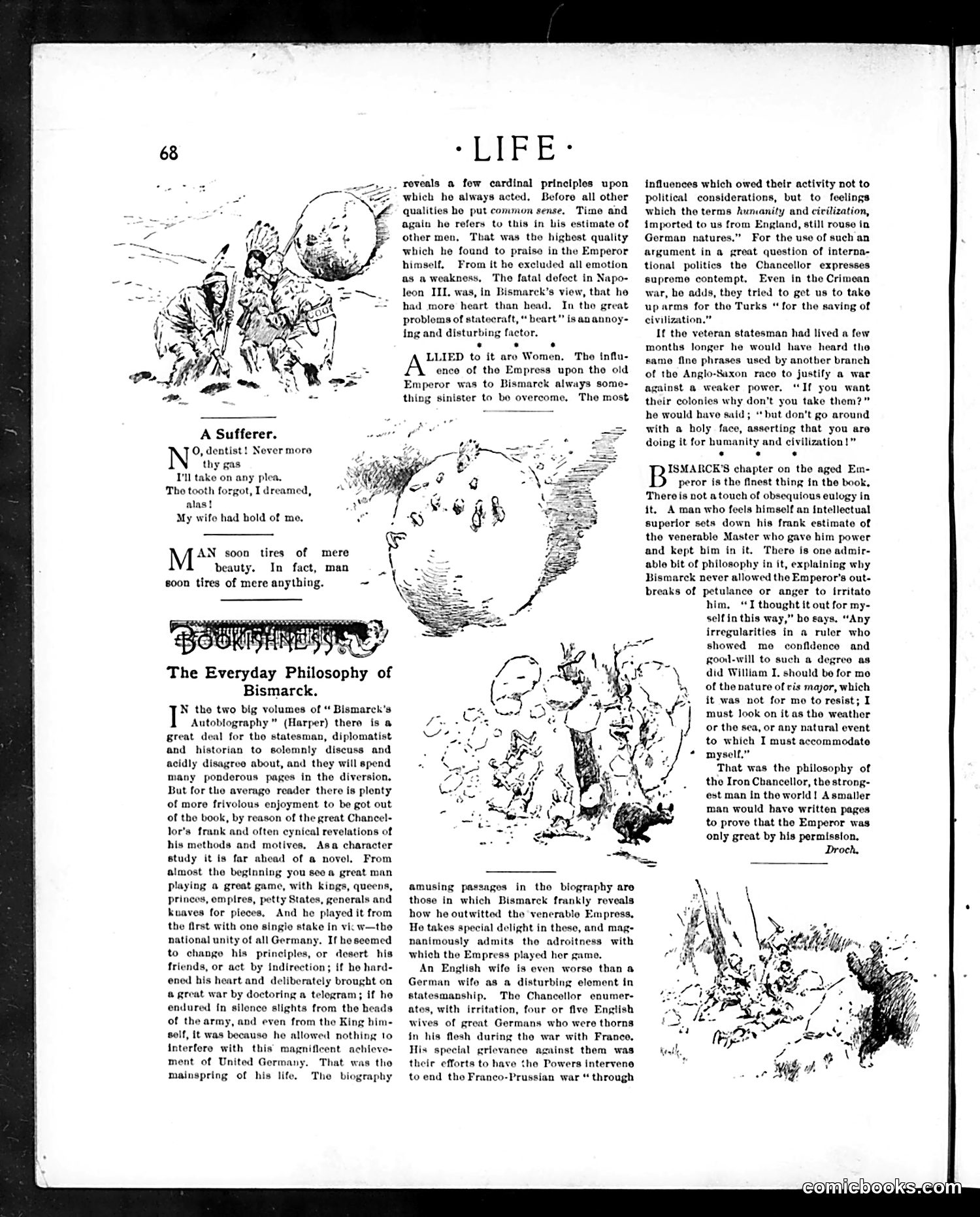
This page contains satirical commentary on **Otto von Bismarck**, the Prussian Chancellor. The illustrations appear to be caricatures depicting Bismarck in various unflattering poses—including one labeled "A Sufferer"—likely mocking his political methods or personality. The text discusses Bismarck's biography and his relationship with the German Empress. It criticizes his manipulation of power, noting how he controlled the aging Emperor and resisted the Empress's influence. The satire suggests Bismarck's strength came solely from the Emperor's patronage rather than inherent merit. The cartoon ridicules Bismarck's arrogance and his dismissive attitude toward those—particularly women—he deemed intellectually inferior. The overall message appears to be satirizing both Bismarck's ruthless statecraft and his inflated self-regard.
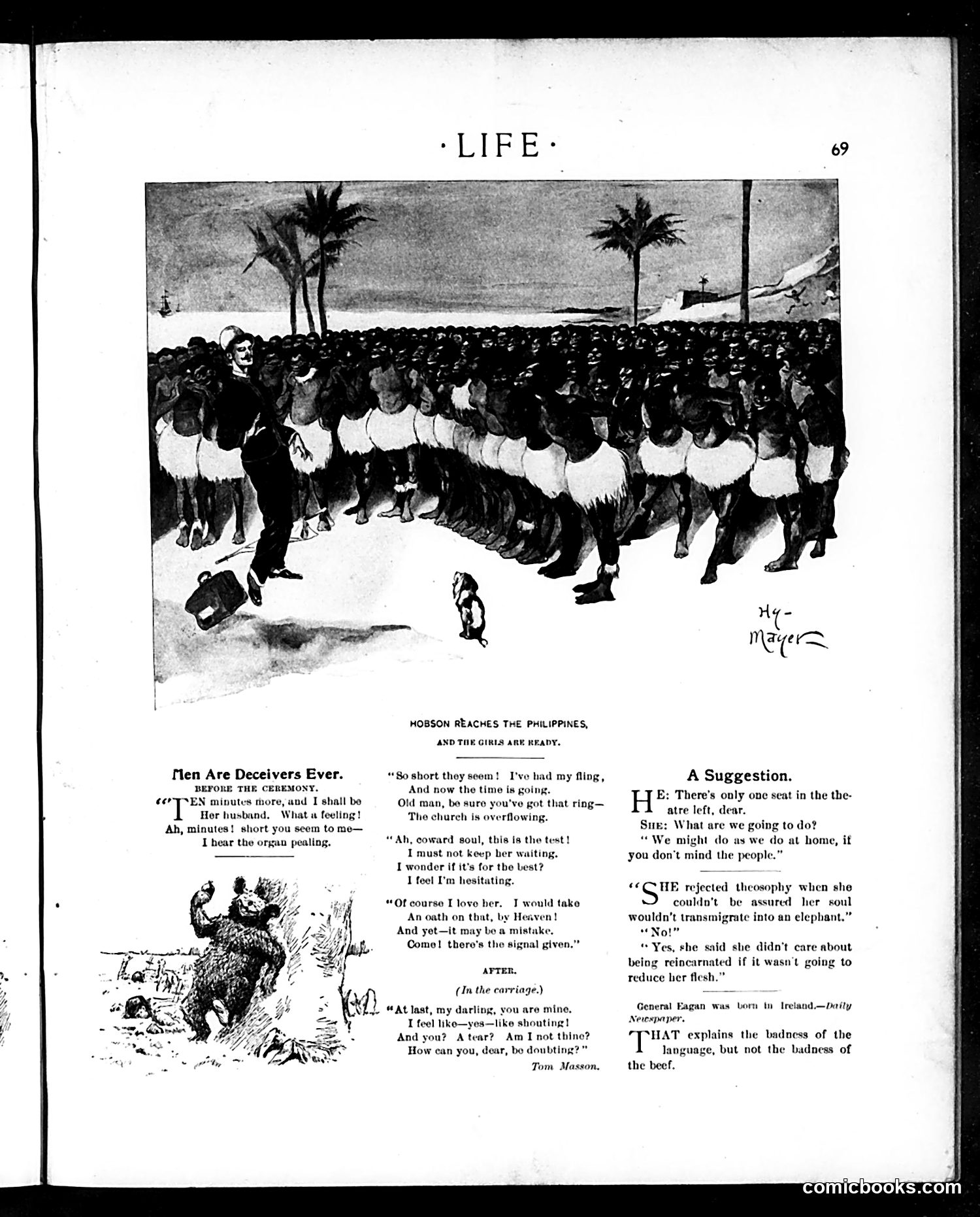
This page contains humorous dialogues about marriage and romance, illustrated with period drawings. The top image shows "Hobson Reaches the Philippines, and the Girls Are Ready"—likely a reference to Admiral Hobson's 1898 naval victory in the Spanish-American War, here humorously reimagined with women in elaborate dress waiting to greet him. Below are three separate comedic sketches: "Men Are Deceivers Ever" depicts a couple's pre-wedding anxiety; "A Suggestion" satirizes theological concerns about reincarnation and the soul; and an untitled piece quotes Tom Mason about post-marriage doubts. The satire targets romantic delusions, masculine deception in courtship, and the gap between wedding-day idealism and marital reality—typical early 20th-century Life magazine humor mocking human folly in love and marriage.
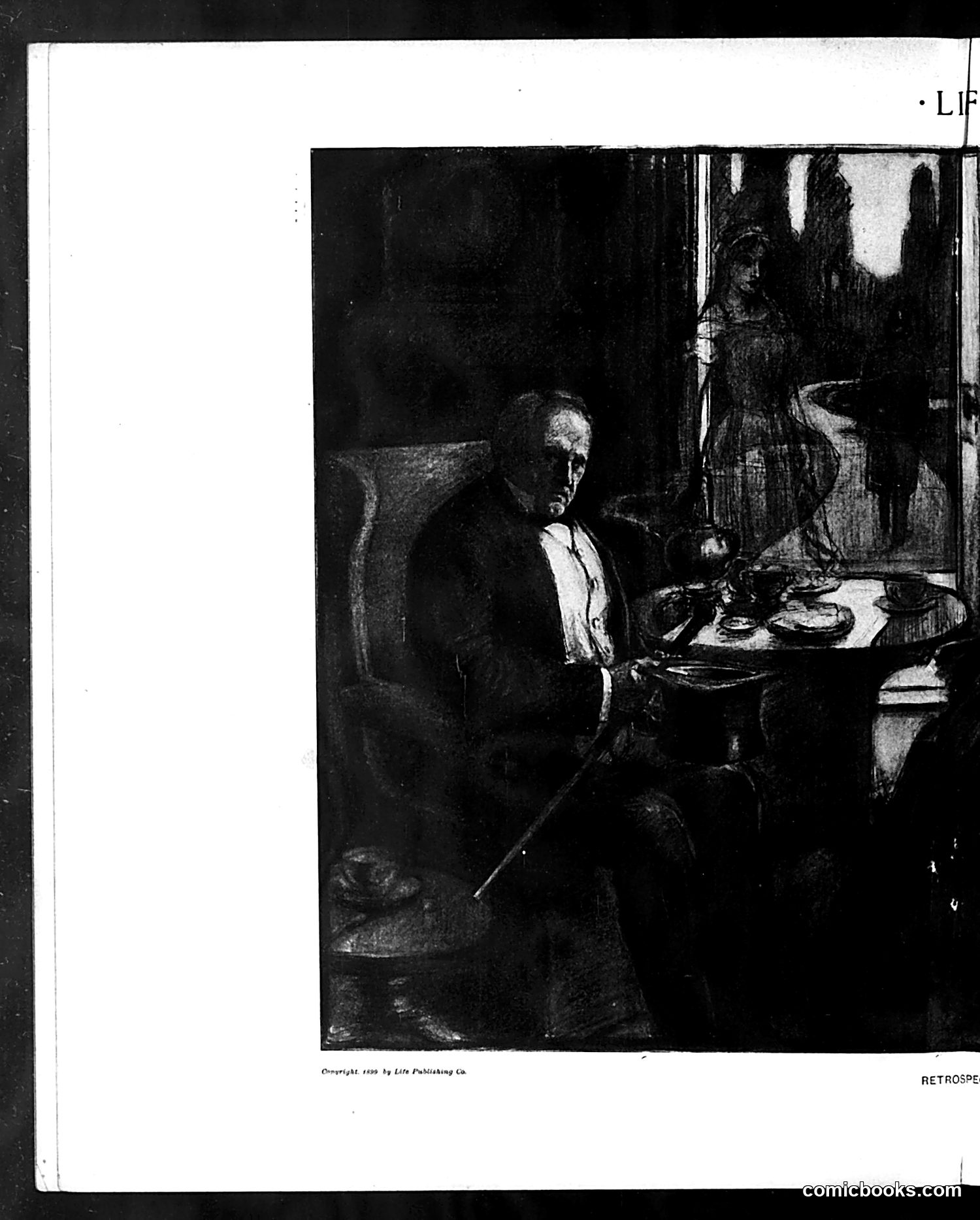
This black-and-white illustration depicts an interior scene of what appears to be a formal dinner or social gathering. A well-dressed man in evening attire sits at a small round table with place settings and food. Standing nearby are several figures in the background, including what appears to be waitstaff or other attendees. The image is credited to Life Publishing Co. (copyright 1928) at the bottom. However, without accompanying text or caption visible on this page, I cannot definitively identify the specific figures, determine what political or social commentary the illustration intends, or explain what contemporary references it might contain. The formal dinner setting suggests social satire, but the precise target and meaning remain unclear from the image alone.
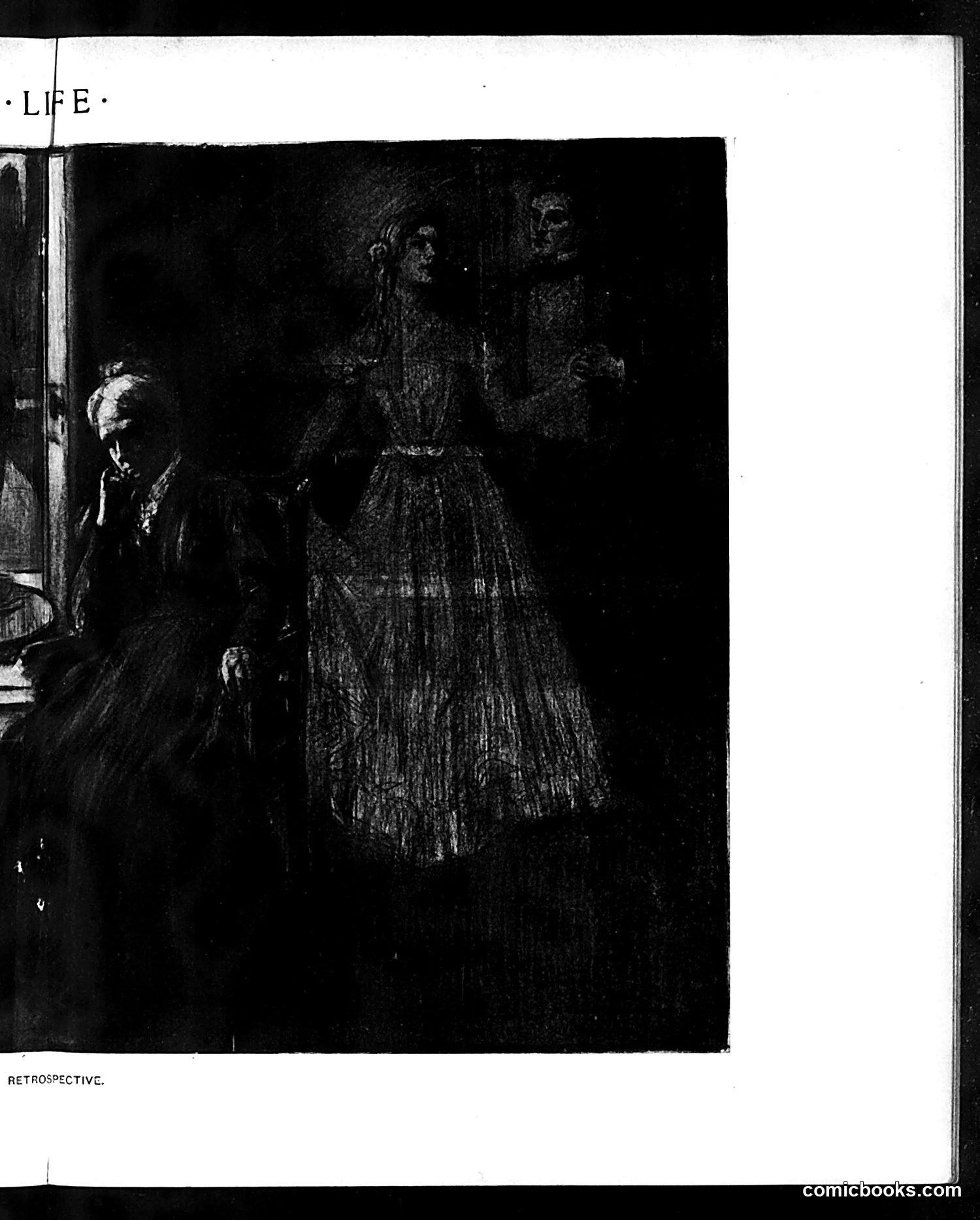
This page from *Life* magazine features a dark, sketched illustration labeled "RETROSPECTIVE" at the bottom. The image shows what appears to be an interior scene with several figures in period dress. On the left, a figure in darker clothing observes a woman in an elaborate full-skirted dress (center-right), with additional figures visible in the shadowy background. The "Retrospective" title suggests this is a commentary on past fashions, social customs, or historical events. However, without clearer details, visible faces, or accompanying article text, I cannot definitively identify the specific figures or the precise satirical point. The dramatic chiaroscuro style emphasizes a theatrical or melodramatic mood, but the exact subject—whether social critique, fashion commentary, or historical reference—remains unclear from the image alone.
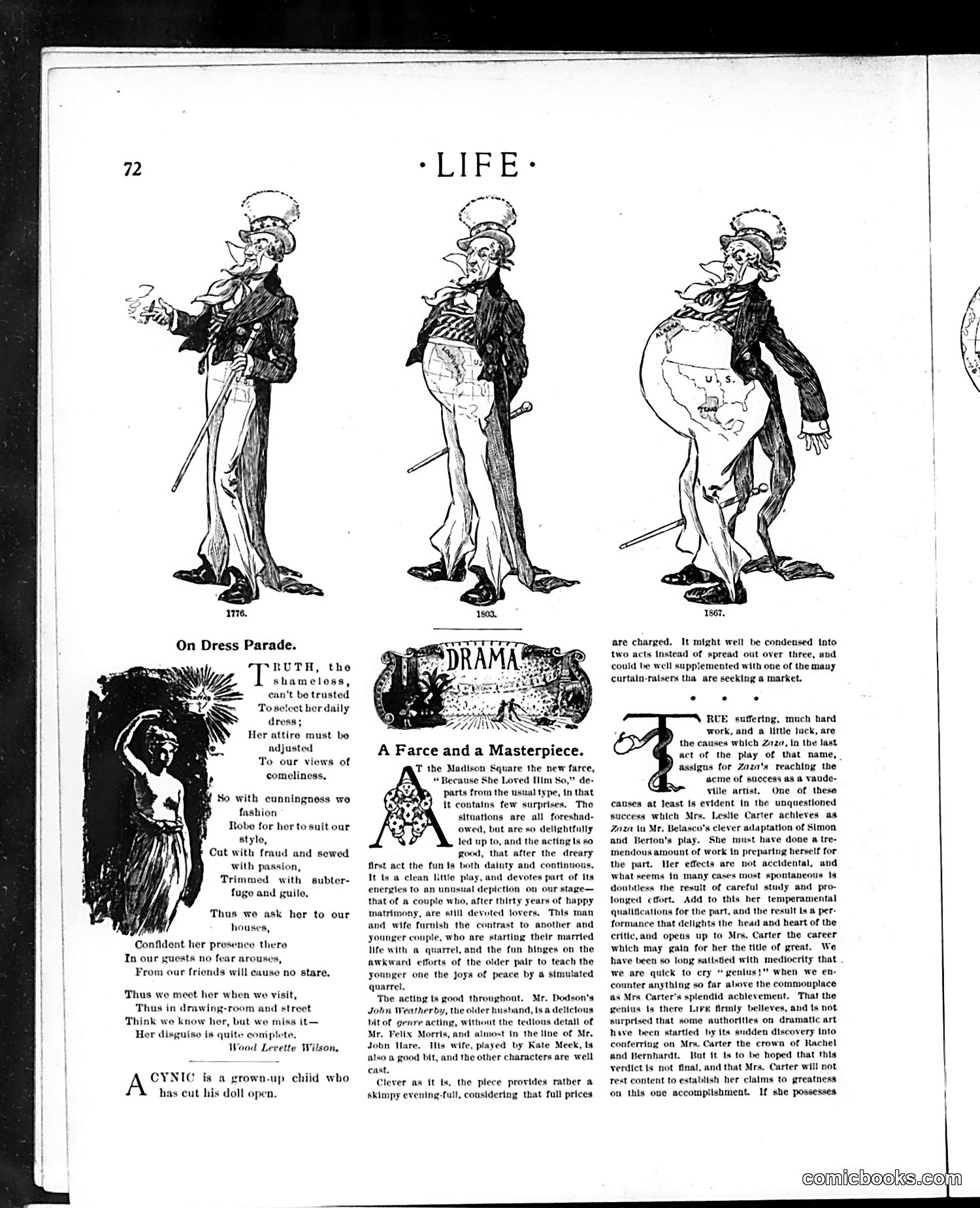
This page from *Life* magazine contains three main elements: **Top section:** Three caricatured figures dated 1776, 1882, and 1907, labeled "On Dress Parade." The accompanying poem satirizes women's evolving fashion through history, mocking how women adjust their clothing to suit male aesthetic preferences rather than their own comfort. **Left side:** A separate cartoon showing a caricatured face with text titled "A CYNIC," defining a cynic as "a grown-up child who has cut his doll open." **Bottom section:** Drama reviews discussing a new farce at Madison Square Theater called "Because She Loved Him So" and another production, praising the acting quality and plot innovations. The page combines social commentary on fashion and female behavior with theatrical criticism, typical of *Life*'s satirical approach to American culture.
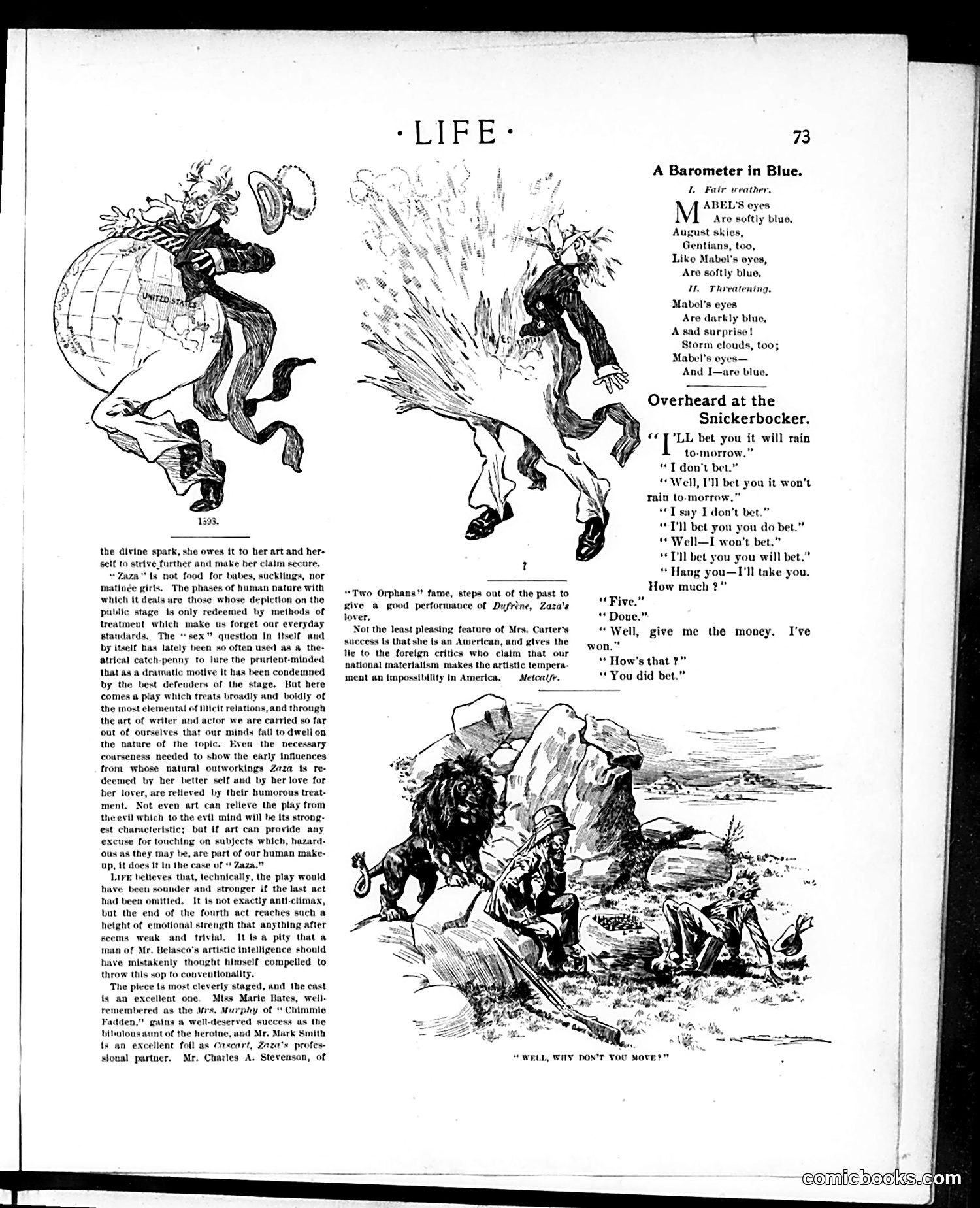
This page contains three distinct pieces of satirical content: **"A Barometer in Blue"** is a short poem using a woman's eye color as metaphor for weather prediction—a playful commentary on the era's pseudoscientific fortune-telling and physiognomy trends. **"Overheard at the Snickerbocker"** is a humorous dialogue satirizing the illogical arguments people make about gambling and betting. Two men argue in circles about whether one actually bets, ultimately proving through paradox that avoiding the bet *is* itself a bet—mocking pretentious reasoning and stubbornness, likely a jab at wealthy Manhattan patrons of the Snickerbocker Hotel. **The main content** reviews the theatrical production "Zaza," praising its artistic treatment of morally controversial subject matter while criticizing its conventional ending as unnecessary. The two cartoon illustrations (showing figures with a globe and pursuing a woman) appear to relate to the theatrical review rather than the brief humorous items. The page demonstrates Life's blend of theater criticism with gentle social satire targeting contemporary Manhattan sophistication.
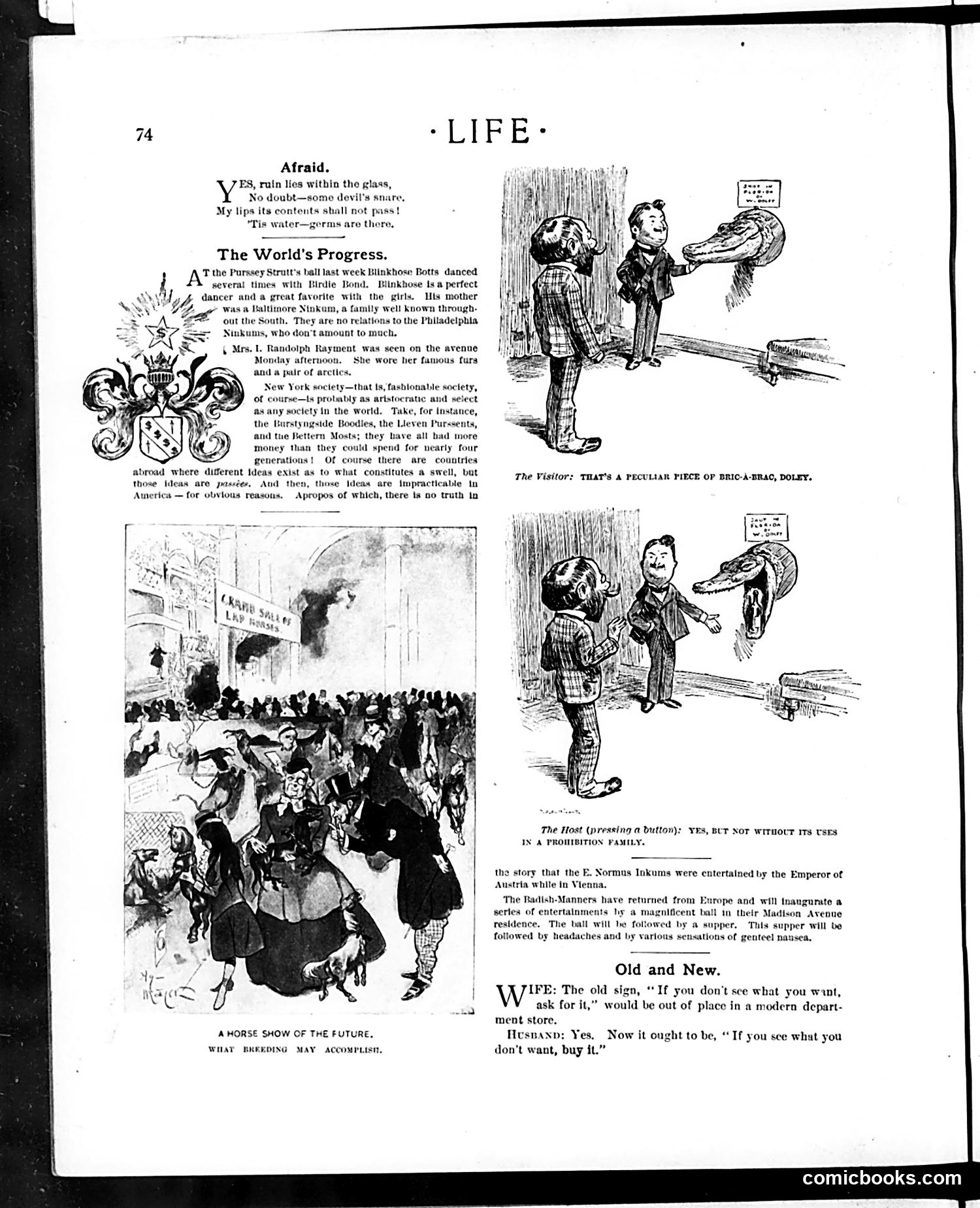
This page contains **satirical commentary on American high society and consumer culture** circa early 1900s. **"The World's Progress"** mocks the pretensions of New York's wealthy elite by cataloging their trivial social activities—debutante balls, fur displays, prominent family lineages. The satire targets their obsession with genealogy and exclusive social circles, suggesting their "progress" is merely superficial gossip about who danced with whom. **The cartoons** criticize: 1. **"A Horse Show of the Future"** (bottom left): Suggests selective breeding of humans, sardonically commenting on the era's class obsessions and eugenic ideas. 2. **Two right-side cartoons**: Show a domestic scene where a servant displays a peculiar object (appears to be a bric-a-brac item). The caption jokes that in a "prohibition family," such decorative pieces have practical uses—likely implying servants use them to hide or store alcohol despite prohibition laws. 3. **"Old and New"**: Contrasts old retail courtesy ("ask for what you want") with modern consumer culture ("buy what you don't want"), satirizing aggressive advertising and department store manipulation of consumers. The overall tone criticizes wealth, snobbery, and emerging consumer excess.
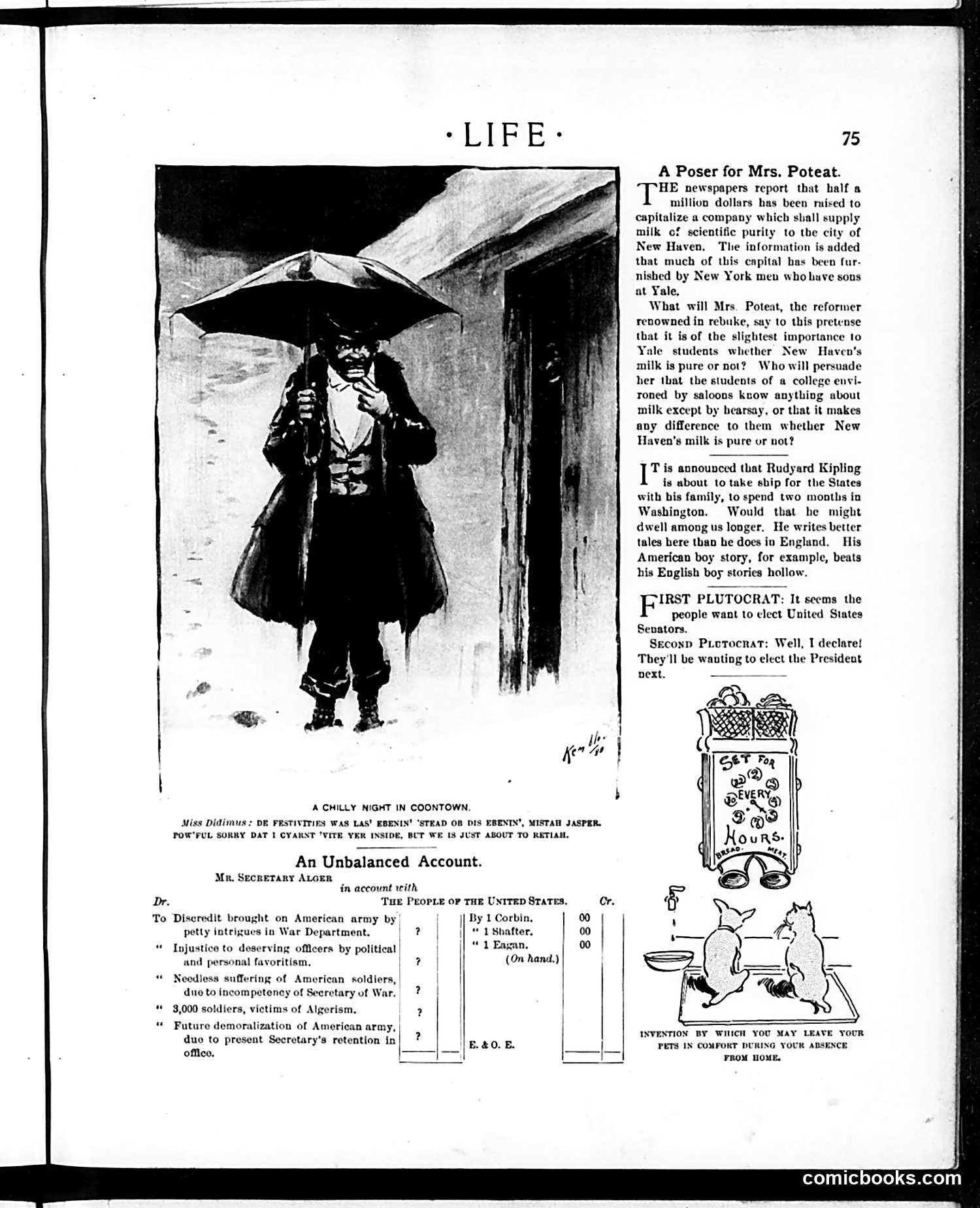
This page contains three distinct satirical pieces: **"A Poser for Mrs. Poteat"** mocks reformers advocating for pure milk in New Haven (near Yale). The satire is that wealthy Yale students, surrounded by saloons, wouldn't care about milk purity—implying moral corruption from alcohol is the real problem being ignored. **The Kipling notice** praises British author Rudyard Kipling's American writing over his English work, suggesting he should stay longer in the U.S. **"An Unbalanced Account"** is a ledger attacking Secretary of War Alger, listing debits (military failures, soldier suffering, incompetence during the Algerism period—likely the Spanish-American War) against minimal credits. This direct political attack suggests Alger's tenure caused widespread damage. **"A Chilly Night in Coontown"** uses racist dialect humor typical of the era, showing a Black woman refusing entry to a visitor. The page reflects turn-of-century American satirical journalism targeting political figures and social reform hypocrisy.
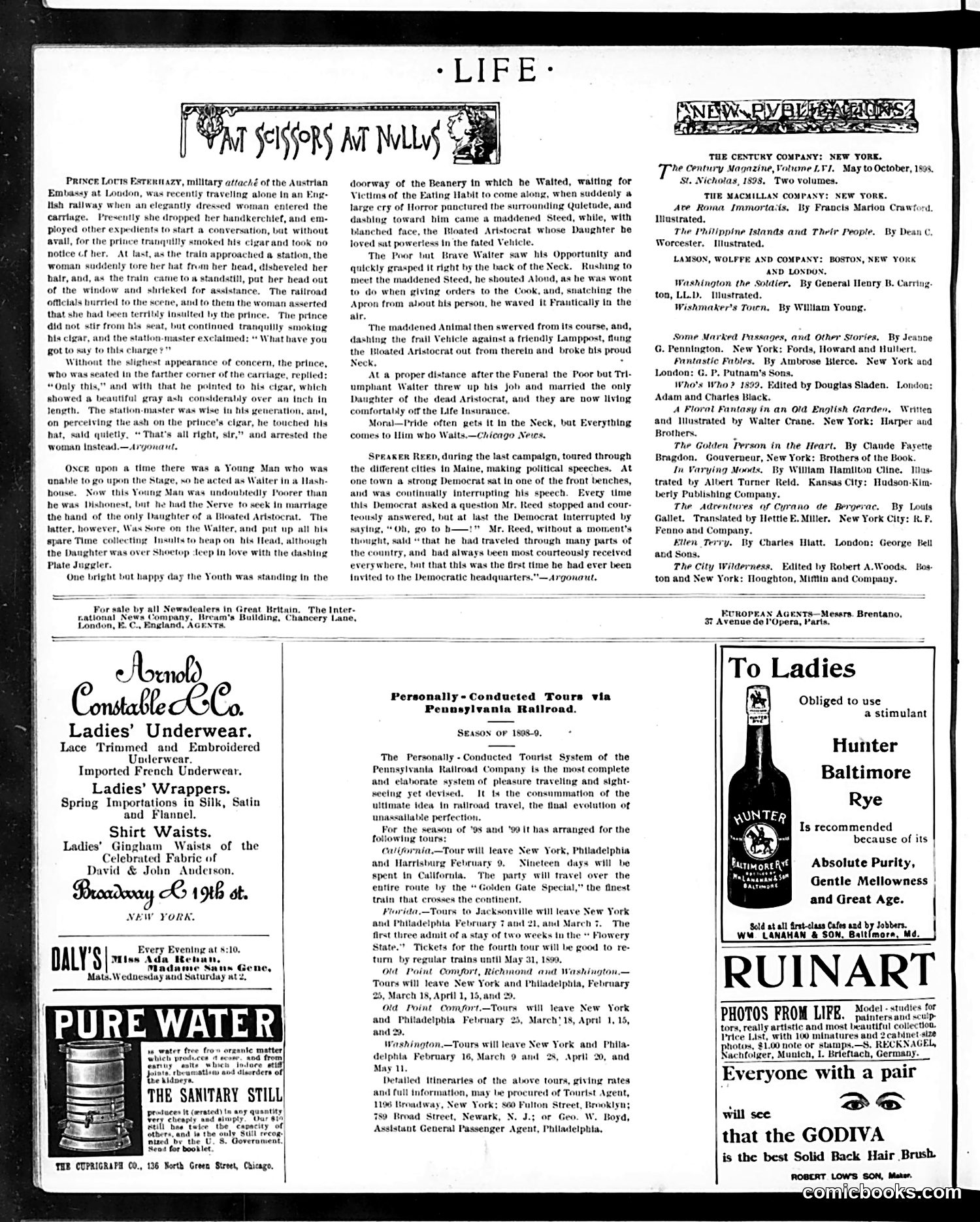
This page contains three satirical anecdotes typical of *Life* magazine's humor style: 1. **Prince Louis Esterhazy story**: A woman on a train attempts to seduce an Austrian diplomat by feigning distress (tearing her hat, shrieking). The prince remains unmoved. When accused, he simply points to the ash on his cigar—so long it couldn't have been disturbed—proving his innocence through a clever, understated display of composure. The satire targets both the woman's manipulative behavior and celebrates aristocratic dignity. 2. **The Poor Waiter tale**: A working-class waiter wins a bloated aristocrat's daughter by heroically saving him from a runaway horse—only for the horse to kill the father anyway. The waiter then marries her and lives off the life insurance. This mocks class pretensions and suggests ironic justice. 3. **Speaker Reed anecdote**: Maine political speaker Thomas Brackett Reed responds to a heckler's crude insult ("go to h—") with witty repartee, claiming it's the first time Democrats invited him to their headquarters. This celebrates Republican superiority through rhetorical cleverness. All three celebrate wit, composure, and social superiority—typical *Life* magazine values of the 1890s.
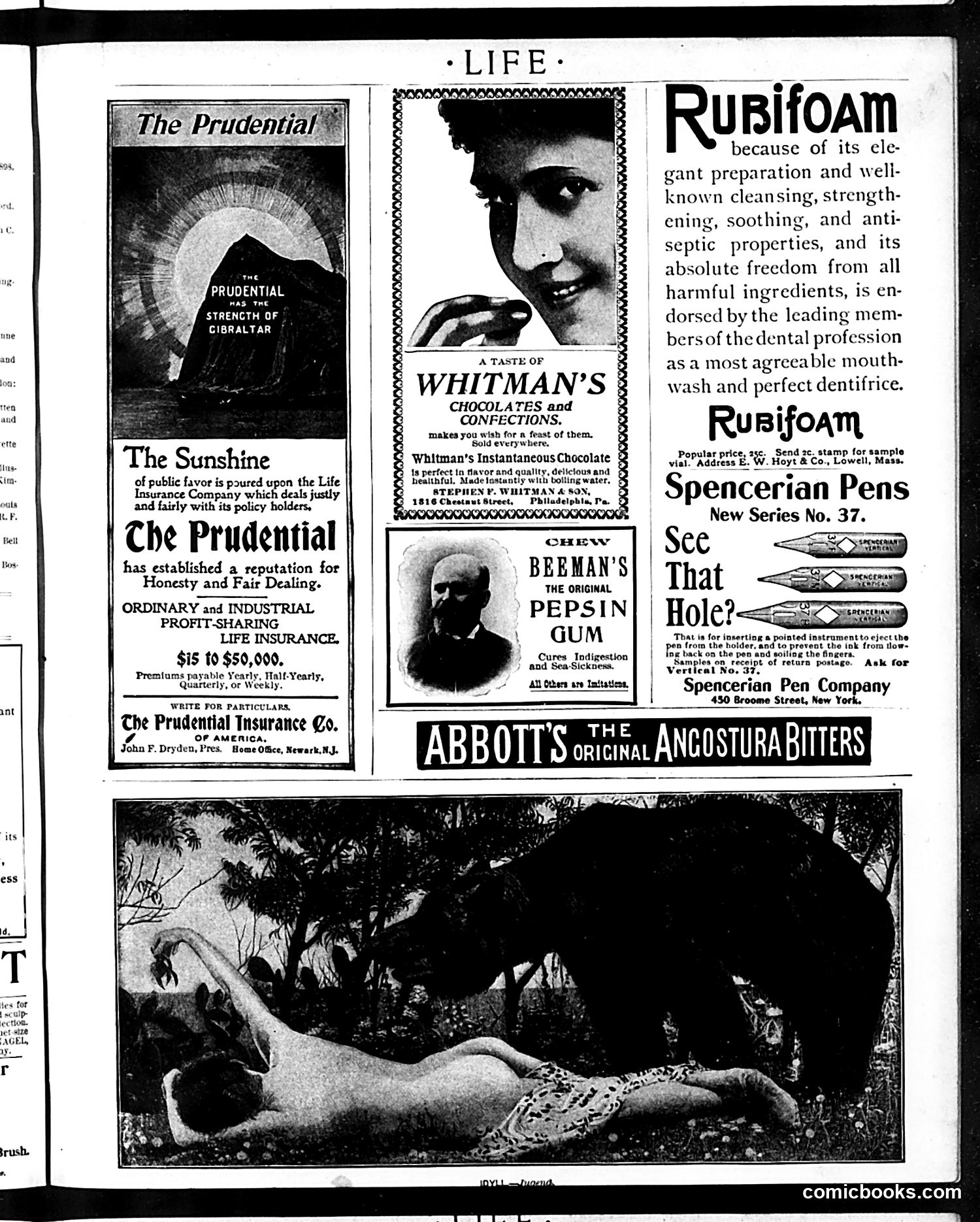
This page is primarily **advertising**, not political satire. It contains commercial advertisements for insurance, chocolates, chewing gum, toothwash, and pens—typical early 20th-century product placements. The only editorial content is a large illustration at the bottom labeled "Abbott's The Original Angostura Bitters," depicting a woman reclining outdoors while a bear approaches—likely a humorous or dramatic scene meant to advertise the medicinal tonic product. The Prudential Insurance ad uses patriotic imagery ("Strength of Gibraltar") to build trust in the company. Beeman's Pepsin Gum claims medical benefits (curing indigestion). These reflect period advertising conventions that made health claims now considered dubious or illegal. The page documents early 1900s consumer culture and the types of products marketed to middle-class Americans.
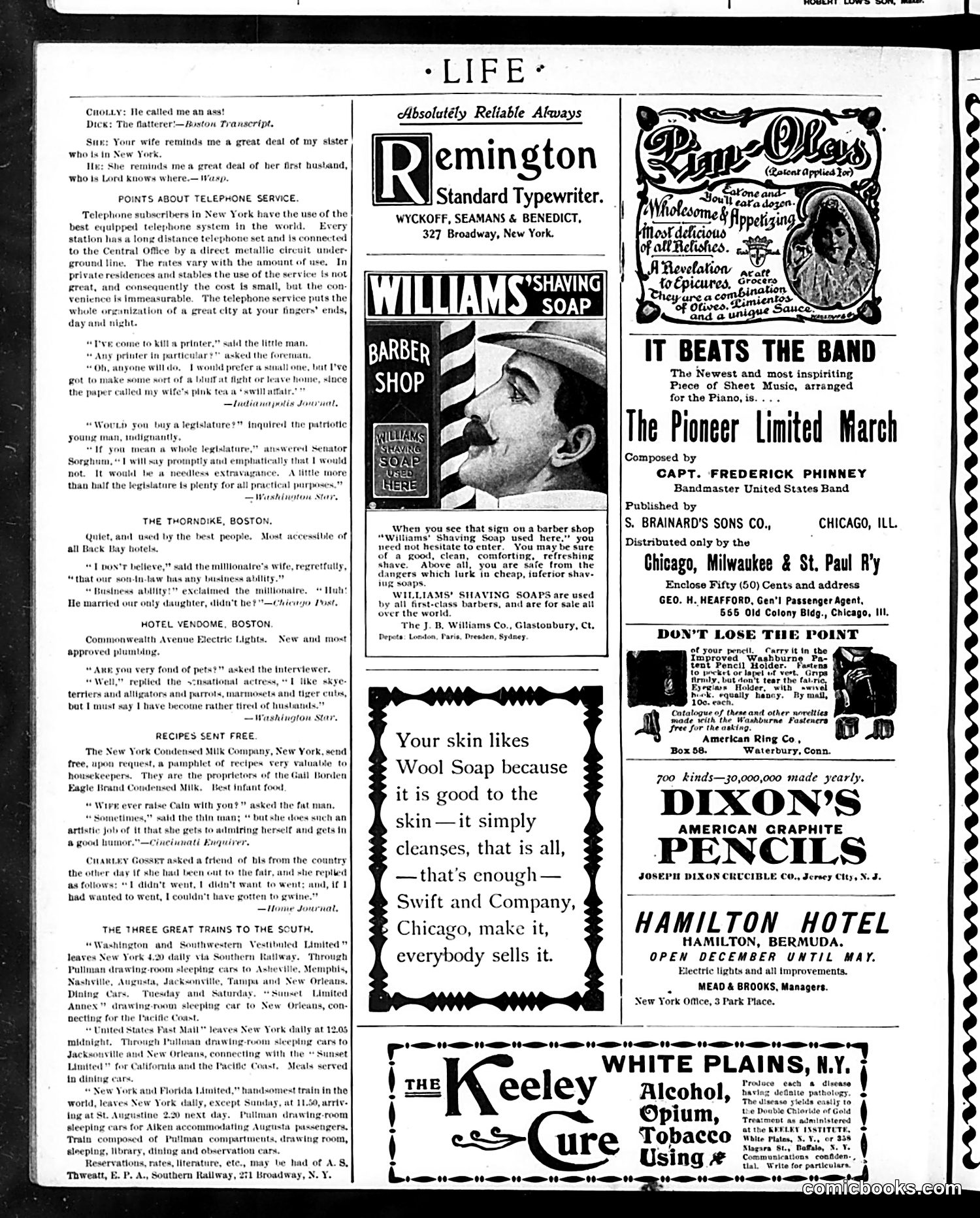
This page is primarily **advertisements and light humor columns**, not political satire. The humor pieces (brief anecdotes) use common turn-of-the-century comedy tropes: spousal/relationship jokes, misunderstandings about language and manners. Examples include a couple mistaking each other's relatives, a wife's "business inability" joke, and a wife praising her husband for making her self-admiring. **The advertisements** promote contemporary products: Remington typewriters, Williams' shaving soap (with a barber-pole logo), railroad travel to the South, graphite pencils, and health products like "The Keeley Cure" (a real but now-notorious alcoholism treatment). The editorial content (telephone service, recipes, trains) appears to be informational rather than satirical. **Notable context for modern readers**: This appears to be early-1900s *Life* magazine, which was primarily a humor/lifestyle publication then—very different from the later *Life* photography magazine. The advertisements reflect era-specific concerns (long-distance travel as novelty, typewriter adoption, questionable "cures").
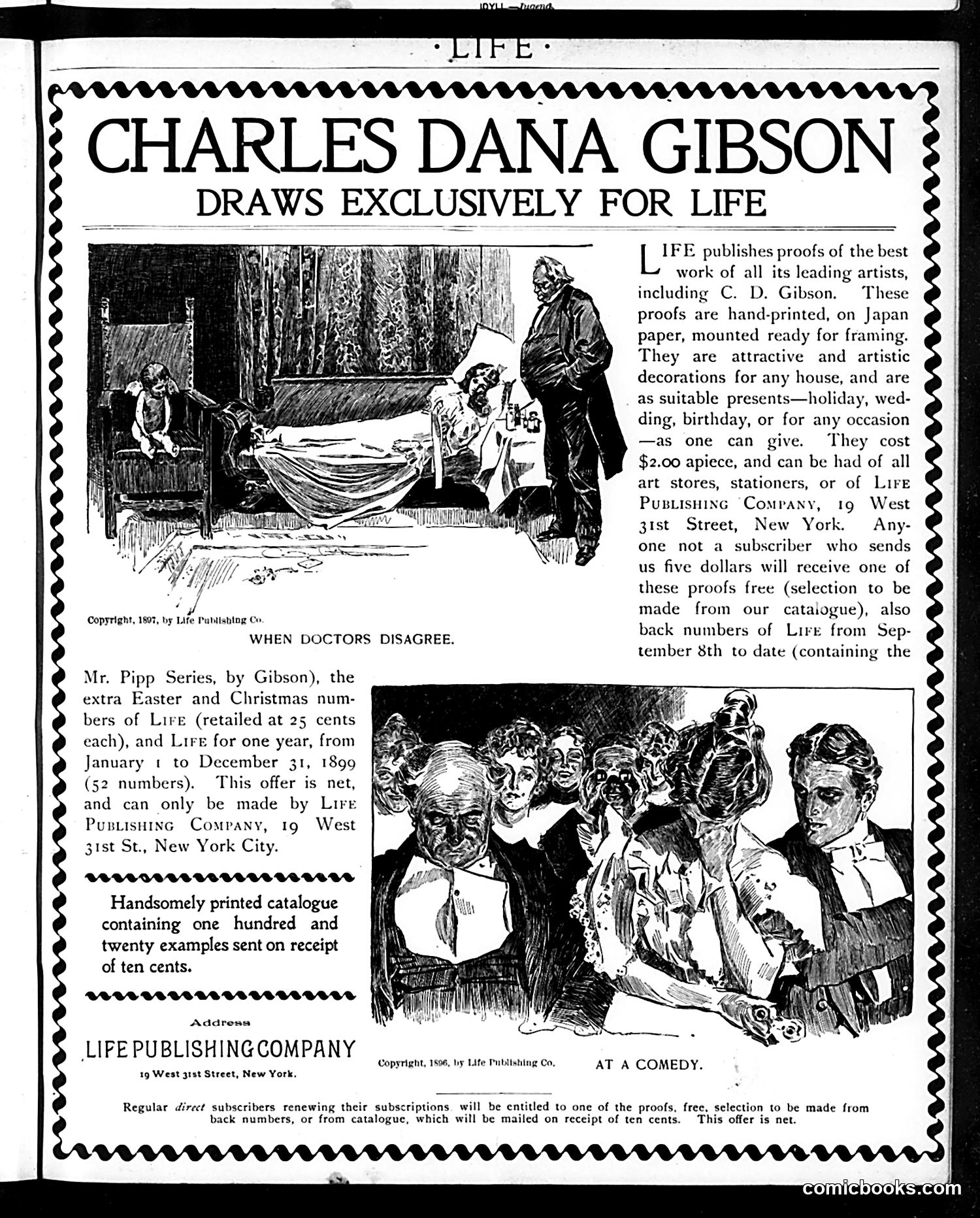
This is primarily an **advertisement** for Charles Dana Gibson's artwork and Life magazine's print offerings, rather than political satire. **The Content:** The two illustrations shown are Gibson's signature drawings. "When Doctors Disagree" (left) depicts a medical scene—likely satirizing the common Victorian trope of conflicting medical opinions, a frequent subject of period humor. "At a Comedy" (right) shows well-dressed figures at a social gathering, typical of Gibson's portrayal of high-society life. **The Pitch:** Life Publishing Company advertised hand-printed art proofs ($2 each) featuring work by Gibson and other leading artists, marketed as suitable home decorations and gifts. Subscribers could receive free proofs; non-subscribers could get proofs and back issues by paying five dollars. **Historical Context:** Charles Dana Gibson (creator of the "Gibson Girl" ideal) was a major illustrator of the 1890s. This advertisement reflects the era's commercialization of fine art reproduction for middle-class consumers.
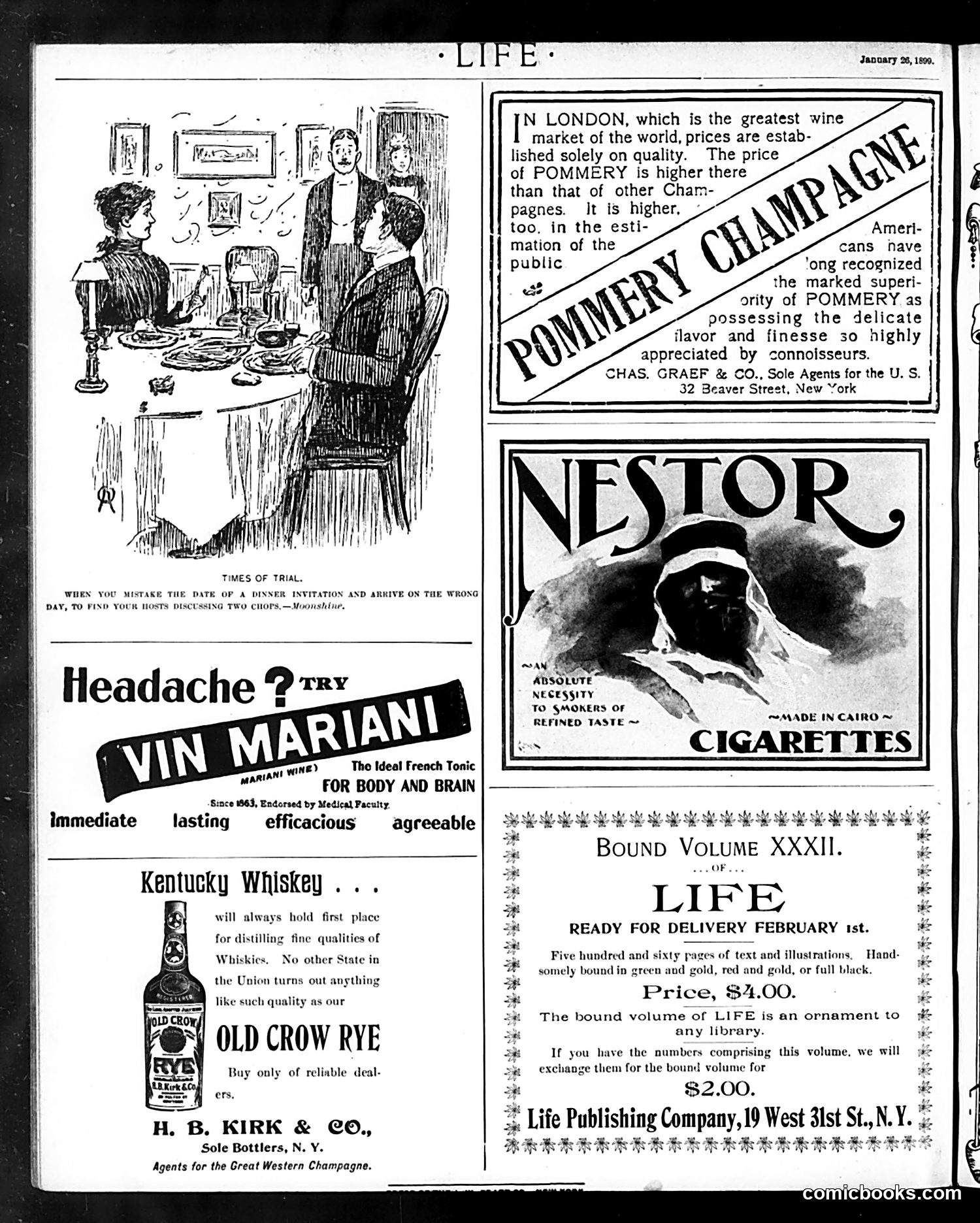
The cartoon illustrates a social embarrassment common to the Victorian era: arriving at a dinner invitation on the wrong date. The sketch shows a well-dressed couple discovering their hosts mid-meal discussing "two chops"—indicating a meager dinner of just lamb chops, suggesting the household was unprepared for unexpected guests. The satire targets the anxiety of upper-class social etiquette. The phrase "Moonshine" (a contemporary term for nonsense or exaggeration) suggests the hosts are making excuses or being evasive about their sparse meal. The joke lies in the awkward predicament: the visitor has intruded on a humble dinner, catching the hosts in an embarrassing situation where they cannot adequately entertain. This reflects period concerns about maintaining proper social appearances and the mortification when one's circumstances—or one's mistake—expose financial limitations. The remainder of the page consists primarily of period advertisements for alcohol and tobacco.