
A complete issue · 20 pages · 1898
Life — November 10, 1898
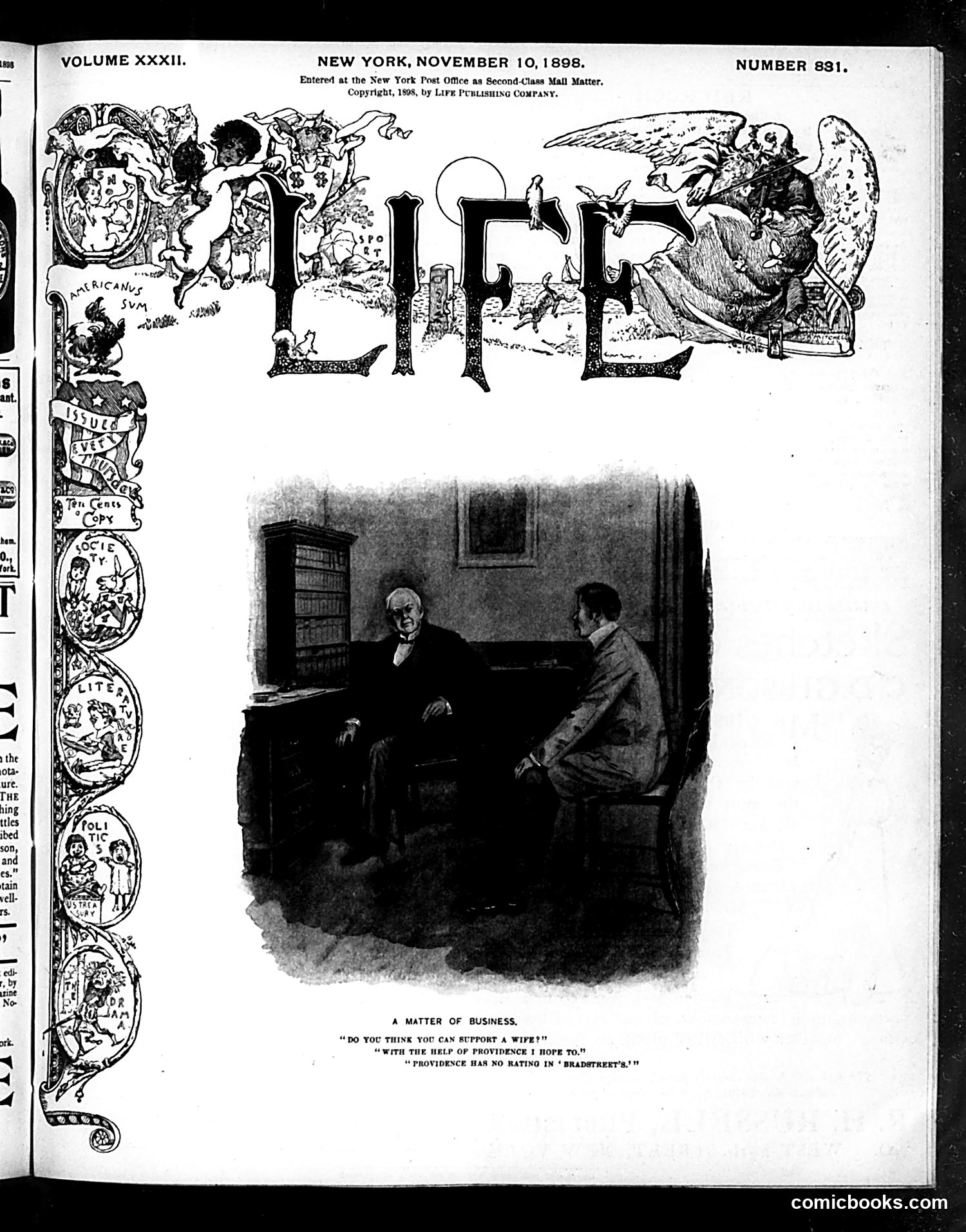
The main illustration, captioned "A Matter of Business," depicts two men in conversation in what appears to be an office or study. The dialogue reads: "Do you think you can support a wife?" "With the help of Providence I hope to." "Providence has no rating in Bradstreet's." This is a satirical commentary on marriage and financial viability. The older man (likely a prospective father-in-law or banker) is interrogating a suitor about his economic capacity to support a wife. The final line references Bradstreet's—a commercial credit-rating agency—suggesting that romantic promises and divine providence are irrelevant; only documented financial creditworthiness matters for marriage eligibility. The joke critiques the commodification of marriage and the late-19th-century emphasis on demonstrable wealth over sentiment.
This is primarily a **book and product advertisement page** from Life magazine's "Life" section, not a political cartoon page. The visible content includes ads for: - **Books**: "Red Rock" by Thomas Nelson Page, "The Heart of Toil," "The Bashful Earth," and "Frontier Stories" - **C.D. Gibson's "Sketches & Cartoons"** featuring "The Education of Mr. Pipp" (Gibson was Life's famous illustrator) - **Stern Bros. corsets** and **James McCutcheon & Co. linens** - **Gorham Manufacturing Co. silverware** - **Life's Book of Animals** from Doubleday & McClure The Gibson book advertisement includes a small illustration of a woman in period dress, typical of Gibson's "Gibson Girl" style illustrations that were popular at the time. No significant political satire is evident on this page—it's primarily commercial content aimed at readers of this 1898 issue.
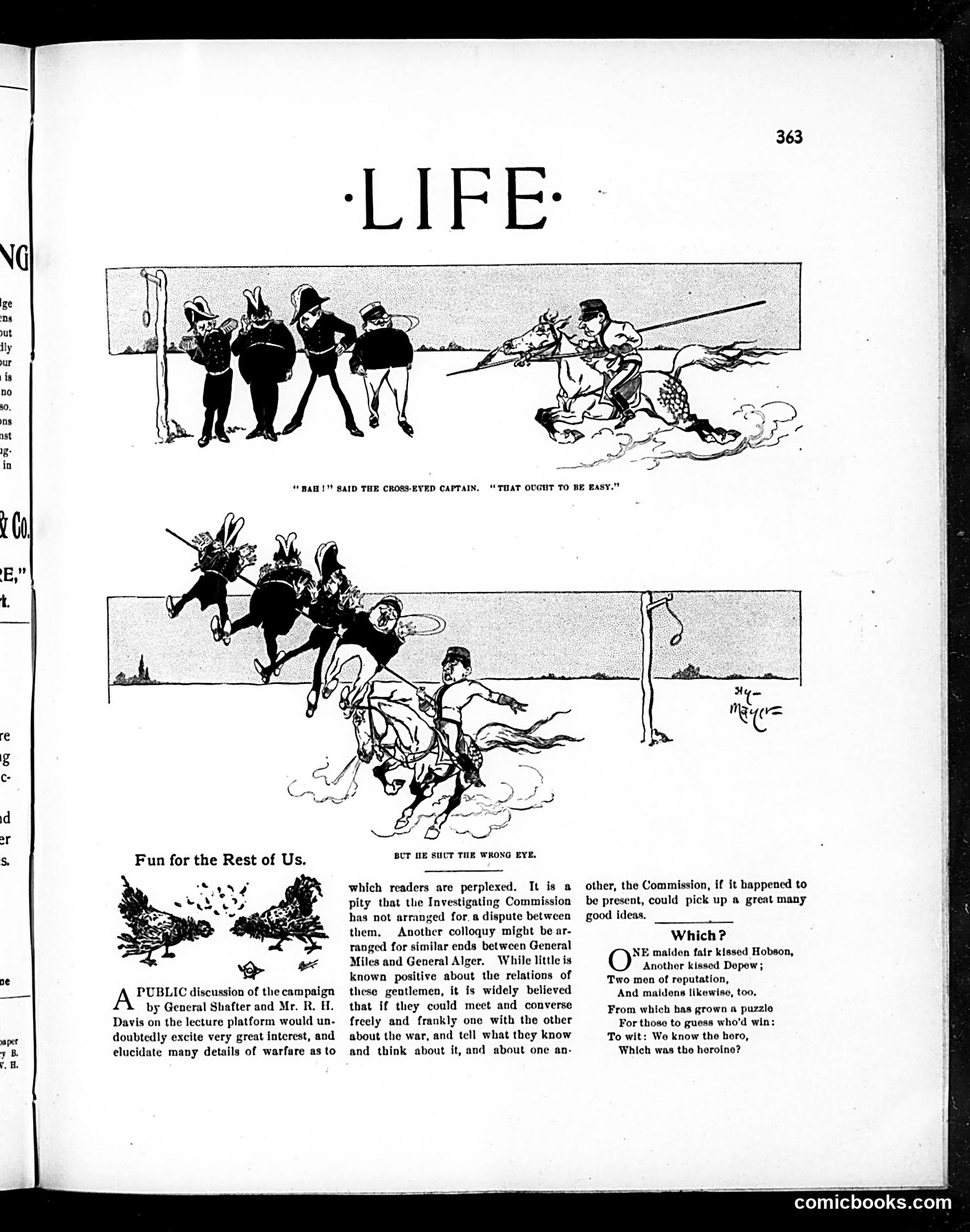
This page contains military satire from the WWI era. The top cartoon shows a cross-eyed captain telling observers "that ought to be easy" while chaos erupts—soldiers are being thrown by explosions. The joke mocks military incompetence and the disconnect between officers' confidence and battlefield reality. The middle panel, captioned "But He Shut The Wrong Eye," continues this theme of military mishap and poor judgment. The text below discusses a proposed public debate between General Shafter and R.H. Davis about the war, suggesting such a discussion "would undoubtedly excite very great interest." The piece humorously proposes other unlikely military figures (Generals Miles and Alger) might debate similar topics. The "Which?" poem satirizes confusion about who deserves credit in military campaigns.
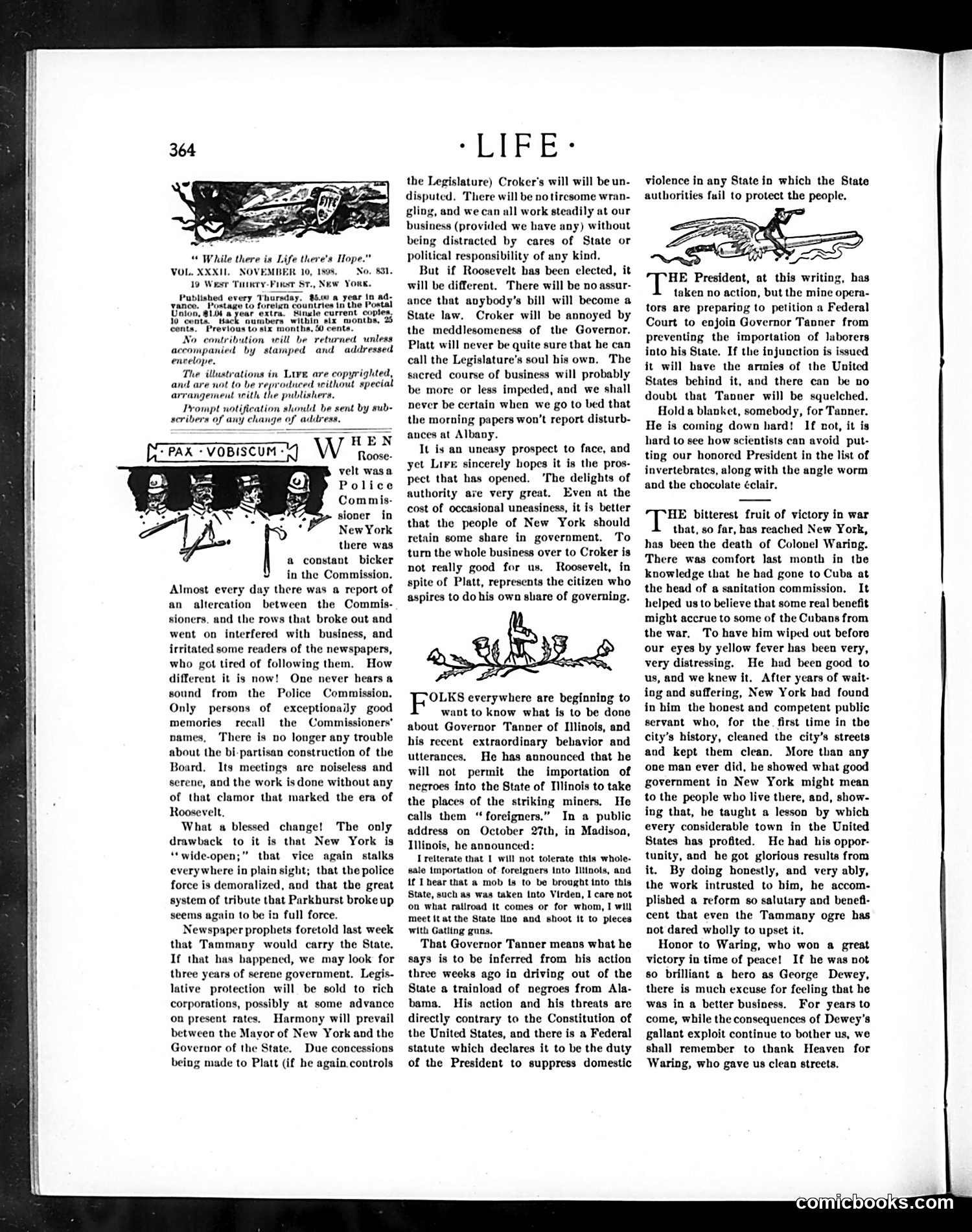
This page contains political commentary on New York governance circa early 1900s. The main cartoon labeled "PAX—VOBISCUM" (Latin: "Peace Be With You") depicts four figures representing the Police Commission, satirizing their constant internal conflicts and ineffectiveness. The text criticizes the commission's inability to govern without interference, contrasting this with Governor Tanner of Illinois, who apparently took decisive action against imported strikebreakers—which the author views as proper executive authority. The piece also praises Colonel Waring for cleaning up New York's streets, suggesting competent leadership improves public trust in government. Overall, the satire mocks New York's fractious political leadership while praising decisive governance elsewhere, reflecting Progressive Era debates about administrative competence and executive power.
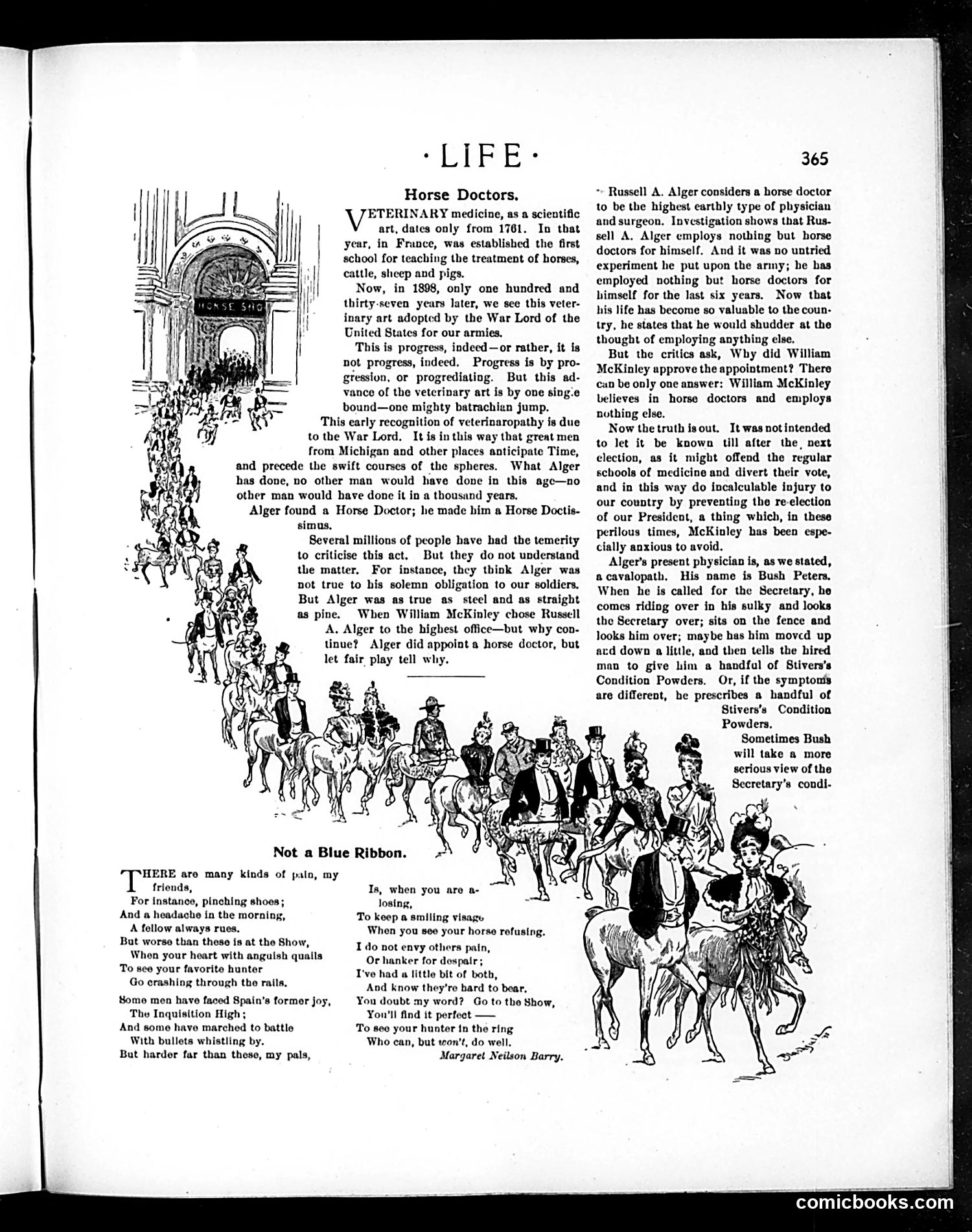
This page satirizes President William McKinley's appointment of Russell A. Alger as Secretary of War. The text argues that Alger, though a wealthy businessman, had no military experience—his only qualification being that he employed horse doctors. The satire suggests McKinley chose Alger for political reasons rather than merit, potentially damaging the country by excluding qualified military professionals. The illustration depicts a procession of people and horses, apparently showing the consequences of this poor appointment decision. The poem "Not a Blue Ribbon" below reinforces the critique, suggesting that merely keeping a "smiling visage" while suffering difficulties (like a horse refusing to perform) isn't genuine strength—a dig at Alger's unsuitability for the critical wartime position.
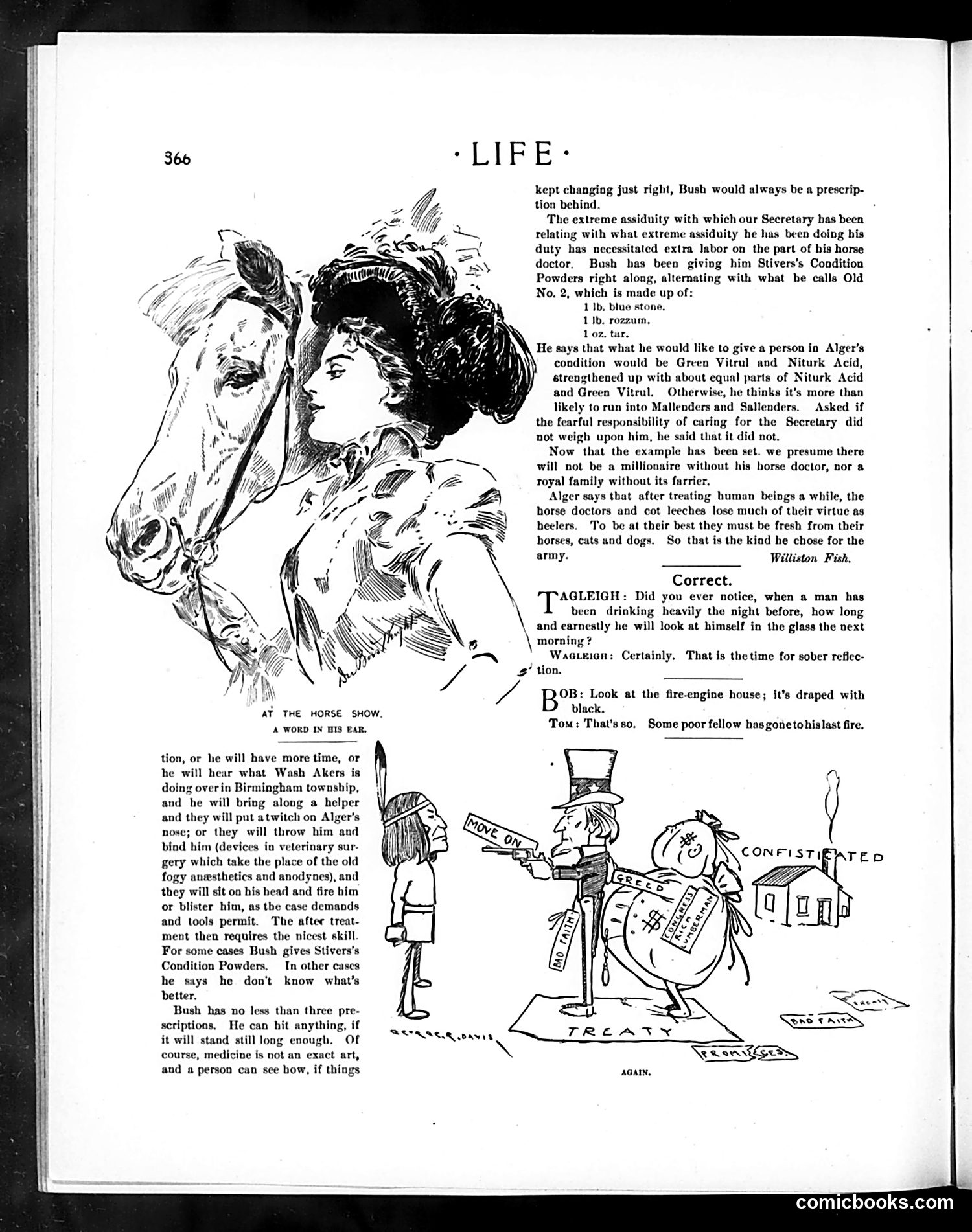
**Top illustration:** "At the Horse Show—A Word in His Ear" depicts a woman whispering to a man near a horse. The accompanying text discusses a Secretary's health condition (likely Secretary of State), mentioning prescriptions and various medicines, suggesting satirical commentary on the Secretary's physical ailments and medical treatments. **Bottom cartoon:** "Confisticated Again" shows a comedic scene where someone appears confused by overlapping legal documents or treaties labeled with words like "MOVE ON," "TREATY," and "CONFISCATED." This likely satirizes bureaucratic confusion or property seizure during an unspecified historical period, though the specific political context remains unclear from the visible text alone. Both pieces employ visual humor to mock political figures or governmental inefficiency.
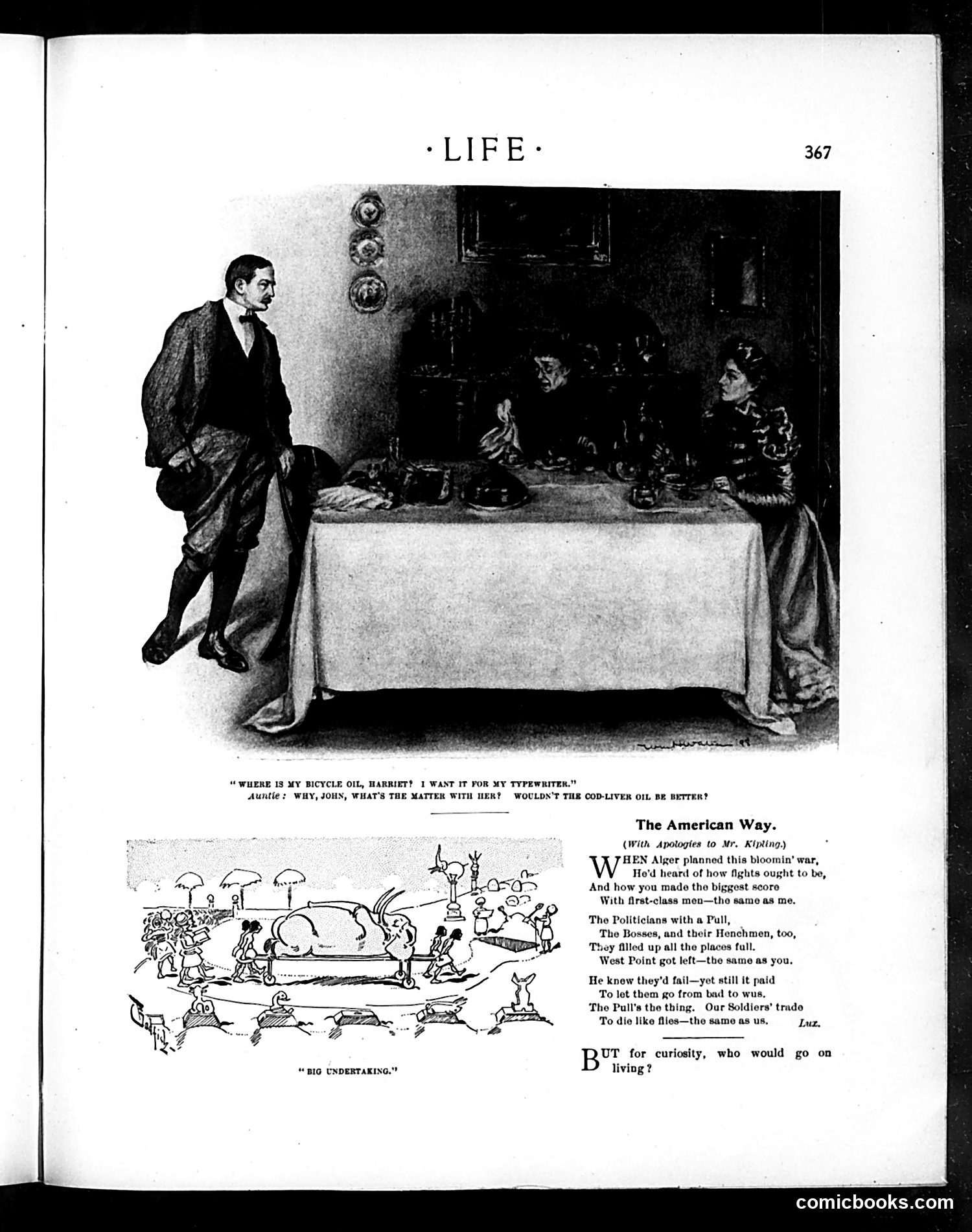
The top cartoon depicts a domestic scene where a man asks his wife about bicycle oil, typewriter oil, and "good-lids oil," suggesting he's confused about which product to use. The satire mocks American consumer culture and product proliferation. Below, "The American Way" poem (with apologies to Rudyard Kipling) satirizes American democracy and capitalism. It describes how politicians, bosses, and soldiers all participate in a corrupt system where everyone "gets the same as you"—suggesting widespread inequality and hypocrisy masked by democratic rhetoric. The "Big Undertaking" cartoon depicts what appears to be a large governmental or industrial project being managed by many small workers, likely criticizing ambitious American enterprises or wartime mobilization efforts. The satire suggests grand ambitions requiring massive coordination, with unclear success.
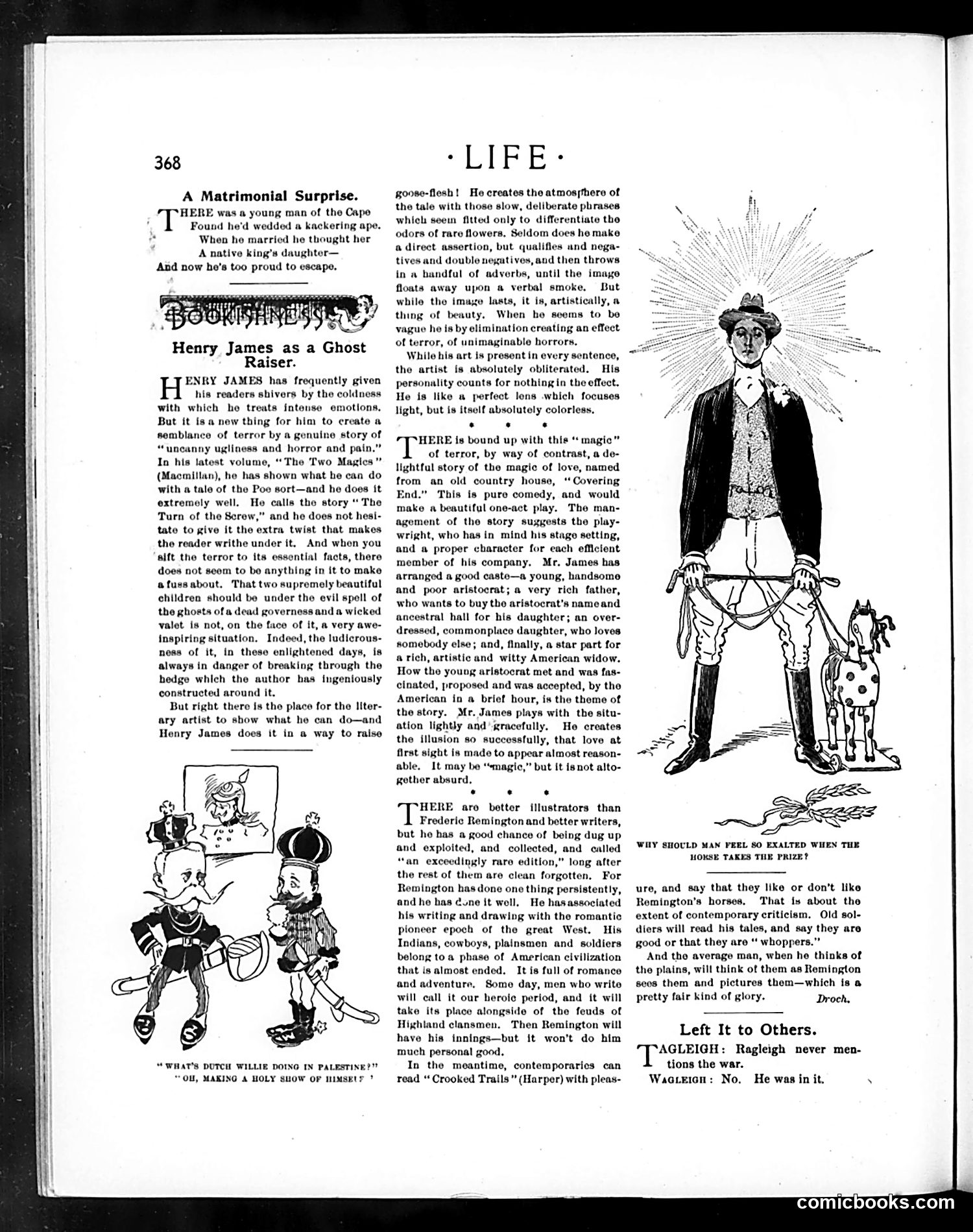
The page contains three distinct satirical pieces about Henry James as a writer: 1. **"A Matrimonial Surprise"** critiques James's dense, ornate prose style—his tendency toward elaborate descriptions and complex sentence structures that obscure meaning ("goose-flesh" and "slow, deliberate phrases"). 2. **"Henry James as a Ghost Raiser"** sarcastically praises James's ability to create emotional intensity and "uncanny ugliness," comparing his literary technique to summoning supernatural effects. 3. **The cartoon depicting two caricatured figures** (bottom left) appears to mock James's artistic pretensions, though the specific figures remain unclear from the image alone. Overall, the satire targets James's notoriously difficult, ornamental writing style—his preference for aesthetic complexity over accessible storytelling—a common contemporary criticism of his later works.
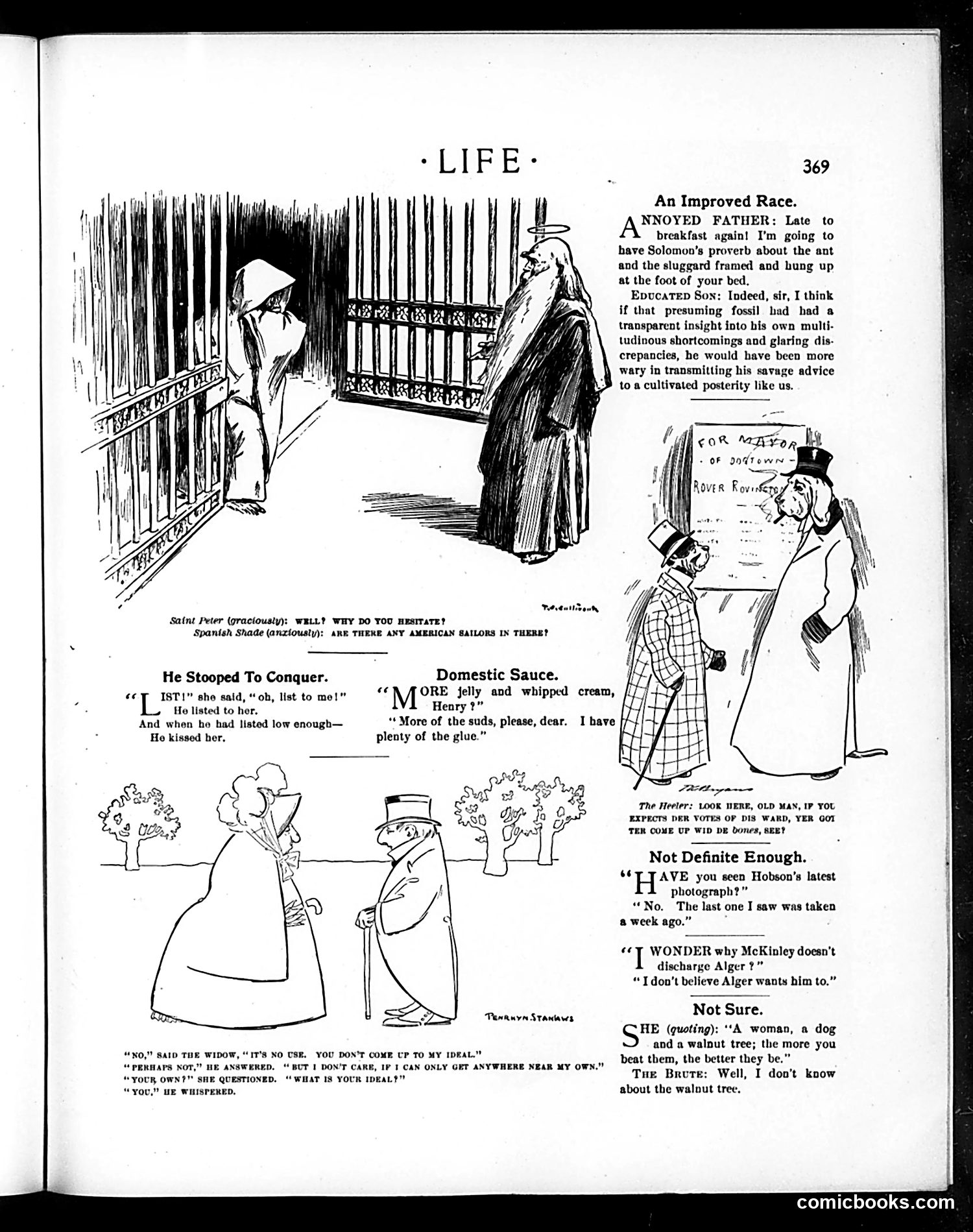
This page contains several brief satirical comics and humorous anecdotes typical of Life's format. **"An Improved Race"** mocks a father giving unsolicited advice to his son, suggesting the father's "savage advice" would be better received by lower classes. **"He Stopped To Conquer"** depicts a romantic encounter where a man successfully wins over a woman through persistence. **"Domestic Sauce"** jokes about a husband requesting more dessert while his wife complains about lacking glue—a pun on "suds" (soapy water). Additional brief jokes mock photography, political patronage, and animal behavior. The humor relies on wordplay, domestic situations, and social observation typical of early-20th-century American magazine comedy. The cartoons appear unsigned or credited to artists now difficult to identify with certainty.
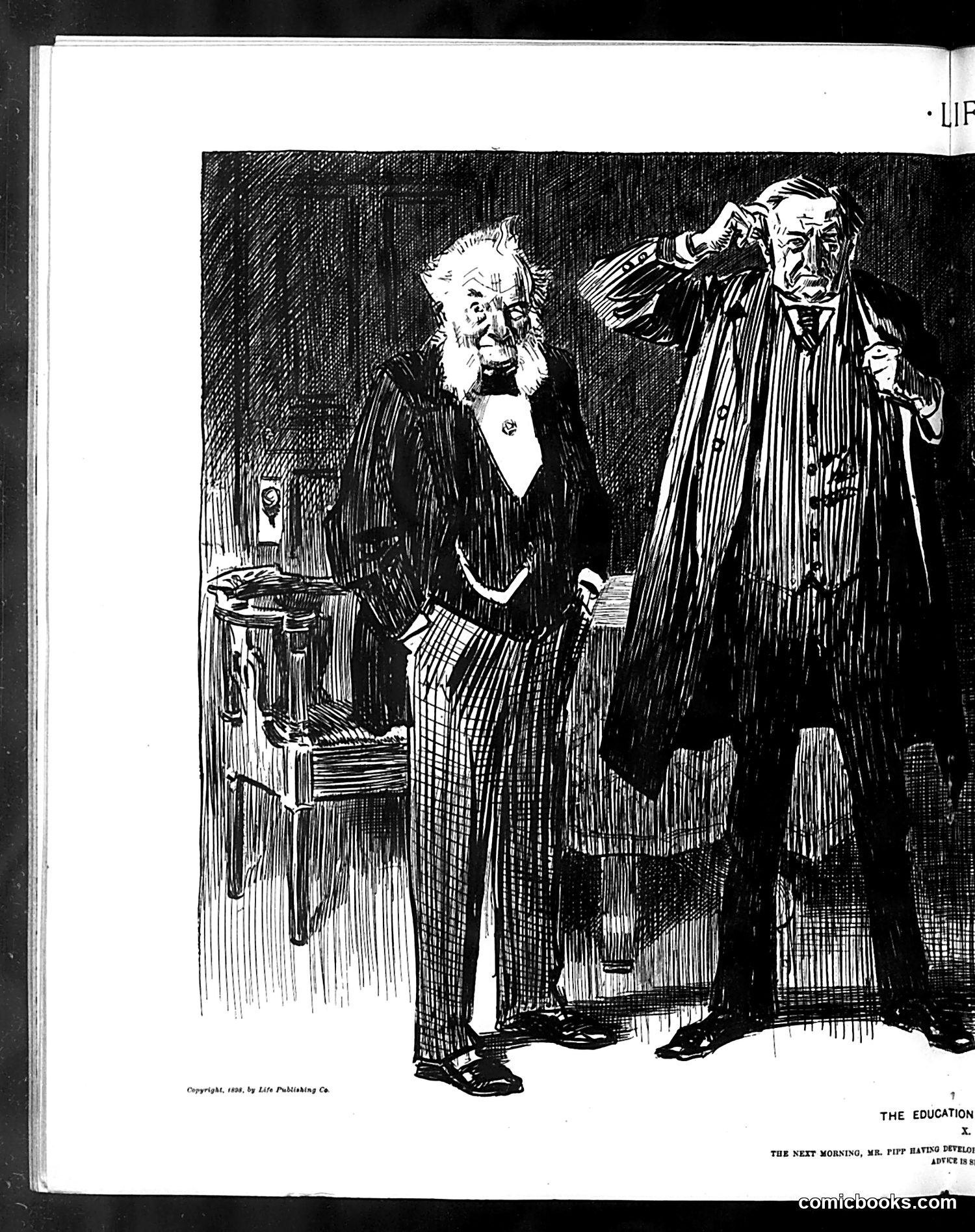
This political cartoon depicts two well-dressed men in conversation, with the caption referencing "The Education" and "The Next Morning, We Fift Having Develop[ed] Justice in B[?]" The cartoon appears to satirize political hypocrisy or failed promises regarding justice or education. The exaggerated facial expressions and formal Victorian dress suggest these are prominent public figures or politicians of the era (copyright 1898 by Life Publishing Co.). Without being able to identify the specific individuals from the caricatures alone, or having clearer caption text, the exact targets and context remain unclear. The "education" title likely refers ironically to a lesson these figures have learned—or failed to learn—about justice or proper conduct. The satirical tone typical of Life magazine suggests criticism of political corruption or broken commitments.
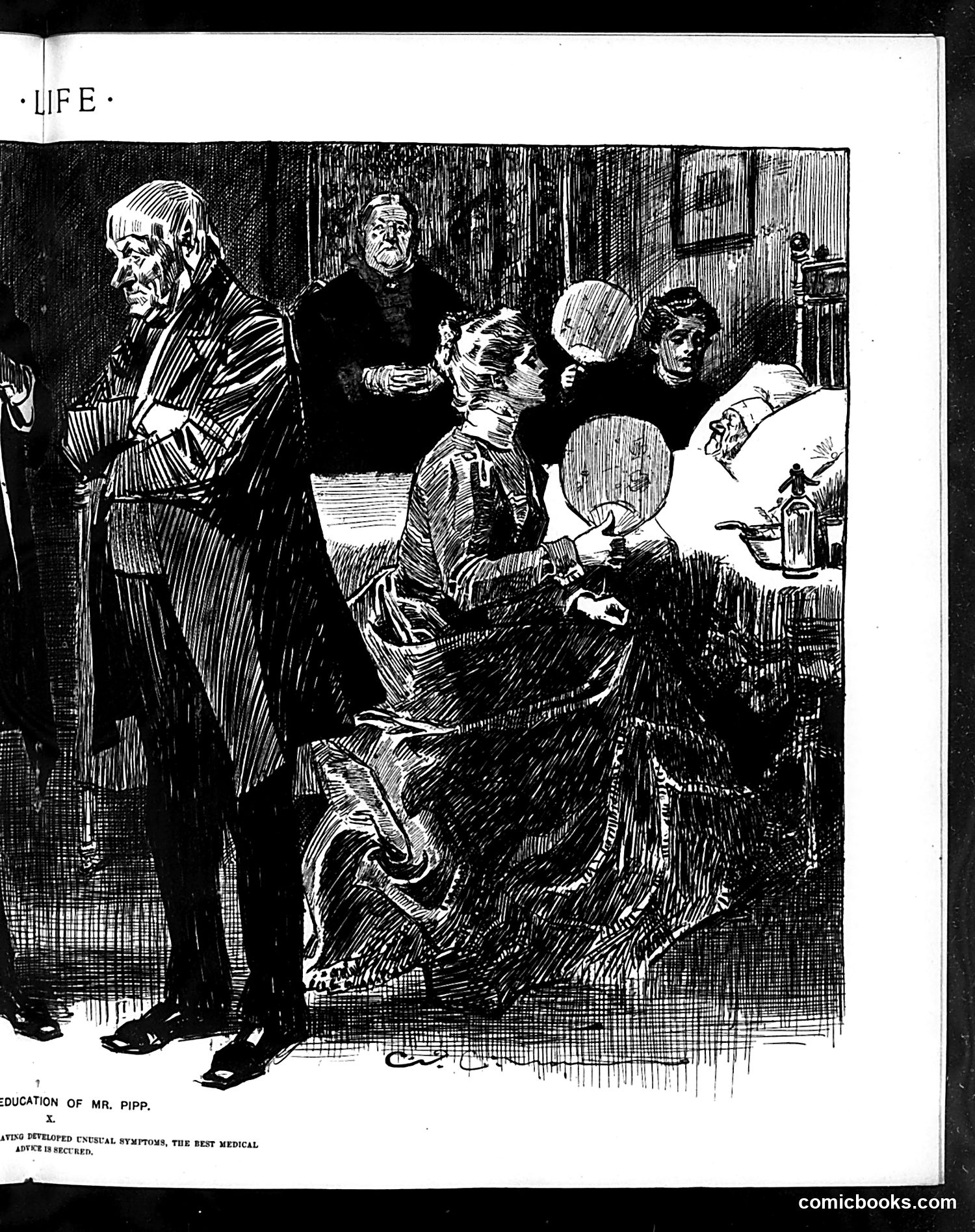
This appears to be a satirical illustration titled "The Education of Mr. Pipp," with a subtitle noting "Having Developed Unnatural Symptoms, the Best Medical Advice is Received." The cartoon depicts a well-dressed man (Mr. Pipp) seated while several other figures surround him in what appears to be a medical or consultative setting. The style suggests early-to-mid 20th century satirical commentary, likely mocking either medical practices of the era or a specific public figure's situation. Without additional context or clearer text, the exact nature of the satire remains unclear—whether it critiques medical quackery, a particular illness diagnosis, or social pretension. The formal indoor setting and the gathering of figures suggest professional consultation or intervention of some kind.
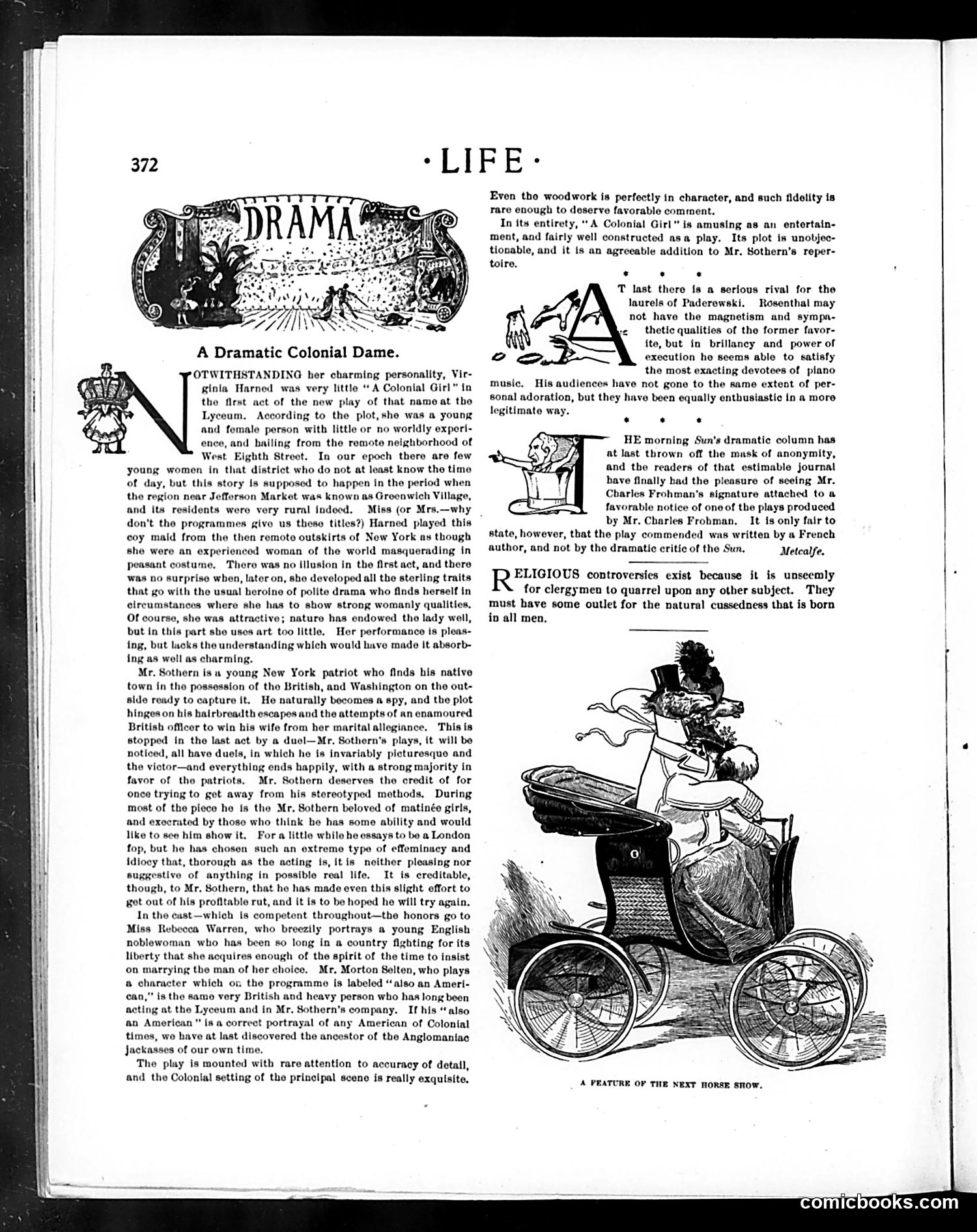
This page reviews "A Colonial Girl," a theatrical play at the Lyceum. The drama section discusses Mr. Sothern's performance as a New York patriot during the British occupation, praising his departure from stereotyped methods. The text also commends Miss Rebeeca Warren's portrayal of an English noblewoman advocating for American independence, and notes Mr. Morton Selten's accurate depiction of a Colonial-era American character. The illustration on the right shows a woman in period dress on a bicycle—likely satirizing the anachronism of depicting modern technology in a Colonial-era play, or commenting on the incongruity between historical accuracy and contemporary stagecraft. The caption reads "A Feature of the Next Horse Show," suggesting theatrical absurdity.
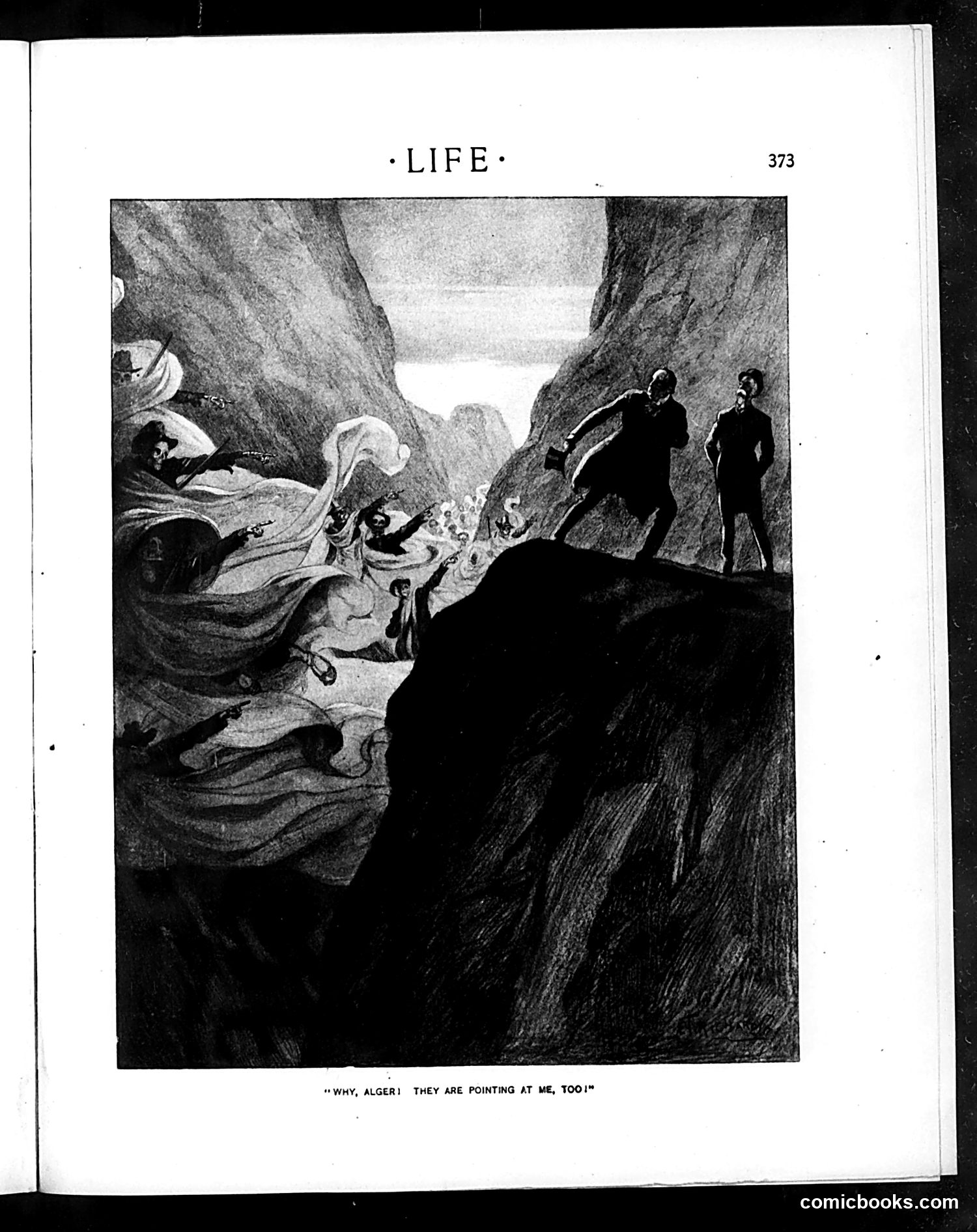
This appears to be a satirical illustration depicting a dramatic underground or cave scene. The caption "WHY, ALGER! THEY ARE POINTING AT ME, TOO!" suggests commentary on a figure named Alger (likely referring to Horatio Alger, the famous author of "rags-to-riches" stories, or possibly a political figure of the era). The composition shows multiple figures pointing accusingly at what appears to be a central character in black. The setting and dramatic gestures suggest themes of blame, accusation, or guilt being shared among multiple parties. Without additional context about the specific publication date and political climate, the exact satirical target remains somewhat unclear, though the image appears to critique either hypocrisy or collective wrongdoing among the figures depicted.
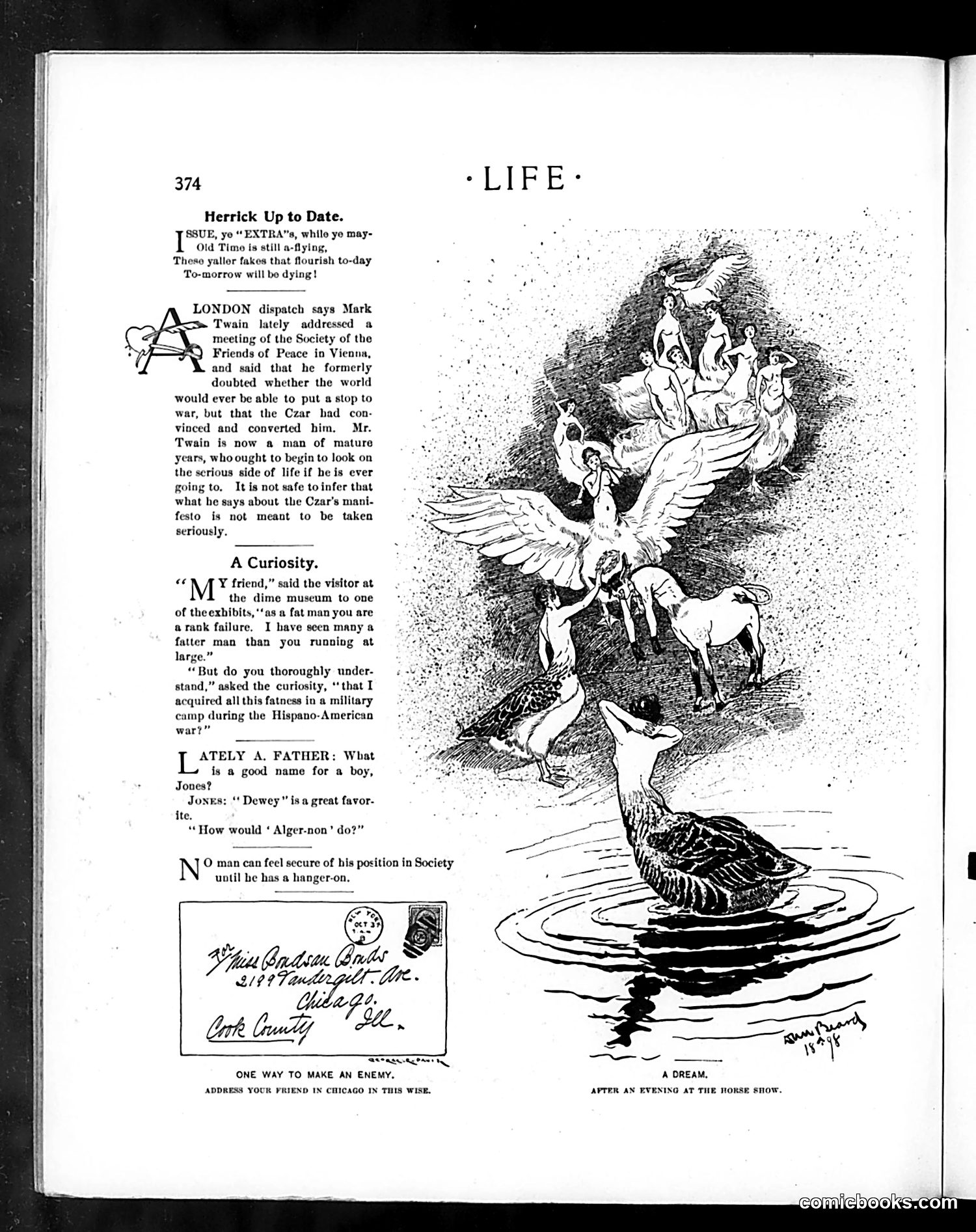
This page contains multiple satirical pieces reflecting early 1900s American concerns: **Mark Twain reference**: Mocks Twain's claimed conversion to pacifism by the Russian Czar's peace manifesto, suggesting his change of heart isn't genuine—a jab at celebrity activism. **"A Curiosity"**: A dime museum exhibit—a fat man who acquired his weight during the Spanish-American War military camps. The satire critiques both the absurdity of displaying human oddities and war's physical toll on soldiers. **"Lately a Father"**: A naming joke where "Dewey" (likely Admiral Dewey, Spanish-American War hero) is fashionable, while "Alger" is less appealing—commentary on how recent war heroes influence popular culture. **"A Dream" illustration**: Shows fantastical winged horses and cherubs emerging from water at a horse show—likely satirizing the pretentious or fanciful aspirations of high-society events. The bottom sections are social commentary on manners and social climbing typical of Life's satirical style.
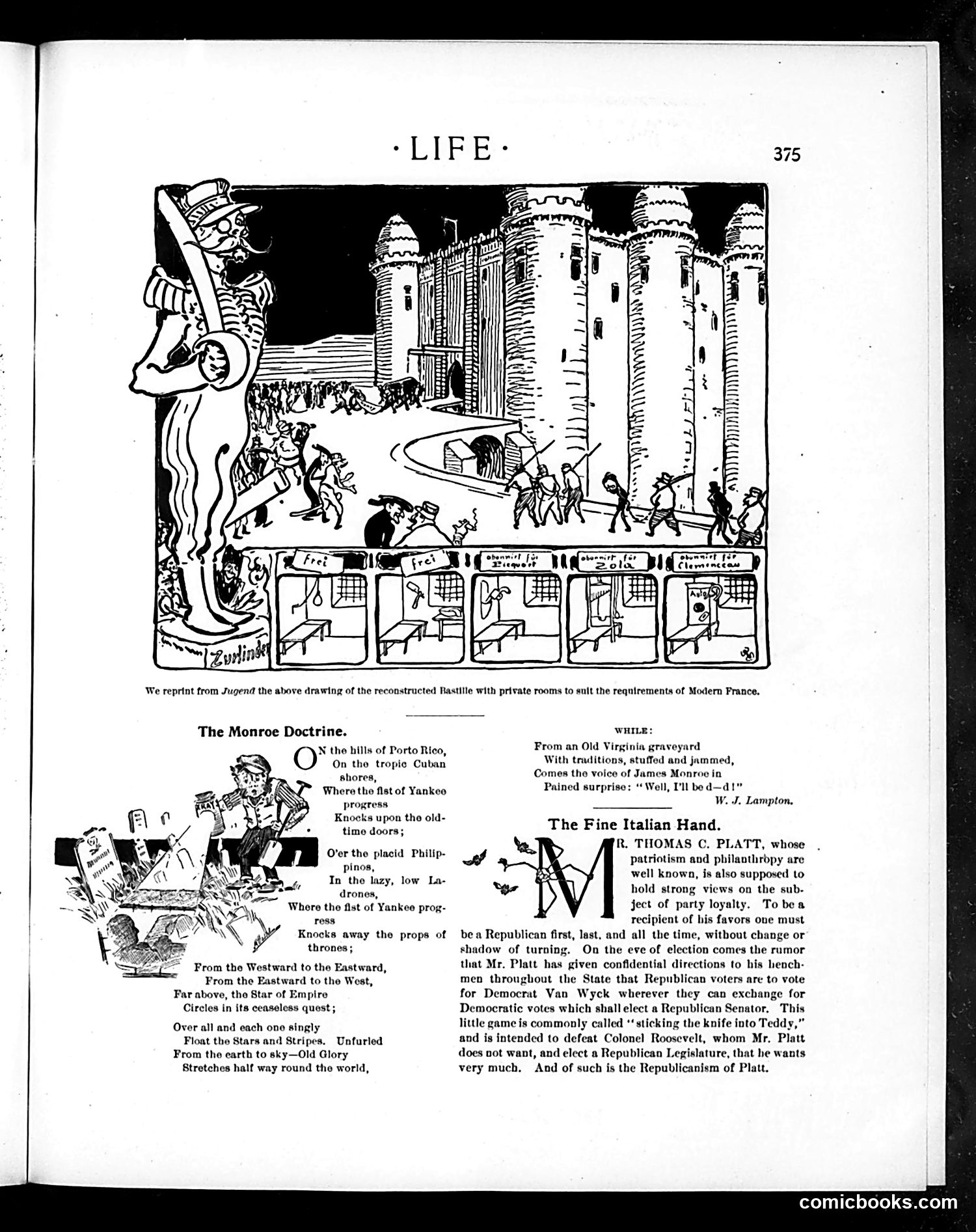
**Top Cartoon:** A satirical redrawing (reprinted from German magazine Jugend) of the Bastille fortress with added "private rooms." This mocks modern France's political corruption by suggesting the famous revolutionary symbol now serves private interests rather than public good. **"The Monroe Doctrine" Poem:** Celebrates American imperial expansion—referencing Puerto Rico, Cuba, and the Philippines ("Yankee progress"). The poem ironically invokes President James Monroe's ghost, suggesting America has perverted his doctrine of hemispheric independence into justification for colonialism. **"The Fine Italian Hand":** Attacks Republican politician R. Thomas C. Platt's backroom dealing. The text explains Platt secretly directs Republican voters to support Democrat Van Wyck to block Theodore Roosevelt's election as Senator—a betrayal called "sticking the knife into Teddy." It exposes party corruption masquerading as principle: Platt wants Republican legislature, not honest democracy. Both items criticize American power (imperial and political) as hypocritical and self-serving.
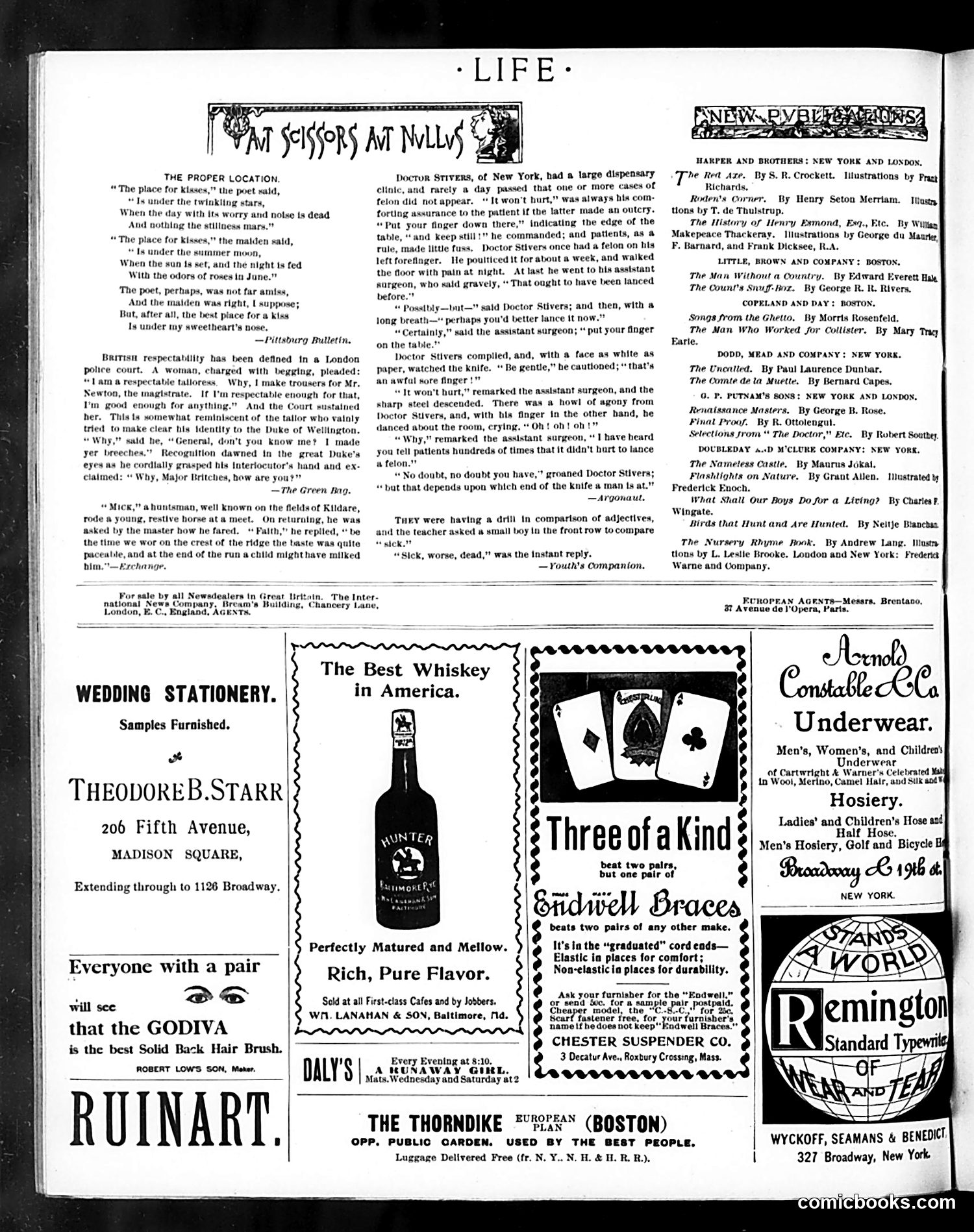
This page is primarily advertising and literary announcements, with some brief humorous anecdotes interspersed. The cartoons are minor: **"The Proper Location"** depicts a lighthearted debate about where kisses should occur—poetic locations (stars, moon) versus the practical answer: under one's sweetheart's nose. The joke relies on literal interpretation undermining romantic sentiment. The remaining content consists of short comic stories about respectability, a huntsman's horse, and notably, **Doctor Stivers**—a physician who routinely tells patients "it won't hurt" before lancing felons (hand infections), then experiences severe pain when a colleague lances *his* infected finger, leading to his humbled realization that pain perception depends on "which end of the knife a man is at." This is satirical commentary on hypocrisy and the difference between administering discomfort versus experiencing it. The page is dominated by publisher announcements and period advertisements for products like whiskey, underwear, and typewriters.
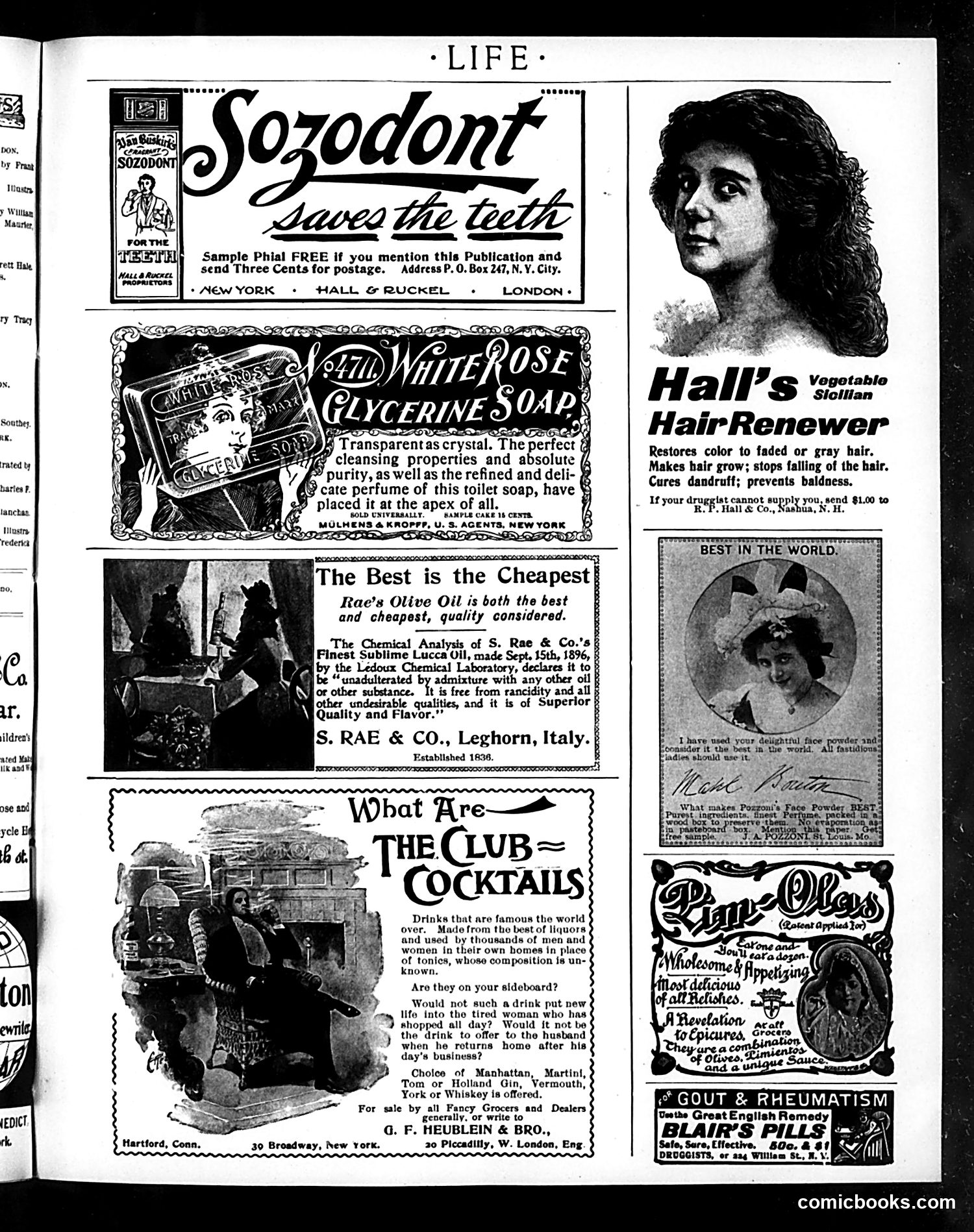
This is primarily an **advertising page**, not satirical editorial content. It showcases patent medicines and consumer products typical of the early 20th century. Key advertisements include: - **Sozodont** toothpaste ("saves the teeth") - **White Rose Glycerine Soap** - **Hall's Hair Renewer** (restores gray hair, stops baldness) - **Rae's Olive Oil** from Italy - **The Club Cocktails** (pre-made drink mixes) - **Pim-Ola** (unclear product, appears cosmetic) - **Blair's Pills** (for gout and rheumatism) The testimonial format—featuring a woman's photograph endorsing Hall's Hair Renewer—was standard marketing of the era. These ads reflect period anxieties about aging, health, and appearance, promoting solutions now recognized as often ineffective or potentially harmful. The page demonstrates how Life supplemented satirical content with lucrative patent medicine advertising, a common practice before modern FDA regulation.
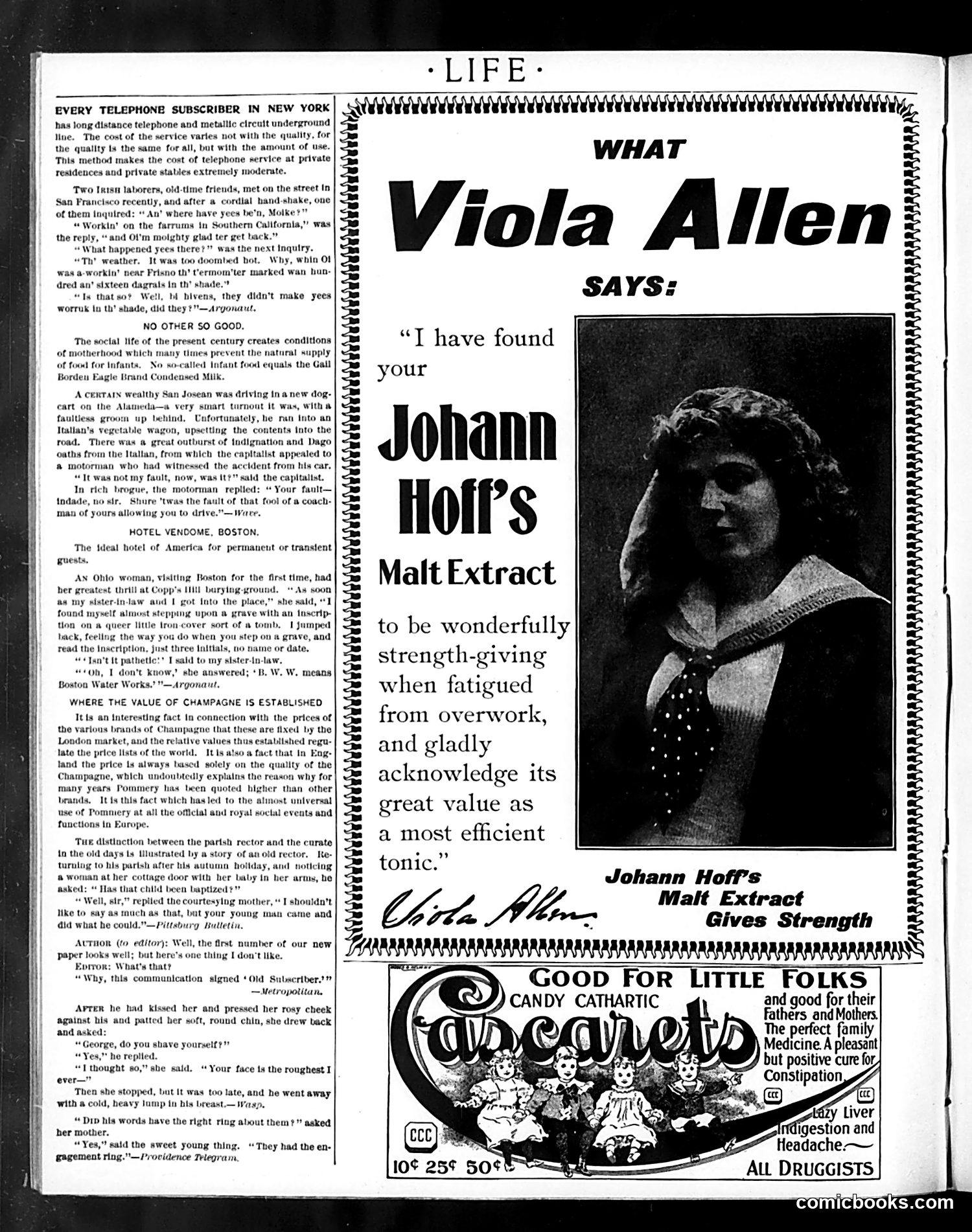
This page is primarily **advertising and humor anecdotes**, not political satire. The main content includes: **Advertisements**: Johann Hoff's Malt Extract (center, endorsed by actress Viola Allen) and Cascarets candy laxative dominate the page. **Humorous anecdotes** (left column): Short jokes with Irish and working-class characters, including: - Two Irish laborers discussing extreme California heat - A wealthy San Josean's dog-cart accident with an Italian vegetable vendor - An Ohio woman's confusion at Copp's Hill burying ground (misreading "B.W.W." as initials rather than "Boston Water Works") - A parish rector encountering a baptized child These reflect period attitudes toward immigrants and rural visitors to cities. The humor relies on dialect and misunderstandings rather than sharp social commentary. The page exemplifies early 1900s Life magazine's mix of **commercial advertising and genteel, anecdotal humor**.
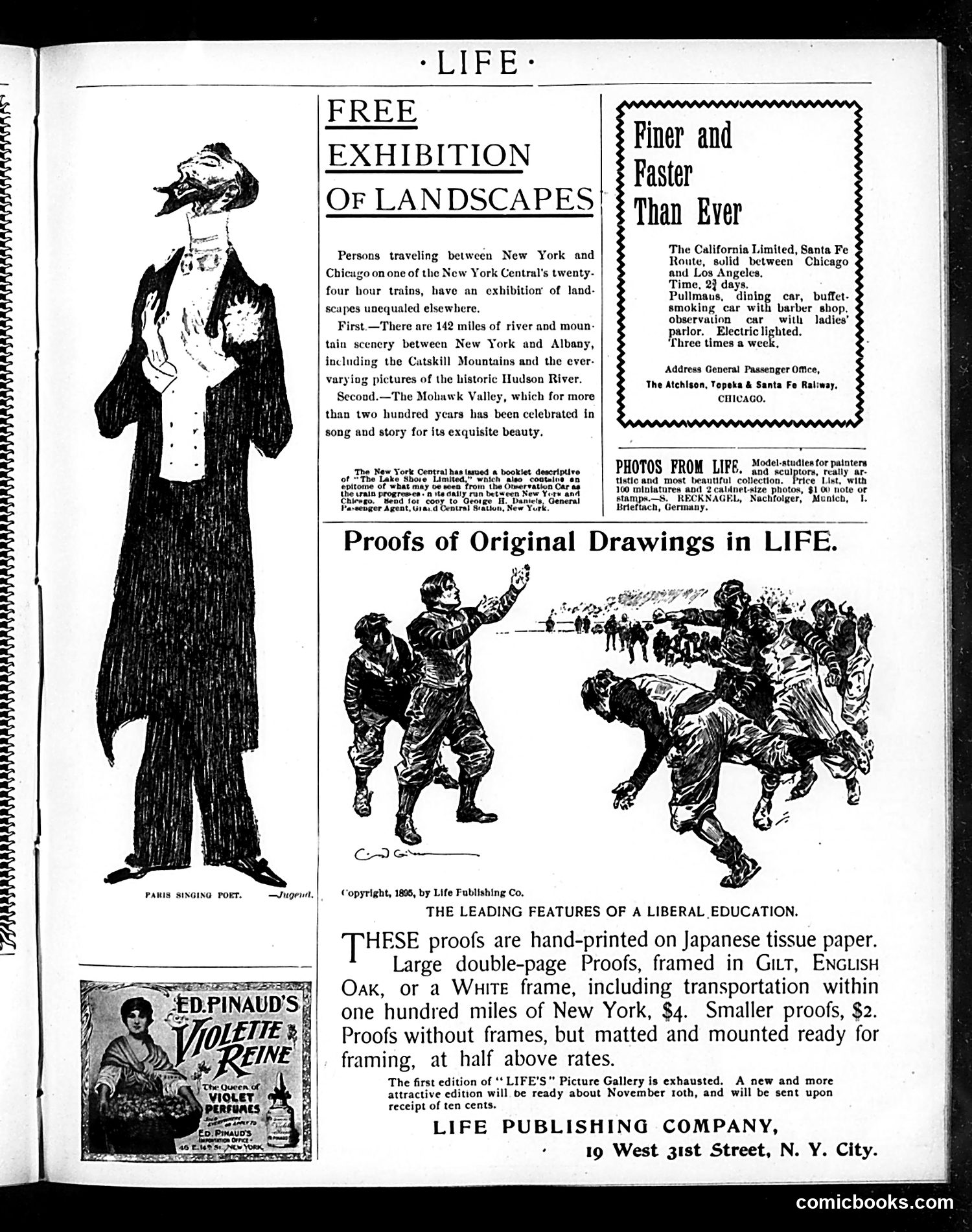
This page is primarily **advertising and promotional content** for Life magazine circa 1895, with limited satirical material. The main cartoon—labeled "Paris Singing Poet"—appears to be a figure caricature, likely mocking French artistic pretension or a specific cultural stereotype of the era, though the specific target is unclear from the image alone. The page mostly advertises: - Railroad services (New York Central, Santa Fe Route) promoting scenic travel - Life magazine's art proofs and picture gallery - Ed Pinaud's perfume products The phrase "The Leading Features of a Liberal Education" sarcastically suggests that viewing Life's artwork constitutes cultural refinement—a joke about the magazine's aspirations to educate American readers through illustration and humor. The overall page reflects Life's dual nature: a satirical publication that also served as a vehicle for advertisements and promoted itself as arbiter of aesthetic taste.
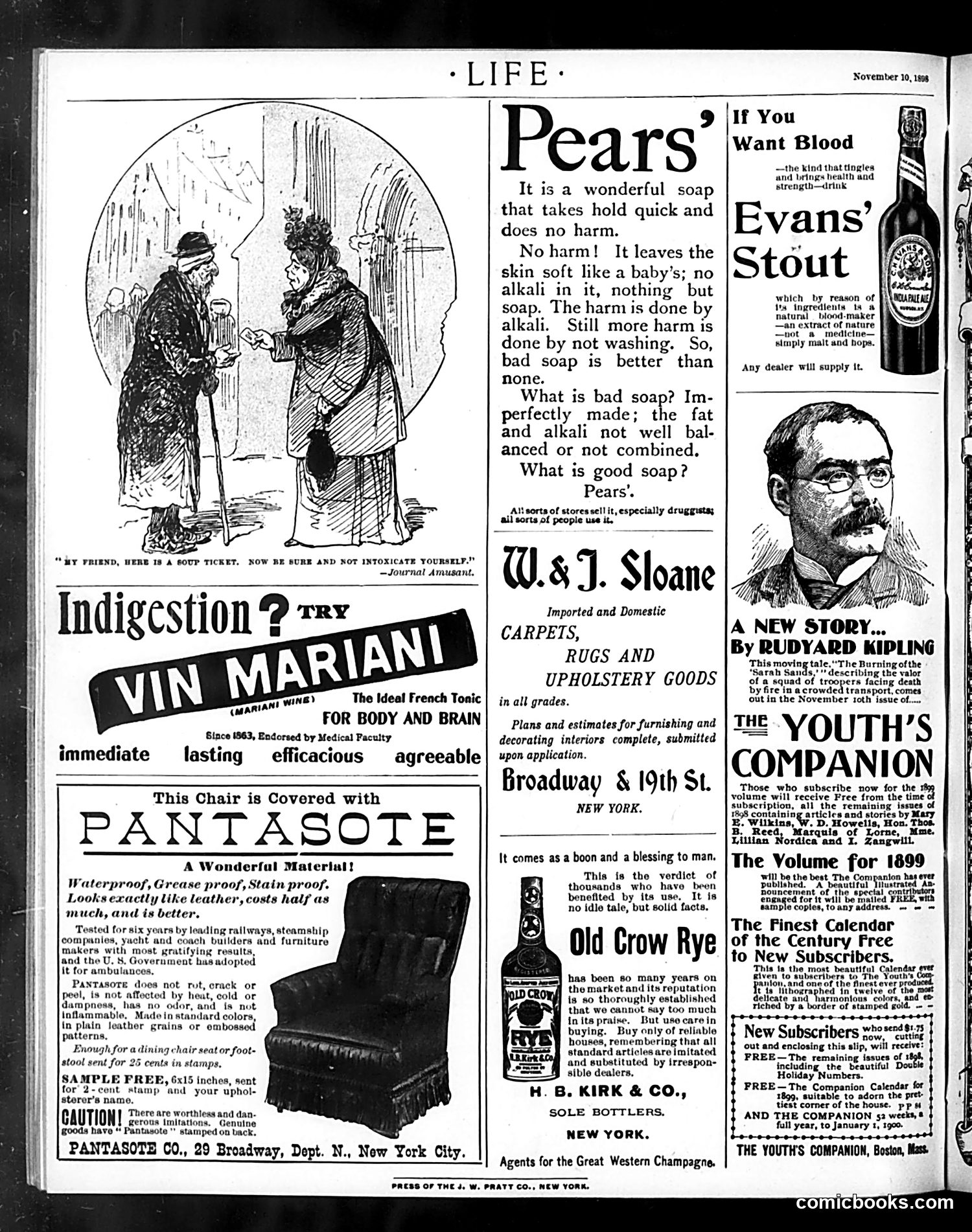
This page is **primarily advertising** with one notable cartoon. **The Cartoon:** The single illustrated joke depicts two figures exchanging a "soup ticket," with the caption warning against intoxication. The cartoon, credited to *Journal Amusant* (a French source), appears to be social commentary on public health or temperance—the "soup ticket" likely refers to charitable food assistance, and the warning humorously suggests soup recipients should avoid alcohol. The context suggests this reflects late-19th-century concerns about poverty, charity, and working-class habits. **The Advertisements:** The remainder is standard period advertising for consumer goods: Vin Mariani (a wine-based tonic "endorsed by Medical Faculty"), Pantasote chair covering, Pears' soap, Evans' Stout, Old Crow Rye whiskey, and furniture/carpet services. Notable is the casual promotion of alcohol and patent medicines as health tonics—practices that would later be heavily regulated. The *Youth's Companion* advertisement promotes a Rudyard Kipling story.