
Life, 1898-11-10 · page 8 of 20
Life — November 10, 1898 — page 8: what you’re looking at
What you’re looking at
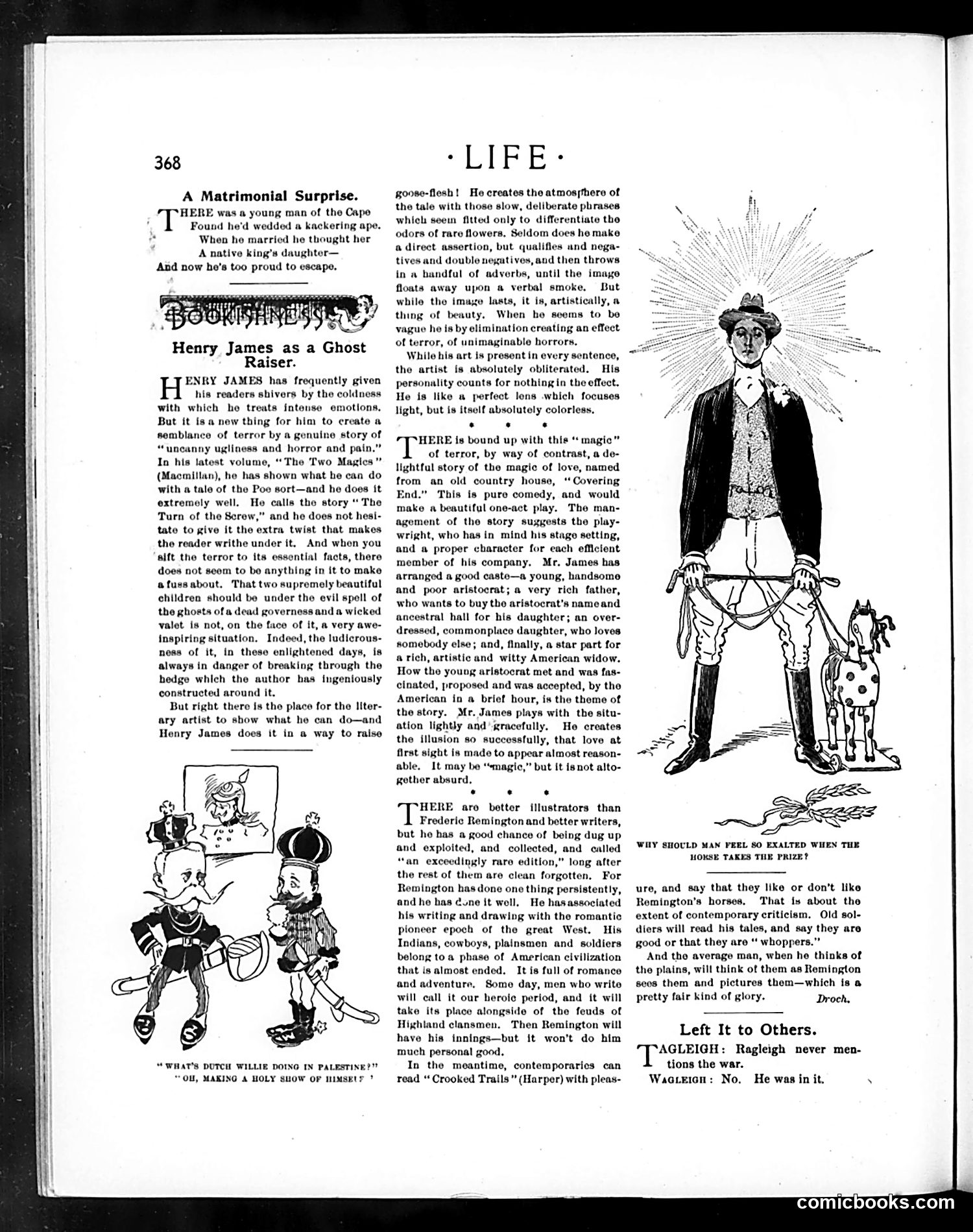
The page contains three distinct satirical pieces about Henry James as a writer: 1. **"A Matrimonial Surprise"** critiques James's dense, ornate prose style—his tendency toward elaborate descriptions and complex sentence structures that obscure meaning ("goose-flesh" and "slow, deliberate phrases"). 2. **"Henry James as a Ghost Raiser"** sarcastically praises James's ability to create emotional intensity and "uncanny ugliness," comparing his literary technique to summoning supernatural effects. 3. **The cartoon depicting two caricatured figures** (bottom left) appears to mock James's artistic pretensions, though the specific figures remain unclear from the image alone. Overall, the satire targets James's notoriously difficult, ornamental writing style—his preference for aesthetic complexity over accessible storytelling—a common contemporary criticism of his later works.
📄 Transcribed text from this page (OCR, searchable)
Machine-transcribed from the original scan — historical spelling and the odd misread are preserved.
368 A Matrimonial Surprise. HERE was a young man of the Capo Found he'd wedded a kackering ape. When ho married he thought her A native king’s daughtor— And now he’s too proud to escape, Henry James as a Ghost Raiser. ENRY JAMES has frequently given H his readers shivers by the coldness with which he treats intense emotions, But it isa new thing for him to create a semblance of terror by a genuine story of “uncanny ugliness and horror and pain,” In his latest volume, The Two Magics” (Macmillan), he has shown what be can do with a tale of the Poe sort—and he does it extremely well. He calls the story “The Turn of the Screw,” and he does not hesi- tate to give it the extra twist that makes the reader writhe under it. And when you sift the terror to its essential facts, there does not seem to be anything in it to make afussabout. That two supremely beautiful children should be under the evil spell of the ghosts of a dead governess and a wicked valet is not, on the face of it, a very awe- inspiring situation. Indeed, the ludicrous- ness of it, in these enlightened days, is always in danger of breaking through the hedge which the author bas ingeniously constructed around it. But right there fs the place for the liter- ary artist to show what he can do—and Henry James does it in a way to raise “WHAT'S DUTCH WILLIE DOING IN PALESTINE ?”” “OU, MAKING A HOLY SHOW OF IMsEIF * goose-flesh! He creates tho atmosjthero of the tale with those slow, deliberate phrases which seein fitted only to differentiate tho odors of rare flowers, Seldom does he make a direct assertion, but qualifies and nega- tives and double negutives, and then throws in a handful of adverbs, until the imayo floats away upon a verbal smoke. But while the image lasts, it is, artistically, a thing of beauty, When be seems to be vague ho is by elimination creating an effect of terror, of unimaginable horrors. While his art is present in every sentence, tho artist is absolutely obliterated. His personality counts for nothing in the effect. He is like a perfect lens which focuses light, but is itself absolutely colorless. . . . HERE is bound up with this “ magic” T of terror, by way of contrast, a de- lightful story of the magic of love, named from an old country house, “Covering End.” This is pure comedy, and would make a beautiful one-act play. The man- agement of the story suggests the play- wright, who has in mind his stago setting, and @ proper character for each efficient member of his company. Mr. James has arranged a good caste—a young, handsome and poor aristocrat; a very rich father, who wants to buy tho aristocrat’s nameand ancestral hall for his daughter; an over- dressed, commonplace daughter, who loves somebody else; and, finally, a star part for a rich, artistic and witty American widow. How tho young aristocrat met and was fas- cinated, proposed and was accepted, by the American in a brief hour, is the theme of the story. Mr. James plays with the situ- ation lightly and’gracefully. Ho creates the illusion so successfully, that love at first sight is mado to appear almost reason- able. It may be “magic,” but it is not alto- gother absurd, * . . HERE aro botter illustrators than Frederic Remington and better writers, but ho has a good chance of being dug up and exploited, and collected, and called “an exceedingly raro edition,” long after the rest of them are clean forgotten, For Remington has done one thing persistently, and he has @sne it woll, He has associated his writing and drawing with tho romantic pioneer epoch of the great West. His Indians, cowboys, plainsmen and soldiers belong toa phase of American civilization that is almost ended, It is full of romance and adventure, Some day, men who writo will call it our heroic period, and it will tako its place alongside of the feuds of Highland clansmen, Then Remington will have his innings—but it won't do him much personal good. In the meantime, contemporarics can read “ Crooked Trails” (Harper) with pleas- WHY SHOULD MAN PEEL SO EXALTED WHEN THE HOMSE TAKES THE PRIZE? ure, and say that thoy like or don’t like Remington's horses, That {s about tho extent of contemporary criticism. Old sol- diers will read his tales, and say they are good or that they aro “ whoppers.”” And tho average man, when ho thinks of tho plains, will think of them as Remington seos them and pictures them—which is a pretty fair kind of glory. Droch. Left It to Others. AGLEIGH: Ragleigh never men- tions the war. Waateicn: No. He was in it, comicbooks.com