
Life, 1898-11-10 · page 4 of 20
Life — November 10, 1898 — page 4: what you’re looking at
What you’re looking at
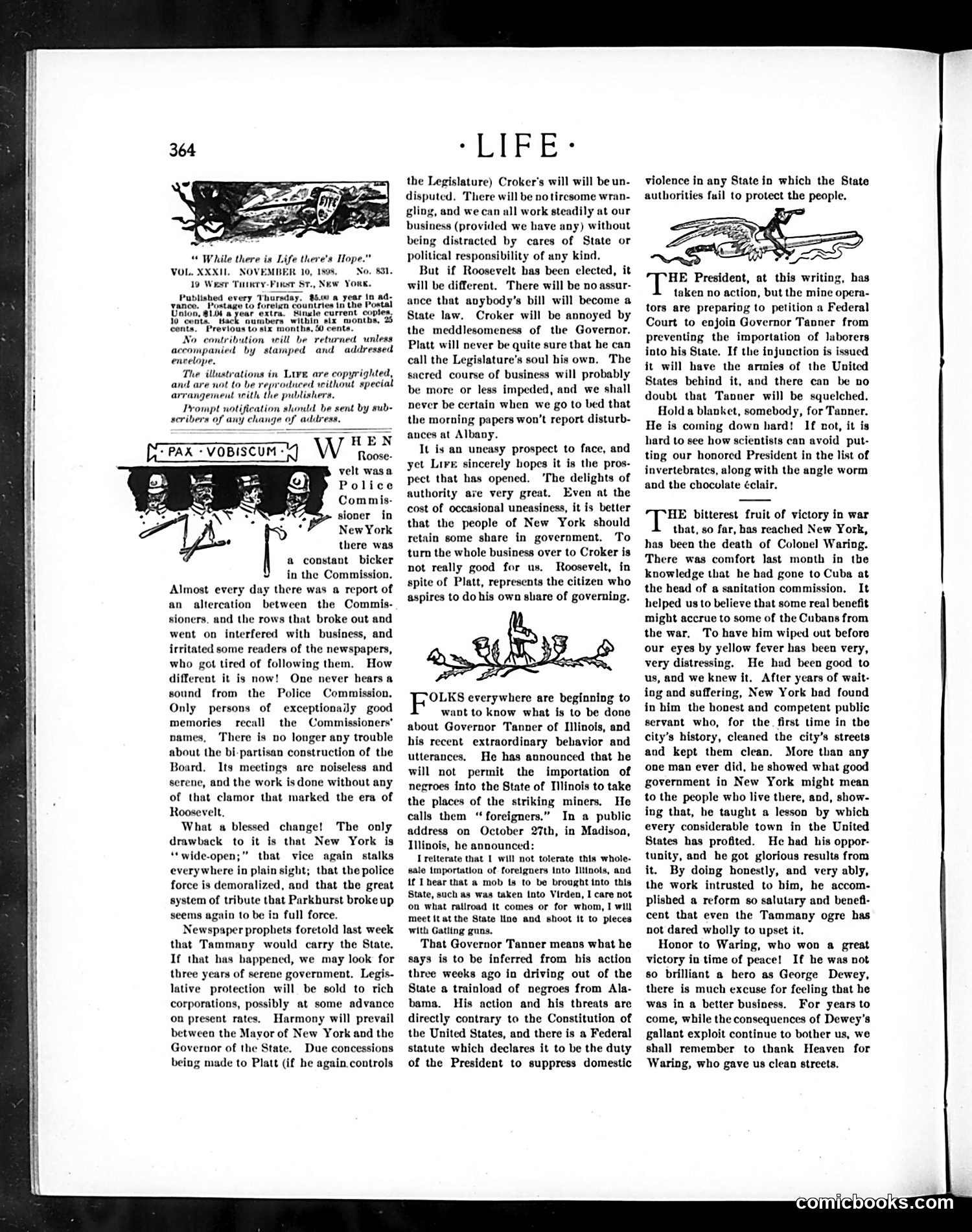
This page contains political commentary on New York governance circa early 1900s. The main cartoon labeled "PAX—VOBISCUM" (Latin: "Peace Be With You") depicts four figures representing the Police Commission, satirizing their constant internal conflicts and ineffectiveness. The text criticizes the commission's inability to govern without interference, contrasting this with Governor Tanner of Illinois, who apparently took decisive action against imported strikebreakers—which the author views as proper executive authority. The piece also praises Colonel Waring for cleaning up New York's streets, suggesting competent leadership improves public trust in government. Overall, the satire mocks New York's fractious political leadership while praising decisive governance elsewhere, reflecting Progressive Era debates about administrative competence and executive power.
📄 Transcribed text from this page (OCR, searchable)
Machine-transcribed from the original scan — historical spelling and the odd misread are preserved.
+ PAX - VOBISCUM- “ While there is Life there's Hope. MH. NOVEMBER 10, 1808, Ne 19 Wesr Tuery-Finst § Published every ‘Thi . 96.0 a year In ad- vance. Postage to forelun countries in the Postal ‘nion, @LOL a year extra. Ninele current coples, mbera within six months, 23 ‘six months, cents. contribution will be returned unless accompanied by stamped and addressed encelope. The illustrations in Lrve. are copyrighted, and are not to be reproduced without special arrangement with the publishers. Prompt notification should be sent by sub- scribers of any change of address. HEN Roose- velt wasa Police Commis- sioner in New York there was a constant bicker in the Commission. Almost every day there was a report of an altercation between the Commis- sioners, and the rows that broke out and went on interfered with business, and irritated some readers of the newspapers, who got tired of following them. How different it is now! One never hears a sound from the Police Commission, Only persons of exceptionally good memories recall the Commissioners’ pames, There is no longer any trouble about the bi-partisan construction of the Board. Its meetings are noiseless and serene, and the work is done without any of that clamor that marked the era of Roosevelt, What a blessed change! The only drawback to it is that New York is ‘*wide-open;” that vice again stalks everywhere in plain sight; that the police force is demoralized, and that the great system of tribute that Parkburst broke up seems again to be in full force. Newspaper prophets foretold last week that Tammany would carry the State. If that has happened, we may look for three years of serene government. Legis- lative protection will be sold to rich corporations, possibly at some advance on present rates. Harmony will prevail between the Mayor of New York and the Governor of the State. Due concessions being made to Platt (if he again controls ‘LIP E* the Legislature) Croker’s will will be un. disputed. There will be no tiresome wran- gling, and we can all work steadily at our business (provided we have any) without being distracted by cares of State or political responsibility of any kind. But if Roosevelt bas been elected, it will be different. There will be no assur- ance that anybody's bill will become a State law. Croker will be annoyed by the meddlesomeness of the Governor. Platt will never be quite sure that he can call the Legislature's soul his own, The sacred course of business will probably be more or less impeded, and we shall never be certain when we go to bed that the morning papers won't report disturb- ances at Albany. It is an uneasy prospect to face, and yet Lire sincerely hopes it is the pros- pect that has opened. ‘The delights of authority are very great. Even at the cost of occasional uneasiness, it is better that the people of New York should retain some share in government. To turn the whole business over to Croker is not really good for us. Roosevelt, in spite of Platt, represents the citizen who aspires to do his own share of governing. OLKS everywhere are beginning to want to know what is to be dono about Governor Tanner of Illinois, and his recent extraordinary behavior and utterances. He has announced that he will not permit the importation of negroes into the State of Illinois to take the places of the striking miners, He calls them “ foreigners.” In a public address on October 27th, in Madisoa, Illinois, he announced: Ireiterate that I will not tolerate this whole- sale Importation of foreigners Into Iittnols, and if Thear that a mob ts to be brought into this State, such as was taken Into Virden, I care not on what ratiroad it comes or for whom, I will meet {tat the State ne and shoot it to pleces with Gatling guns, That Governor Tanner means what he says is to be inferred from his action three weeks ago in driving out of the State a trainload of negroes from Ala- bama. His action and his threats are directly contrary to the Constitution of the United States, and there is a Federal statute which declares it to be the duty of the President to suppress domestic violence in any State in which the State authorities fuil to protect the people. HE President, at this writing, has taken no action, but the mine opera- tors are preparing to petition a Federal Court to enjoin Governor Tanner from preventing the importation of laborers into his State. If the injunction is issued it will have the armies of the United States behind it, and there can be no doubt that Tanver will be squelched. Hold a blanket, somebody, for Tanner. He is coming down hard! If not, it is hard to see how scientists can avoid put- ting our honored President in the list of invertebrates, along with the angle worm and the chocolate éclair. HE bitterest fruit of victory in war that, so far, has reached New York, has been the death of Colonel Waring. There was comfort last month in the knowledge that he had gone to Cuba at the head of a sanitation commission, It helped us to believe that some real benefit might accrue to some of the Cubans from the war. To have him wiped out before our eyes by yellow fever has been very, very distressing. He hud been good to us, and we knew it. After years of wait- ing and suffering, New York bad found in him the honest and competent public servant who, for the. first time in the city’s history, cleaned the city’s streets and kept them clean. More than any one man ever did, he showed what good government in New York might mean to the people who live there, and, show- ing that, he taught a lesson by which every considerable town in the United States has profited. He had his oppor- tunity, and he got glorious results from it. By doing honestly, and very ably, the work intrusted to him, he accom- plished a reform so salutary and benefl- cent that even the Tammany ogre has not dared wholly to upset it, Honor to Waring, who won a great victory in time of peace! If he was not so brilliant a hero as George Dewey, there is much excuse for feeling that he was in a better business. For years to come, while the consequences of Dewey's gallant exploit continue to bother us, we shall remember to thank Heaven for Waring, who gave us clean streets.