
Life, 1898-11-10 · page 12 of 20
Life — November 10, 1898 — page 12: what you’re looking at
What you’re looking at
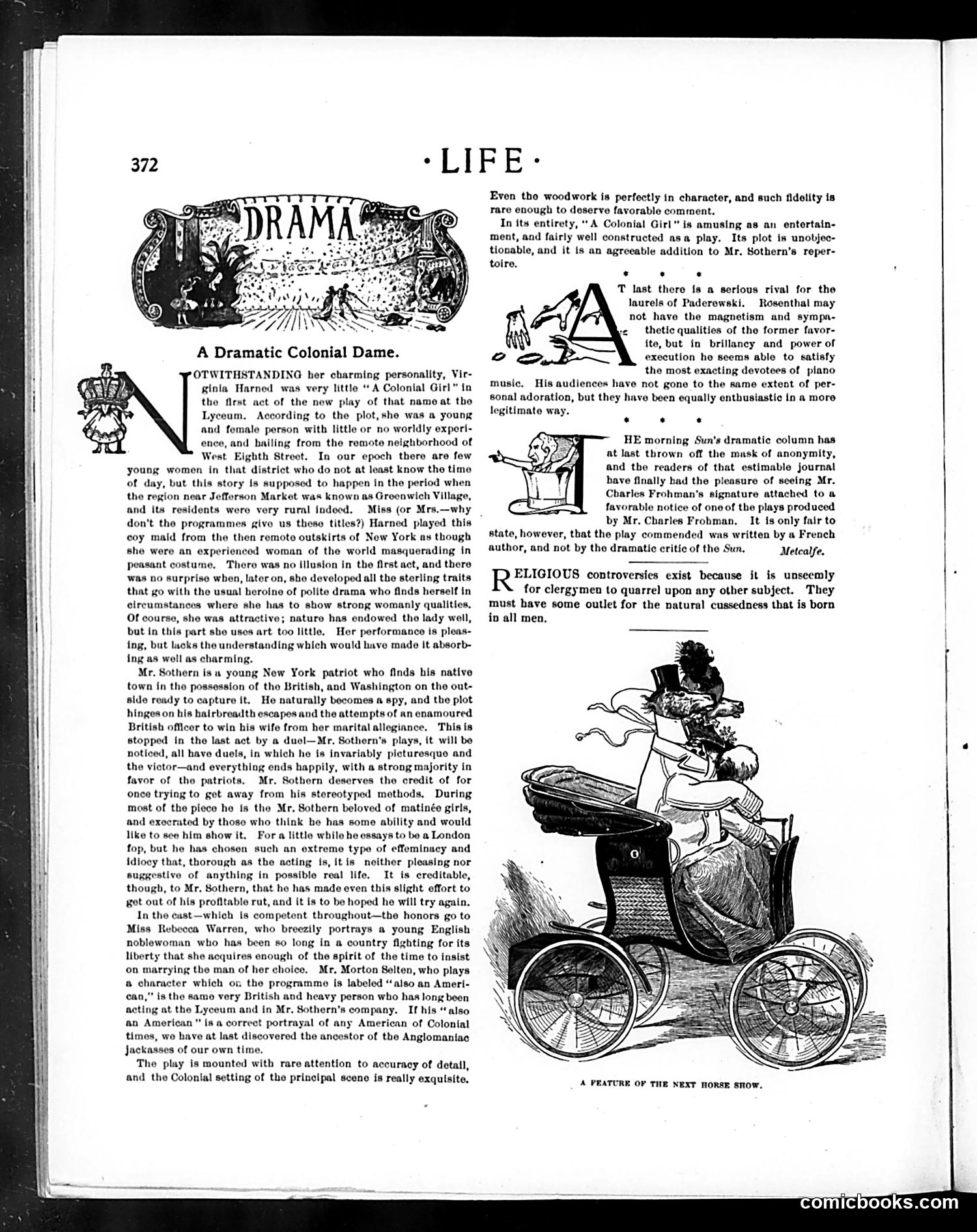
This page reviews "A Colonial Girl," a theatrical play at the Lyceum. The drama section discusses Mr. Sothern's performance as a New York patriot during the British occupation, praising his departure from stereotyped methods. The text also commends Miss Rebeeca Warren's portrayal of an English noblewoman advocating for American independence, and notes Mr. Morton Selten's accurate depiction of a Colonial-era American character. The illustration on the right shows a woman in period dress on a bicycle—likely satirizing the anachronism of depicting modern technology in a Colonial-era play, or commenting on the incongruity between historical accuracy and contemporary stagecraft. The caption reads "A Feature of the Next Horse Show," suggesting theatrical absurdity.
📄 Transcribed text from this page (OCR, searchable)
Machine-transcribed from the original scan — historical spelling and the odd misread are preserved.
A Dramatic Colonial Dame. OTWITHSTANDING her charming personality, Vir- ginia Harned was very little “A Colonial Girl” in the first act of the new play of that namo at tho Lyceum, According to the plot,she was a young and female person with little or no worldly experi- ence, and hailing from the remote neighborhood of West Eighth Street. In our epoch there are few young women in that district who do not at least know the timo of day, but this story is supposed to happen in the period when tho region near Jefferson Market was known as Greenwich Village, and {ts residents were very rural indecd. Miss (or Mrs.—why don’t the programmes givo us theso titles?) Harned played this coy maid from the then remot outskirts of Now York as though she were an experienced woman of the world masquerading in peasant costume, There was no illusion in the first act, and there was no surprise when, later on, sho developed all the sterling traits that go with the usual heroine of polite drama who finds herself in circumstances where she has to show strong womanly qualities, Of course, she was attractive; nature has endowed tho lady well, but in this part sho usos art too little. Hor performance is pleas- ing, but lacks the understanding which would have mado it absorb- ing as woll as charming. Mr. Sothern is u young New York patriot who finds his native town in tho possession of tho British, and Washington on tho out- side ready to capture it. He naturally becomes a spy, and the plot hinges on his hairbreadth escapes and the attempts of an cnamoured British officer to win his wife from her marital allegiance. This is stopped in tho last act by a ducl—Mr. Sothern’s plays, it will be noticed, all have duels, in which ho is invariably picturesque and tho victor—and everything ends happily, with a strong majority in favor of tho patriots, Mr. Sothern deserves the credit of for once trying to get away from his stereotyped mothods, During most of the pieco he 1s the Mr. Sothern beloved of matinée girls, and execrated by those who think be has some ability and would like to see him show it, For a little while he essays to be a London fop, but he has chosen such an extreme type of effeminacy and {diocy that, thorough as the acting is, itis neither pleasing nor suggestive of anything in possible real life. It is creditable, though, to Mr. Sothern, that ho has made even this slight offort to got out of his profitable rut, and it is to be hoped he will try again, In the cast—which is competent throughout—the honors go to Miss Rebecca Warren, who breezily portrays a young English noblewoman who has been so long in a country fighting for its Uberty that she acquires enough of the spirit of the time to insist on marrying the man of her choice, Mr, Morton Selten, who plays @ character which on the programmo Is labeled “also an Ameri- can,” is the samo very British and heavy person who has long been acting at the Lyceum and in Mr. Sothern’s company. If his “also an American” is a correct portrayal of any American of Colonial timos, wo have at last discovered the ancestor of the Anglomaniac jackasses of our own time. The play is mounted with rare attention to accuracy of detail, and the Colonial setting of the principal sceno is really exquisite. *LIFE- Evon tho woodwork is perfectly in charactor, and such fidelity 1s rare enough to deserve favorable comment. In its entirety, “A Colonial Girl” is amusing a6 an entortain- ment, and fairly well constructed asa play. Its plot is unobjec- tionable, and it {8 an agreeable addition to Mr. Sothern’s reper- toire. . . . T last thoro {s a sorious rival for the Iaurels of Paderowski. Rosenthal may not have the magnetism and sympa- -< thetic qualities of the former favor- ite, but in brillancy and power of oe, execution ho seems able to satisfy the most exacting devotees of piano music. His audiences have not gone to the same extent of per- sonal adoration, but they have been equally enthusiastic in a more legitimate way. «oe . HE morning Sun’s dramatic column has at last thrown off the mask of anonymity, and tbe readers of that estimable journal have finally had the pleasure of seeing Mr. Charles Frohman’s signature attached to a favorable notice of one of the plays produced by Mr. Charles Frohman, It {s only fair to state, however, that the play commended was written by a French author, and not by the dramatic critic of the Sun, Metcalfe. ELIGIOUS controversies exist because it is unseemly for clergymen to quarrel upon any other subject. They must have some outlet for the natural cussedness that is born in all men, A FEATURE OF THE NEXT MORSE STOW. comicbooks.com