
A complete issue · 20 pages · 1898
Life — September 1, 1898
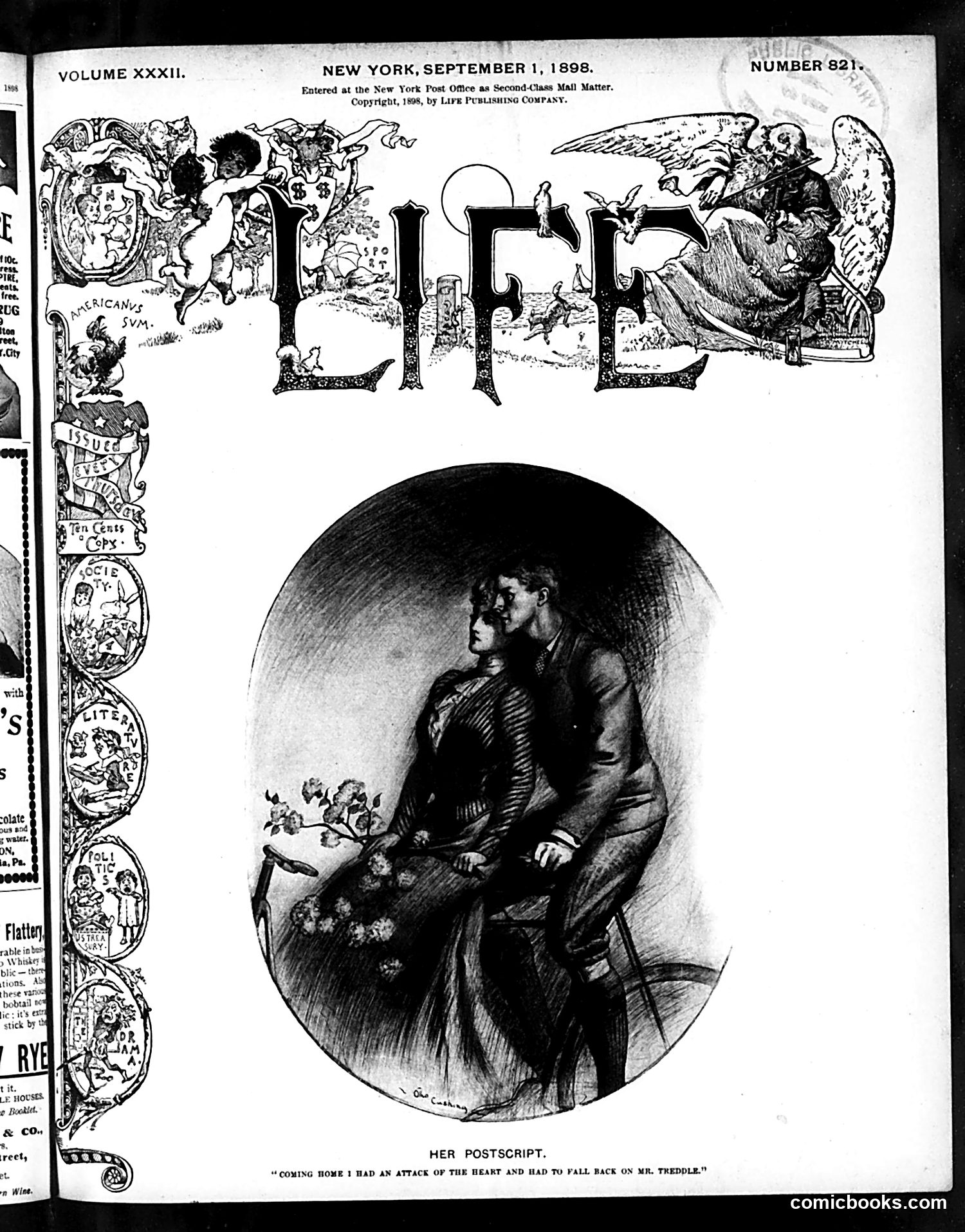
This page from Life magazine features a romantic illustration titled "Her Postscript" with the caption: "Coming home I had an attack of the heart and had to fall back on Mr. Treddle." The cartoon depicts a couple in an intimate moment—a woman and man seated together. The joke plays on a double meaning: "attack of the heart" typically suggests romantic emotion or passion, but the caption suggests the man (Mr. Treddle) was needed for literal heart distress, implying he's a doctor or medical professional. The humor derives from this ambiguous wordplay about heartache being both romantic and medical. The ornate decorative border and elaborate header with "LIFE" lettering are characteristic of 1890s magazine design.
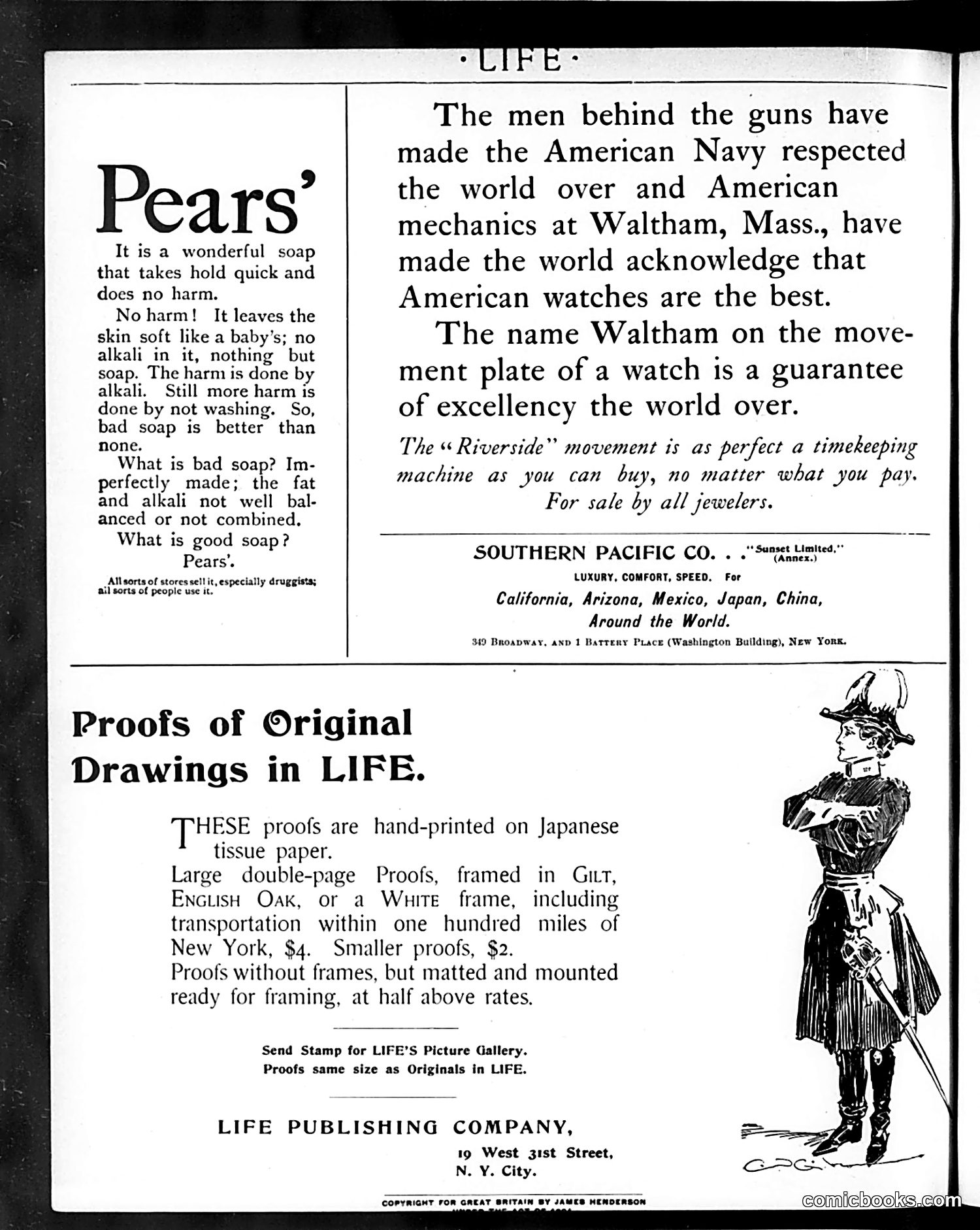
This page is primarily **advertising**, not political satire. It contains three separate ads: 1. **Pears' Soap**: A product advertisement emphasizing that Pears soap is harmless and gentle, contrasting it with poorly-made competitors. 2. **Waltham Watches**: Promotes American-made watches from Waltham, Massachusetts, claiming they're superior worldwide. References the "Riverside" movement and appeals to nationalist pride in American manufacturing. 3. **LIFE Publishing Company**: Offers hand-printed proofs of original drawings on Japanese tissue paper, with framing options available. The illustration on the right appears to be a fashionable woman in early 1900s attire—likely decorative imagery supporting the ads rather than satirical commentary. The page reflects early 20th-century advertising appeals to quality, American superiority, and consumer pride.
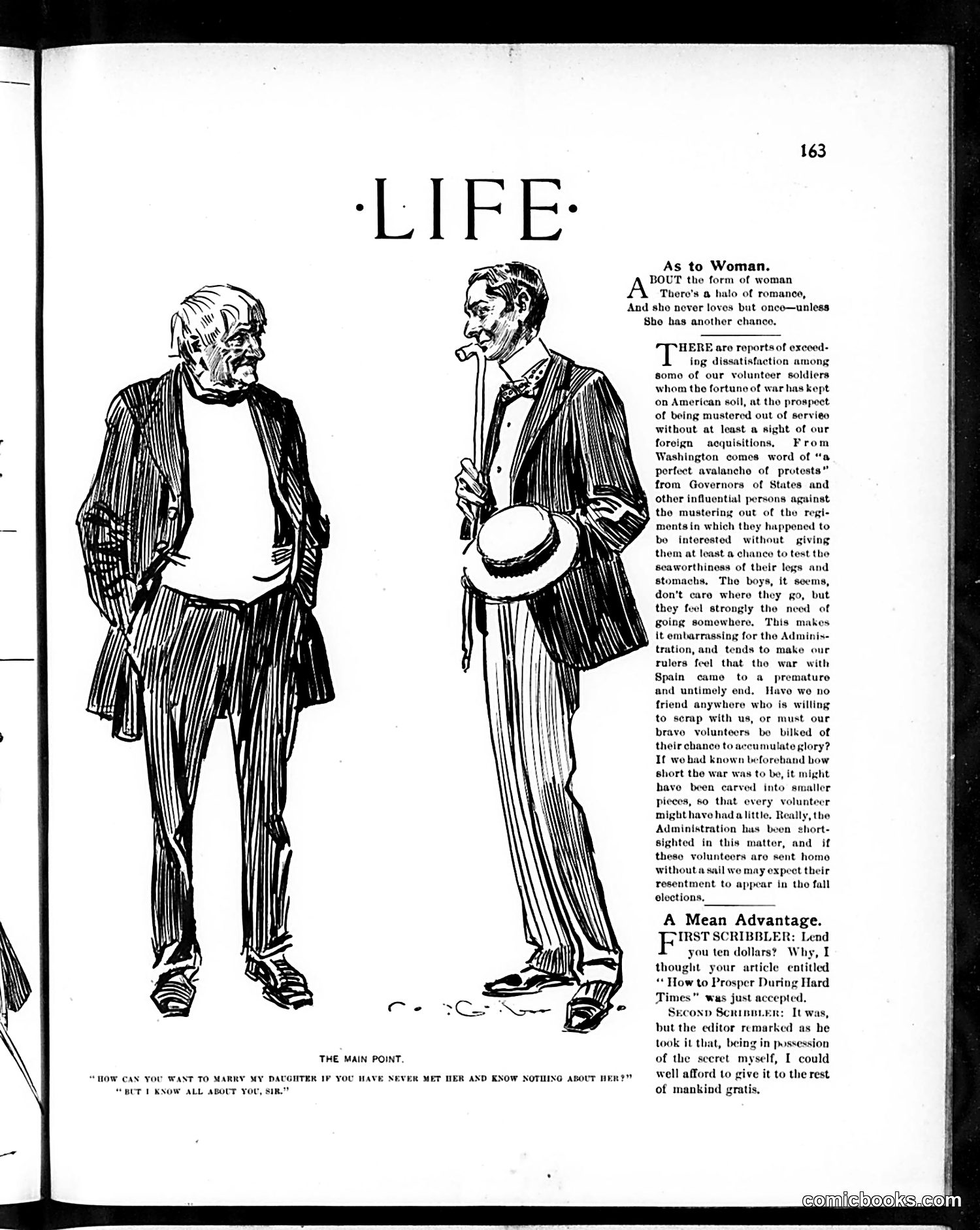
This page from *Life* magazine satirizes military recruitment and administrative mismanagement, likely from the Spanish-American War era (referenced in the text). **The Main Cartoon** depicts two men in conversation. The caption reads: "How can you want to marry my daughter if you have never met her and know nothing about her?" / "But I know all about you, sir." This is a **political allegory**: the older man represents a government official or administrator, while the younger represents volunteer soldiers. The joke satirizes the Administration's contradictory stance—they rush soldiers into service without proper vetting or preparation, yet claim to know the soldiers' character. The cartoon criticizes how volunteers are mustered out hastily without adequate support or recognition for their sacrifice. The accompanying article discusses similar administrative failures regarding discharged soldiers.
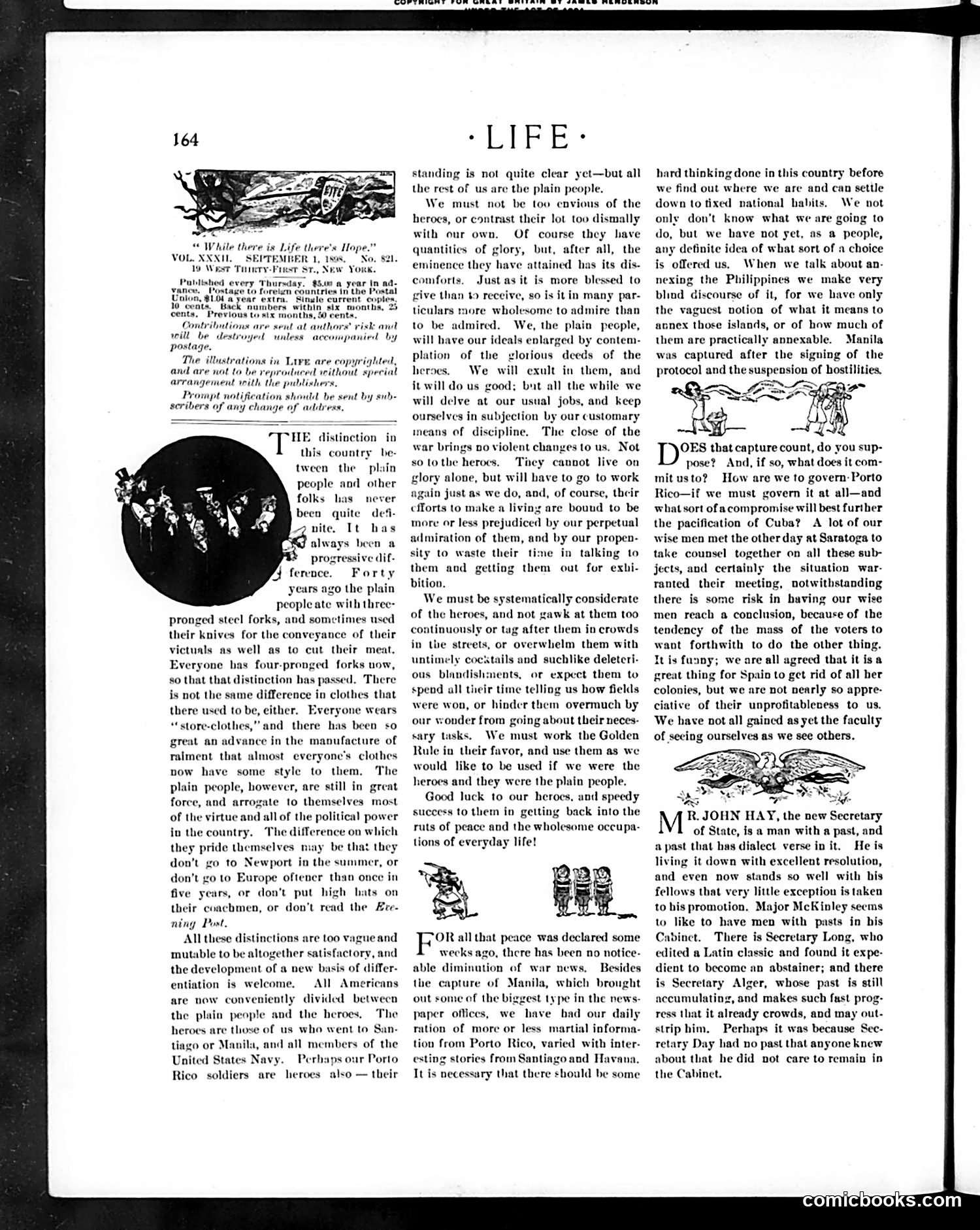
This page discusses class distinctions in America following the Spanish-American War. The main cartoon (large circular illustration, top left) depicts what appears to be wealthy or upper-class figures in contrast to ordinary people, illustrating the article's argument that despite American ideals, social hierarchies persist. The text argues Americans shouldn't envy war heroes' glory, as they'll still need to work like ordinary citizens. It critiques the tendency to either ignore or over-romanticize soldiers, urging readers to treat them as equals rather than pedestals. The final paragraph mentions John Hay (new Secretary of State) and cabinet members, suggesting contemporary political commentary about leadership during the post-war period. The overall message emphasizes equality and practical rather than sentimental treatment of national heroes.
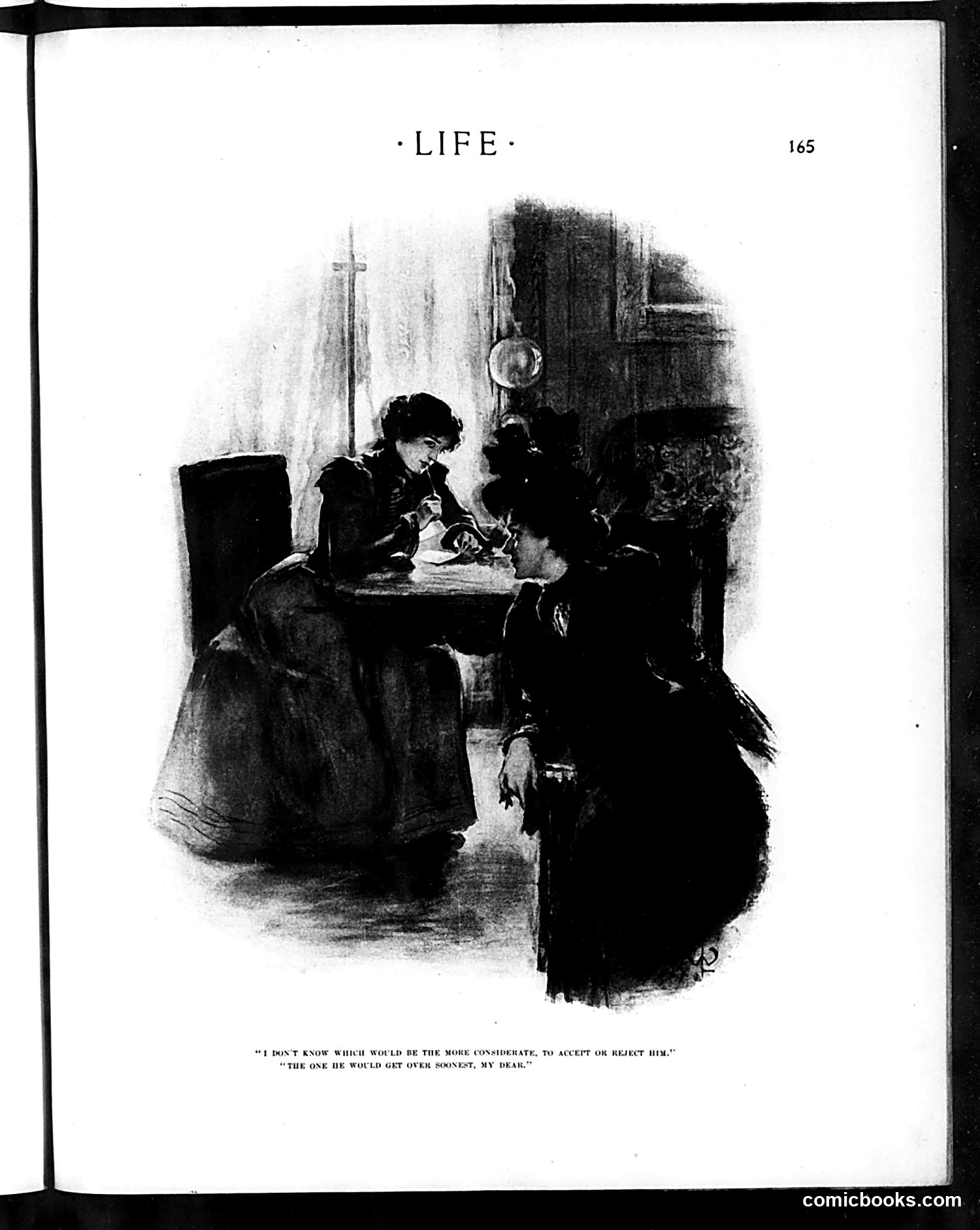
This illustration depicts two women in what appears to be a late 19th or early 20th-century interior, seated at a small table. The caption reads: "I don't know which would be the more considerate, to accept or reject him. The one he would get over soonest, my dear." The cartoon satirizes the social convention of marriage proposals and women's decision-making about romantic matters. The joke hinges on the women's cynical calculation: they're debating whether accepting or rejecting a suitor would be more "considerate"—the unstated implication being that either response might cause him emotional distress, but one would allow him to recover faster. This reflects period anxieties about female autonomy in marriage decisions and gently mocks the elaborate social courtesies surrounding courtship.
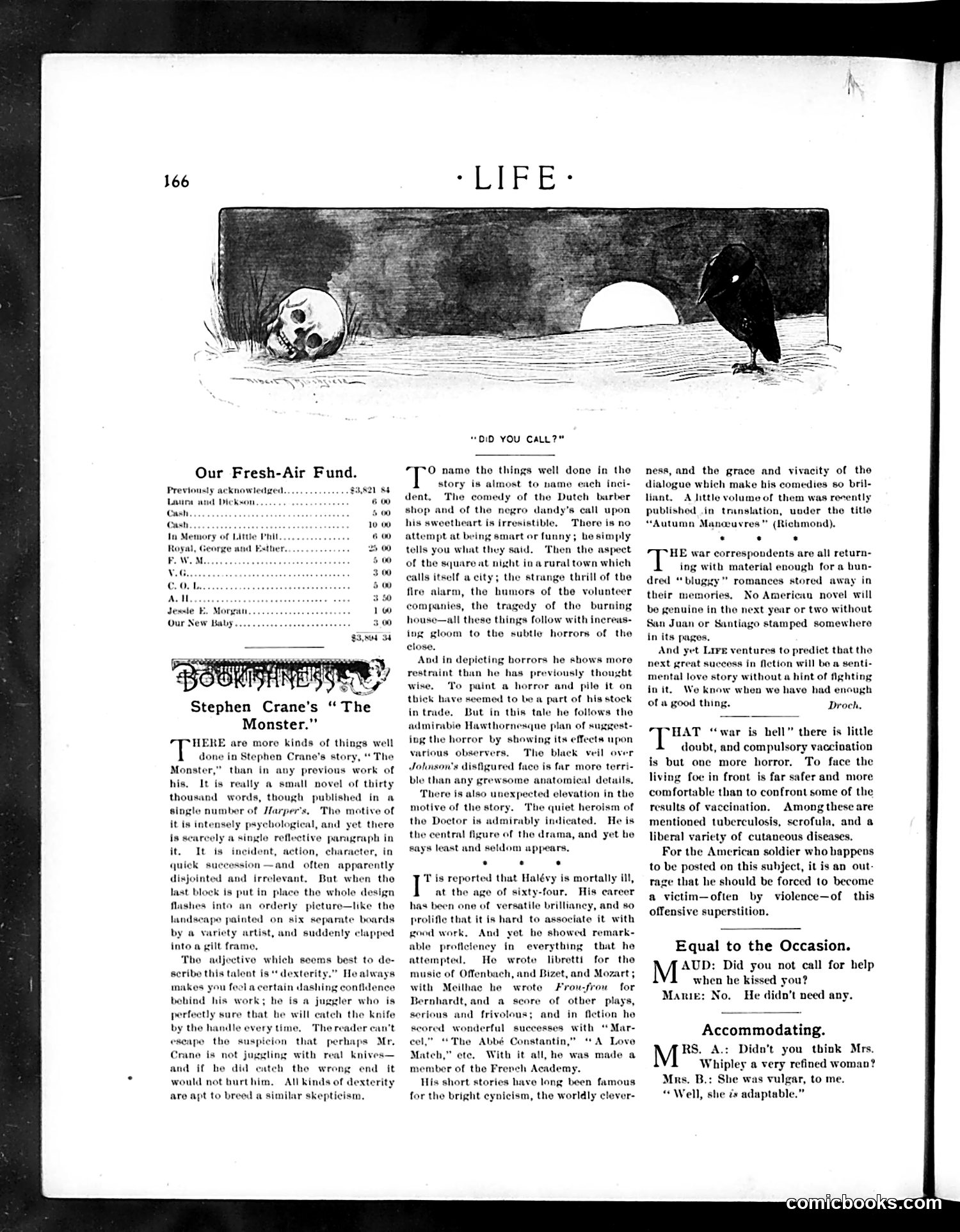
The main illustration shows a skull, a sun, and a crow in a desolate landscape—a memento mori composition symbolizing death and decay. This appears to accompany a review of Stephen Crane's "The Monster," which the text praises for its psychological depth and restraint in depicting horror. The page primarily contains literary criticism rather than political satire. It discusses Crane's novella about a Dutch barber shop and a burning house, praising his ability to convey tragedy without sensationalism. The text notes Crane avoids being "smart or funny," instead letting events speak for themselves. Below are two brief comic dialogues offering social commentary on courtship and female adaptability, though these are minor humor pieces rather than substantive satire.
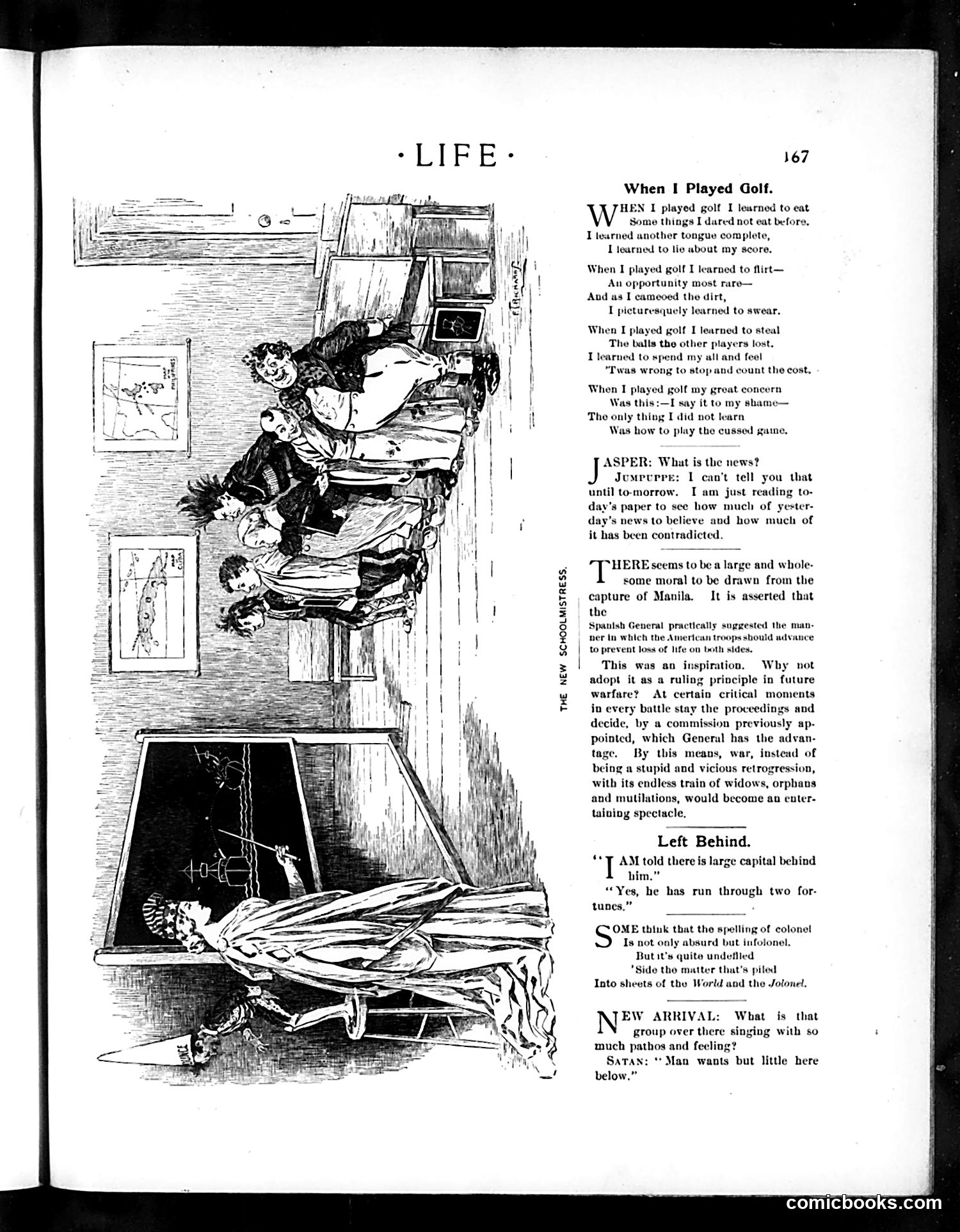
This page contains humorous verse and commentary rather than political cartoons. "When I Played Golf" is a lighthearted poem about learning golf's etiquette—the speaker humorously admits to swearing, overspending on lost balls, and poor sportsmanship while playing. Below are brief satirical exchanges: Jasper and Jumperpe discuss reading yesterday's news, and there's commentary on the "capture of Manila," likely referencing the Spanish-American War and Philippine-American War period. The text suggests adopting a humorous "ruling principle" where generals would pause battles to decide outcomes by commission rather than actual combat. The final items are brief comic quips about spelling errors and Satan's observations about human desires.
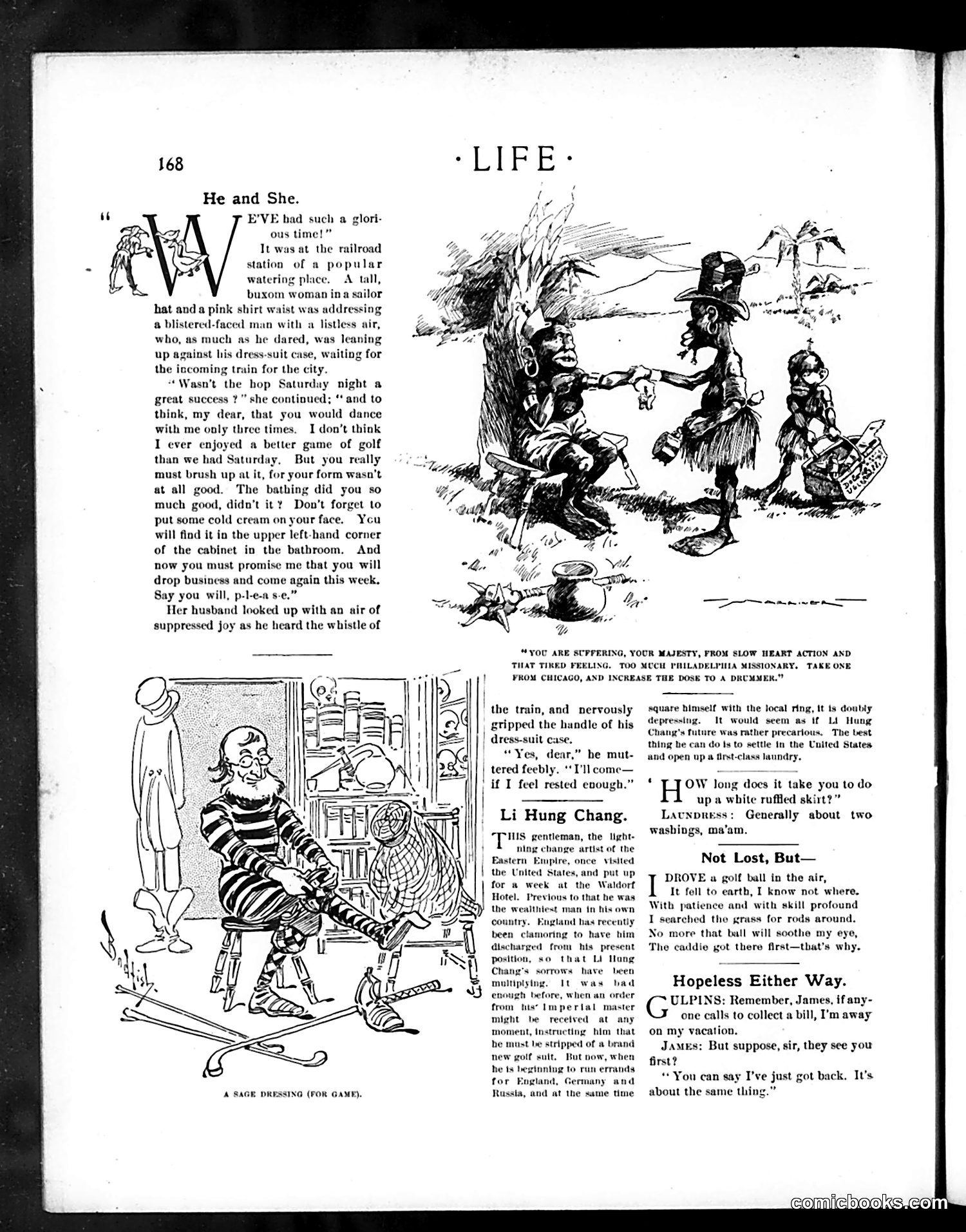
This page contains several satirical pieces typical of early 20th-century Life magazine humor: **"He and She"** (top): A domestic comedy about a husband criticizing his wife's dancing and social abilities, threatening to withhold her allowance unless she improves. The satire targets marital dynamics and female dependence on husbands' financial control. **"A Sage Dressing for Game"** (lower left): An illustration showing someone in striped clothing being fitted or dressed, likely satirizing fashion or vanity. **"Li Hung Chang"** section discusses a Chinese dignitary's visit to the U.S., suggesting contemporary interest in international figures and American attitudes toward visitors from the "Eastern Empire." The remaining sections are brief humorous Q&As about laundry, golf, and bill collection—typical period humor targeting domestic and leisure activities.

This page from *Life* magazine (page 169) features a portrait labeled "LI HUNG CHANG." The image shows an elderly Asian man with a long beard, wearing glasses and traditional clothing with what appears to be formal dress or insignia. Li Hung Chang was a prominent 19th-century Chinese statesman and diplomat. Without additional satirical text or captions visible on this page, the cartoon's specific political point remains unclear. However, *Life* magazine frequently used such portraits to comment on international relations and foreign dignitaries. The inclusion likely reflected contemporary American interest in or commentary about China's political situation, though the exact satirical intent—whether laudatory, critical, or mocking—cannot be determined from the image alone.
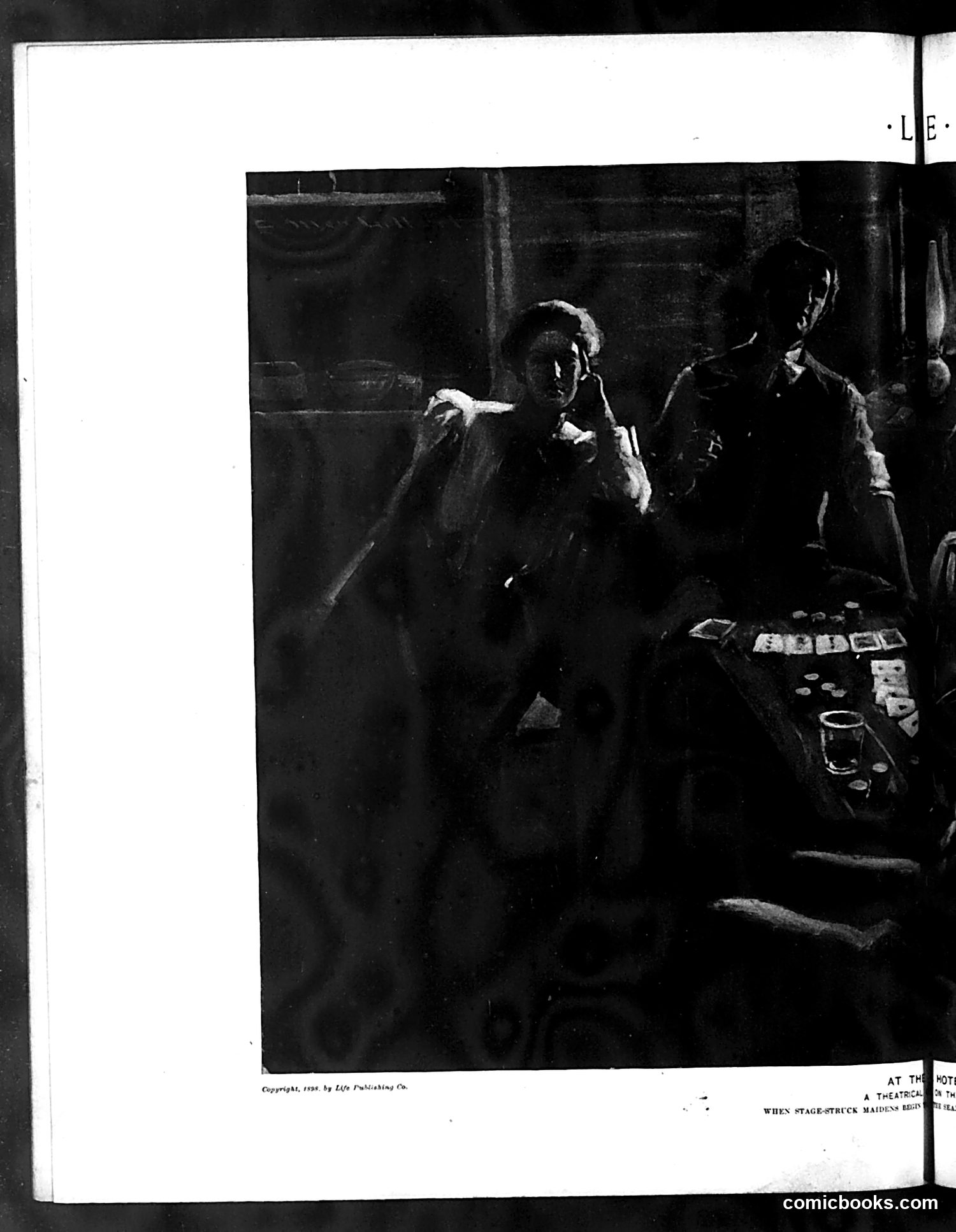
This appears to be a theatrical photograph rather than a political cartoon. The black and white image shows what looks like a backstage or dressing room scene with multiple figures in period costume or theatrical dress. There are various props visible on a table, including what appear to be cosmetics or theatrical supplies. The caption at bottom references "WHEN STAGE-STRUCK MAIDENS RIGHT" (text is partially cut off), suggesting this illustrates a theatrical theme about young women aspiring to stage careers. The copyright line reads "Copyright, 1924, by Life Publishing Co." Without the complete caption or clearer context, I cannot definitively identify the specific theatrical production, characters, or social commentary being referenced. The image documents a theatrical scene from 1924, but the satirical point requires more legible text.
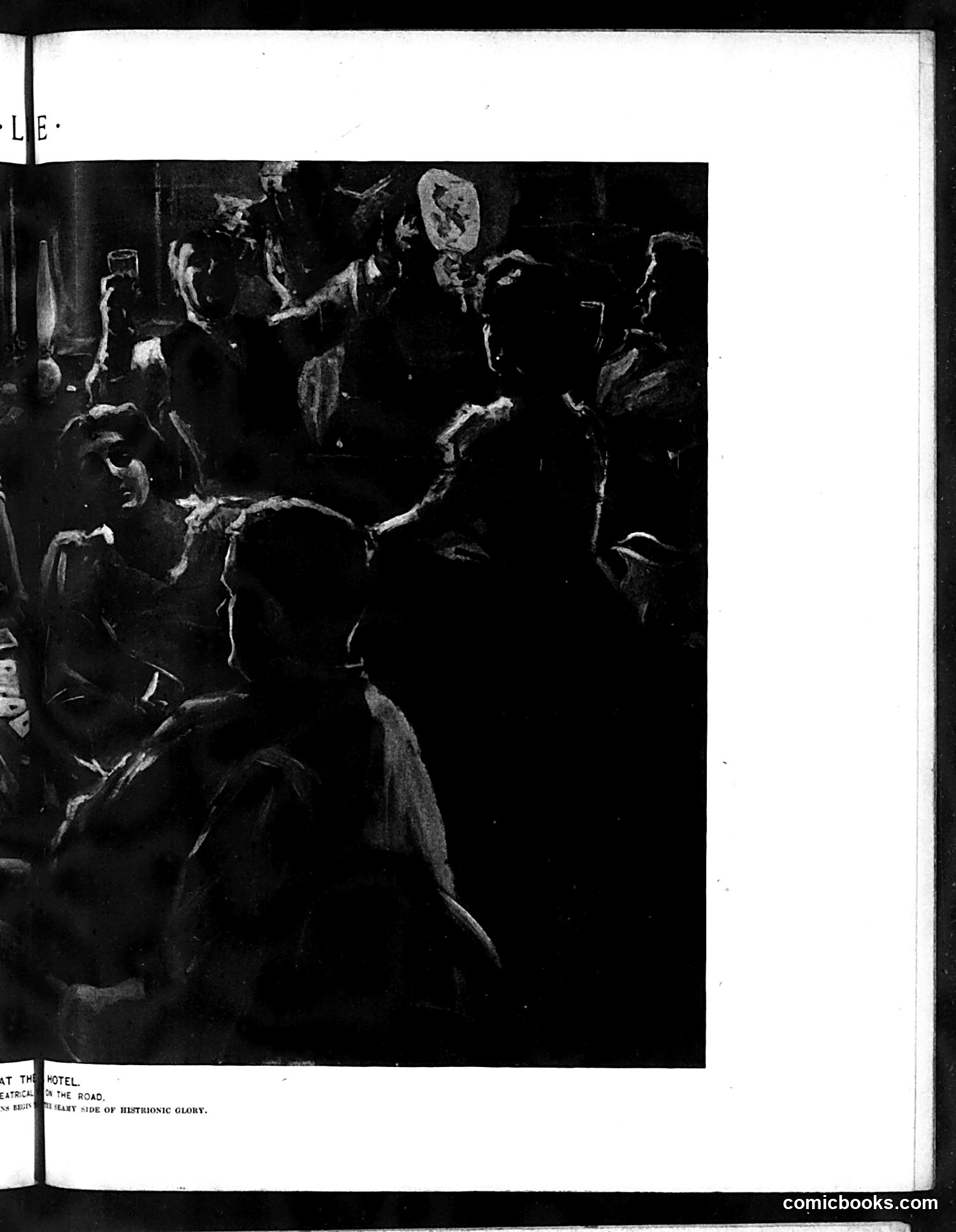
This appears to be a dramatic scene from a theatrical or literary work rather than a political cartoon. The OCR text mentions "AT THE HOTEL," "IN THE ROAD," and "ON THE WEARY SIDE OF HISTRIONIC GLORY" — suggesting this illustrates a scene involving theatrical or dramatic performance, possibly showing actors in a dramatic moment. The dark, high-contrast image depicts multiple figures in what appears to be an indoor setting, with one central figure gesturing dramatically. Without clearer identification of the specific play, work, or performers referenced, I cannot definitively state which theatrical production or satirical point this illustrates. The caption references suggest commentary on theatrical life or performance, but the specific historical or satirical context remains unclear from the visible information.
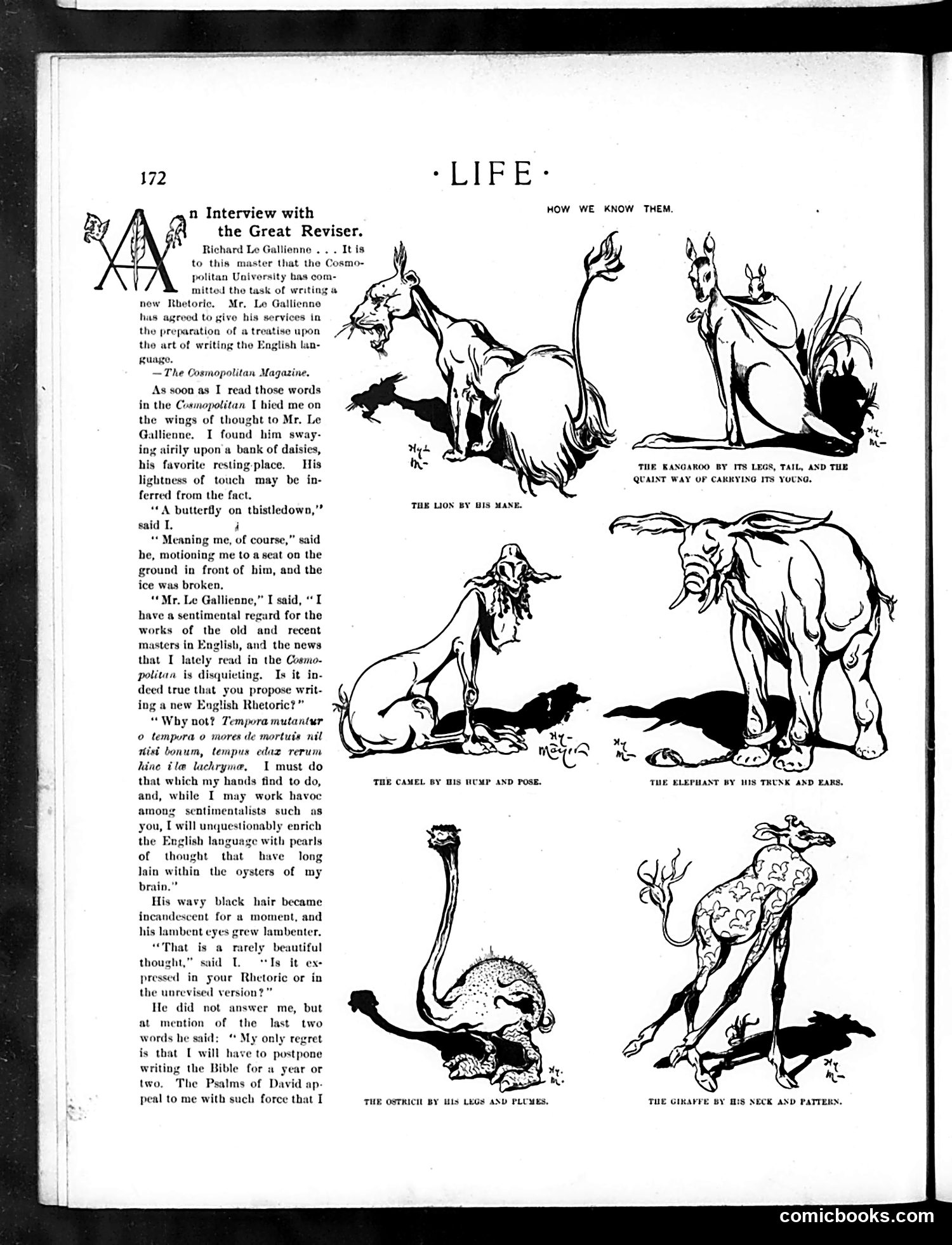
This page satirizes the literary critic "Le Gallienne," apparently a prominent figure in English language and rhetoric debates. The left column contains an "Interview with the Great Reviser" where the speaker (likely the author) debates Le Gallienne about whether to create new English rhetoric, referencing classical Latin phrases. The right side is titled "How We Know Them"—a humorous visual guide identifying animals by their distinctive physical features (lion's mane, kangaroo's tail, camel's hump, etc.). This appears to be witty commentary on Le Gallienne's pedantic, taxonomic approach to language—suggesting he catalogues and defines things with the same mechanical precision one might use to identify animals, reducing living language to rigid categories rather than understanding its organic evolution.
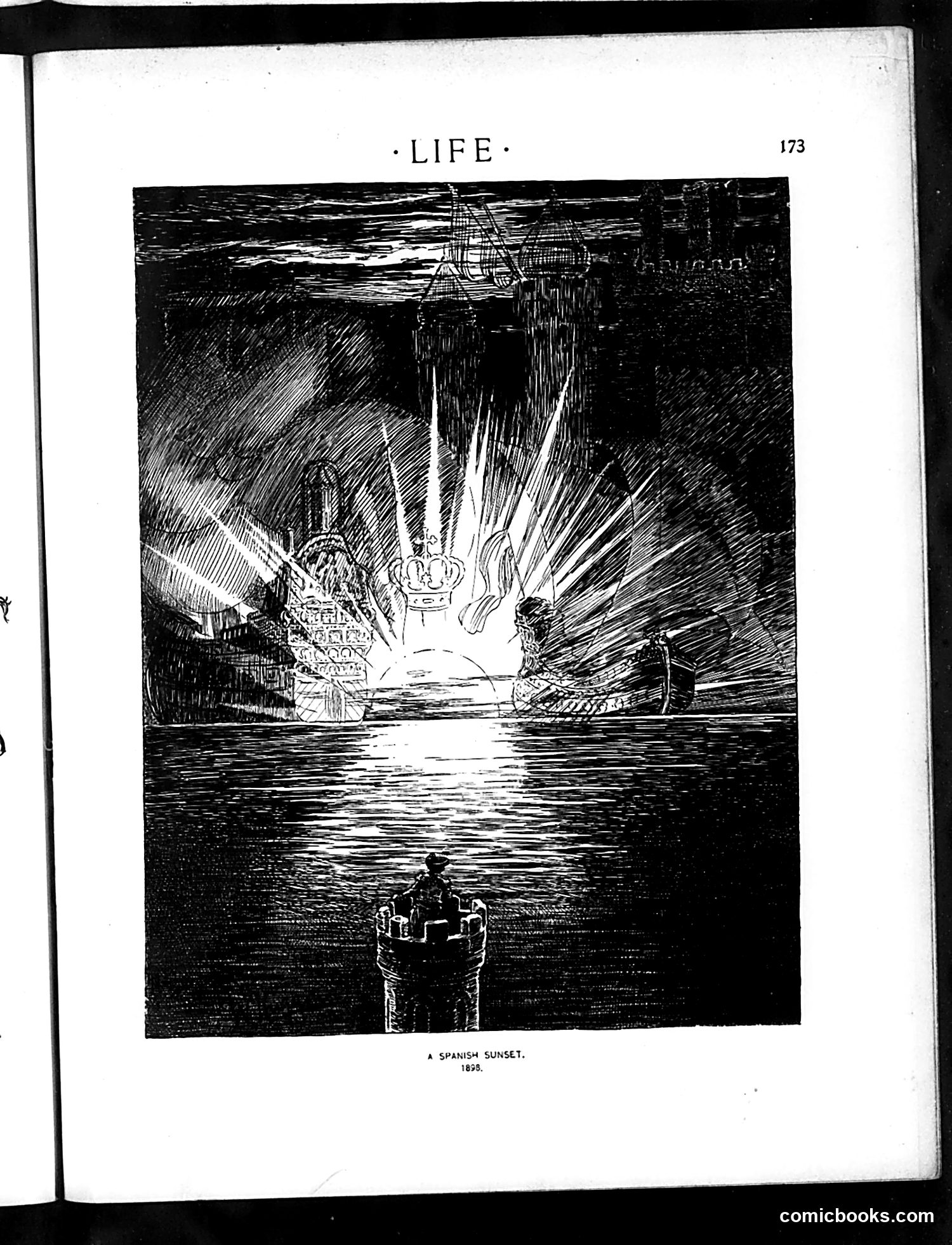
This is an engraving titled "A Spanish Sunset, 1898" depicting a dramatic naval scene. The image shows a burning ship in harbor with bright flames and smoke illuminating the night sky, while a small boat with observers watches from the foreground. The 1898 date is significant: this likely references the Spanish-American War and the destruction of Spanish naval vessels. The composition—with the crown visible amid the flames and wreckage—suggests the decline of Spanish imperial power. The "sunset" metaphor in the title underscores this theme of Spain's waning dominance. For modern readers: this satirizes Spain's military defeat and the end of its colonial empire during the 1898 conflict, using the burning ship as a symbolic representation of Spanish power being extinguished.
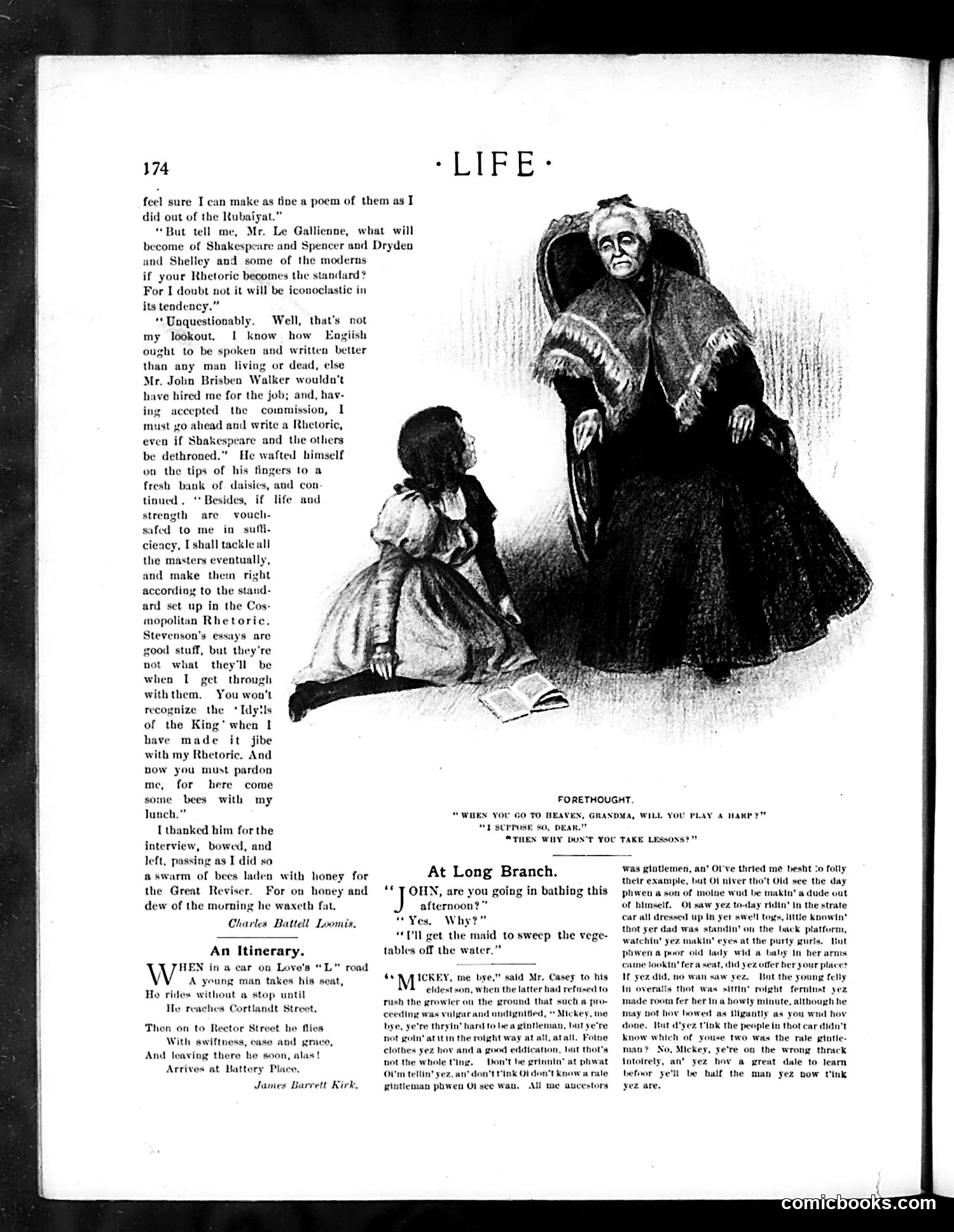
This page satirizes **Richard Le Gallienne**, a literary critic and writer, through a fictional interview. The satire mocks his pretentious ambitions to write a "Cosmopolitan Rhetoric"—a grammar/style guide that would standardize English writing. The joke: Le Gallienne boasts he'll improve Shakespeare, Spenser, Shelley, and other canonical authors by rewriting them according to his rules. He's so self-important he claims to subsist on honey and dew like some celestial being. The absurdity is the implicit arrogance—that a contemporary critic could "correct" literary masters. The cartoon shows two figures (likely Le Gallienne and the interviewer), with the caption "WHEN YOU GO TO HEAVEN, GRANDMA, WILL YOU PLAY A HARP?" / "I SUPPOSE SO, DEAR" / "THEN WHY DON'T YOU TAKE LESSONS?"—another jab at presumptuous self-importance. Below are two unrelated comic pieces: a poem about city transit ("An Itinerary") and a dialogue about bathing at Long Branch (a Jersey shore resort), featuring Irish-accented working-class characters. The target: literary pretension and self-aggrandizing criticism.
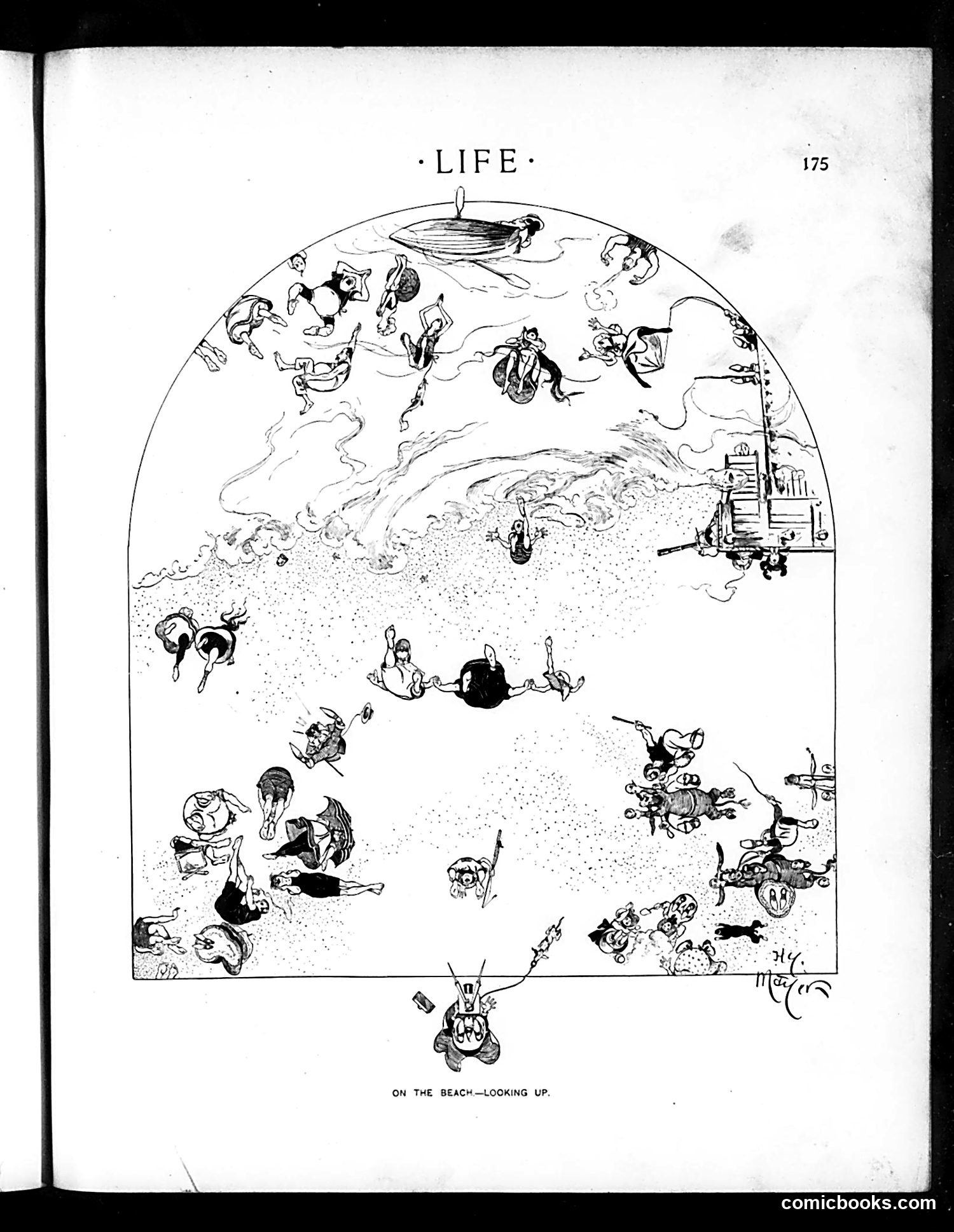
This satirical cartoon depicts a beach scene viewed from below the water's surface, showing swimmers and beachgoers from an underwater perspective. The title invites viewers to see the beach as marine life might—looking upward at humans in the water. The cartoon appears to be social satire about beach culture and leisure activities. Various figures are shown swimming, playing, and lounging, rendered in the exaggerated caricature style typical of early-to-mid 20th century Life magazine. The unusual vantage point creates comedic effect by defamiliarizing ordinary beach behavior. Without additional context about the publication date, the specific identities of any caricatured figures remain unclear, though the drawing style and page number (175) suggest this is from Life's golden age of satirical illustration.
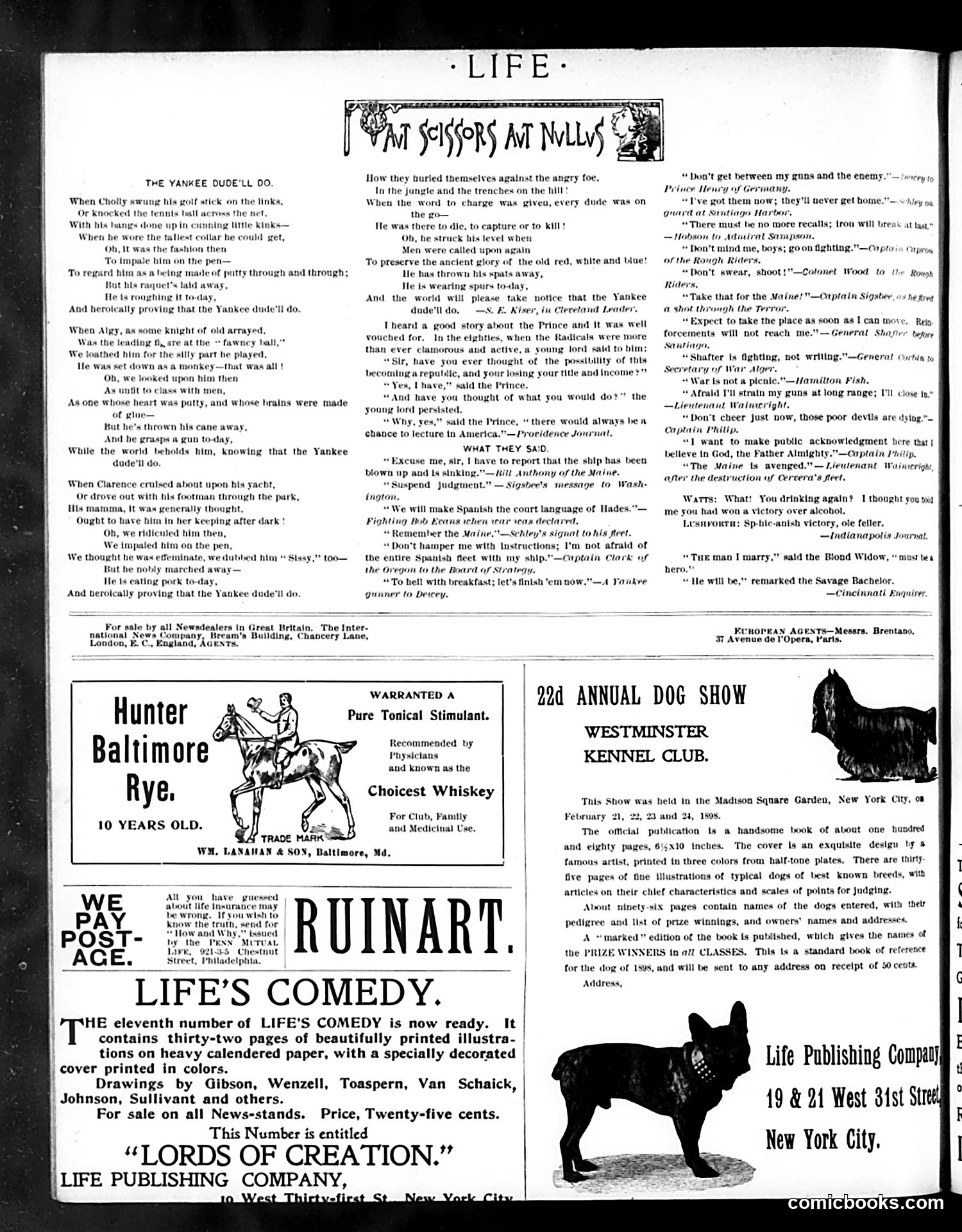
This poem satirizes American upper-class men ("dudes") who were previously mocked for their effeminate affectations—fancy clothes, golf, yachting, affected speech. The satire's point: when war came (the Spanish-American War, 1898), these despised dandies proved themselves brave soldiers, charging into battle, fighting at Manila and Santiago. The poem tracks a transformation: Cholly with his golf clubs, Algy at fancy balls, and Clarence with his yacht were all ridiculed as unmanly. But when called to war, they "threw [their] canes away," wore spurs, and proved willing to die for their country—earning grudging respect. The surrounding quotes from war heroes reinforce this theme, celebrating American military prowess in the recent conflict. The satire's irony is gentle: yes, we mocked these men, but American democratic society redeemed them through military service. The "Yankee dude" ultimately embodies national virtue.
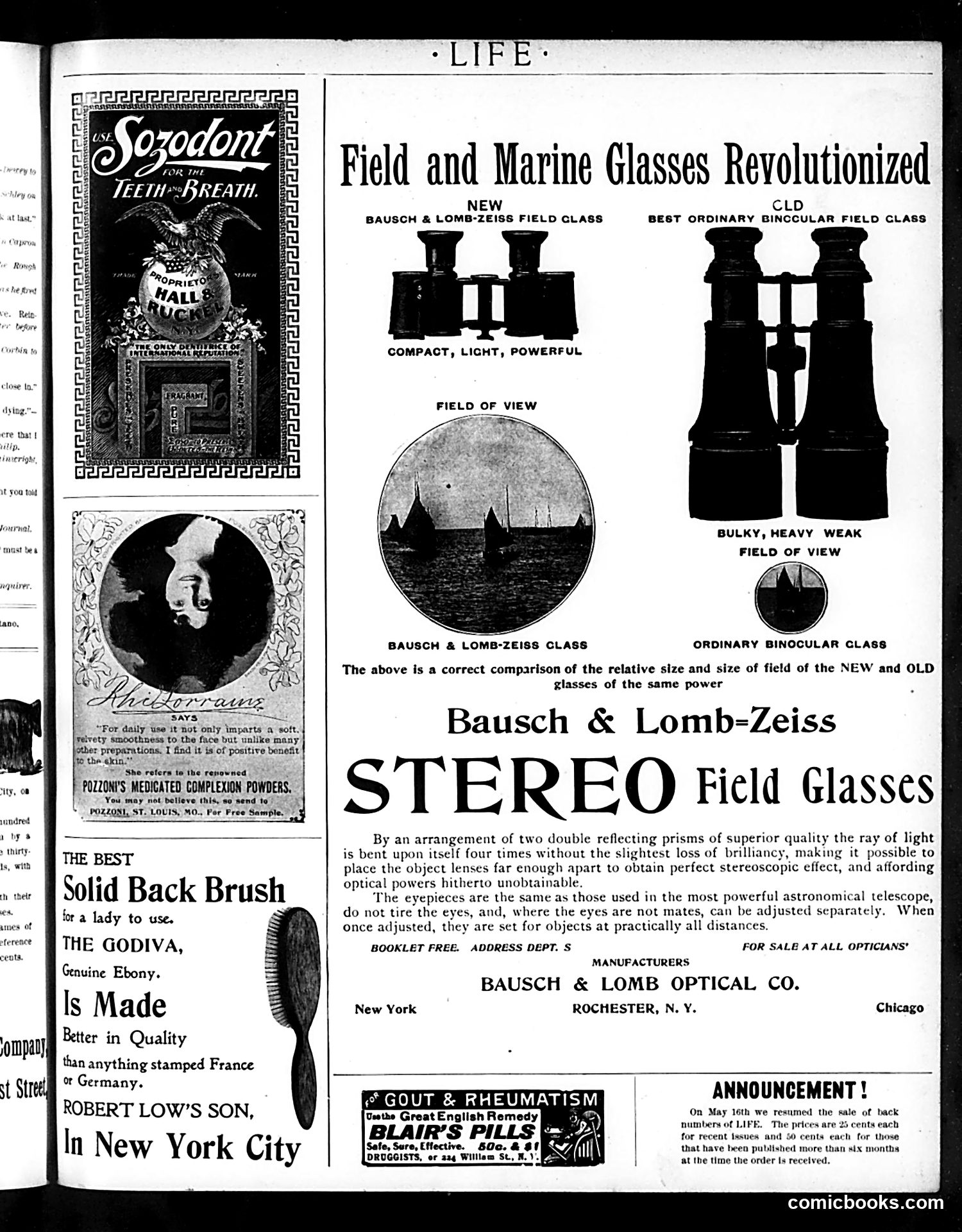
This page is primarily **advertising**, not satire or political commentary. The dominant content features a major advertisement for **Bausch & Lomb-Zeiss binocular field glasses**, comparing their new compact design against older, bulkier competitors. The ad uses circular diagrams showing expanded field of view as its selling point—a genuine optical innovation. The page also contains period advertisements for **Sozodont toothpaste**, **Pozzoni's complexion powder** (featuring a testimonial, possibly from an actress), and **Robert Low's Son brushes**—typical early 20th-century product placements. A minor **announcement** at bottom notes Life magazine has resumed selling back issues at 25 cents. The only potentially humorous element is the actress testimonial for face powder, but this appears to be standard advertising copy rather than satirical content. The page represents commercial magazine filler typical of the era.
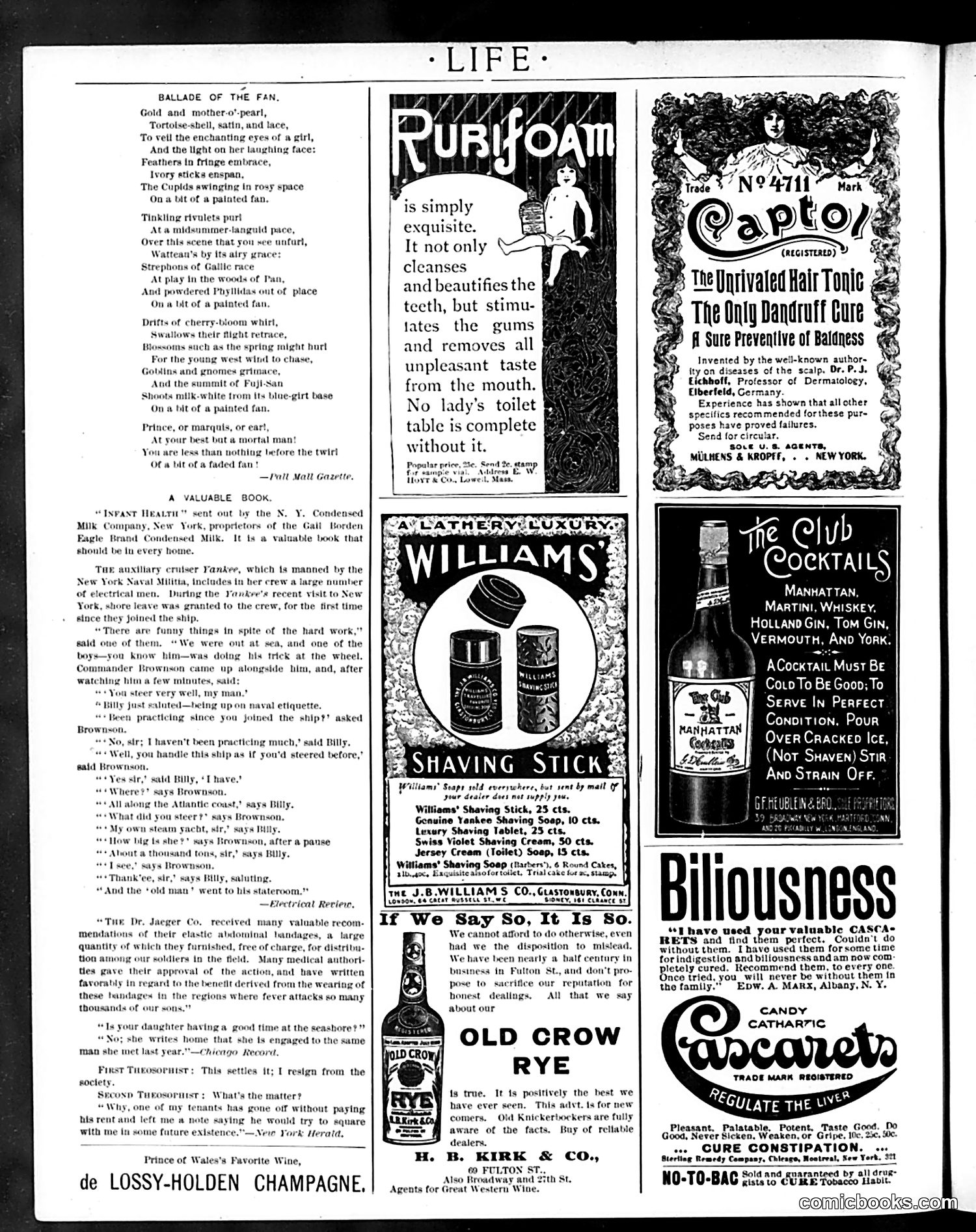
This page is primarily **advertisements and light literary content**, not political satire. The "Ballade of the Fan" is a romantic poem celebrating decorative fans as feminine accessories—reflecting early 1900s upper-class aesthetics where ornate fans were status symbols and flirtation tools. The humor pieces are mild workplace anecdotes: one involves a naval recruit who steered a ship along the Atlantic coast (the joke being he learned on a merchant vessel, not military training), and another mocks theosophists resigning over unpaid debts. The bulk of the page consists of product advertisements typical of *Life* magazine's era: **Purifoam toothpaste, Captor hair tonic, Williams' shaving products, Old Crow Rye whiskey, and digestive remedies**. These ads use exaggerated claims common to pre-FDA regulation—hair tonics promising baldness cures, tonics claiming broad health benefits. The magazine functioned as both satirical commentary and advertising vehicle. This particular page reveals **early 1900s consumer culture** and the products marketed to affluent readers.
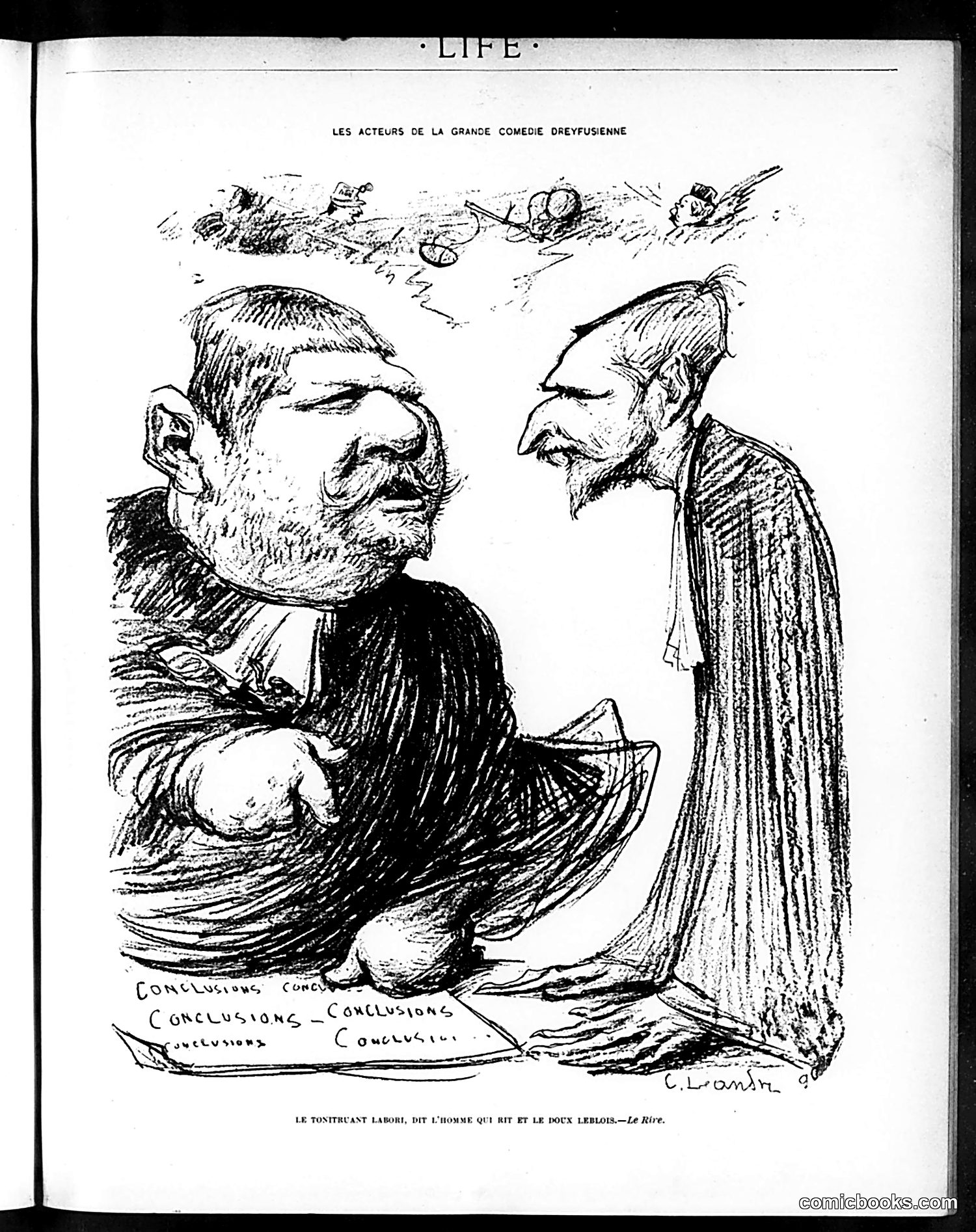
This French satirical cartoon from *Life* depicts two caricatured figures labeled as participants in the Dreyfus Affair controversy. The title references "The Actors of the Great Dreyfusian Comedy," mocking the affair as theatrical performance. The figure on the left, identified as "Labori" (likely Dreyfus's lawyer Maître Labori), is drawn as bombastic and gesticulating wildly. The right figure appears to be "Leblois," characterized as gentle/mild ("doux"). The repeated word "CONCLUSIONS" scattered throughout suggests the satire targets the endless legal proceedings and rhetorical arguments dominating French public discourse during the Dreyfus case. The cartoon ridicules both the affair's principal actors and the public obsession with its dramatic legal theater, presenting them as overwrought performers rather than serious participants in justice.
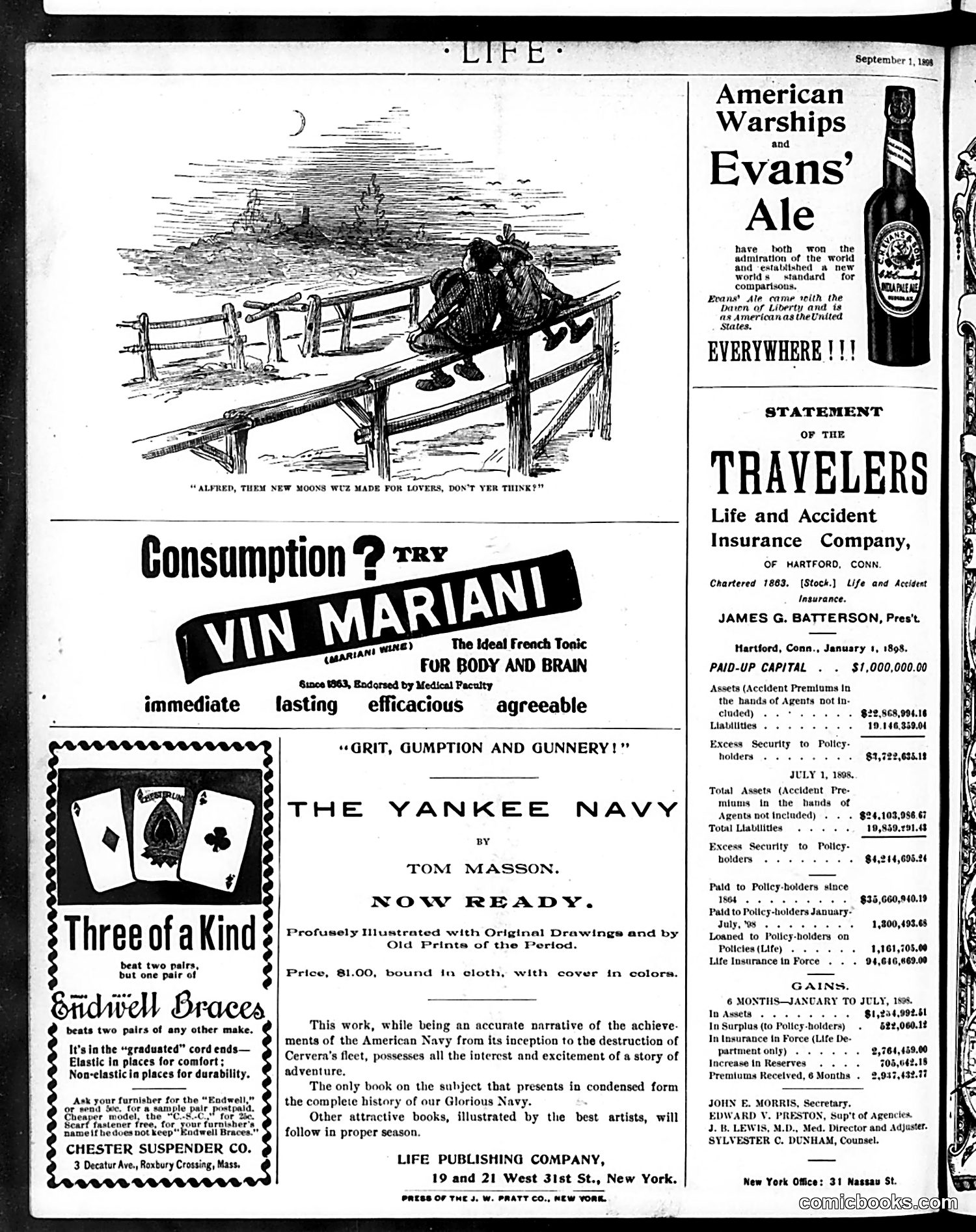
This page is primarily **advertising and business notices**, not political satire. The main content includes: **Top cartoon**: A humorous domestic scene captioned "Alfred, then new moons wuz made for lovers, don't yer think?" — a man and woman embrace on a fence under moonlight. This appears to be a lighthearted joke about romance, not political commentary. **Advertisements**: The page features commercial pitches for Vin Mariani (a French tonic wine), Chester Suspender Co., and Evans' Ale. There's also a book announcement for *The Yankee Navy* by Tom Masson, capitalizing on American naval pride following the Spanish-American War (note the 1898 dates and references to "Cervera's fleet"). **Insurance statement**: A detailed financial report from the Travelers Life and Accident Insurance Company. The only patriotic element is the Evans' Ale ad linking American naval strength with the product. Overall, this is a commercial page rather than satirical commentary.