
Life, 1898-09-01 · page 6 of 20
Life — September 1, 1898 — page 6: what you’re looking at
What you’re looking at
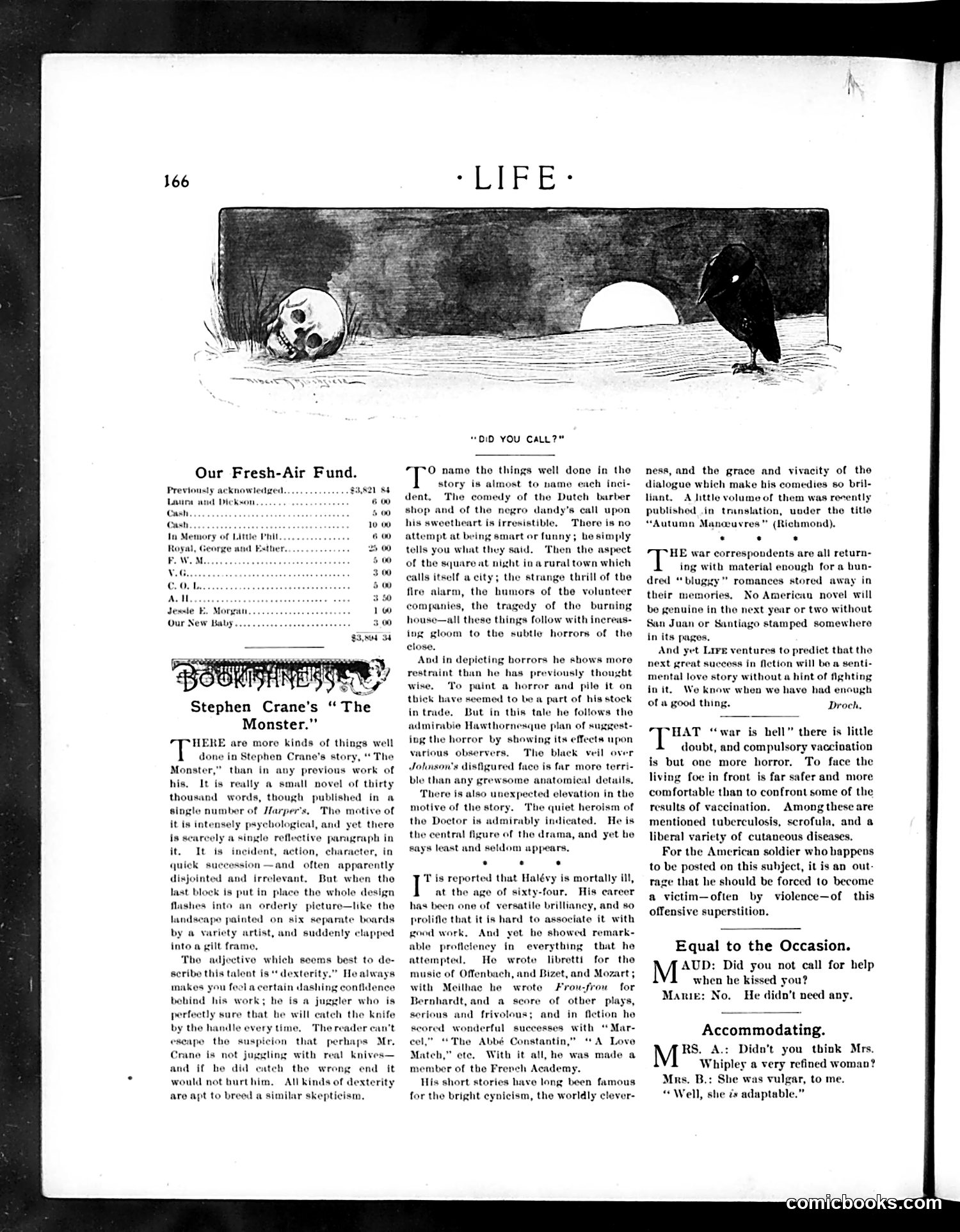
The main illustration shows a skull, a sun, and a crow in a desolate landscape—a memento mori composition symbolizing death and decay. This appears to accompany a review of Stephen Crane's "The Monster," which the text praises for its psychological depth and restraint in depicting horror. The page primarily contains literary criticism rather than political satire. It discusses Crane's novella about a Dutch barber shop and a burning house, praising his ability to convey tragedy without sensationalism. The text notes Crane avoids being "smart or funny," instead letting events speak for themselves. Below are two brief comic dialogues offering social commentary on courtship and female adaptability, though these are minor humor pieces rather than substantive satire.
📄 Transcribed text from this page (OCR, searchable)
Machine-transcribed from the original scan — historical spelling and the odd misread are preserved.
Our Fresh-Air Fund. Previously acknowledged... -oBHS21 84 600 of Littie Phil orge and Bathe 3.00 SH a] ¥ ye Stephen Crane's “ The Monster.” HERE are more kinds of things well » in Stephen Crane's story, “ The than in any previous work of his, It is really a small novel of thirty thousand words, though published in a single number of Harper's, Tho motive of it is intensely psychological, and yet there is scarcely a single reflective panugraph in it. It is incident, action, character, in quick succession —and often apparently disjointed and irrelevant, But when the last block is put in place the whole design flashes into an orderly picture—like the landscape painted on six separate boards by a variety artist, and suddenly clapped into a gilt frame, Tho adjective which seems best to de- scribe this talent is “dexterity.” He always makes you fect a certain dashing confidence behind his work; he is a juggler who is perfectly sure that be will catch the knife by the handle every time, The reader can't seapo the suspicion that perhaps Mr. Crano is not juggling with real knives— and if he did exteh the wrong end it would not burthim, All kinds of dexterity aro apt to breed a similar skepticism, “DID YOU CALL? ‘J7O namo tho things well done in tho story is almost to name each inci- The comedy of the Dutch barber shop and of the negro dandy’s call upon his sweetheart is irresistible, Thore is no attempt at being smart or funny; be simply tells you what they said. Then the aspect of the square at night ina rural town which calls itself a city; the strange thrill of the fire alarm, the humors of the volunteer companies, the tragedy of the burning house—all these things follow with increas- ing gloom to the subtle horrors of the close. And in depicting horrors he shows more restraint than he has previously thought wise, ‘To paint a horror and pile it on thick have seemed to be a part of his stock in trade, But in this tale he follows tho admirabie Hawthornesque plan of suggest- ing the horror by showing its effects upon various observers, The black veil over Johnson's disfigured face is fur more terri- ble than any grewsome anatomical details. There is also unexpected elevation in the motive of the story. The quiet heroism of the Doctor is admirably indicated. He is the central figure of the drama, and yet be says least and seldom appears. dent, . . . T is reported that Halévy is mortally ill, at the age of sixty-four, His career has been one of versatile brillianey, and so prolifle that it is hard to associate it with good work. And yet he showed remark- able proficiency in everything that he attempted, He wrote libretti for the music of Offenbach, and Bizet, and Mozart ; with Meilhac he fi for Bernhardt, and a score of other plays, serious and frivolous; and in fiction he «d wonderful successes with “ Mar- “The Abbé Constantin,” “A Love ch,” ete, With it all, he was made a member of the French Academy. His short stories have long been famous for tho bright cynicism, the worldly clever- wrote Fron-frow sco! ness, and the grace and vivacity of the dialogue which make bis comedies 80 bril- lant. A little volume of them was recently published in translation, under the title “Autumn Mancuvres" (Richmond). . . . HE war correspondents are all return- ing with material enough fora bun- dred “ bluggy” romances stored away in their memories, No American novel will be genuine in the next year or two without San Juan or Santiago stamped somewhere in its pages. And yet Lire ventures to predict that tho next great success in fetion will be a senti- mental love story without a hint of fighting in it. We know when we have had enough of a good thing. yet “war is hell” there is little doubt, and compulsory vaccination is but one more horror. To face the living foe in front is far safer and more comfortable than to confront some of the results of vaccination. Among these are mentioned tuberculosis, scrofula, and a liberal variety of cutaneous diseases. For the American soldier who happens to be posted on this subject, it is an out- rage that he should be forced to become a victim—often by violence—of this offensive superstition. Droch, Equal to the Occasion. M2e: Did you not call for help when he kissed you? No. He didn’t need any. Accommodating. RS. A.: Didn't you think Mrs. Whipley a very refined woman? Mrs. B.: She was vulgar, to me. “Well, she ix adaptable.” Mani