
Life, 1898-09-01 · page 4 of 20
Life — September 1, 1898 — page 4: what you’re looking at
What you’re looking at
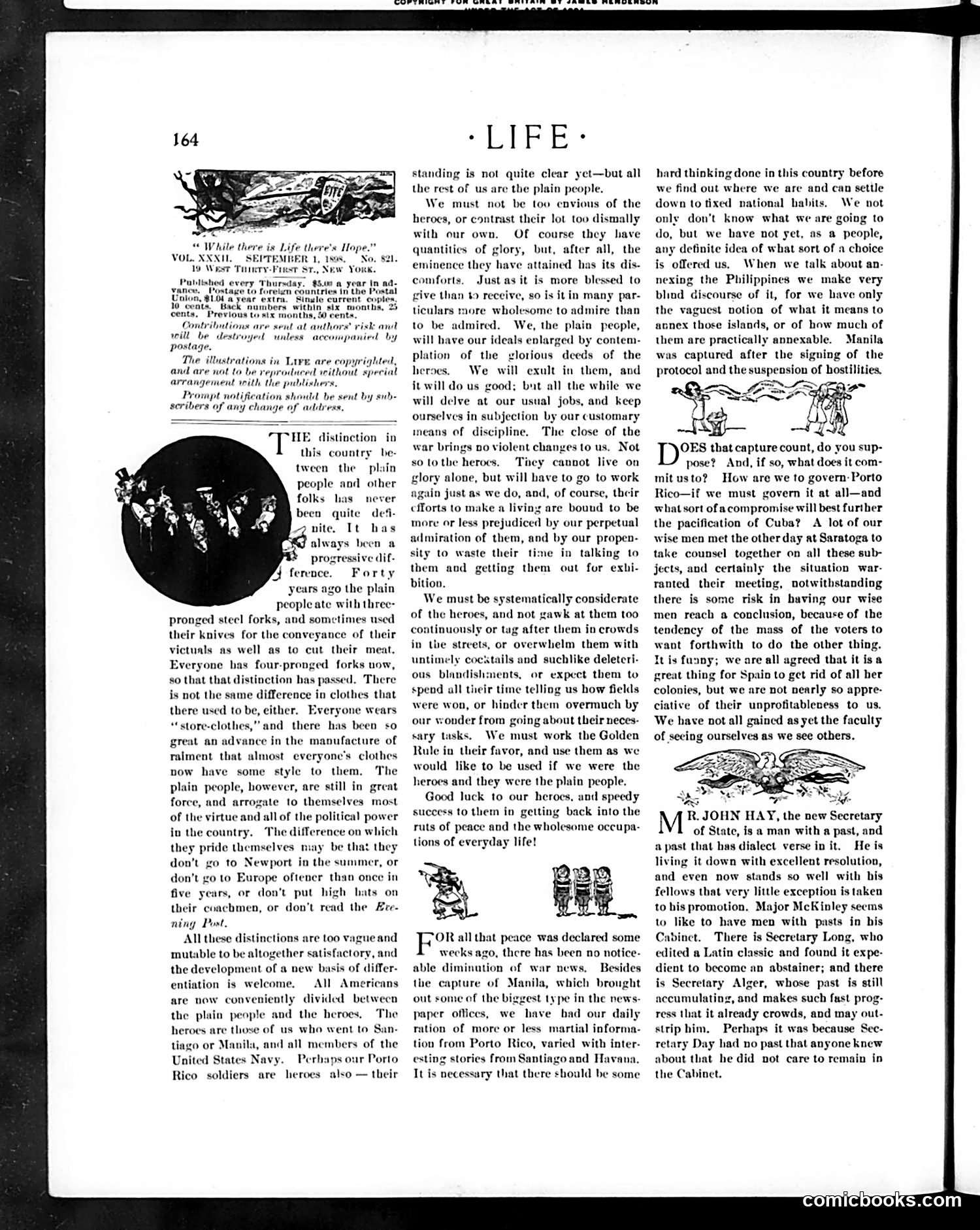
This page discusses class distinctions in America following the Spanish-American War. The main cartoon (large circular illustration, top left) depicts what appears to be wealthy or upper-class figures in contrast to ordinary people, illustrating the article's argument that despite American ideals, social hierarchies persist. The text argues Americans shouldn't envy war heroes' glory, as they'll still need to work like ordinary citizens. It critiques the tendency to either ignore or over-romanticize soldiers, urging readers to treat them as equals rather than pedestals. The final paragraph mentions John Hay (new Secretary of State) and cabinet members, suggesting contemporary political commentary about leadership during the post-war period. The overall message emphasizes equality and practical rather than sentimental treatment of national heroes.
📄 Transcribed text from this page (OCR, searchable)
Machine-transcribed from the original scan — historical spelling and the odd misread are preserved.
“ While there ix Life there's Hope x EM + 1898, No. New York. , mtage Colon, $104 a'year Wo cents, Back cents, Previous postag The illustrations in Lave are copyrighte and are not to be reproduced without § arrangement with the publishers Prompt notification shout be sent by snb- seribers of any change of address, HE distinction iv this country be- tween the plain people and other folks has never been quite defi- quite. It has PF always been a BS progressive dif- yi ference. Forty years ago the plain people ate with three- pronged stecl forks, and sometimes used their knives for the conveyance of their jals as well as to cut their meat, Everyone has four-pronged forks uow, so that that distinction has passed. There is not the same difference in clothes that there used to be, either. Everyone wears “store-clothes,” and there has been so great an advance in the manufacture of ralment that almost everyone's clothes now have some style to them. The plain people, however, are still in great force, and arrogate to themselves most of the virtue and all of the political power in the country. The difference on which they pride themselves. y be that they don't go to Newport in the summer, or don’t go to Europe oftener than once in five years, or don’t put high bats on their coacbmen, or don’t read the Eve- ning Post. All these distinctions are too vague and mutable to be altogether satisfactory, and the development of a new basis of differ- entiation is welcome. All Americans are vow conveniently divided between the plain people and the heroes, The heroes are those of us who went to San- tiago or Manila, and all members of the United States Navy. Perhaps our Porto Rico soldiers are heroes also — their Re eke ce ‘LIFE « standing is not quite clear yet—but all the rest of us are the plain people. We must not be too envious of the heroes, or contrast their lot too dismally with our own. Of course they hav quantities of glory, but, after all, the eminence they have attained has its dis- comforts, Just as it is more blessed to give than to receive, so is itin many par- ticulars more wholesome to admire than to be admired. We, the plain people, will have our ideals enlarged by contem- plation of the glorious deeds of the heroes. We will exult in them, and it will do us good; but all the while we will delve at our usual jobs, and keep ourselves in subjection by our customary means of discipline. The close of the war brings no violent changes to us. Not so tothe herocs. Tiey cannot live on glory alone, but will bave to go to work again just as we do, and, of course, their efforts to make a living are bound to be more or less prejudiced by our perpetual admiration of them, and by our propen- sity to waste their time in talking to them and getting them out for exhi- bition. We must be systematically considerate of the heroes, and not gawk at them too continuously or tag after them in crowds in the streets, or overwhelm them with untimely cocktails and suchlike deletcri- ous blandishments, or expect them to spend all their time telling us how fields were won, or hinder them overmuch by our wonder from going about their neces- sary tasks. We must work the Golden Rule in their favor, and use them as we would like to be used if we were the heroes and they were the plain people. Good luck to our heroes, and speedy success to them in getting back into the ruts of peace and the wholesome occupa- tions of everyday life! = ‘OR all that peace was declared some weeks ago, there has been no notice- able diminution of war news. Besides the capture of Manila, which brought out some of the biggest type in the news paper offices, we have bad our daily ration of more or less martial informa- tion from Porto Rico, varied with inter- esting stories from Santiago and Havana, It is necessary that there should be some hard thinking done in this country before we find out where we are and can settle down to tixed national habits. We not only don’t know what we are going to do, but we have not yet, as a people, any definite idea of what sort of a choice is offered us, When we talk about an- nexing the Philippines we make very blind discourse of it, for we have only the vaguest notion of what it means to annex those islands, or of how much of them are practically annexable. Manila was captured after the signing of the protocol and the suspension of hostilities, EELS aS fle OES that capture count, do you sup- pose? And, if so, what does it com- mit usto? How are we to govern: Porto Rico—if we must govern it at all—and what sort of acompromise will best further the pacification of Cuba? A lot of our wise men met the other day at Saratoga to take counsel together on all these sub- jects, and certainly the situation war- ranted their meeting, notwithstanding there is some risk in baving our wise men reach a conclusion, because of the tendency of the mass of the voters to want forthwith to do the other thing. It is fanny; we are all agrecd that it is a great thing for Spain to get rid of all her colonies, but we are not nearly so appre- ciative of their unprofitableness to us. We have not all gained as yet the faculty of secing ourselves as we see others. R. JOHN HAY, the new Secretary of State, is a man with a past, and a past that bas dialect verse in it. He is living it down with excellent resolution, and even now stands so well with bis fellows that very little exception istaken to bis promotion. Major McKinley seems to like to have men with pasts in bis Cabinet. There is Secretary Long, who edited a Latin classic and found it expe- dient to become an abstainer; and there is Secretary Alger, whose past is still accumulating, and makes such fast prog- ress that it already crowds, and may out- strip him. Perhaps it was because Sec- retary Day had no past that anyone knew about that he did not care to remain in the Cabinet.