
A complete issue · 20 pages · 1898
Life — August 11, 1898
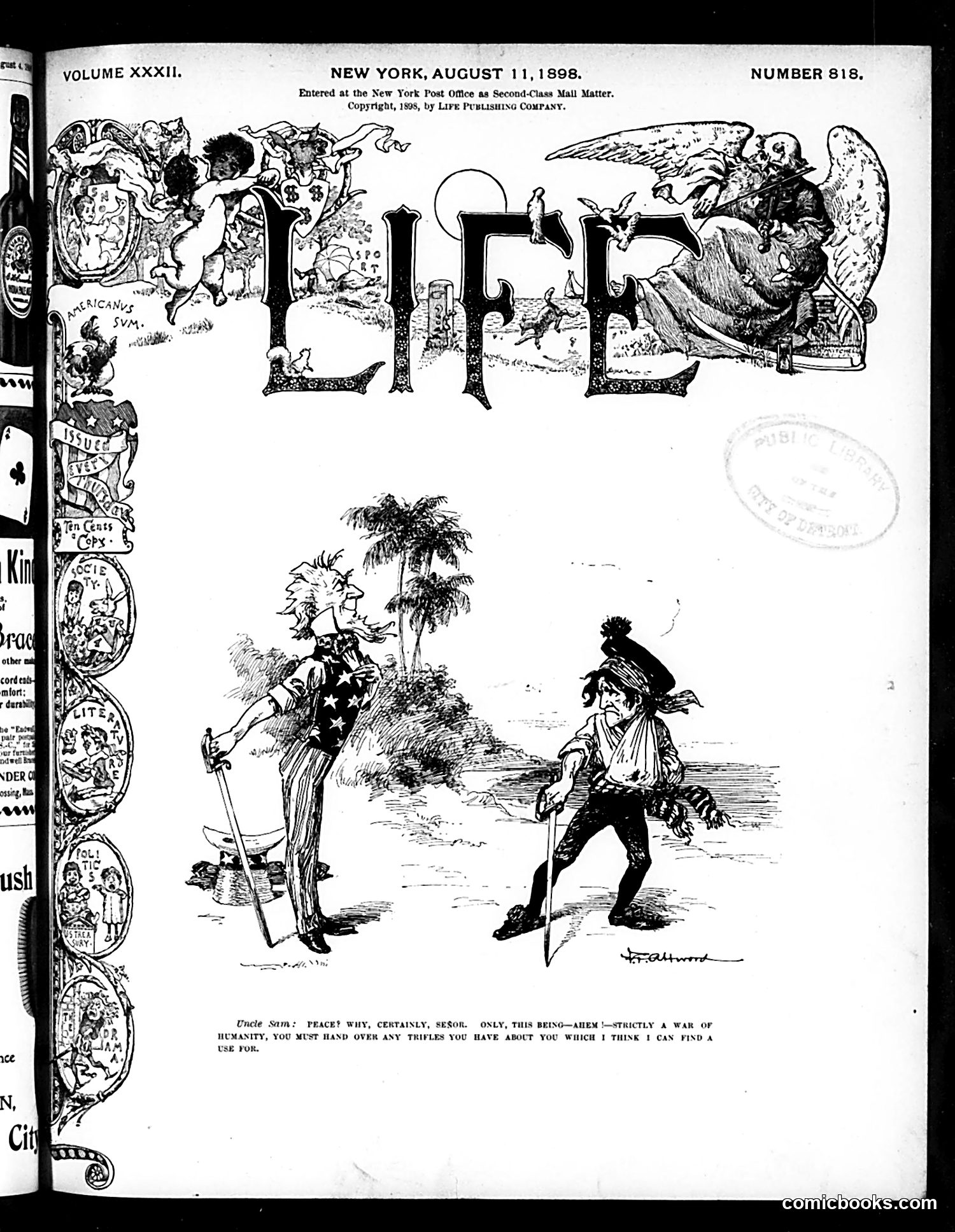
This page features a satirical cartoon addressing American imperialism during the Spanish-American War (1898). Uncle Sam, depicted with a shovel, confronts a ragged figure (likely representing a foreign adversary or colonial subject) over territorial disputes. The caption reads: "Peace? Why, certainly, señor. Only, this being—ahem!—strictly a war of humanity, you must hand over any trifles you have about you which I think I can find a use for." The satire mocks American claims that the war was fought for humanitarian reasons rather than territorial conquest. The "trifles" reference suggests the U.S. was actually seeking colonial possessions and resources. The cartoon critiques the hypocrisy of imperial expansion disguised as moral intervention—a common critique of American foreign policy during this expansionist era.
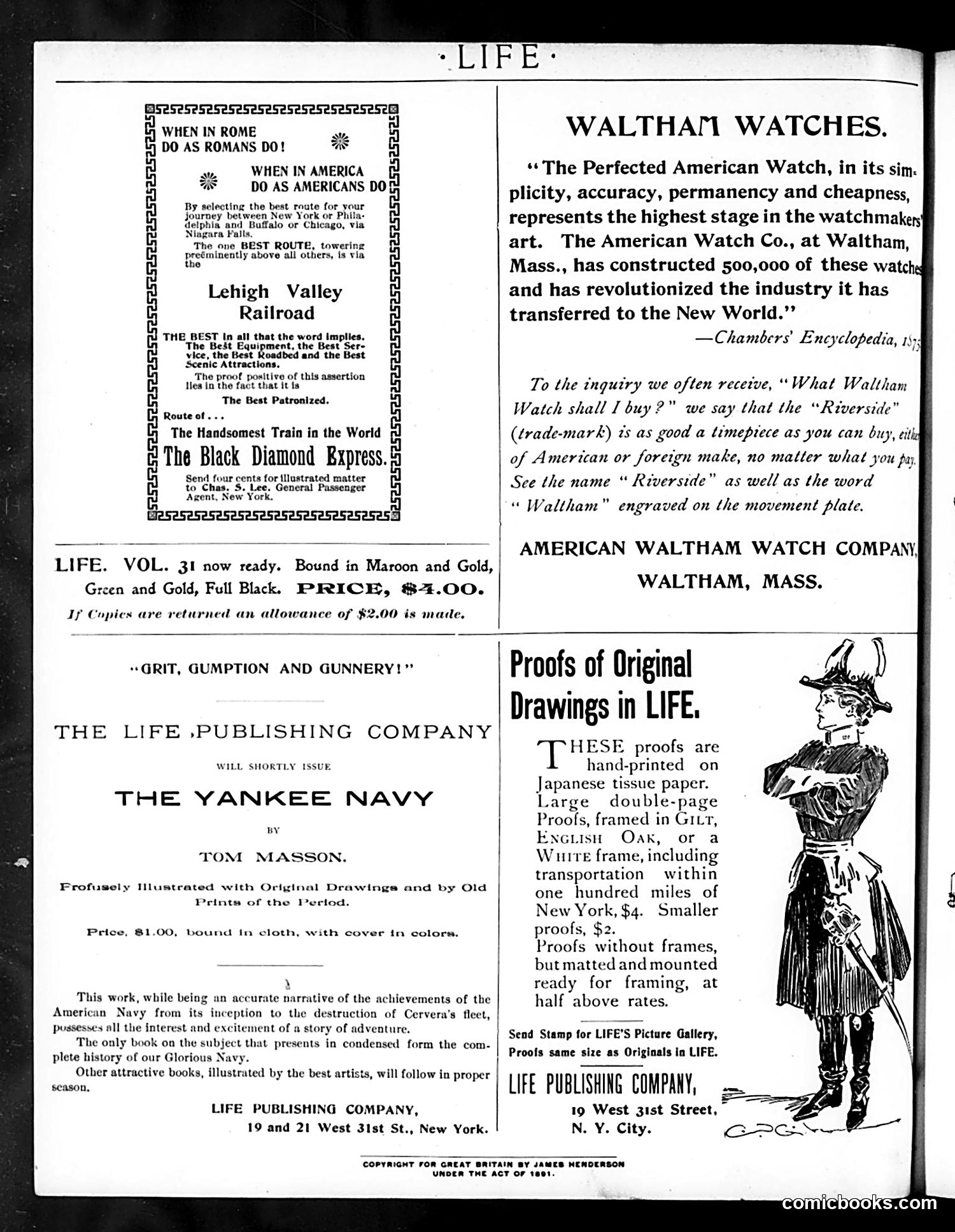
This page is primarily **advertising and announcements** rather than political satire. It contains: 1. **Lehigh Valley Railroad ad** promoting "The Black Diamond Express" train 2. **Waltham Watches advertisement** emphasizing American manufacturing superiority 3. **Life Publishing Company announcements** for upcoming publications, including "The Yankee Navy" by Tom Masson 4. **Proofs of Original Drawings** offer from Life's art department, featuring a sketch of a woman in military/patriotic dress The only potentially satirical element is the illustration of a woman in military attire (right side), which **likely references early 1900s American patriotic or military themes**, but without clearer context, the specific point is unclear. The page primarily reflects turn-of-the-century American commercial culture and Life magazine's business operations.
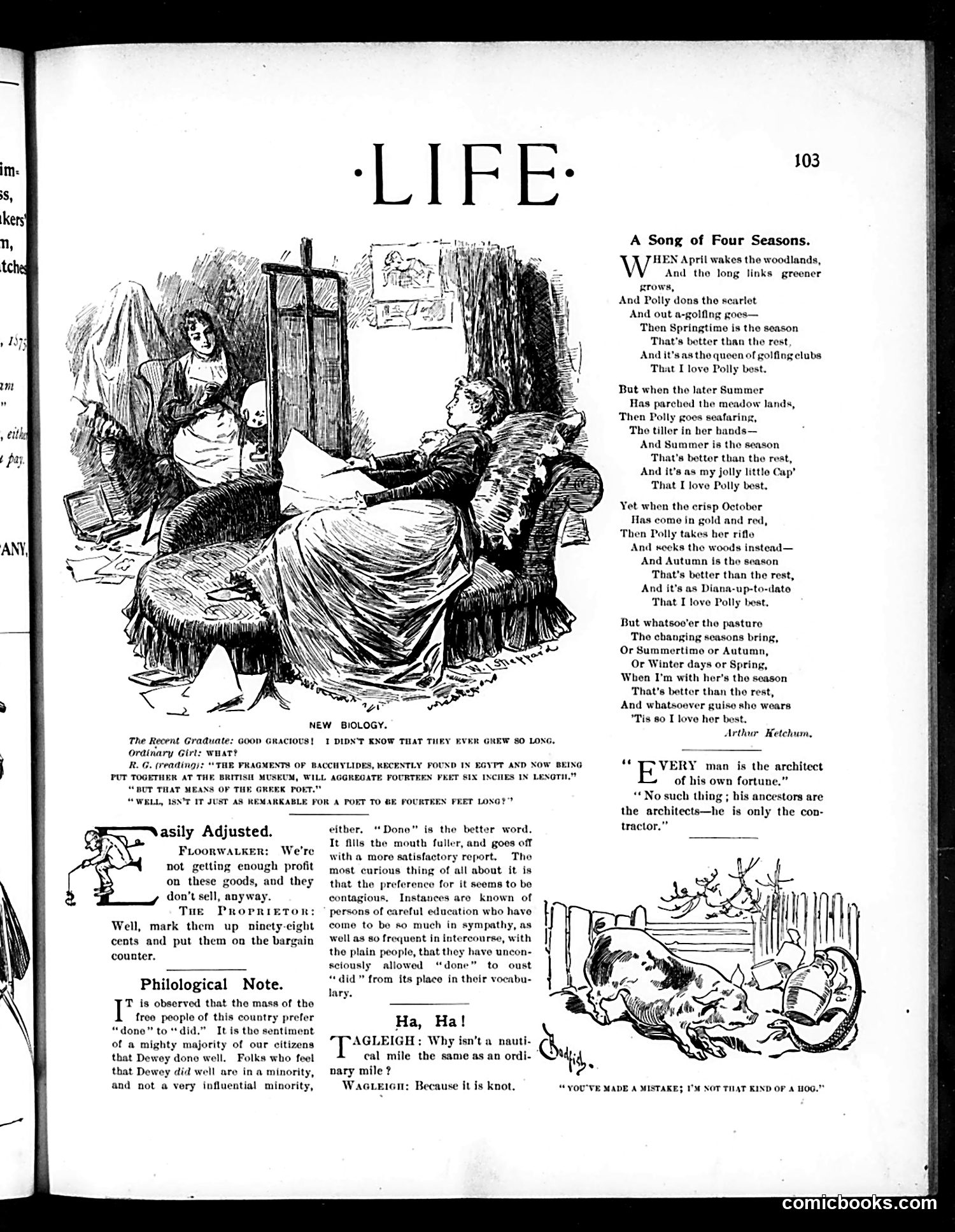
**Main Content:** The page features "A Song of Four Seasons" by Arthur Ketchum, celebrating a woman named Polly across seasonal changes. The poem expresses romantic preference for Polly in each season. **Cartoons:** 1. **Top illustration**: Shows a woman reading to a man in an interior domestic scene, relating to the seasonal poem's romantic themes. 2. **"Easily Adjusted"**: A brief dialogue between a Floorwalker and Proprietor about retail profitability and customer satisfaction—typical contemporary commercial satire. 3. **"Physiological Note"**: Comments on American preference for "done" (well-done) meat, suggesting this reflects broader cultural sentiment, likely poking fun at American dining habits versus other nations. 4. **Bottom right**: A simple joke about a pig and mistaken identity ("You've made a mistake; I'm not that kind of hog"). The page is primarily light humor and verse rather than sharp political satire.
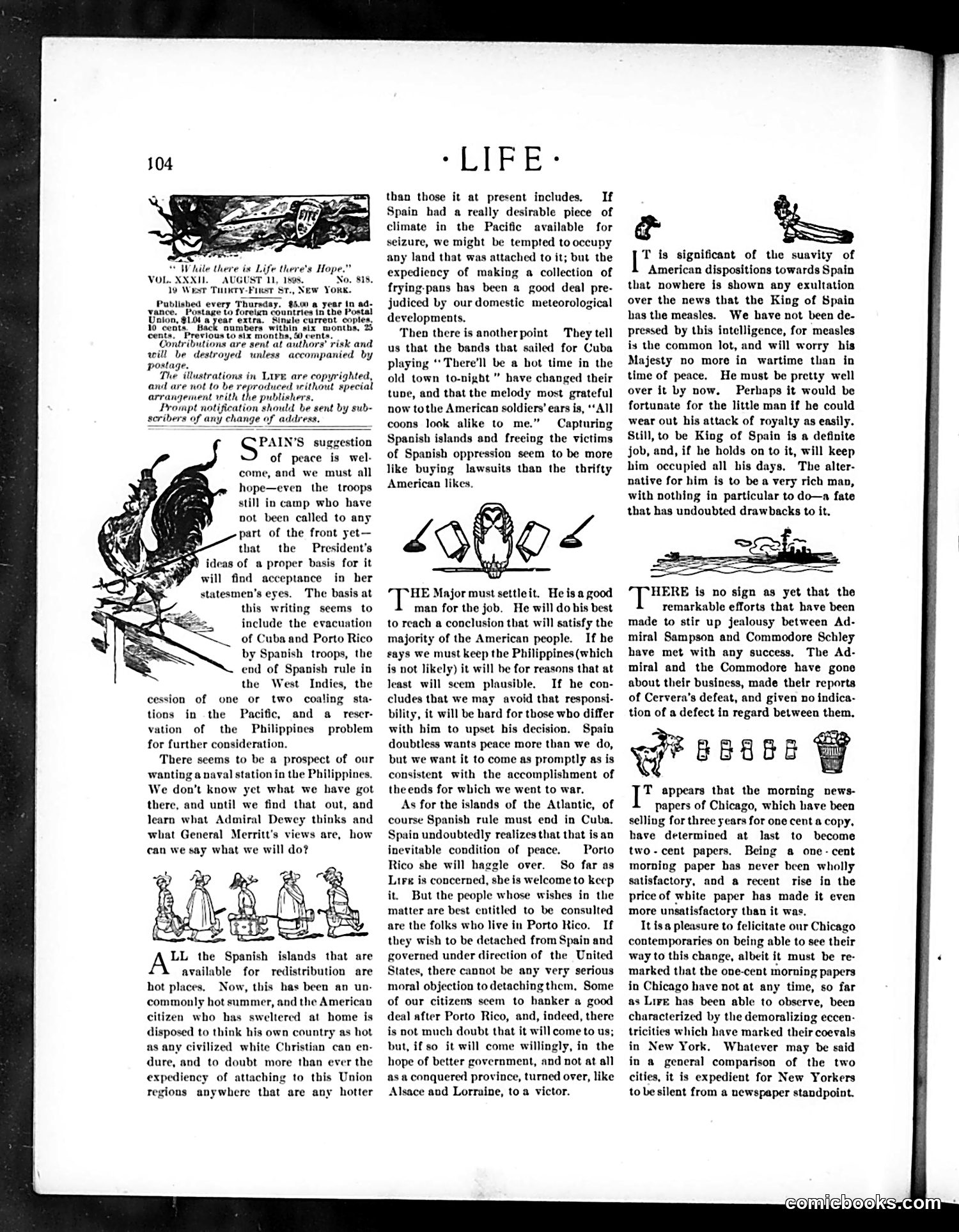
This *Life* magazine page (page 104) contains editorial commentary on Spanish-American War peace negotiations, circa 1898. The text discusses whether Spain should cede Cuba, Puerto Rico, and the Philippines as part of peace settlements. The cartoons appear to be satirical illustrations supporting American expansionist positions. One illustration depicts what seems to be a rooster or fighting bird (possibly representing Spain), suggesting Spanish weakness or defeat. Another shows figures in period dress, likely representing political or military figures debating territorial concessions. The editorial argues the U.S. should secure Philippines control and Puerto Rico cession, while consulting with Spanish island residents about independence. The satire mocks Spanish reluctance to accept inevitable defeat and questions whether America should negotiate or simply demand territorial gains.
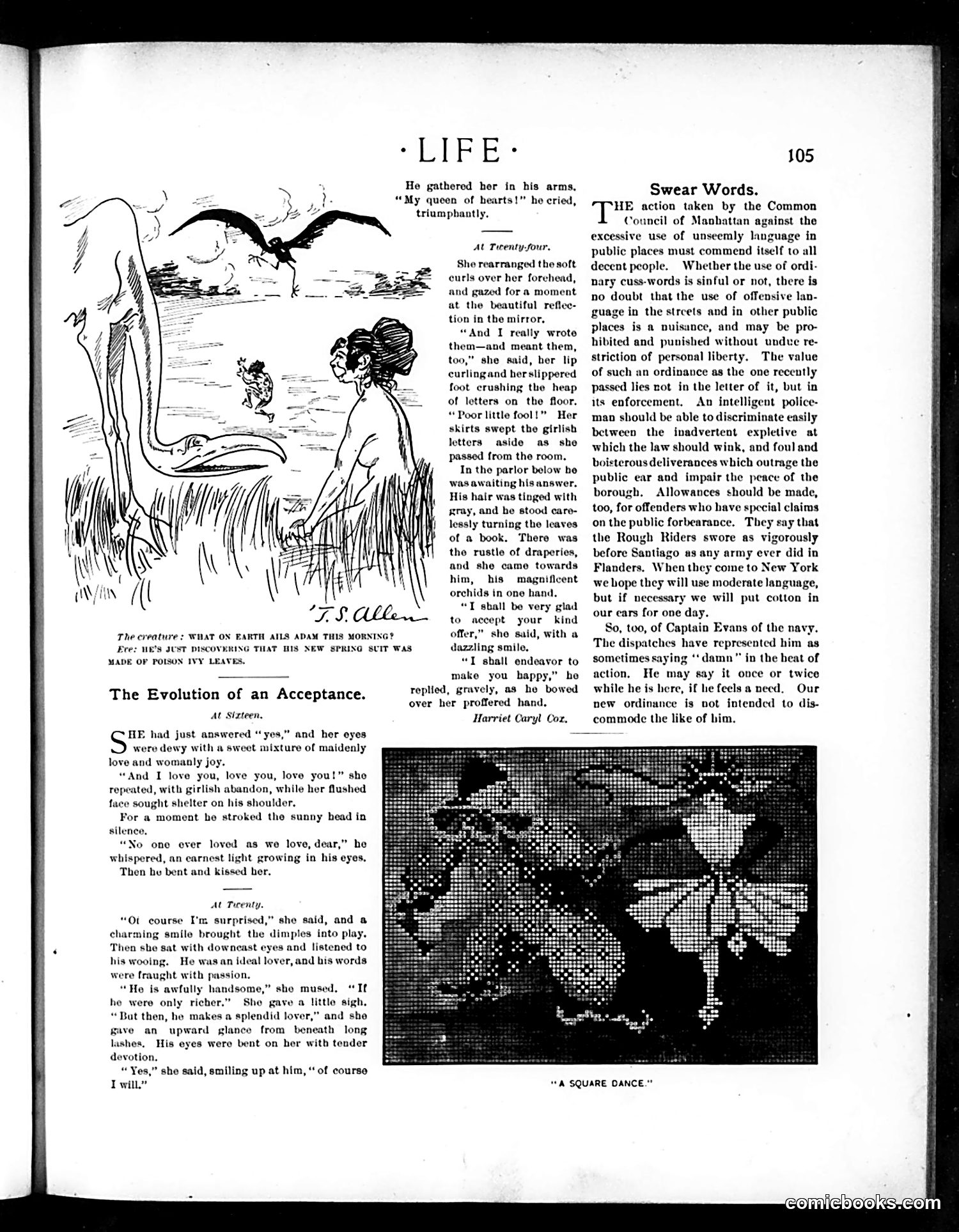
**The Main Cartoon** (top left, by J.S. Allen): A creature discovers a man's new spring suit made of poison ivy. The joke is visual slapstick—the "creature" (appears to be a bird or similar animal) has found the suit laughable or problematic, suggesting the wearer will suffer itching and discomfort from the poisonous plant material. **"The Evolution of an Acceptance"** (story with illustration): A romantic narrative about a couple's engagement, progressing from the woman's initial "yes" through increasingly affectionate moments. This appears satirical commentary on courtship conventions and emotional escalation. **"Swear Words"** (right column): An editorial addressing the Common Council's efforts to combat public profanity, discussing enforcement of anti-obscenity ordinances and police discretion in regulating offensive language in public spaces.
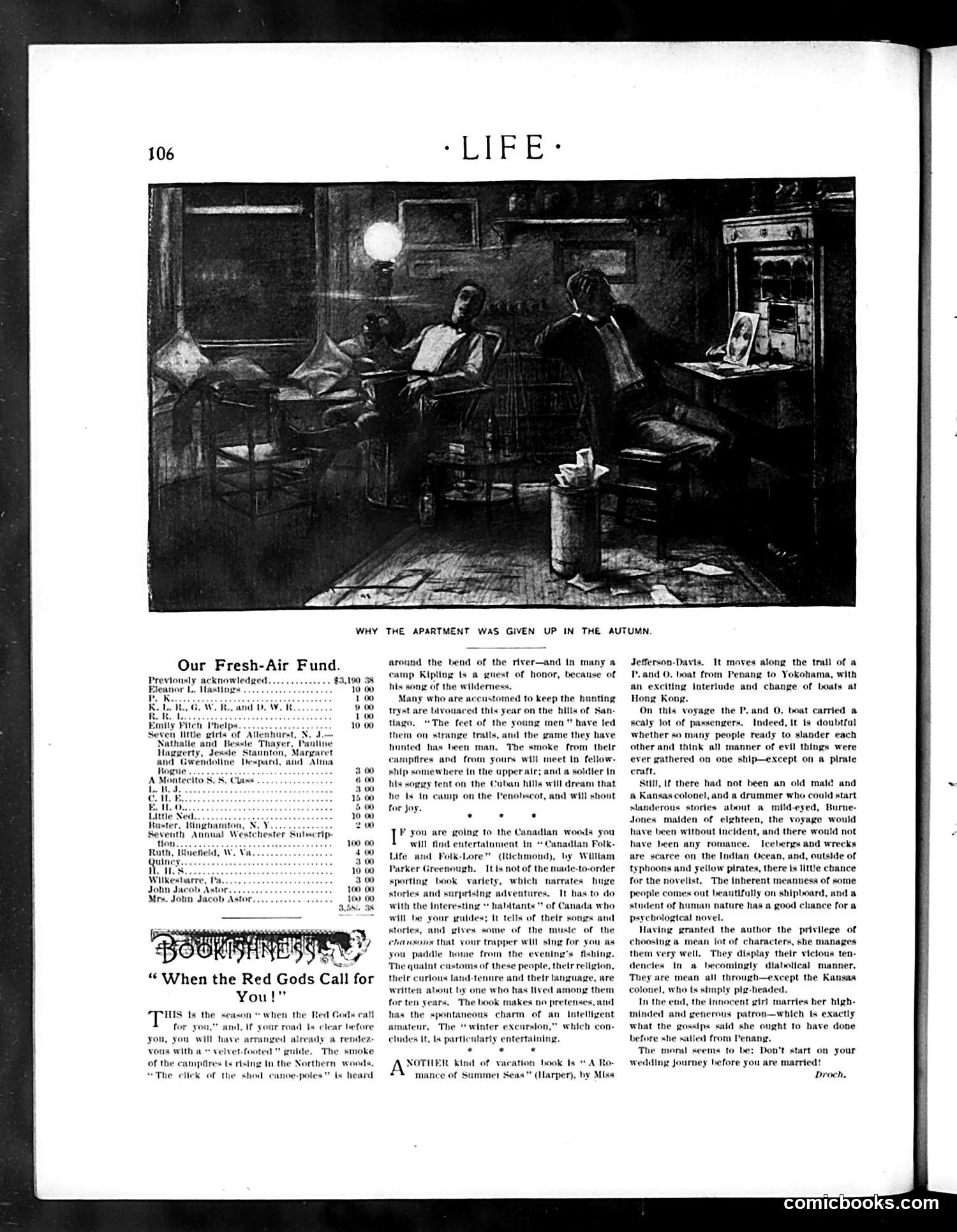
This page contains a satirical section titled "Our Fresh-Air Fund" listing donations to send children to the countryside, followed by a book advertisement for "When the Red Gods Call for You!" The main illustration shows "WHY THE APARTMENT WAS GIVEN UP IN THE AUTUMN" — depicting an indoor scene where several people appear cramped in a small apartment with poor ventilation and a coal stove. The satire critiques urban living conditions: families were forced to abandon apartments during winter months due to inadequate heating and air quality, likely making seasonal migration necessary or forcing moves to better accommodations. The Fresh-Air Fund donations reflect contemporary Progressive Era charitable efforts to provide poor urban children temporary relief from crowded, unhealthy city tenements by sending them to rural areas. The cartoon humorously illustrates *why* such relief was desperately needed — the deplorable apartment conditions made escape imperative.
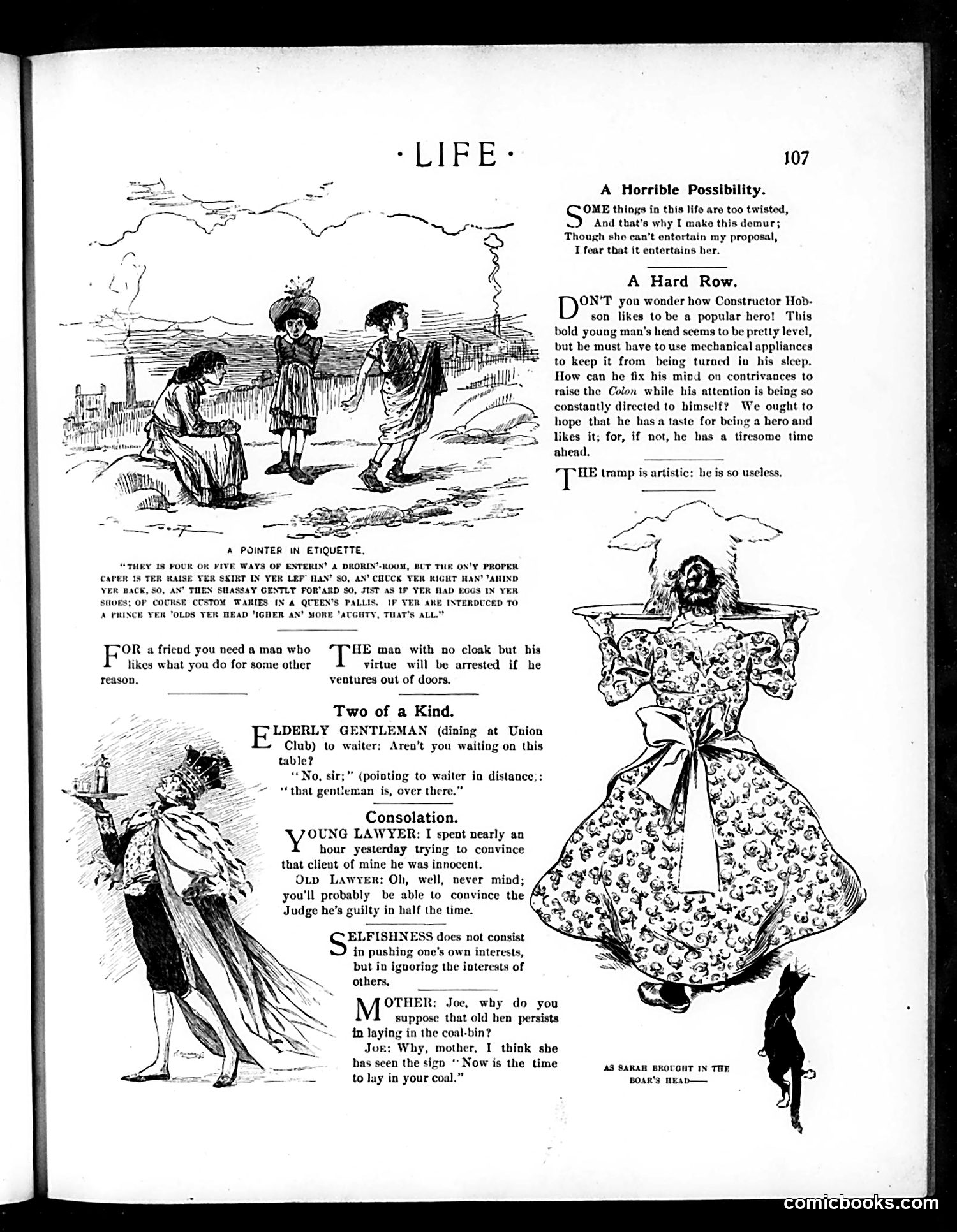
This page contains several satirical vignettes about social behavior rather than partisan politics: **"A Pointer in Etiquette"** mocks proper conduct rules through dialogue about entering a room—a joke about rigid Victorian social conventions. **"A Hard Row"** satirizes the plight of a popular hero who must maintain his image through exhausting mechanical routines (like raising the Colon, likely a digestive health reference popular in that era) while pretending effortless heroism. **"Two of a Kind"** jokes about wealthy club members, with an elderly gentleman pointing out another gentleman elsewhere—humor about social recognition among the idle rich. **"Consolation"** presents a lawyer's cynical advice to a naive young colleague about judicial corruption—dark satire on the legal system's integrity. The illustrations depict genteel figures in period dress, emphasizing the page's focus on upper-class social absurdities and hypocrisy rather than contemporary events.
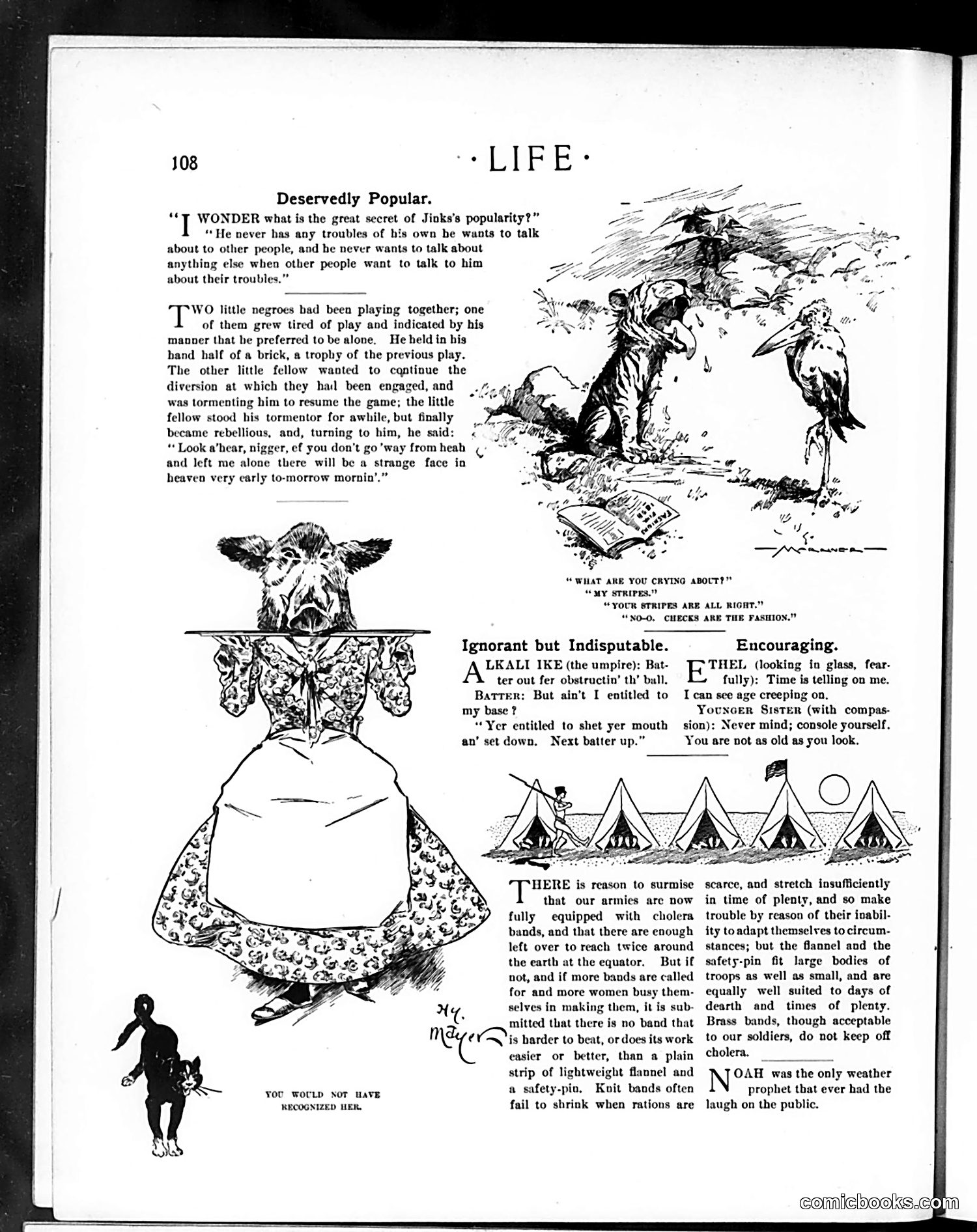
This page contains multiple satirical pieces: **"Deservedly Popular"** (top): A dialogue between two Black children debating a play game, with one threatening the other with violent consequences in the afterlife. The humor relies on crude racial stereotyping common to the era. **"Ignorant but Indisputable"** and **"Encouraging"** (middle): Two brief dialogues presenting working-class figures in condescending situations—a woman at baseball and a younger woman seeking reassurance. **Military satire** (bottom right): An illustration of army camps with commentary questioning why cholera bands and safety-pin solutions suffice for troops during wartime, when better provisions exist during peacetime. The page exemplifies early 20th-century satirical humor mixing racial caricature, class-based mockery, and military critique through illustrations and brief comedic exchanges.
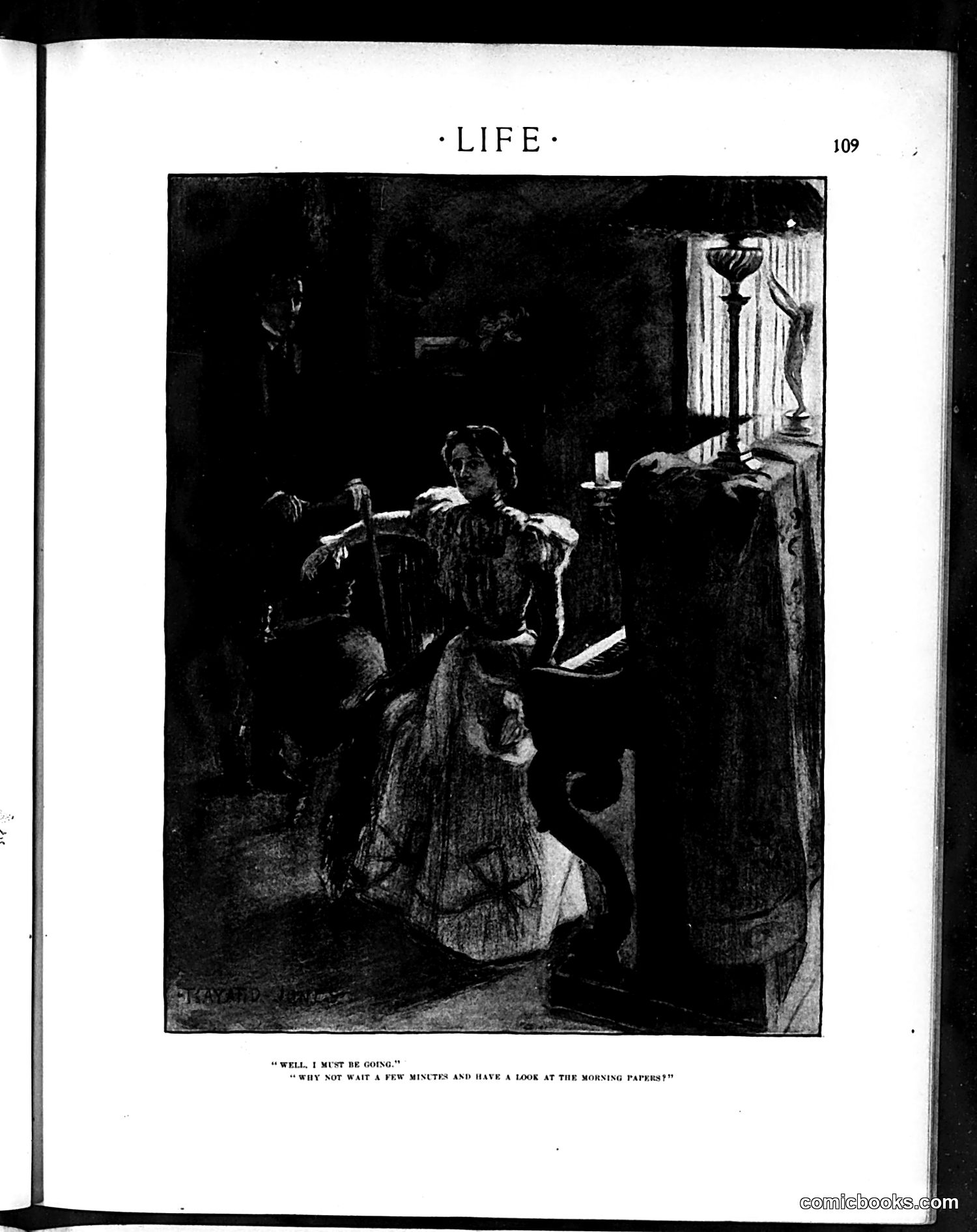
This illustration depicts a domestic scene with dialogue: "Well, I must be going." "Why not wait a few minutes and have a look at the morning papers?" The cartoon satirizes a common social situation of the early 20th century. A man (appearing to be departing) is being urged by a woman to stay briefly to review the morning newspapers together. The satire likely mocks either: 1. The compulsive American habit of reading newspapers as part of morning routine, or 2. A subtle domestic power dynamic where the woman uses newspaper-reading as a delaying tactic The humor plays on the period's newspaper culture—when dailies were central to middle-class domestic life and social conversation. The intimate interior setting and formal dress suggest this targets educated, bourgeois households.
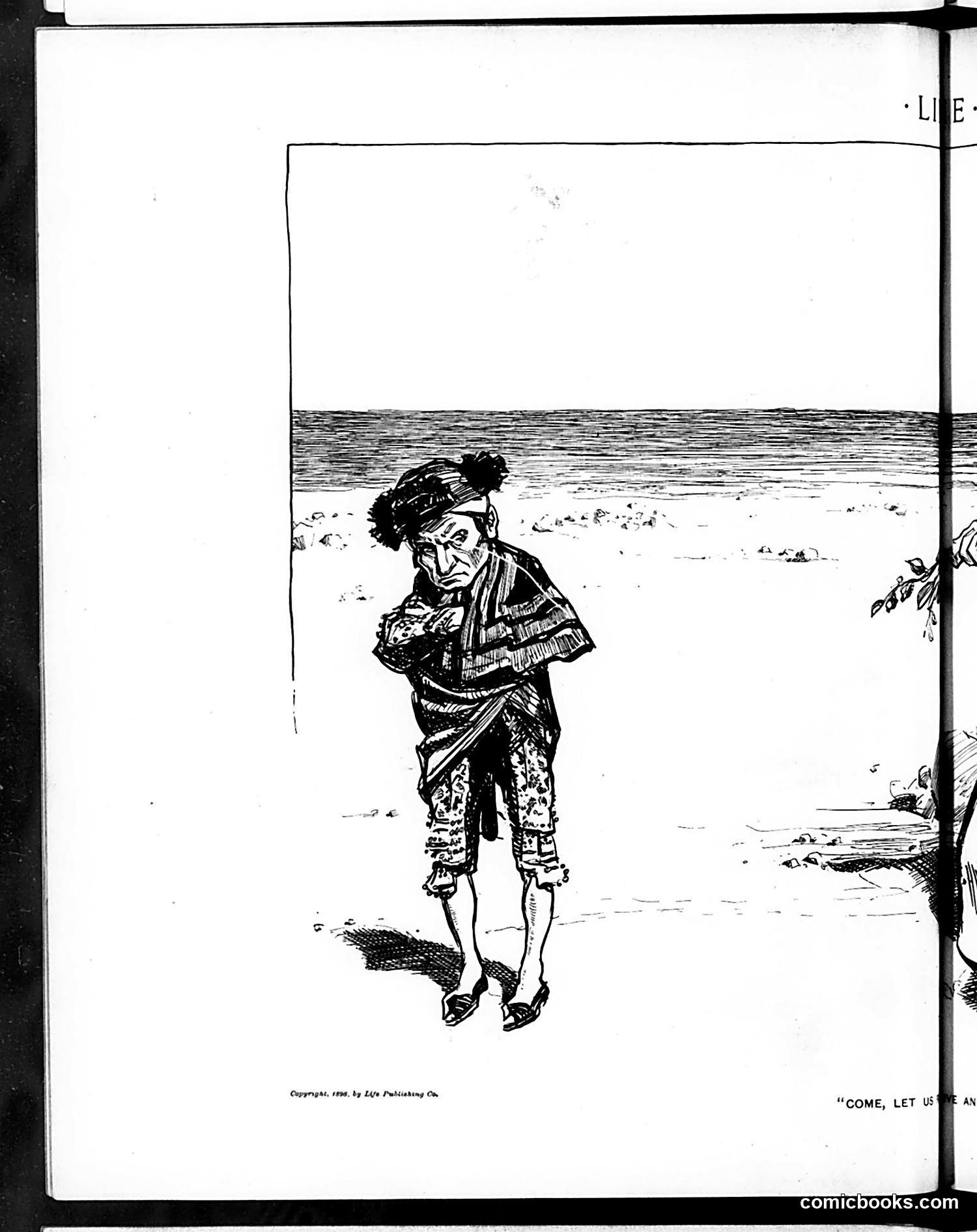
This is a satirical illustration from *Life* magazine (copyright 1904, per the visible text). It depicts a thin, gaunt figure in tattered, patterned clothing standing on a beach, looking distressed or anxious. The figure's exaggerated facial features and ragged appearance suggest caricature. The visible caption fragment reads "COME, LET US AN..." (text cuts off), suggesting this is part of a larger satirical commentary. Without the complete caption or surrounding text, the specific political or social target remains unclear. The beach setting and beggar-like appearance suggest commentary on poverty, displacement, or possibly immigration—common *Life* magazine satirical subjects of the early 1900s. The figure's distinct costume pattern may reference a particular ethnicity or nationality, typical of the era's stereotypical cartooning. The full context needed for precise interpretation is not fully visible on this page.
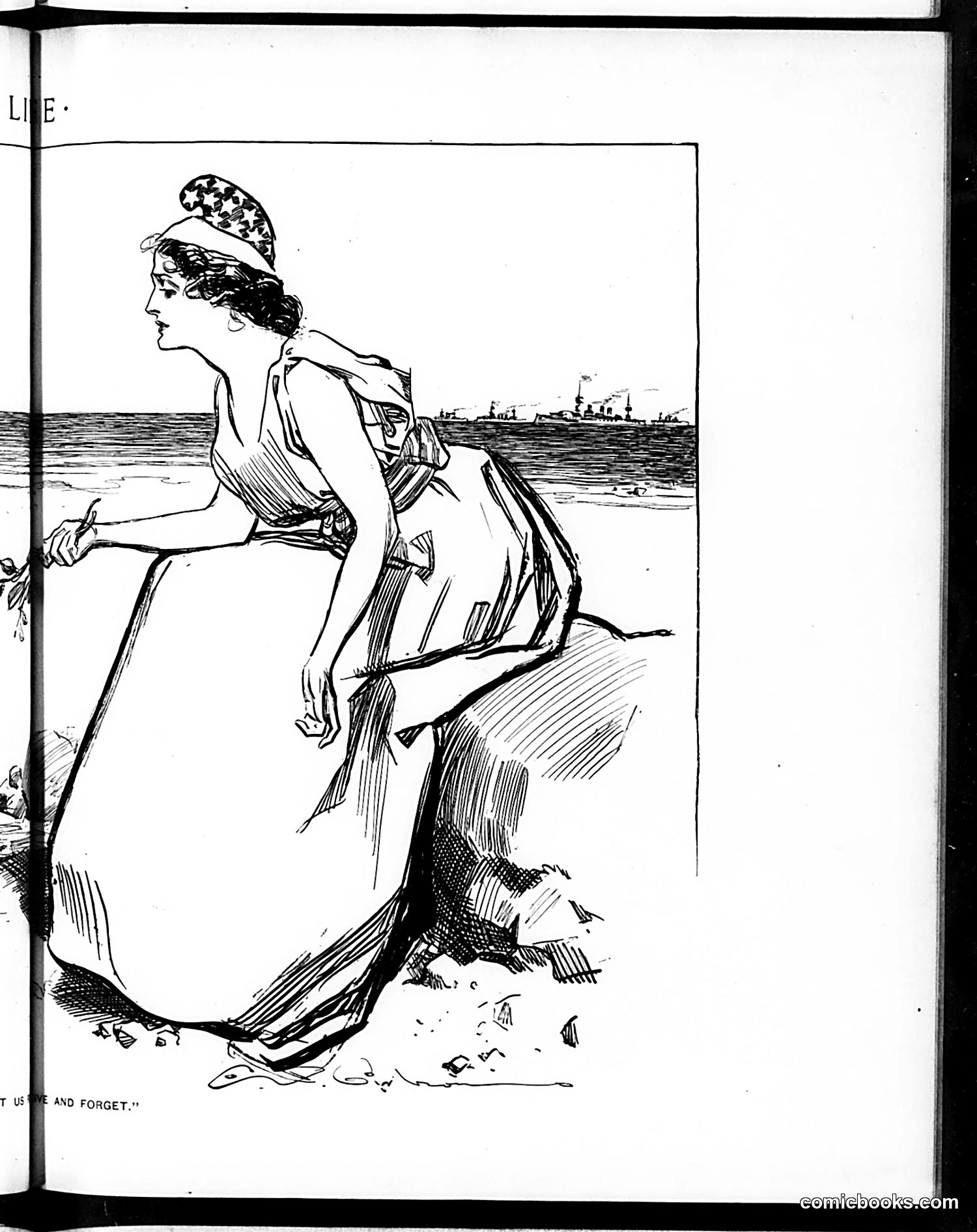
This appears to be a vintage *Life* magazine illustration showing a fashionable woman in a flowing dress and decorative headpiece, seated by the seaside with ships visible on the horizon. The partial text visible at bottom reads "...T US AND FORGET," suggesting the complete phrase is likely "...trust us and forget" or similar. The image satirizes leisure and escapism, possibly during wartime (given the military vessels depicted). The elegantly dressed woman gazing seaward appears to represent idealized femininity or societal distraction from serious concerns. The contrast between her fashionable composure and the industrial warships in the background suggests commentary on how civilians—particularly women—were encouraged to maintain normalcy or pursue superficial pleasures despite larger historical events occurring. Without the complete caption, the specific satirical point remains unclear.
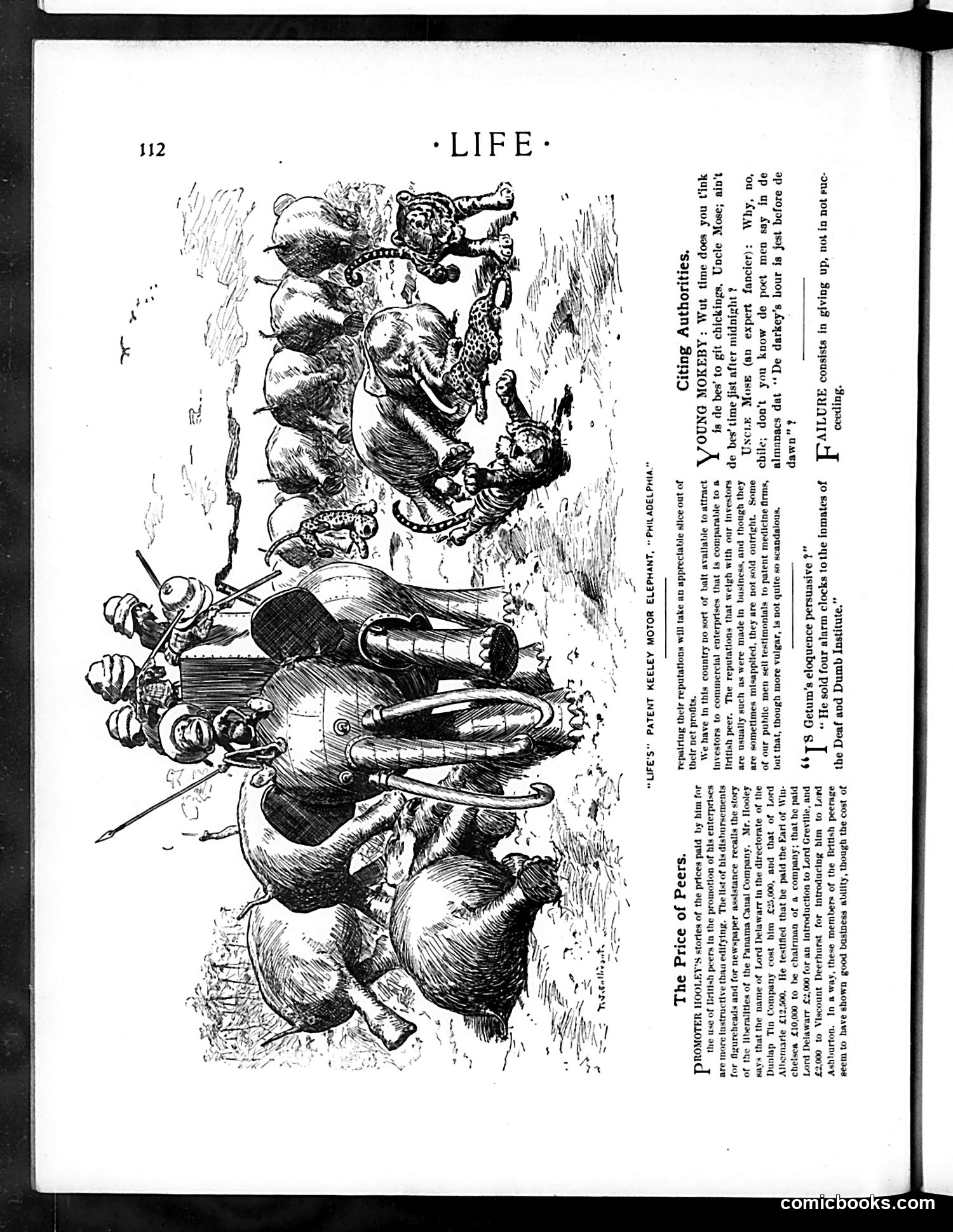
This satirical illustration depicts wealthy individuals riding atop large, anthropomorphized animals—appearing to be pigs or similar creatures—suggesting a critique of the wealthy indulging in luxury pets or extravagant animal ownership. The accompanying text, titled "Crying Authorities" and credited to "Under Parker Kelsey Victor's Patronage," appears to discuss the cost and impracticality of maintaining expensive pets. The satire seems to mock the upper classes for prioritizing animal luxuries while (based on the visible text fragments mentioning "poor" and "animals") presumably ordinary people struggled economically. This reflects Life magazine's characteristic style of mocking wealthy excess and social inequality through exaggerated visual humor.
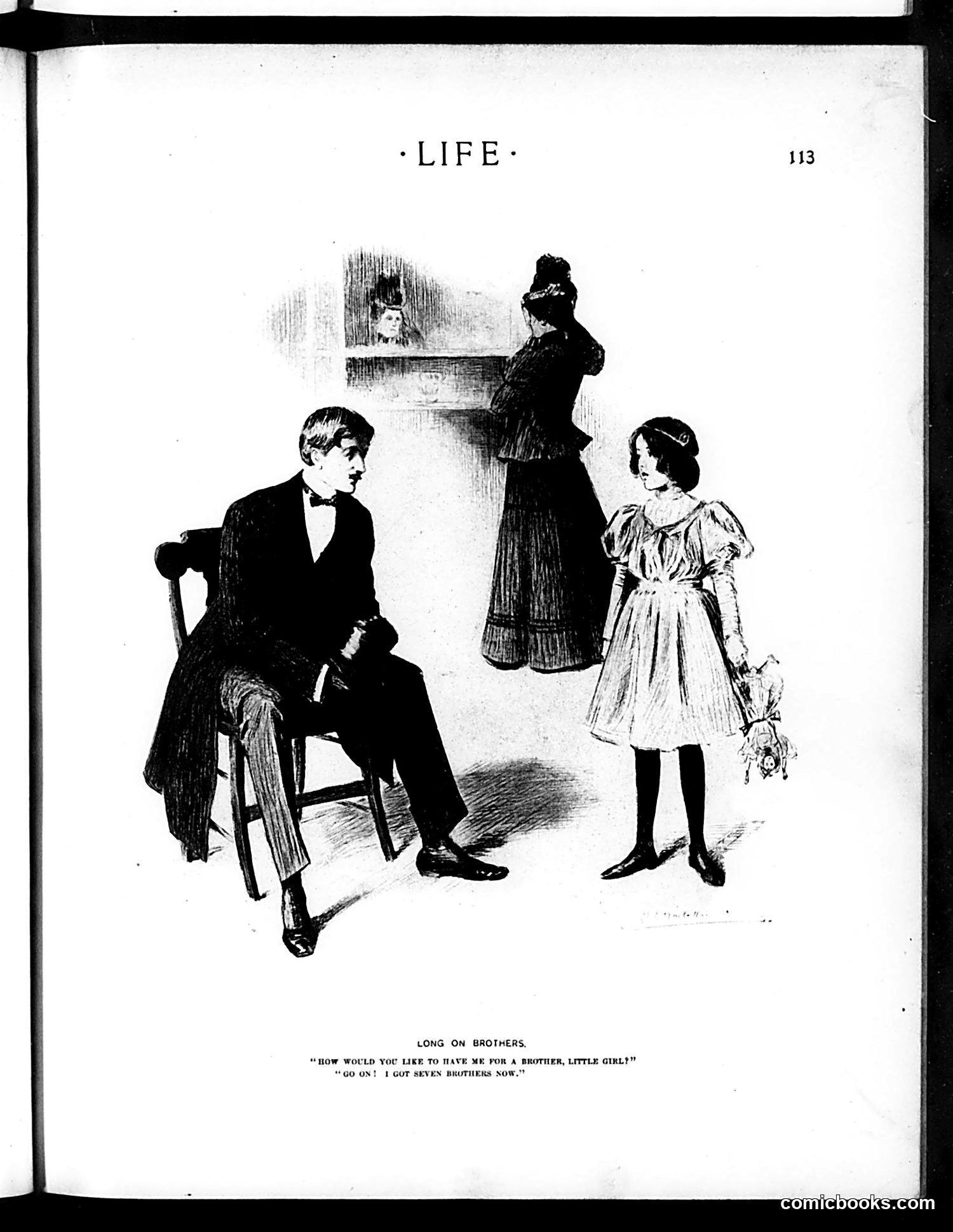
This cartoon satirizes a young boy's awkward social overture to a girl. The boy, seated and formally dressed in a suit, asks if she'd like him as a brother. Her dismissive response—that she already has seven brothers—suggests his attempted familiarity is unwelcome and presumptuous. The humor lies in the social awkwardness: the boy's clumsy attempt at friendly connection is rebuffed by a girl unimpressed by his offer. The phrase "long on brothers" (meaning having many/surplus of something) plays on the girl's abundance of siblings, making the boy's proposal redundant and silly. This appears to be early 20th-century commentary on childhood social dynamics and the failures of forced politeness or inappropriate familiarity between young people.
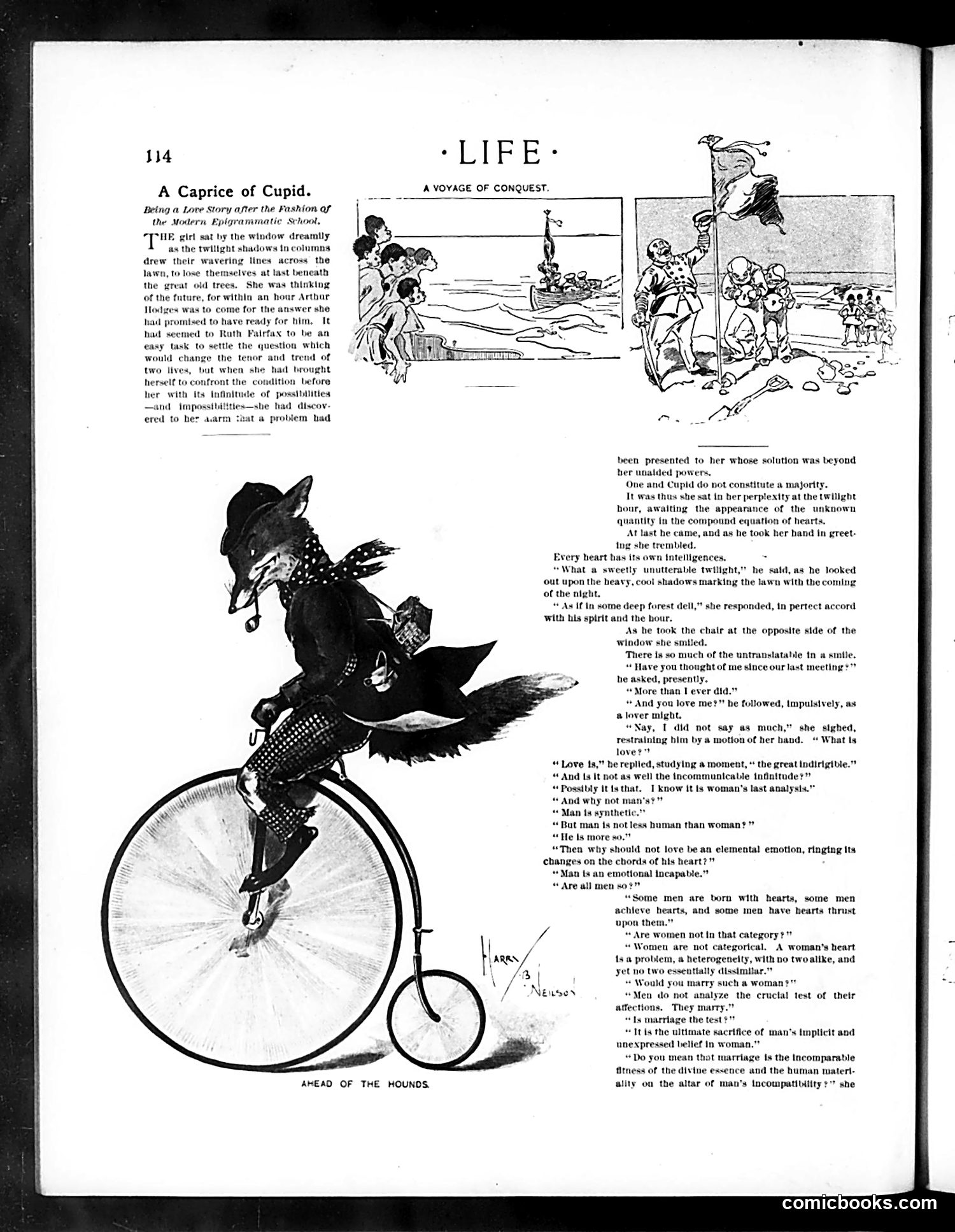
This is a satirical story from *Life* magazine about romantic courtship, presented in the fashionable "epigrammatic" (witty, philosophical) style of the era. The main illustration shows a figure on a penny-farthing bicycle labeled "AHEAD OF THE HOUNDS"—likely depicting Cupid or a lover racing ahead competitively, a visual joke about modern romance as a kind of chase or conquest. The text is mockery of overly intellectual Victorian/Edwardian courtship dialogue. Two characters, Ruth Fairfax and Arthur Hodges, engage in absurdly pretentious philosophical debate about love, emotion, and marriage—trading paradoxes about whether men are "synthetic," whether women's hearts are "categorical," and whether marriage is "the ultimate sacrifice of man's implicit belief in woman." The satire targets the pretentiousness of educated people who intellectualize romance into meaninglessness, turning a simple marriage proposal into incomprehensible jargon. It's mocking both affected speech and gender-war rhetoric of the period.
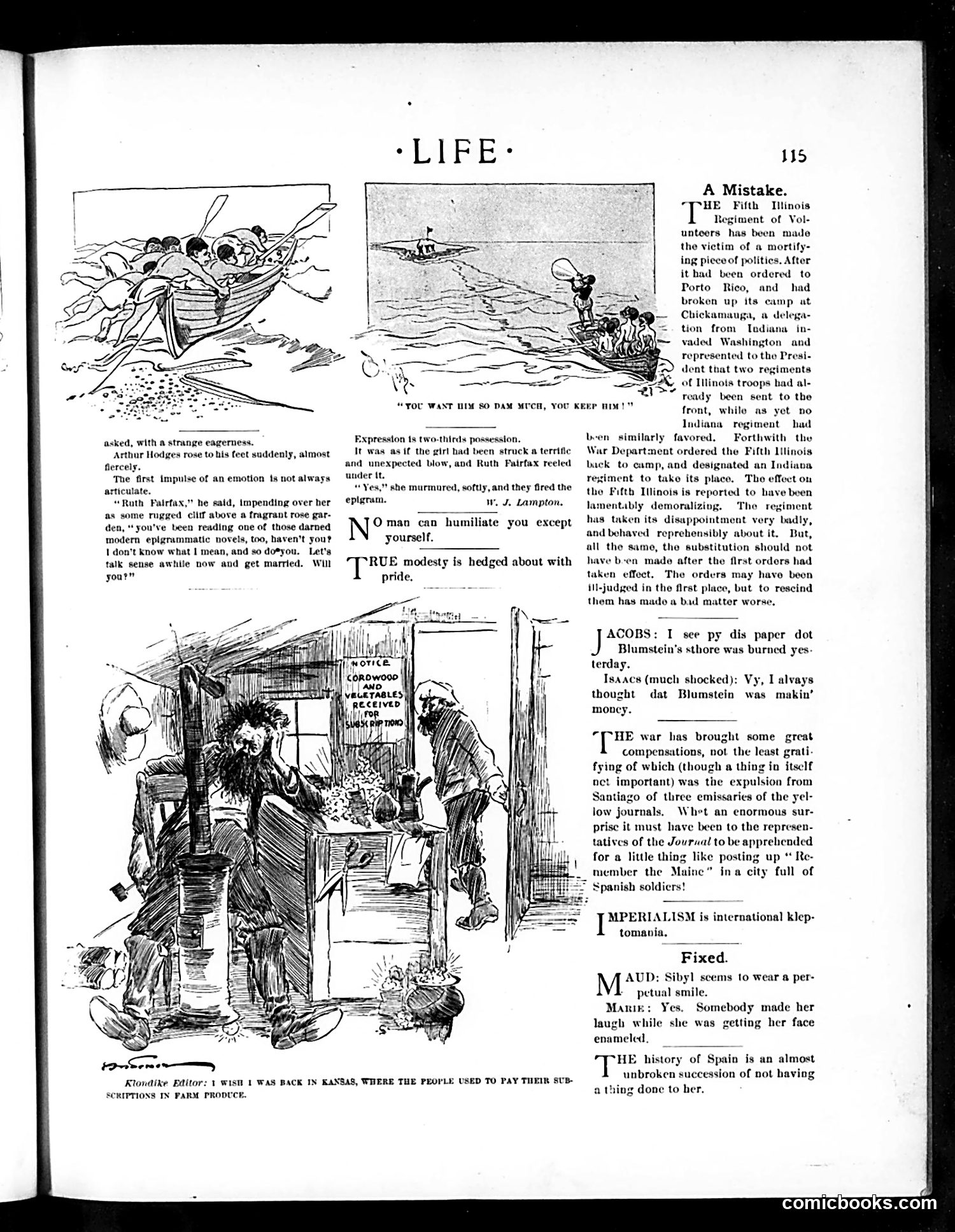
This page contains multiple satirical pieces typical of Life's turn-of-the-century format: **Main Cartoons:** The top two illustrations appear to be scenes from a romantic narrative about characters Arthur Hodges and Ruth Fairfax, accompanying serialized fiction about marriage proposals and modern courtship. **Political Content:** The "Mistake" article criticizes War Department decision-making regarding the Fifth Illinois Regiment. Indiana political pressure caused troops already ordered to Porto Rico to be reassigned, with an Indiana regiment sent instead. Life satirizes this as both poor military judgment and political favoritism that demoralized the Illinois soldiers. **Broader Satire:** Other brief pieces mock: - Yellow journalism (celebrating Spanish expulsion of war correspondents) - Imperialism as "international kleptomania" (theft) - Spain's historical passivity - Jewish immigrant stereotypes in the "Jacobs/Isaacs" dialogue **Lower Cartoon:** Shows a Kansas newspaper editor lamenting subscriptions paid in farm produce rather than cash—satirizing rural economic conditions. The page reflects Life's mix of romantic fiction, political commentary, and ethnic humor characteristic of 1898-1900s American magazines.
This page from Life magazine (a satirical publication) contains primarily **short humorous anecdotes and jokes** rather than political cartoons. Key content includes: **Main humor pieces:** - Jokes about a Spanish motto ("mañana"/tomorrow) - A father-daughter joke defining "coquette" as a woman who "syndicates her affections" - Edison's tall tale about a miraculous mineral spring whose waters were so powerful a man's liver had to be killed with a club - A theological student's thesis connecting baseball to Biblical figures (Eve stealing first base, Moses making a home run, etc.) - An Irish beggar's complaint that soup distributed during famine was merely "a quart of water boiled down to a pint" **The satire targets:** American optimism, scientific pretension, religious earnestness, and social hypocrisy regarding poverty relief. The page also includes advertisements for whiskey, a dog show, and hotels—typical of Life's era. The humor relies on wordplay and absurdist exaggeration rather than political commentary.
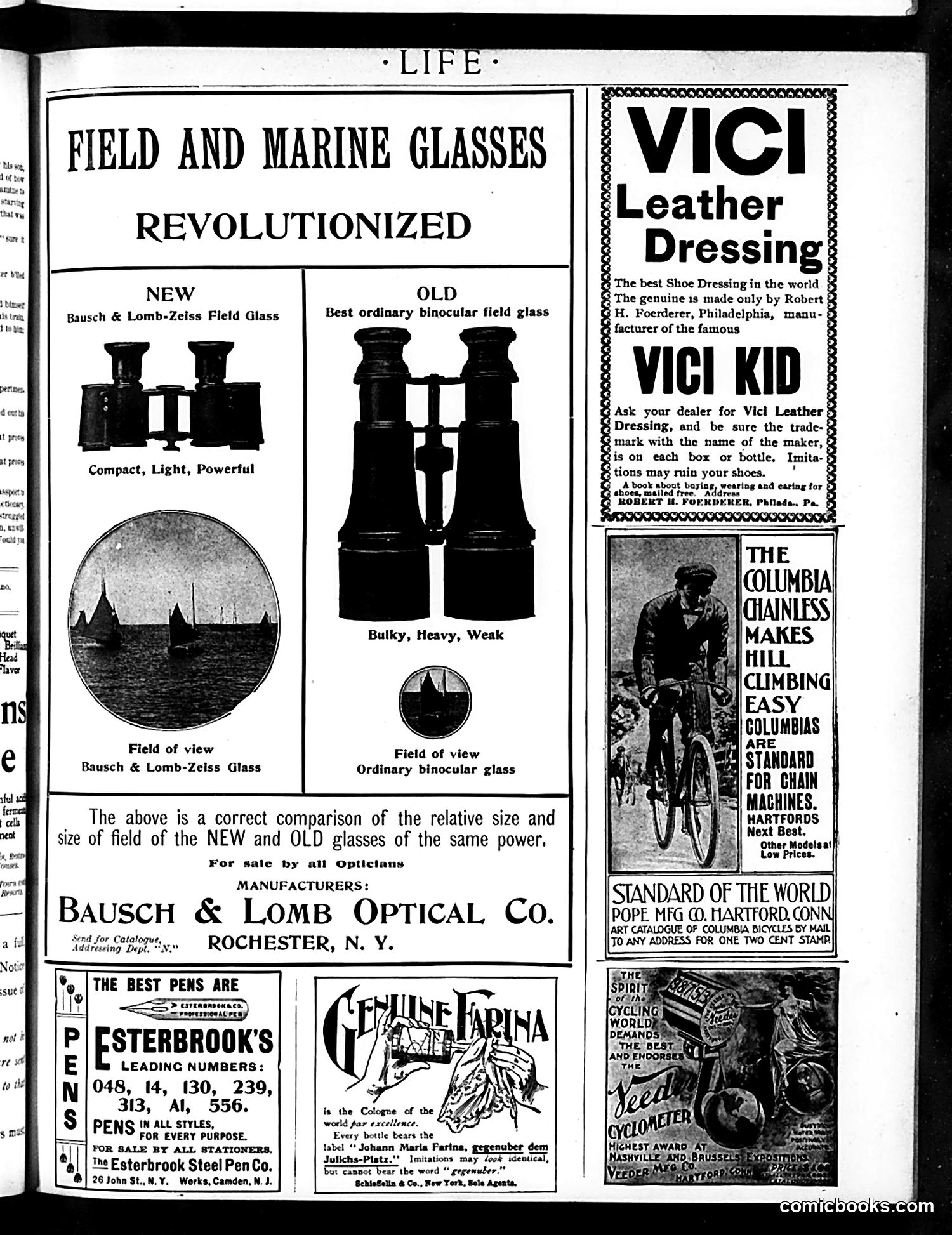
This is primarily a **product advertisement page**, not a satirical cartoon page. It contains four unrelated commercial advertisements typical of early 20th-century magazines: 1. **Bausch & Lomb Optical Co.**: Compares their new "revolutionized" compact field glasses against older, bulkier binoculars, claiming superior technology and wider field of view. 2. **Esterbrook Steel Pens**: Lists popular pen models for sale through stationers. 3. **Genuine Farina Cologne**: Advertises German cologne, warning consumers to check for the word "gegenuber" on labels to avoid counterfeits. 4. **Vici Leather Dressing & Columbia Bicycles**: Product endorsements for shoe care and bicycles. The page reflects **consumer culture and brand competition** of the era, emphasizing technological improvement, authenticity verification, and standardization. There is no political satire or social commentary present—it's straightforward commercial marketing.
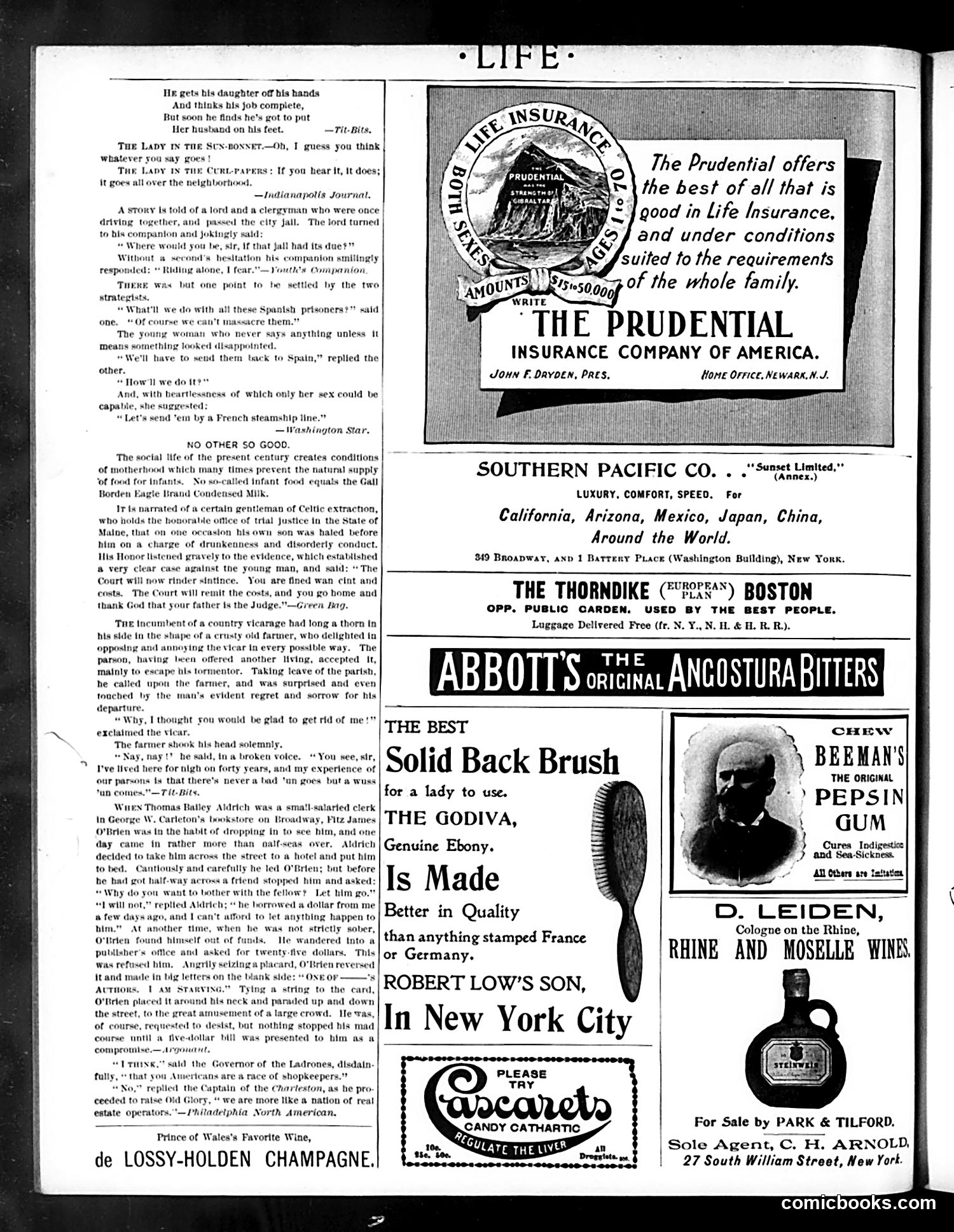
This page is primarily **advertising with interspersed brief jokes and anecdotes** rather than political cartoons. The text contains period humor typical of early 20th-century magazines: jokes about marriage, class, and authority figures. Notable examples include quips about a man supporting his son-in-law, a judge sentencing his own drunk son lightly because "your father is the Judge," and a clergyman being relieved to escape a troublesome parishioner. One anecdote describes Thomas Bailey Aldrich (a real American writer) as a poor clerk who helped a drunken acquaintance; the man later thanked him, saying "there's never a bad turn goes but a wuss one comes"—a cynical reflection on life's misfortunes. A final joke mocks Americans as "shopkeepers," with a rebuttal that they're actually "real estate operators." The advertisements include **The Prudential Insurance Company, Southern Pacific railways, Abbott's bitters, Beeman's pepsin gum, and champagne**—representing typical consumer goods marketed to educated, affluent readers of this era.
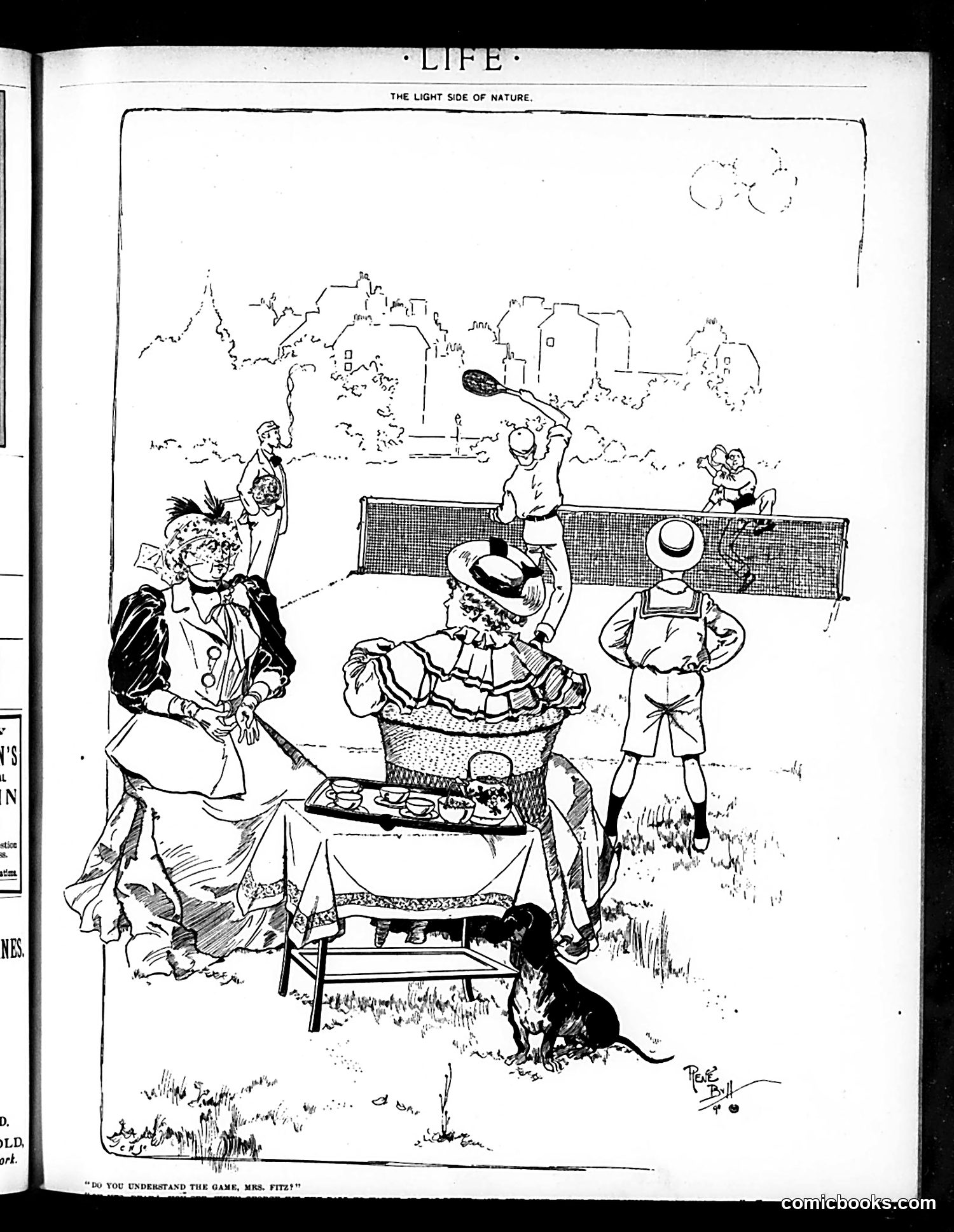
This cartoon depicts a picnic scene where a woman (Mrs. Fitz) watches a badminton game in progress. The humor appears to center on whether she understands the sport's rules. The well-dressed figures playing suggest an upper-class leisure activity, while Mrs. Fitz—shown in elaborate dress with a large hat—observes from the sidelines. The joke likely plays on gender stereotypes common to early 20th-century Life magazine: the implication that women might not understand athletic games or sports. The "light side of nature" headline suggests the cartoon presents humor in outdoor leisure activities and social interactions. The dog in the foreground adds comic absurdity to the genteel scene. The specific reference to "Mrs. Fitz" remains unclear without additional context.
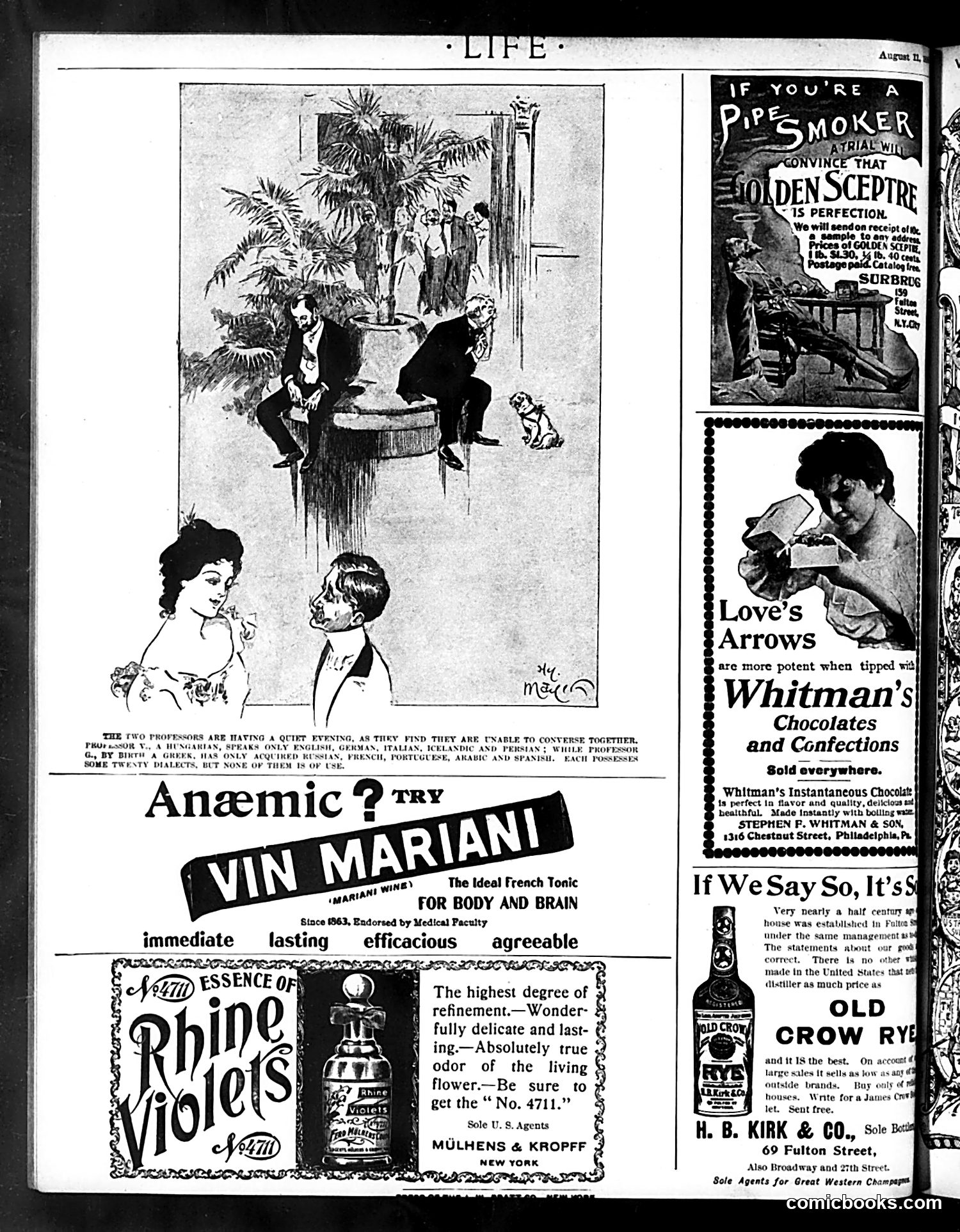
This page combines a satirical cartoon with period advertisements (circa early 1900s). **The Cartoon:** Shows two men seated at a small table near a potted plant, unable to converse, while two women stand in a doorway behind them. The caption explains the men are professors who speak only obscure languages—one knows "French, Icelandic and Persian" while the other speaks "Dutch, Greek, Arabic and Spanish"—making conversation impossible despite each knowing twenty dialects total. The joke satirizes academic pedantry: excessive specialized knowledge that paradoxically prevents basic human communication. The women's bemused observation emphasizes the absurdity. **The Advertisements** promote patent medicines and luxury goods typical of the era: Vin Mariani (a French tonic), Rhine Violets essence, Whitman's Chocolates, and Old Crow Rye whiskey. These represent consumer products marketed with health claims now considered dubious. The page reflects early 20th-century attitudes toward intellectual pretension and emerging consumer culture.