
Life, 1898-08-11 · page 4 of 20
Life — August 11, 1898 — page 4: what you’re looking at
What you’re looking at
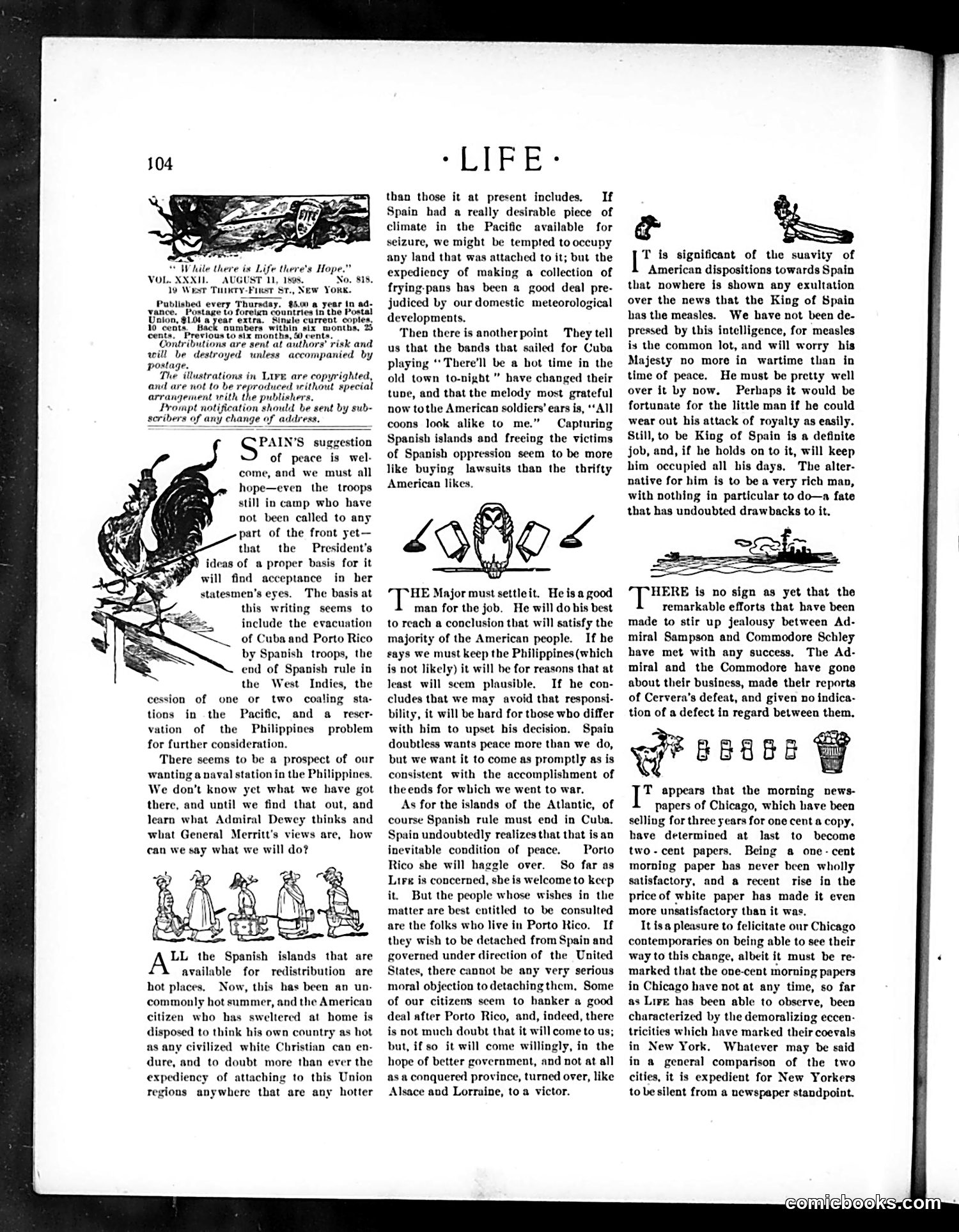
This *Life* magazine page (page 104) contains editorial commentary on Spanish-American War peace negotiations, circa 1898. The text discusses whether Spain should cede Cuba, Puerto Rico, and the Philippines as part of peace settlements. The cartoons appear to be satirical illustrations supporting American expansionist positions. One illustration depicts what seems to be a rooster or fighting bird (possibly representing Spain), suggesting Spanish weakness or defeat. Another shows figures in period dress, likely representing political or military figures debating territorial concessions. The editorial argues the U.S. should secure Philippines control and Puerto Rico cession, while consulting with Spanish island residents about independence. The satire mocks Spanish reluctance to accept inevitable defeat and questions whether America should negotiate or simply demand territorial gains.
📄 Transcribed text from this page (OCR, searchable)
Machine-transcribed from the original scan — historical spelling and the odd misread are preserved.
While there is L VOL. XXXII. AUC 19 West Tun Publisbed every Thu: $5.00 a year in ad- ance. Postage to forein countries in the Postal Union, st04 (Was extra. Sinule current coples. 10 cents umbers within six giontht, 2 cents, Previous to six months, @ cet Contributions are sent af authors’ risk and will be destroyed unless accompanied by ge. illustrations in Lure. are copyrighted, and are not to be reproduced without special arrangement rrith the publishers. Prompt notification should be sent by sub- seribers of any change of « PAIN’S suggestion of peace is wel- come, and we must all hope—even the troops still in camp who have not been called to any part of the front yet— that the President's will find acceptance in her statesmen’s eyes. The basis at this writing seems to include the evacuation of Cuba and Porto Rico by Spanish troops, the end of Spanish rule in the West Indies, the one or two coaling sta- tions in the Pacific, and a reser- vation of the Philippines problem for further consideration. There seems to be a prospect of our wanting a naval station in the Philippines, We don’t know yet what we have got there, and until we find that out, and learn what Admiral Dew what General Merritt's views are, how can we say what we will do? cession of A™ the Spanish islands that are available for redistribution are hot places, Now, this has been an un- commonly hot summer, and the American citizen who has sweltered at home is disposed to think his own country as hot as any civilized white Christian cao en- dure, and to doubt more than ever the expediency of attaching to this Union regions anywhere that are any hotter LIPE than those it at present includes, If Spain had a really desirable piece of climate in the Pacific available for seizure, we might be tempted to occupy any land that was attached to it; but the expediency of making a collection of frying-pans has been a good deal pre- judiced by our domestic meteorological developments. ‘Then there is anotherpoint They tell us that the bands that sailed for Cuba playing ‘* There'll be a hot time in the old town to-night ” have changed their tune, and that the melody most grateful now tothe American soldiers’ ears is, ‘All coons look alike to me.” Capturing Spanish islands and freeing the victims of Spanish oppression seem to be more like buying lawsuits than the thrifty American likes. LOUID & T= Major must settleit. He isa good man for the job. He will do his best to reach a conclusion that will satisfy the majority of the American people. If he says we must keep the Philippines(which is not likely) it will be for reasons that at least will scem plausible. If he con- cludes that we may avoid that responsi- bility, it will be hard for those who differ with him to upset his decision. Spain doubtless wants peace more than we do, but we want it to come as promptly as is consistent with the accomplishment of theends for which we went to war. As for the islands of the Atlantic, of course Spanish rule must end in Cuba. Spain undoubtedly realizes that that is an inevitable condition of peace. Porto Rico she will haggle over. So far as Lire is concerned, she is welcome to keep it. But the people whose wishes in the matter are best entitled to be consulted are the folks who live in Porto Rico. If they wish to be detached from Spain and governed under direction of the United States, there cannot be any very serious moral objection to detaching them, Some of our citizens scem to hanker a good deal after Porto Rico, and, indeed, there is not much doubt that it will come to us; but, ifso it will come willingly, in the hope of better government, and not at all as a conquered province, turned over, like Alsace aud Lorraine, to a victor. & [7 is significant of the suavity of American dispositions towards Spain that nowhere is shown any exultation over the news that the King of Spain has the measles. We have not been de- pressed by this intelligence, for measles is the common lot, and will worry his Majesty no more in wartime than in time of peace. He must be pretty well over it by now. Perhaps it would be fortunate for the little man if he could wear out his attack of royalty as easily. Still, to be King of Spain is a definite job, and, if he holds on to it, will keep him occupied all his days, The alter- native for him is to be a very rich man, with nothing in particular to do—n fate that has undoubted drawbacks to it. HERE is no sign as yet that the remarkable efforts that have been made to stir up jealousy between Ad- miral Sampson and Commodore Schley have met with any success, The Ad- miral and the Commodore have gone about their business, made their reports of Cervera’s defeat, and given no indica- tion of a defect in regard between them, FS @ [’ appears that the morning news- papers of Chicago, which have been selling for three years for one cent a copy, have determined at last to become two-cent papers. Being a one-cent morning paper has never been wholly satisfactory, and a recent rise in the price of white paper has made it even more unsatisfactory than it was, It isa pleasure to felicitate our Chicago contemporaries on being able to see their way to this change, albeit it must be re- marked that the one-cent morning papers in Chicago have not at any time, so far as Lire has been able to observe, been characterized by the demoralizing eccen- tricities which have marked their coevals in New York. Whatever may be said in a general comparison of the two cities, it is expedient for New Yorkers to be silent from a newspaper standpoint.