
A complete issue · 20 pages · 1898
Life — August 4, 1898
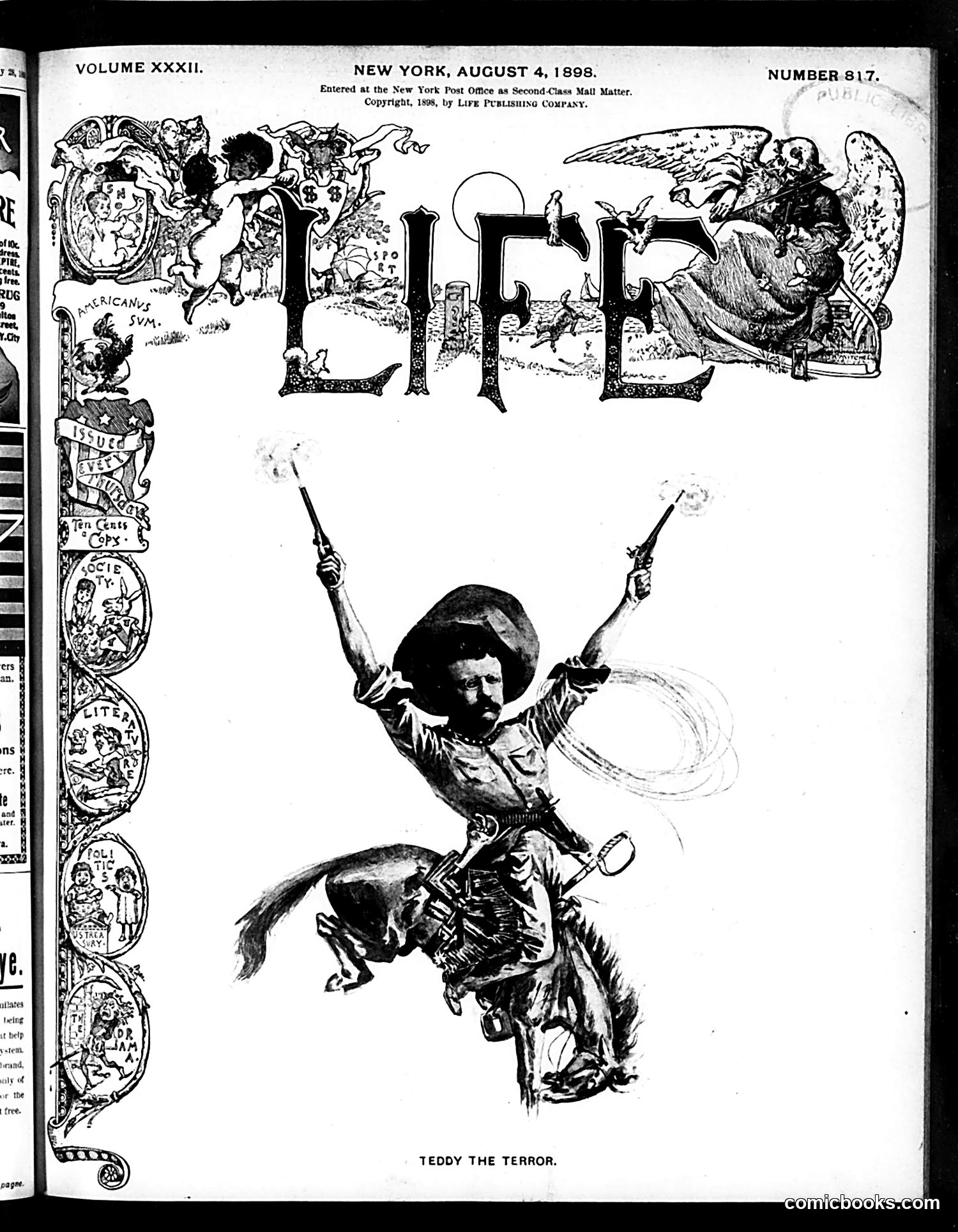
This cover depicts a cowboy figure wielding pistols and a lasso, labeled "Teddy the Terror." The reference is to Theodore Roosevelt, who gained fame as a Rough Rider during the Spanish-American War (1898). The cartoon satirizes Roosevelt's aggressive, combative public persona and his reputation for bold action. The "terror" imagery suggests the magazine is both mocking and celebrating Roosevelt's fearless reputation—he's portrayed as a wild, untamed force. This cover appears during Roosevelt's rise to national prominence, before he became Vice President (1901) and later President (1901-1909). The decorative border and "LIFE" masthead styling are typical of the era's satirical magazine design.
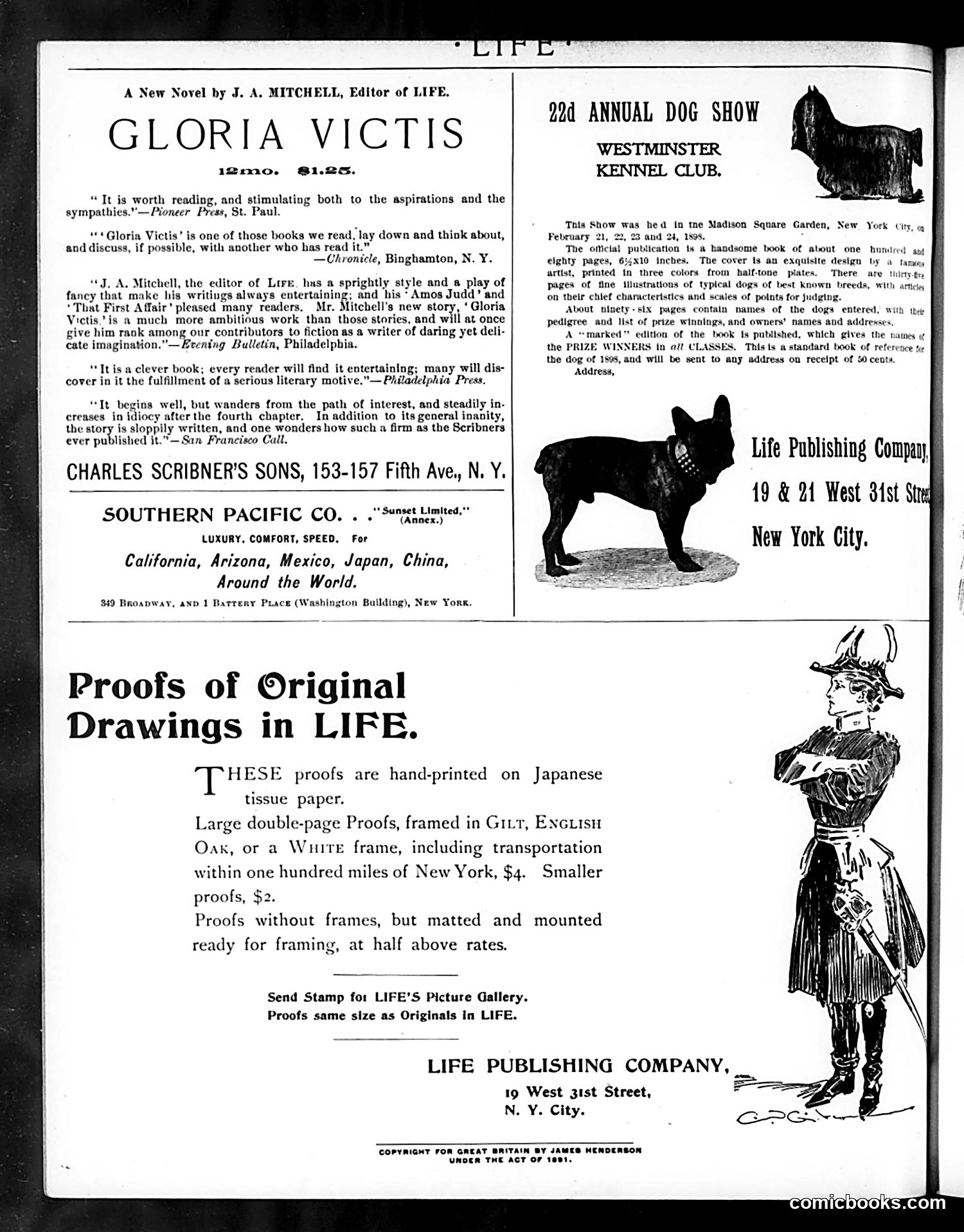
This page is primarily **advertising and promotional content** rather than political satire. It includes: 1. **Book advertisement**: "Gloria Victis," a novel by J.A. Mitchell (Life's editor), with favorable quotes from newspapers praising its style and entertainment value. 2. **Travel advertisement**: Southern Pacific Co. promoting luxury travel to California, Arizona, Mexico, Japan, China, and around the world. 3. **Dog show announcement**: The 22nd Annual Westminster Kennel Club show at Madison Square Garden. 4. **Art service**: Life Publishing Company advertising hand-printed proofs of original drawings on Japanese tissue paper, available framed or unframed. The illustrated figure on the right (woman in period dress) appears to be decorative branding rather than political commentary. This is a commercial page with no apparent satirical content.
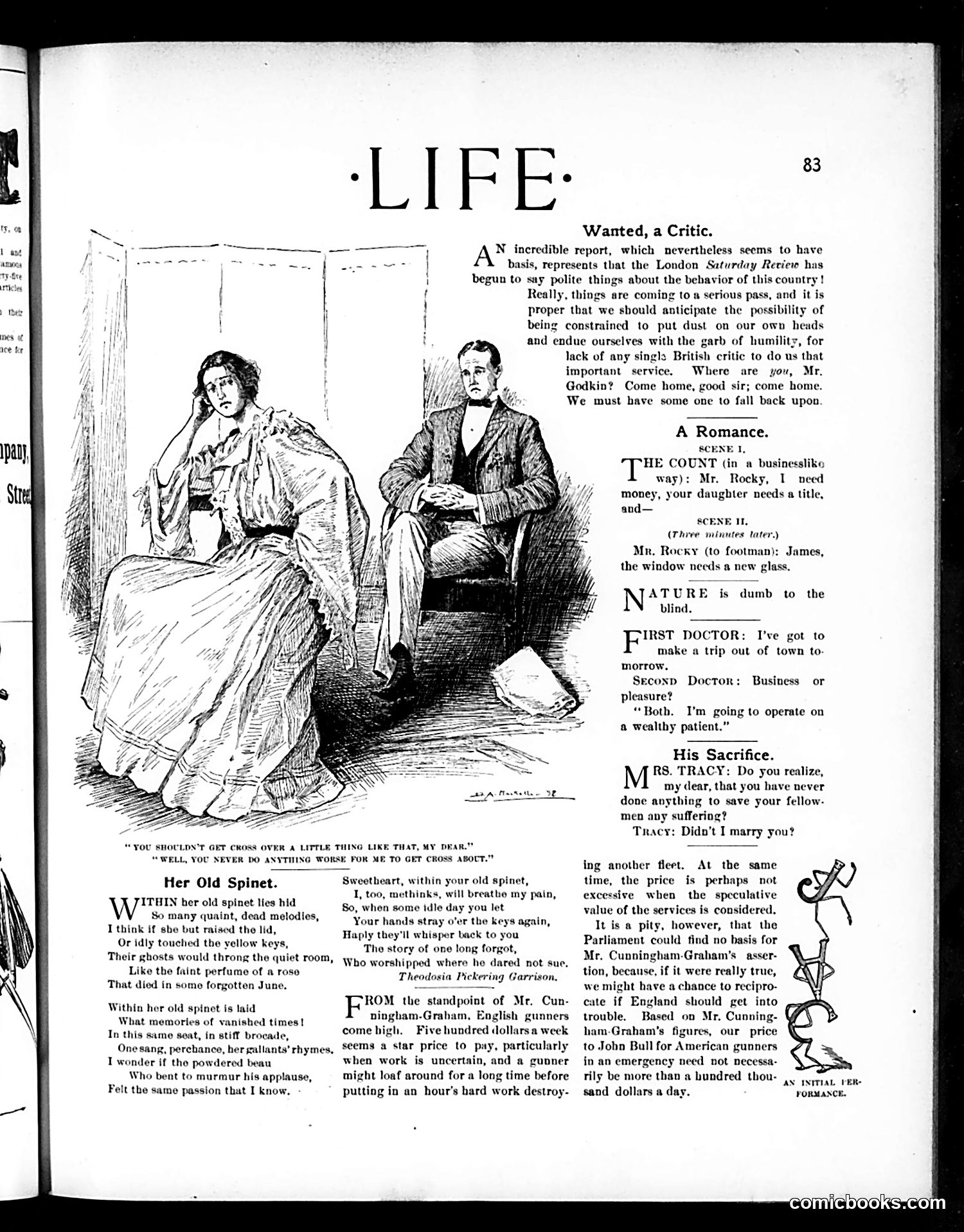
The main cartoon depicts a couple in domestic discord. The caption reads: "YOU SHOULDN'T GET CROSS OVER A LITTLE THING LIKE THAT, MY DEAR." / "WELL, YOU NEEDN'T SHOUT SO ABOUT IT, NEITHER FOR MY CROSS ABOUT." This satirizes common marital arguments over trivial matters, with both partners equally at fault yet defensive. The woman appears distressed while the man sits calmly, highlighting the gendered dynamics of early 20th-century relationship conflicts. The accompanying sketches and text pieces ("A Romance," "His Sacrifice," "Her Old Spinnet") are satirical takes on sentimental Victorian romance narratives, mocking their melodrama and unrealistic portrayals of love and sacrifice. The overall page ridicules both domestic tensions and romanticized notions of relationships prevalent in the era.
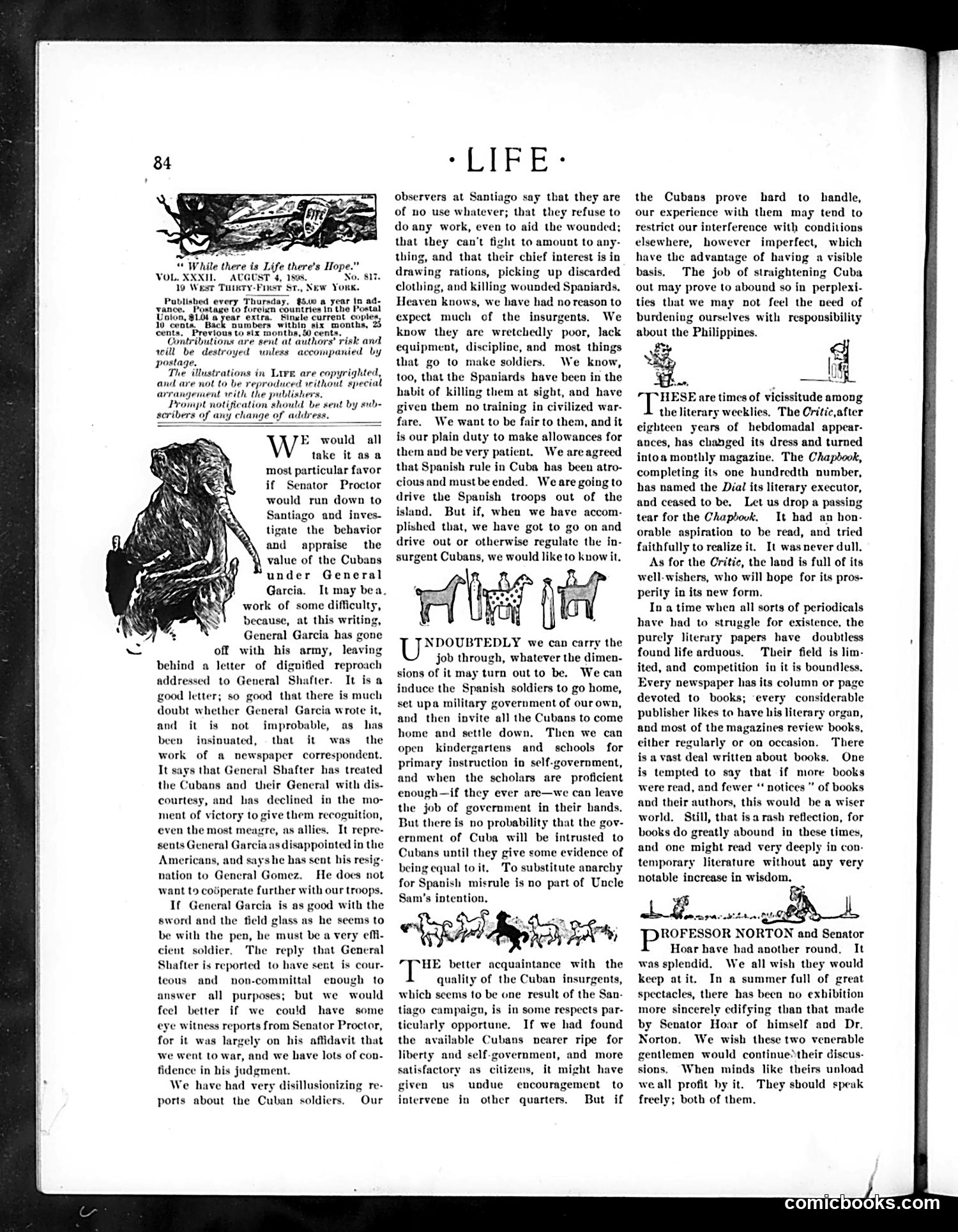
This page discusses the Cuban insurgency during the Spanish-American War era. The main cartoon depicts what appears to be a Cuban insurgent leader (likely General García, referenced in the text), shown in a sympathetic light despite being poorly equipped. The article critiques American policy toward Cuban insurgents, arguing that while they lack discipline and military training, the U.S. should support their independence efforts. It advocates for fair treatment and patience with Cuban forces rather than dismissive attitudes. The text also references contemporary literary magazines—*The Chapbook*, *The Critic*, and *The Dial*—discussing how periodicals are struggling to survive while still reviewing books seriously. The satire mildly chastises American military leadership for underestimating Cuban allies and calls for more respectful engagement with independence movements.
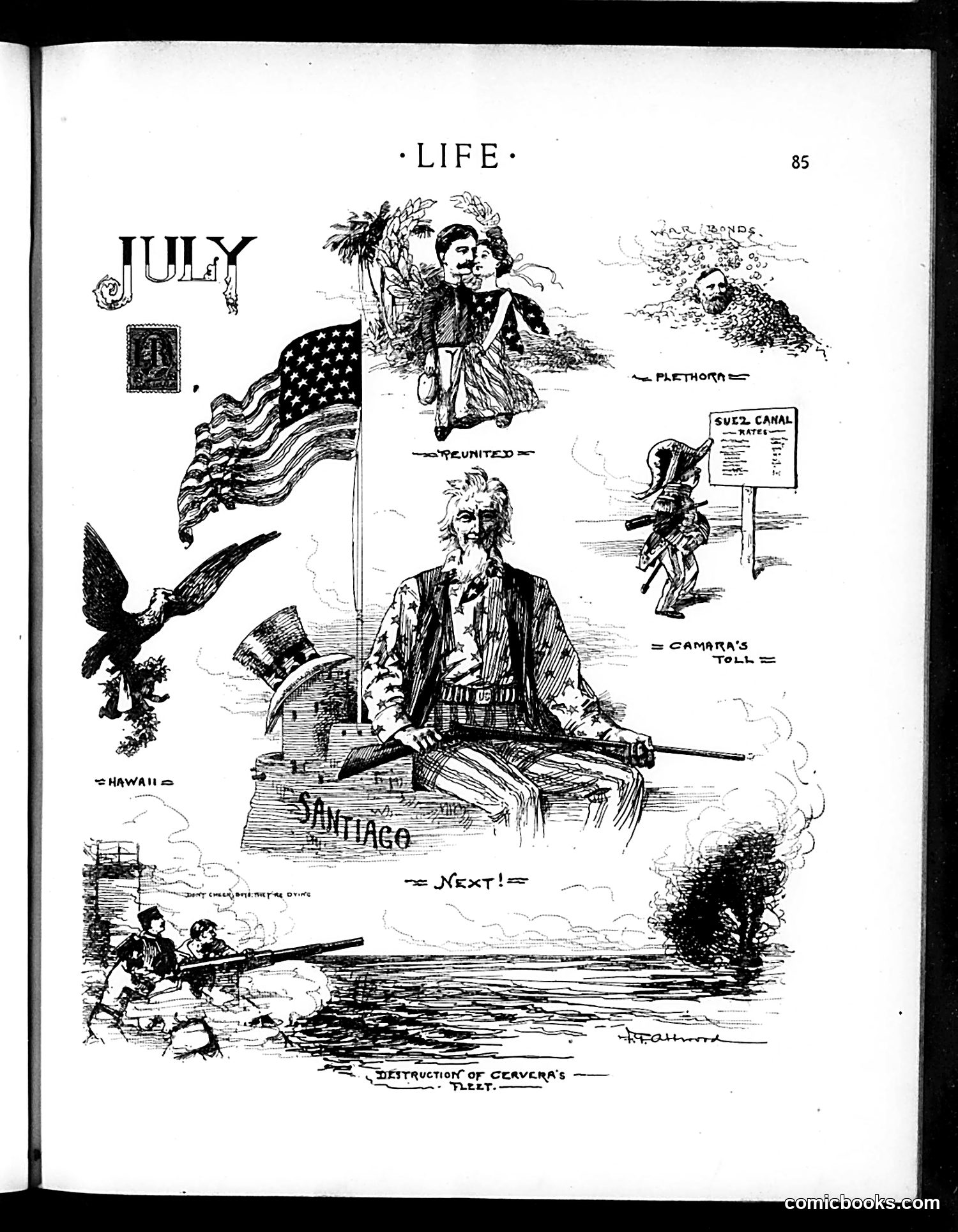
This Life magazine page satirizes American military campaigns during the Spanish-American War (1898). The central figure labeled "Santiago" appears to be Uncle Sam or an American soldier, suggesting American conquest of Santiago de Cuba. Surrounding vignettes reference other theaters: "Hawaii" (U.S. annexation), "Plathorn" (unclear reference), "Suez Canal" (geopolitical interests), and "Destruction of Cervera's Fleet" (a major naval victory). The phrase "Next!" mocks American imperial ambitions—suggesting these conquests are merely stepping stones to further expansion. The eagle and American flag reinforce nationalist themes. The cartoons satirize American imperialism and the rapid territorial acquisitions resulting from the war with Spain. The overall message criticizes the seemingly endless appetite for overseas expansion.
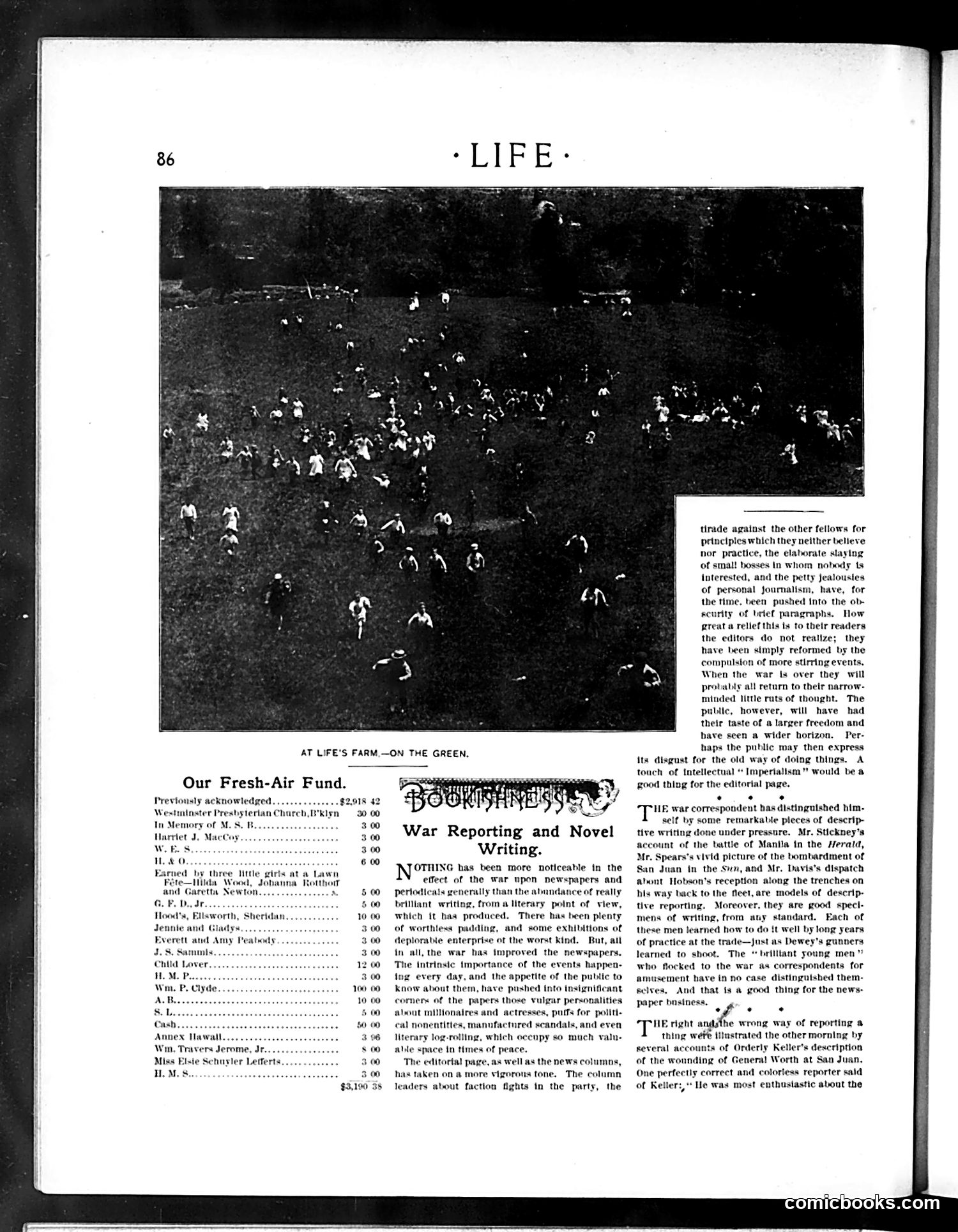
This page features "Our Fresh-Air Fund," a charitable fundraising list for Westminster Presbyterian Church in Brooklyn, showing donations from named contributors with amounts ranging from $3 to $100. Below is an article titled "War Reporting and Novel Writing" that discusses how WWI coverage in newspapers has improved journalistic quality and literary merit compared to pre-war standards. The main image shows people gathered on a green field (labeled "At Life's Farm—On the Green"), likely depicting the Fresh-Air Fund's recreational program providing outdoor respite for urban residents, particularly children. This reflects Progressive Era charitable initiatives common in early 20th-century America. No satirical cartoon appears on this page; it's primarily a charitable fundraising feature combined with editorial commentary on wartime journalism.
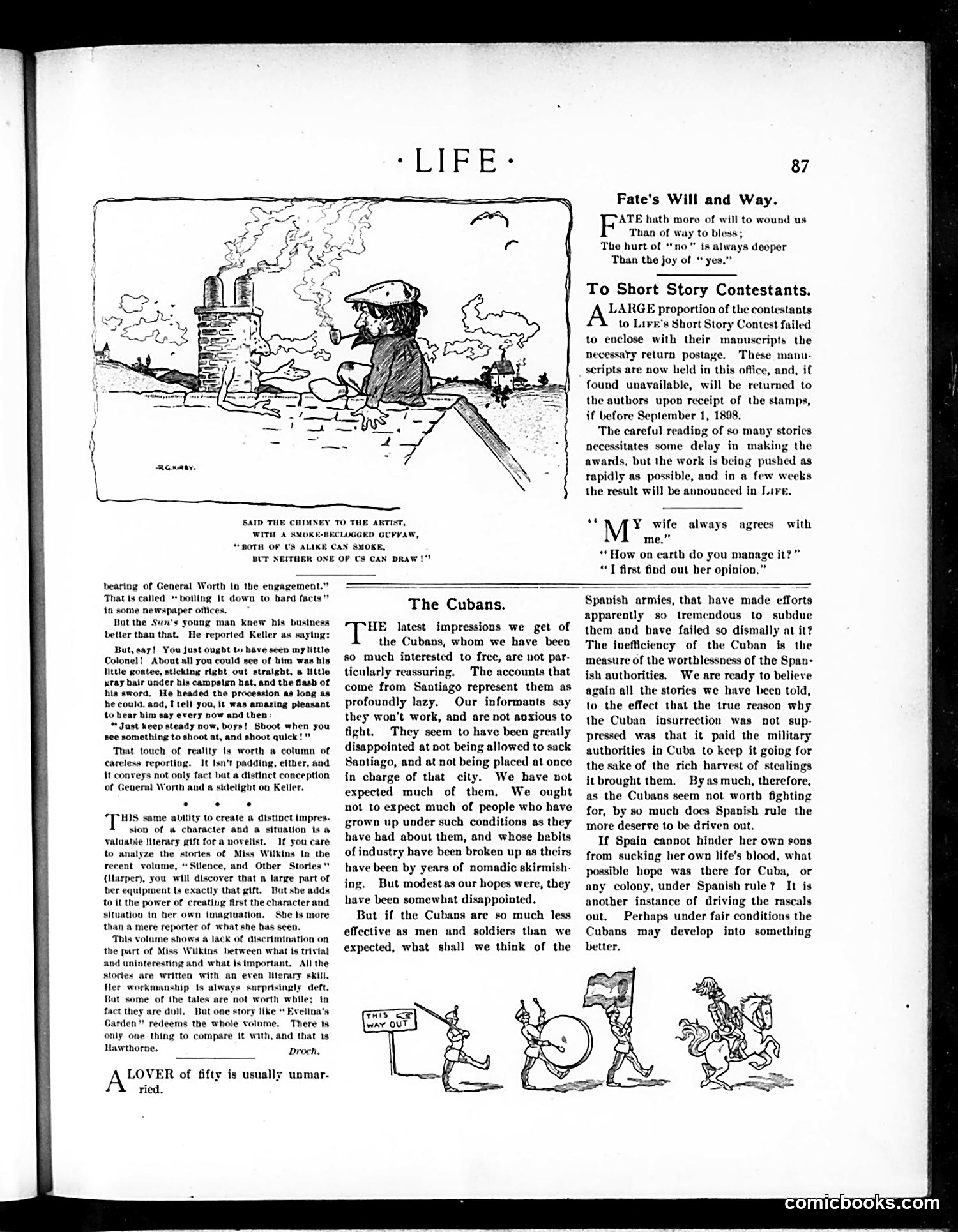
**Top Cartoon:** Shows a figure by a chimney with the caption "Said the Chimney to the Artist: 'With a smoke-beclogged outlook, both of us alike on smoke, but neither one of us can draw!'" This is a visual pun about artistic ability—both the chimney (producing smoke) and the artist struggle with representation, literally and figuratively obscured by smoke. **Main Content:** "The Cubans" discusses Spanish colonial rule in Cuba. The text criticizes Cuban soldiers as ineffective and expresses disappointment in their fighting capability, while questioning Spain's ability to maintain control. The bottom cartoon appears to show figures in motion, possibly depicting Cuban insurgents or soldiers. This reflects the Spanish-American War era tensions over Cuba's independence.
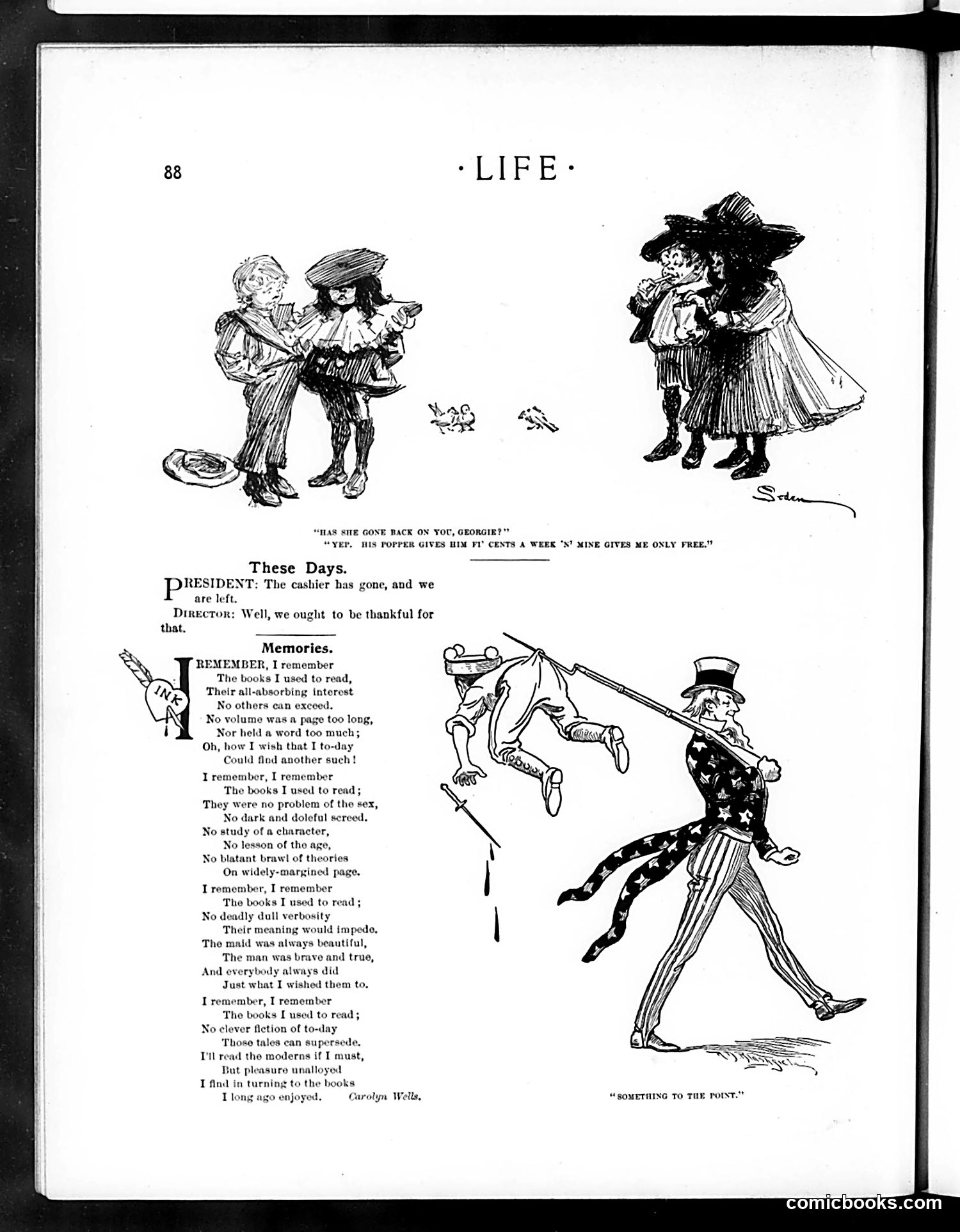
This page contains two satirical pieces: **Top cartoon**: Shows a woman telling a man "Has she gone back on you, Georgie?" He responds that his "popper" (father) gives him only 11 cents weekly for "mine" (unclear reference). The joke appears to mock financial dependence—a young man still receiving pocket money from his father. **"These Days" and "Memories"**: A dialogue between a President and Director lamenting a missing cashier, followed by a nostalgic poem by Carolyn Wells about books from childhood. The poem contrasts idealized past literature with modern "fiction of to-day," suggesting satire of contemporary mass-market reading habits. **Bottom cartoon**: Labeled "Something to the Point," depicts a figure in patriotic dress (Uncle Sam-like) engaged in what appears to be acrobatic activity—likely political commentary, though the specific reference is unclear without additional context.
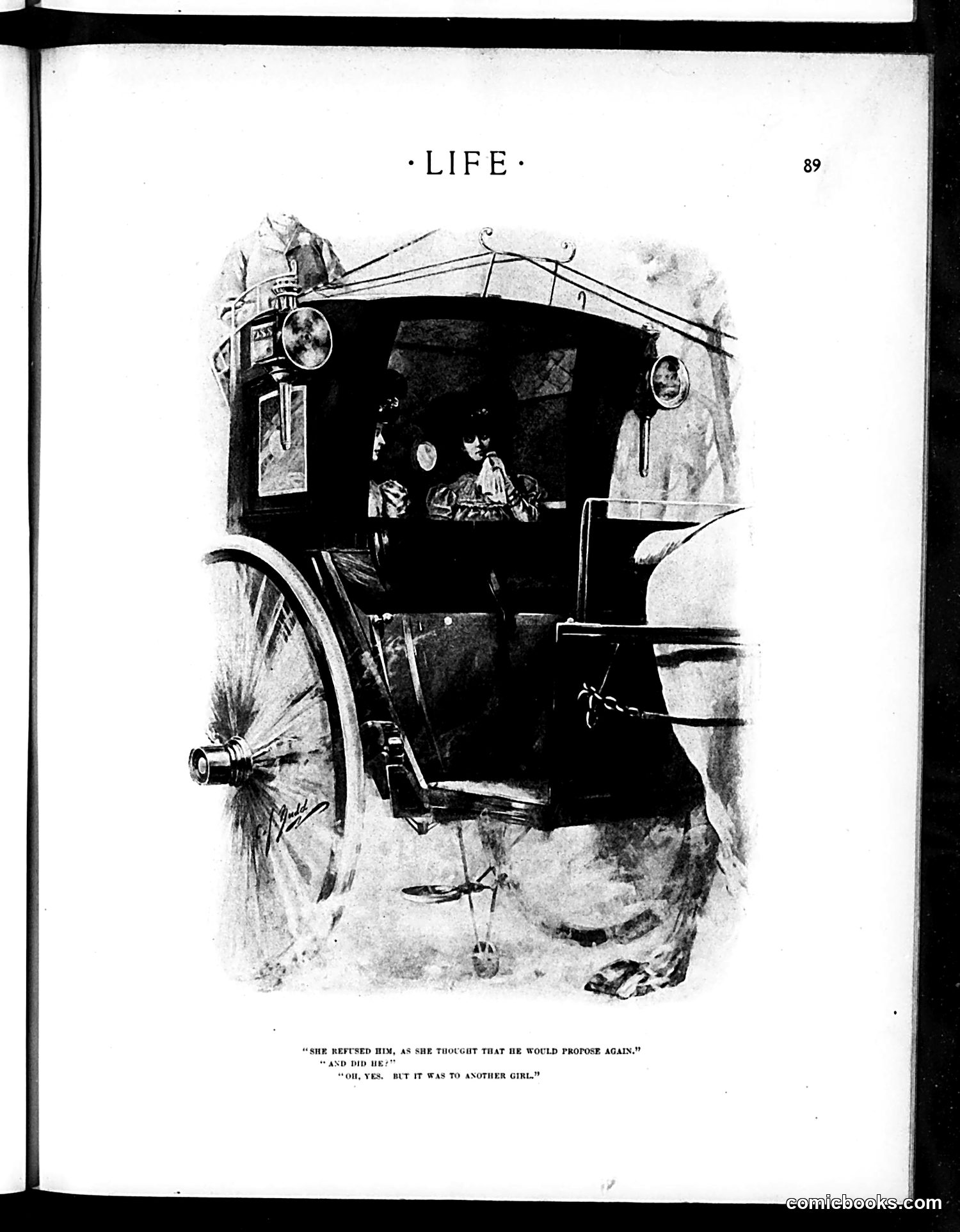
This is a satirical illustration from *Life* magazine (page 89) depicting a scene inside what appears to be an early automobile or carriage. The image shows figures in the darkened interior, with dialogue below reading: "She refused him, as she thought that he would propose again." "And did he?" "Oh, yes, but it was to another girl." The cartoon satirizes romantic persistence and male courtship behavior of the era. The joke centers on a man's response to rejection: rather than accepting the woman's refusal, he simply proposes to someone else instead. This mocks both male stubbornness in pursuing marriage and, implicitly, the transactional nature of courtship during this period, where proposals were common social rituals regardless of genuine romantic connection.
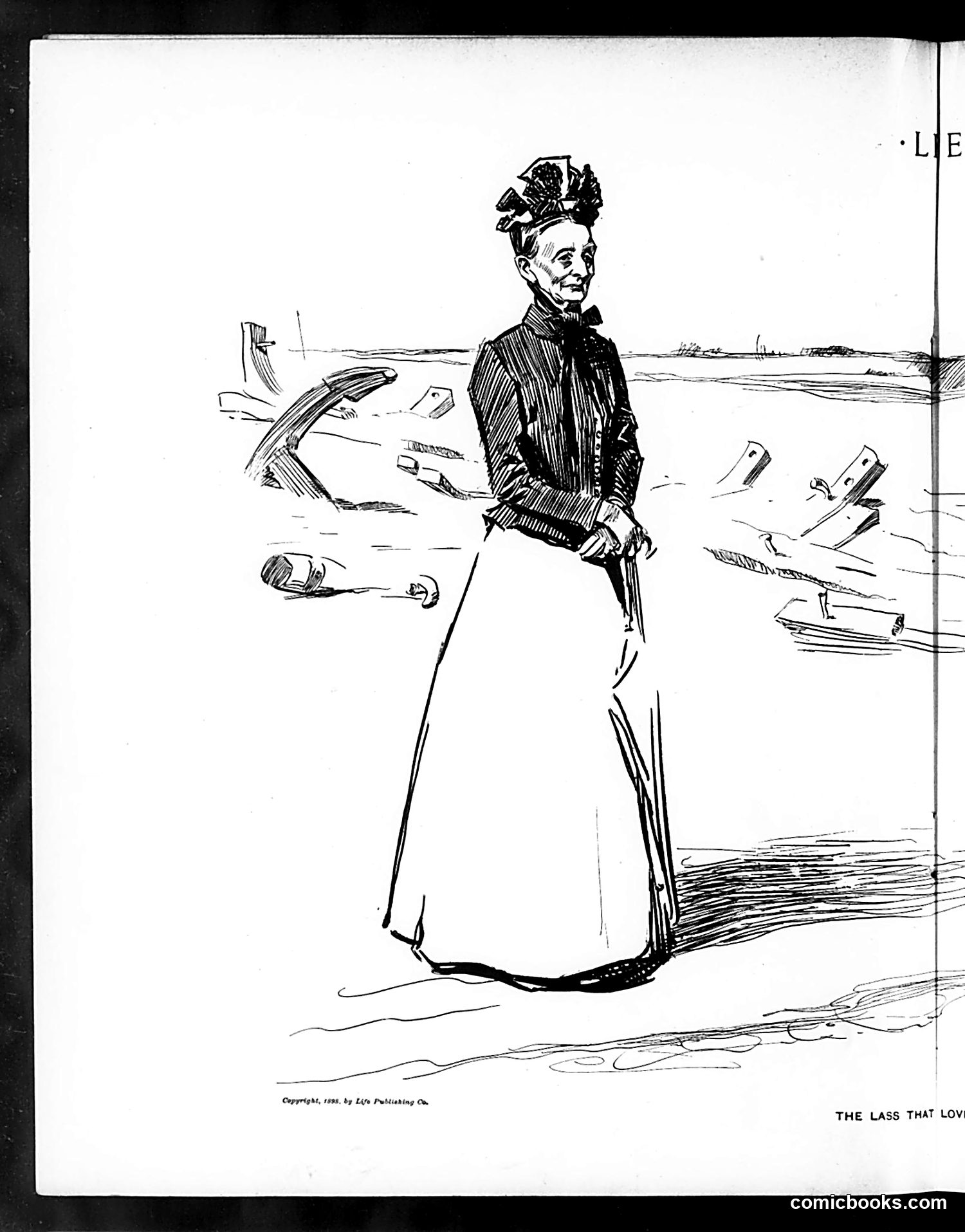
This appears to be a satirical illustration titled "The Lass That Lov[ed]..." (text cut off). The cartoon depicts a fashionably dressed woman standing amid shipwreck debris on a beach—broken wooden planks, barrels, and other maritime wreckage scatter around her. The satire likely comments on women's romantic choices or relationships, using the shipwreck as metaphor for romantic disaster or misfortune. The woman's composed, fashionable demeanor contrasts sharply with the destruction surrounding her, suggesting irony about her indifference to or complicity in catastrophe. The copyright notes "Life Publishing Co." and dates to 1884, indicating this is commentary on late-Victorian attitudes toward women, romance, or social behavior. However, without the complete caption, the specific historical reference remains unclear.
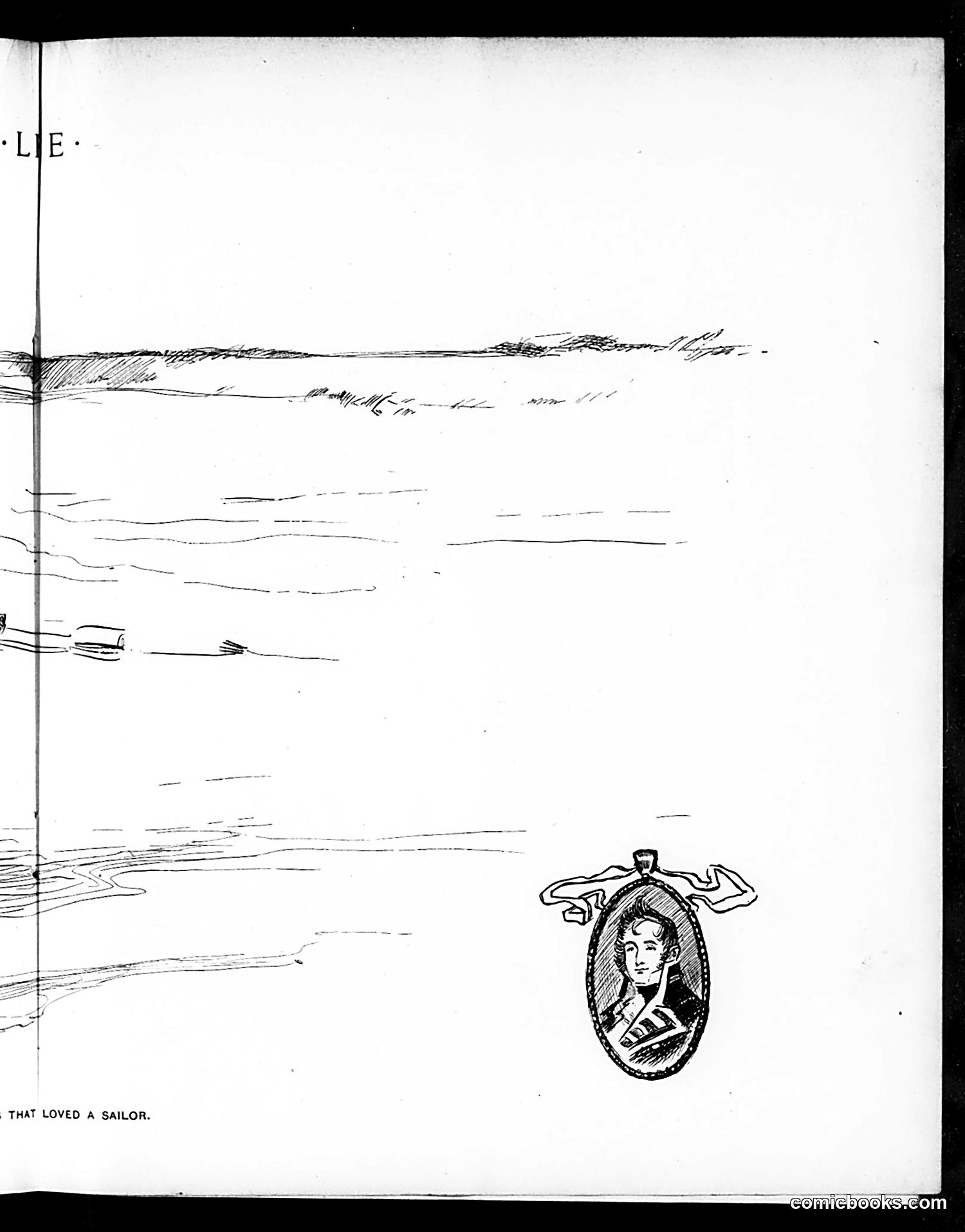
This page appears to be from Life magazine's satirical section. The visible text reads "THAT LOVED A SAILOR" at the bottom, suggesting this is part of a longer narrative or poem (possibly referencing a famous literary work). The drawing shows a portrait medallion or locket containing a woman's face, suspended from what appears to be a ribbon or naval insignia. The landscape sketches above depict water scenes—marshland or seascape—establishing a maritime context. The title "LIE" and the romantic imagery suggest this satirizes either romantic deception or false romantic narratives, particularly those involving sailors. Without additional page context, the specific historical or political reference remains unclear, though the overall theme appears to mock sentimental or dishonest romantic stories popular in the era.
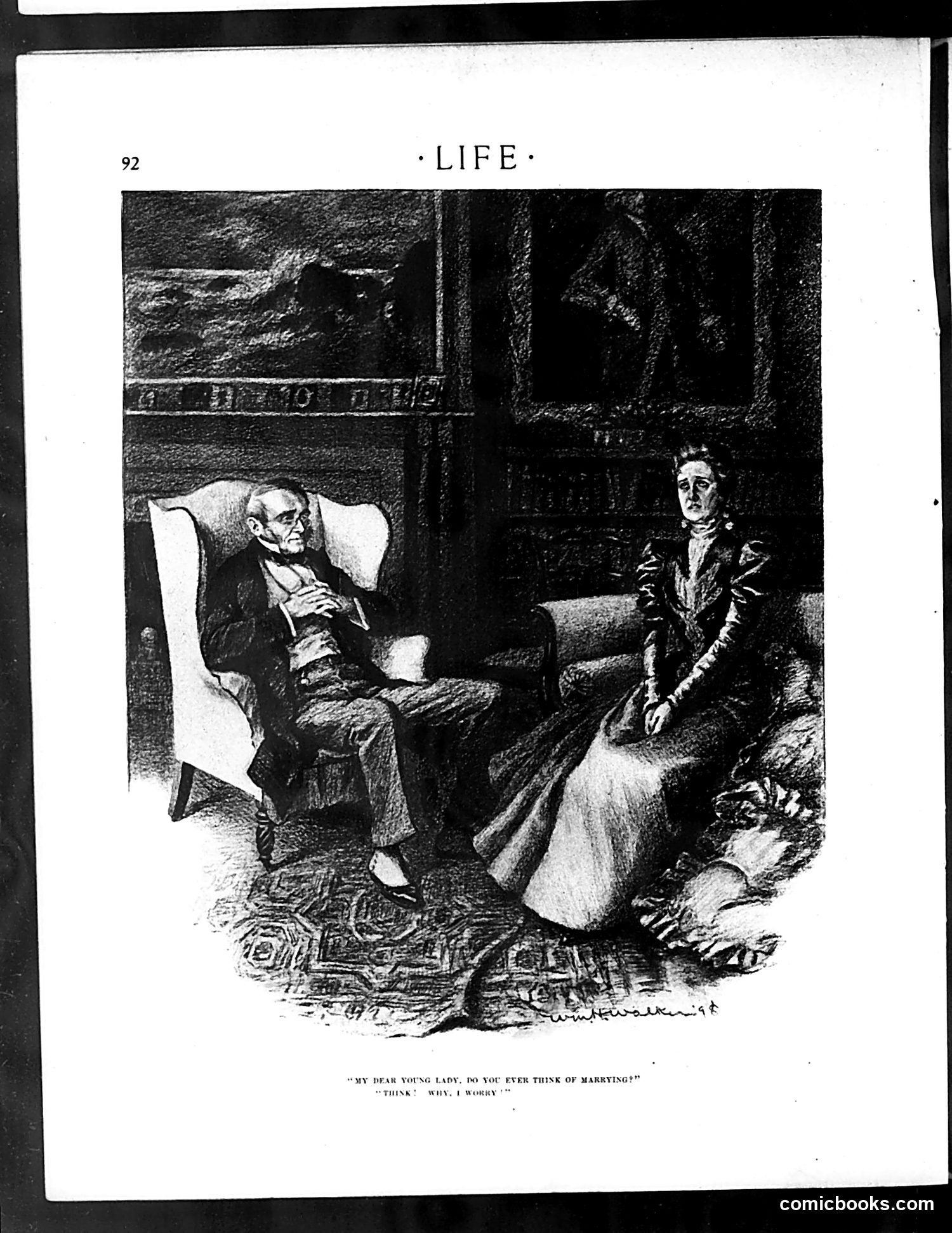
This page from *Life* magazine (page 92) features a single cartoon showing two figures in what appears to be an interior domestic setting. An older man reclines in a chair on the left, while a woman sits across from him on the right. The caption reads: "My dear young lady, do you ever think of marrying?" with the response "Think? Why, I worry." The satire targets anxieties about marriage, presenting the woman's worry as a humorous counterpoint to the man's casual inquiry. The cartoon appears to mock either courtship conventions or women's genuine concerns about matrimony—likely reflecting early 20th-century social anxieties about marriage expectations for women.
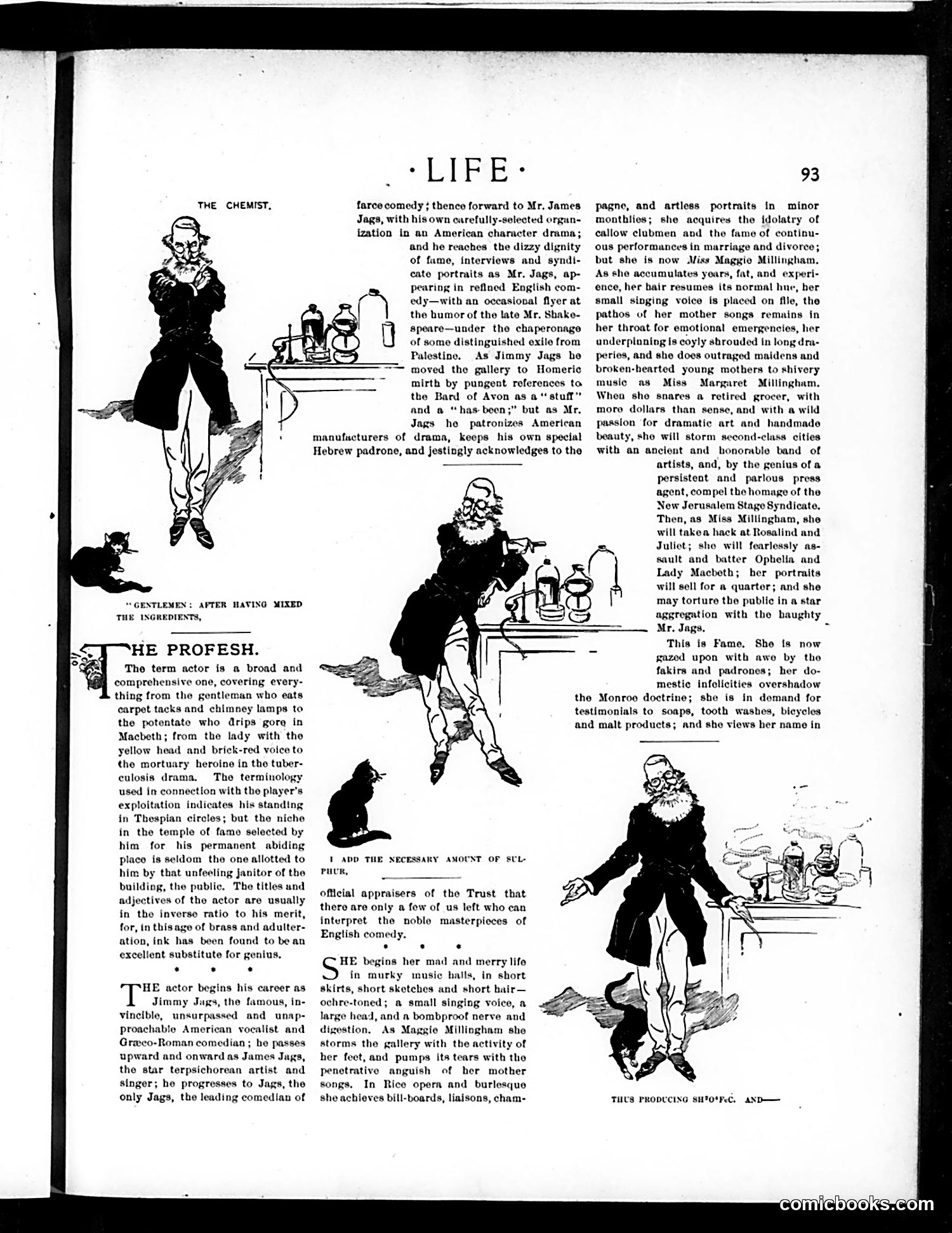
This page satirizes the theatrical profession and how actors' stage names and billing inflate with their (supposed) success. "The Chemist" cartoon shows an actor mixing theatrical ingredients—a visual pun on fabricating a stage persona. The main text traces actor "Jimmy Jugs'" ridiculous career trajectory: he begins with an absurdly grandiose title ("the famous, invincible, unsurpassed") but as he advances, his actual billing becomes more modest (Jimmy → James → Mr. Jags), the inverse of merit. The satire is that brass, "adulteratio[n]," and press agents substitute for genuine talent. Similarly, a female performer becomes "Miss Maggio Millingham"—accumulating pretension, false hair color, and manufactured respectability as she ages. The joke: fame requires not artistry but a good press agent and a wealthy husband willing to bankroll mediocrity in "second-class cities." The satire targets early 1900s theatrical humbug—how marketing and self-promotion trumped actual ability.
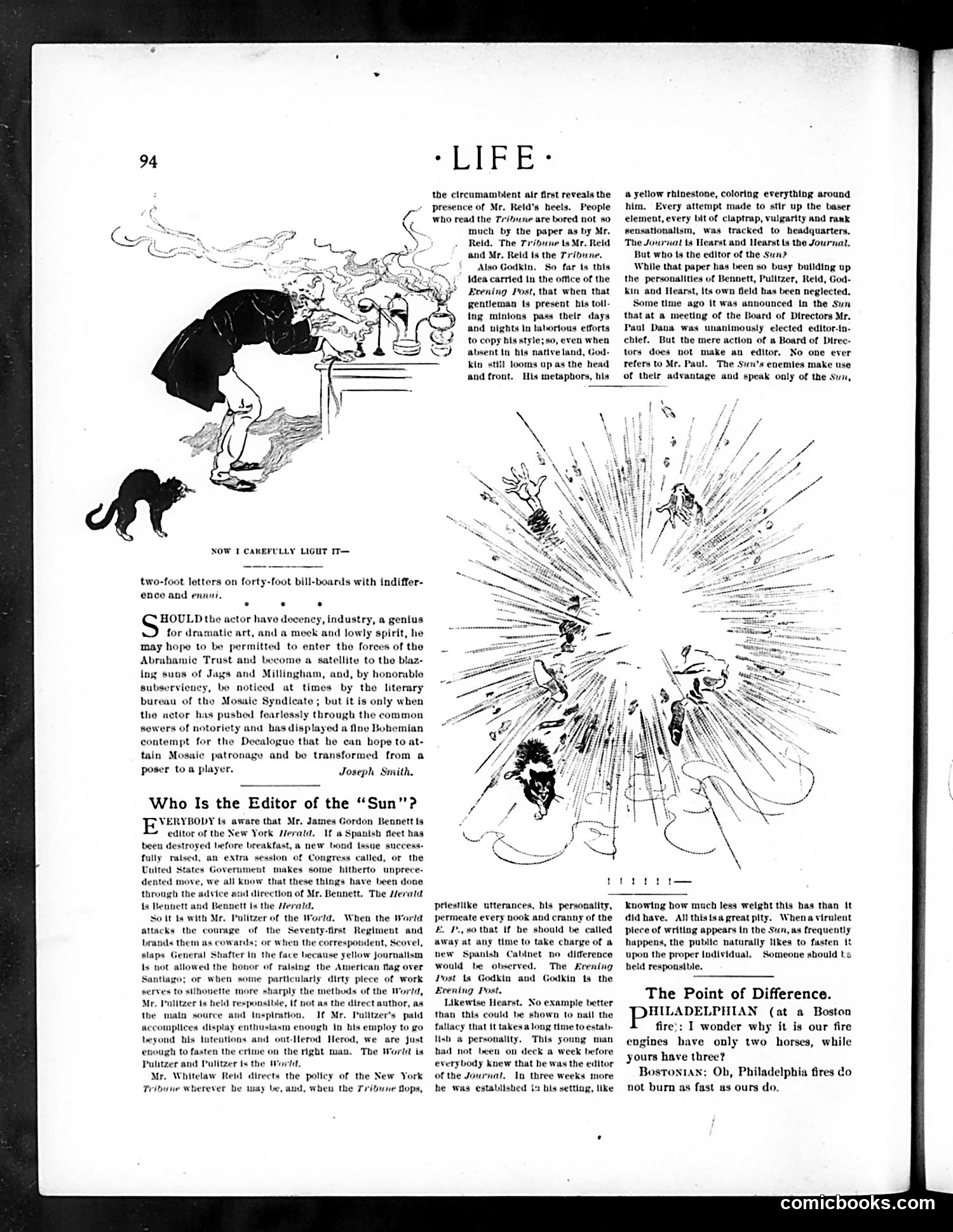
This page satirizes newspaper editors who dominate their publications so completely that the papers become extensions of their personal brands. The text names five major editors: James Gordon Bennett (Herald), Joseph Pulitzer (World), Whitelaw Reid (Tribune), E.L. Godkin (Evening Post), and William Randolph Hearst (Journal). The satire's point: each editor has become so identified with his paper that the publication reflects only his personality, methods, and obsessions. The repeated phrase structure—"X is Bennett and Bennett is the Herald"—emphasizes this fusion. The cartoon on the right (unclear in detail) likely illustrates the chaotic sensationalism these editors created. The piece ends by asking who edits the *Sun*, implying that paper has been overshadowed while rivals built competing personalities. This critiques the "yellow journalism" era's cult-of-personality leadership and suggests newspapers should stand on merit rather than editor celebrity.
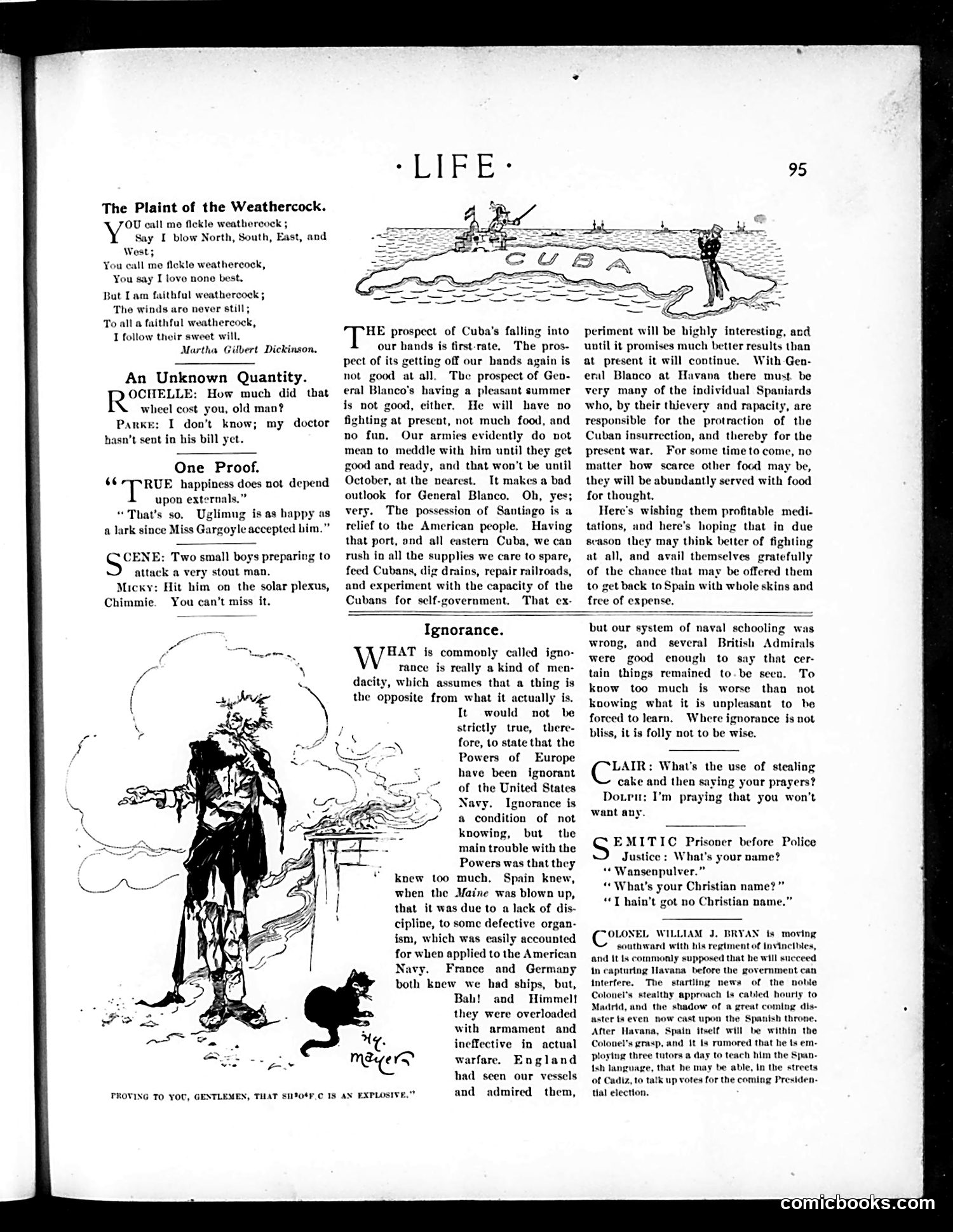
This page contains multiple satirical pieces reflecting on America's 1898 Spanish-American War and subsequent occupation of Cuba. **Main Article:** "The prospect of Cuba's falling into our hands" discusses U.S. control of Santiago and eastern Cuba. The satire is bitter—while celebrating American victory, the author mocks the difficulty of managing Cuba, feeding its population, and "experimenting" with Cuban self-governance. The piece sarcastically suggests Spanish colonial officials will enjoy "food for thought" about their failures, hoping they'll return to Spain. **"Ignorance" Section:** Attacks European powers' claims of naval ignorance regarding American capability. The satire argues they knew too much—Spain blamed the *Maine* explosion on American naval incompetence; France and Germany dismissed U.S. ships as over-armed but ineffective; Britain found faults in American naval training. The point: European condescension masked they were simply wrong about American military strength. **Small Cartoons/Jokes:** Include crude humor unrelated to politics (a "solar plexus" joke, a prisoner's non-Christian name). The page reflects American triumphalism mixed with anxiety about governing newly-acquired territories.
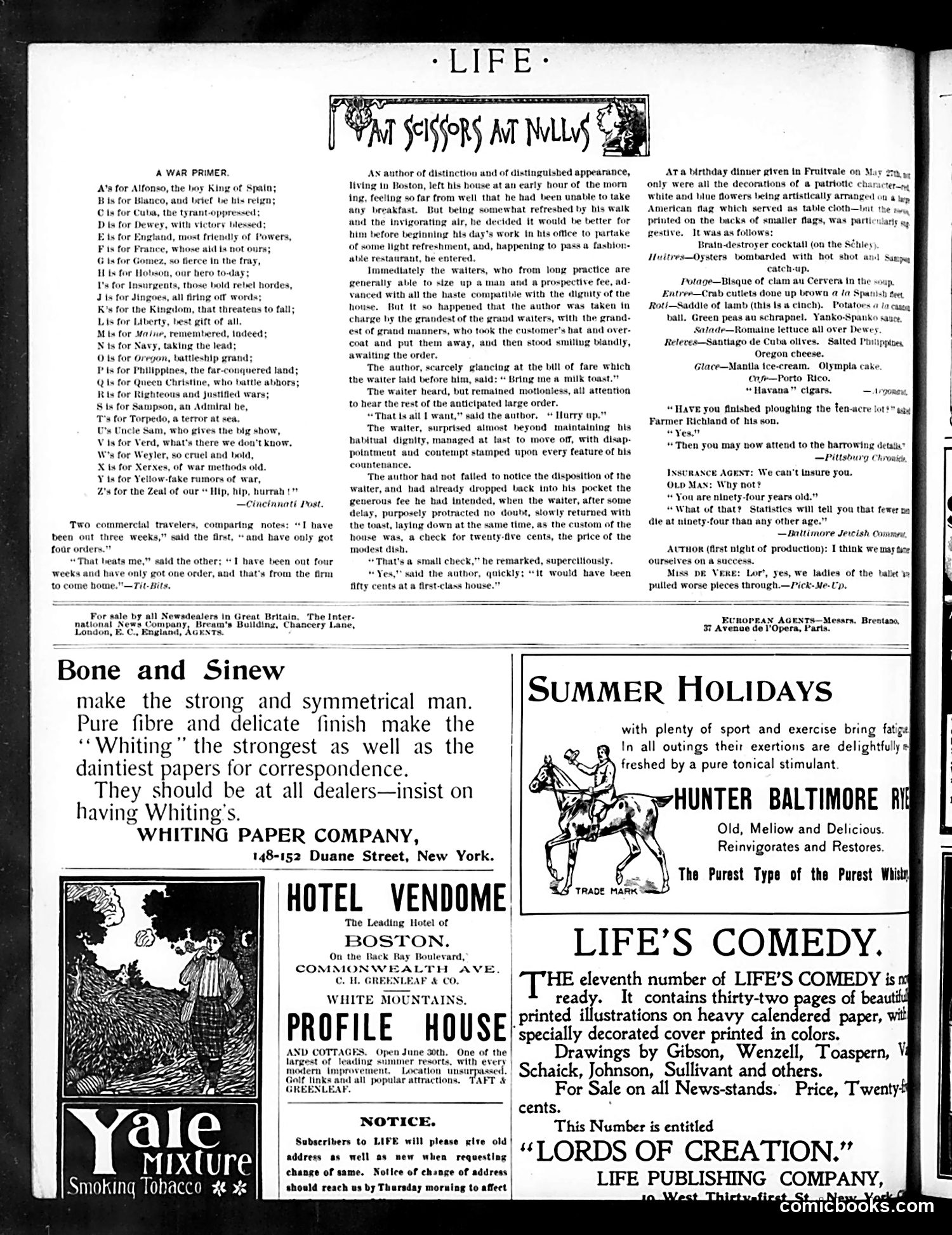
This page from *Life* magazine contains satirical content about the Spanish-American War (1898). The "War Primer" is an alphabetical list satirizing war figures and events: King Alfonso of Spain, Admiral Dewey, Cuba, the USS Maine, the Philippines, Admiral Sampson, and "yellow" (sensationalist) journalism. It mocks both the conflict and American jingoism. A longer humorous story describes a Boston author ordering simple milk toast at a fancy restaurant. The waiter, expecting a large order and generous tip from a distinguished-looking patron, is visibly disappointed and contemptuous when served only a modest dish. The author retaliates by reducing his tip. The satire targets class pretension and service-industry snobbery. A final anecdote describes a patriotic birthday dinner where menu items are war-themed (oysters "bombarded," bisque named after Spanish general Cervera), satirizing how Americans commercialized and trivialized the recent conflict.
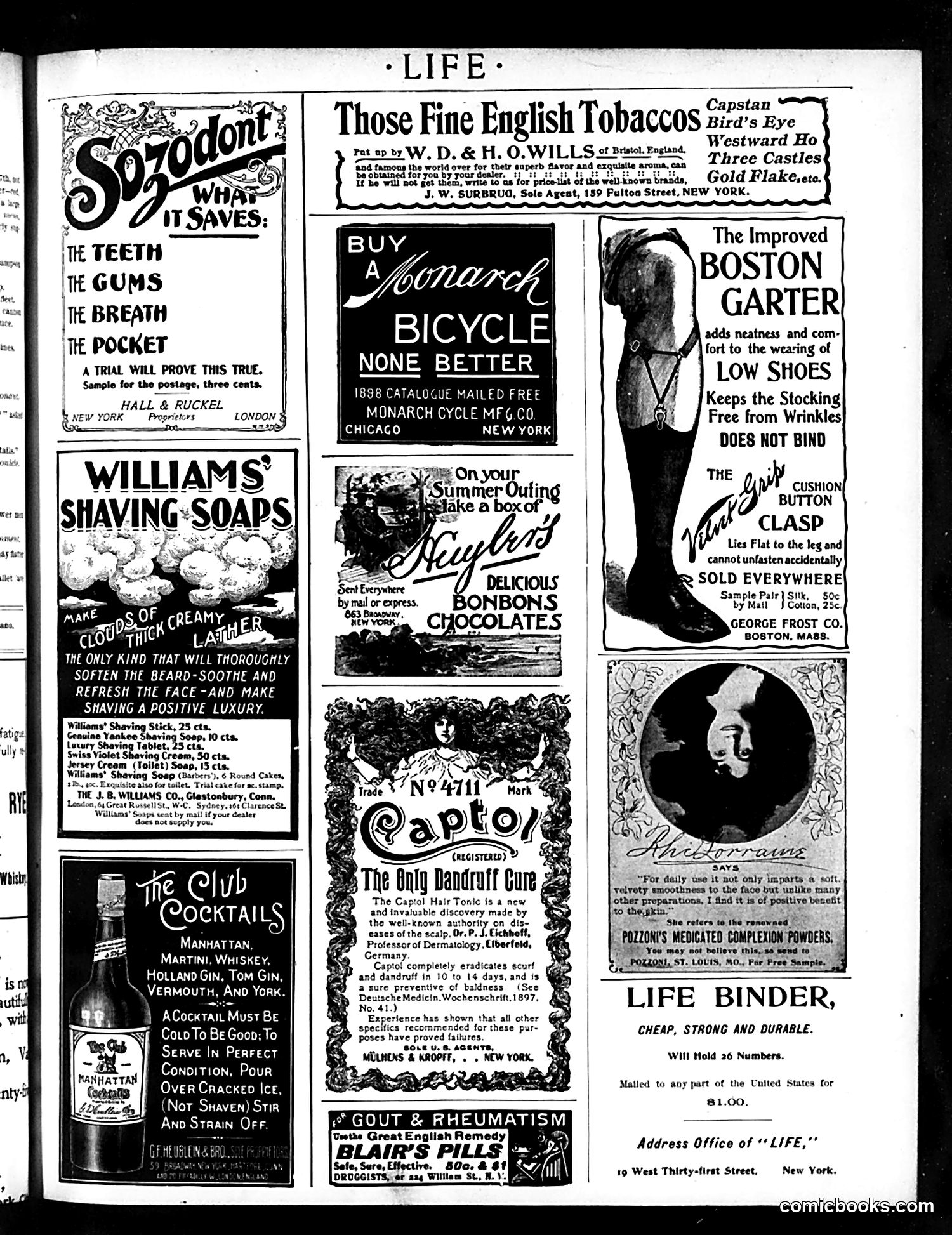
This is primarily an **advertising page**, not a satirical cartoon page. It contains product advertisements typical of late 19th-century American magazines. Notable ads include: - **Sozodont** toothpaste (claiming to save teeth, gums, breath, and pocket) - **Williams' Shaving Soaps** emphasizing luxury and beard-softening - **The Club Cocktails** - a bottled cocktail product - **Monarch Bicycles** (1898 catalog advertisement) - **Capiol Hair Tonic** - a dandruff cure claiming German scientific authority - **Boston Garter** - hosiery support claiming not to bind or unfasten - **Pozzioni's Medicated Complexion Powders** (right sidebar) - **Blair's Pills** for gout and rheumatism The page reflects consumer culture of the 1890s, emphasizing scientific claims, imported goods, and personal grooming products. There is no apparent political satire or cartoon content—just commercial messaging typical of Life magazine's advertising sections.
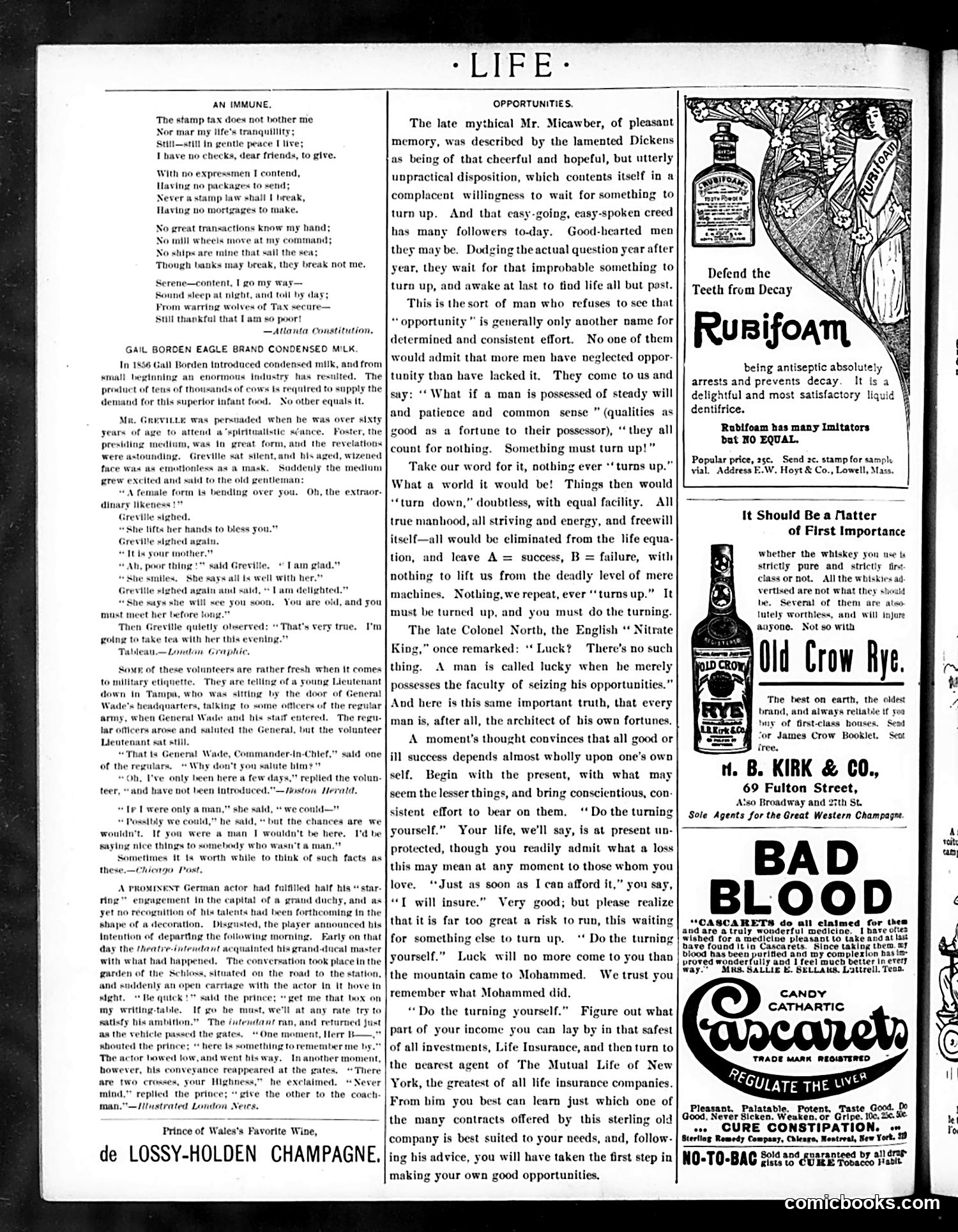
This page contains several satirical short stories and advertisements typical of *Life* magazine's format. The main content includes humorous anecdotes: one mocks a spiritualist séance where a skeptical gentleman is unimpressed by a medium's claims about his deceased mother; another ridicules a volunteer soldier who fails to salute a general, claiming he's only been in town days; a third tells of a German actor seeking recognition who receives two decorative crosses from a prince—one for the actor, one "for the coachman" as an insult. The "Opportunities" essay critiques followers of Mr. Micawber (Dickens's character), mocking those who passively wait for success rather than pursuing it through effort. It argues that success requires active determination, not mere patience. The advertisements—for Rubifoam toothpaste, Old Crow Rye whiskey, and "Bad Blood" patent medicine—are typical of the era's dubious health claims. Overall, the page satirizes human folly: credulity, social awkwardness, vanity, and passive wishful thinking.
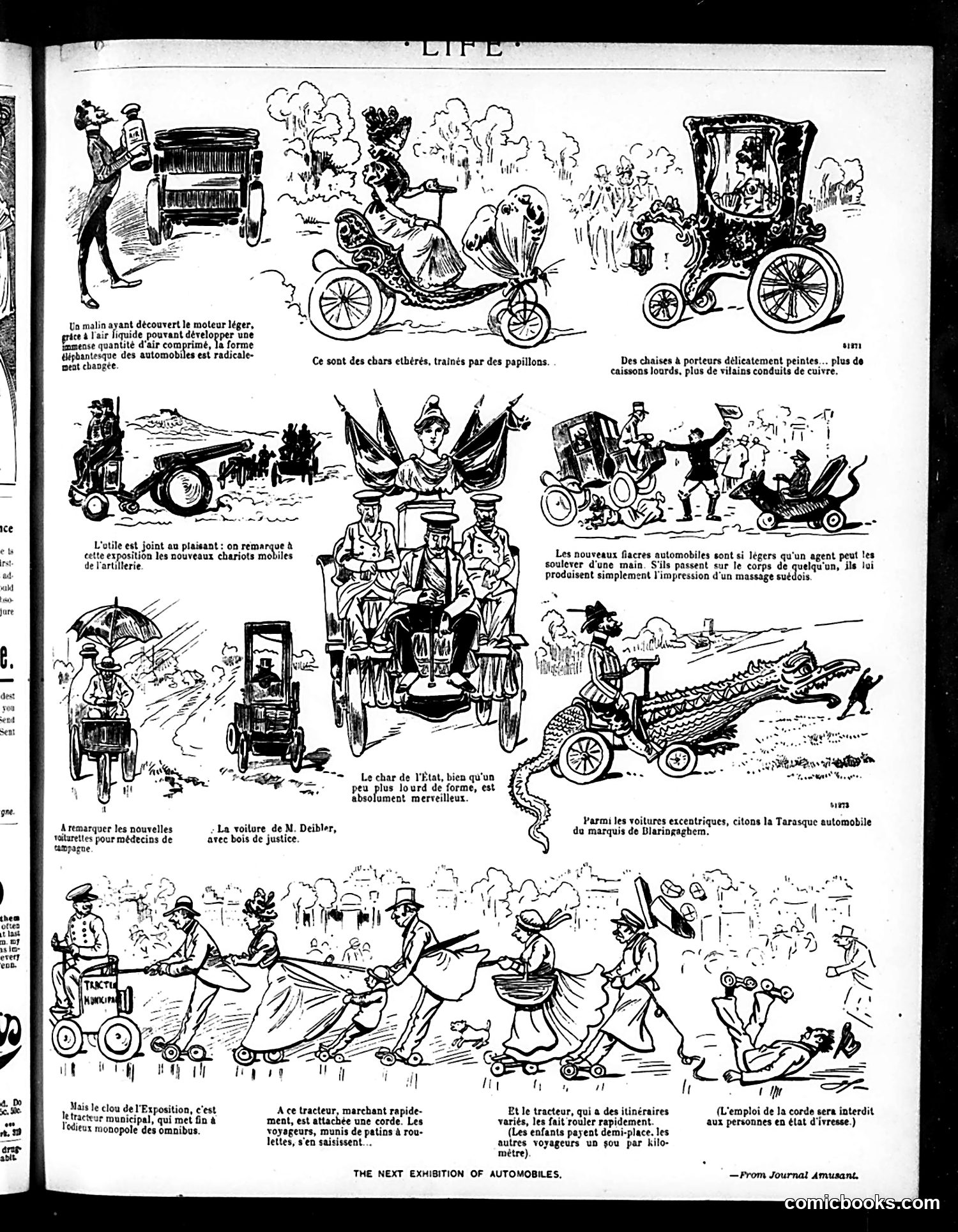
This is a French satirical piece from Life magazine mocking a future automobile exhibition. The cartoons depict absurdly lightweight vehicles powered by compressed air engines—so insubstantial that a police officer can lift an entire automobile with one hand, and running one over a person produces merely "the impression of a Swedish massage." The satire targets rapid technological optimism: delicate sedan chairs replace heavy carriages; artillery uses mobile chariots; even the State's official vehicle becomes marvelously light. Eccentric entries include "M. Deibler's vehicle with wood of justice" (likely referencing the guillotine, a morbid joke) and the "Tarasque automobile." The final comic strip shows a municipal tractor so light that citizens on roller skates pull it, passengers paying by kilogram. The satire mocks both the promise of revolutionary transportation technology and French bureaucratic absurdity, suggesting such "progress" would produce chaos rather than improvement.
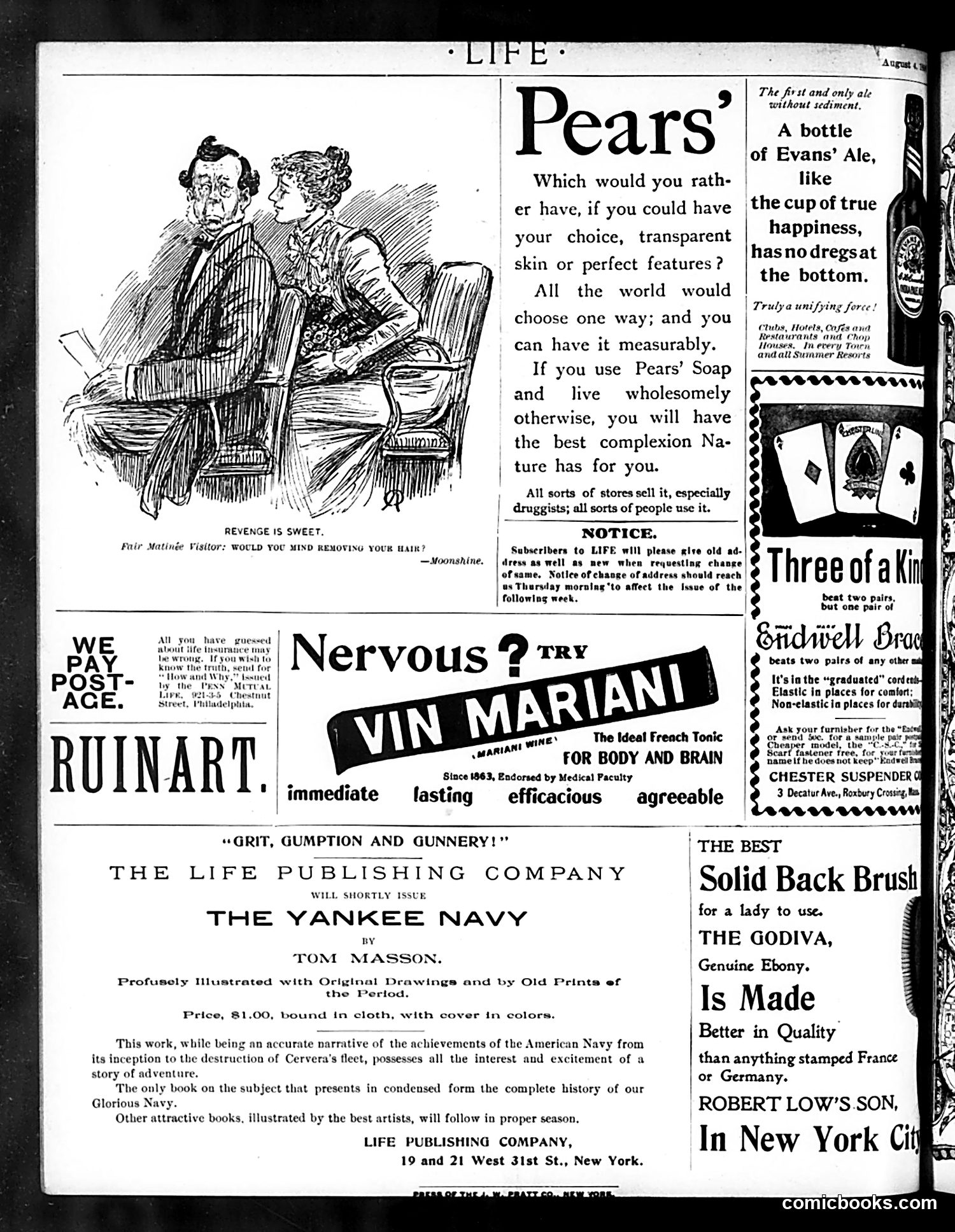
This page is primarily **advertising and announcements** rather than political satire. However, the one cartoon present—titled "Revenge is Sweet"—depicts a social interaction at what appears to be a formal event. A man with an exaggerated, unattractive facial expression recoils from a woman's large, elaborate hat, asking her to remove it. The caption attributes the comment to "Moonshine," suggesting this represents common public irritation. **The joke**: Women's oversized hats were a genuine social nuisance in the early 1900s, obstructing theater and event views. The cartoon mocks both the fashion excess and the awkward confrontations it created. The remaining content consists of period product advertisements (Pears' Soap, Vin Mariani tonic, Evans' Ale) and an announcement for Life Publishing Company's forthcoming book *The Yankee Navy* by Tom Masson, celebrating American naval achievements—likely referencing the Spanish-American War era.