
Life, 1898-08-04 · page 4 of 20
Life — August 4, 1898 — page 4: what you’re looking at
What you’re looking at
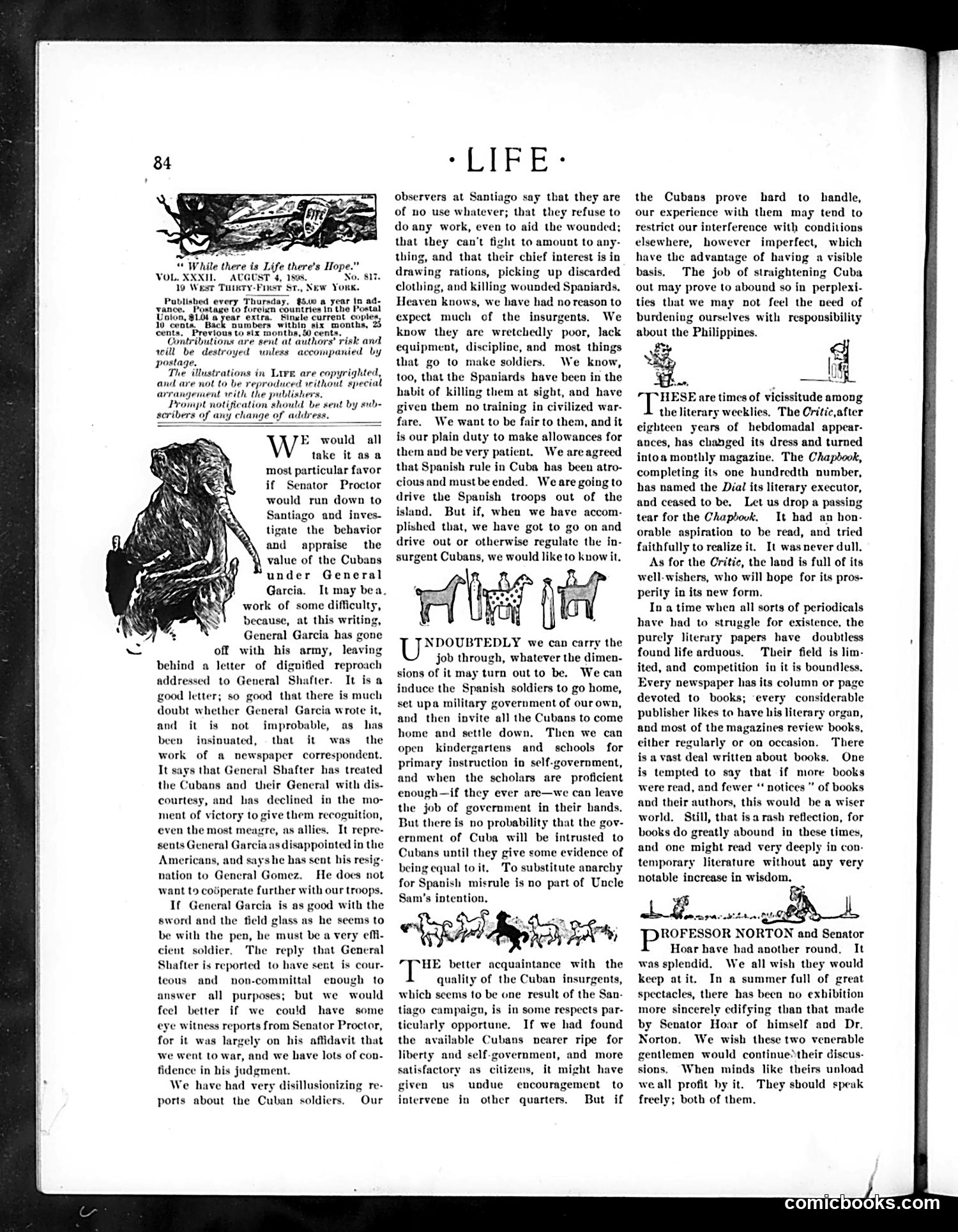
This page discusses the Cuban insurgency during the Spanish-American War era. The main cartoon depicts what appears to be a Cuban insurgent leader (likely General García, referenced in the text), shown in a sympathetic light despite being poorly equipped. The article critiques American policy toward Cuban insurgents, arguing that while they lack discipline and military training, the U.S. should support their independence efforts. It advocates for fair treatment and patience with Cuban forces rather than dismissive attitudes. The text also references contemporary literary magazines—*The Chapbook*, *The Critic*, and *The Dial*—discussing how periodicals are struggling to survive while still reviewing books seriously. The satire mildly chastises American military leadership for underestimating Cuban allies and calls for more respectful engagement with independence movements.
📄 Transcribed text from this page (OCR, searchable)
Machine-transcribed from the original scan — historical spelling and the odd misread are preserved.
10 West THIerY- Pins Sr Published every Thursday. $3.0 a year In ad- vance. Portage to foreign countries In the Postal Union, $106 a year extra. Sinule current coples, 1 conta, Back numbers within six months, 23 ents. Previous to six months, 60 cents, Contributions are sent at authors’ risk and will be destroyed wnless accompanied by postage, The illustrations in Lire are copyrighted, anil are not to be reproduced without special arrangement with the publishers, Prompt notification should be sent by sub- scribers of any change of address W f would all take it asa most particular favor if Senator Proctor would run down to Santiago and inves- tigate the behavior and appraise the value of the Cubans under General Garcia. work of some difficulty, because, at this writing, General Garcia has gone off with his army, leaving behind a letter of dignified reproach addressed to General Shafter. It isa good letter; so good that there is much doubt whether General Garcia wrote it, and it is not improbable, as has been insinuated, that it was the work of a newspaper correspondent. It says that General Shafter has treated the Cubans and their General with dis- courtesy, and has declined in the mo- meant of victory to give them recoguition, even the most meagre, as allies, It repre- sents General Garcia as disappointed in the Americans, and says he has sent his resig- nation to General Gomez. He does not want to codperate further with our troops. If General Garcia is as good with the sword and the field glass as he seems to be with the pen, be must be a very effi- cient soldier, The reply that General Shafter is reported to have sent is cour- teous and non-committal enough to answer all purpos but we would feel better if we could have some eye witness reports from Senator Proctor, for it was largely on his affidavit that ‘We went to war, and we have lots of con- fidence in his judgment. We have had very disillusionizing re- ports about the Cuban soldiers, Our y YORK. Tt may bea. LYFE observers at Santiago say that they are of no use whatever; that they refuse to do any work, even to aid the wounded; that they can't fight to amount to any- thing, and that their chief interest is in drawing rations, picking up discarded clothing, and killing wounded Spaniards, Heaven knows, we have had no reason to expect much of the insurgents. We know they are wretcbedly poor, lack equipment, discipline, and most things that go to make soldiers. We know, too, that the Spaniards have been in the habit of killing them at sight, and have given them no training in civilized war- fare. We want to be fair to them, and it is our plain duty to make allowances for them and be very patient. We are agreed that Spanish rule in Cuba has been atro- cious and must be ended. Weare going to drive the Spanish troops out of the island. But if, when we have accom- plished that, we have got to go on and drive out or otherwise regulate the in- surgent Cubans, we would like to know it. Ce [ev \DOUBTEDLY we can carry the job through, whatever the dimen- U sions of it may turn out to be. We can induce the Spanish soldiers to go home, set upa military government of our own, and then invite all the Cubans to come home and settle down. Then we can open kindergartens and schools for primary instruction in self-government, and when the scholars are proficient enough—if they ever are—we can leave the job of government in their hands. But there is no probability that the gov- ernment of Cuba will be intrusted to Cubans until they give some evidence of being equal to it, To substitute anarchy for Spanish misrule is no part of Uncle Sam’s intention, “isp. HE better acquaintance with the quality of the Cuban insurgents, which seems to be one result of the San- tiago campaign, is in some respects par- ticularly opportune. If we had found the available Cubans nearer ripe for liberty and self-government, and more satisfactory as citizens, it might have given us undue encouragement to intervene in other quarters. But if the Cubans prove bard to handle, our experience with them may tend to restrict our interference with conditions elsewhere, however imperfect, which have the advantage of having a visible basis, The job of straightening Cuba out may prove to abound so in perplexi- ties that we may not feel the need of burdening ourselves with responsibility about the Philippines. By Sy HESE are times of vicissitude among the literary weeklies, The Critic,after eighteen years of hebdomadal appear- ances, has changed its dress and turned intoa monthly magazine. The Chapbook, completing its one hundredth number, has named the Dial its literary executor, and ceased to be, Let us drop a passing tear for the Chapbovk, It had an hon- orable aspiration to be read, and tried faithfully to realize it. It was never dull, As for the Critic, the land is full of its well-wishers, who will hope for its pros- perity in its new form. In a time when all sorts of periodicals have had to struggle for existence, the purely literary papers have doubtless found life arduous. Their field is lim- ited, and competition in it is boundless, Every newspaper has its column or page devoted to books; every considerable publisher likes to have his literary organ, and most of the magazines review books, either regularly or on occasion. There is a vast deal written about books. One is tempted to say that if more books were read, and fewer “ notices” of books and their authors, this would be a wiser world. Still, that isa rash reflection, for books do greatly abound in these times, and one might read very deeply in con- temporary literature without any very notable increase in wisdom, ROFESSOR NORTON and Senator Hoar have had another round. It was splendid. We all wish they would keep atit. In a summer full of great spectacles, there has been no exhibition more sincerely edifying than that made by Senator Hoar of himself and Dr. Norton. We wish these two venerable gentlemen would continue their discus- sions, When minds like theirs unload we all profit by it. They should speak freely; both of them. comicbooks.com