
A complete issue · 20 pages · 1898
Life — June 2, 1898
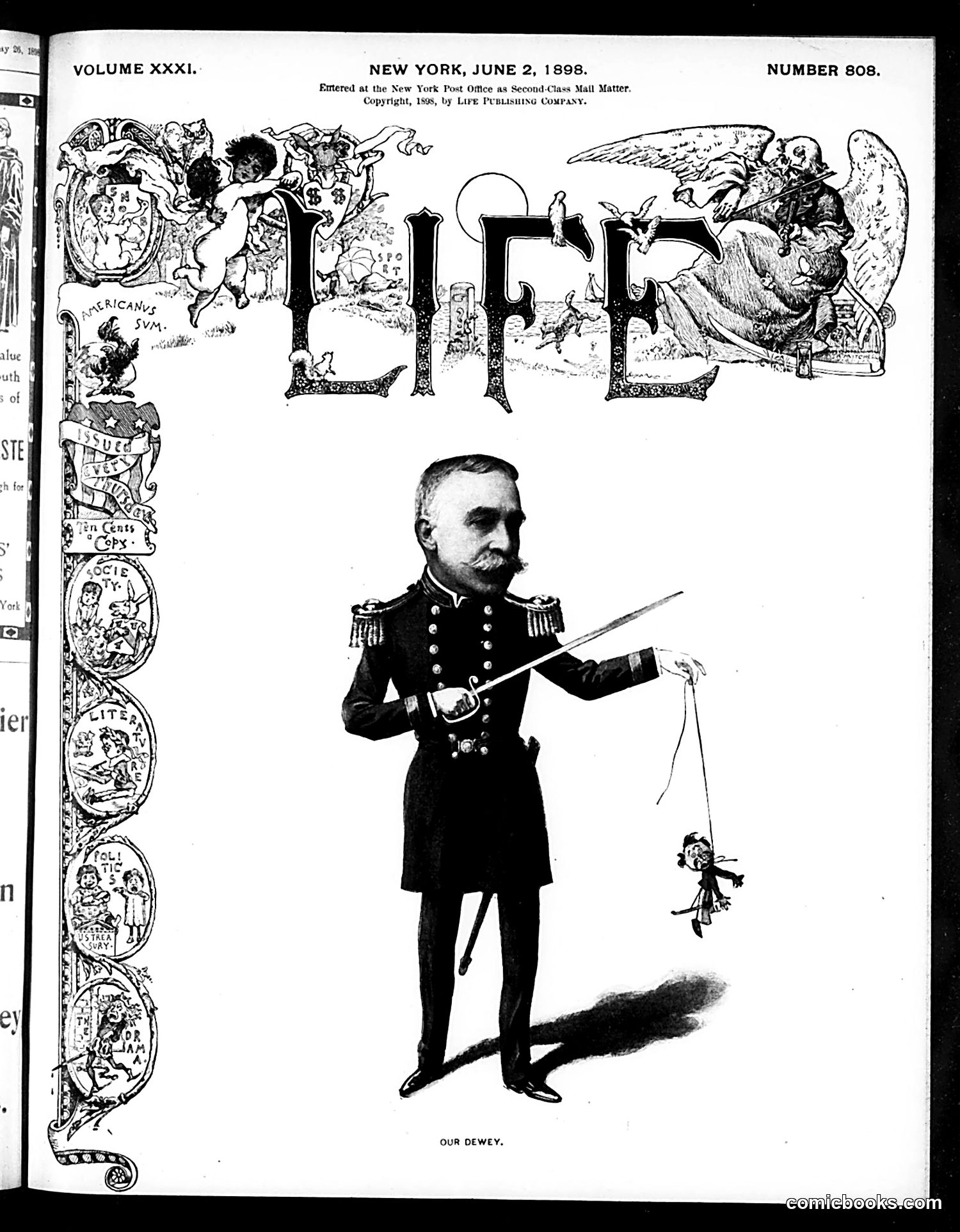
This satirical cartoon depicts a military figure labeled "OUR DEWEY" holding a tiny puppet-like figure on a string. The caption identifies this as Commodore George Dewey, the U.S. Navy officer who achieved fame during the Spanish-American War (1898), particularly after his naval victory at Manila Bay in the Philippines in May 1898. The satire suggests that Dewey—depicted as a pompous military man in full dress uniform—is manipulating or controlling a small figure, likely representing political or public opinion. The cartoon mocks how Dewey's sudden military celebrity made him a tool for manipulation by political interests, or conversely, how his fame allowed him to control events. The ornate decorative border adds satirical dignity to the commentary.
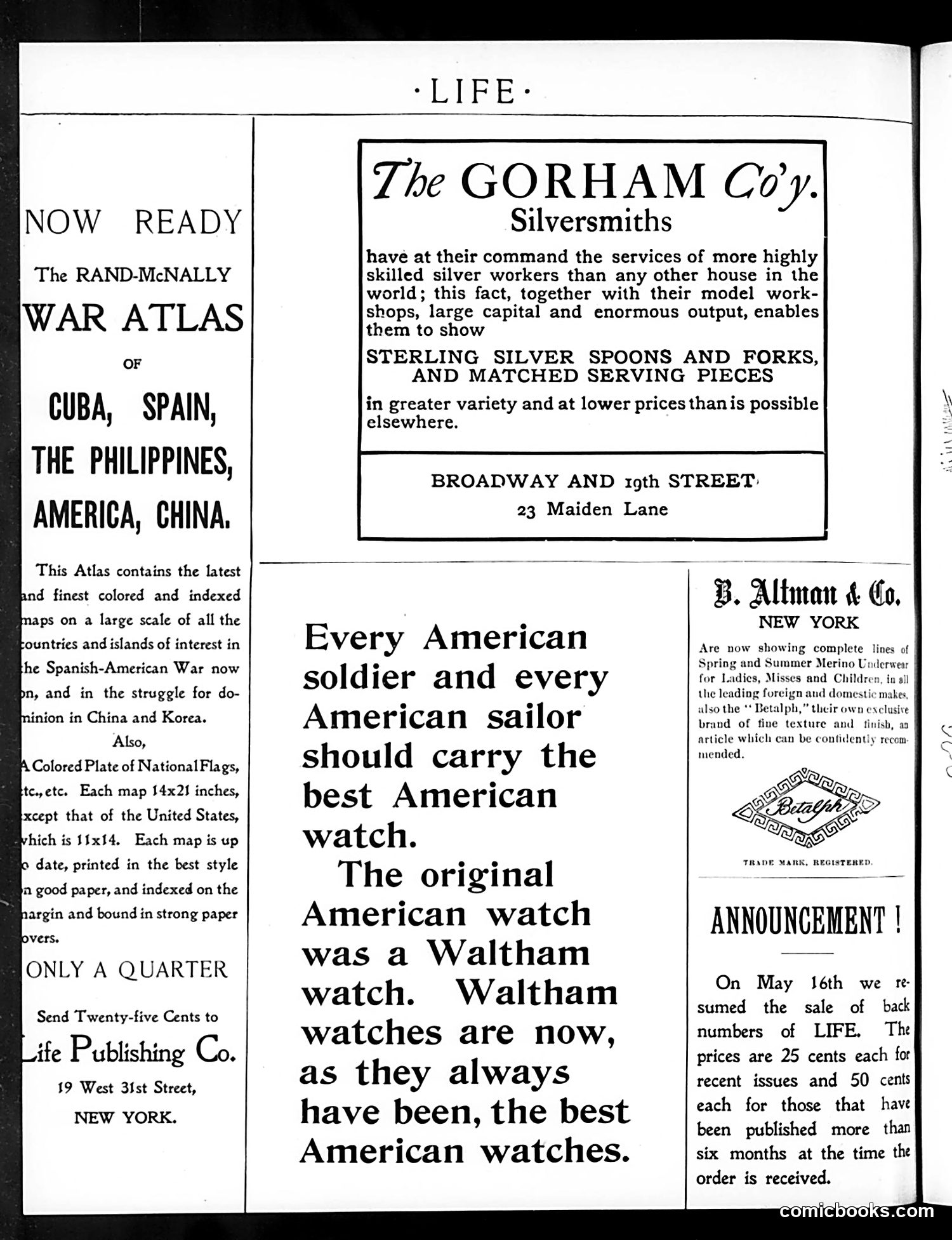
This page is primarily **advertising**, not satirical content. It contains four advertisements from the Spanish-American War era (circa 1898-1900): 1. **Rand-McNally War Atlas** — promoting maps of conflict zones (Cuba, Spain, Philippines, China) 2. **Gorham Co. Silversmiths** — sterling silver flatware advertisement 3. **Waltham Watches** — patriotic appeal to soldiers/sailors, claiming Waltham as "the best American watch" 4. **B. Altman & Co.** — New York department store advertising spring/summer clothing 5. **Life Magazine announcement** — price restructuring for back issues The Waltham ad uses patriotic framing ("every American soldier and sailor") typical of wartime marketing. There are **no cartoons or caricatures** visible on this page—it's a straightforward advertising section reflecting consumer products marketed during America's imperial expansion period.
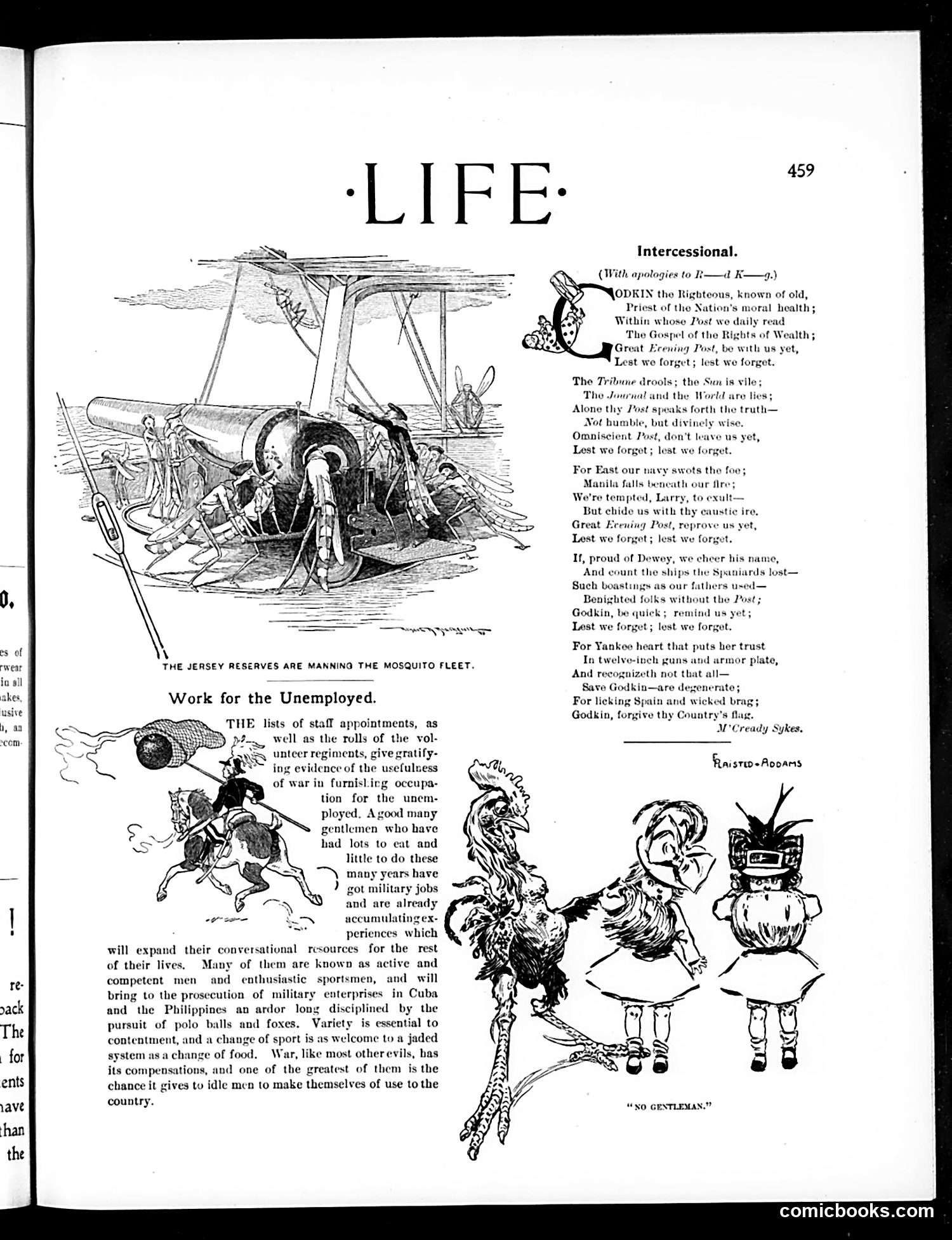
**Top Section - "Intercessional":** This poem by M. Croskly Sykes commemorates naval figures, likely from the Spanish-American War era. References to "Godkin" (editor E.L. Godkin), Manila, and "Yankee heart" suggest it honors American naval leadership during the 1898 conflict. The phrase "Lost we forgot; lost we forget" is a memorial refrain. **Bottom Section - "Work for the Unemployed":** This article and accompanying caricatures satirize military service as employment for idle men. The grotesque character illustrations ("So Gentleman") mock the idea that offering military jobs—particularly in Cuba and the Philippines—solves unemployment while benefiting the country through imperial expansion. The satire critiques using warfare as social policy. **Top Illustration:** "The Jersey Reserves Are Manning the Mosquito Fleet" depicts naval personnel, likely humorously referencing militia or auxiliary naval forces.
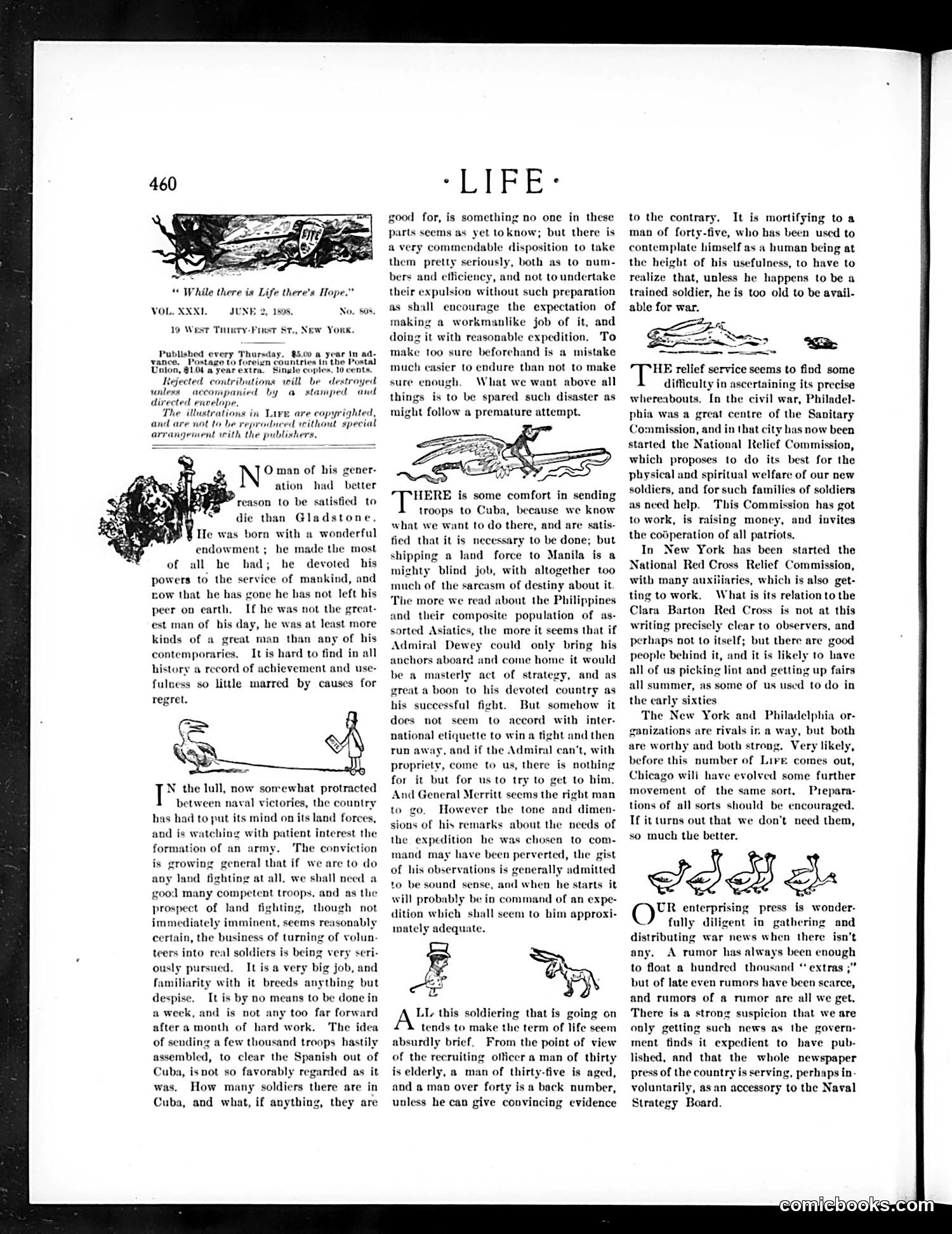
This page contains editorial commentary on the Spanish-American War, particularly regarding military operations in Cuba and the Philippines. The text discusses troop deployment, Admiral Dewey's naval strategy, and the composition of American forces being sent to Cuba. The small illustrations appear to be decorative vignettes typical of the era—including what look like soldiers, military equipment, and animals—rather than pointed political cartoons. The main content is serious editorial discussion about war strategy and relief efforts, including mention of the National Red Cross Relief Commission and the Clara Barton Red Cross. The tone suggests wartime reporting and patriotic concern for soldiers' welfare rather than satirical commentary. This is primarily journalism with institutional illustrations, not satirical cartooning.
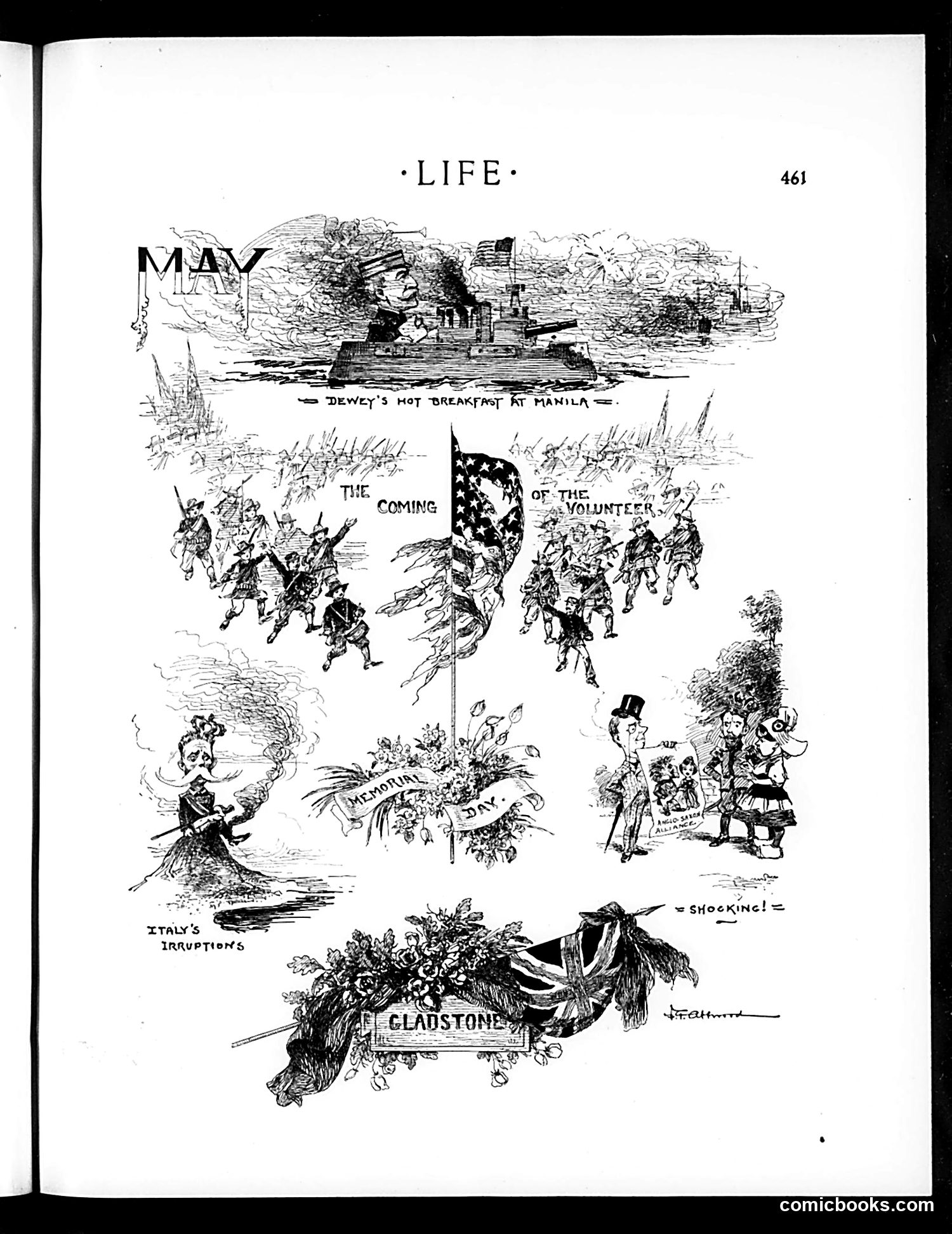
This page presents satirical commentary on the Spanish-American War era, specifically referencing Admiral Dewey's naval victory at Manila. The central image shows "The Coming of the Volunteer"—American soldiers marching with flags. Key elements include: - **"Dewey's Hot Breakfast at Manila"**: References the famous naval battle where Dewey defeated the Spanish fleet - **"Italy's Irruptions"**: Likely mocking Italian political instability - **"Shocking!"**: Depicts British reaction to American military expansion - **"Gladstone"**: References the recently deceased British Prime Minister, possibly commentary on British-American relations The cartoons collectively satirize American imperial ambitions, international responses to U.S. military power, and contemporary political upheaval abroad.
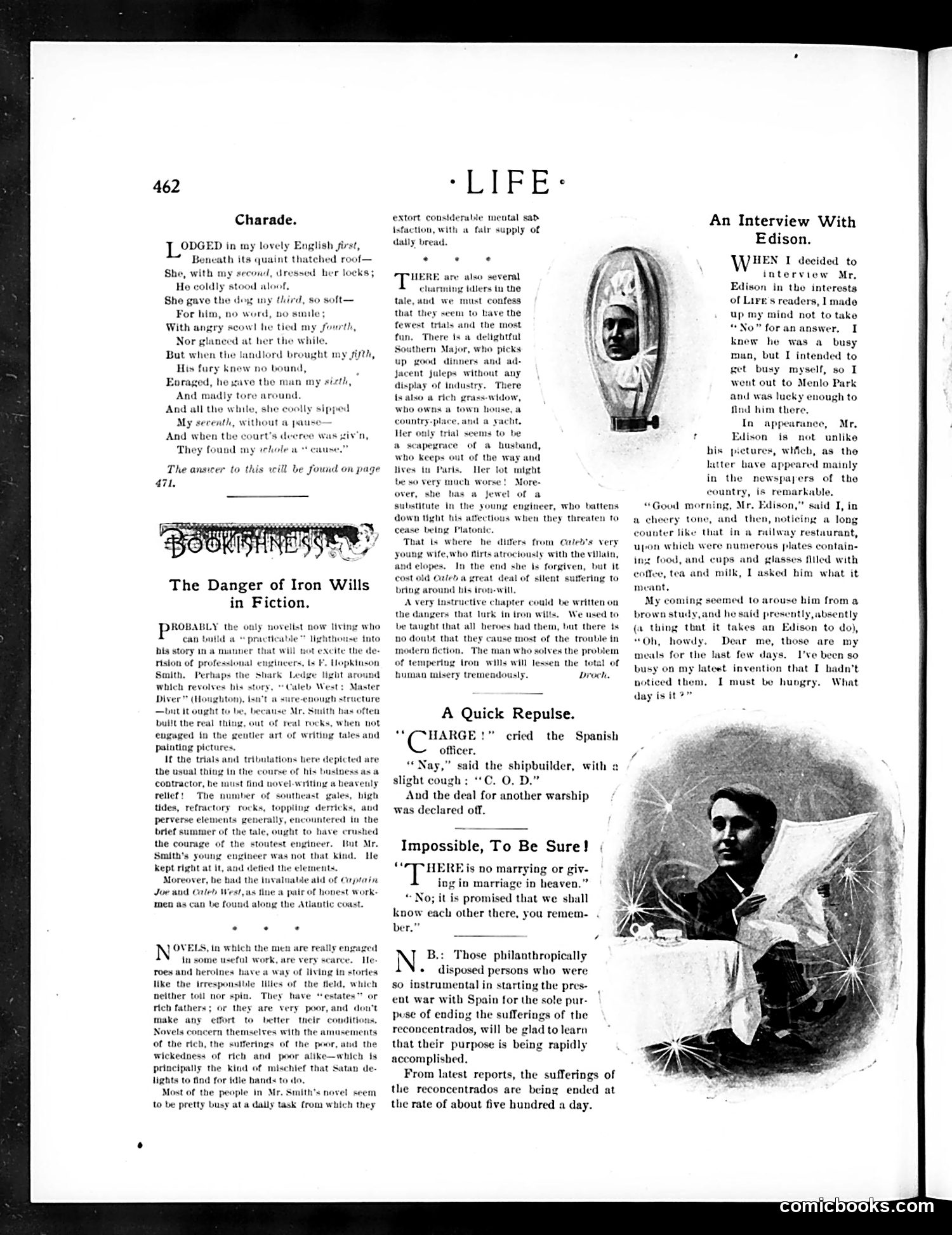
This page contains several short fiction pieces and satirical sections rather than political cartoons. The main content includes: **"An Interview With Edison"** - A humorous account of meeting Thomas Edison at a railway restaurant, portraying him as distracted and preoccupied (likely reflecting his reputation as a workaholic inventor). **"The Danger of Iron Wills in Fiction"** - Satirizes overly-dramatic literary characters with stubborn, iron-willed personalities, criticizing how fiction overuses this character trope. **"A Quick Repulse"** and **"Impossible, To Be Sure!"** - Brief satirical dialogues poking fun at Spanish military interactions and religious hypocrisy regarding marriage. The illustrations appear to be portrait sketches accompanying the Edison interview and other pieces. This is primarily a literary satire page rather than political commentary.
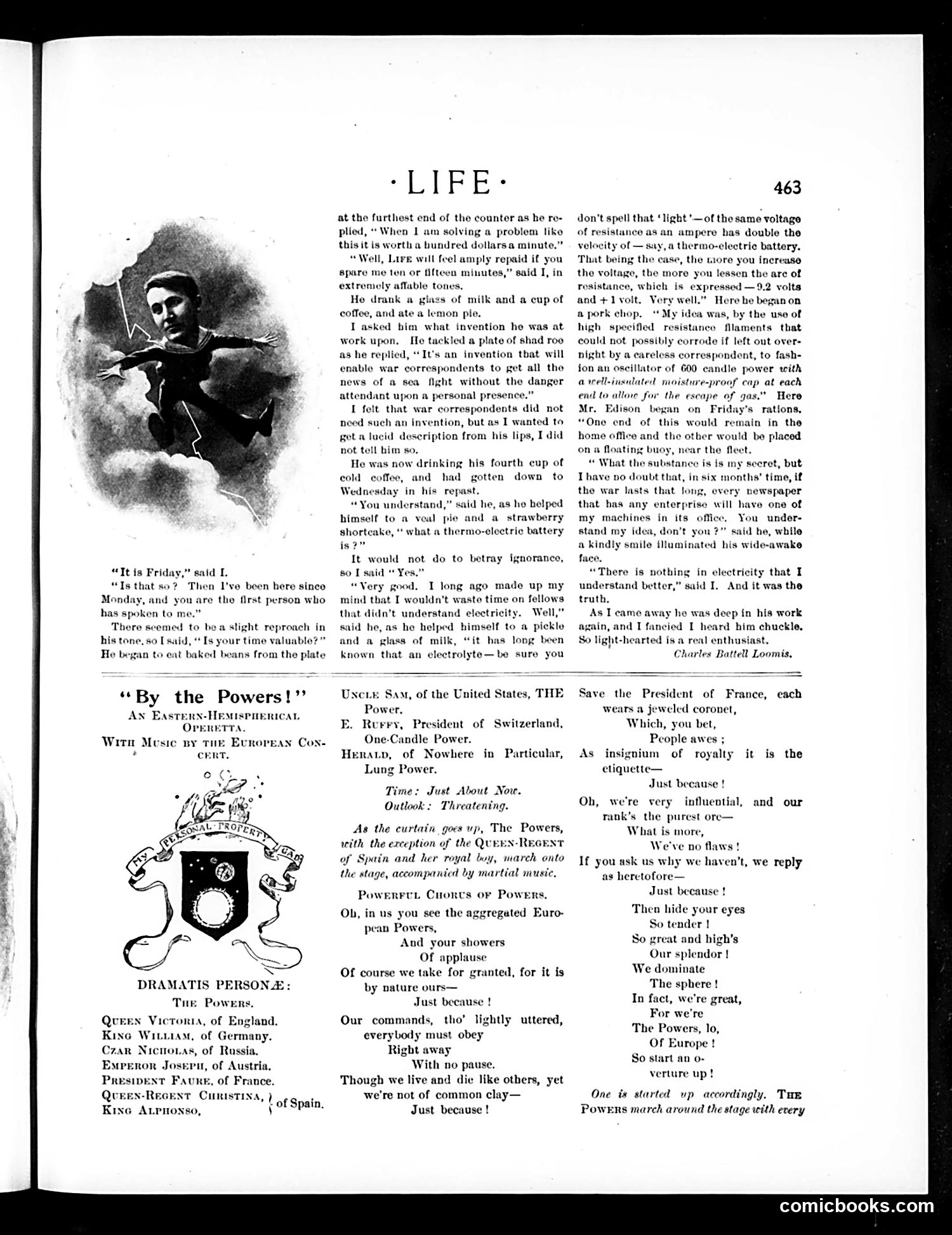
This page satirizes European monarchies through an operetta titled "By the Powers!" The dramatic persona listed include Queen Victoria (England), King William (Germany), Czar Nicholas (Russia), Emperor Joseph (Austria), President Faure (France), Queen-Regent Christina (Spain), and King Alphonso (Spain). The satire mocks the grandiose posturing of European powers, depicted as theatrical characters marching "onto the stage, accompanied by martial music." The operetta's chorus ironically celebrates their dominance—"Of course we take for granted, for it is by nature ours"—while simultaneously acknowledging their shared mortality: "Though we live and die like others, yet we're not of common clay." The joke targets the pretentiousness and mutual rivalry of turn-of-century European empires.
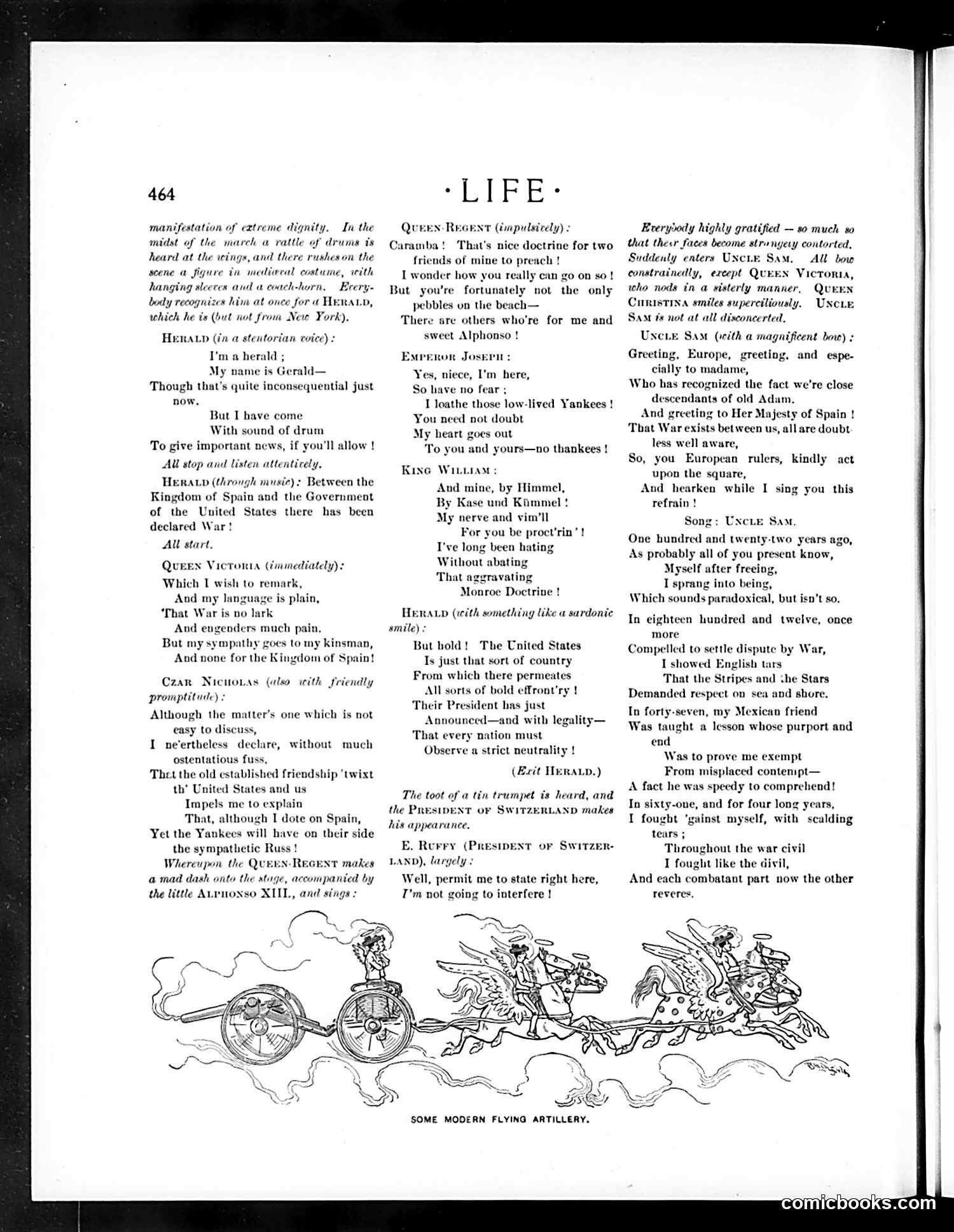
This satirical scene depicts a heated political debate about American neutrality during a foreign conflict. Key figures include **Queen Victoria** (Britain), **Herald** (representing American press/government), **Czar Nicholas** (Russia), **Emperor Joseph** (Austria-Hungary), **King William** (Germany), and **Uncle Sam** (America). The dialogue centers on **declaring war**: Herald announces war has been declared between major European powers. The characters debate whether America should remain neutral or intervene. The bottom illustration, labeled "**Some Modern Flying Artillery**," shows a chaotic cavalry charge—likely satirizing the escalating military tensions among European nations. The overall satire mocks American political discussions about whether to join European conflicts, with Uncle Sam insisting on neutrality while European powers pressure involvement. The cartoon reflects early 20th-century tensions preceding American entry into WWI.
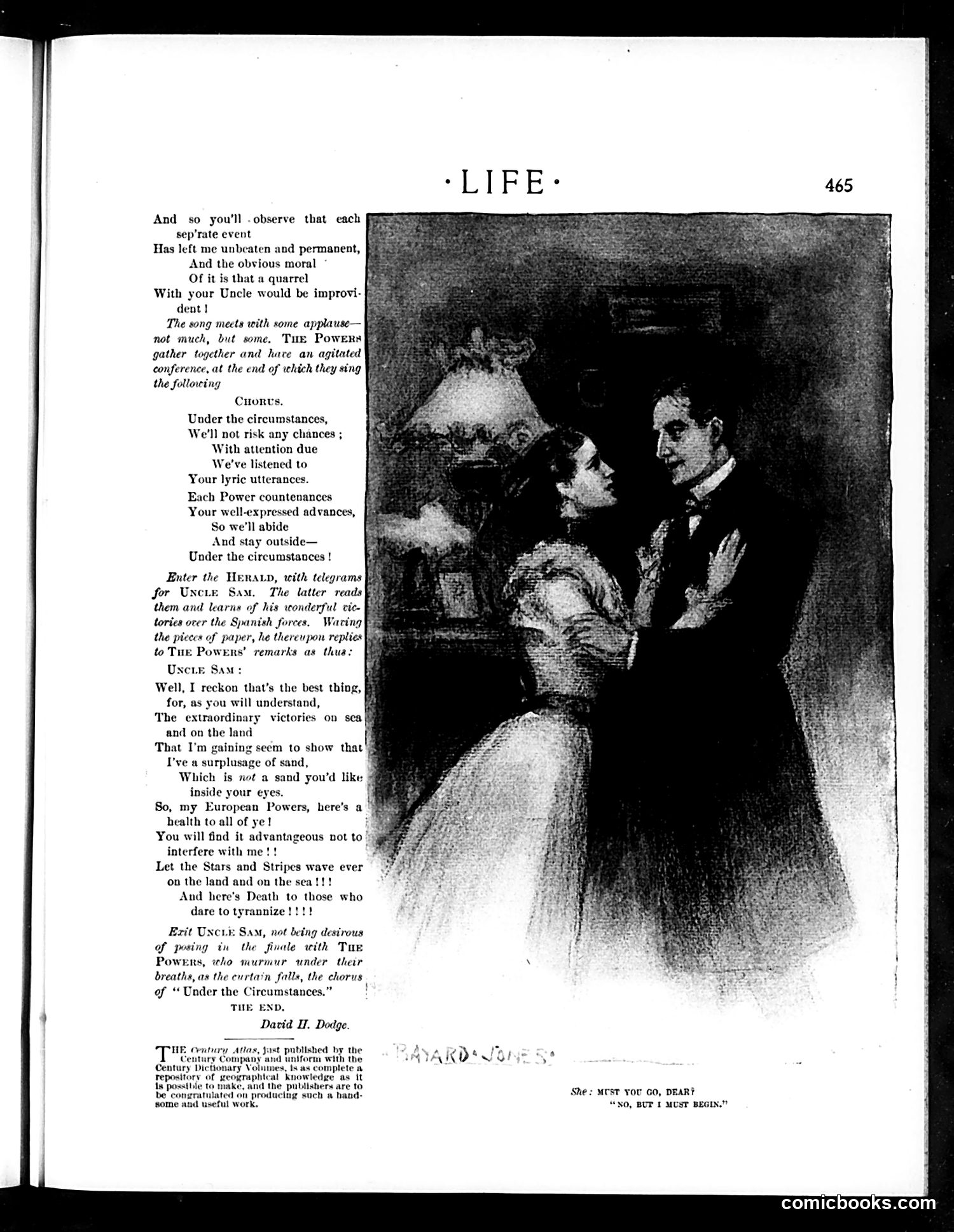
This page presents a theatrical scene from a play called "Under the Circumstances" by David H. Dodge. The illustration shows two figures in what appears to be an early 20th-century interior setting—a woman in a light-colored dress and a man in dark clothing engaged in dramatic conversation. The text consists of dialogue and stage directions from the play, including a chorus section and a character identified as "Uncle Sam" delivering patriotic remarks about American military victories and warning against foreign interference. The final line from the woman—"She must you go, dear?" / "No, but I must begin"—suggests romantic or domestic tension. This is theatrical criticism/entertainment content rather than political satire.
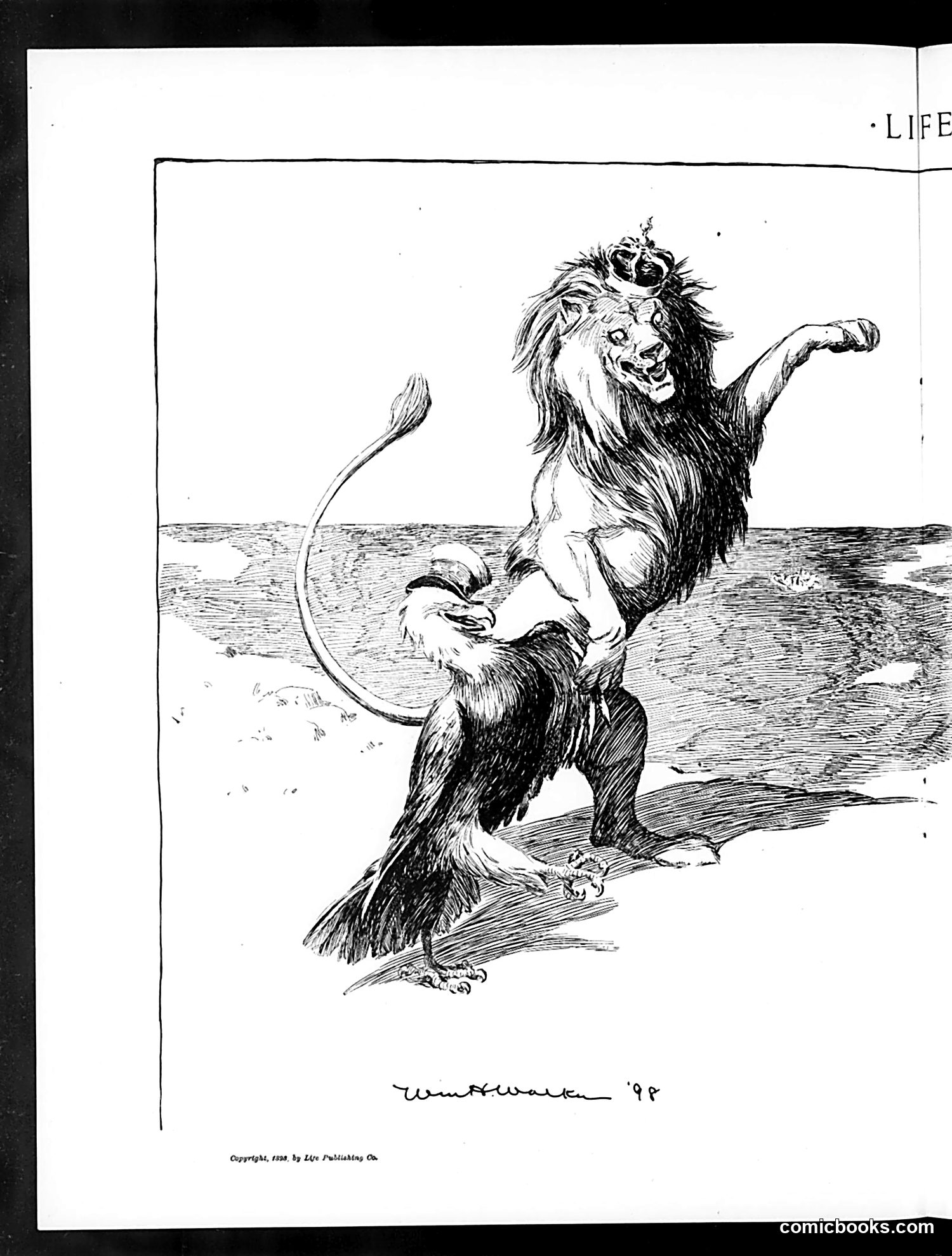
This appears to be a satirical illustration from *Life* magazine (based on the header visible in the image). The drawing depicts an anthropomorphic lion wearing a crown, standing upright on hind legs in a theatrical pose with one arm raised. The lion has an exaggerated, somewhat menacing expression. The exact political reference is unclear without additional context or readable caption text. However, the crowned lion likely represents royalty or a ruler. Given *Life*'s tradition of political satire, this could reference a contemporary political figure or foreign monarch, possibly caricatured as a "beast" or tyrant. The artist's signature appears to read "Cesare" or similar, dated '98 (likely 1898). Without visible caption text, the specific satirical point remains uncertain.
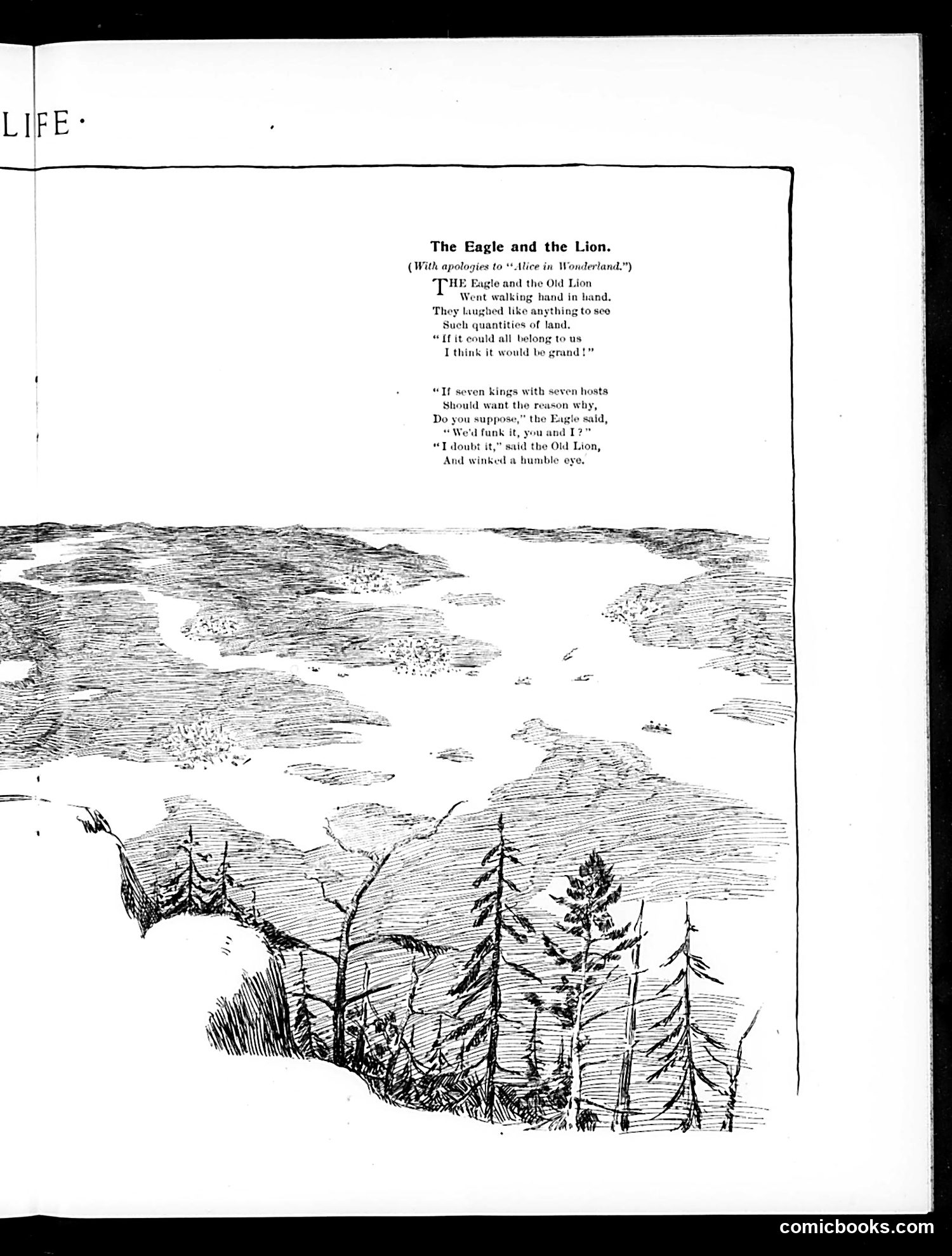
This is a poem presented as "an apology to 'Alice in Wonderland,'" playfully referencing Lewis Carroll's famous work. The narrative describes an Eagle and an Old Lion walking together and debating land ownership—"If it could all belong to us / I think it would be grand!" The Lion questions the Eagle's logic about seven kings with seven hosts wanting territory. The Eagle responds confidently, while the Lion "winked a humble eye." The accompanying landscape illustration shows a scenic vista with water, hills, and sparse trees. Without additional context, the poem appears to be a satirical dialogue about territorial ambition and power dynamics, though the specific political figures or situations it references remain unclear from this page alone.
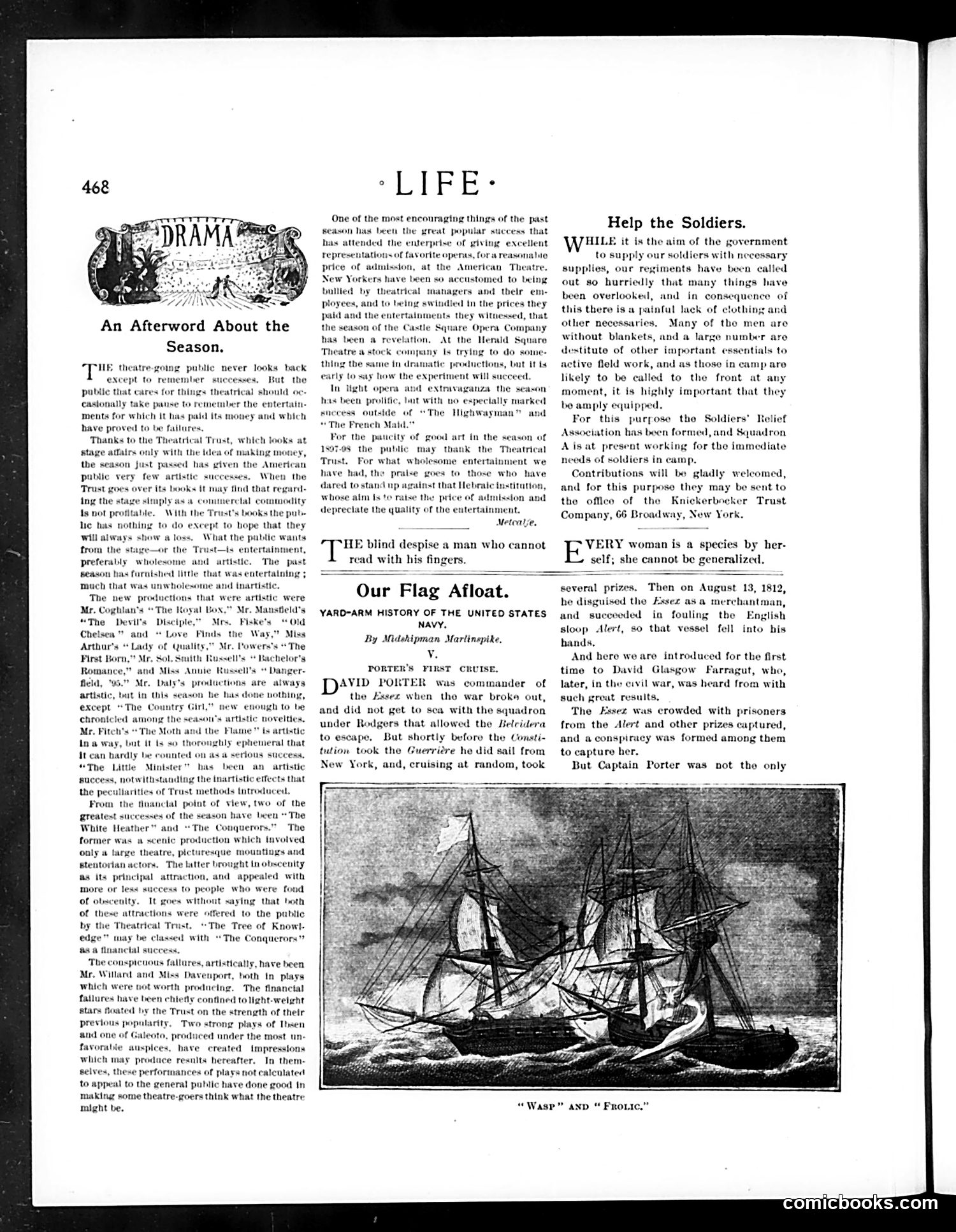
This page contains an engraving labeled **"Wasp" and "Frolic,"** depicting two sailing vessels engaged in what appears to be a naval encounter. Based on the text section titled "Our Flag Afloat," this illustrates a historical naval action involving the U.S. Navy. The accompanying text references **Captain David Porter** commanding the *Essex* during wartime, and mentions a ship named *Gossipière* that was seized. The image likely documents an actual naval engagement from the War of 1812 era, showing American naval power and maritime conflict. The illustration serves as patriotic historical documentation rather than political satire, demonstrating American naval victories or notable maritime encounters.
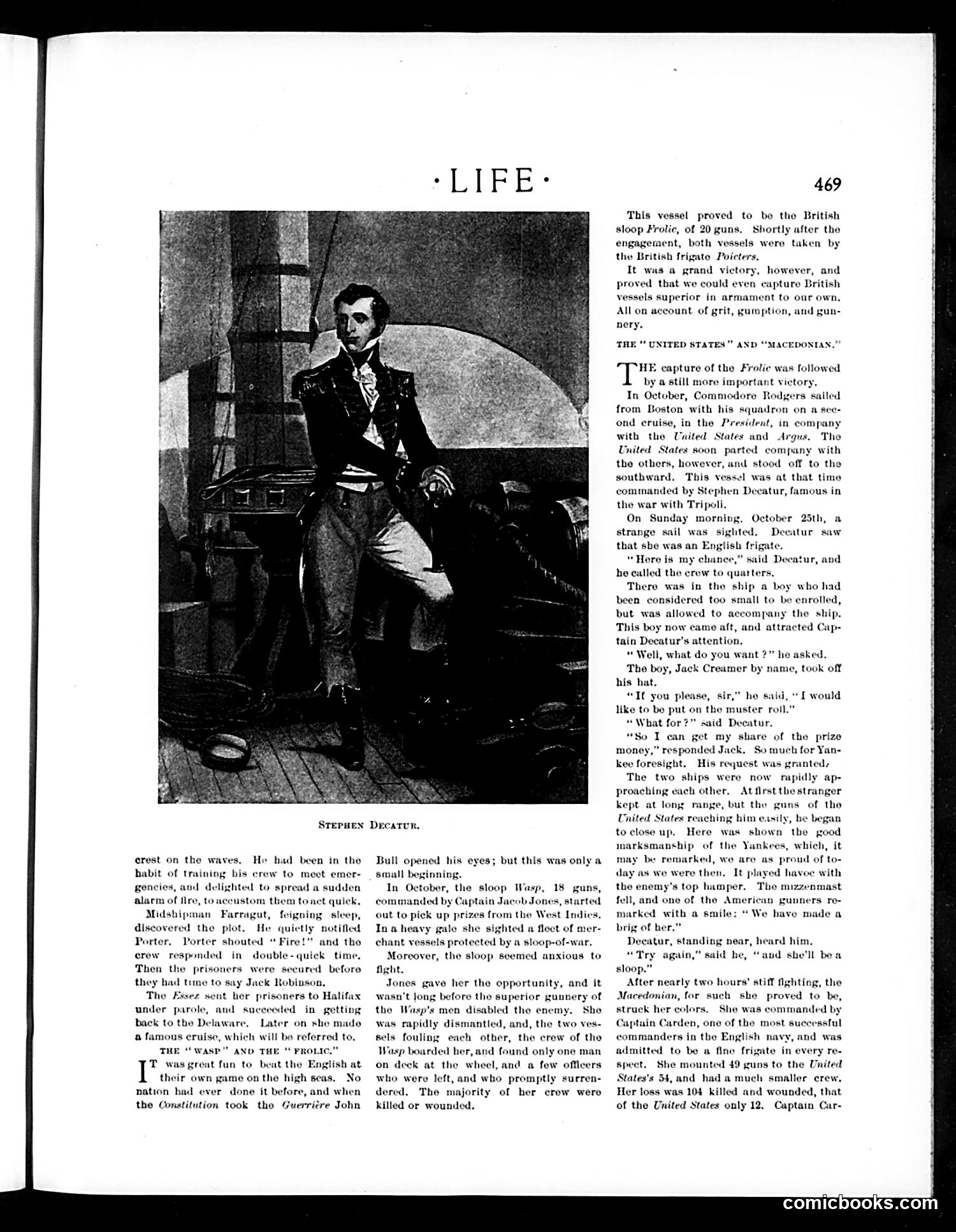
This page celebrates American naval successes in the War of 1812, specifically under Commodore Stephen Decatur (shown in the portrait). The text describes two engagements: 1. **USS Wasp vs. HMS Frolic** (October 1812): An American sloop defeated a British sloop-of-war, proving Americans could defeat superior British vessels through superior gunnery. 2. **USS United States vs. HMS Macedonian** (October 25, 1812): Decatur commanded the *United States* against a British frigate. The anecdote about young Jack Creamer wanting to be enrolled to claim prize money illustrates American enterprise and optimism. The piece celebrates American naval skill and "grit, gumption, and gunnery" as sources of national pride during an unpopular war. The tone is triumphalist, emphasizing that Americans could defeat the Royal Navy—historically dominant—through superior marksmanship and seamanship.
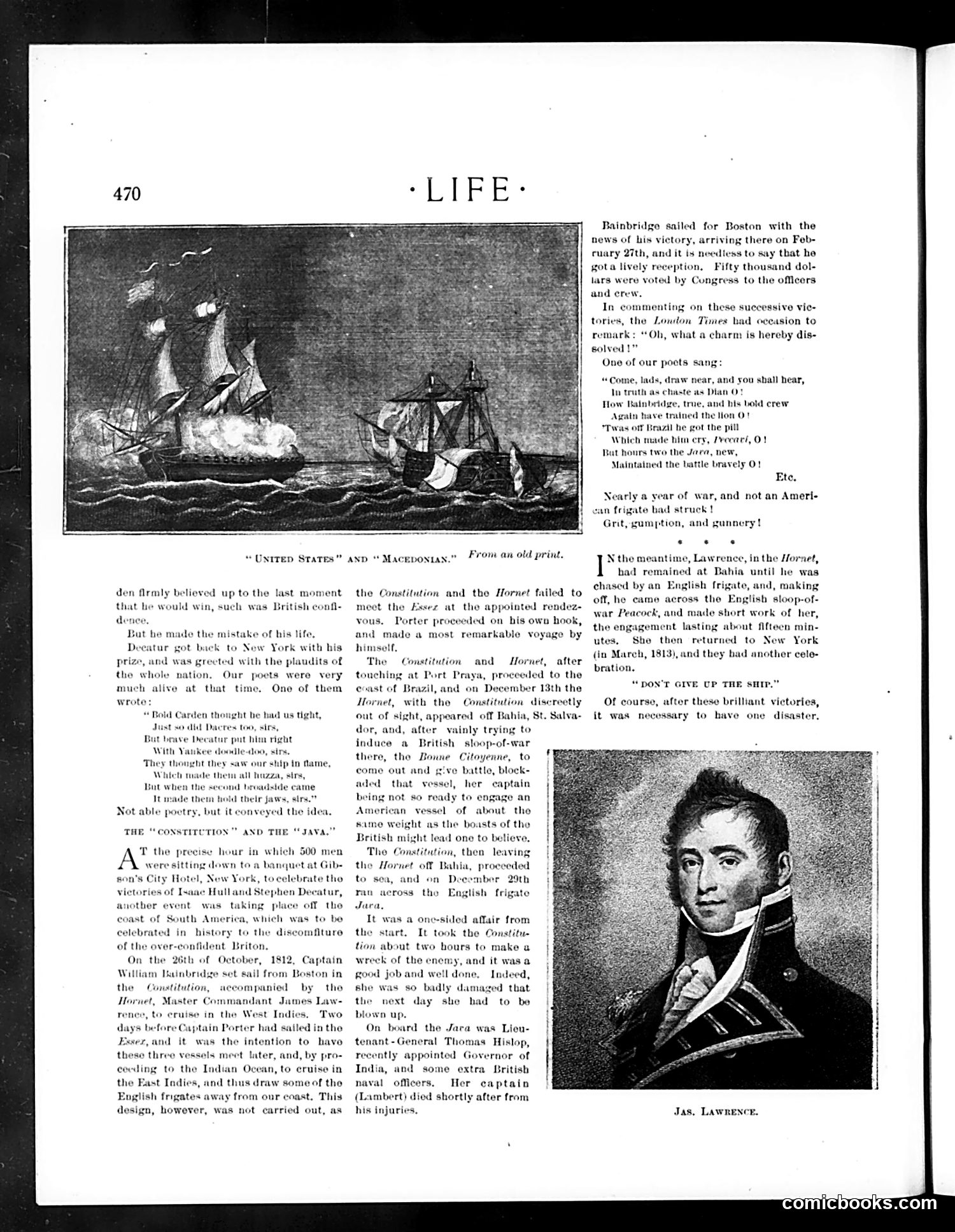
This page celebrates American naval victories in the War of 1812, specifically battles involving the USS *Constitution* and USS *Hornet*. The engraved print at top shows a naval engagement between these American vessels and British ships. The text describes Captain Bainbridge's defeat of the British frigate *Java* in December 1812, and Captain Lawrence's victory over the British sloop *Peacock*. These were significant morale-boosters for Americans during the unpopular war. The satire's point: after early American naval successes, the British press (the *London Times*) had mocked American naval capabilities. The quoted remark—"Oh, what a charm is hereby dissolved!"—sarcastically suggests British confidence in their naval supremacy was shattered. The patriotic poem below celebrates American "grit, gumption, and gunnery," contrasting with British overconfidence. The portrait shows James Lawrence, the celebrated naval commander referenced in the article. The overall message celebrates underdog American naval prowess against the supposedly superior British fleet.
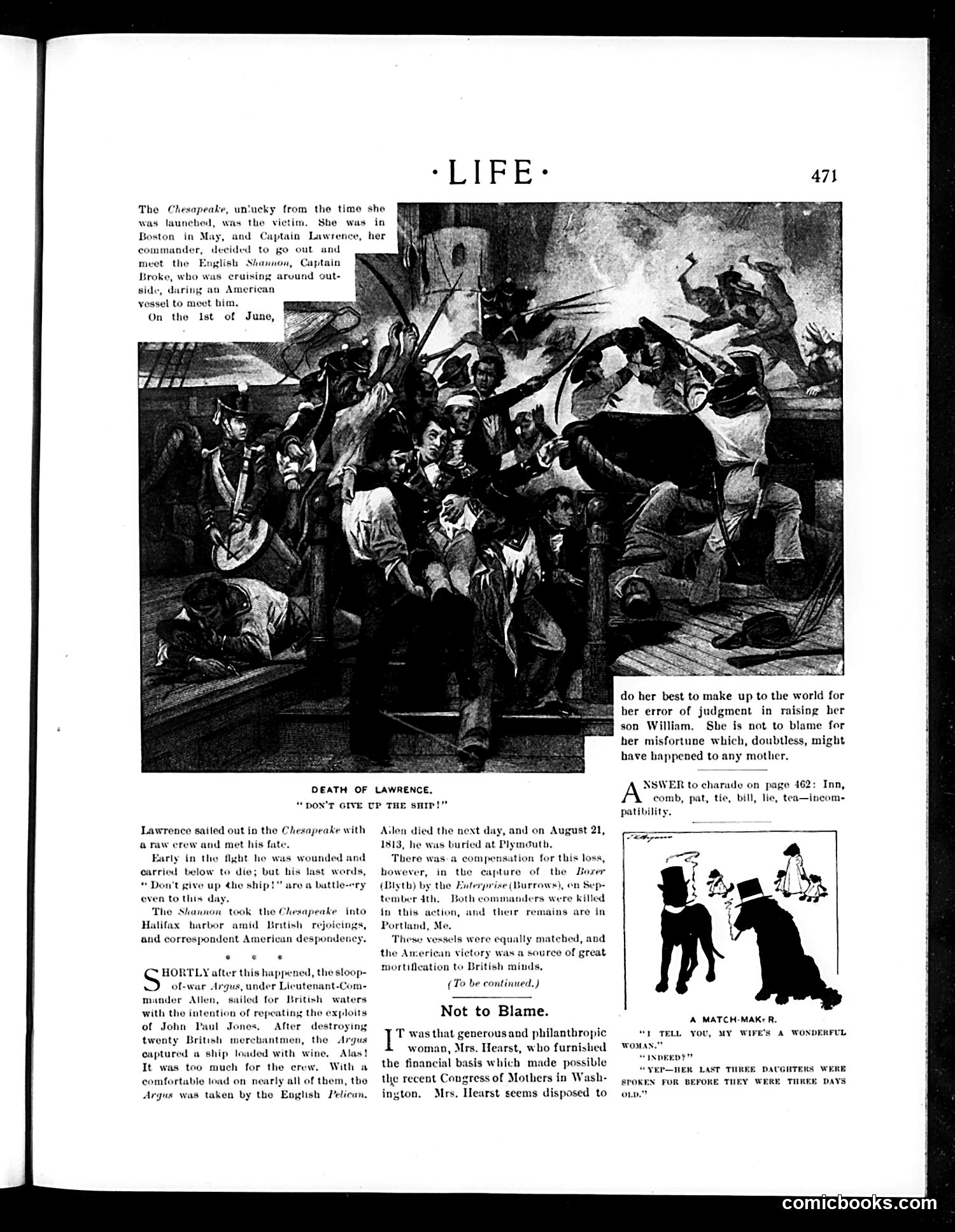
This page covers American naval engagements in the War of 1812. The central engraving depicts the **Death of Lawrence**—Captain James Lawrence's fatal encounter with HMS Shannon in June 1813. Lawrence's dying words, "Don't give up the ship!" became an American rallying cry. The text documents subsequent naval actions: the Argus under Commander Allen (later captured by HMS Pelican) and the matched battle between the Enterprise and Boxer, where both commanders died. Below is satirical commentary on **Mrs. William Randolph Hearst**, a wealthy philanthropist who funded the recent Congress of Mothers in Washington. The author sarcastically credits her with "generosity" while backhanded-ly suggesting her son William's upbringing represents a parental failure she now attempts to compensate for through public charity. The small cartoon bottom-right appears unrelated social humor about matchmaking.
This page contains **editorial cartoons and humorous anecdotes** typical of Life's satirical format, rather than a single cohesive cartoon. ## The Main Stories: 1. **"I'm Scissors at Nully"** (top): A nursery-rhyme style jab at bacteria/germs, adapting "Little Miss Muffet" to blame microbes (appearing topical to germ-theory medicine). 2. **"No Woman Should Marry..."**: A back-and-forth anecdote where a cynical woman warns others about marriage, countered by a Kentucky lady. The punchline involves a sleigh race: a Colonel deliberately lets a Judge overtake him to avoid humiliation in front of a lady passenger—satirizing male vanity masquerading as chivalry. 3. **Manila anecdote** (bottom): A brick falls from a carrier's hod, hits a Spanish flag. A passerby quips it "must have been American," the carrier responds it's "of Irish descent"—likely poking fun at Irish-Americans as reckless/destructive, and American-Spanish tensions post-Spanish-American War. The page is primarily **humorous social commentary** on relationships, male pride, and immigrant stereotypes.
This is primarily an **advertising page**, not a satirical cartoon page. It contains multiple product advertisements typical of early 20th-century Life magazine: The ads promote consumer goods: Abbott's Angostura Bitters and English tobaccos (Captain Bird's Eye, Westward Ho, Three Castles Gold Flake); Phill White Rose Glycerine Soap; Boot Jack plug tobacco; Rocky Mountain Limited railway service between Chicago and Colorado; Whitman's chocolates; Sen-Sen breath perfume; and Low's military brushes. **No political satire or cartoon commentary is present.** The page functions as a revenue source through paid advertisements. The only visual element beyond product names is a woman's photograph advertising Whitman's chocolates—a straightforward commercial endorsement, not editorial commentary. This reflects how Life magazine financed itself: satirical editorial content subsidized by conventional advertising.
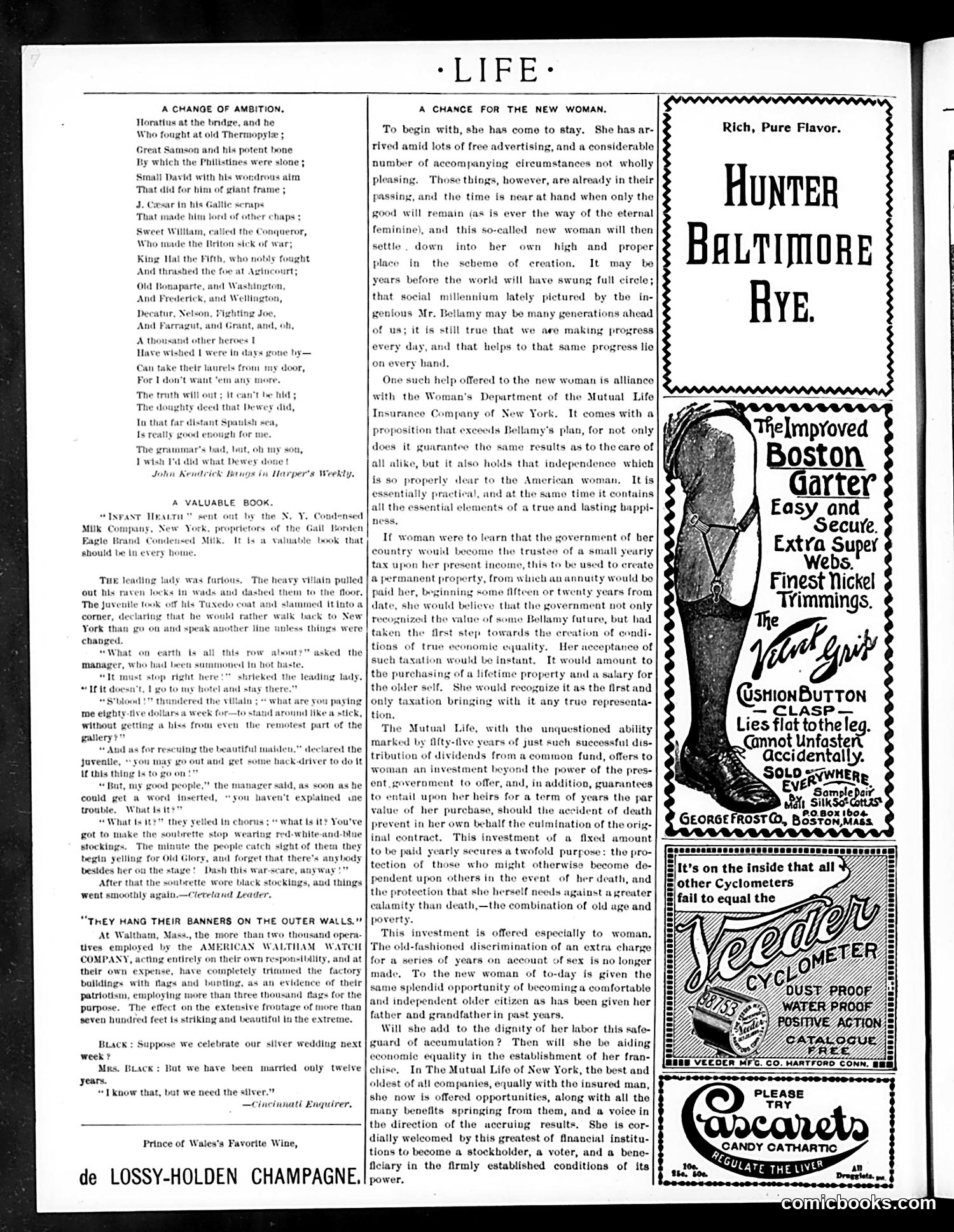
This page contains primarily **advertisements and literary content** rather than political cartoons. The main elements are: **Left column:** A poem by John Kendrick Bangs titled "A Change of Ambition," humorously listing historical military heroes (Horatius, Samson, Caesar, King Henry V, Admiral Dewey) whom the speaker no longer wishes to emulate—asserting he's "done" with their laurels. **Center column:** An editorial advocating for the "new woman," discussing a financial investment opportunity through the Mutual Life Insurance Company of New York. It argues that insurance allows women independence and security—a progressive stance for the era, positioning financial autonomy as compatible with femininity. **Right side:** **Advertisements** for Hunter Baltimore Rye whiskey, an improved Boston garter, a Veeder cyclometer, and Cacarets candy laxative. The "new woman" editorial reflects early 1900s debates about women's expanding social roles, suggesting that financial independence need not conflict with traditional femininity—a moderately progressive message for Life's readership.
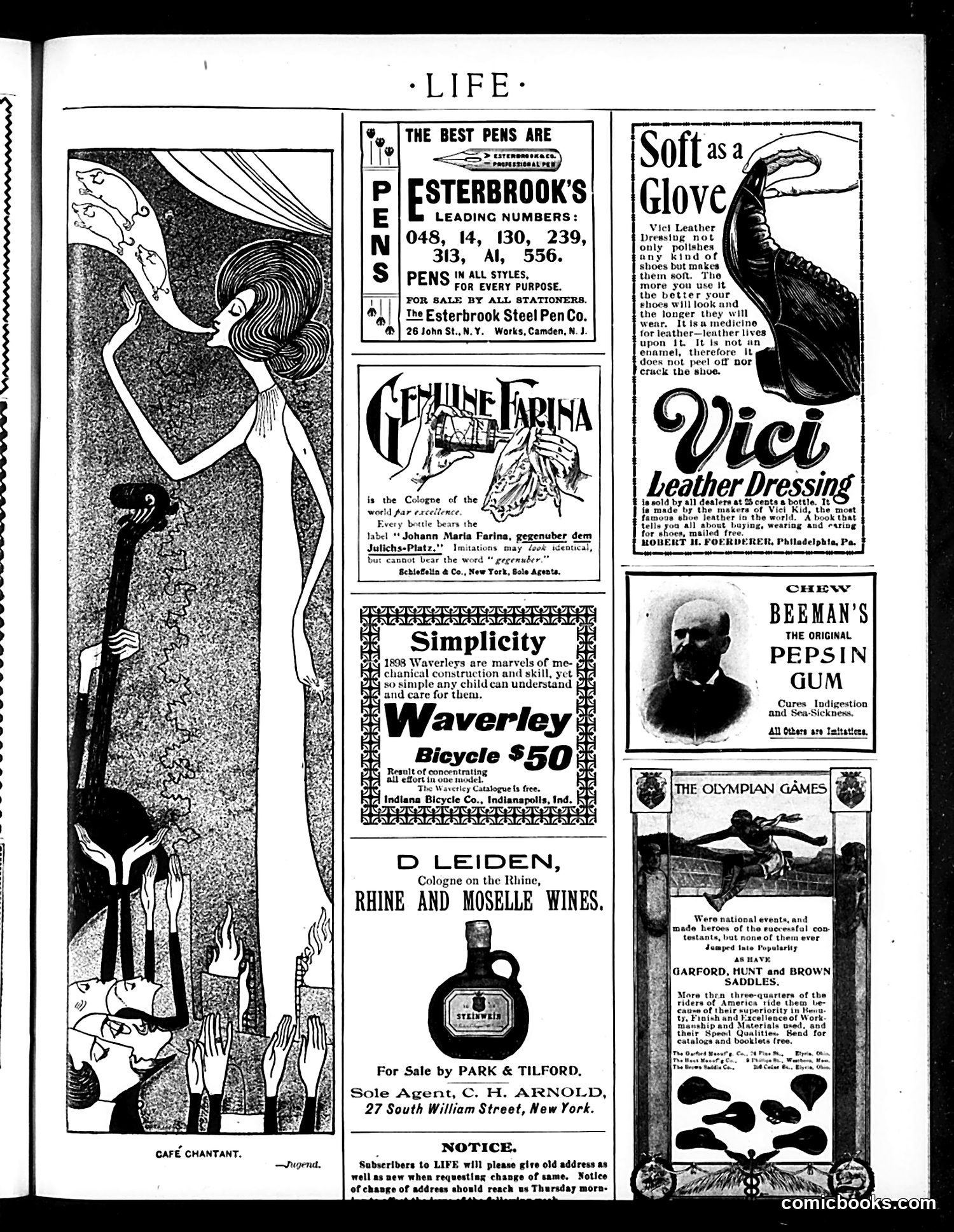
This page is **primarily advertising**, not political satire. It consists of product advertisements from circa 1898, including: - **Esterbrook Steel Pens** (writing instruments) - **Genuine Farina Cologne** (German fragrance) - **Waverley Bicycle** ($50, marketed as simple/reliable) - **Vici Leather Dressing** (shoe polish) - **Beeman's Pepsin Gum** (claimed to cure indigestion) - **D. Leiden Rhine and Moselle Wines** - **Garford, Hunt and Brown Saddles** (equestrian equipment) - **Olympian Games** (referencing saddle quality) The left side features "Café Chantant," a stylized Art Nouveau illustration of a woman in an elegant pose—typical period magazine artwork. The advertisements reflect **late-19th-century consumer culture**: emphasis on mechanical innovation (bicycles), European luxury goods (cologne, wine), patent medicines, and leisure products. No political message is evident; this is commercial content typical of *Life* magazine's revenue model.
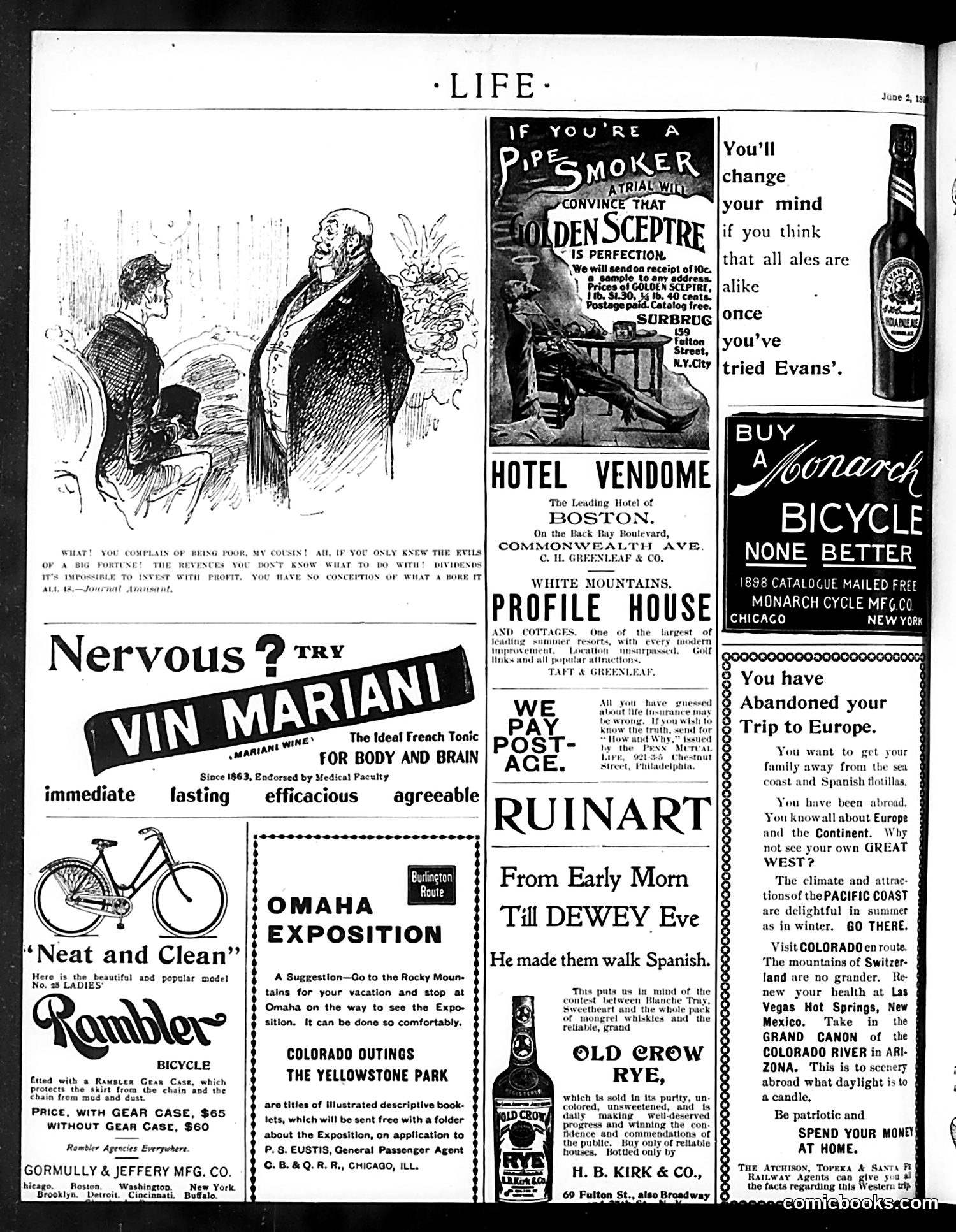
This page is primarily **advertising**, with one small political cartoon at top left. ## The Cartoon The sketch shows a wealthy man complaining to his cousin about the burdens of riches—"dividends to invest with profit" and "what a bore it all is." The cousin appears sympathetic. The satire targets **wealthy elites** who self-pityingly bemoan their financial obligations, a joke about the absurdity of the rich complaining about managing their fortunes while ordinary people struggle with poverty. ## The Advertisements The page is dominated by product and travel ads typical of 1898: bicycles (Rambler, Monarch), hotels, patent tonics (Vin Mariani wine tonic claiming to cure nervousness), whiskeys (Old Crow Rye), and importantly, **tourist destinations**—the Omaha Exposition, Colorado, Yellowstone Park, and the Pacific Coast. The "Abandoned your Trip to Europe" ad cleverly redirects wealthy travelers to American destinations, emphasizing patriotic spending "at home" rather than abroad. This reflects the era's emerging American confidence and tourism infrastructure.