
Life, 1898-06-02 · page 4 of 20
Life — June 2, 1898 — page 4: what you’re looking at
What you’re looking at
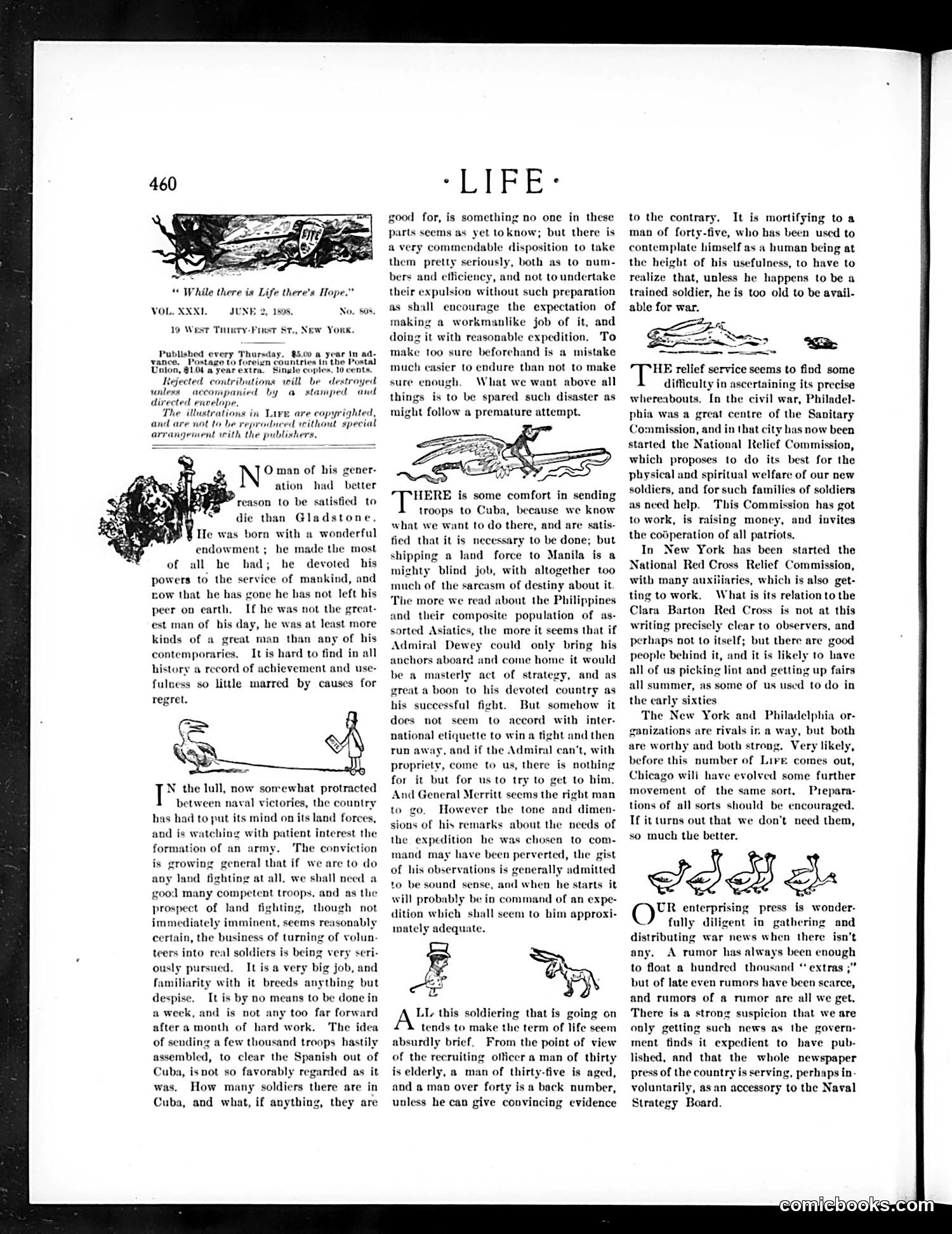
This page contains editorial commentary on the Spanish-American War, particularly regarding military operations in Cuba and the Philippines. The text discusses troop deployment, Admiral Dewey's naval strategy, and the composition of American forces being sent to Cuba. The small illustrations appear to be decorative vignettes typical of the era—including what look like soldiers, military equipment, and animals—rather than pointed political cartoons. The main content is serious editorial discussion about war strategy and relief efforts, including mention of the National Red Cross Relief Commission and the Clara Barton Red Cross. The tone suggests wartime reporting and patriotic concern for soldiers' welfare rather than satirical commentary. This is primarily journalism with institutional illustrations, not satirical cartooning.
📄 Transcribed text from this page (OCR, searchable)
Machine-transcribed from the original scan — historical spelling and the odd misread are preserved.
“ While there is Life there's Hope.” VOL. XXXI. JUNE 2, 1898. No, $605. 19 West Tury-Pinest St., New Yor. Published every Thursday. vane Union, $5.00 @ year | tage to foreign countries in the year extra. Single coples. 10 ed contributions will be destroyed wnless mpanied by a stamped and directed envelope, The illustrations in Live are copyrighte and are not to ber ‘odneced without 3} ial arrangement with the publishers, O man of his gener- ation had better reason to be satisfied to die than Gladstone. ¥ He was born with a wonderful endowment ; he made the most of all he had; he devoted his powers to the service of mankind, and tow that he has gone he has not left his peer on earth. If he was not the great- est man of his day, he was at least more kinds of a great man than any of his contemporar It is hard to find in all history a record of achievement and use- fulness so little marred by causes for regret. Ts the lull, now somewhat protracted between naval victories, the country has had to put its mind on its land forces, and is watching with patient interest the formation of an army. The conviction is growing general that if we are to do any land fighting at all, we shall need a good many competent troops, and as the prospect of land fighting, though not immediately imminent, seems reasonably certain, the business of turning of volun- teers into real soldiers is being very seri- ously pursued. It is a very big job, and familiarity with it breeds anything but despise. It is by no means to be done in a week, and is not y too far forward after a month of hard work. The idea of sending a few thousand troops hastily assembled, to clear the Spanish out of Cuba, isnot so favorably regarded as it was. How many soldiers there are in Cuba, and what, if anything, they are “LIFE - good for, is something no one in these parts seems as yet toknow; but there is a very commendable disposition to take them pretty seriously, both as to num- bers and efficiency, and not to undertake their expulsion without such preparation as shall encourage the expectation of ing a workmanlike job of it, and g it with reasonable expedition. To make too sure beforehand is a mistake much easier to endure than not to make sure enough. What we want above all things is to be spared such disaster as might follow a premature attempt. HERE is some comfort in sending troops to Cuba, because we know what we nt to do there, and are satis- fied that it is necessary to be done; but shipping a land force to Manila is a mighty blind job, with altogether too much of the sarcasm of destiny about it. The more we read about the Philippines and their composite population of as- sorted Asiatics, the more it seems that if Admiral Dewey could only bring his anchors aboard and come home it would be a masterly act of strategy, and as great a boon to his devoted country as his successful fight. But somehow it does not seem to accord with inter- national etiquette to win a tight and then run away, and if the Admiral can’t, with propriety, come to us, there is nothing for it but for us to try to get to him. And General Merritt seems the right man to go. However the tone and dimen- sions of his remarks about the needs of the expedition he was chosen to com- mand may have been perverted, the gist of his observations is generally admitted to be sound sense, and when he starts it will probably be in command of an expe- dition which shall seem to bim approxi- mately adequate. e °s3 LL this soldiering that is going on tends to make the term of life seem absurdly brief, From the point of view of the recruiting olticcr a man of thirty is elderly, a man of thirty-five is aged, and a man over forty is a back number, unless he can give convincing evidence to the contrary. man of forty. It is mortifying to a five, who has been used to contemplate himself as a human being at the height of his usefulness, to have to realize that, unless he happens to be a trained soldier, he is too old to be avail- able for war. HE relief service seems to find some difficulty in ascertaining its precise whereabouts. [n the civil war, Philadel- phia was a great centre of the Sanitary Commission, and in that city has now been. started the National Relicf Commission, which proposes to do its best for the physical and spiritual welfare of our new soldiers, and for such families of soldiers as need help. This Commission has got to work, is raising money, and invites the codperation of all patriots. In New York has been started the National Red Cross Relief Commission, witb many auxiliaries, which is also get- ting to work. What is its relation to the Clara Barton Red Cross is not at this writing precisely clear to observers, and perhaps not to itself; but there are good. people behind it, and it is likely to have all of us picking lint and getting up fi all summer, as some of us used to do in the carly sixties The New York and Philadelphia or- ganizations are rivals ir a w but both are worthy and both strong. Very likely, before this number of Lire comes out, Chicago wili have evolved some further movement of the same sort, Prepara- tions of all sorts should be encouraged. If it turns out that we don't need them, so much the better. 2B J. Om enterprising press is wonder- fully diligent in gathering and distributing war news when there isn’t any. A rumor has always been enough to float a hundred thousand “ extras ;” but of late even rumors have been scarce, and rumors of a rumor are all we get. There is a strong suspicion that we are only getting such news as the govern- ment finds it expedient to have pub- lished, and that the whole newspaper press of the country is serving, perhaps in voluntarily, as an accessory to the Naval Strategy Board.