
A complete issue · 20 pages · 1898
Life — March 24, 1898
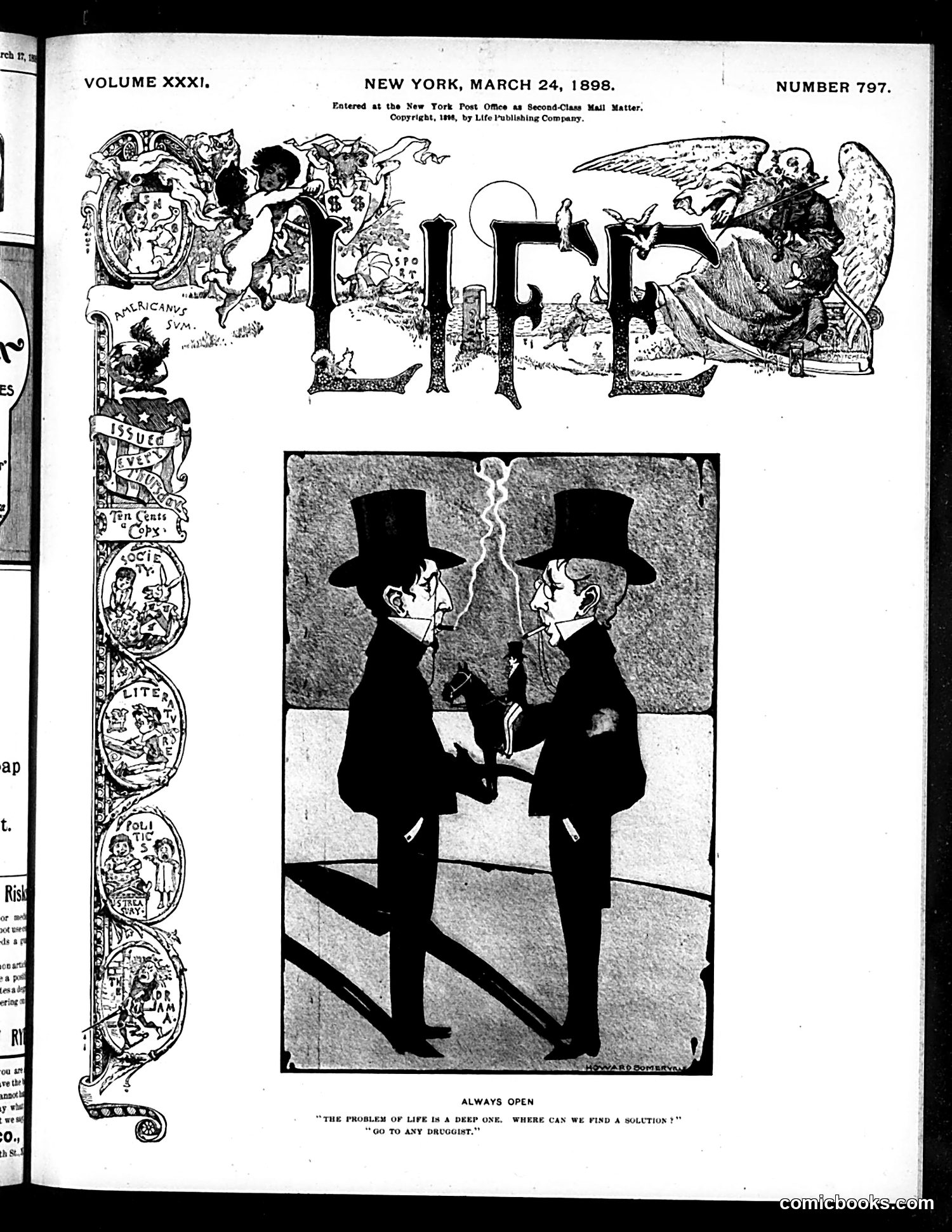
The main cartoon depicts two men in top hats facing each other, smoking cigars, with a small figure between them. The caption reads: "THE PROBLEM OF LIFE IS A DEEP ONE. WHERE CAN WE FIND A SOLUTION?" with the suggestion "GO TO ANY DRUGGIST." This is satirical commentary on a contemporary social issue—likely referencing either patent medicine culture or a political/social problem of 1898. The two well-dressed figures represent establishment authority or opposing viewpoints, while the tiny figure between them suggests an insignificant person caught in an important debate. The punchline mocks the era's tendency to solve complex problems through commercial remedies (druggists commonly sold patent medicines and tonics as cure-alls). The ornate decorative border on the left is typical of Life's design aesthetic of this period.
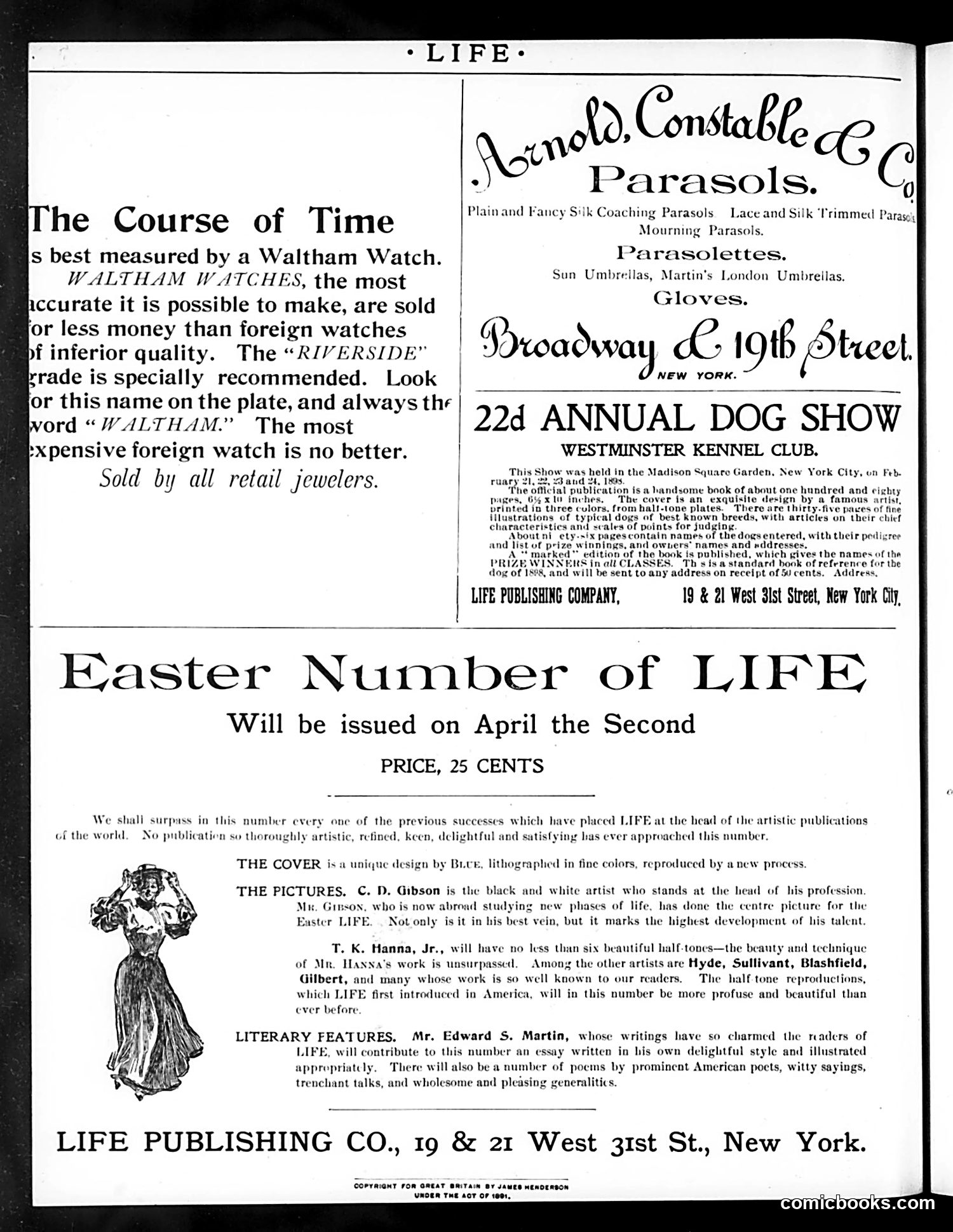
This page is **primarily advertising and promotional content**, not political satire. The visible elements include: - **Waltham Watch advertisement** promoting accurate timekeeping - **Arnold, Constable & Co. advertisement** for parasols and gloves at Broadway & 19th Street, New York - **Westminster Kennel Club Dog Show announcement** for the 22nd annual show - **Life Magazine's Easter Number promotion** (April 2nd issue, 25 cents) The bottom half features promotional text about the upcoming Easter issue, highlighting cover design, illustrations, and literary contributions. There is a decorative illustration of a woman in period dress on the left side. **This is not satirical content**—it's a magazine back page devoted to advertisements and self-promotion, typical of early 1900s publication layouts.
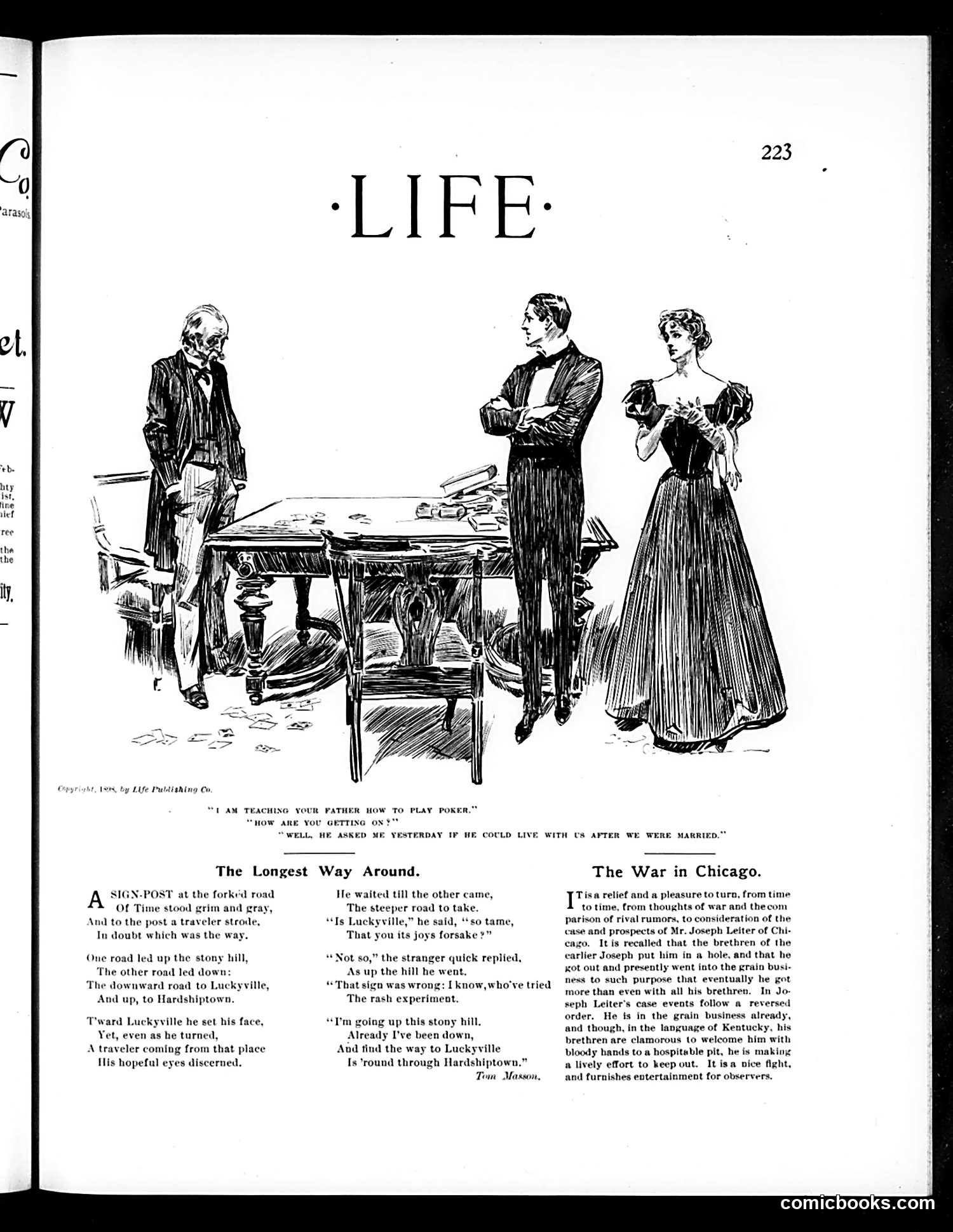
The page shows a social satire cartoon titled "Life" (page 223). The illustration depicts three figures around a desk: two men and a woman in late 19th/early 20th-century dress. The caption reads: "I am teaching my wife to play poker. 'How are you getting on?' 'Well,' he asked me yesterday if he could live with us after we were married.'" The joke satirizes the emerging phenomenon of women learning "masculine" games like poker. The husband's concern that his wife's poker skills might be *too good*—suggesting she could win money from potential suitors—reflects period anxieties about changing gender roles. The satire mocks both wives' growing independence and husbands' fears of losing financial or social control. Below are two unrelated poems: "The Longest Way Around" and "The War in Chicago."
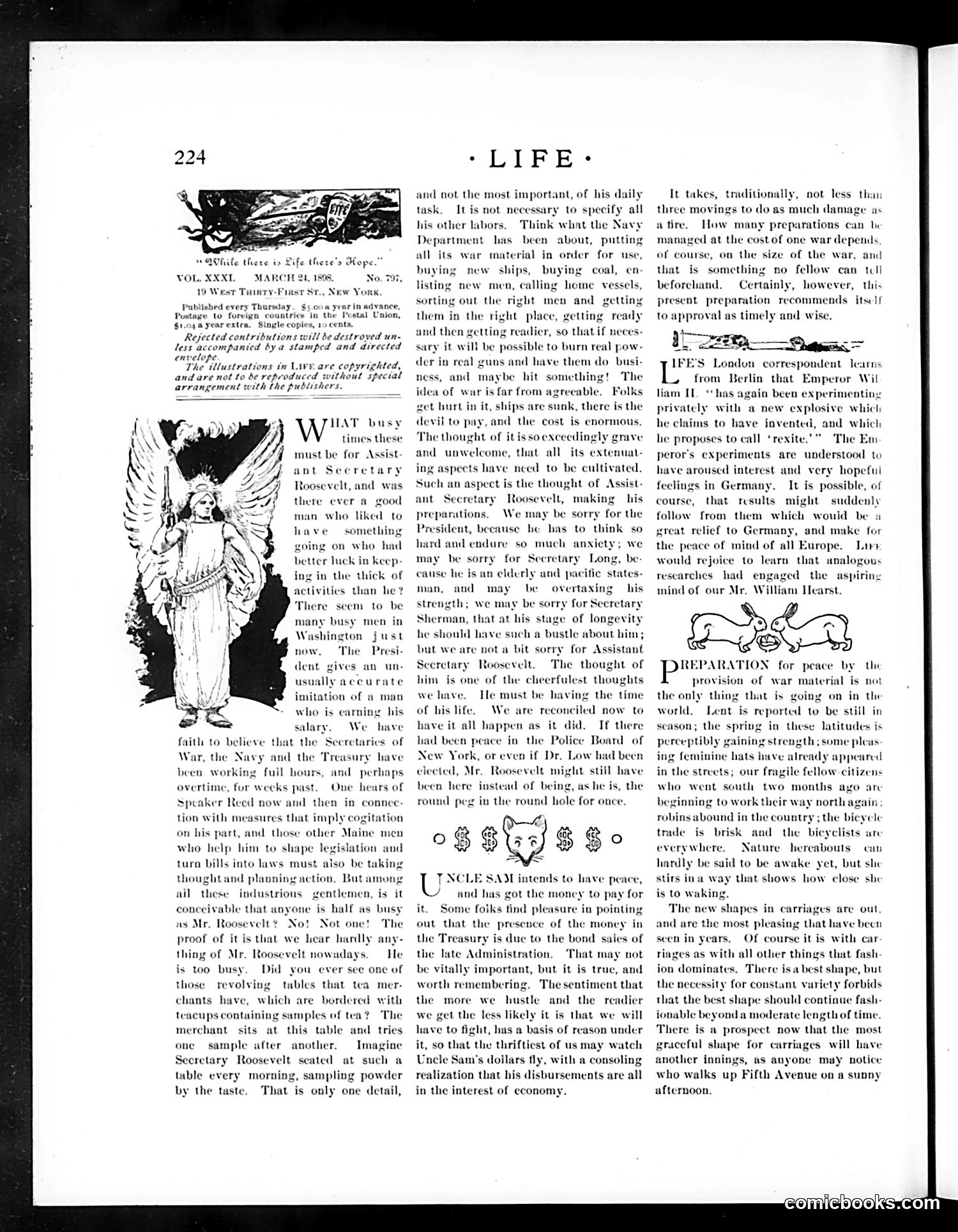
This page contains satirical commentary on WWI preparedness during America's involvement in the war. The left cartoon depicts a winged female figure (Lady Liberty or similar allegorical symbol) addressing busy government officials, captioned "What busy times there are for Assistants and Secretaries!" The satire critiques the Roosevelt administration's wartime bureaucracy. The text mocks how many subordinate officials are occupied with preparations while questioning whether the actual leadership (appearing to reference Assistant Secretary Roosevelt and Secretary of the Navy) is adequately managing war efforts—particularly ship production, coal supplies, and personnel deployment. The right column discusses material shortages and civilian preparations, including bicycles and spring fashions, tying the war effort to everyday American life. The overall tone suggests frustration with bureaucratic inefficiency during critical wartime mobilization.
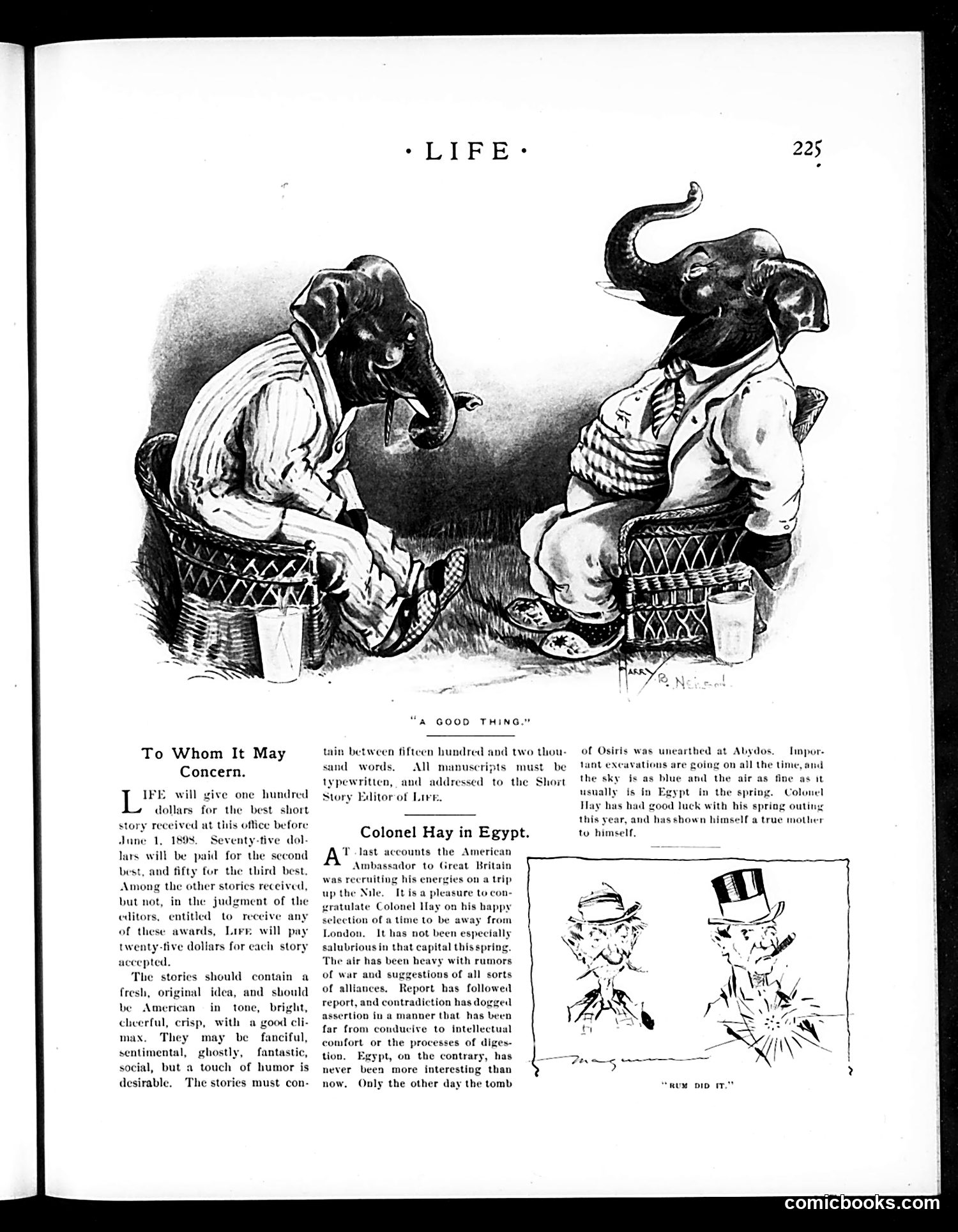
**Main Cartoon ("A Good Thing"):** Two anthropomorphic elephants sit conversing. This is satirical commentary on American politics, as the elephant is the Republican Party symbol. The cartoon appears to mock political discourse or strategy of the era, though the specific political situation isn't entirely clear from the visible text. **"Colonel Hay in Egypt" Section:** References American Ambassador John Hay's diplomatic mission to Egypt. The text describes excavations of the tomb of Osiris occurring near Aswan and comments on Hay's good fortune being away from London during spring. Two small caricature sketches below show figures labeled "Rum Did It"—likely satirizing some diplomatic or political situation related to Hay's absence. The page mixes political humor with international affairs commentary typical of Life's satirical approach.
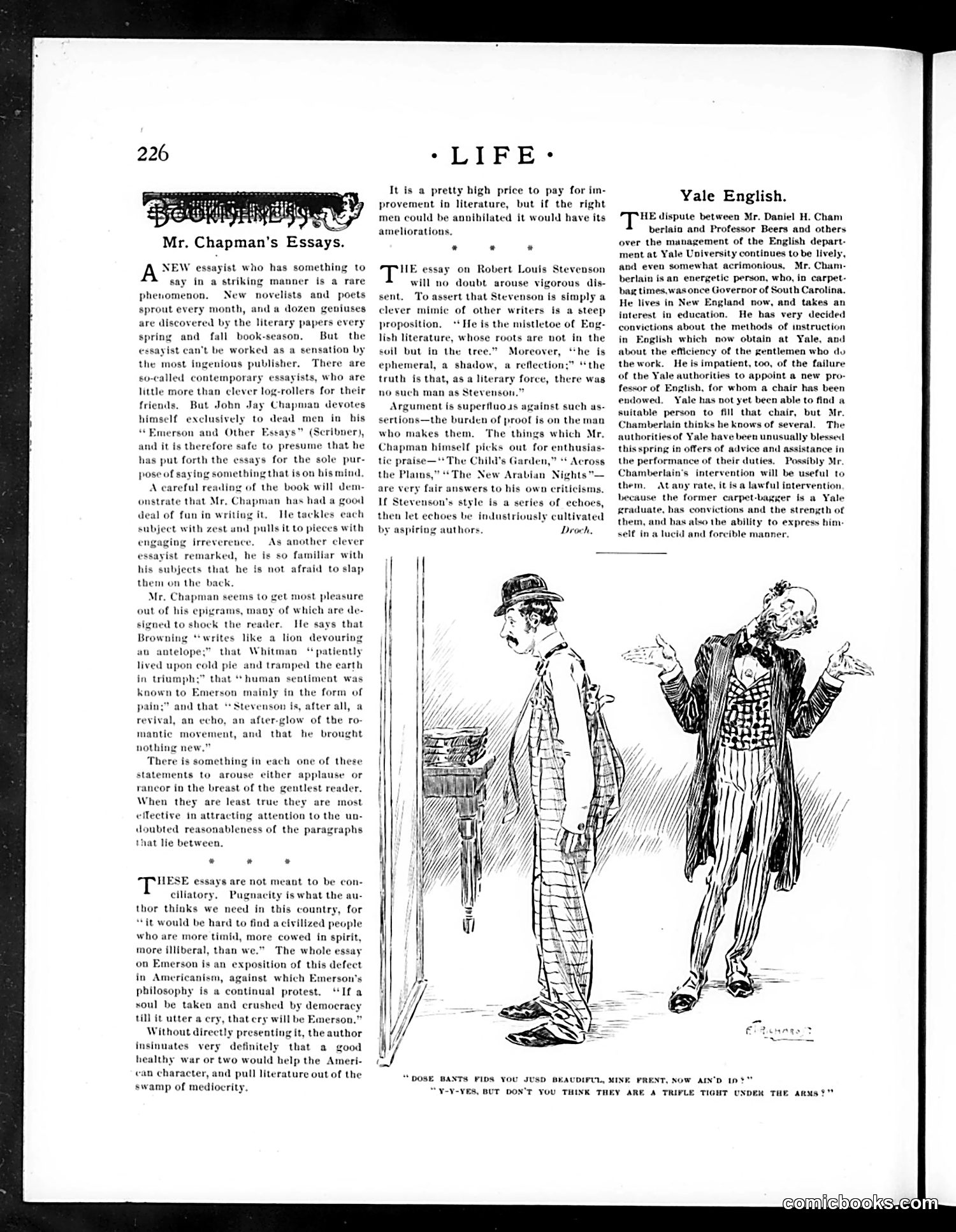
The page contains a literary essay about Mr. Chapman's Essays and Yale English studies, not a political cartoon. The illustration shows two men in conversation—one wearing a bowler hat and checkered suit (appearing somewhat eccentric or affected), and another in formal attire gesturing expressively. The caption reads: "DOES RANTS FITS YOU JUNO BEAUTIFULLY, NINE FRONT, NOW AIN'D IN?" followed by "Y-Y-YES, BUT DON'T YOU THINK THEY ARE A TRIFLE TIGHT UNDER THE ARMS?" This appears to be satirizing pretentious or affected speech and fashion consciousness among the upper classes—mocking someone's overly formal diction and vanity about clothing fit. The humor derives from the contrast between aspirational formal language and the mundane concern about tight armpits.
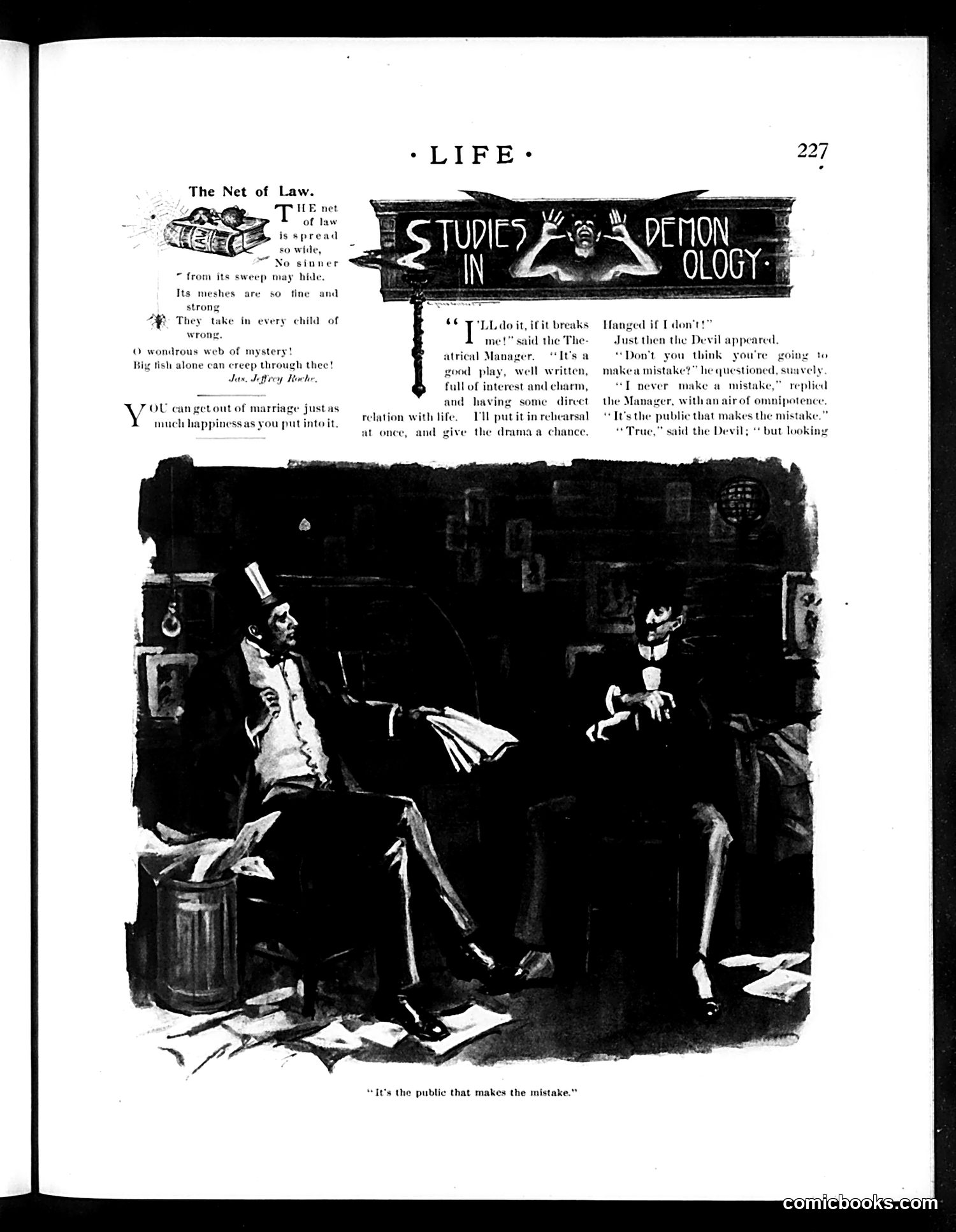
This page features a theatrical satire about a play's reception. The headline "Studies in Demonology" frames a dialogue between a Theatrical Manager and the Devil, discussing whether the play will succeed. The cartoon below depicts a scene in what appears to be a theater office or backstage area. A well-dressed man (the Manager) sits conversing with a demonic figure, while a third character (possibly representing the public) observes from the right. The satire's punchline—"It's the public that makes the mistake"—suggests the piece mocks how theatrical success depends on audience reception rather than artistic merit. The Devil's involvement implies the play may be morally questionable yet commercially viable. This reflects early 20th-century concerns about public taste and commercialism in theater.
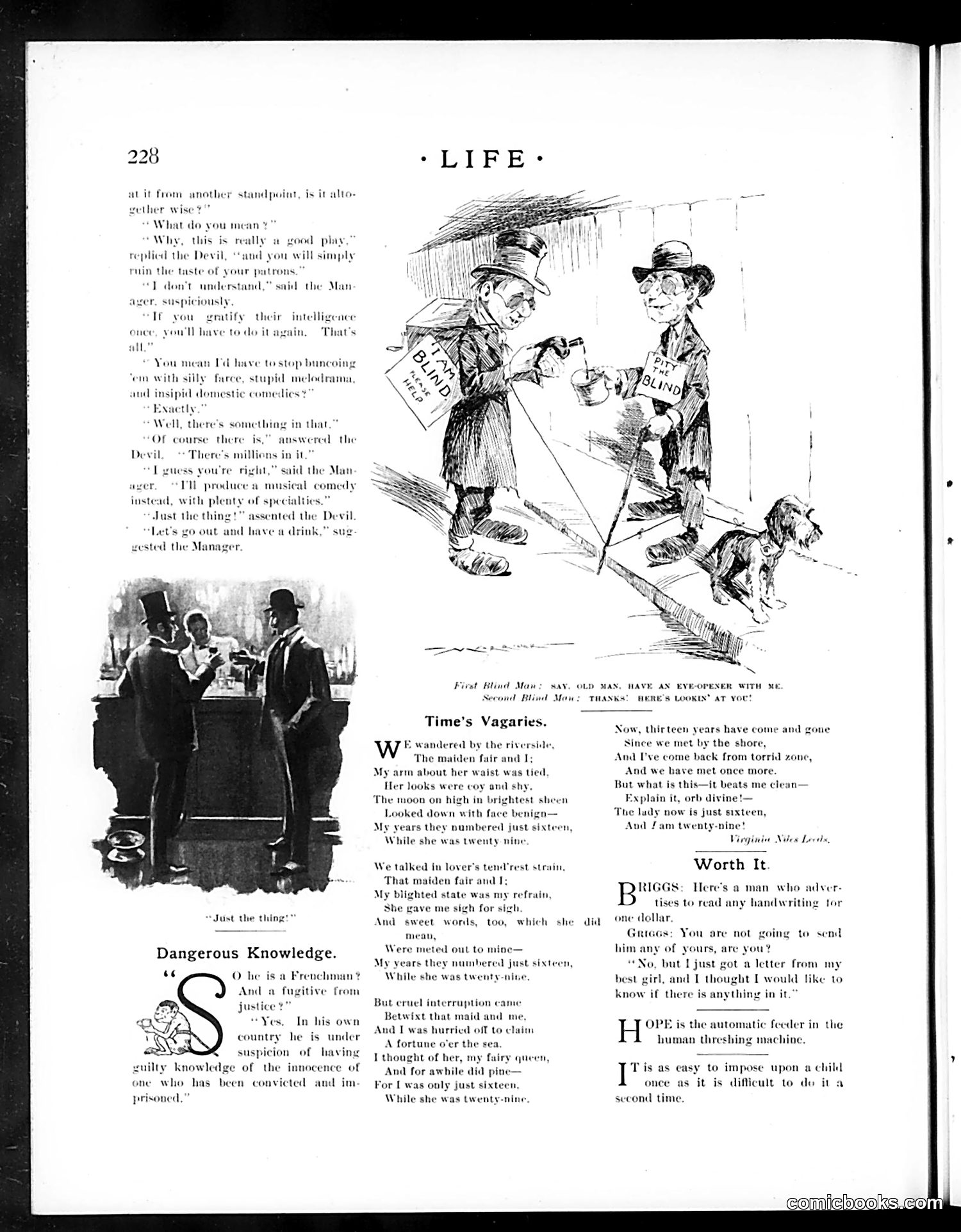
The main cartoon titled "Just the thing" depicts two men in formal attire (top hats) at what appears to be a bar, with dialogue about producing a "musical comedy" and stopping "bouncing on with silo force, stupid melodrama, and insipid domestics." The joke satirizes theatrical producers who compromise artistic standards for commercial appeal. The accompanying photograph shows three formally dressed men in conversation, likely illustrating the cartoon's scenario. Below, "Time's Vagaries" is a sentimental poem about lost love and the passage of years. Additional short humor pieces ("Worth It," "Dangerous Knowledge," "Hope") fill the page with typical satirical magazine jokes about human nature and social absurdities. The content represents early 20th-century magazine humor focusing on theatre, romance, and everyday social foibles rather than specific political commentary.
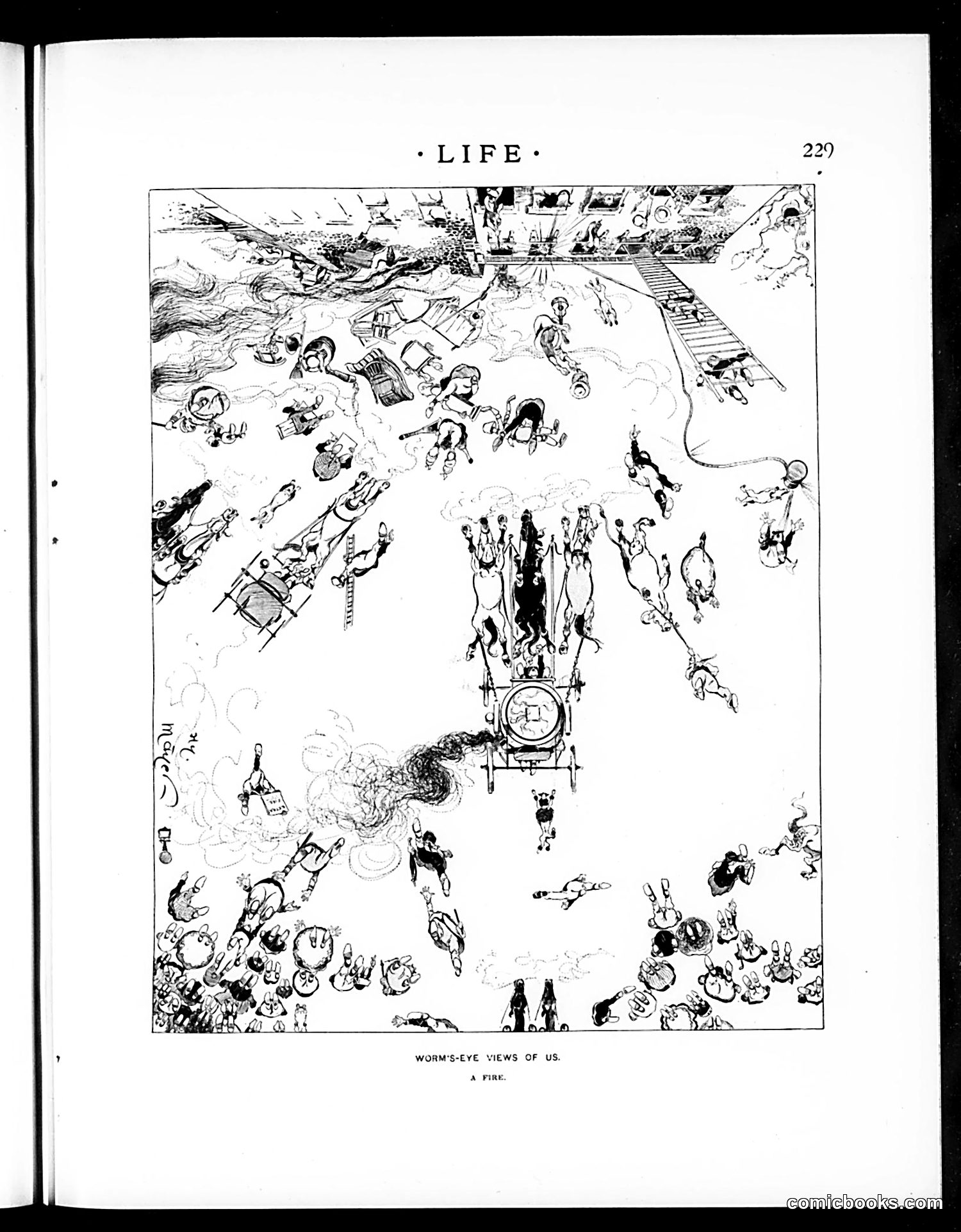
This satirical illustration depicts a chaotic fire scene from an ant's perspective—literally a "worm's-eye view." The cartoon shows a horse-drawn fire engine at center with firefighters and civilians scattered about in disarray. The satire appears to target the inefficiency and confusion of urban fire response: people run in various directions, some climbing ladders, others standing idle or gesturing uselessly. The humor derives from the overhead perspective, which reduces human activity to ant-like scrambling. This was likely commentary on either mismanaged emergency services or the comedic absurdity of human panic during crises. The vantage point emphasizes how small and frantic our efforts appear when viewed from an external, detached angle—a common satirical technique in *Life* magazine's social criticism.
This page shows a black and white photograph labeled "LIFE" on the left margin. The image depicts a person in formal attire (appearing to wear a suit and possibly holding a cane or stick) positioned horizontally or in a reclining pose against a dark background. Without clearer visibility of facial features or additional contextual text on the page, I cannot confidently identify the specific individual being depicted or the particular political or social commentary intended. The dramatic lighting and unusual positioning suggest this may be satirical commentary on a public figure of the era, but **I cannot determine the specific reference, event, or satirical point without risking inaccurate attribution.** To properly explain this cartoon's meaning to a modern reader, I would need additional context—such as a caption, date, or clearer identifying details.
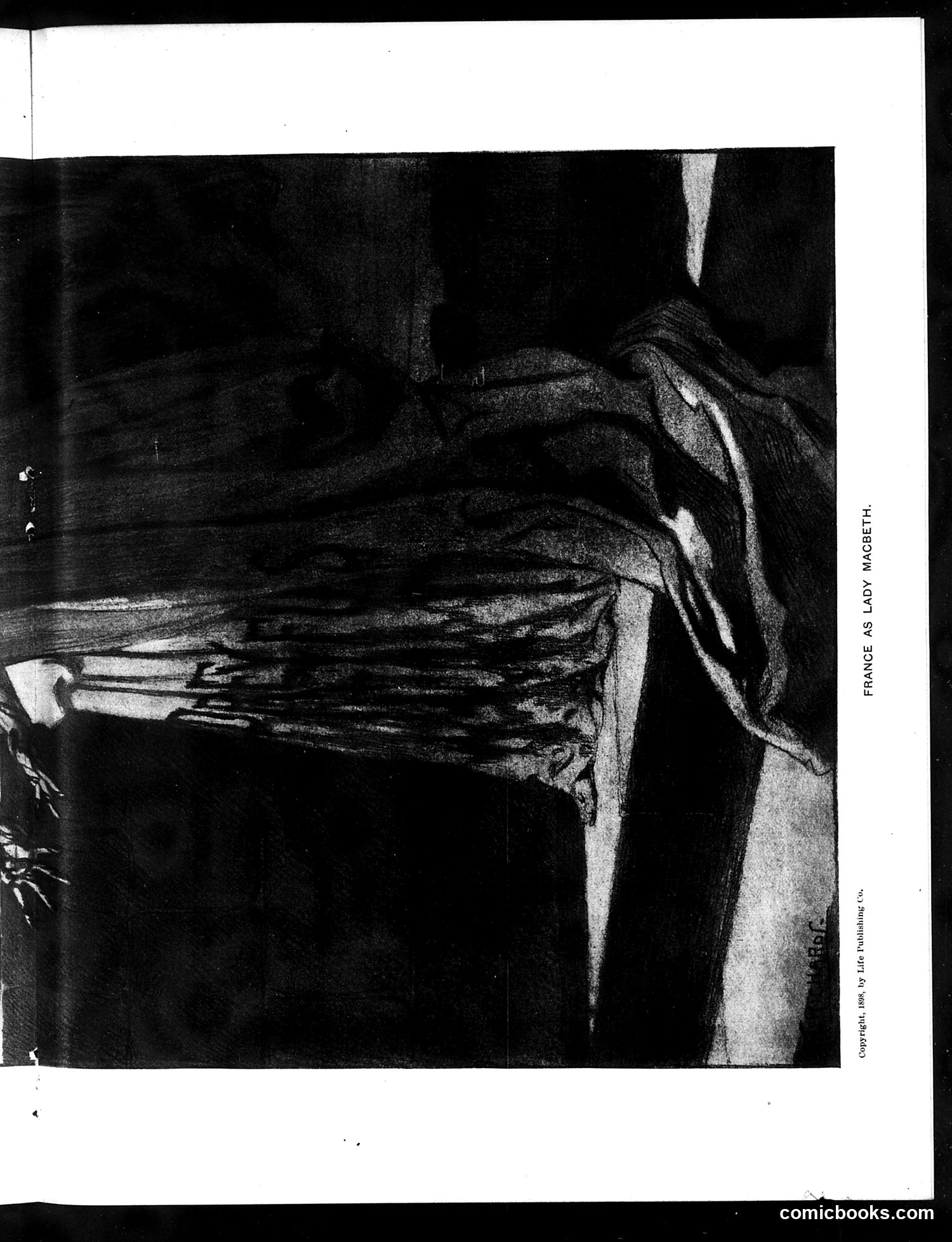
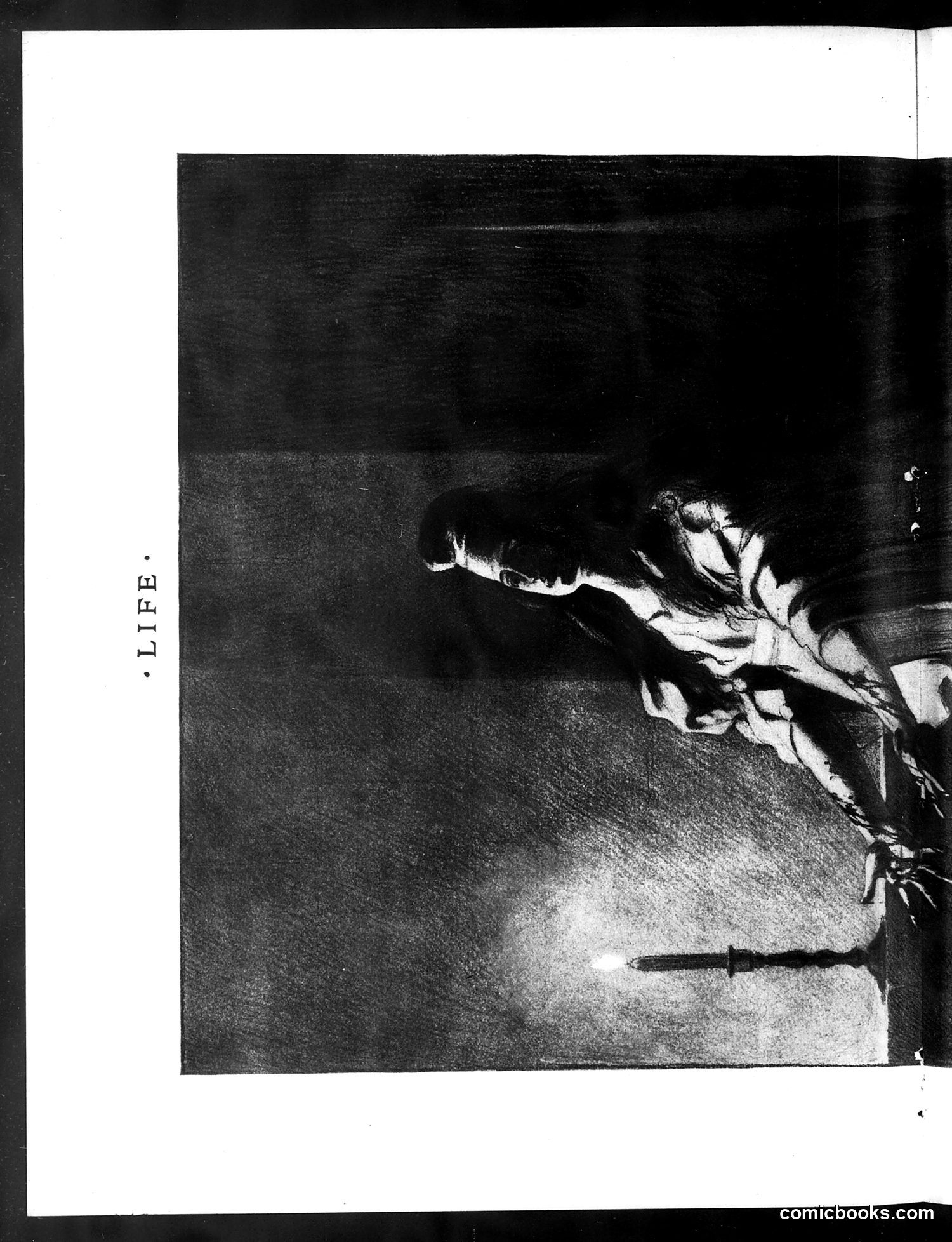
This appears to be a historical illustration showing a figure in elaborate period dress (possibly 18th century based on the clothing style and draping). The caption reads "FRANCE AS LADY MACBETH," which is the key to understanding the satire. The image uses Shakespeare's *Macbeth* as a political metaphor, depicting France personified as Lady Macbeth—the character famous for her ruthless ambition and complicity in murder. This suggests the cartoonist is characterizing French political leadership or foreign policy as morally corrupt or dangerously ambitious, comparable to Lady Macbeth's scheming nature. Without additional context about the specific publication date, I cannot identify the exact historical event being referenced, but the comparison implies criticism of French governmental actions or intentions during whatever period this was published.
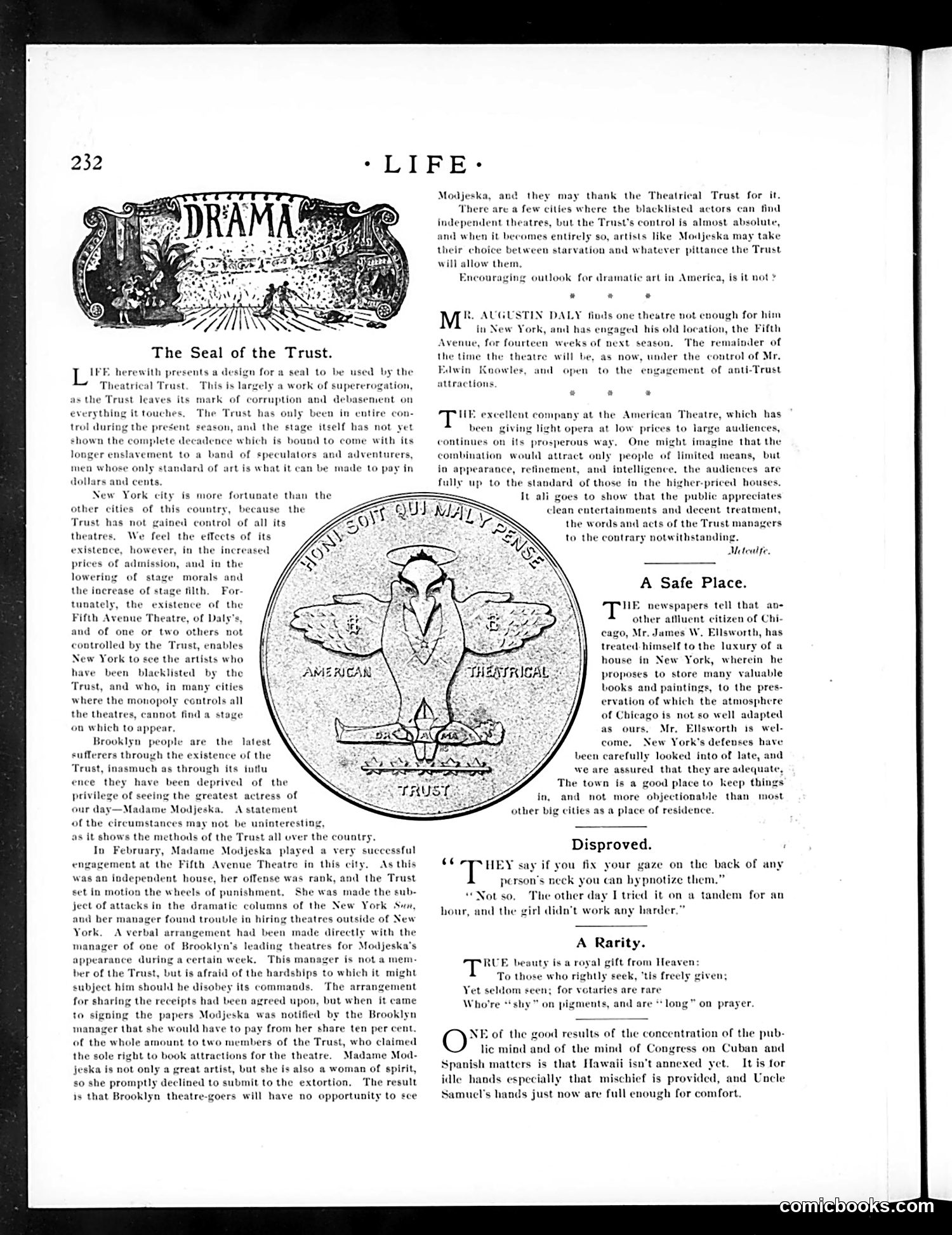
This page contains theater criticism rather than political cartoons. The central image is "The Seal of the Trust"—a circular seal depicting an eagle labeled "American Theatrical Trust" standing on a nest labeled "TRUST." **The Satire:** The article critiques the Theatrical Trust's monopolistic control over American theaters. The text describes how the Trust blacklisted independent theaters and artists, controlling which productions could play where and extracting financial penalties from non-compliant venues. **Key References:** Madame Modjenska (a celebrated actress) faced difficulties booking theaters due to the Trust's power. The article suggests the Trust forced artists to choose between "starvation" and submission to its control. The eagle-on-nest imagery symbolizes the Trust's predatory grip over theatrical commerce—a monopoly presented as parasitic rather than protective.
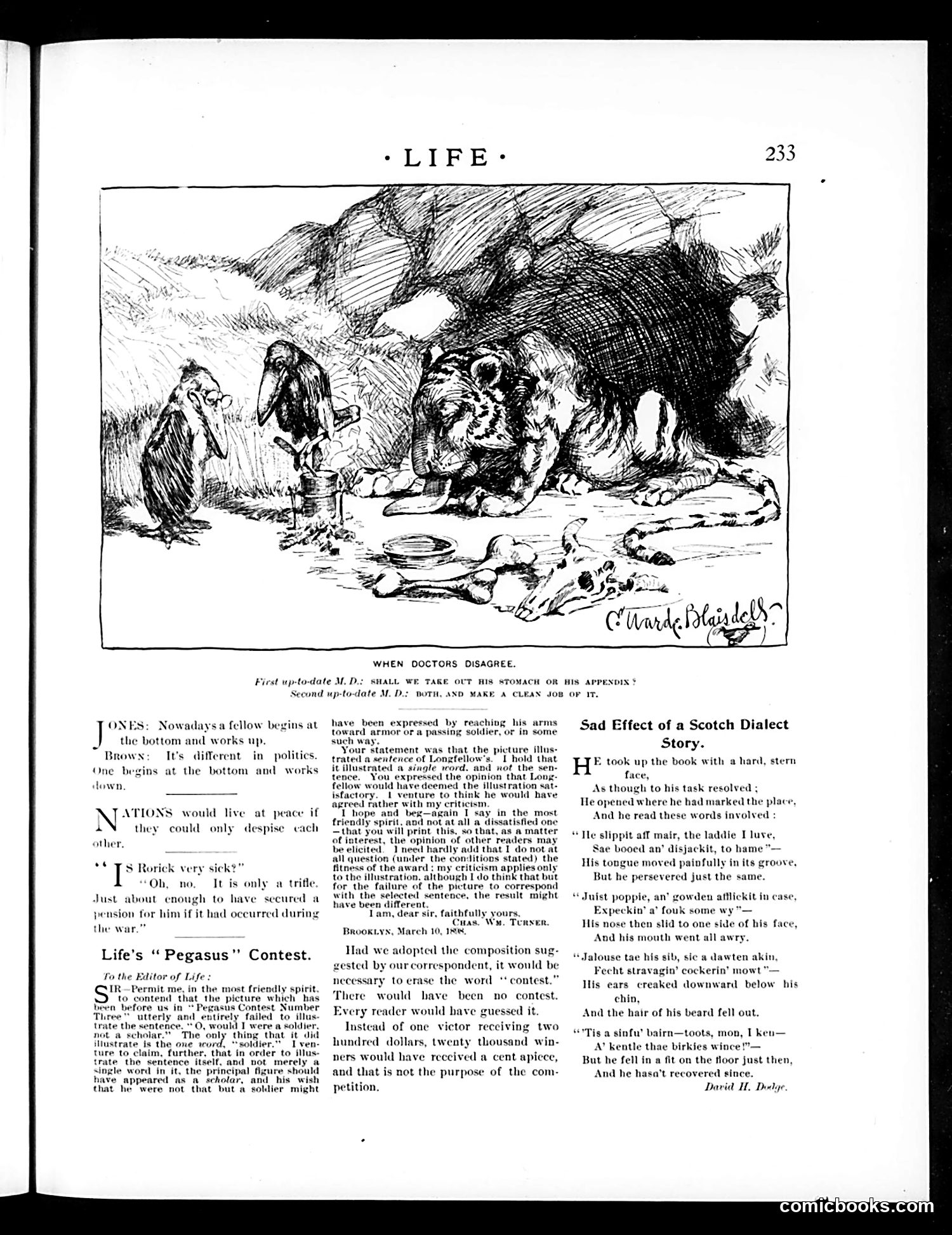
**Top Cartoon ("When Doctors Disagree"):** Two contemporary physicians debate whether to remove a patient's stomach or appendix—then suggest doing both. The satire mocks the disagreement among medical experts and the invasive, aggressive treatment philosophy of early 20th-century medicine. The caption's dialogue about politics ("One begins at the bottom and works down") suggests doctors, like politicians, proceed with little regard for actual consequences. **Middle Section:** A reader's letter criticizes *Life*'s "Pegasus Contest," arguing that an illustration failed to represent a full Longfellow sentence, only a single word. The editor defends the choice, explaining that a more complete illustration would make the puzzle too obvious, eliminating the contest's appeal. **Bottom ("Sad Effect of a Scotch Dialect Story"):** Humorous verse describing a man's physical deterioration while reading a story written in heavy Scottish dialect. His face contorts grotesquely from struggling to parse the incomprehensible phonetic spellings and unfamiliar Scottish words—a satire on the popularity of dialect humor writing that prioritizes comic accent over readability.
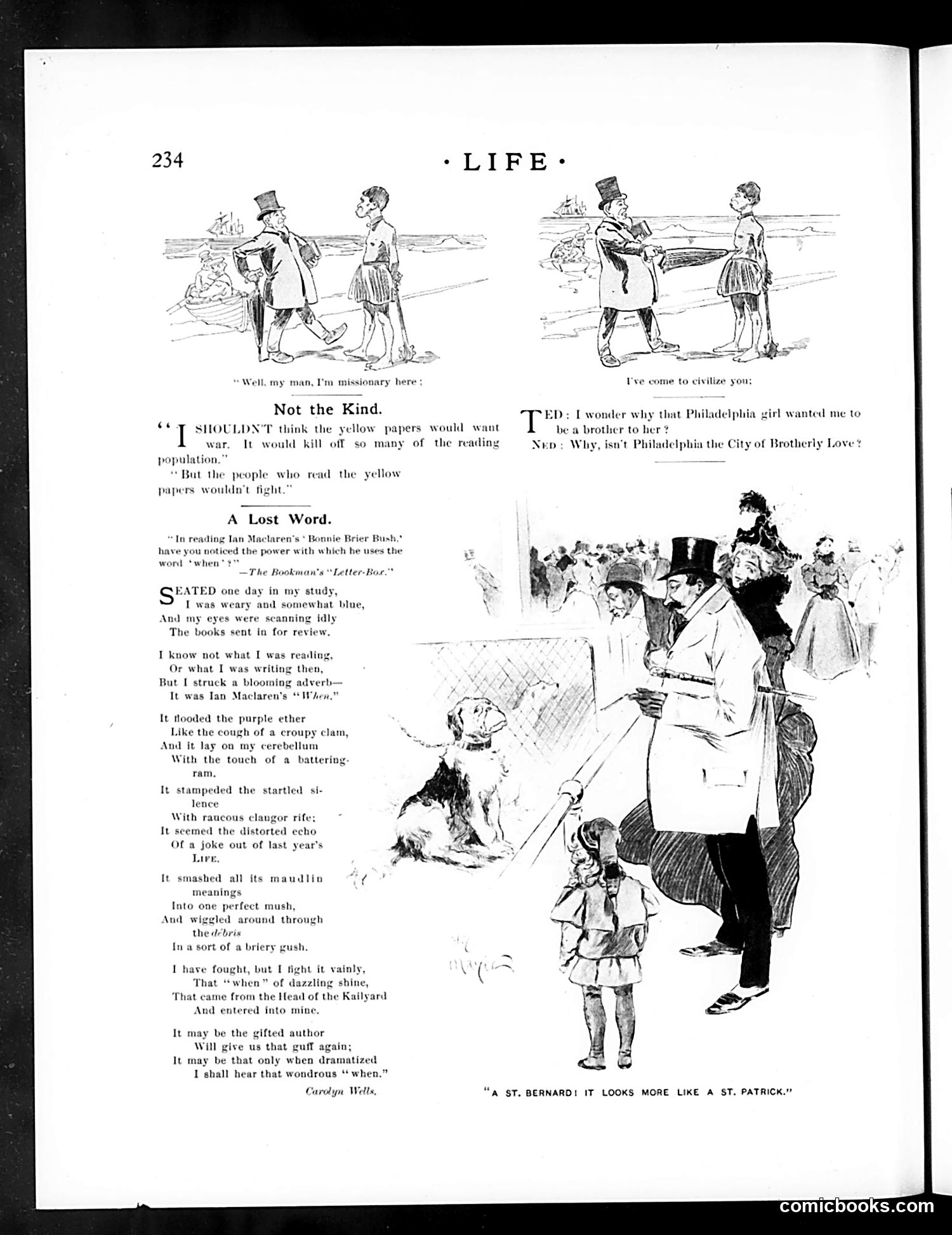
This page contains three separate satirical pieces from *Life* magazine: **"Not the Kind"** mocks yellow journalism's war-mongering. A man tells a missionary that sensationalist papers wouldn't want actual war because it would kill their readers—the irony being that those same readers don't fight anyway, only consume the inflammatory coverage. **"A Lost Word"** by Carolyn Wells parodies literary criticism's obsession with author Ian Maclaren's repeated use of "when" in his popular *Kailyard* fiction. The poem humorously describes the word as an invasive, maddening force that has infected the narrator's mind. **The bottom cartoon** plays on Philadelphia's motto "City of Brotherly Love." A man (labeled "ST. BERNARD") appears at what seems to be a street festival or gathering, with the caption suggesting his appearance—possibly his size or demeanor—resembles a St. Patrick's Day celebration rather than the refined "brotherly love" Philadelphia claims. All three pieces use humor to deflate pretension in journalism, literature, and civic identity.
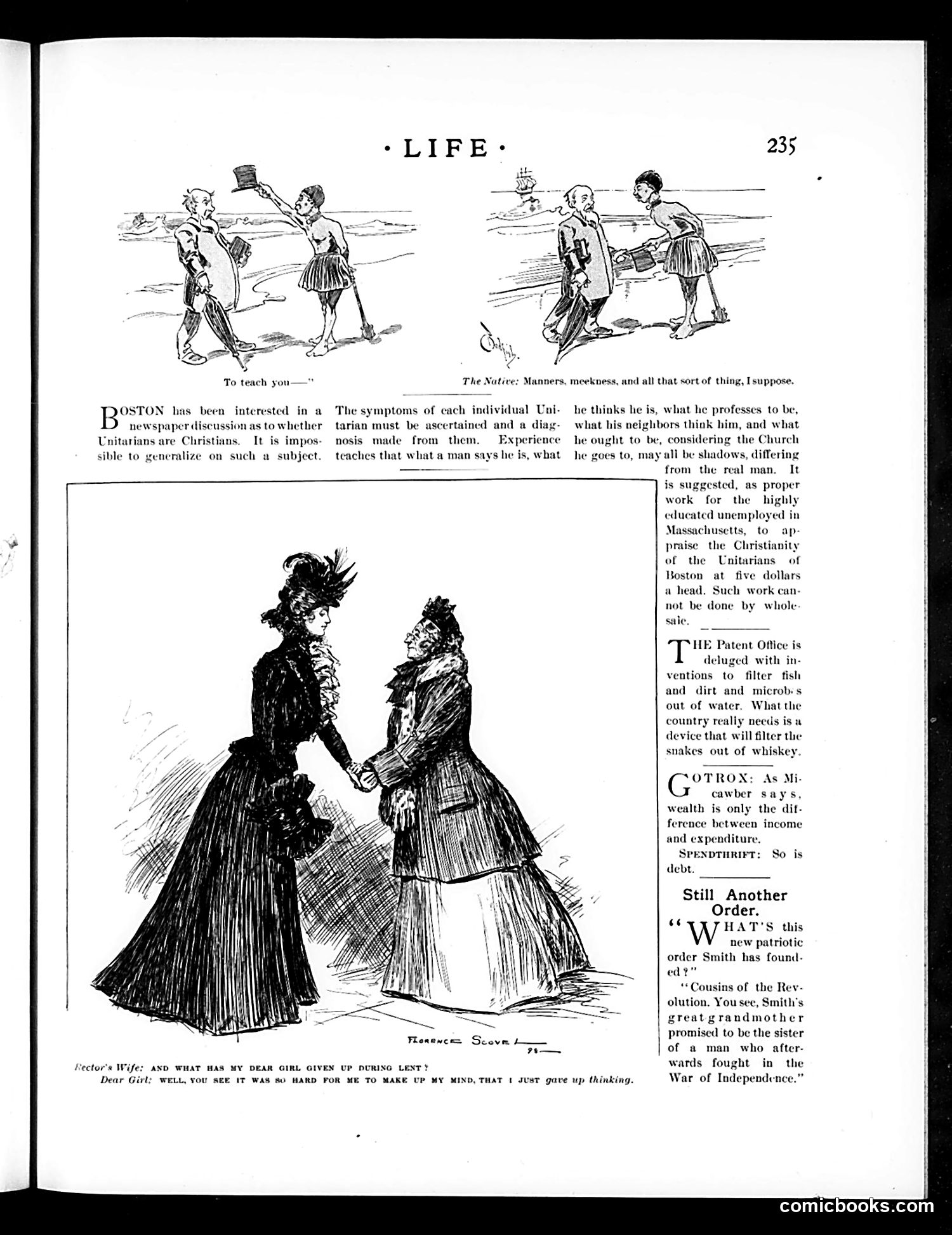
This page contains three distinct satirical pieces: **Top cartoons**: Two beach scenes mocking social pretension. The left shows someone attempting to teach another person proper etiquette; the right depicts "The Native" instructing visitors on mannered behavior—satirizing how people adopt artificial social personas at leisure. **Main illustration**: A "Rector's Wife" and young woman discussing Lenten sacrifice (Catholic/religious practice). The joke: the girl gave up *thinking* for Lent rather than food or pleasures—a barb at women's intellectual capacity or social frivolity. **Text snippets**: Several brief satirical commentaries. One mocks Boston's theological debate over whether Unitarians are Christians. Others ridicule patent office inventions (water filters), financial pretension (defining wealth as income minus spending), and absurdly loose patriotic credentials (Smith's ancestor merely *promised* to be sister to a Revolutionary War participant). The overall tone targets hypocrisy, intellectual laziness, and social pretense among the educated classes.
This page contains brief humorous anecdotes rather than a political cartoon. The main content consists of three short satirical stories: 1. **The Irish Hussars story**: Officers attend a dance but refuse to participate, prompting an Irish hostess to hope they'll "marry" (improve their behavior). The joke mocks their stiffness and social awkwardness. 2. **The Sir Walter Scott anecdote**: A beggar blesses Scott after receiving a shilling instead of the sixpence offered, satirizing Irish gratitude and social class interactions. 3. **The Husband's Account Book**: A husband gives his spendthrift wife a ledger to track expenses, but she simply writes "Received from Willie" and spends the fifty dollars anyway—mocking wives' financial irresponsibility (a common period trope). These are genteel Victorian humor pieces targeting Irish characters, marital dynamics, and social pretension. The rest of the page comprises book advertisements and product promotions typical of Life's era.
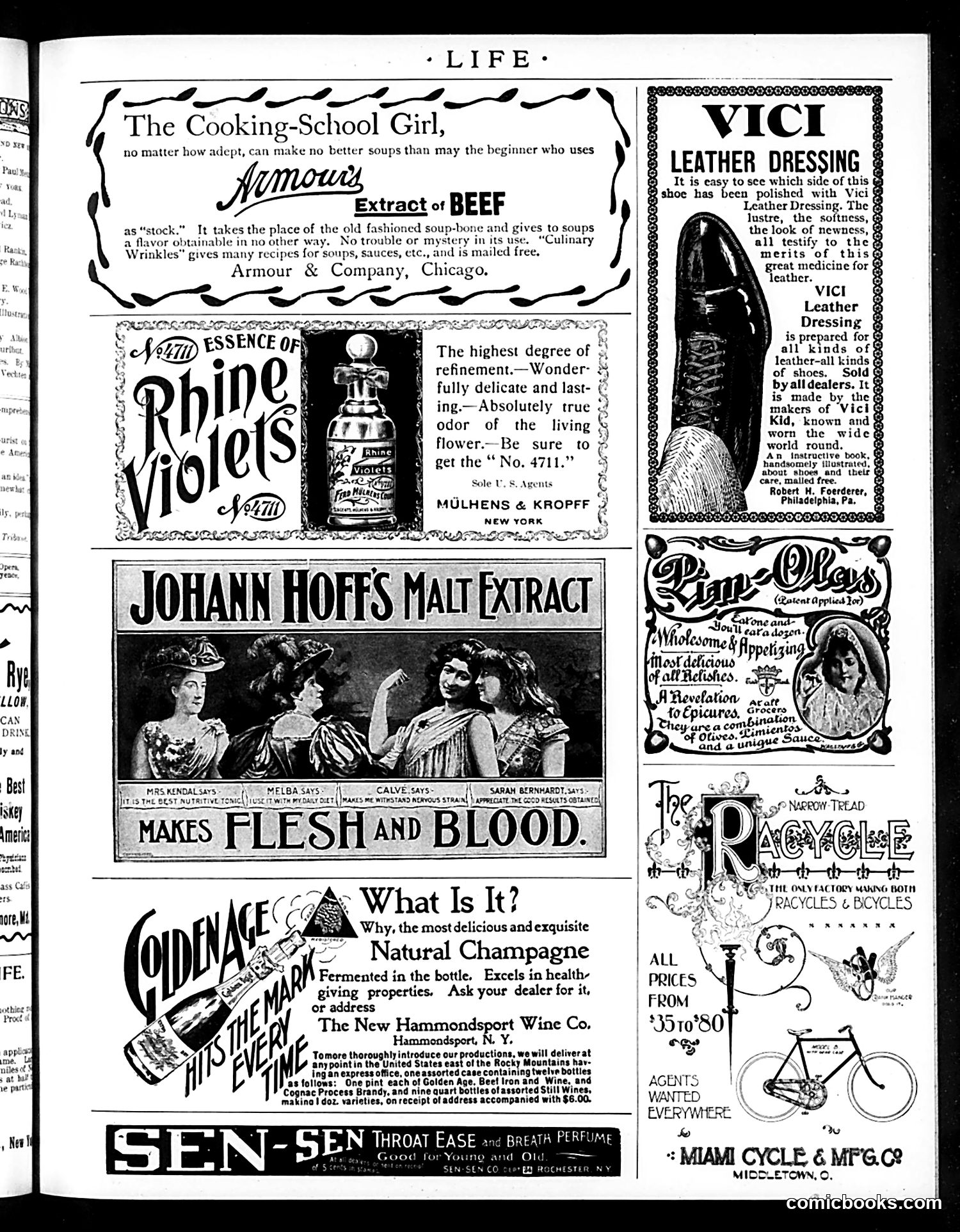
This page is primarily **advertisements**, not political satire or editorial cartooning. It contains commercial promotions typical of early 20th-century magazines: **Content includes:** - Armour's beef extract (positioned as a cooking aid for soups) - Rhine Violets perfume (claiming refinement and delicate flower scent) - Johann Hoff's Malt Extract (with an image of women, promising to "make flesh and blood") - VICI Leather Dressing (shoe polish) - Codenage Natural Champagne (wine) - Sen-Sen throat lozenges - Racycle bicycles **Notable to modern readers:** The Johann Hoff advertisement uses pseudo-medical language ("makes flesh and blood") typical of patent medicine era marketing—before FDA regulations required evidence. The champagne ad offers bulk wine delivery across the U.S., reflecting pre-Prohibition availability. This is a commercial page rather than editorial content, representing the advertising landscape of the period.
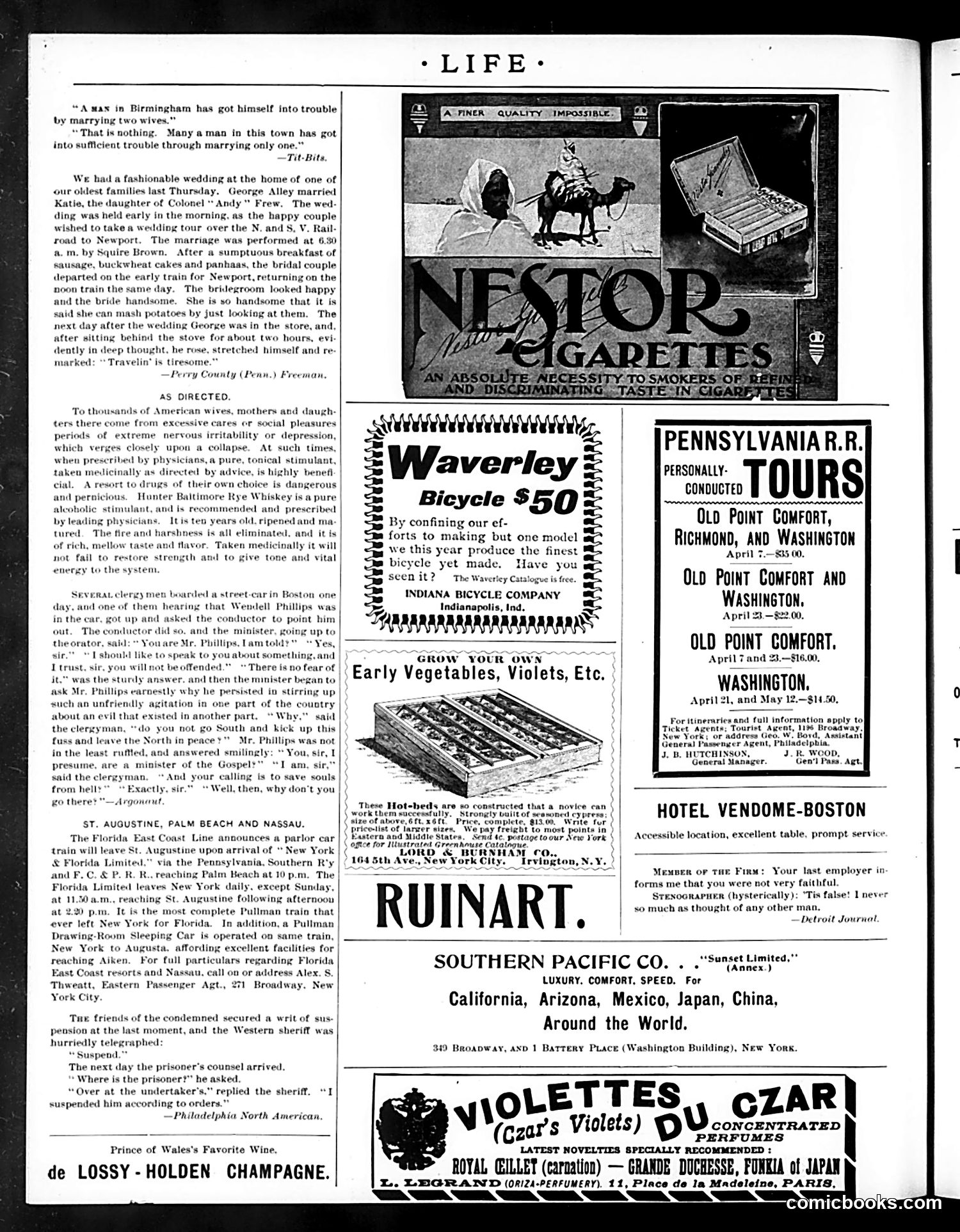
This page from Life magazine (a 19th-century satirical publication) contains primarily **social humor and advertisements rather than political cartoons**. The main joke section opens with witty observations about marriage troubles—contrasting a Birmingham man who married two wives with local men who encountered sufficient difficulty marrying just one. A lengthy anecdote follows about a fashionable wedding and the bride's alleged potato-mashing beauty. Another humorous piece depicts an exchange between abolitionist Wendell Phillips and a Northern clergyman who questions why Phillips agitates about slavery in the South rather than improving the North. Phillips responds by asking if the clergyman, as a minister, focuses only on saving souls in one location rather than everywhere—a clever rhetorical riposte exposing the clergyman's hypocrisy. The page concludes with a dark joke about a sheriff executing a condemned prisoner, then receiving orders to "suspend"—which he interprets literally by suspending the corpse. The remainder comprises period advertisements for bicycles, train travel, hotels, and patent medicines.
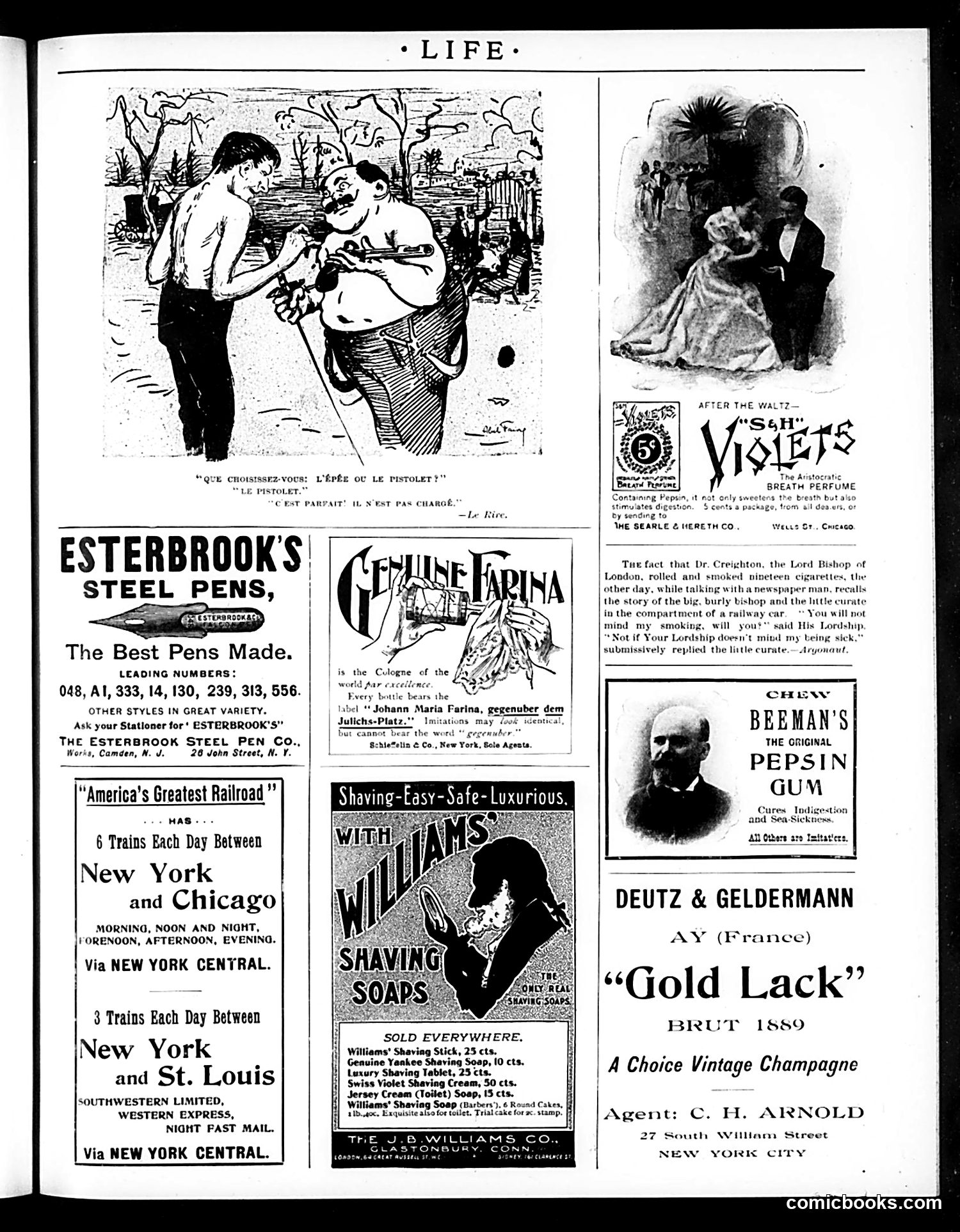
This page is primarily **advertising**, with one small cartoon at top left. The cartoon, credited to "Le Rire" (a French humor publication), depicts two figures by water in what appears to be a flirtatious scene. The French caption translates roughly to "Will you cross [the river]? The pistol?" with the punchline "It's perfect! It's not loaded"—a playful double entendre about seduction and risk. The bulk of the page contains period advertisements for Esterbrook steel pens, New York Central Railroad, Williams shaving products, Genuine Farina cologne, Beeman's Pepsin gum, and champagne. A small box advertises "Violets" perfume with an illustration of a couple at a social event. The content reflects early 20th-century consumer culture and product marketing typical of *Life* magazine's commercial pages during this era.
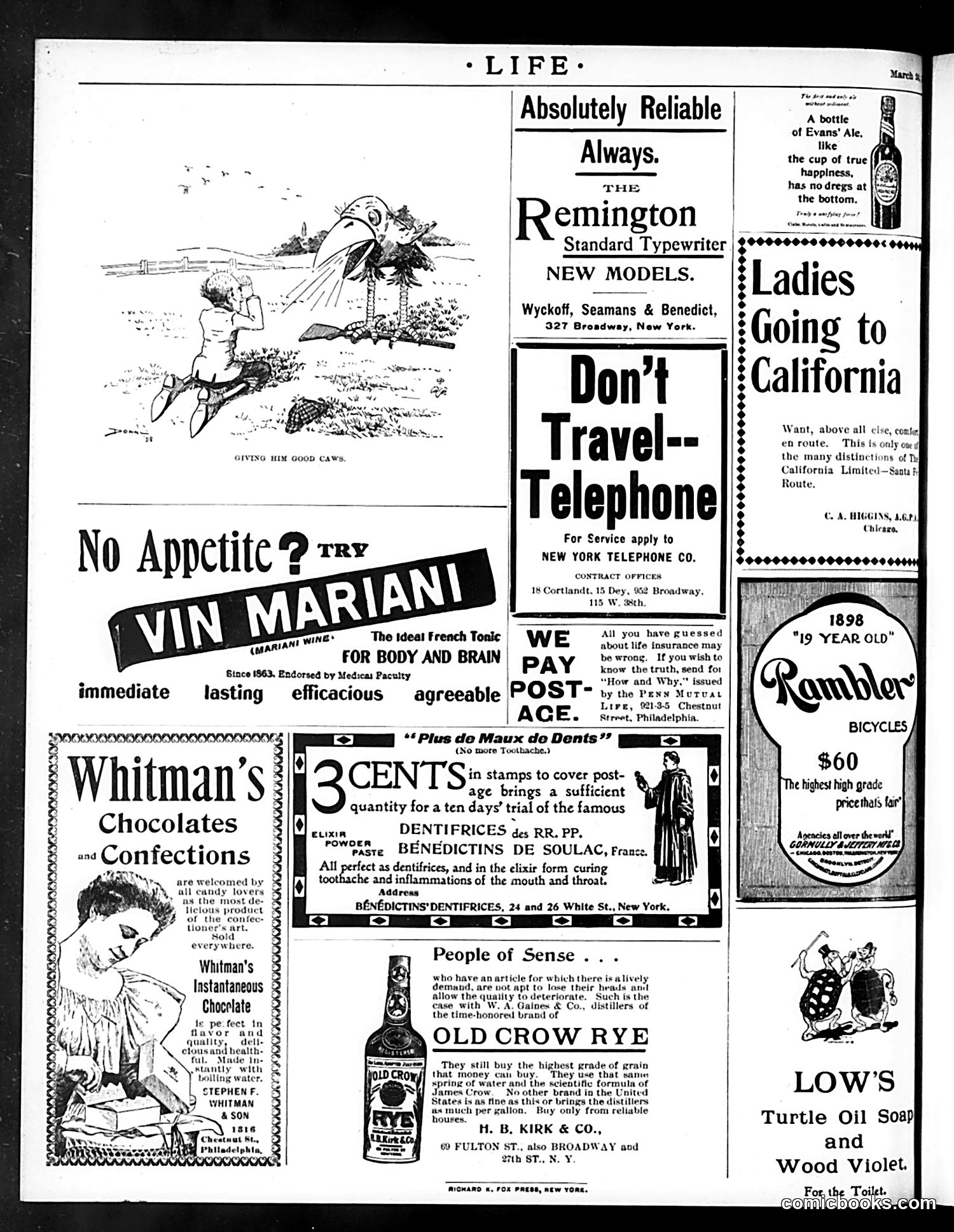
This is primarily an **advertising page** from Life magazine (date visible: March, likely early 1900s based on style). The single cartoon, titled "GIVING HIM GOOD CAWS," depicts a cherubic child feeding a cow—a gentle, domestic scene with no political satire. It appears to be decorative filler accompanying the advertisements rather than editorial content. The page is dominated by period product ads: Remington typewriters, Vin Mariani (a French tonic wine), Whitman's chocolates, telephone service, railroad travel to California, Rambler bicycles, and Old Crow whiskey. These reflect early 20th-century consumer goods and services. The "People of Sense" copywriting for Old Crow typifies the era's marketing approach—appealing to discerning buyers through quality claims. There is **no political commentary or satirical content** on this page; it represents Life's revenue model: mixing light illustrations with commercial advertising.