
Life, 1898-03-24 · page 6 of 20
Life — March 24, 1898 — page 6: what you’re looking at
What you’re looking at
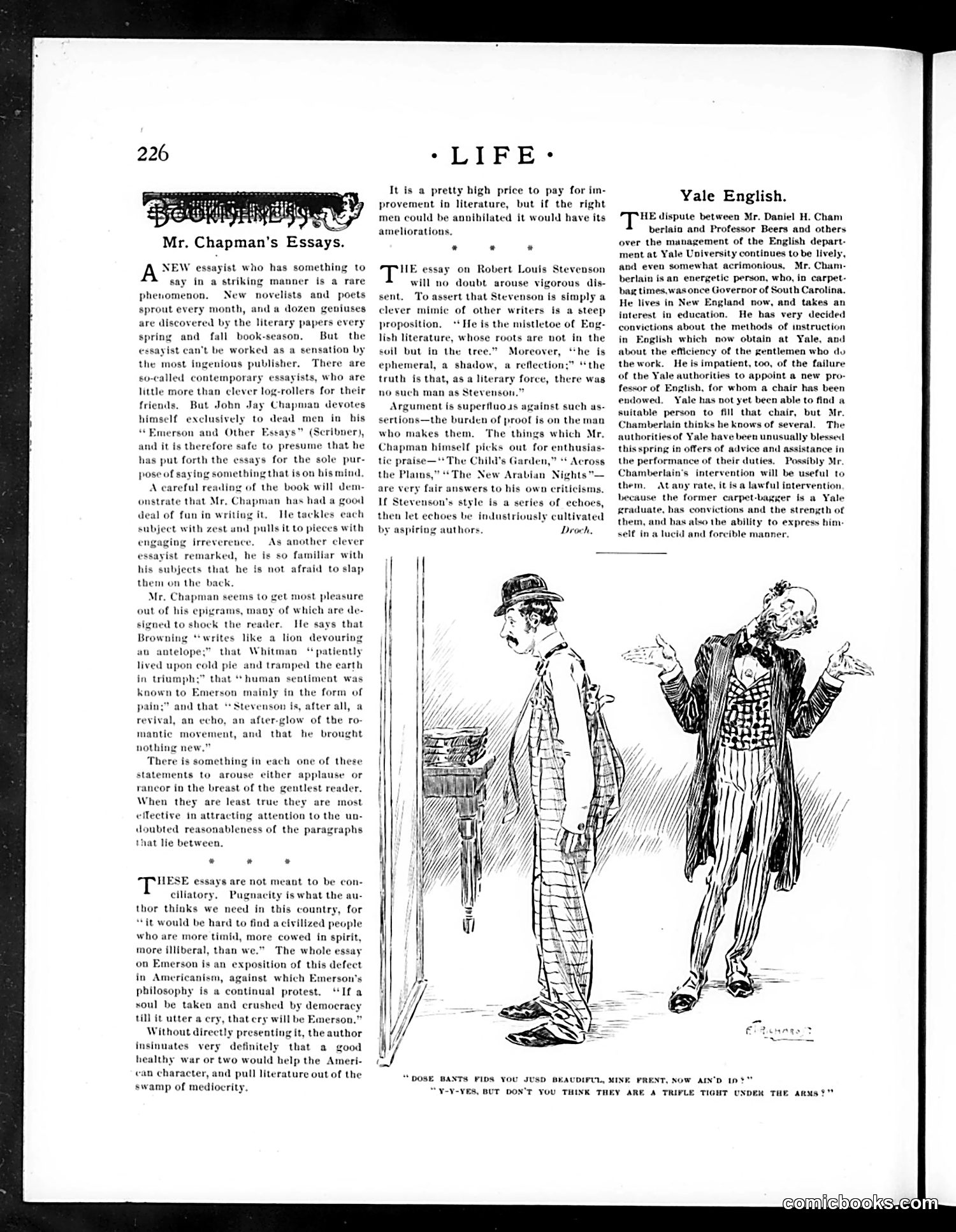
The page contains a literary essay about Mr. Chapman's Essays and Yale English studies, not a political cartoon. The illustration shows two men in conversation—one wearing a bowler hat and checkered suit (appearing somewhat eccentric or affected), and another in formal attire gesturing expressively. The caption reads: "DOES RANTS FITS YOU JUNO BEAUTIFULLY, NINE FRONT, NOW AIN'D IN?" followed by "Y-Y-YES, BUT DON'T YOU THINK THEY ARE A TRIFLE TIGHT UNDER THE ARMS?" This appears to be satirizing pretentious or affected speech and fashion consciousness among the upper classes—mocking someone's overly formal diction and vanity about clothing fit. The humor derives from the contrast between aspirational formal language and the mundane concern about tight armpits.
📄 Transcribed text from this page (OCR, searchable)
Machine-transcribed from the original scan — historical spelling and the odd misread are preserved.
Mr. Chapman's Essays. NEW essayist who has something to say in a striking manner is a rare New novelists and poets month, and a dozen geniuses the literary papers every book-season, But the ) worked as a sensation by the most ingenious publisher, There are phenomenon. sprout ever; liscovered b and fall -called contemporary essayists, who are little more than clever log-rollers for their But Jobn Jay Chapman devotes ad men in his » (Scribner), friends, himself exclusively to di “Ei ‘son and Other Essa: and it is therefore safe to presume that he has put forth the essays for the sole pur- pose of saying something that is on bis mind, A careful reading of the book will dem- onstrate that Mr. Chapman. deal of fun in writing subject with zest und pulls it to pieces with gaging irreverence. As another clever yist remarked, he is so familiar with his subjects that he is not afraid to slap them on the Mr. Chapman seems to g out of his epigrams, many of whict signed to shock the reader. He says that Browning “writes like a lion devouring au antelope;” that Whitman “patiently lived upon cold pie and tramped the earth in triumph:” that “human sentiment was known to Emerson mainly in the form of pain;” and that “Stevenson is, after all, a revival, an echo, an after-glow of the ro- mantic movement, and that he brought nothing new. There is something in each one of these state! arouse either applause or rancor in the breast of the gentlest reader. When they are least true they are most ective in attracting attention to the un- doubted rea the paragraphs that lie between, T= E essays are not meant to be con- ciliatory, Pagnacity is what the au- thor thinks we need in this country, for “it would be hard to find a civilized people who are more timid, more cowed in spirit, more illiberal, than w The whole essay on Emerson is an exposition of this defect in Americanism, against which Emerson's philosophy is a continual protest. “If a soul be taken and crushed by democracy till it utter a cry, that ery will be Emerson,” Without directly presenting ft, the author insinuates very definitely that a good healthy war or two would help the Ameri- can character, and pull literature out of the swamp of mediocrity. most pleasure nents to onableness ¢ . * LIFE: It is a pretty high price to pay for im- provement in literature, but if the right men could be annihilated it would have its ameliorations. * . * IIE essay on Robert Louis Stevenson will no doubt arouse vigorous dis- sent. To assert that Stevenson is simply a clever mimic of other writers is a steep proposition. “He is the mistletoe of Eog- lish literature, whose roots are vot in the soil but in the tre Moreover, ephemeral, a shadow, a reflection: truth is that, asa literary force, there was no such man as Stevenson.” Argument is superfluo4s against such as- sertions—the burden of proof is on the man who makes them. The things which Mr, Chapman himself picks out for enthusi tic praise—** The Child’s Garden,” ** Across the Plains,” The New Ar Nights "— are very fair answers to his own criticism If Stevenson's sty! then let echoes be industrivusly cultivated by aspiring authors. Droch, e is a series of echo Yale English. HE dispute between Mr. Daniel H. Cham berlain and Professor Beers and others over the management of the English depart- ment at Yale University continues to be lively, and even somewhat acrimonious, Mr. Cham- berlain is an energetic person, who, in carpet bag times, was once Governor of South Carolina, He lives in New England now, and takes an interest in education. He bas very decided convictions about the methods of instruction in English which now obtain at Yale, and about the efficiency of the gentlemen who do the work. He is impatient, too, of the failure of the Yale authorities to appoint a new pro- fessor of English, for whom a chair has been endowed, Yale has not yet been able to find a suitable person to fill that chair, but Mr. Chamberlain thinks he knows of several. The authoritiesof Yale bave been unusually blessed this spring in offers of advice and assistance in the performance of their duties. Possibly Mr. Chamberlain's intervention will be useful to them, At any rate, itis a lawful intervention Decause the former carpet-bagger is a Yale graduate, has convictions and the strength of them, and has also the ability to express him: self ina lucid and forcible manner, “DOSE BANTS FIDS YOU JUSD BXAUDIFUL, MINK PRENT, NOW AIX’D ID?” “Y-Y-VES, BUT DON'T YOU THINK THEY ARE A TRIPLE TIGHT UNDEX THE anus