
Life, 1898-03-24 · page 12 of 20
Life — March 24, 1898 — page 12: what you’re looking at
What you’re looking at
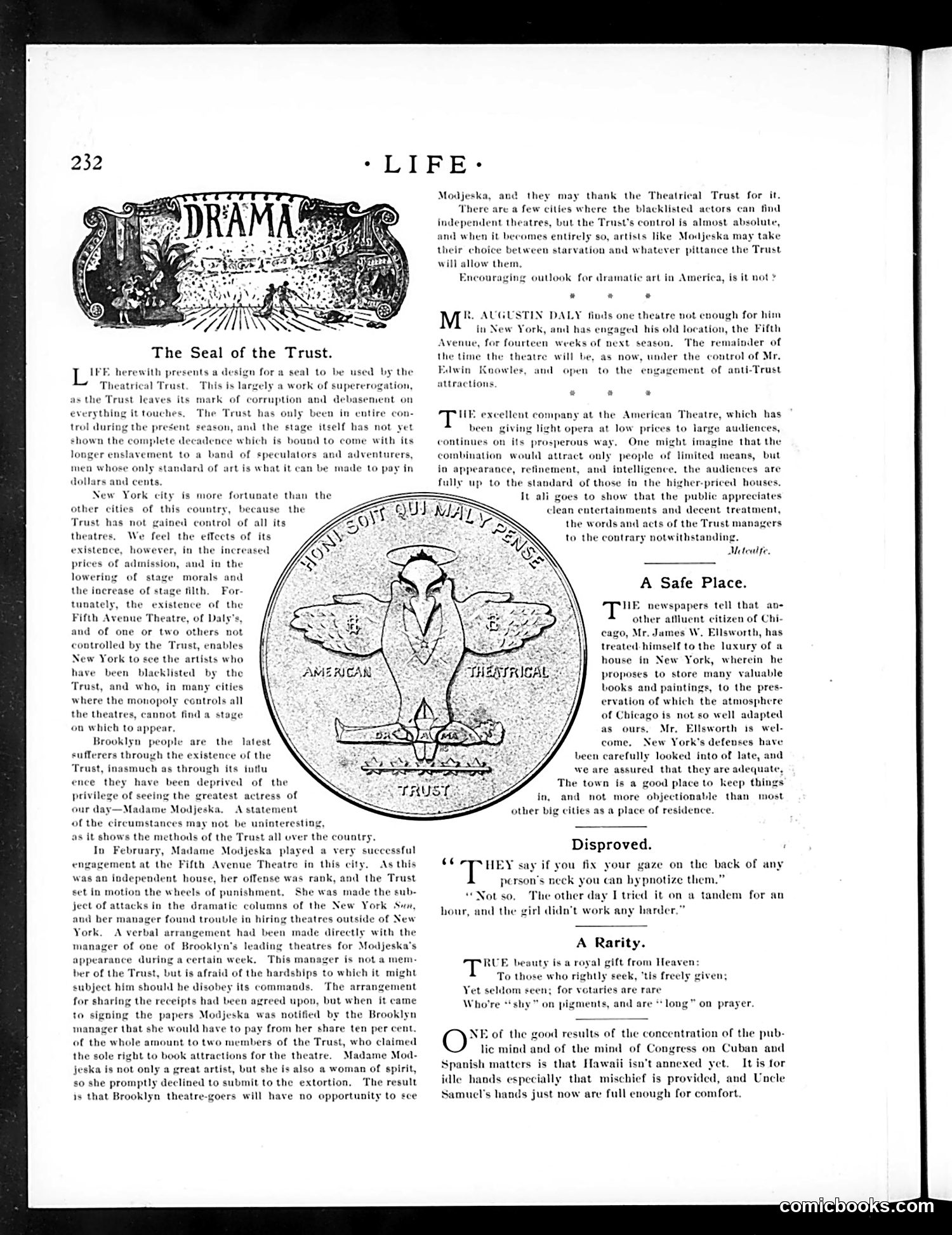
This page contains theater criticism rather than political cartoons. The central image is "The Seal of the Trust"—a circular seal depicting an eagle labeled "American Theatrical Trust" standing on a nest labeled "TRUST." **The Satire:** The article critiques the Theatrical Trust's monopolistic control over American theaters. The text describes how the Trust blacklisted independent theaters and artists, controlling which productions could play where and extracting financial penalties from non-compliant venues. **Key References:** Madame Modjenska (a celebrated actress) faced difficulties booking theaters due to the Trust's power. The article suggests the Trust forced artists to choose between "starvation" and submission to its control. The eagle-on-nest imagery symbolizes the Trust's predatory grip over theatrical commerce—a monopoly presented as parasitic rather than protective.
📄 Transcribed text from this page (OCR, searchable)
Machine-transcribed from the original scan — historical spelling and the odd misread are preserved.
IFF, herewith presents a design fora seal to be used by the Theatrical Trust. This is largely a work of supererogation, the Trust leaves its mark of corruption and deba everything it touches, ent on he Trust has only been in entire con- trol during the present itself has not yet shown the complete decadence which is bound to come with its longer enslavement to a band of speculators and men whose only standard of art is what it can t dollars and cents. New York city is more fortunate than the other cities of this country, because the Trust has not gained control of all its theatres, We feel the effects of its existence, however, in the increased prices of admission, and in the lowering of s\ morals and the increase of stage filth. For- tunately, the existence of the Fifth Avenue Theatre, of Daly's, and of one or two others not controlled by the Trust, enables New York to sce the artists who ave been blacklisted by the Trust, and who, in many cities where the monopoly controls all the theatres, cannot find a stage on which to appear, Brooklyn people are the latest sufferers through the existence of the Trust, inasmuch as through its tutu they have been deprived of the vilege of seeing the greatest actress of Madame Modjeska, A statement cumstances may not be uninteresting, as it shows the methods of the Trust all uver the country. In February, Madame Modjeska played a very successful at the Fifth Avenue Theatre in this city. As this was an independent house, her offense was rank, and the Trust set in motion the wheels of punishment, Sbe was made the sub- ject of attacks in the dramatic columns of the New York Siw, and ber manager found trouble in hiring theatres outside of York. A verbal arrangement had been made directly with the r of one of Brooklyn's leading theatres for Modjeska appearance during a certain week. This manager is not a men ber of the Trust, but is afraid of the hardships to which it might subject him should be disobey its commands. The arran for sharing the receipts had been agreed upon, but when it came to signing the papers Modjeska was notified by the Brooklyn manager that she would have to pay from her share ten per cent. of the whole amount to two members of the Trust, who claimed the sole right to book attractions for the theatre. Madame Mod- jeska is not only a great artist, but she fs also a woman of spirit, so she promptly declined to submit to the extortion, The result is that Brooklyn theatre-goers will have no opportunity to sce Iventurers, ade to pay in may thank the Theatrical Trust for it. re a few cities where the blacklisted actors can find atres, but the Trust's control is almost absolute and when it becomes entirely so, artists like Modjeska may ts their choice between starvation and whatever pittance the Trust wil low the Encouraging outlook for dramatic art in America, is it not? M* AUGUSTIN DALY finds one theatre not enough for him in New York, and has eu his old location, the Fifth Avenue, for fourteen weeks of next season. The remainder of the time the theatre will be, as now, under the control of Mr. hlwin Know and yn to the engagement of anti-Trust attractions * ’ * ILE excellent company at the American Theatre, which has y to large audiences, continues on its prosperous way, One might imagine that the combination would attract only people of limited means, but in appearance, refinement, and intell the audiences are es to show that the public appreciates clean entertainments and decent treatment, the words and acts of the Trust managers to the contrary notwithstanding. Mitealfe. A Safe Place. HE newspapers tell that an= other affluent citizen of Chi- cago, Mr. James W. Ellsworth, treated: himself to the luxury of house in New York, wherein he proposes to store many valuable Looks and paintings, to the pre: ervation of which the atmosphere of Chicago is not so well adapted as ours, Mr, Ellsworth 1s wel- come, New York's defenses have been carefully looked into of late, and we are assured that they are adequate, The town is a good place to keep things in, and not more objectionable than most other big cities as a place of residenc Disproved. SY say if you fix your gaze on the back of any “s neck you can hypnotize them.” The other day I tricd it on a tandem for an rl didn't work any harder. “Not so, hour, and the A Rarity. beouty is a royal gift from Heav To those who rightly seek, ‘tis freely given; Yet seldom seen; for votaries are rare Whore “shy” on pigments, and are “long” on pr: O Sof the good results of the concentration of the pub- lic mind and of the mind of Congress on Cuban and Spanish matters is that Hawa n’tannexed yet. It is for idle hands especially that mischief is provided, and Uncle Samucl's hands just now are full en 1 for comfort,