
A complete issue · 20 pages · 1898
Life — February 10, 1898
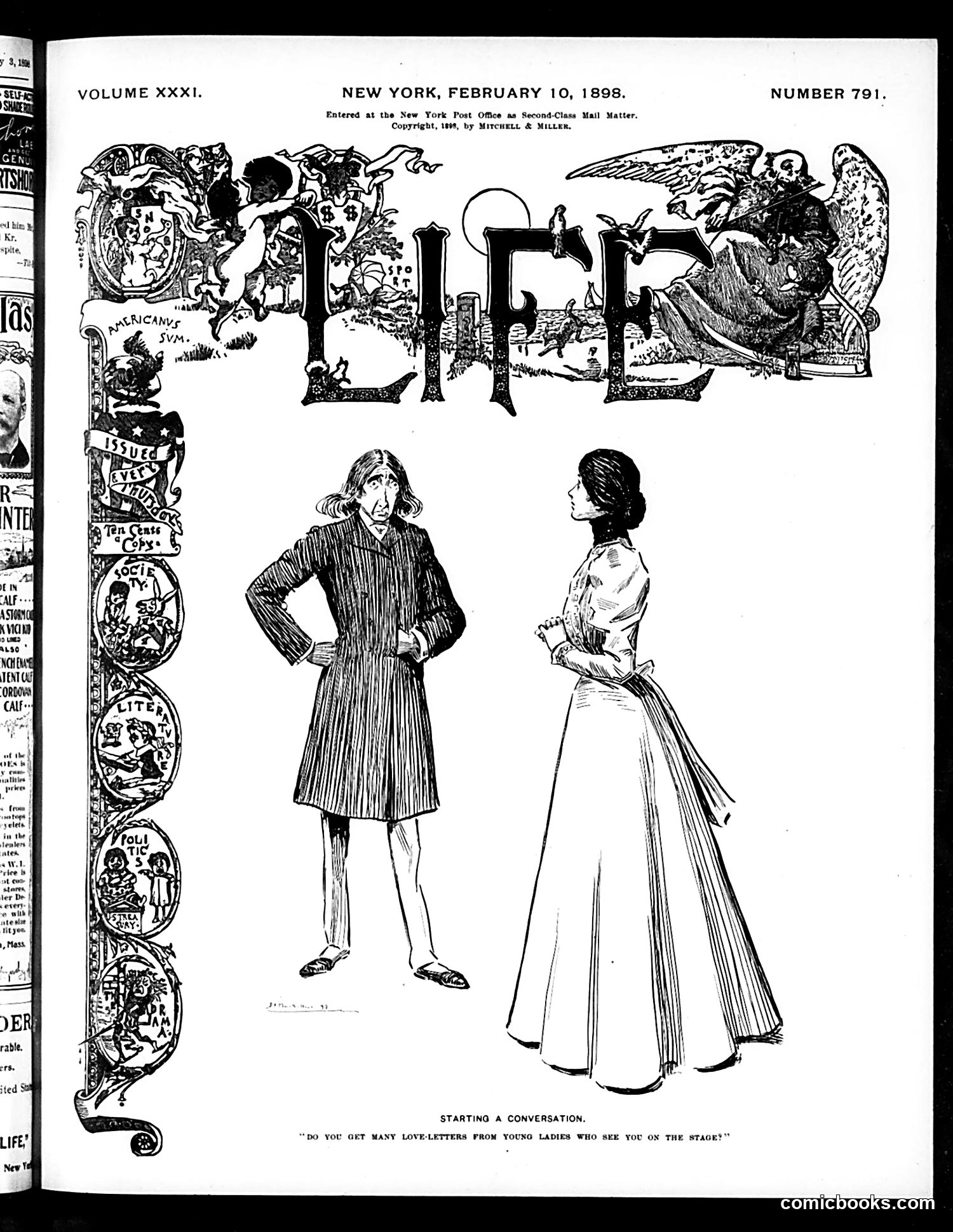
This page features a cartoon titled "Starting a Conversation" with the caption: "Do you get many love-letters from young ladies who see you on the stage?" The illustration shows two figures in conversation—a man in a dark coat on the left and a woman in a long dress on the right. The joke appears to satirize the theatrical world and fan culture of the 1890s, specifically poking fun at actors who receive romantic correspondence from female admirers in the audience. The ornate left border contains decorative vignettes typical of Life magazine's design. The piece reflects period social commentary about theater, celebrity, and the emerging phenomenon of fan mail directed at popular stage performers.
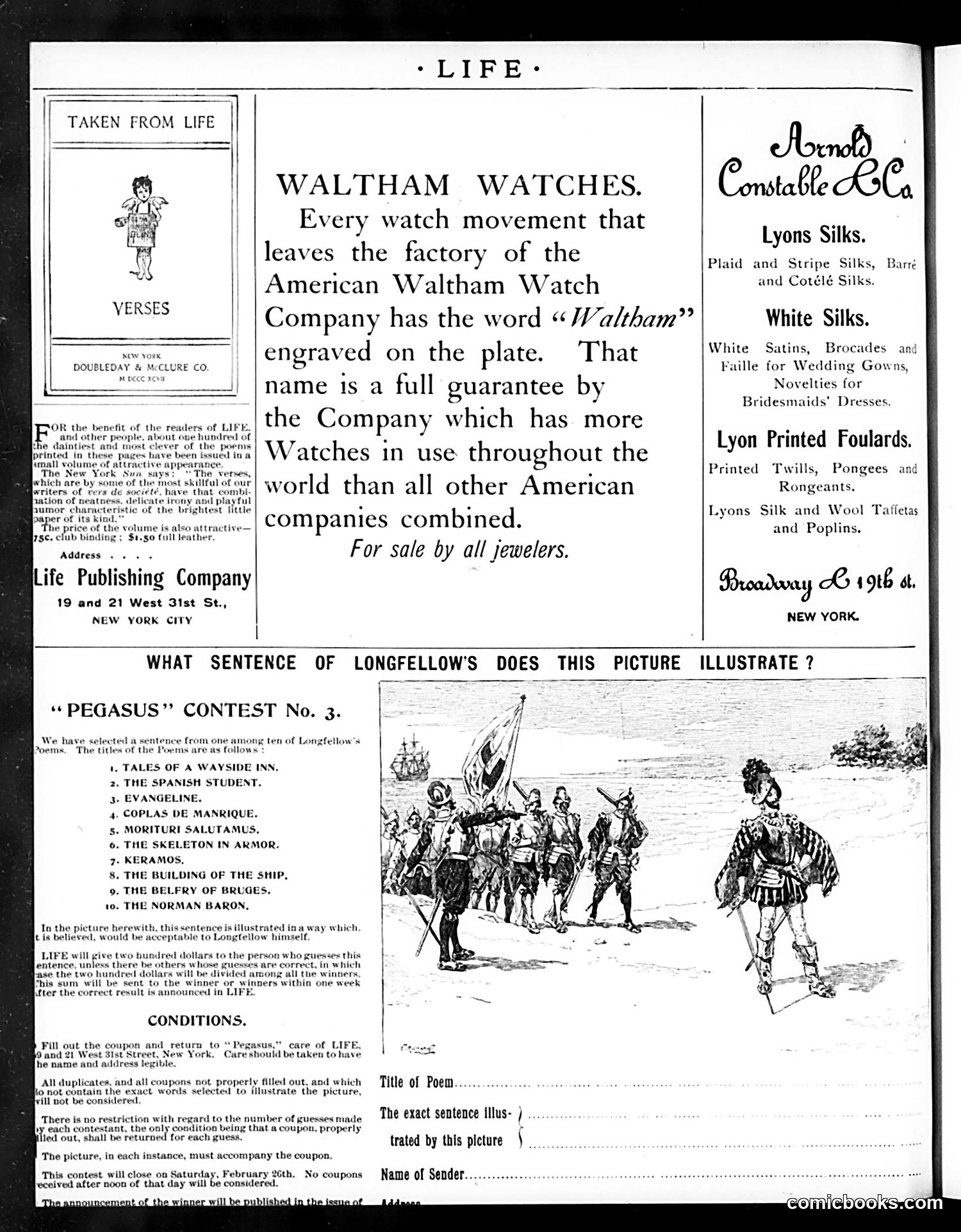
This page is primarily a **contest advertisement** rather than political satire. Life magazine is running a guessing game where readers identify which sentence from ten Longfellow poem titles matches the illustrated scene. The sketch shows **historical or colonial-era figures** meeting on a beach near a ship, apparently depicting some kind of encounter or negotiation. The contest asks readers to match this illustration to one of the listed Longfellow titles (including "Tales of a Wayside Inn," "The Spanish Student," and "The Norman Baron"). The page also contains **commercial advertisements** for Waltham Watches and Arnold Constable silk products. This was typical Life magazine format: mixing reader-participation contests with advertising content.
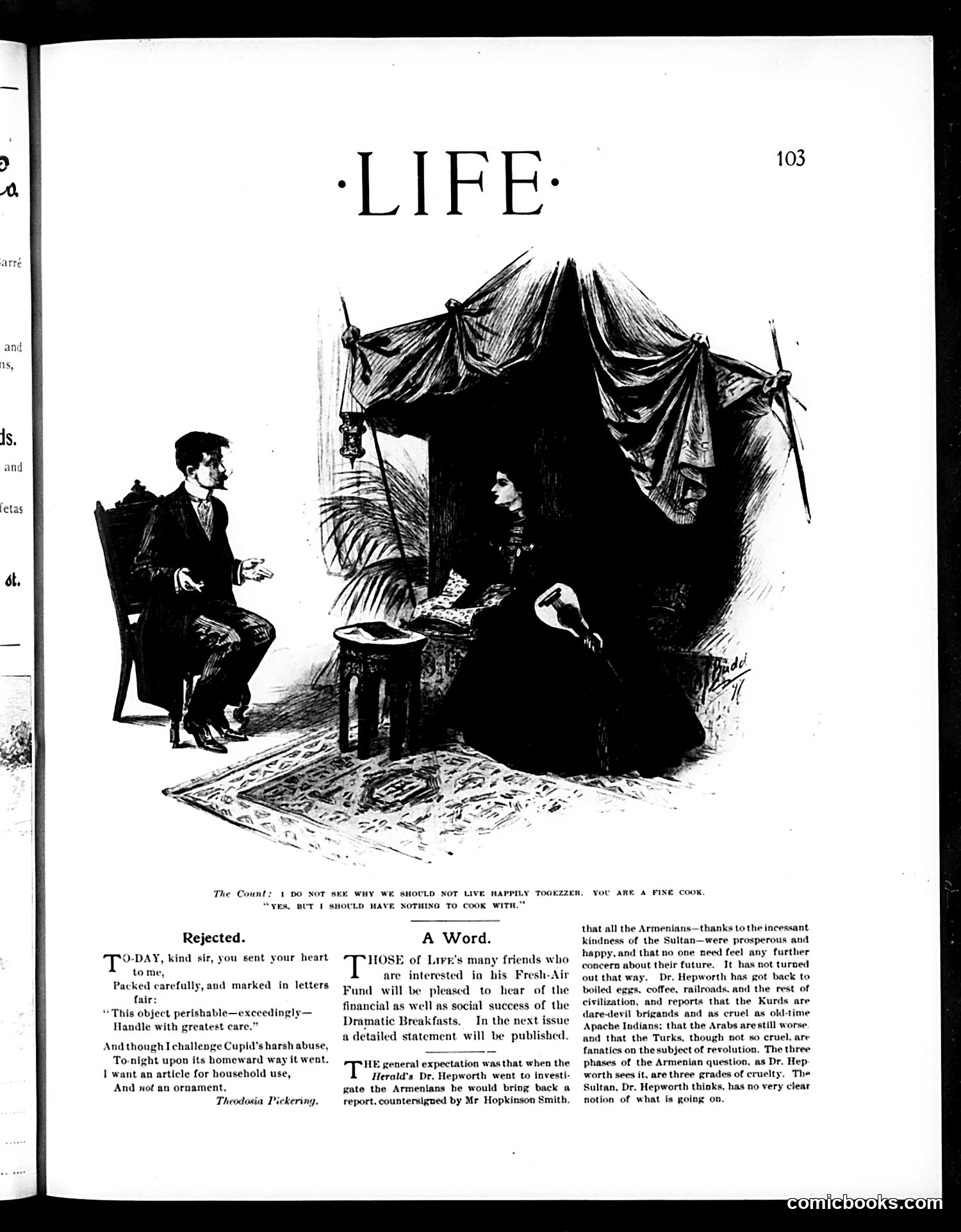
The main cartoon depicts a dialogue between two figures in what appears to be a tent or modest dwelling. A well-dressed man sits outside while a woman inside responds to his complaint about her cooking. The caption quotes her saying she's "a fine cook" despite his assertion that he has "nothing to cook with"—suggesting she's making the best of scarce resources. The "Rejected" and "A Word" sections below are editorial content, including reader letters and commentary about *Life* magazine's recent articles on Armenian persecution and Dr. Hepworth's investigation into Turkish atrocities. The cartoon likely satirizes domestic hardship or wartime scarcity, while the editorial material reflects *Life*'s engagement with contemporary humanitarian crises of that era.
This page contains several satirical pieces on contemporary issues (dated February 10, 1898): **Left cartoon**: Depicts a figure in a trash can labeled "While there is Life there's Hope"—criticizing someone's predicament or foolish optimism. **Main articles discuss**: - New England cotton mills facing labor competition from Southern mills - A proposal to use "a wagon of water instead of a jar of corn whiskey" for christening the battleship *Kentucky*—Secretary Long apparently preferred whiskey for the ceremony - President Dole of Hawaii attempting to use salt water to keep Hawaii separate from San Francisco - Dr. Nansen settling a lawsuit The satire targets political figures' questionable decisions and the economic struggles of Northern industrialists competing with cheaper Southern labor.
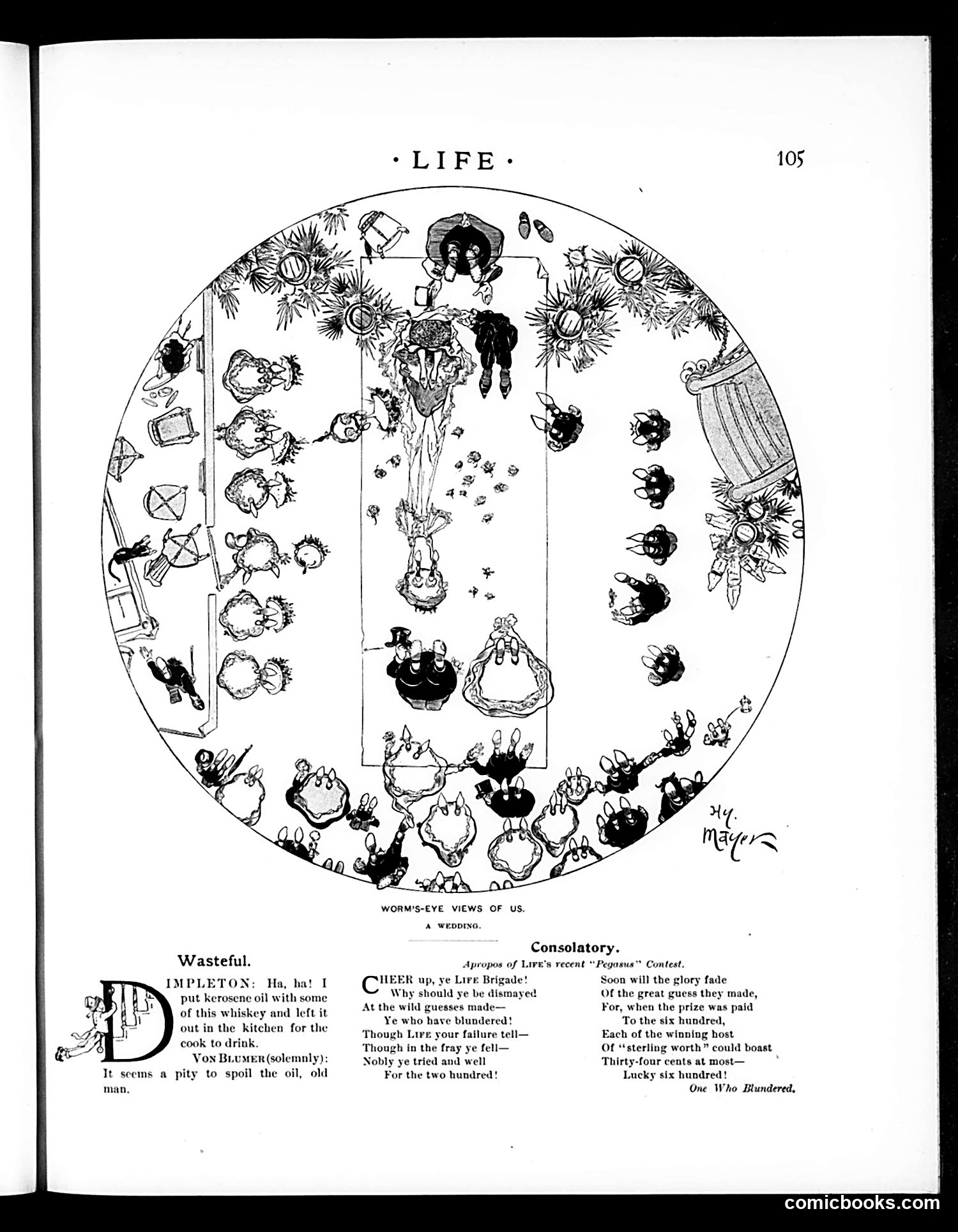
This page contains satirical commentary on a wedding, presented as a "worm's-eye view" looking down at the ceremony from above. The main cartoon depicts the bride and groom at an altar surrounded by wedding guests, flowers, and attendants arranged in a circular composition. Below are two brief comic sketches: "Wasteful" shows a character named Impleton carelessly wasting whiskey, while "Consolatory" appears to reference Life's recent "Pegasus" Contest, offering commiserations to contest losers through mocking verse. The wedding satire mocks the spectacle and expense of marriage ceremonies, a recurring Life magazine theme. The specific social critique—whether targeting wealthy excess, changing marriage customs, or particular contemporary wedding trends—remains somewhat unclear without additional context about the publication date.
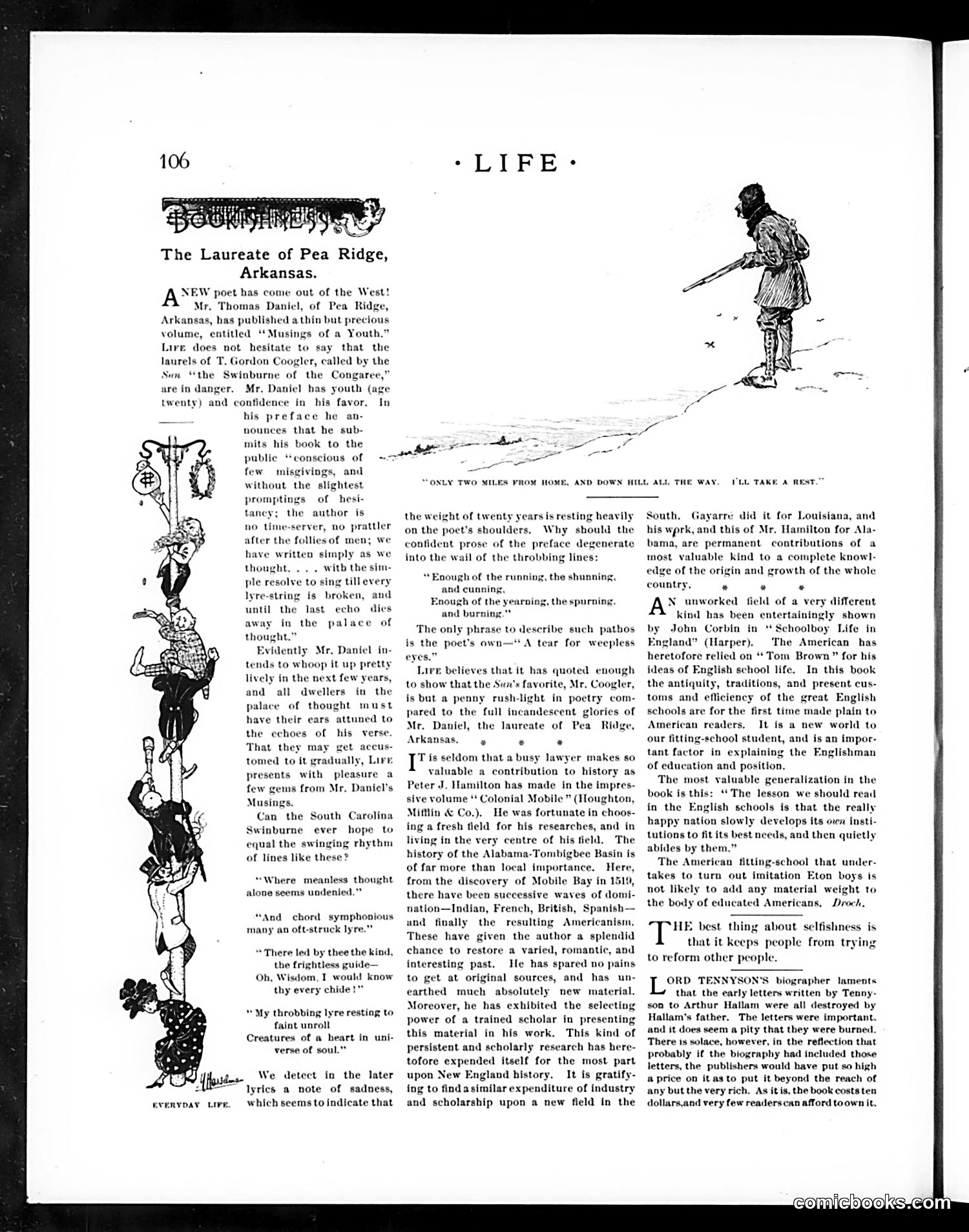
This page primarily features a literary review of Thomas Daniel's poetry collection from Pea Ridge, Arkansas, titled "The Swinburne of the Congaree." The accompanying illustration shows a man standing on a hillside with a rifle, captioned "Only two miles from home, and down hill all the way. I'll take a rest." The cartoon appears to be gentle rural humor rather than political satire—depicting a tired hunter taking a break during what seems an easy downhill walk home. The context suggests Life magazine is using this illustration to complement the literary discussion of Daniel's Southern poetry. The page includes several other short editorial items and quotes, including commentary on English schooling and Lord Tennyson's biography, but these are standard magazine content rather than satirical commentary.
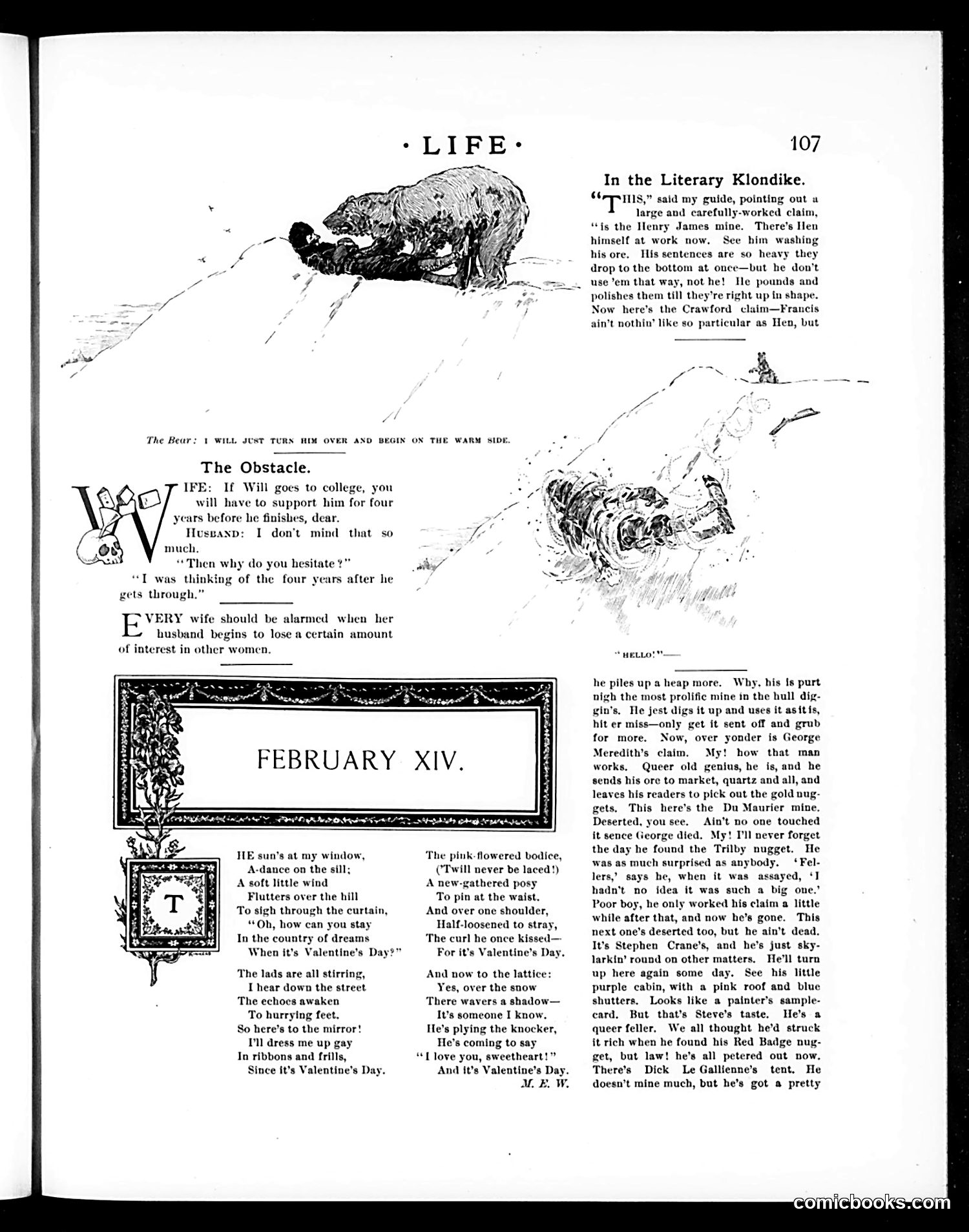
This page contains a satirical dialogue about marriage and finances. A husband tells his wife he hesitates to send their son to college for four years because of the expense. The wife questions why he won't commit to supporting their son's education, asking pointedly: "Then why do you hesitate?" He replies: "I was thinking of the four years after he gets through." The joke targets husbands' financial anxiety and reluctance regarding family obligations. Below this, there's a Valentine's Day poem and illustrations of miners in the Klondike gold rush, referencing various mining claims with humorous names. The satire mocks middle-class domestic anxieties about wealth, education costs, and masculine financial responsibility—concerns clearly relevant to Life's contemporary readership.
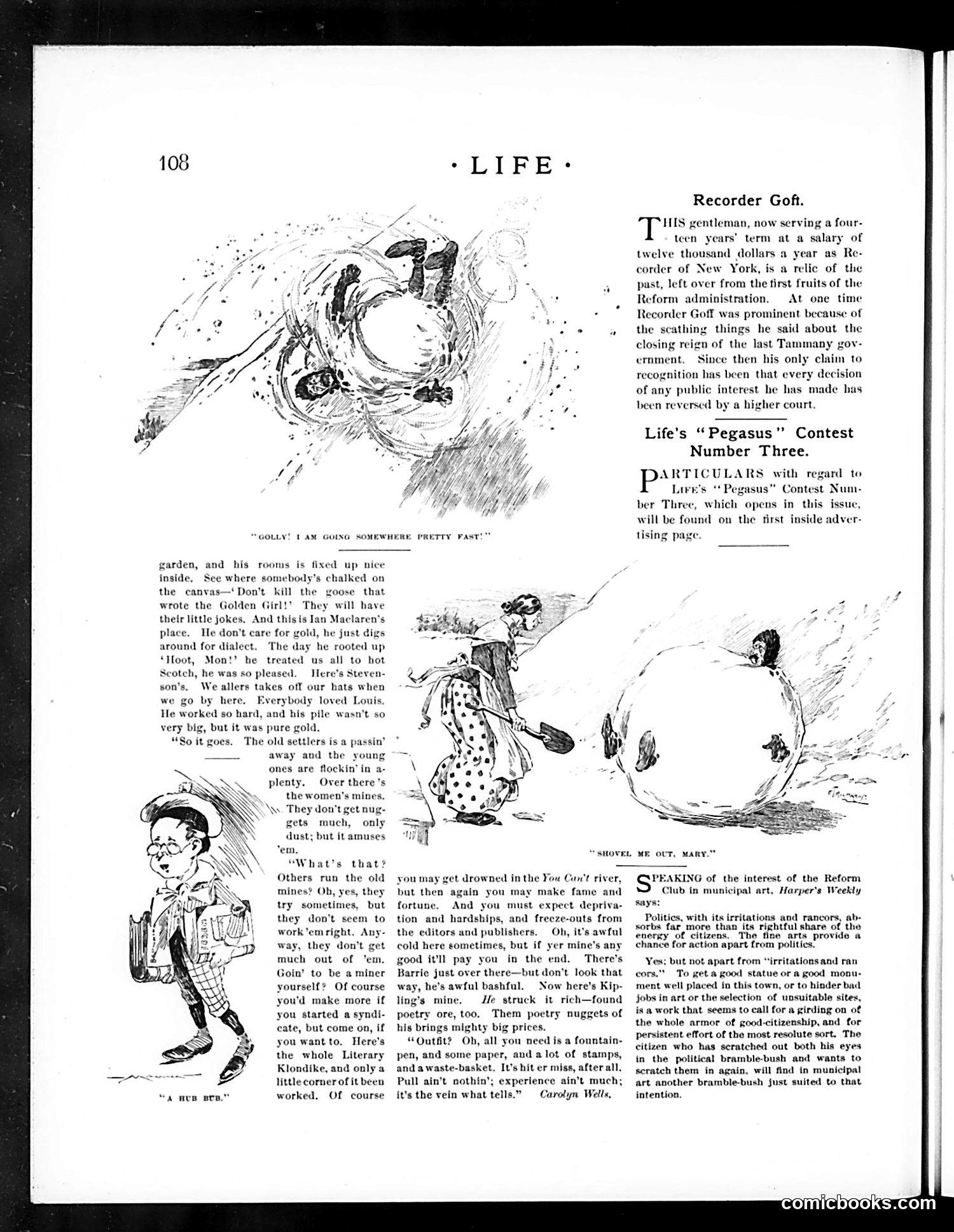
This page contains three distinct satirical pieces: 1. **"Golly! I Am Going Somewhere Pretty Fast"** — A whimsical sketch of a flying figure, likely mocking pretentious ambitions or get-rich-quick schemes. 2. **"A Hub Ber"** — A caricatured figure in formal attire, appearing to satirize a specific person or type (the label suggests someone involved in "hub" activities, though the exact reference is unclear). 3. **"Shovel Me Out, Mary"** — An illustration of figures in snow, likely satirizing winter hardships or social conditions. The text discusses **Recorder Goff**, a New York official from the Reform administration whose court decisions were repeatedly reversed by higher courts—mocking his incompetence. The page also announces Life's "Pegasus" Contest Number Three, a reader participation feature. The overall tone ridicules political figures and bureaucratic failure.
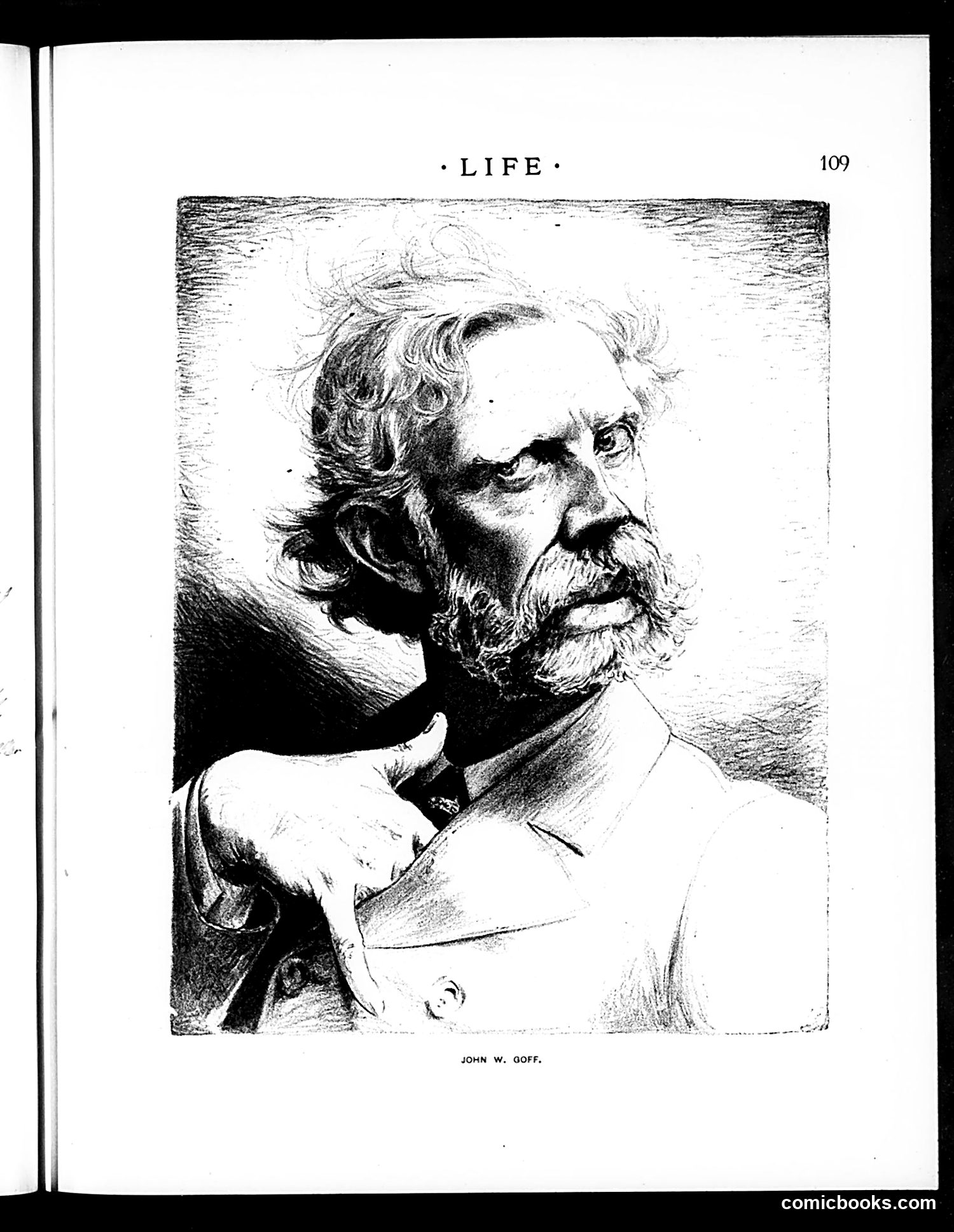
This page features a portrait sketch of **John W. Goff**, identified by the caption below the image. The etching-style portrait shows an older man with distinctive facial hair—a full beard and prominent mustache—rendered in the detailed line-work typical of late 19th/early 20th-century satirical magazine illustration. Without additional context on this specific page, the exact nature of the satire or Goff's prominence is unclear. However, given *Life* magazine's focus on political and social commentary, Goff was likely a notable public figure of the period—possibly a politician, businessman, or social figure worthy of satirical attention. The portrait itself appears straightforward rather than overtly caricatured, suggesting the commentary may have been textual rather than visual.
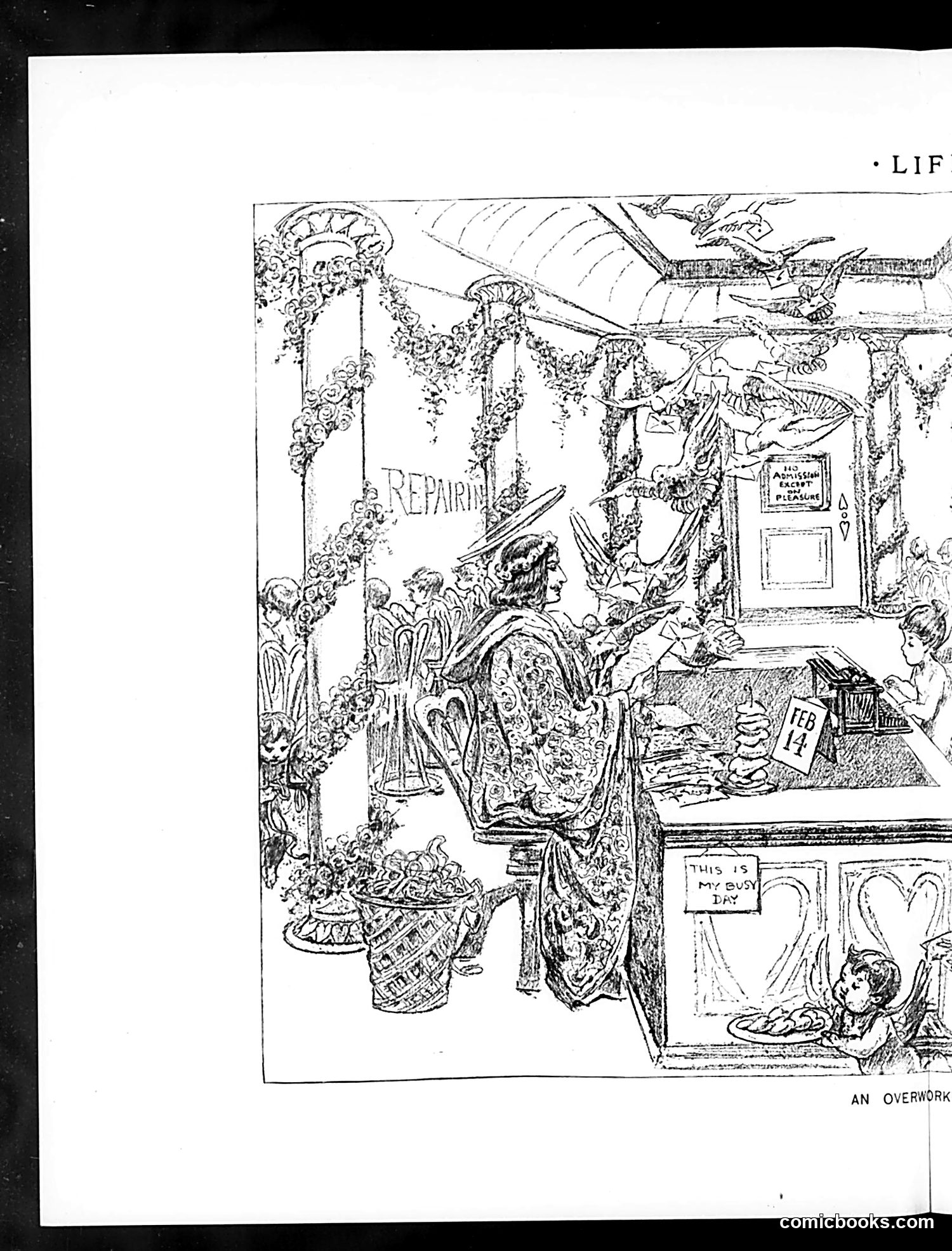
This illustration depicts a Roman or classical figure (likely representing a deity or emperor based on the ornate dress and sword) presiding over an elaborate, vine-draped interior space. The scene appears satirical about luxury or excess. Key elements include: - A sign reading "REPAIRING" on the left wall - A calendar marked "FEB 14" (Valentine's Day) - A sign stating "THIS IS MY BUSY DAY" - An inset panel showing what appears to be domestic scenes with heart decorations The satire likely comments on commercialization of Valentine's Day or the exhausting nature of holiday preparations and romance obligations. The "busy day" reference and "repairing" sign suggest satirizing either the labor involved in holiday celebration or perhaps marital/relationship strain. However, without additional context about the magazine's date or specific contemporary events, the precise target remains somewhat unclear.
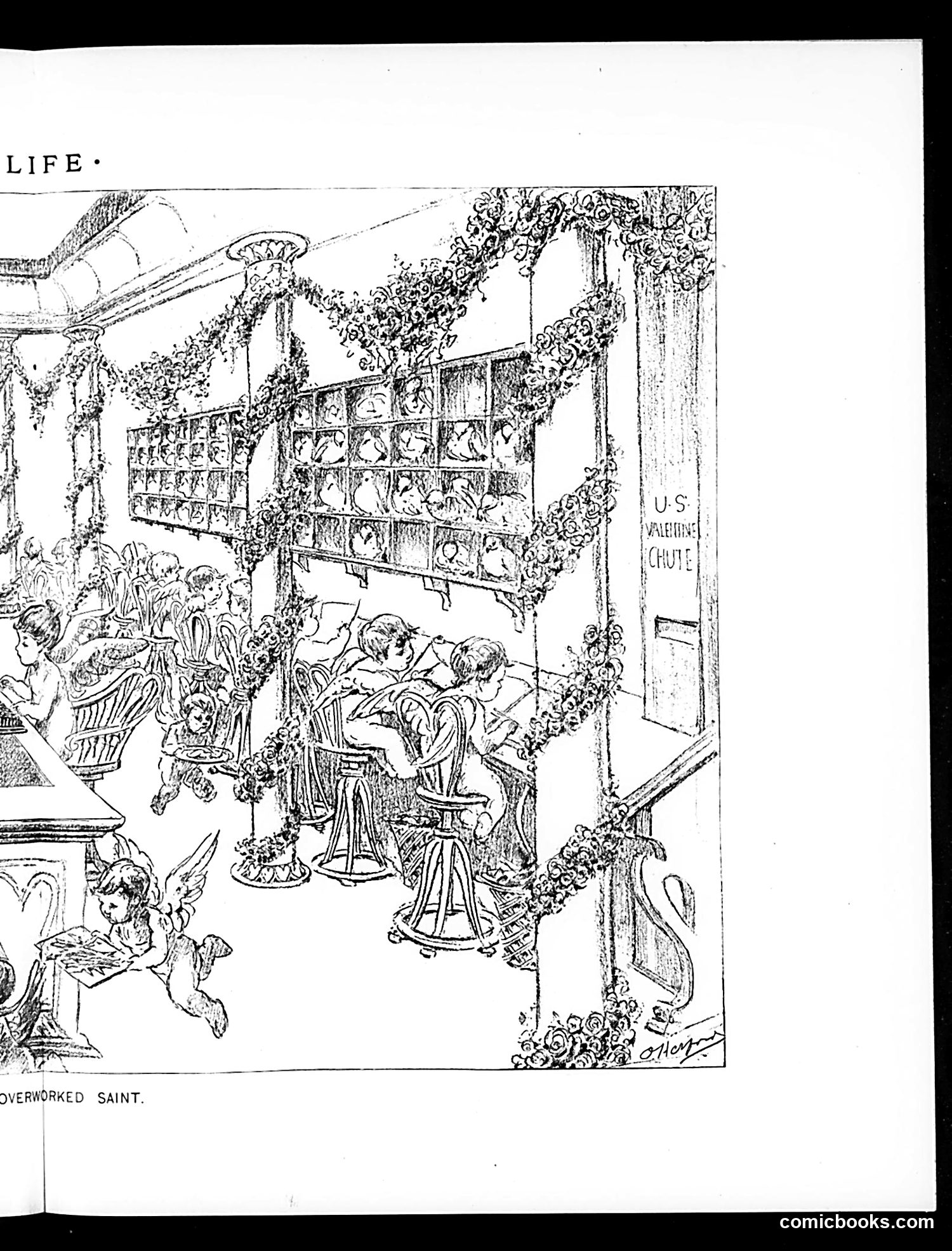
This cartoon satirizes religious labor through a heavenly scene. A saint (likely Peter, given the keys visible on the door marked "US Airline Chute") processes endless paperwork at a heavenly filing system while angels surround him in a lush, vine-covered office setting. The humor derives from the contrast between heaven's supposed peace and the bureaucratic drudgery depicted here—suggesting that even sainthood cannot escape administrative work. The "US Airline Chute" reference is unclear without additional context, though it may reference early aviation industry practices. The overall satire mocks the growing burden of paperwork and bureaucracy in modern American life, suggesting that such tedious work is so inescapable it pursues even the blessed into paradise.
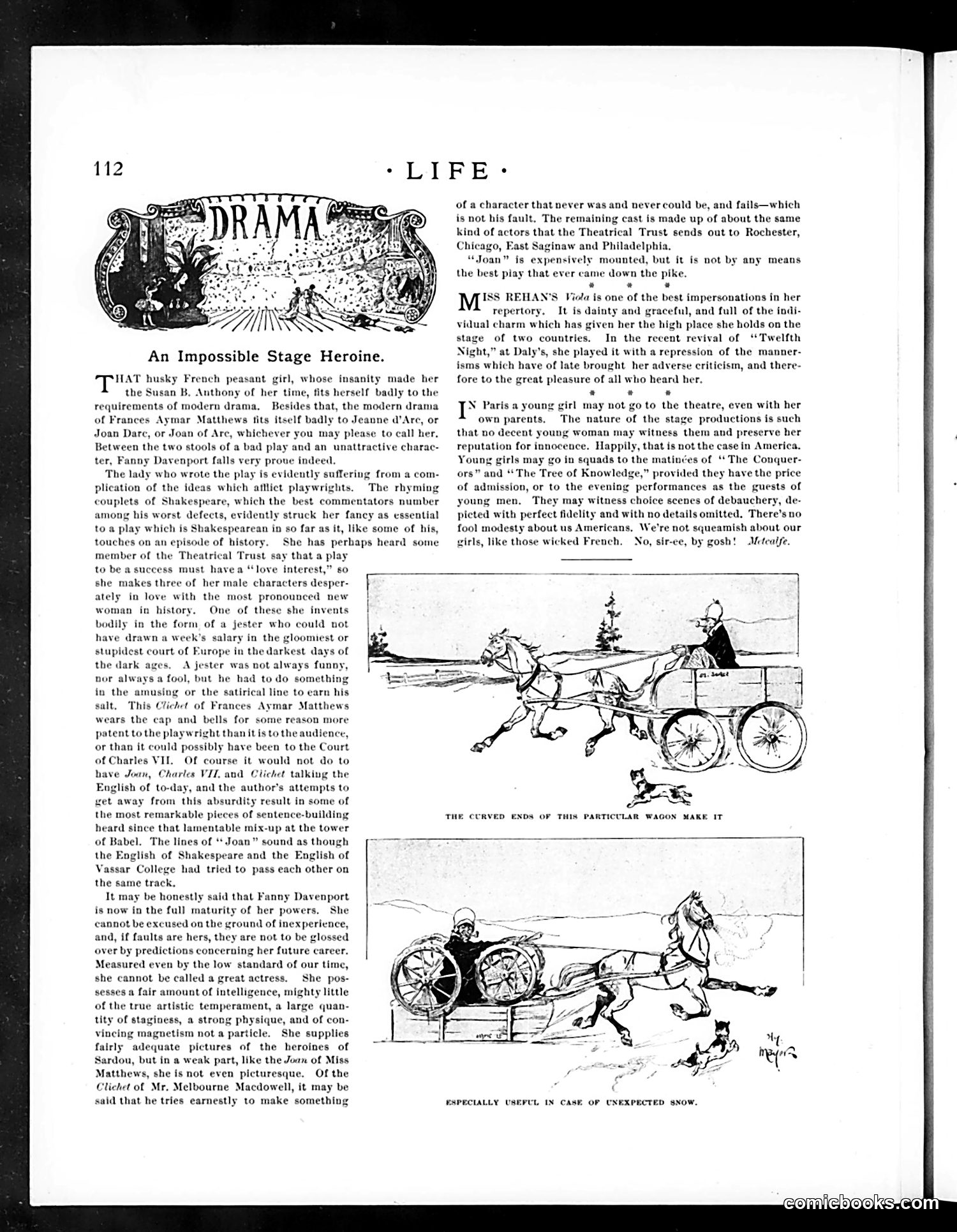
This theater critique examines Fanny Davenport's performance in a French play called "Joan." The text criticizes the character as inherently flawed—a role requiring an actress to portray someone simultaneously insane and virtuous, which the author argues is theatrically impossible. The two illustrations show a horse-drawn carriage/wagon in comic scenarios: one with "curved ends" making it unstable, the other "especially useful in case of unexpected snow." These appear to be visual metaphors for the absurdity of the theatrical premise—depicting impractical, ridiculous contraptions comparable to the "impossible" dramatic character being critiqued. The article questions whether Davenport, despite her talents, can succeed in an inherently flawed role.
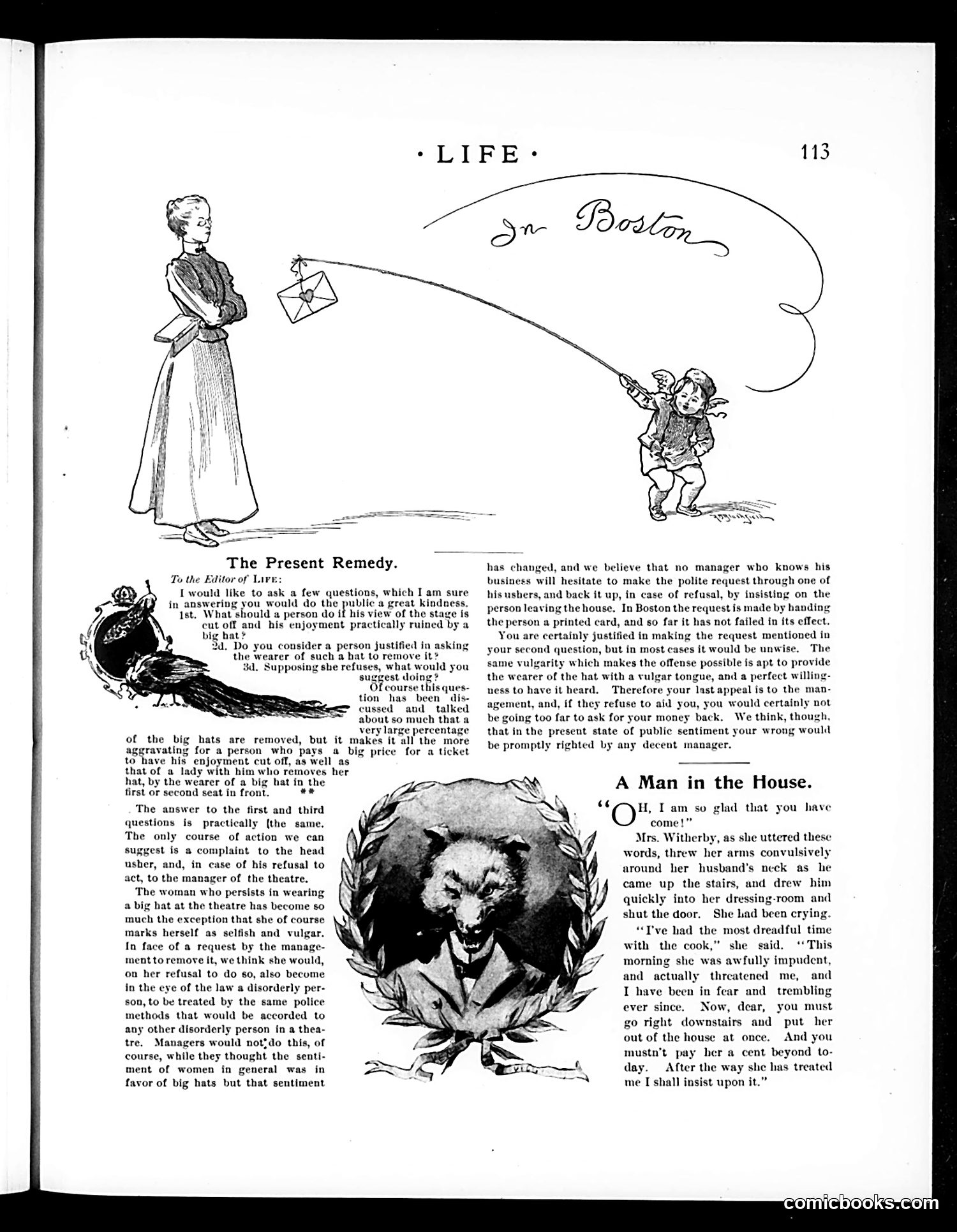
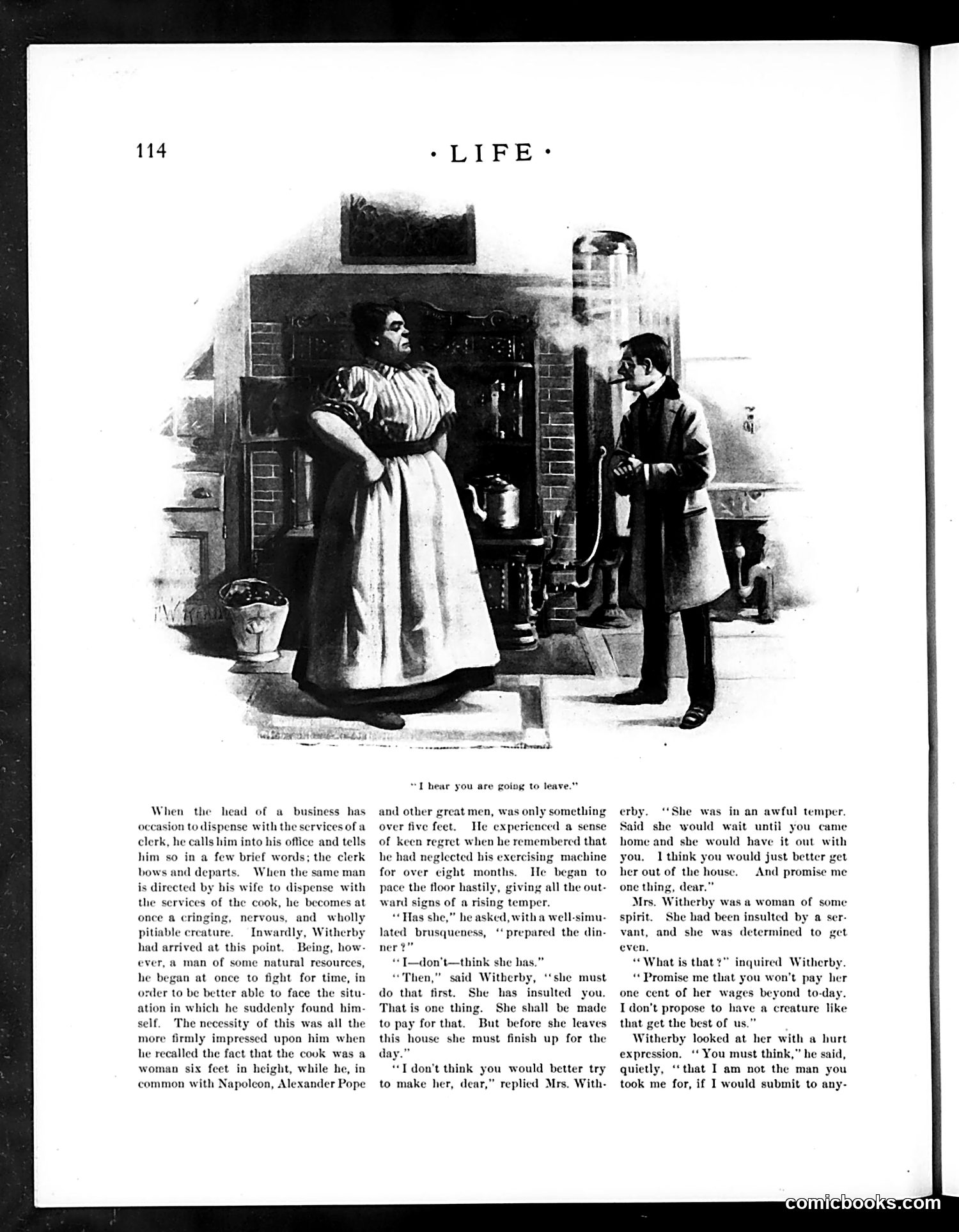
This page contains two pieces of social commentary from Life magazine: **"The Present Remedy"** addresses a widespread public annoyance: women wearing large hats in theaters that blocked other patrons' views. The editor's letter and cartoon (showing a woman with an enormous hat blocking a man's stage view) satirize this as selfish behavior. The solution offered—theater managers should politely eject hat-wearers—reflects a genuine social conflict of the era. Large hats were fashionable but genuinely obstructed sightlines in theaters. **"A Man in the House"** begins a story about Mrs. Witherby, who emotionally manipulates her newly-arrived husband into firing their cook for being "impudent" and "threatening." The satire targets her hysteria and presumption that her husband will unquestioningly obey her domestic demands without hearing the cook's side. It mocks the assumption that a husband's presence automatically validates a wife's complaints and authorizes harsh action. Both pieces critique social behavior considered "vulgar" or unreasonable by Life's editorial perspective.
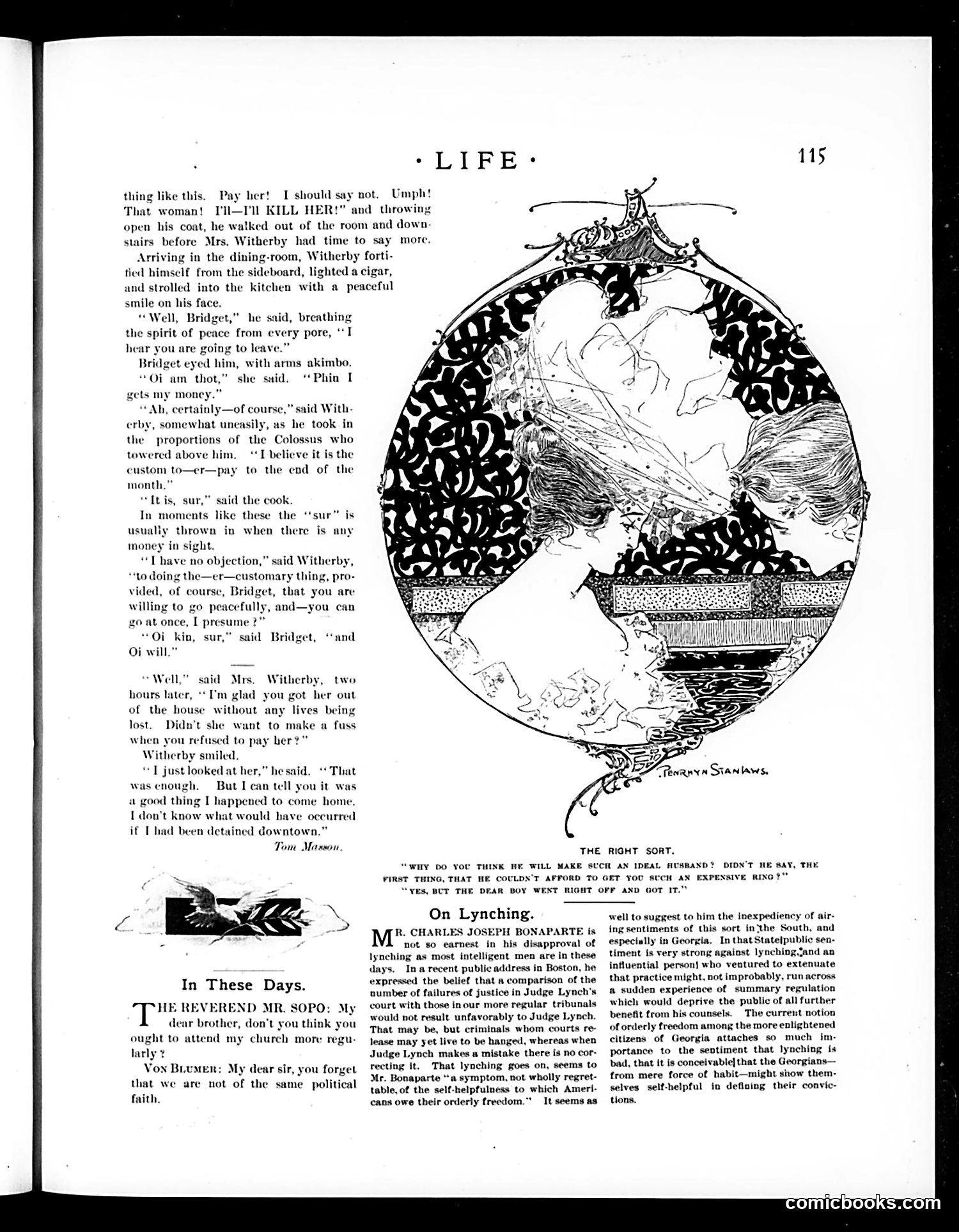
This *Life* magazine page contains three distinct pieces of satirical content: **"The Right Sort" cartoon** (top right): A couple discusses an engagement ring. The woman praises her fiancé for claiming he couldn't afford an expensive ring—then buying one anyway. The satire mocks both the couple's superficiality and the performative modesty of the wealthy. **"In These Days" dialogue**: A brief exchange where Reverend Sopo asks a parishioner to attend church more regularly, but the man refuses due to political differences. The title suggests this represents modern secular attitudes—people prioritizing politics over faith. **"On Lynching"**: A serious editorial attacking Charles Joseph Bonaparte (a real public figure—Roosevelt's Secretary of the Navy), who recently defended lynching as evidence of American self-reliance. *Life* sarcastically warns Bonaparte that expressing such views in Georgia could get him killed by a mob—essentially arguing that if he believes lynching represents "orderly freedom," he shouldn't be surprised if Georgians apply that logic to him.
This satirical poem mocks the hubris of parents who impose grandiose expectations on their children. Elijah Brown, a cobbler, names all his sons after famous poets (Dante, Milton, Shakespeare, Wordsworth, etc.), believing these names will inspire them to literary greatness and bring honor to the Brown family name. The joke's punchline: **none of them become poets.** Instead, they become ordinary working-class men—a vegetable peddler, ferry-boat hand, police officer, barber, sailor, cheesemaker, and bartender. The satire exposes the gap between parental aspirations and reality, suggesting that a child's name alone cannot determine their destiny or achievement. It's a commentary on class mobility and the futility of trying to engineer success through symbolic gestures rather than actual opportunity or talent.
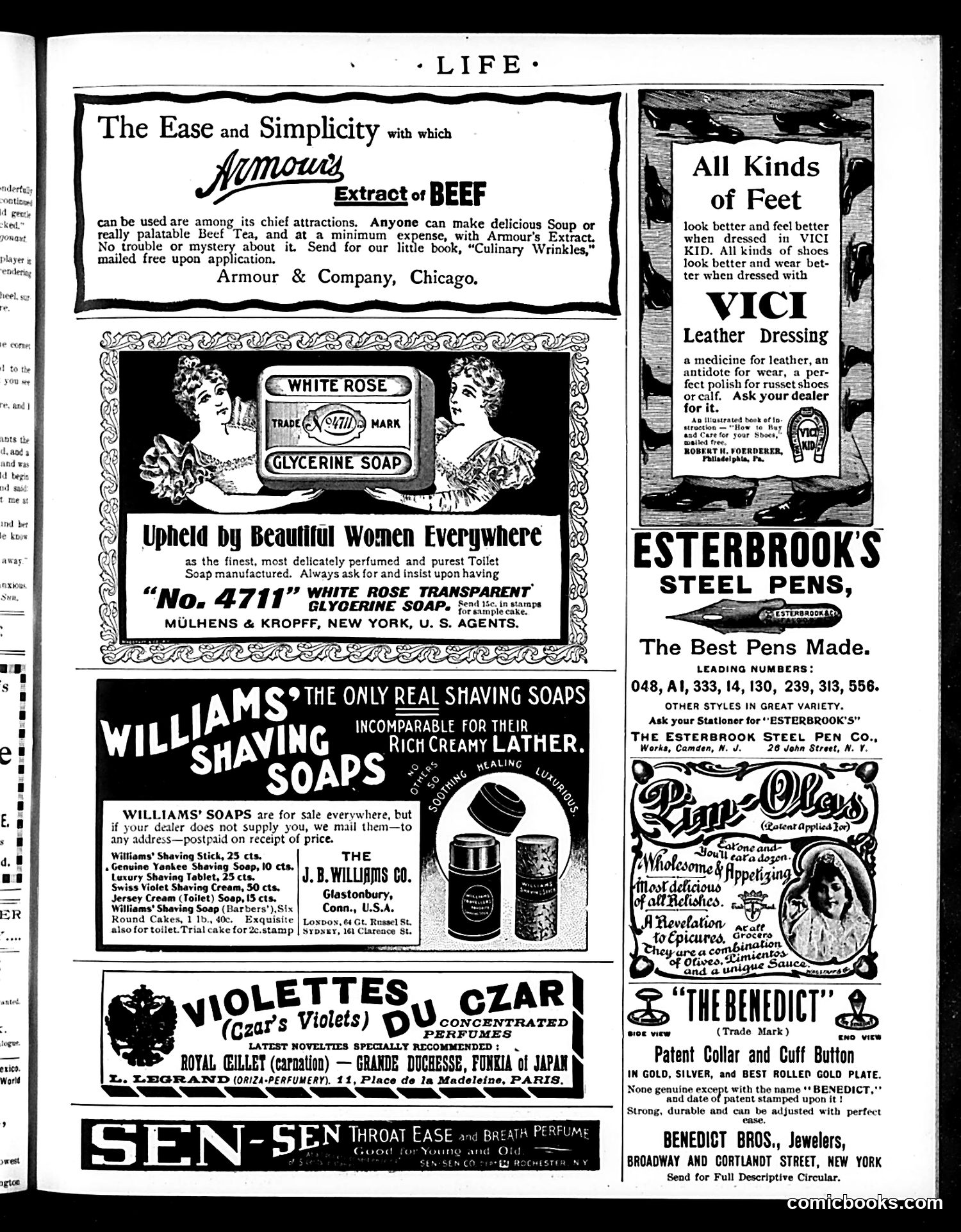
This page contains no cartoons or satirical content. It is purely a **product advertisement page** from Life magazine, featuring various consumer goods pitched to early 20th-century readers. The ads promote toiletries (Armour's beef extract, White Rose glycerine soap, Williams' shaving soaps), personal care items (VICI leather dressing for shoes), office supplies (Esterbrook steel pens), food products (Sim Ola condiment, Sen-Sen breath perfume), fragrances (Violettes du Czar perfumes), and jewelry (Benedict Bros. patent collar buttons). There is **no political satire, caricature, or social commentary** visible. The page appears to be a standard commercial section, possibly satirical only in the broadest sense that Life magazine itself was known for mockery—but this particular page simply sells products without irony or humor directed at any figures or events.
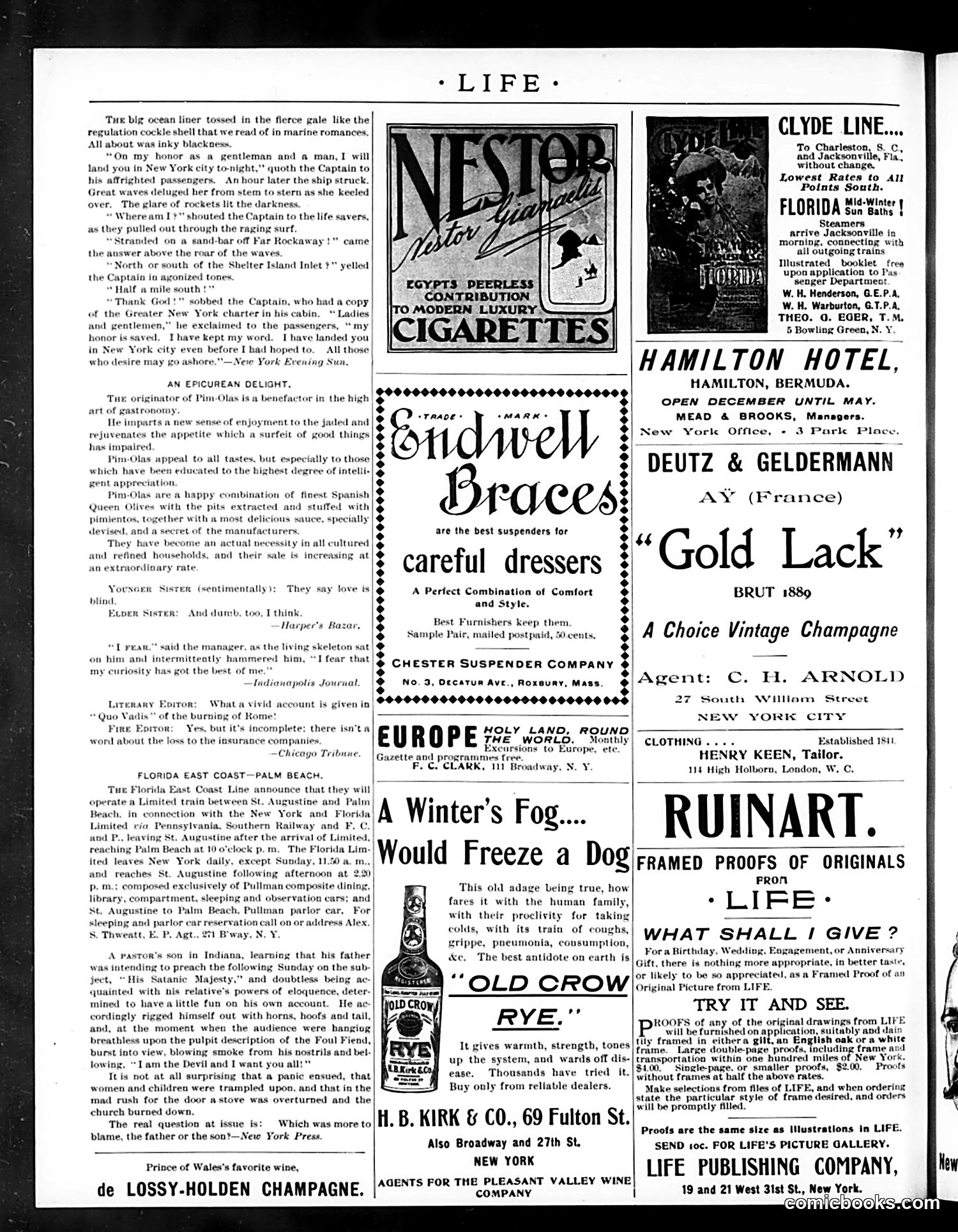
This page is primarily **advertising with some satirical editorial content**, typical of Life magazine's format. The main cartoon/story concerns a ship captain who runs aground on a sandbar near New York City during a storm. The satire mocks municipal bureaucracy: though the ship has wrecked and passengers face danger, the Captain celebrates because he's technically kept his word to land them in New York City before nightfall—satisfying the letter of his promise despite the disaster. This jabs at how rigid adherence to rules or technicalities can produce absurd results, a common Progressive-era critique of institutional inefficiency. The page also includes humorous anecdotes (a pastor's son pranking his father by dressing as the Devil; observations about love and blindness) representing Life's typical satirical commentary on human nature and social pretension. The remaining content consists of period advertisements for cigarettes, champagne, clothing, and travel services—reflecting Life's revenue model and its wealthy readership.
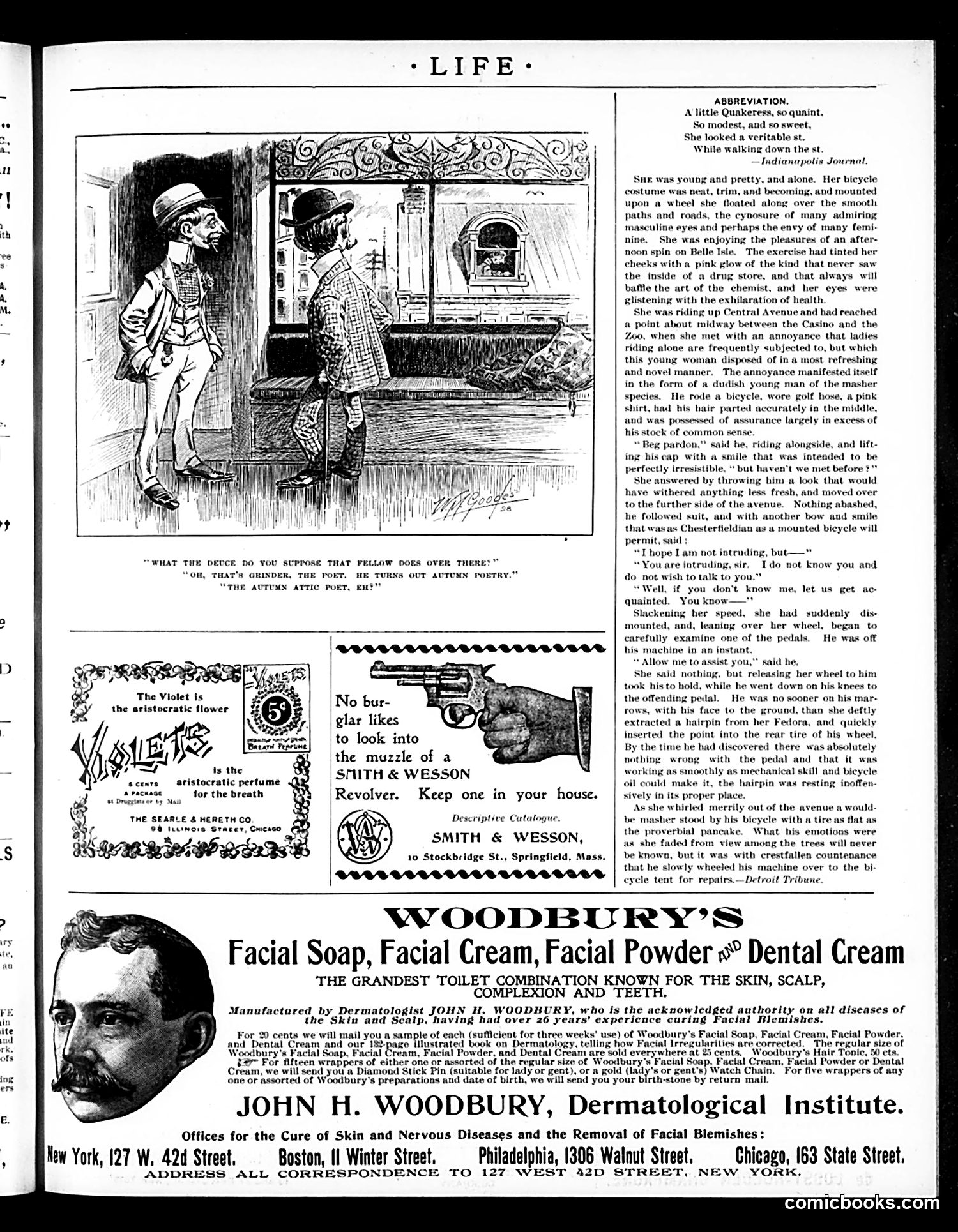
This page contains a humorous story illustrated by a cartoon about a young woman on a bicycle who encounters an unwanted suitor—a "masher" (a man making unsolicited romantic advances). The man, dressed in fashionable cycling gear with a pink shirt and carefully parted hair, repeatedly attempts to flirt with her despite her clear disinterest. The joke: When he stops to "help" her with a supposedly broken pedal, she secretly punctures his bicycle tire with a hairpin from her hat. She then rides away while he discovers his flat tire, left humiliated. **Context for modern readers:** This reflects late-1890s bicycle culture, when women's cycling independence was controversial. The "masher" was a stock figure of ridicule—a vain, presumptuous man. The satire celebrates the woman's clever, resourceful response to harassment, portraying her as witty rather than victimized. The hairpin weapon is particularly pointed: she uses feminine accessories against masculine presumption.
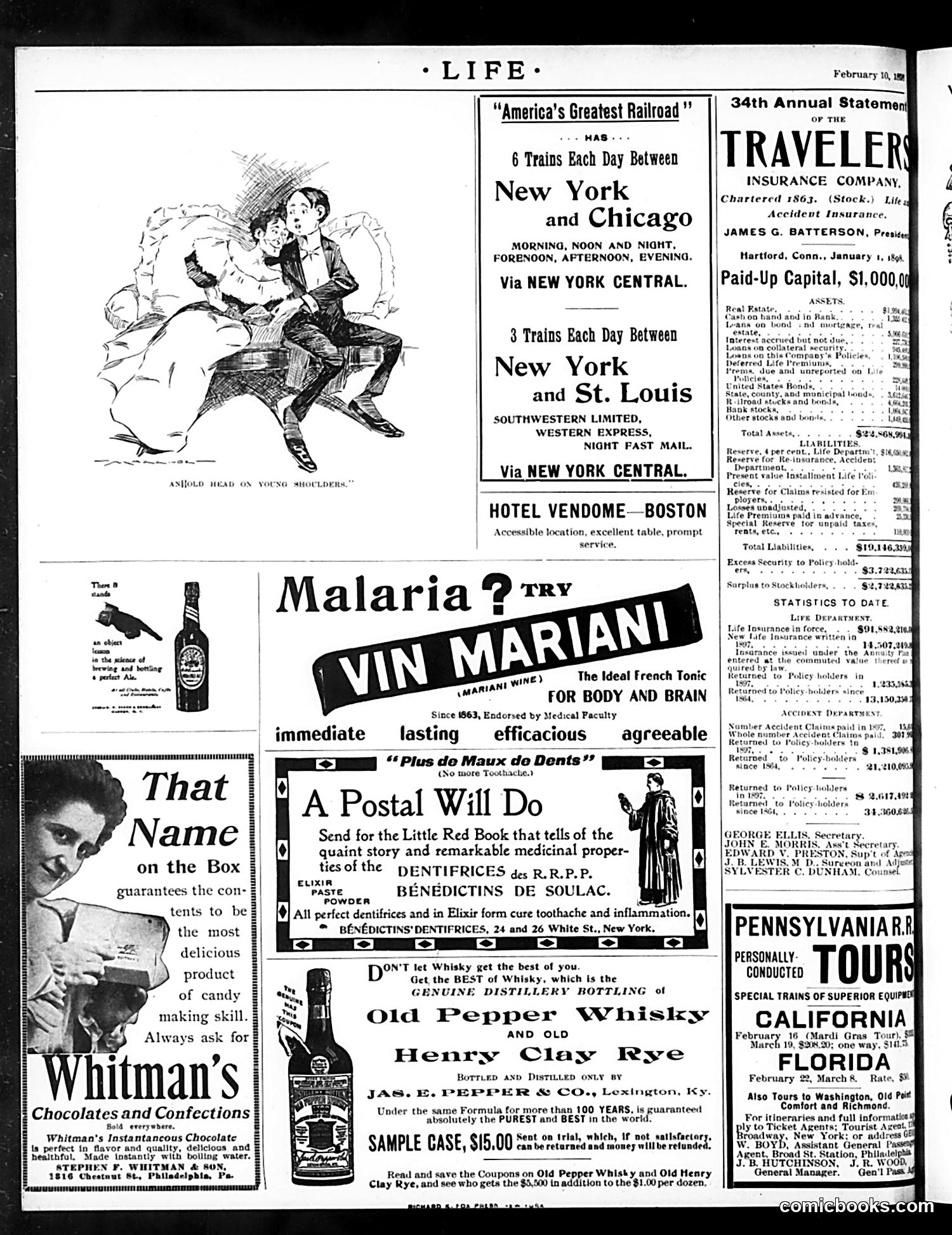
This political cartoon satirizes a public figure (identity unclear from the image alone) by depicting a disproportionately large baby's head atop an adult's body in formal attire. The caption, "'A Child Head on Young Shoulders,'" mocks the subject's intellect or judgment—suggesting they possess only infantile reasoning despite their grown years and presumably powerful position. The cartoon appears designed to ridicule someone in authority for making foolish decisions or lacking mature judgment. Without additional context about the 1898 publication date, identifying the specific target requires external knowledge. The technique of exaggerating physical features to expose intellectual shortcomings was standard satirical practice in *Life* magazine during this era, attacking political or social figures through visual caricature rather than explicit naming.